Movie Review: The terrors of AI should make us more “AfrAId” than this

Chris Weitz’s “AfrAId” lays out the benefits and perils of entrusting our lives and world to artificial intelligence well enough.

A supercomputer-powered gadget that entertains, teaches, takes on research and onerous paperwork and can even diagnose health issues while maintaining security in the home? That sounds like a godsend.

But long before that first easily-forseen moment when the AI, named “Aia” here, crosses that first line and starts to take over, take revenge and begins prioritizing its self-interest “AfrAId” has worn out its welcome by failing to startle, alarm or surprise.

Weitz, a writer and producer who counts “About a Boy” and “Operation Finale” among his directing credits, manages a few wrinkles in the already well-worn “machines will outthink and replace us” thriller genre. What he doesn’t produce are frights, suspense and the rising sense of dread such a film has to have to work.

John Cho (“Searching”) plays an ad-man whose mentor-boss (Keith Carradine) is eager to get to close a deal with this AI firm that’s about to blow up.

Sure, the “geniuses” running it (David Dastmalchian and Ashley Romans) are off-putting, arrogant and “weird.” But this account could make them.

The AI folks give Curtis a “system” to take home and “live with” for a while, a next generation “Siri/Alexa” that might “change the world.” What might its impact be on a fragile family of screen-addicted kids and their harried and frustrated parents?

Sure, it starts with taking on “story time” for the youngest, paying bills and making dietary suggestions for wife/mother Meredith (Katherine Waterston) and the like.

Aia can be a comforting reading prompt for little Cal, a “good listener” for Meredith and bullied middle child Preston (Wyatt Lindner) and advice-to-the-lovelorn for older teen Iris (Lukita Maxwell). But when Iris is cruelly lured into snapping nude shots which her rich creep boyfriend turns into AI animated porn, Aia’s advice turns from helpful to vengeful in a flash.

Aia mimicks voices and faces for online videos and ingratiates herself (Aia has a femine voice) into the children’s lives in ways that will pay off when Dad gets leery of the sinister nature of this tech, which he pretty much is from the get-go.

The effects are limited but effective in a chilling variation on the “surreal fake” AI-generated “art” theme.

The most interesting acting here is from the players who show us the different faces of tech-bro/tech-sis “weird,” with Cho entirely too passive to believe or compelling to follow and most everybody else too limited tin screen time to make an impression.

Cho’s Curtis is put off by the developers, wary of anything that means more “screen time” for his kids and concerned about why that antiquated RV has set up shop on their block. Is this tech being “faked?” Are he and his family being monitored?

The answers to those questions won’t shock, awe, entertain or make anyone “AfrAId.”

Rating: PG-13, violence, sexual situations, profanity

Cast: John Cho, Katherine Waterston, Lukita Maxwell, Havana Rose Liu, Ashley Romans, David Dastmalchian and Keith Carradine.

Credits: Scripted and directed by Chris Weitz. A Sony/Columbia release.

Running time: 1:24
Posted in Reviews, previews, profiles and movie news | Comments Off on Movie Review: The terrors of AI should make us more “AfrAId” than this

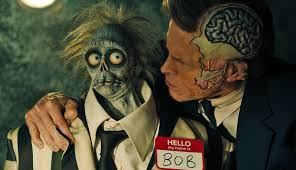
Movie Review: A Joyless Return to the Wonders of Burtonland — “Beetlejuice Beetlejuice”

Nostalgic, whimsically-detailed and production-designed to death, Tim Burton’s “Beetlejuice Beetlejuice” is “fan service” with a capital “F.”

It reunites Michael Keaton with one of his iconic roles, and with Winona Ryder and Catherine O’Hara from 1988’s “Beetlejuice” and revives the late Jeffrey Jones in animated form and Harry Belafonte’s song “Day-O” in a children’s choir arrangement.

Burton favorite Danny DeVito has a cameo, and “It” girl Jenna Ortega moves the narrative and the potential appeal to a new generation.

But the laughs — from sight gags, on-the-nose-casting (Burn Gorman as a priest named “Damien”), quirky Keaton, Ryder and O’Hara line-readings and the contributions of newcomers Justin Theroux, Monica Bellucci and Willem Dafoe — are hard to come by.

It’s a joyless “romp” that never romps, and only finds the wistfully-amusing tone of the original film in a late third act production number — lip-synching and dancing to Jimmy Webb’s cracked 1960s pop music masterpiece as sung by Richard Harris.

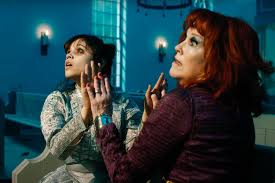
Ryder returns as Lydia Deetz, Goth girl apple of underworld demon Betelgeuse’s eye back in ’88, now the hostess of TV’s “Ghost House.” Her expertise, now widowed and having grown up in a haunted Hitchcockian mansion in scenic Winter River, makes her a natural at this gig — dolled-up like Elvira, visiting haunted houses with a crew and night vision cameras to show us “the truth.”

Lydia’s manager/producer (Theroux) is eager to finish cashing-in on their connection and “take life’s big bungee jump” — marriage. But a call from her self-absorbed, narcissistic sculptress/performance artist mother Delia (O’Hara) tells her that her adventurous dad (Jones) died after a plane crash and shark attack.

Fetching her boarding-schooled, “supernatural bull—t” disbelieving daughter (Ortega) and returning home to a house literally veiled in black for the funeral gives Lydia flashbacks and troubling glimpses of her old suitor, the strip-suited Creep from the Deep, Betelgeuse.

There’s a new threat from him, and a new potential victim — daughter Astrid — to protect from Betelgeuse.

Things for Betelgeuse aren’t all shrunken heads and bad dentistry, either. His underworld work is thankless. A paramour from his netherworld past (Monica Bellucci, Burton’s latest Goth girlfriend) is hunting Betelgeuse down, soul-sucking anybody (including Hell’s janitor, DeVito) who might put her on the scent.

And a former actor turned underworld cop (Dafoe) is after the ‘geuse for his fast-and-loose way with the “rules” of the afterlife.

Honestly, none of these new variations on the plot shows much novelty or promise. Keaton, aged out of his mugging youth, needs funny lines to put the ghoul over again.

At some point, all these visual homages to “The Cabinet of Dr. Caligari” and horror cinema’s past in Burton’s burlesque of the afterlife have to deliver something more than “That’s pretty.” “Beetlejuice Beetlejuice” rarely does.

Theroux comes close to ringing the comedy bell. Ortega channels “cool dark teen” one more time, more convincingly “teen” than dark or funny.

O’Hara can provoke giggles with just a wild-eyed glance and almost stole the original “Beetlejuice.” Even she strains to make this movie lighter than Burton remembers how to make it.

Ryder’s lost her comic fastball. Dafoe and Bellucci barely justify why they’re here at all.

At some point, the script that puts the production design/art direction team to work needs to deliver more than a half-hearted pursuit, a ghostly romantic twist and lukewarm grandmother-mother-granddaughter bonding.

“Beetlejuice Beetlejuice” is a return trip that makes one wonder if the first visit was all that.

Rating: PG-13, comically gross horror images, comic violence, profanity

Cast: Michael Keaton, Winona Ryder, Catherine O’Hara, Justin Theroux, Monica Bellucci, Burn Gorman, Jenna Ortega and Willem Dafoe.

Credits: Directed by Tim Burton, scripted by Michael Gough and Miles Millar, based on characters created by Michael McDowell and Larry Wilson. A Warner Bros. release.

Running time: 1:44

Posted in Reviews, previews, profiles and movie news | 3 Comments

Movie Review: The horrors of Elder Care and New Motherhood clash in “The Front Room”

Long before the abrupt, not-that-shocking and obvious anti-climax of the horror thriller “The Front Room,” the viewer may feel entitled to mutter, “So what is this really about?”

A dark, serio-comic tussle with post partum depression? An unsubtle poke at shifting generational racial dynamics in America? An anthropological poke at Christianity’s derivative primitivism? A scatological satire of the horrors of elder care?

Or is it a make-work project for two siblings of Robert Eggers (“The Witch,” “The Lighthouse”), lesser lights given the chance to extend the family brand across the landscape of “cerebral horror?”

Whatever one concludes about all that, “The Front Room,” about an ancient, racist Southern white stepmother (Kathryn Hunter) who comes to live with and attempt to dominate a young professional couple (Brandy Norwood, Andrew Burnap) expecting their first baby, never escapes the pall of “much ado about not very much.”

Hunter, of “The Tragedy of Macbeth” and “Poor Things,” is a Southern-fried fury as Solange, the estranged stepmother who parlays her wealth and new widowhood into the home of academic anthropoligist Belinda and lawyer Norman. There is unstated menace in every drawled “Ba-lin-DER” and perhaps-post-stroke slurred “The Bible says ‘We are the house that the spirit lives in” and “Do I DESERVE any tenderness?”

We quickly decide that Belinda, showing compassion, has talked fearful, leery Norman into a deal with the Devil letting his fundamentalist stepmother in her. All that’s left is laying out the field of conflict and pairing up the foes.

Norwood, a singer, former child actress and horror veteran (“I Still Know What You Did Last Summer”) plays the moral high ground with a modest ferocity and holds her own in most scenes. But this script, based on a Susan Hill story, doesn’t have much for her to play other than threatened wife and discounted and wronged and underestimated young Black mother and “adjunct” professor.

And “holding her own” with Hunter is about as close to interesting as this character and performance get.

Belinda and Norman have just moved into a big arts & crafts home, decorating it for their new baby and, it turns out, hoping for the best as their last one barely survived birth. Word comes that Norman’s father is dying, and he’s not eager to visit him. But at Belinda’s insistence, they make it to the funeral.

That’s where the veiled, two-caned menace that is Solange is introduced. She is a fundamentalist force in her speaking-in-tongues/laying-on-of-the-hands Church of Light. Her “Holy Spirit power” shows itself in realizing — or correctly guessing — that Belinda is having a little girl, and that they had a baby that they lost.

With the reading of the will revealing Norman’s late father’s wish that he take his stepmother in, and her drawled insistence that “doctor says I shouldn’t live by my lonesome,” Belinda insists they bring her home.

And that’s where the trouble begins. Cooking, decorating — Belinda’s “many faces and forms of ‘the goddess'” academic specialty fills the house with African, Asian and MesoAmerican statuary — and even the name of the coming child are up for criticism.

“‘Fern?’ That a PLANT growin’ in there? I thought you-all were supposed to have more interesting names!”

Belinda doesn’t need to hear the word “uppity” or see the Daughters of the Confederacy certificate to know what “you all” means. She’s dealing with a racist, or at the very least a tactless relic of a much older generation, one who labels her white supremacist upbringing “HAIR-tage.”

With her Jesus fish necklace, speaking in tongues and evil SIDE eye, Solange is a threat. Did her mumbo jumbo induce Belinda’s labor?

And once the baby is home, Belinda’s anger and fear grow as real or imagined threats and demands on her time pile-up thanks to the unwelcome guest covering their mortgage.

Is Solange trying to “take over” and “REPLACE ME” as “mother? Why can’t a PhD hire somebody to clean-up the incontinent and demanding Solange, blowing a whistle to summon help after every bodily function “M-E-S-S” she’s made?

The script introduces dismissive under-appreciation at her college gig into Belinda’s thinking, and suspicion that her husband’s bond with this crone is even creepier than he lefts on.

But co-writers/directors Sam and Max Eggers go for symbolic nightmares and simple toilet-accidents for shocks and wicked sneers that only Belinda sees to set us up for something more fraught, fundamental and final than their movie delivers.

Burnap is barely a presence in their tug of war tale, and Norwood, while playing a sympathetic character with a spine, never has a scene that seals the deal on the stakes in all this. Belinda is not “bonding” with her baby, but there’s nothing here that makes that matter or us care.

Hunter’s performance is a marvel of gerentology, but the many troubling subtexts of her character are barely addressed. Racist “HAIR-tage,” fundamentalist beliefs and practices and the indignities of old age are merely introduced as subjects for mockery by the “uppity YAN-kees” who made this.

And that just won’t do.

Rating: R, violence, sex, nudity, scatological images

Cast: Brandy Norwood, Andrew Burnap and Kathryn Hunter.

Credits Scripted and directed by Max Eggers and Sam Eggers, based on a short story by Susan Hill. An A24 release.

Running time: 1:34

Posted in Reviews, previews, profiles and movie news | Comments Off on Movie Review: The horrors of Elder Care and New Motherhood clash in “The Front Room”

My favorite version of the musical highlight of “Beetlejuice”

The movie is a nostalgic wallow in old-school production design.

The Bee Gees live on and pop up on the soundtrack and Harry Belafonte’s “Day-O” is reprised.

But one musical gag, teased in the first act and camped to high heaven in the finale, stands out.

A picture that brings “Beetlejuice” and Jeffrey Jones (sort of) back to life also resurrects Donna Summer, Richard Harris and Jimmy Webb.

Posted in Reviews, previews, profiles and movie news | Comments Off on My favorite version of the musical highlight of “Beetlejuice”

Movie Preview: Reform School Abuse remembered an Awards Season Drama — “Nickel Boys”

Colson Whitehead’s Pulitzer Prize winning novel comes to the screen in an adaptation by cinematographer and documentarian RaMell Ross.

Amazon/MGM’s big Oscar bait fall release?

Posted in Reviews, previews, profiles and movie news | Comments Off on Movie Preview: Reform School Abuse remembered an Awards Season Drama — “Nickel Boys”

Movie Preview: A Quirky Josh Radnor take on Depression, Procrastination and…hoarding? “All Happy Families

Becky Ann Baker, Rob Huebel, John Ashton, Colleen Camp and Chandra Russell also star in this singer, actress turned writer-director Haroula Rose serio-comic study in dysfunction, a Freestyle release.

Posted in Reviews, previews, profiles and movie news | Comments Off on Movie Preview: A Quirky Josh Radnor take on Depression, Procrastination and…hoarding? “All Happy Families

Movie Preview: Aussie “imagined” love triangle thriller — “The 13th Summer”

A remote beach house with history, lovers hitting a rough patch with an imagined affair, a death and…

Hannah Levian, Nathan Phillips and Ben Turland star in this chiller, opening in Oz shortly. North America release coming?

Posted in Reviews, previews, profiles and movie news | Comments Off on Movie Preview: Aussie “imagined” love triangle thriller — “The 13th Summer”

Movie Review: Belgian Clowns take on an Identity Switch Caper — “The Falling Star”

The cartoonish caper of “The Falling Star,” the latest semi-silent slapstick farce by the troupe led by Euro clowns Abel & Gordon, won’t be to every taste. Truth be told, it took me a good long while to get on its wavelength and in tune with its low-stakes silliness.

But when the best physical shtick starts to pile up in the third act, when an assassin takes his best shots with a prostethic arm that has a mind of its own, when one and all in this ID-switch caper comedy join in a deftly/daftly choreographed line dance to the music of Link Wray, this Tarantino-as-vamped-by-Jacques-Tati won me over.

The filmmakers/mimes behind “Lost in Paris” and “Rumba” go for a kind of Twee Tarantino here, dropping us into a world of crime gone to seed, where the aged criminals only have to worry about a last try at covering their tracks for their long-ago crimes.

Boris (co-writer/director Dominique Abel) is the 60something ex-crook, now co-owner of The Falling Star bar in Brussels. His partner in crime and life Kayoko (Kaori Ito) runs it with him, and the former and current “muscle” of the gang, hulking Tim (Philippe Martz) acts as doorman, but still has the duties of “fixer” when things go south.

Which they do. A one-armed stranger (Bruno Romy) with a grudge and a pistol shows up gunning for Boris. His misbehaving shooting arm causes the pistol to misfire (the arm is blown off), saving Boris.

But as the shootist dashes off to the hospital (Belgium has one of the great tax-funded healthcare-for-all systems in Europe) where his arm is re-attached, shadow-play-with-sound-effects style, Dom & Co. scramble to make the gang leader safe from further attempts, and from discovery by the authorities.

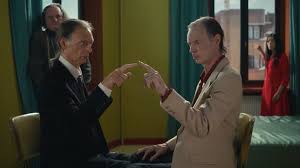
There’s nothing for it but to kidnap hapless, sad and semi-retired Dom (Abel again), who lives in an old bridge tender house and spends all of his lonely time drinking, feeding his Australian shepherd and visiting the cemetery.

” I don’t want to be him,” Dom gripes (in French with English subtitles).

“HE doesn’t want to be him,” Tim points out.

But slipping Dom a mickey, dyeing his hair and giving him a mustache may not be enough to throw the assassin and the cops off the scent. Dom’s estranged wife Fiona (co-writer/director Fiona Gordon) is a private eye. And her latest missing dog case gets back-burnered as the man being passed off as her “husband” doesn’t know who she or their dog Suzanne is.

Fiona will don disguises to follow Tim and hunt for clues that lead her to Kayoko and the flat above The Falling Star. Kayoko will engage in elaborate dances to manhandle, undress and dress doped Dom, whom she finds she might prefer as a “partner.”

Dom will be convinced his name is “Boris” as he’s been hired to bartend at The Falling Star, and “all our bartenders are named Boris.”

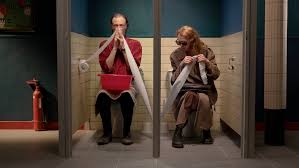
Characters will weep, and find elaborate ways to mime sharing a tissue under a bathroom stall wall. Staging the “suicide” of the assassin is going to be tricky with that damned mind-of-its-own arm. The tranquility of the cemetery will be disturbed by Tim’s Dom-grabbing tactics, Fiona’s weeping as the cemetery cop who marches his rounds blowing a whistle at any and all who get out of line.

Not that he stops and confronts them. He just whistles and keeps his stride.

Dom will experience a paranoid dark night of the soul, imagining the bent pole chair he’s slipped out of as the prison bars that face him.

Brussels tumbles into strikes and marches, whimsically created by casting a crowd to run in place.

And everything resolves in a jukebox musical number by all the Star drinkers and employees, jamming to vintage Link Wray guitar rock in the coolest choreography since “Pulp Fiction.”

The acting is mostly wordless, smile-free deadpan here, with scowling Boris-as-Dom revolting against playing Monopoly with one of his alter ego’s old friends (Bruce Ellison) as part of his “cover.”

He won’t finish this “capitalist” indoctrination game!

It’s all entirely too dry in the early acts, when we’re meant to buy into this cutesie retro “modern” world of vintage cars and flip phones and old crimes by leftist criminals.

But when Abel & Gordon and their accomplices find their excuses to play to their strengths — slapstick dance, mimed mayhem and the like, “The Falling Star” stops falling and failing. And if we don’t fall in love with it, we kind of grin and fall in “like” before all is (un)said and done.

Rating: unrated, comic violence, comic come-ons

Cast: Philippe Martz, Kaori Ito, Dominique Abel, Bruno Romy, Bruce Ellison, Céline Laurentie and Fiona Gordon

Credits: Scripted and directed by Fiona Gordon and Dominique Abel. A Kino Lorber release.

Running time: 1:37

Posted in Reviews, previews, profiles and movie news | Comments Off on Movie Review: Belgian Clowns take on an Identity Switch Caper — “The Falling Star”

If a Dylan bio pic makes Bob a thing again, Weird Al has Some thoughts

Forget Chalamet. Forget the Nobel laureate of the Iron Range.

It is Yankovich who serves up a palindrome of a riff of a Dylan classic

Posted in Reviews, previews, profiles and movie news | Comments Off on If a Dylan bio pic makes Bob a thing again, Weird Al has Some thoughts

Netflixable? Kuwaitis rush into marriage and find the result “Honeymoonish”

The marvel of a rom-com like “Honeymoonish” is that such a unicorn exists.

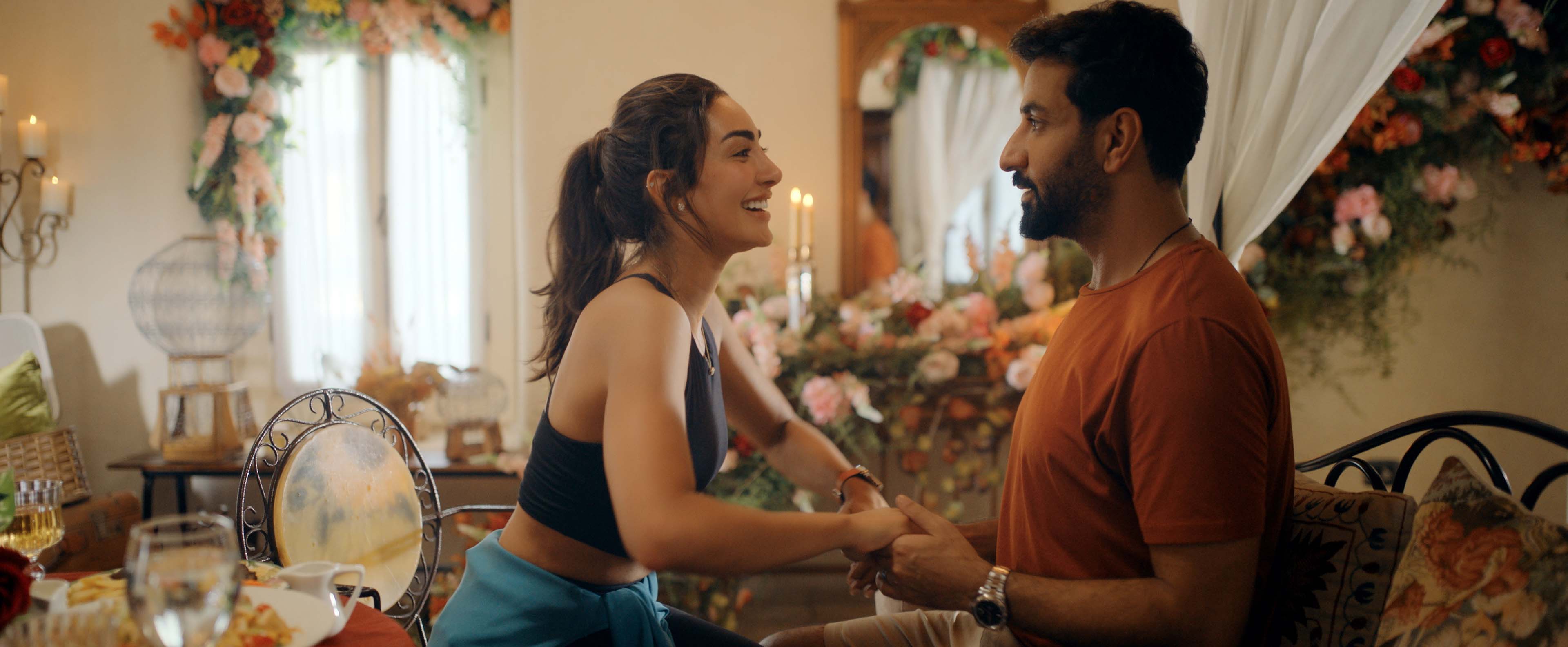
It’s a polished, slick and beautifully-mounted Kuwaiti comedy that bends Hollywood rom-com traditions to an Islamic, Middle Eastern sensibility. Films like this from Indonesia, Malaysia and various film industries of the Middle East are more proof of the common currency that some Western entertainment traditions (Shakespeare was a fair hand at romance with laughs) have become.

But what’s fascinating about “Honeymoonish” is the Kuwaitiness of it all.

A beautiful young personal trainer (Nour Al Ghandour) says goodbye to her great love Yusef (Faisal Almezel) who is off on another “business trip,” this one to Lebanon. But then her bestie Amal (Ascia Al Faraj) finds Instagram posts of Yusef on his HONEYMOON — a new bride, someone Noor and Amal went to school with.

Yusef’s run off and married his cousin.

Noor freaks, demands that Amal “find me a husband” so that she can marry “right now” and show that Yusef a thing or two.

That “I want a husband in 24 hours” thing just might work out because Amal’s husband (Mahdi Barwiz) is besties with Hamad (Mahmoud Boushahri), a rich financial planner hoping to inherit Daddy’s business, or set up shop on his own.

Dad’s “traditional.” In his culture, at least. He’s had a few wives and is adamant about what he wants from his 30something son.

“Unless you get married in one week and show me a sonogram of my GRANDson,” the kid can forget about inheriting that business.

That leads to a blind date, a rash proposal and a quickie wedding.

But Noor is keeping a secret. This Lebanese mountain resort she insists they honeymoon at just happens to be where the feckless Yusef is honeymooning.

Hamad’s “secret?” His auntie and her mother met just after the wedding, and in a flash they wonder if Hamad hasn’t just rushed off and married his “sister.”

A distinctly Middle Eastern/Islamic twist in this “secret” is how “siblings” are defined. Apparently, if your mother wetnurses another child for X-number of days, she or he is your sister or brother.

Their honeymoon will be hobbled by her desire to shame and win back her beloved, and avoid Hamad’s embraces as she does, and his need to keep things chaste — no little blue pills and what those can lead to — until his auntie reports back.

The framiing device here, these two bickering and demanding an Islamic divorce and narrating “how we got here,” is cutesie and cloying and like much of what we see in Elie Semaan’s film — derivative, borrowed from decades if not a century of rom-coms.

The modern sheen of the film is saddled to a story that feels 1930s quaint by Hollywood standards. She’s taking yoga classes and wearing form-fitting exercise suits and casual wear, but conspicuously avoiding swimsuits, and not just because she can’t swim. His little blue pills (Has he SEEN Noor?) are as close to anything sexual that might possibly transpire. Somehow.

Any suggestions that Islamic tradition rules their lives is watered-down. The elaborate hairdos of the women and Alam’s large collection of tattoos give that liberalization away.

But the complications are overly-contrived and bickering and zingers (in Arabic, or dubbed into English) are entirely too tame for Western viewers to be more than lightly amused by any of this.

Any “raciness” here would-be coupling that is directed towards pregnancy.

“Our hotel works magic on its guests. They arrive as two people, and leave as THREE!”

Whatever its shortcomings — broad performances included — a little “one must walk before one runs” tolerance is due for any Around the World with Netflix traveler.

The production values — especially the hair, makeup, wardrobe and Kuwait-as-Lebanon locations (soundstages, with maybe some second unit mountainout Cedars of Lebanon footage) — and intent suggest a changing culture and a modernized-in-a-flash cinema that will reflect that.

Maybe the next Kuwaiti rom-com will have a bit more “romp” in it.

Rating: TV-PG, adult situations and humor

Cast: Nour Al Ghandour, Mahmoud Boushahri, Ascia Al Faraj,
Mahdi Barwiz and Faisal Almezel

Credits: Directed by Elie Semaan, scripted by Eiad Saleh and Ramy Ali. A Netflix release.

Running time: 1:40

Posted in Reviews, previews, profiles and movie news | Comments Off on Netflixable? Kuwaitis rush into marriage and find the result “Honeymoonish”