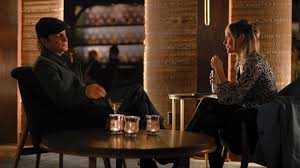
Movie Preview: Zoë Kravitz directs this last pre-release peek at Channing Tatum at his creepiest — “Blink Twice”

Naomie Ackie, Kyle MacLachlan, Haley Joel Osment and Alia Shawkat also star in this “billionaire’s island” nightmare from actress turned writer-director Zoë K.

August 23.

Posted in Reviews, previews, profiles and movie news | Comments Off on Movie Preview: Zoë Kravitz directs this last pre-release peek at Channing Tatum at his creepiest — “Blink Twice”

Netflixable? A Shakespearean spin on Nigerian history — “House of Ga’a”

“House of Ga’a” is a sweeping historical epic from Nigeria, a tale of backstabbing and poisoning intrigues, lust, brutality and greed set just before the events depicted in the West Africa of “The Woman King.”

There’s a universality to this story of power, how to get it and how to murder and rape your way out of it, summoning up memories of “Macbeth,” “Romeo and Juliet” and other works from Western theater, literature and history.

Battle scenes, cities and palaces of the Oyo Empire and its rivals are recreated in this story of of the rise and fall of Bashuron (prime minister/warlord) Ga’a, played by Femi Branch (“Unknown Soja”) in the latest film by the director of “Man of God,” Bolanle Austen-Peters.

Unfortunately, it’s a movie whose ambition is somewhat undone by a general ham-fisted approach to the situations, characters, dialogue and plot. And this Nigerian “Nollywood” saga is badly battered by one of the worst dialogue dubbing jobs I’ve seen since the death of Bruce Lee.

We meet the patriarch of the House of Ga’a after a great victory on the battlefield against one of the Oyo Empire’s Muslim rivals. His generals, sons and lieutenants praise his leadership and marvel at how the ruling council of the Alaafin (king) will react to his inspired use of infantry and cavalry. But Ga’a cuts them off by asserting that he and he alone with “report” this.

The story is narrated in voice-over by youngest son Oyemekun (Mike Afolarin), who is more of a lover than a warrior. Princess Agbonyin (Bridget Nkem), “the most beautiful woman in the kingdom,” is his great love. But their fates fall to the whims of the Bashuron, who sends Oye to Dahomey where a warrior woman will train him in the martial arts.

When we see Ga’a take a defeated and beheaded king’s youngest bride (Tosin Adeyemi) as his slave/concubine, we fear the worst.

When she rebuffs him with the assertion that her body will serve his desires, but “If you want my heart, you will have to earn it,” we know we’re slipping into clumsy soap operatic situations, scenes and dialogue.

Through the ups and downs of his rise to authoritarian, “king-maker/king breaker” power, we hear clunky lines like “I am disgraced, I am DISGRACED” repeated half a dozen times, as if we don’t roll our eyes at the first utterance.

Bashuron’s wives rebel at his new slave-girl “concubine,” and conspire to burn her as a witch. His sons do whatever he commands, but assorted kings and officials (there are many, and they’re maddening to keep straight) tremble at his wrath and ponder ways out from under his blood-stained thumb.

The most interesting character in all this might be the shaman/witch doctor Sasa (Ibrahim Chatta), a counselor and co-conspirator who purports to have supernatural powers over Ga’a’s health and events the two of them set in motion.

“Death is superior to sickness,” Sasa asserts. “A thief is superior to a witch! All a witch has a thief be able to steal!”

“House of Ga’a” is at its best in action, as the fight choreography is good and the pacing is sharpest. When we settle on palace intrigues, the picture slows to the point of being static with interiors, infighting and betrayals of the sort one sees in soap operas the world over, even those set in pre-colonial West Africa.

Rating: TV-MA, graphic violence, sex, nudity

Cast: Femi Branch, Mike Afolarin, Funke Akindele, Tosin Adeyemi, Femi Adebayo Bridget Nkem and Ibrahim Chatta

Credits: Directed by Bolanle Austen-Peters, scripted by Tunde Babalola. A Netflix release.

Running time: 2:00

Posted in Reviews, previews, profiles and movie news | Comments Off on Netflixable? A Shakespearean spin on Nigerian history — “House of Ga’a”

Movie Review: An Elegy to Age, Memory and Regret — “Great Absence”

“Great Absence,” the festival-feted “breakout film” of director and co-writer Kei Chika-ura, is a somber, obscure mystery about memory, regret and entropy. It’s centered on a son trying to learn what his long-estranged father was really like before dementia took hold.

But the director of the engrossing, culture-dissecting “Complicity” makes his subtext Japanese culture itself — with an ageing populace, rigid social codes and adult children at a loss to understand how it call came undone in a single generation.

It opens with a SWAT team swarming around a tidy condo. An old man (Tasuya Fuji, who came to fame in 1976 with “In the Realm of the Senses”) opens the door, dressed and carrying his valise, seemingly resigned to his fate.

His son Takashi, played by Mirai Moriyama (“We Couldn’t Become Adults”) is an actor rehearsing a new multimedia play. He and wife Yuki (Yôko Maki of “After the Storm”) cross the country to deal with a social services review board planning the retired college professor’s care, and meet with the father who left his family, remarried and had little to do with the kid he nicknamed “Takkun” afterwards.

Our first impressions of Yohji Toyama (Fuji) aren’t pleasant. He’s bullying, brusque and “callous” his son admits. And he’s forgetting things, mixing-up facts. Rehearsals take a back seat as Takashi digs into the mystery that this man was and is.

His second wife, Naomi? He did marry her, right? Where is she?

“Dead,” the old man announces gravely. Cheated by electricians, raped. She killed herself. We, like Takashi, suspect that this isn’t true.

As Takashi and Yuki go through the house, he happens upon Naomi’s diary, with Yohji’s letters confessing decades-long romantic longing for her. The son decides that explains the loveless marriage he grew up under.

Every visit to his father deepens the mystery of his recent years. Is Naomi dead? Her son from her first marriage shows up, wanting help with her hospital care. Which hospital? Can we go and see her?

Um, no.

His father mentions an old colleague and protege who had his Dad lined-up to give a lecture and had no clue about his declining mental state.

And as these pieces of the puzzle come to light, the film’s point-of-view shifts, with flashbacks showing us Naomi’s plight, being married to an overbearing jerk who, as his mental faculties fail him, refused to give up taking the wheel or express what he should to her before his memory gave out.

A dementia-sufferer’s life of endless post-it notes, memory-prompt photo albums, lapses and their consequences is glimpsed in mostly quiet understated scenes.

Fuji’s performance is the highlight here, a man of science and obsessive Ham radio buff struggling to communicate what he’s going through but failing to soften his personality as his memory, and the self-control it might contain, fail.

Yohji lays out Japan’s “population loss” and the inevitable slide that accompanies it in a simple chat with his Ham radio gear salesman. The entropy here is personal, symbolic and grim. Who will take care of the rising tide of Yohjis in a culture that is literally shrinking, generation by generation?

The letters touch the son and the viewer in the contrast they provide — a judgemental grump who pined for the woman he finally would-up with in writing that is poetic and achingly romantic.

The shifts in points of view, slow-to-come explanations and slack pacing test one’s patience in ways “Complicity” — track that one down — never did. But Kei Chika-ura immerses us in these lives, in the sins of the fathers and the puzzlement of the children who recognize the “absence” of parents, even those who were never there for them all along.

Rating: unrated, implied violence

Cast: Mirai Moriyama, Tasuya Fuji, Yôko Maki and Hideko Hara

Credits: Directed by Kei Chika-ura, scripted by Kei Chika-ura and Keita Kumano. A Gaga release.

Running time: 2:13

Posted in Reviews, previews, profiles and movie news | Comments Off on Movie Review: An Elegy to Age, Memory and Regret — “Great Absence”

Movie Preview: A daughter missing for a decade “comes home” — “Reawakening”

Jared Harris and Juliet Stevenson play the parents, distraught yet never giving up hope in this thriller.

But when that daughter (Erin Doherty)  shows up, there are “so many questions.”

A Sept. 13 UK opening is set for this one, with a possible awards season release for North America.

Posted in Reviews, previews, profiles and movie news | Comments Off on Movie Preview: A daughter missing for a decade “comes home” — “Reawakening”

Classic Film Review: “Sideways” (2004) at 20 — aging like fine whine

Twenty years since its release, it’s fair to call Alexander Payne’s “Sideways” a classic, and even fairer to label this vintage dramedy a film that changed the culture — a couple of cultures.

It made Paul Giamatti a star and regular contender at the Oscars, lifted, expanded and extended the careers and of Virginia Madsen and Thomas Haden Church and thrust Payne’s then-wife, Sandra Oh, into the spotlight that led to her stardom.

It didn’t do the maverick movie-maker Payne (“Election,” “Citizen Ruth,””About Schmidt”) any harm, either. “The Descendents,” “Nebraska,” “The Holdovers” and two Oscars would make him the actor’s darling that he remains to this day.

And while wine was a pretty big deal pre-“Sideways,” its wine-wise/wine obsession changed that world, too. Merlot sales dropped and “pinot noir” became king of California and a big part of every vintner’s acreage and every wine-seller’s inventory in North America.

The film’s many locations became a tourist draw.

Bits of dialogue entered the popular lexicon.

“If anyone orders Merlot, I’m leaving. I am NOT drinking any f—–g Merlot!”

How does it play, twenty years on? Like a lovely vintage whose pedigree is no well-known, aging into intimate “special occasion” cinema. The wine analogies about it abounded from the first, and they’ve only grown richer with the years.

As I said in my review back in Nov. of 2004, “Payne has made a movie for the same sorts of people, one with body and ‘nose’ and character that movie lovers will savor long after the credits have rolled.”

Giamatti plays Miles, a self-described “loser,” temperamentally tardy and ethically “flexible.” He’s a San Diego middle school teacher living in a spartan apartment, a 40something divorcé with another overlong novel that no one wants to buy with his agent, broke and still driving an ’87 Saab convertible that he probably bought when he was young, about to marry and life had promise.

He’s taking a college pal, Jack (T.H. Church) north to wine country as a bachelor gift to an actor whose career peaked with a recurring role in a soap opera years before, a cocky charmer who is marrying money while his looks still hold up.

Miles is into wine, REALLY into it. He gets positively pedantic about the subject, even with the boorish Jack.

“First thing, hold the glass up and examine the wine against the light. You’re looking for color and clarity. Just, get a sense of it. OK? Uhh, thick? Thin? Watery? Syrupy? OK? Alright. Now, tip it. What you’re doing here is checking for color density as it thins out towards the rim.”

There’s one of the meanings of the film’s title, taken from the Rex Pickett novel it’s adapted from. You can’t get a handle on anything until you look at it “sideways.”

The other meaning gleaned from that title is how the trip turns sidseways thanks to Jack’s obsession with getting “Miles laid,” and his own desire to have a final fling before putting on a wedding ring.

Miles is a regular to the Solvang, Buellton, Santa Ynez Valley wine-stomping grounds. The fetching waitress he knows by name, Maya (Madsen), may or not be married, but Jack figures “She’s INTO you, man.” Jack starts badgering Miles to make a move.

Meanwhile, there’s Stephanie (Oh) the server at a local tasting room who responds to Jack’s flirtation with an extra generous pour.

“Oh, Stephanie, you bad girl.”

“I know, I need to be spanked.

Miles and Maya talk about wine and life, with aspiring writer Miles godsmacked by Maya — Madsen at her most romantic and soulful — in a couple of monologues that’ll make you swoon, too.

Wine is “a living thing,” she says. “I like to think about what was going on the year the grapes were growing; how the sun was shining; if it rained. I like to think about all the people who tended and picked the grapes. And if it’s an old wine, how many of them must be dead by now. I like how wine continues to evolve, like if I opened a bottle of wine today it would taste different than if I’d opened it on any other day, because a bottle of wine is actually alive.”

Miles the wine purist has made the grape the one thing in his life he will not compromise about. But we’ve seen him steal cash from his mother (Marylouise Burke, terrific) to finance his “gift” to Jack. What we learn about how his marriage ended ironically fits in his grumpy reluctance to cover for Jack’s indiscretions. He’s not the dogmatic purist he claims to be.

The performances and situations age well despite the comical, pre-#MeToo vulgarity and sexism of it all. The locations lend the picture a pre “Sideways Tourism” beauty and unspoiled novelty that burnish director of photography Phedon Papamichael’s gorgeous warm glow moments, which blend into even its downmarket working class wine country look.

Madsen and T.H. Church landed meatier roles for a stretch after this film. Oh’s career took off — “Grey’s Anatomy” to “Under the Tuscan Sun” to “Killing Eve.”

Giamatti had played highly-strung villains — comical, mostly — in films before this. Here, he shows us blasts of that and a mopey, whiny, solitary self-awareness that became his brand, kind of that “character actor’s plight” — destined to “never get the girl.” When he won the Golden Globe for “The Holdovers,” he took the award with him, in his tux, to an LA In-and-Out Burger for a post-awards evening snack.

That was totally on-brand, most of us thought. That’s about as “Sideways” as it gets.

Rating: R, sex, violence, nudity, profanity

Cast: Paul Giamatti, Thomas Haden Church, Sandra Oh and Virginia Madsen

Credits: Directed by Alexander Payne, scripted by Alexander Payne and Jim Taylor, based on a novel by Rex Pickett. A Fox Searchlight release on Amazon, Youtube etc.

Running time: 2:07

Posted in Reviews, previews, profiles and movie news | Comments Off on Classic Film Review: “Sideways” (2004) at 20 — aging like fine whine

Movie Preview: Joel Kinnaman’s a deaf cop who uncovers a scandal in “The Silent Hour”

Mark Strong and Mekhi Pfifer co-star in this thriller about a hearing-impaired detective/interpreter who figures out the cops are trying to silence a deaf witness to a crime.

The most promising thing about it is that Brad Anderson directed it. He did “The Machinist” and “Transsiberian” and “Fractured.”

Oct. 3 from Paramount.

Posted in Reviews, previews, profiles and movie news | Comments Off on Movie Preview: Joel Kinnaman’s a deaf cop who uncovers a scandal in “The Silent Hour”

Movie Preview: Can AI Megan Fox’s “Subservience” be counted on?

No other big names in the cast of this “That AI you have looks like Megan Fox” thriller.

Sexy? Yes. But will this AI be bad right out of the box? Bet on it. “Subservience” opens Sept. 13.

Posted in Reviews, previews, profiles and movie news | Comments Off on Movie Preview: Can AI Megan Fox’s “Subservience” be counted on?

Movie Review: M. Night falls into the Parent “Trap”

An expertly shot and edited thriller built around a cringey/creepy performance by Josh Hartnett is undone by an indulgent father trying to make a pop starlet/actress out of his daughter in “Trap,” the latest from M. Night Shyamalan.

Mr. Suspense-with-a-Twist Hitchcock for the fanboy era takes another shot at passing on the family business to his offspring. And as this tale of serial killer dad possibly undone by indulging his daughter’s fervent desire to see her favorite pop diva in concert goes utterly off the rails in the third act, one cannot help but smirk at the irony of it all.

Because that’s how Daddy Shyamalan’s film is undone, indulging singer/songwriter/actress Saleka Shyamalan to the point where she’s not just the remote performer whose big Philly show “The Butcher” is trapped in, but a key player in the drama that will decide the fate of this monster.

Screen veteran Hartnett plays Cooper, rewarding his tween Riley (Ariel Donghue) for her latest report card by taking her to the big arena concert by Lady Raven (Saleka S.). She’ll sing along with the rest of the crowd, dance with her fellow fans and capture a bit of the spectacle on her cell phone.

But whatever everybody else thinks of the massive police presence at the show, ol’Dad is put on edge. His dark (shadowed in many shots) eyes dart about the venue, not exactly alarmed, but warily and instinctively searching for a cop-free exit.

Some officious Brit, played by Hayley Mills (a LONG way from “The Parent Trap”), seems to be in charge.

As the good-time vibes of the PG-Gaga stage show get underway, Dad makes it his business to avoid the mother (Marnie McPhail) of a child who’s gone mean girl on his daughter. And he turns on his toothiest grin to get answers from a too-helpful shirt vendor (Jonathan Langdon) who might know what’s up.

“You know that serial killer, ‘The Butcher?'” Twelve grisly dismemberment murders and all? The cops know he’s here, and they’re going over everyone the profiler (Mills) thinks could be their suspect.

“Trap” thus becomes a puzzle, an escape room exercise, with the city fireman Cooper refusing to panic, pilfering a security pass and police radio and plotting his getaway.

That “working the problem” is well-handled, with the camera letting us see much of what Cooper might view as a means of slipping through the dragnet. Shyamalan’s shot strategy was to film Hartnett in close-ups and extreme close-ups, highlighting his sinister guise and efforts to mask it for bystanders, police and his daughter, who can’t help but ask “Is something WRONG Dad?” more than once.

Sometimes we see just a portion of Hartnett’s face — one eye only in the frame, or just eyes and mouth — underscoring a situation closing in on a cool-headed killer.

Cooper considers this option and that one, and being the Best Dad Ever, lies to a talent handler (M. Night Shyamalan himself) to help his kid get selected to be the “Dream Dancer” who shares the stage with Lady Raven in one of her numbers. He has ulterior motives.

And every so often, he checks his phone where he has a camera on his latest imprisoned and doomed victim.

Some touches here pay off nicely, such as the fact that the more we see and hear of Mean Girl Mom, the more we let ourselves smirk at her possible fate. But as the plot unfolds, Shyamalan’s work-the-problem steps become more and more far-fetched. And the more he involves his daughter in those machinations, to more of an eye-roller this thriller becomes.

The character’s place in all this we might buy. Her performance of it we won’t.

Young Ms. Shyamalan isn’t wincingly bad, but her inane self-written/self-performed songs are best absorbed in tiny samples, her stage presence as a pop diva is adequate only up to the moment when she stops singing and starts talking with the crowd.

She might “get there” someday, but jumping her to the front of the line does her no favors. All of Daddy’s tricks can’t cover a performance that demands more from her than merely dressing and play-acting “famous.”

Kid Cudi has a fun cameo as The Thinker, a singer/rapper who helped Raven get her start and as Cooper and Riley note backstage, is bitter about it. The Thinker “notices” hunky Cooper, too.

Mills was an odd, gimmicky choice for the all-seeing, all-predicting profiler, who might as well be a psychic.

“Trap” still succeeds in wrong-footing the viewer more than once, but at least some of that comes from Shyamalan’s third-act contortions to bring this thing across some sort of finish line — or finish lines.

As events take their turn in that direction, plot points and narrow escapes become a series of more and more absurd twists.

In other words, if any of us are ever on the lam, maybe traveling north to the City of Brotherly Love to lay low is our best option. Shyamalan’s version of Philly’s finest couldn’t find Rupaul in a rodeo.

Rating: PG-13, violence

Cast: Josh Hartnett, Ariel Donaghue, Saleka Shyamalan, Kid Cudi, Marnie McPhail, Jonathan Langdon, Hayley Mills and Alison Pill.

Credits: Scripted and directed by M. Night Shyamalan. A Warner Bros. release.

Running time: 1:45

Posted in Reviews, previews, profiles and movie news | Comments Off on Movie Review: M. Night falls into the Parent “Trap”

Movie Review: Red Marks for “Harold and the Purple Crayon”

The diplomatic thing to do would be to say the new film of “Harold and the Purple Crayon” is misguided, dull and mostly humorless and leave it at that.

It’s harmless enough, which is the bare minimum parents expect from a kids movie.

And it’s no easy thing, taking a slight but warm children’s picture book and making a feature film out of it. A short film, sure. But that came out in 1959, four years after Crockett Johnson’s book about a child inventing adventures for himself by drawing his way into odd situations with strange creatures thanks to his “magical” purple crayon. There was also an animated TV series aimed at the very young back in the early 2000s.

But almost from the moment the story of Harold stops being animated in the prologue, his life narrated (by Alfred Molina), this children’s entertainment goes wrong.

It parks our now adult hero (Zachary Levy) and his besties Moose (Lil Rel Howery) and Porcupine (Tanya Reynolds) in the “real world,” and that fish-out-of-water joke wears out before the punchline.

With an “imaginary friend” element, it’s similar enough to the early summer blockbuster “IF” to beg comparison, but this puts the problematic star of “Shazam” and other childish adults from a book — they don’t realize that, at first — in an adult world instead dragging imaginary friends into adult life with “Deadpool”/Ryan Reynolds.

While “Harold” never ceases to be childish, “entertainment” almost never enters the picture.

Harold tires of the simple lines and scenarios of the printed page and draws himself into reality and pops up in Providence, Rhode Island in an adult-sized onesie. The “kind and wise old man” is no longer narrating his story and telling him what to do, so he’s at a loss.

The fact that Moose tumbles into the real world with him is no help. Porcupine makes the transition later, showing up with a British accent and Goth girly wardrobe, sniffing around for Moose and Harold and getting into trouble for it. .

After drawing them a purple tandem bicycle to explore their new world with, Harold and Moose are hit by a Subaru driven by a widowed mom (Zooey Deschanel), with her imaginary-friend-obsessed pre-tween Mel (Benjamin Bottani).

Mel learns of Harold’s crayon super power when the dorky adult magically repaints Mom’s house, draws a kitchen full of berry pies and draws a purple plane to fly off in as they search for “The Old Man” narrator.

Harold, Moose and Mel run afoul of Gary the Librarian (Jemaine Clement), a frustrated fantasy novelist who figures out that “Harold” and his “Purple Crayon” come from a book published during the Eisenhower administration.

Gary covets that crayon, making him the villain.

Mel has enough “pure imagination” to be gifted with half his crayon by Harold. That just adds to all the trouble bullied Mel gets into while not lessening Harold’s capacity for blundering mischief.

The almost-funny bit of the movie has Harold and Moose fill in on Mom’s job, in the stockroom of the discount chain Ollie’s. Anybody who’s ever been in an Ollie’s will feel cheated that their Ollie’s — typically an oversized and even more cluttered Dollar Tree — doesn’t look more like the swank down-market Macy’s depicted here.

Deschanel has nothing to play, save for the purple piano Harold draws her to get her back into music.

Clement is in rare form, unable to land a single laugh thanks to this David Guion/Michael Handelman script. They count a “Night at the Museum” sequel and the far more inventive but just as clunky “Slumberland” among their duo-credits.

Howery puts in a lot of effort in pursuit of laughs, to little avail.

And Levy, while relieved to get the work and still willing to tap into his inner child, adds nothing light, insightful or amusing to a children’s movie that was stillborn from the start.

Maybe if he’d kept wearing that onesie.

Rating: PG

Cast: Zachary Levy, Zooey Deschanel, Lil Rel Howery, Benjamin Bottani, Tanya Reynolds and Jemaine Clement, narrated by Alfred Molina

Credits: Directed by Carlos Saldanha, scripted by David Guion and Michael Handelman, based on the children’s picture by Crockett Johnson. A Columbia/Sony release.

Running time: 1:32

Posted in Reviews, previews, profiles and movie news | 2 Comments

Netflixable? A caper comedy about undoing the caper — “Breaking and Re-Entering”

I laughed more than once at the jaunty Taiwanese action farce “Breaking and Re-Entering.”

It’s a jokey, violent and lighthearted collection of heist movie cliches rendered in caper comedy form.

Certainly it’s an overreach when a character in this tale of robbers, hired to rob a shady, crypto-friendly bank’s vaulted “charity” cash, intones, “When a cliche is well executed, it becomes a classic.”

But funny is funny, and the jokes — ranging from “disguise” gags (involving actors swapping voices in their new guise) to a homoerotic riff and slo-mo “take a bullet for you, bro” gag — land about half the time.

“Hey Siri, what does ‘I need him alive’ mean in Chinese?”

That’s almost as funny in subtitles s it probably is in Guoyo, aka Taiwanese Mandarin.

Bo-lin Chen plays Chang Bo-chun, the leader of the gang, an ex-con who took the rap for tech nerd Kao (Kent Tsai), master-of-disguise Uncle Bin (Frederick Ming Zhong Lee) and Mr. Brooding Muscle (J.C. Lin).

They’ve just ripped-off this inherited-a-bank nepo baby Chen Hai-jui (Kang Ren-wu), who’s not the crypto wizard/bank-charity philanthropist he seems. He may be all over TV, pitching suckers with “Do you want to get rich now, or die broke forever?” But he’s taking deadly shortcuts to get there himself.

No sooner have they emptied the vault and timed their tunnel-detonation blast to the arrival of New Year’s Eve fireworks than Bo-chun realizes this was no victimless crime after all. The assistant manager of the bank, Shen Shu-wen (Cecilia Choi) has been set up to take the fall.

Coincidentally, Bo-chun was sweet of Shu-wen, back before he went to jail. There’s nothing for it but for them to sneak the money back in, “breaking and re-entering” as it were.

What’s worse, taking the fall entails silencing Shu-wen. Bo-chun’s got to save her life as well as her reputation. Will the gang go for it? Will she?

It’d be a pretty short action comedy if one and all didn’t.

“Jaunty” here includes stealing that Guy Ritchie “Sherlock Holmes” trick of having Bo-chun wargame out every scenario — from the steps in the heist to simply getting himself or someone else out of a jam — in his head, letting us see how A, B and C would fail, which is why he settled on D.

The fights are violent but jokey, the stunts dangerous but jokey, and writer-director Leo Wang (“Dì jiu fenju”) renders it all in the many shades of “cutesie.”

That works…up to a point. Beyond that point, the action drags and the “cute” in the characters and situations wears off and the jokes and cliches — so many clcihes — wear thin.

Rating: TV-MA, violence, profanity

Cast: Bo-lin Chen, Cecilia Choi, Kent Tsai, J.C. Lin, Kao Ying-Hsuan, Kang Ren-Wu and Frederick Ming Zhong Lee

Credits: Scripted and directed by Ding lin (Leo) Wang, scropted by A Netflix release.

Running time: 1:48

Posted in Reviews, previews, profiles and movie news | Comments Off on Netflixable? A caper comedy about undoing the caper — “Breaking and Re-Entering”