


Movie Review: A Child’s turn as Robinson Crusoe in “Kensuke’s Kingdom”

“Kensuke’s Kingdom” is a simply but attractively animated film based on a Michael Morpurgo novel.

The novel, in turn, is based on the classic tale “Robinson Crusoe,” here modernized to place a shipwrecked boy and his dog in tropical paradise, an island all but deserted save for a Japanese WWII survivor.

In subject matter, look and feel it’s a lot like those “Famous Classic Tales” — condensed fiction animated for children and shown on American TV in the ’70s and ’80s and repeated for years beyond that.

But while this British/Welsh/Luxembourg co-production shares the same simplified-for-children story and under-animated look of TV animation of that era, it features the voices of an Oscar winner — Cillian Murphy — and two Oscar nominees, Sally Hawkins and Ken Watanabe — as the adults in the cast.

Michael (Aaron MacGregor) is a headstrong lad stuck on a 44 foot ketch with his parents (Hawkins, Murphy) and big sister (Raffrey Cassidy) as the grownups have lost their jobs and decided “a fresh start” means buying a sailboat for a world cruise.

Michael is too young for responsibilities, or to have a say in whether or not the family dog gets to come with them. But he’s smuggled Stella onboard, something nobody else figures out until weeks into the trip.

Right.

The boy’s hardheadedness includes his reluctance to wear his safety harness, which is how he almost falls overboard, and after all that foreshadowing a storm whips up in the South Seas, he finally does, with Stella tumbling after him.

They survive without life jackets and awake on an island, marooned on a beach he can’t seem to reason or explore their way off of. When food and water start appearing before them in the mornings, they eventually realize it’s from Kensuke, a tall, skinny old man who speaks no English and can’t understand why they insist on cooking his sushi.

The island features dense forest, steep waterfalls and a widely-varied eco-system of wildlife including great apes, whom Kensuke has befriended. He lives in the standard issue Robinson Crusoe kids’ fantasy tree house, elaborately engineered and plumbed in bamboo in a Japanese fashion.

A faded family photo tells us of Kensuke’s wife and child, and flashbacks give away his story. He survived the late WWII sinking of his destroyer, his family back in Nagasaki did not.

Now he broods and hides from the world, with the island itself his only real purpose.

The outside threat to their paradise comes from poachers who’d love exotic birds and a baby ape for their sellable menagerie. The headstrong boy must learn caution, responsibility and empathy if he’s to get along with this stranger hellbent on protecting his “kingdom.”

The “learning” is soft-pedaled here as the script’s ambition doesn’t extend much beyond hurling a child into a “Survivor” situation with only his dog and a magnifying glass compass to help them survive.

Well, and their Japanese Robinson Crusoe savior.

“Kensuke’s Kingdom” is engaging enough for its target audience, and parents probably won’t mind explaining the “Famous Classic Tale” that Michael Morpurgo leaned on. Maybe plant a little bamboo in the backyard, because as Crusoe to Kensuke to Gilligan, there’s just no plante that’s more useful in a pinch.

Rating: PG

Cast: The voices of Sally Hawkins, Cillian Murphy, Aaron MacGregor, Raffrey Cassidy, and Ken Watanabe.

Credits: Directed by Neil Boyle and Kirk Hendry, scripted by Frank Cottrell Boyce, based on the children’s novel by Michael Morpurgo. A Blue Fox release.

Running time: 1:24

Posted in Reviews, previews, profiles and movie news | Tagged , , , , , , | Comments Off on Movie Review: A Child’s turn as Robinson Crusoe in “Kensuke’s Kingdom”

Movie Review: Glenn Close stars in a “Beach Read” that might cure insomnia — “The Summer Book”

“The Summer Book” is a picturesque period piece based on a novel Tove Jannson wrote, inspired by her own experiences living on an island in the Gulf of Finland. It aims for “lyrical” and “meditative” as it tells the story of a little girl and her father dealing with or avoiding the grief that came with the loss of the child’s mother.

But if the distributors of it were cheeky enough to make their own book “based on the film,” it’d be nothing but pretty pictures. It’s characterized by dry, scenic emptiness, a dash of melodrama and a Glenn Close performance of pointillistic perfection.

Nothing much happens, and not all that much is experienced in it, either.

Sophie, her illustrator father and wisened grandmother boat off to the deserted island where their family has summered for decades. The child (newcomer Emily Matthews) is six or so, and whatever happened to her mother is not something she can articulate or properly process. Dad (Anders Danielsen Lie) has memories of this place that probably haunt him, so he throws himself into his work and in coaxing back to life a poplar tree he planted — perhaps with his wife, or in her honor the year before.

Grandma (Close) twinkles and stumbles about with the infirmities of great age but the confidence of someone who knows every rock at the seaside, ever corner of the tiny forest there. She has a notion of what these two are going through, but doesn’t have much in the way of words of comfort or wisdom to offer.

The child can be a chatterbox, and granny has only so much patience for the incessant observations and questions such as “Are there ants in heaven?”

“Life is long, Sophia.”

They will spend the summer wandering, boating around the archipeligo and planning for the Midsomer bonfire, something they’ve always celebrated here.

Dad puts up a tent, another tradition, and grandma introduces Sophia to the wonders of nature and woodcarving as Dad practically disappears from the picture.

Thank heavens somebody brings Sophia a cat to adopt. Too bad it’s a cat.

“The more I love him, the less he loves me!”

But the child experiences this world and this life in what should turn out to be the formative memories of her future. Perhaps as an adult she’ll decide this was when she realized what loss was (not likely). But certainly she’ll figure out how inane she sounded saying this to her granny, who’s told her and us she helped found The Girl Scouts of Finland.

“I came to tell you what it’s like sleeping in a tent. I thought you would like to know.”

Too much of the movie is a read-between-the-lines/fill-its-holes-yourself experience — quiet idylls, grandma looking at the sea, the cove, the cabin and the trees as if this might be the last time, indulging Sophia as she’s really “getting” the place for the first time.

At one point, grandma runs naked through the trees, a scene not set up as “something we did as children.” That is merely implied. Or perhaps granny is going natural. Or a bit balmy.

The insights about the fragility of moss balance with the superstitions of grandma’s people.

“We’ll put seven leaves under your pillow and you’ll dream of the man you’ll marry.”

Sophia decides to test her newfound interest in the Almighty with a prayer — “Dear God, I’m bored as BEEF. Let SOMEthing happen.” Because “even a STORM” would be a break from the tedium.

Sure enough, that’s what happens, something served up in six thousand, two-hundred and seventy-two melodramas that preceded “The Summer Book.”

Whatever the meditative, “inspiring” merits of the novel, veteran British TV writer Robert Jones and “The One I Love” nepo baby director Charlie McDowell (son of Mary Steenbergen and Malcolm McDowell) don’t find its cinematic equivalents in this adaptation.

But Glenn Close, America’s Judi Dench (Give her an honorary Oscar, for the love of Mike.), makes the film watchable with another spot-on performance. Every gaze at the horizon, every movement, every gesture seems exactly right, calculated to seem as natural as taking that next deep breath.

Even if the script doesn’t move us through this character, Close almost manages that with just a look, a sigh or an old woman’s last wistful twirl of her Scandinavian pony tails.

Rating: unrated, nudity

Cast: Glenn Close, Anders Danielsen Lie and Emily Matthews

Credits: Directed by Charlie McDowell, scripted by Robert Jones, based on a novel by Tove Jansson. A Charades release.

Running time: 1:35

Posted in Reviews, previews, profiles and movie news | Tagged , , , , , , | Comments Off on Movie Review: Glenn Close stars in a “Beach Read” that might cure insomnia — “The Summer Book”

Classic Film Review: A Grifter Dramedy Urtext –“Elegant Beast” (1962)

Before “Parasite,” before “Shoplifters,” and even before “The Grifters,” there was the darkly comic Japanese morality play “Elegant Beast,” which makes the old W.C. Fields saying, “You can’t cheat an honest man” universal.

Yûzô Kawashima’s 1962 film, titled “Shitoyakana kedamono,” which is sometimes translated as “The Graceful Brute,” is a minor masterpiece in amoral, entangled thieving at its most personal. Confined to basically a single set — a modest but well-stocked Tokyo apartment — Kawashima’s film of a Kaneto Shindô screenplay is paranoid, callously amusing and cruelly cautionary.

There’s no such thing as a “victimless crime,” after all.

The apartment belongs to the Maedas. Or so we think. Their rush in hiding their TV, their Polaroid camera, the Renoir that sometimes hangs on the living room wall, their liquor collection and even members of the family tell us something’s up when three people come to their door.

Mr. Katori (Hideo Takamatsu), a talent agent hoping to book an “Evelyn Presley” tour of Japan, is furious. He’s brought along his accountant, Yuki (Ayako Wakao) and the ridiculous-looking but possibly tough jazz singer (Shôichi Ozawa) for backup.

There’s money missing from the office, and the Maeda’s son Minoru has taken it!

“There must be some mistake,” Mr. (Yûnosuke Itô) and Mrs. (Hisano Yamaoka) protest, in Japanese with English subtitles, the first of MANY such protests. “Our son would never do such a thing!”

A tirade of bellowing accusations filled with facts, details and precise amounts confronts a lot of very Japanese apologizing and bowing.

But it’s only afterward that Katori’s “I’ll go to the POLICE” threat is dissected. That’s when Minoru, played by Manamitsu Kawabata with an Alain Delon edge and swagger, comes out of hiding.

“He cheats on his taxes,” Minoru cackles as changes out of his sharkskin suit. No, Katori won’t be ratting them out to the cops.

When tarted-up daughter Tomoko (Yûko Hamada) sashays in, we start to get a picture of the scope of the crimes of this family that preys together. The novelist she’s been cleaning out has kicked her out. Something about Dad’s “pimping her out” to him as his mistress rubbed him the wrong way.

When novelist Yoshizawa (Kyû Sazanka) barges in to “break things off,” he makes himself at home and asks about his Renoir. That’s when we figure out he pays for this apartment. He apparently recommended Minoru for the booking agency job. Minoru didn’t just loot them, he apparently stole book residuals by passing off Yoshizawa’s business card to his publishing house.

“It might be rude of me to talk this way, but are you all in this together?”

Every knock at the door of this apartment further complicates this delicious plo and the relationships, and adds money to the tally and layers to all the grifting that’s going on.

“Elegant Beast” was one of the last films of Kawashima (“The Temple of Wild Geese”) and an early jewel on screenwriter (“The Naked Island,” “Hachi: A Dog’s Tale,” “Postcard”) and sometime director Shindô’s resume.

The early scenes set it up as a con artist family farce, with the “Evelyn Presley” references and jazz singer with the silliest spitcurls this side of “Alice in Wonderland.” But as sketchy women talk of using and letting themselves be used, sexually, for money and as corrupt men rage at being used in simular fashion, we start to taste the “cost” of all this conning, however one and all rationalize it.

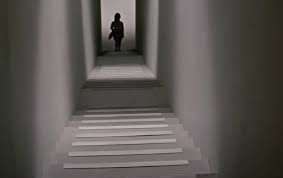
Kawashima shows characters ascending or descending a shadowy symbolic white staircase, up towards their dream life, or down into debt, jail or hell.

Conversations are overheard as characters are glimpsed listening via a fan vent, a doorway, through an air duct or down a stairwell. The compositions by cinematographer Nobuo Munekawa are pristine and striking, and the editing (by Tatsuji Nakashizu) crisply underscores the combative — without fisticuffs — nature of the many harangues and bowing apologies that constitue the story’s conflicts.

The acting is blunt and brisk — sinister coming in all shapes and sizes here.

But best of all is the clockwork screenplay that complicates the characters and their interrelationships, allows them to miss seeing others just out of the frame and allows us to wonder not simply where the grifting ends, but who, in all this corruption, will come out clean and who will pay a price.

That makes “Elegant Beast” the mother of every dark grifter tale to follow. Because not every scam ends with a twinkle, a smirk and “The Sting.”

Rating: TV-14, but racy — nudity, profanity, innuendo

Cast: Ayako Wakao, Manamitsu Kawabata, Yûnosuke Itô,
Kyû Sazanka, Yûko Hamada, Hideo Takamatsu,
Hisano Yamaoka and Shôichi Ozawa

Credits: Directed byYûzô Kawashima, scripted by
Kaneto Shindô. A Daiei Release on Tubi, Amazon, etc.

Running time: 1:35

Posted in Reviews, previews, profiles and movie news | Comments Off on Classic Film Review: A Grifter Dramedy Urtext –“Elegant Beast” (1962)

Movie Preview: An Adrien Brody epic in Ayn Randian Tones — “The Brutalist”

Actor turned director and co-writer Brady Corbet (“Vox Lux”) named the hero of his immigrant saga Lazlo Toth, the name of the fellow who busted up a famous statue way back when.

Not the same fellow, but what’s really interesting to me about this festival-buzzed epic is the fellow in the lead role.

Adrien Brody has marched to his own drummer, pretty much from the start of his career. He’s been a hep cat with not-unjustified delusions of Brando, gave one of the most memorable Oscar speeches in recent memory and has played roles large and small in big pictures and indie ones.

Felicity Jones and Guy Pearce also star in this drama with an Ayn Rand vibe — a visionary architect and his wife (Jones) flee Europe after WWII for America and make their fame — with the aid of a mysterious wealthy patron (Pearce).

This one comes to theaters at the height of Awards Season — Dec.

Posted in Reviews, previews, profiles and movie news | Comments Off on Movie Preview: An Adrien Brody epic in Ayn Randian Tones — “The Brutalist”

Movie Review: Belgium’s hope for an Oscar nomination? “Julie Keeps Quiet”

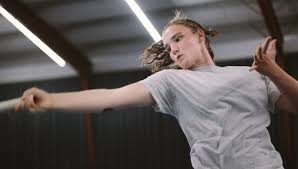
She wants to become a professional tennis player, so Julie stays focused. She’s a teen, and if wants to continue to train Julie knows she has to keep her eye on the ball, on and off the court.

Julie has to work on her conditioning. Julie spends hours hitting, hours shadow-playing out points. She haunts the weight room and practices her footwork. She’s even taken up juggling to maintain that “eyes always on the ball” intensity.

Julie eschews most socializing. She won’t let her parents distract her. She’s so far into her head that walking her dachshund is the only pleasure she allows herself.

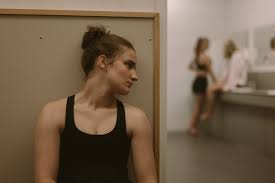
And when a teammate of Julie’s kills herself and the coach they shared is suspended from their club, Julie doesn’t lose that focus. Others have questions, but “Julie Keeps Quiet.”

Belgium’s submission for this year’s Best International Feature Oscar is a simmering, interior drama about the myopia required to become a professional athlete. Tessa Van den Broeck has the title role, the strokes and the game to make a convincing junior straining with every fiber of her being to make it to “junior pro” with the BTF, the Belgian Tennis Federation.

We never see her play a match. This Leonardo Van Dijl film (co-written with actress Ruth Becquart) lives in Julie’s head and makes us guess what’s going on in there.

Julie doesn’t talk. Even when she’s questioned by classmates, fellow players and the director of the club (Claire Bodson), she is close-lipped.

She has questions of her own, but her solution to every problem, every dilemma facing her in her life, has always been “practice, practice” and “more practice.” She throws herself into preperation, grudgingly accepts a new coach (Pierre Gervais) and carries on.

But something happened. Something was going on. Was it just the pressure of focusing one’s life this narrowly, the fear of not making it, that caused promising junior pro Aline to kill herself? That’s what that suspended coach (Laurent Caron) says.

Julie is young, naive and impressionable, all traits exaggerated by the juvenile nature of sports and making that your life focus. But she’s not stupid.

The script nimbly avoids directly addressing the matter at hand, which the viewer figures out almost from the start. But Van Dijl, making his feature debut, gives us clues in what Julie and the accused Jeremy talk about by phone as she stays in touch with the club pariah. And then Van Dijl delivers a quiet, child-questioning-an-adult scene about why everyone is “stressing out” that will knock your socks off.

“Jeremy, why did she do it?”

That conversation is not loud, explosive or accusatory. It’s as “quiet” as everything else in this film. At times, “mesmirizing” crosses over into tedium in this French and German (they’re studying it in high school) with English subtitles drama.

Who wants to watch an hour of tennis practice? Even players and former players might blanch at that.

But any hint that Julie’s journey to adulthood is stunted by her focus gradually washes away in this smart, tense and above all very “quiet” drama about a tragedy, a possible crime and how one tennis player handles it and what she herself can do about it.

Rating: unrated, adult subject matter

Cast: Tessa Van den Broeck, Pierre Gervais, Claire Bodson and Laurent Caron.

Credits: Directed by Leonardo Van Dijl, scripted by Ruth Becquart and Leonardo Van Dijl. A Cineuropa release.

Running time: 1:40

Posted in Reviews, previews, profiles and movie news | Tagged , , , , , , , | Comments Off on Movie Review: Belgium’s hope for an Oscar nomination? “Julie Keeps Quiet”

Netflixable? Eric Bana and Sadie Sink are a father and daughter staring down a cult — “A Sacrifice”

“A Sacrifice” is a thriller about an American father who is the last to realize that his daughter’s being recruited by a German cult.

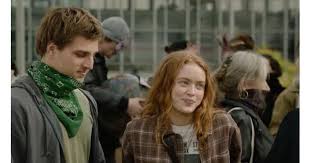
As Ben Monroe is an expert on “groupthink” and cult behavior, this is humbling. He’s the one who invited Mazzy (Sadie Sink of “Stranger Things”) to Germany — where he’s teaching — to “get her grades up,” which suggests flawed reasoning backed up by inattentive parenting.

Who figures bringing a sixteen year-old to cosmopolitan, hedonistic Berlin, where she doesn’t speak the language and where he is too distracted by his work, is going to help her “grades?”

Logic isn’t the strong suit this latest thriller from Ridley Scott’s writer-director daughter Jordan Scott (“Cracked”), a picture that broods and occasionally chills and takes its time entrapping the daughter right up to the abrupt twists of the finale. It’s short but not “brisk,” and not really developed enough or long enough to score its points.

Ben’s academic friend since his college days (Stephan Kampwirth) has police connections, which is how he gets Ben onto the scene of a mass suicide. The author of “The Science of Loneliness” is working on a new book on “Groupthink” and seeing all the bodies, ritualistically staged pre-death, and hearing the theories of the police profiler (Sylvia Hoeks of “Blade Runner 2049”) could help him with his research.

They banter about what people get from cults — “community, believing” in something greater than themselves, causing one to “give away your free will” in an effort to give “you life some meaning.”

This is an “off the radar” cult, and will require all the profiler’s skill, with maybe some help from an author whose work she respects, to chase down.

That’s the perfect time for Mazzy to show up, forced to make her way from the airport on her own, unable to figure out the subway and its long, tortured Germanic station names. It’s a good thing helpful hunk Martin (Jonas Dassler) is there to show her the way.

Ben may be absorbed by the sort of thinking that leads to “groupthink,” and having someone to discuss that with. Mazzy checks out the profiler and wonders “Who’s the midlife-crisis bait?”

We can guess most of what’s to come just in that first act set-up. So Scott, adapting a novel by Nicholas Hogg, tries to throw us off the obvious by shifting the point of view to show us Martin’s life — living with his doting grandmother — and the cult he’s in, where everyone takes the reassurances of leader Hilma (Sophie Rois), that “you’ll never be lonely again” at face value even as she’s warning of global collapse, mass extinctions and — RED FLAG time — “chemtrails.”

The ticking clock here is watching Mazzy get lured into a cult while her father is distracted by researching a cult with the cute cop on the case.

Scott pretty much botches that, with the shifting points of view never building the necessary suspense to make this come off. She succeeds in serving up Jonestown chills at what gullible people, from the People’s Temple to Heaven’s Gate to MAGA Q-Anon devotees, can be talked into doing as they take the wrong advice on fighting loneliness.

Connecting that condition to totalitarianism is as close as “A Sacrifice” gets to sending a message.

The story is reasonably absorbing, and the leads compelling enough to make us invest in “A Sacrifice.” But the lapses in logic are thrown into sharp relief in a third act that pretty much collapses in on itself.

The Big Confrontation and Race to Save are utterly botched, which Scott doubles down on by then OVER-explaining what we’ve seen set up in the first two acts.

The reason one always points out “nepo babies” in showbiz is that “talent” isn’t heriditary, even if the urge to give your offspring a leg or two up in your profession is. Scott’s filmmaking isn’t anything that makes her stand out from legions of other filmmakers trying to get their movies made, and her competence is easily questioned in the execution here, no matter how much fatherly advice her producer-dad gave her, if any.

language, sometimes she does, mostly she can’t even pronounce the place names.

Rating: R, violence, disturbing images

Cast: Eric Bana, Sadie Sink, Jonas Dassler and Sylvia Hoeks

Credits: Scripted and directed by Jordan Scott, based on a novel by Nicholas Hogg. A Vertical release on Netflix.

Running time: 1:36

Posted in Reviews, previews, profiles and movie news | Tagged , , , , , | Comments Off on Netflixable? Eric Bana and Sadie Sink are a father and daughter staring down a cult — “A Sacrifice”

Movie Preview: “The Strangers” are back — “The Strangers: Chapter 2”

This teaser trailer promises a Fundamentalist variation on a theme — at least on the car radio — pursued unto death in the masked murderers tale “The Strangers.”

The IMDB page of this Renny Harlin “I’m BACK, baby!” sequel — part of a trilogy — doesn’t have a release date, nor does this teaser trailer.

It’s set up to be a trilogy. Perhaps that explains the insane running time (2:42) listed for this title on IMDB. The third film is due next year, with “Chapter 2” smuggled out in late 2024.

Posted in Reviews, previews, profiles and movie news | Comments Off on Movie Preview: “The Strangers” are back — “The Strangers: Chapter 2”

Movie Preview: “The Vanishing?” David Schwimmer’s BACK, and in “Goosebumps”

Schwimmer tells “Dad Jokes” before going all “Red ROSS” on kids and neighbors over something that happened in the city decades ago.

Looks fun, I have to say. Good to see Schwimmer kvetching and kvelling on screen again.

Jan. 10, this “Goosebumps” tale of terror comes to Hulu and Disney +.

Posted in Reviews, previews, profiles and movie news | Comments Off on Movie Preview: “The Vanishing?” David Schwimmer’s BACK, and in “Goosebumps”

Classic Film Review: Was “Caligula” (1976, ’79, 2024) as bad as we remember?

No matter how scorned by one generation of film critics and/or filmgoers, once a movie is finished and preserved for all time there’s always a chance of “rediscovery” and reevaluation by film fans of the future.

“Lost” films come back to life, flops are revived as “classics” as more sober-minded assessors weigh in once the furor and stain of notoriety have faded.

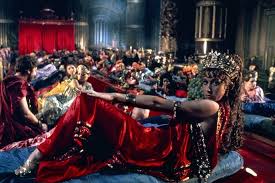
“Caligula” starred Malcolm McDowell, an elite talent hot off of “A Clockwork Orange,” and three future Oscar winners — Peter O’Toole, Helen Mirren and John Gielgud. It was scripted by acclaimed novelist and screenwriter Gore Vidal, who had a hand in “Ben Hur,” “The Best Man” And “Is Paris Burning?”

Director Tinto Brass (“Yankee” and “I Am What I Am”) had won respect in Italian filmmaking circles.

But when the film — released and yanked, re-edited and re-released — finally arrived in theaters, all anybody wanted to talk about was its Penthouse Magazine touches, the graphic depravitity, the sex and omnipresent nudity and sexually transgressive nature of it all. Penthouse publisher Bob Guccione produced it, and fired Tinto Brass to shoot additional “dirty” stuff and edit it in ways that played-up the titillation.

Reviews were brutal. Vidal demanded that his name be taken from the script, and the editor and composer did the same. If you wanted to get most anyone in front of or behind the camera red in the face in later decades, all you had to do was mention the title.

Was it really that awful? A new “ultimate cut” restoration, putting the film back as Brass and Vidal et al wanted it, removing some of Guccione’s excesses, promises to let us see how to looked when it premiered in Italy before Guccione took it over and invites us to rethink “Caligula.”

What I remember about it, never having sat through the many cable TV servings of it O channel-surfed by over the ensuing decades, is that I had to cross a picket line at the Manor Theatre in Charlotte, N.C. to see it.

Yes, it was picketed.

The beheading tank, a vast rolling scythe invented for the film as a means of delivering”entertaining” executions by God-Emperor Caligula (born in 12 CE, assassinated in 41, CE) struck me as particularly revolting.

All the breasts, bare bottoms and penises deployed here had a numbing effect in the theater.

And Matthew McDowell, in the title role, summed up the film with repeated references to his need for more stimulus in his depraved (not wholly endorsed by historians) life.

“Dull, dull, DULL!”

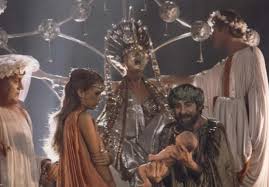
But how do memories of this abortion — featuring an actual live childbirth (three pregnant extras were employed to achieve this) — compare to experiencing it anew, “restored?”

Vidal was right to try and take his name off this, as the script is trite, disorganized and tin-eared. The day may come when all that we remember Vidal for are his contributions to films (he added the gay subtext to “Ben-Hur,” he claimed) and his feuds with Truman Capote and others.

If there’s a more insipid, oft-repeated line than “I hope I’m not interrupting,” I am at a loss to recall it. And deploying it while “interrupting” Caligula’s sexual dalliance with his sister Drusella (Teresa Ann Savoy, all but forgotten now) isn’t “cute.”

The vast majority of shots are held several seconds after their payoff, a pronounced and obvious flaw in the early acts, an insufferable agony in the later ones. Editor Nino Baragli (“The Good, the Bad and the Ugly,” “Mediterraneo” can’t have wanted that.

Perhaps that’s the work of director Brass, an uncredited editor here. Let the record show that Tinto Brass never made a great or good film, before or after “Caligula.” Restoring this picture doesn’t change that dubious track record.

The sets, from the grottos of Capri to “The Glory that was Rome,” look like tacky, over-decorated soundstage versions of TV productions of the era.

And never has the addition of buzzing flies on the soundtrack seemed more superfluous. The film is ugly and the picture just reeks, and pretty much has from the start.

Continue reading
Posted in Reviews, previews, profiles and movie news | Tagged , , , , , , , , , | Comments Off on Classic Film Review: Was “Caligula” (1976, ’79, 2024) as bad as we remember?

Netflixable? A TV reporter fakes his way to folk hero status — “The Man Who Loved UFOs”

In the 1980s, Argentina became the new epicenter of the UFO conspiracy universe as an intrepid and enterprising TV reporter doggedly pursued and then presented “proof” of a UFO landing in the mountains of rural Argentina.

His breathless, credulous reporting produced images of the burn-spot landing site, heiroglyphics he found in nearby caves and local eyewitnesses — at least some of whom had their hair turn bleached-white due to what they saw.

Former entertainment reporter Jose De Zer became a sensation, going on to cover Argentine conflict and politics. And the UFO world moved on to the next “hot spot” for alleged alien activity, sightings and “contact.”

Years later, it turned out De Zer didn’t just hype and sensationalize, he flat-out made it all up. He went so far as to make the cave drawings himself, and fake the “lights” in the night sky and his famous closest “encounter” with beings from another world.

Filmmaker Diego Lerman looked at this story, which seems suited for farce or ripe for a cautionary allegory in the latest era of “fake news,” and goes for something more poignant, a huxter’s descent into the madness of his own invention in “The Man Who Loved UFOs.”

It doesn’t work. Leonard Sbaraglia may be a deadr-inger for the long-dead De Zer — born José Bernardo Kerzer. He may do his utmost to make the guy sympathetic, someone who believes his own BS about reinventing journalism and taking himself and his station into “the television of the future” (in Spanish, or dubbed into English) by pulling out all the stops on covering “something people WANT to believe.” But Sbaraglia never makes that hard sell.

Yes, that “what hasn’t been proven but believed by everyone” is prophetic, as much of the world flirts with fascism, manipulated by sinister media figures who prey on the ignorant prejudices and conspiracy mania of their audience. But the movie isn’t really about that.

De Zer was an opportunist. His idea of giving “the people” something other than bad news about the Argentine economy, reminders of how badly The Falklands War went and the politics that had produced coups and mass murder along with them is debated by his TV higher-ups.

“But we’ve never actually just LIED to our viewers!”

De Zer — sort of an Art Bell/Tucker Carlson/Geraldo character — gets his way, and with his long-suffering cameraman Chando (Sergio Prina) he sets out to solve an economically depressed mining region’s “tourism” problem by helping them publicize their “UFO landing.”

There’s nothing noble, heroic, comical or tragic about him as he’s presented here. From the moment he gets his first bribe to “report” there (gold nuggets from their long-dormant mines) we keep our distance. And nothing Sbaraglia or Lerman do makes him riveting or even all that interesting, much less compelling.

There’s no “charm” to this scoundrel’s ill-gotten fame, or his connection to the singing, dancing TV personality (Mónica Ayos) whose flattering TV profiles are a joke — he’s sleeping with her.

Noting is made of the amusing possibilities of poor Chando trying to rein his on-air personality in when De Zer is hurdling across rocks and fields of the mountainous plateaus or plunging down a mine tunnel which they’ve “discovered” by accident, but a discovery that was “meant to be” by the aliens allegedly directing their quest, luring them on.

And while there are glimpses of how this “coverage” made De Zer a folk hero, Lerman makes no effort to convey the fanatical devotion, the deluded “belief” and how their credulity made Argentines look or feel, and what being fooled this way cost them.

What we get instead are flashbacks to De Zer’s service during “The Six Day War” in Israel (he’s Jewish), the Sinai Desert epiphany he maintains ordained him to be the one the aliens “trust” for this “story.”

Even that had comic possibilities, one of the “chosen people” chosen by aliens, or so he wants everyone to believe.

Every journalist knows how easy it would be to “fake” most stories, just as every cop is most expert in the field of knowing what she/he can get away with. Seeing someone, for screenplay reasons that we never, ever buy into, go to all this trouble to fool people and fake his way to TV fame is more disheartening than amusing.

On the positive side of things, this film amusingly undercuts every huxter trying to sell his or her latest “UFO Investigation” documentary. “The truth is out there,” as De Zer repeats. Too bad most of the people claiming they’re “finding” that truth are either credulous clowns or con-artists.

There’s no suspense in the tale, even in its “big finish.” “Tragic” was never in the cards, as this con man got away with his stunt. But this could have been dark and funny. It isn’t.

Presenting this story in a fstraightforward manner does the character no favors, as he is beneath contempt, but never in an amusing way. It’s a progressively more fanatical performance that feels too colorless to make us care.

Rating: TV-MA, nudity, sex, smoking, profanity

Cast: Leonardo Sbaraglia, Sergio Prina and Mónica Ayos

Credits: Directed by Diego Lerman, scripted by Adrián Biniez and Diego Lerman. A Netflix release.

Running time: 1:48

Posted in Reviews, previews, profiles and movie news | Tagged , , , , , , | Comments Off on Netflixable? A TV reporter fakes his way to folk hero status — “The Man Who Loved UFOs”