Movie Review: “Wicked” girlfriend, you’ve put on an awful lot of weight

“Wicked” moves from the Broadway stage to the cinema, an epic that transitions from “musical” to “intellectual property” in a bloated, lumbering, gear-grinding crash.

Whatever Disney or most any other producing studio might have done to this beloved prequel to “The Wizard of Oz,” Universal smothers the life out of it, slowing it down for a tedius exercise in theme-park attraction-scale “world building.”

Casting Cynthia Erivo and Ariana Grande in the leads can seem inspired, here and there, with kids’ TV sitcom alum (“Victorious”) turned pop pixie Grande dazzling in ways only the original stage show’s Galinda could rival.

But bringing in Kristen Chenoweth (the original Galinda) and Idina Menzel (Broadway’s Elphaba) for cute-but-pointless cameos late in “Part 1” of what will turn out to be a five hour+ magnum opus musical just underscores the bloat, the Seussian excess of production design, costumes and the joyless art deco kitsch of it all.

Whatever the charms of the stage version, they’re budgeted right out of this “product.” The songs, separated by excessive filler between the musical highlights, are robbed of much of their wit and pathos. The characters are underscored with some cute cinematic touches and undermined by dead weight scenes and dull, overdressed supporting characters.

The story is about the unloved life that Elphaba (Erivo), the Wicked Witch of the West, endured before meeting and befriending her rival Galinda (Grande) at Shiz University, which can only be seen as a derivative Ozian Hogwarts.

Elphaba has a ready response to ridicule for her green skin that includes “No, I did not eat grass as a child.” Galinda’s life of fashionable, effortless and shallow beauty has made her spoiled.

“Something is very wrong! I didn’t get my way!”

Studying under Madame Morrible (Oscar winner Michelle Yeoh), competing for the amusingly vain and handsome Prince Fiyero (Jonathan Bailey), these two will supposedly learn the depths and limits of each other’s compassion. They’ll matchmake Elphaba’s paraplegic sister Nessarode (Marissa Bode) to tall-for-a-Munchkin Boq (Ethan Slater), and understand the cruelty of caging animals, denying even some of their professors (Peter Dinklage voices a PhD goat) the power of speech.

Belittled and discriminated against for being green and thus “different,” Elphaba has grown up bitter, with her magical powers unleashed in fits of fury. Galinda’s friendship might soften that, and befriending the outcast Elphaba might make the dizzy blonde drop the “Ga” from “Galinda” as she learns emphathy and earns her own powers.

The Wizard of Oz? He’s a remote, feared and admired God, in a “Thank Oz,” “Oz help us,” Oz bless you” sense. The two star pupils will have to study hard to “find your way to the Wizard of Oz.”

Continue reading
Posted in Reviews, previews, profiles and movie news | Tagged , , , , , | Comments Off on Movie Review: “Wicked” girlfriend, you’ve put on an awful lot of weight

Movie Preview: To be Young and Distractingly hot on the Sunny Coast of Italy in the summer — “Partenope”

She is a siren, literal or figurative. And the men? They must swoon, because nature or the supernatural has ordained it so.

Celeste Dalla Porta has the title role.

Gary Oldman’s the geezer who has to pretend he’s not interested in this new film from the director of “Il Divo,” “Youth,” “Loro,” “The Great Beauty” and “The Hand of God.”

The new film from Paolo Sorrentino opens in the U.S. on Feb. 7.

Posted in Reviews, previews, profiles and movie news | Comments Off on Movie Preview: To be Young and Distractingly hot on the Sunny Coast of Italy in the summer — “Partenope”

Movie Review: A Black Boy’s Odyssey through the London “Blitz”

A single photo in Britain’s Imperial War Museum — a mixed-race child snapped as he joined the sea of children being evacuated from a British city early in World War II — inspired the brilliant writer-director Steve McQueen’s “Blitz,” a harrowing, moving and nostalgic day and a couple of nights in the life of a Black boy lost during the darkest days of World War II.

“Twelve Years a Slave” and “Small Axe” filmmaker McQueen used that photo to sweep away the whitewashed history of Britain’s “finest hour,” a trial by fire that’s almost always been depicted as a united, forthright and all-white country, loyal to its king, relying on the Royal Air Force, keeping calm and carrying on.

“Blitz” restores the many immigrants there to that not-that-calm story, and the ghoulish opportunists, the officious prigs behind early government blundering and the impersonal tragedy of it all in an odyssey undertaken and experienced by a nine year-old mixed race boy evacuated from the city, but determined to get back to his mum.

It’s sentimental, as such “Hope and Glory” enterprises always are. But “sentimental” gets a bracing reimagining through McQueen. The “truth” about the past wasn’t the misty lore of generations of WWII movies. It can include minorities of various stripes facing discrimination and outright hostility, and a Nigerian-born air raid warden (Benjamin Clémentine) reminding racists that “there is no segregation” in the Underground, where one and all take shelter from German bombing, and that using racism to “divide us” is just the sort of thing “Hitler” does.

Saoirse Ronan is Rita, a Stepney East Ender who keeps her Rosie the Riveter scarf around her blonde scalp as she’s building bombs for the war effort. It’s September of 1940, and the Battle of France has been lost. The Battle of Britain — an air offensive — is just ramping up. And city Britons and those from the south of the country, closest to the German bombers and under threat from Nazi invasion, are evacuating their children, en masse, to the north.

Rita’s boy George (Elliott Heffernan) is a prime candidate. He’s nine, living with her and her father (Paul Weller) in a townhouse, with danger arriving every night from German bombs plummeting out of the gloom.

We meet George’s Grenadian father via flashbacks, Rita remembering their jazz club courtship and the racism that “took him away.” We don’t know what happened, or if they got around to getting married.

George doesn’t want to get on that evacuation train, but he does. Slack supervision by the few adults in charge and the state of rail safety in those flimsy, wood-and-steel carriages (with doors everywhere) make it easy for George to make a break for it.

That begins his quest to “get home” and maybe apologize to the mum he told “I HATE you” to when he departed.

George will meet fellow escaped evacuees, kind strangers and a gang of “artful dodger” thieves who rob bombed stores and pillage the dead before the authorities can remove the bodies, because McQueen knows his Dickens.

George will face racism and deny being “Black,” until he meets that no-nonsense air raid warden (Clémentine) whom even the bigots have to listen to.

Rita will work, get dolled-up to go out pubbing with the girls — “Hey, sailor!” — and sing a sentimental song on the radio when the BBC comes by their factory for a morale-building broadcast.

She doesn’t know George is missing, and George doesn’t know that she’s not yet looking for him as they experience air raids and the comraderie of sheltering in the tunnels — where everybody had a “talent” or even an “act” to keep everybody else enterained.

In a lot of ways, “Blitz” is McQueen’s most conventional film, serving up the cliches and tropes of many a Blighty during “The Blitz” movies. But the melting pot world of foreign-born Brits who appear here — from an all Black big band at a club to the Caribbean islanders and Africans living in besieged Britain — freshen up those plot conventions.

McQueen may oversell the idea that Britain was as diverve in 1940 as it certainly became by 1950, but pretty much everything we see here is historically defensible if not literally ripped from this or that page from history.

Showing a swank nightclub where plentiful fresh food, drink and a Black big band let the swells pretend there isn’t “a war on” seems off — with the U-boat war/Battle of the Atlantic raging and the country under strict rationing since the preceding Jan. But nothing else here earns a “Surely that never happened” dismissal.

McQueen’s bomb-lit fires and post-bombing calamities above and below ground are vividly, impressionistically real recreations, adding to the sense that we’re experiencing not just history, but history forgotten or erased.

Ronan is properly feisty and stoic, and a believable new-to-running-a-drill-press factory woman and amateur (wavering pitch) singer.

Character actor Stephen Graham makes a properly demented leader of the gang of thieves.

And young Heffernan impresses as a child who uses grandpa’s parting advice to deal with bullies and bigots at every turn — “All talk and no trousers!” His George is just the sort of plucky, reckless kid we’d want as a tour guide through a familiar war-is-hell-on-Earth setting, a tour that lets us see this moment in history through fresh eyes.

Rating: PG-13, violence, sex, some profanity

Cast: Saoirse Ronan, Elliott Heffernan,
Benjamin Clémentine, Harris Dickinson, Paul Weller and Stephen Graham.

Credits: SCripted and directed by Steve McQueen. An Apple release on Apple TV+.

Running time: 2:00

Posted in Reviews, previews, profiles and movie news | Tagged , , , , , , | Comments Off on Movie Review: A Black Boy’s Odyssey through the London “Blitz”

Netflixable? A Transgender Telenovela with Tunes — “Emilia Pérez”

“Emilia Pérez” is bold and daring musical treatment of subjects most often covered in telenovelas — Mexican soap operas — and in crime series such as “Queen of the South.”

It’s about a Mexican cartel boss who decides to change his life and his gender, to “leave everything behind” but still have the blood money earned as a ruthless gang leader. A defense attorney willing to do anything for money will be coerced into arranging it all.

But the Israeli surgeon’s warnings about the limits of hormonally and surgically ending gender dysphoria will come back to haunt one and all.

“I can fix the body. I will never fix the soul.”

It’s a French film — written and directed by the writer-director of “A Prophet” and “The Sisters Brothers”– a tale told mostly in Spanish, with a Mexican subject and Hollywood and Spanish stars.

Action franchise queen Zoe Saldana has perhaps her best role ever as Rita Moro Castro, a driven 40something single lawyer whose defense of drug lords draws her into the orbit of that one cartel king who’d like to be a queen, and give up the stresses of murderously maintaining an empire. Saldana sings, dances a bit and lets us see the calculations that go on when someone is promised great riches to arrange and keep the biggest secret of all.

Transgender Spanish actress Karla Sofía Gascón has the break-out role of Manitas Del Monte, one of the top men in the illicit drug trade who’d trade all that for the chance to be her true self, reborn as Emilia Pérez.

Selena Gomez is Jessi, the unknowing younger wife and mother of Del Monte’s two children, spirited off to Switzerland after her husband’s faked death, never the wiser. Being the most experienced singer and dancer in the cast, Gomez tackles the few moments that could be called “production numbers.”

And Edgar Ramírez plays the rough customer who wins the love of Gomez’s “widow,” but who brings out the cartel killer in the “newborn” jet setter who misses her children, Emilia.

Audiard’s audicity, adapting a Boris Razon novel, folding in songs by Camille and Clément Ducol, bowls the viewer over in the first act, which is all Saldana as we’ve never seen and heard her before. We see Rita kidnapped and coerced, then globe-trotting, diving into the research that brings her to the Tel Aviv doctor (Mark Ivanir) who will do the surgery, pocket the cash and deliver that warning.

The film’s big finish has action, pathos, fury and bloodshed.

But the middle acts, where Emilia Pérez has her coming out, reconnects with her “fixer” lawyer and pulls her kids and her still-clueless ex-wife close to her, sag and slow the movie’s sprint to a crawl.

The forgettable songs and limited dance sequences remind us of all the things this genre-bending/gender-bending thriller is not — a proper, emotionally resonant musical, an opera (despite somes songs recited, “recitative,” not sung) — and the one sure thing it is, gimmicky.

Gascón is effective as the gender-changing lead, a convincing grilled (gold teeth) and face-tattooed goon transformed into a woman. But before we stamp her name on an Academy award, maybe we should consider the performance beyond the stunt. Does she make anybody care about her fate? A non-singer “singing” (recitative) with one convincing release-her-inner-thug moment in between scenes caressing her kids doesn’t really make the sale.

Adriana Paz brings more humanity to her performance as the woman Emilia falls for after her transition and Gomez, adding another credit to her own transformation, is able to hold her own with her elders.

But the film’s opening act is where we connect with the most interesting character and performance. Saldana may not have the title role, but she’s the observer swept up in all this, the one most will identify with and frankly, the Oscar contender worth rooting for. She abandons her action credentials and glam (showing her age) to play a woman with her own agenda, risk-assessing skills and hole in her soul.

Audiard loses track of her in the middle acts, and “Emilia Pérez” palpably withers away when he does.

Rating: R, violence, sexual situations, profanity

Cast: Zoe Saldana, Karla Sofía Gascón, Selena Gomez, Adriana Paz, Mark Ivanir and Edgar Ramirez.

Credits: Directed by Jacques Audiard, scripted by Jacques Audiard, Thomas Bidegain, Léa Mysius and Nicolas Livecchi, based on the novel by Boris Razon, songs by Camille and Clément Ducol. A Netflix release.

Running time: 2:12

Posted in Reviews, previews, profiles and movie news | Tagged , , , , | Comments Off on Netflixable? A Transgender Telenovela with Tunes — “Emilia Pérez”

Movie Preview: Another live action remake nobody asked for…save for the accountants — “How to Train your Dragon”

And you thought “Red One” was ill advised.

Posted in Reviews, previews, profiles and movie news | Comments Off on Movie Preview: Another live action remake nobody asked for…save for the accountants — “How to Train your Dragon”

Movie Review: Britain’s “Best International Feature” Oscar hope is an Indian Police Procedural — “Santosh”

American TV has pretty much beaten to death the police procedural drama thanks to overexposure to the infallible, unimpeachable justice system fantasies of Dick Wolf, the self-righteous heroes of “Blue Bloods” and and the scientist sleuths of “C.S.I.”

That’s why the British-made Indian policing drama “Santosh” hits you like a wet slap.

Writer-director Sandhya Suri conjures up a mystery thriller about policing, sexism, class and caste that gets into the dark corners of India and the overwhelmed, hidebound and corrupt culture of those entrusted to keep the peace.

Suri, who cut her filmmaking teeth on documentaries, found a great hook to hang her tale on — the country’s peculiar “laws of compassion” that allow the widows of fallen policemen to take their place on the force. Through a woman who takes up that offer, we see a broken system from the inside and watch a politically-charged murder case investigated, blundered and manipulated by figures who range from ineptly misogynistic to sinister.

The widow Santosh Saini (Shahana Goswami of the “Rock On!” Bollywood franchise) doesn’t have any good options when her husband is killed in the line of duty. Coming from a poor family, rejected by venal in-laws and about to lose her police-force-provided housing, she takes the “inherited” job offered by the Machogar P.D.

Santosh will become Constable Saini via on-the-job training. Unarmed, she will work with other female cops (mostly) who are given the delicate jobs pertaining to female complaints and crime victims (escorting a woman’s corpse to the morgue) and try to put the fear of the law into men who misuse and abuse women.

Everything from taking indecent liberties to breach of promise falls under their jurisdiction, where threats, abuse and bribes are part of the job, but carrying firearms isn’t.

Santosh watches and listens, and when a poor laborer from the Dalit caste tries to report a missing daughter, she is the only one who hears and sees him. Her best efforts can’t make the lazy, disorganized, dismissive louts of her department even file a report.

When the missing teen turns up dead in a well, there’s hell to pay — thanks to the media. Her aloof, classist boss (Nawal Shukla) is transferred. As no-nonsense older-woman detective (Sunita Rajwar) elbows her way in and takes on the case, Santosh now has a mentor and a champion.

With a bit of basic detecting, a veiled threat or two and some unveiled ones, they’re out to get their man, no matter how little the men who work with them care about another Indian rape and murder victim.

Writer-director Suri takes pains to showcase the overwhelming nature of policing a nation of 1.4 billion and counting. But she doesn’t flinch from highlighting “It’s not our job” (in Hindi with English subtitles) cops and the “rape culture” that men in and out of uniform callously and carelessly tolerate.

All of the women police officers depicted are more or less united in opposition to this ingrained attitude, with Inspector Sharma (Rajwar) their avenging angel.

But the injustices can seem too deep, too broad and too numerous for a few women to challenge.

“We’re illiterate,” the mother of the dead girl hisses at Santosh. “Isn’t that why the police are deaf to us?”

The hardest lesson comes from the seasoned detective, who arrives as a white knight but seems more tarnished and complicated than that the longer this case goes on.

“There are two kinds of ‘untouchables’ in this country. The ones people don’t want to touch. And the ones who can’t be touched.”

If that universal “law” doesn’t wipe the smugness off any First World viewer thinking “This is just how policing is in the Third World,” nothing will.

Goswami’s understated performance drives this brilliant debut feature, a sometimes silent observer who can barely register shock at some of what she sees and experiences. Goswami lets us see that Constable Santosh Saini knows how things have been and that they probably will continue to be, no matter what she and anybody she works with does.

Rating: R, violence

Cast: Shahana Goswami, Sunita Rajwar, Nawal Shukla and
Arbaz Khan.

Credits: Scripted and directed by Sandhya Suri. A Metrograph release.

Running time: 2:08

Posted in Reviews, previews, profiles and movie news | Tagged , , , , | Comments Off on Movie Review: Britain’s “Best International Feature” Oscar hope is an Indian Police Procedural — “Santosh”

Movie Review: Oscar contender “Under the Volcano” lets Ukrainians vacation until Russia Invades

The Biden administration had been warning for months that Russia was preparing to invade Ukraine. But when it finally happened, Ukrainians, right up to the country’s president, were shocked.

Even some of those accepting that it might happen carried on living. Some were even caught flatfooted, on vacation, when Putin made his move.

“Under the Volcano” embeds us with such a family, enjoying their time in the vacation hotspot Tenerife, in the Canary Islands. The bottom drops out and their world is upended just as they’re about to board a plane for home.

As they grasp the stunning news, “trapped” in a much longer holiday than they’d planned, stresses and fractures in the family are exposed and their teenage daughter finds herself forced to grow up fast, almost as fast as her war zone schoolmates back home and the African refugee teens she meets on the island.

This grim travelogue, a quietly gripping drama about Ukrainians stranded, like those African refugees, in a Spanish possession, is Poland’s submission as its Best International Feature contender at the Oscars, due to its production and the filmmaker who conceived it.

Polish director and co-wroter Damian Kocur’s follow-up to his award-winning “Bread and Salt” is a study in characters under stress in a place billed as a break from stress and the worries of everyday life.

But enjoying the beach, the Spanish singers at the hotel, the festivals and the sights — and reveling in making social media posts about their “good times” — ends the moment they stare at the airport departure board, which is when they first get the news.

Spaniard show them compassion, with the hotel giving them back their room and telling them there’s “no charge” for the extra stay, or the meals they eat there. Tourist guides pitch them distractions — road trips and treks up the island’s famous volcano. African refugees still hustle tourist trap trinkets at every turn.

It’s all either of the parents (Roman Lutskyi, Anastasiya Karpenko) can do to go through the motions. Their little boy (Fedir Pugachov) may be almost oblivious. But as she facetimes with a friend back home, hearing of the trauma and fear everyone in Kyiv is experiencing, standoffish teen Sofia (Sofia Berezoska) finds herself shaken in ways the adults are not. She might be the one who “sees” the Africans in similar straits all around them, some of them selling, others just wanting to make a human connection.

Kocur uses only brief TV and cell phone glimpses of the war “back home” to rattle this family. We don’t see the cancellation notices at the airport, just the parents’ shocked faces.

Their dilemma makes all of them easily triggered — by fireworks, by not knowing how to respond to the hospitality and empathy their Spanish hosts show them and by rowdy, unconcerned (but guilty and somewhat ashamed, when confronted) Russian tourists.

Sofia, who looks to be about 14, had been tentatively observing and videoing vacationing Spanish teens as part of her social media version of her vacation. She dotes on her kid brother, but keeps the adults at a distance. We start to pick up on the family dynamics that contribute to that as Roman and Nastasiya bicker, lash-out and struggle with their dilemma and their relationship in a country that isn’t their own.

Kocur’s film is a tad too patient at times, dumping more “vacation” experiences on these hapless vacationers without a country. And the allegories folded into the story aren’t the easy fit he may have envisioned.

One subtext here is the illusion of a united Europe — with the family and many of those they meet speaking English and a little Spanish as the needs arise — whose fissures widen (brutishly bullying Brits) thanks to these severe tests of a European war on top of an ongoing refugee crisis.

But “Under the Volcano” can most easily be appreciated for allowing us to put ourselves in others’ shoes — a vacation interrupted by tragedy, the struggle to remain a family “team” while trying to reason one’s way out of a crisis, and the grim realization that the day you went to the airport might have been the last good day you and everyone you know will see for years and years to come.

Rating: unrated, profanity

Cast: Sofia Berezovska, Roman Lutskyi, Anastasiya Karpenko and
Fedir Pugachov

Credits: Directed by Damian Kocur, scripted by Damian Kocur and Marta Konarzewska. A Lizart/MGM production.

Running time: 1:44

Posted in Reviews, previews, profiles and movie news | Tagged , , , , , | Comments Off on Movie Review: Oscar contender “Under the Volcano” lets Ukrainians vacation until Russia Invades

Movie Preview: Seth Rogen runs “The Studio,” but Hollywood beats him down

Real Hollywood folk (Scorsese) mingle with Bryan Cranston, Rogen, Kathryn Hahn and Catherine O’Hara in this send up of the cinema as it exists today. 

March 26, Apple TV.

Posted in Reviews, previews, profiles and movie news | Comments Off on Movie Preview: Seth Rogen runs “The Studio,” but Hollywood beats him down

Movie Review: Coming of Age, “What We Find on the Road”

“What We Find on the Road” is a dramatically dull indie roadtrip dramedy that reaches for “coming of age” and strains itself getting there.

The film begins with mystery and promise, drifts into predictable and undramatic and doesn’t really rally to become anything more than a scenic screensaver as it follows an 18 year-old driving a ’68 Dodge Polara from Cape Cod to California…by way of Tennessee (!?) and Texas (!?).

But if you’ve ever nursed an overheating, engine-knocking beater on a long drive and if you’ve never been to the Grand Canyon or seen a “road picture” in your life, it may have a little something to offer. Very little.

It stars young and still unknown bit player Finn Haney and was scripted by his father Bill, a documentary filmmaker (“The Last Mountain,” “The Price of Sugar” and “A Life Among Whales”), producer and sometime screenwriter.

Haney-the-younger plays TC, who just turned 18 and is looking at the collegiate future when an aged pot-bellied biker shows up at his door, asks his name and confirms that birthday.

“You old man wanted me to give you this,” he growls, and leaves the kid a set of car keys and a Vallejo, California address. The car? It’s at an old Cape Cod repair shop down the road, where Bill presides.

What’s rule #3 when you’re making an indie film, kids? Write a chewy part with a pithy speech or two that you can use to talk a “name” into taking that role. Here, that pays dividends as the great character actor Paul Guilfoyle (“C.S.I,” “The Good Fight,” just seen in “Arthur the King”) plays the sage of the sparkplugs mechanic who has stored that ancient “Blue Biscuit” convertible for “The Hammer,” TC’s estranged father.

The Hammer had a reputation — “rock and roll” and drugs and trouble with the law — which is why TC’s unseen mother wants nothing to do with him. But Bill leads the kid through the bring-the-383-cubic-inch-engine-back-to-life in a montage, and gives him a flashlight, “a c-note,” car advice and life advice before the boy sets off to meet a father he never knew.

“Start saving money for gas, it’s a guzzler.” And “You’re being perversely tested by your old man — 3000 miles in a beat-up old bomber to find your father, who hasn’t exactly nailed the fathering business.”

And with that bit of wisdom — with no mention of updated registration, insurance or title, a wonky radiator and a mysterious steel box welded into the trunk — TC is off, to be “tested” along the way, we figure.

Of course bestie Jake (William Chris Sumpter) shows up and demands to go along, as TC hasn’t ever driven on the highway before, ditching his parents’ Volvo wagon at the garage as he does.

The screenwriting problem-solving logic leaves a lot to be desired in this narrative, from the lads not telling their parents (While licensing and registering a car? While ditching a Volvo?) to their first stop, a pointless “upstate New York” visit to relatives that adds nothing to the narrative, no colorful supporting characters or performances of them. That first breakdown/traffic stop is a “Tennessee” cop whom they somehow encounter between Cape Cod and Vallejo via upstate New York in an overheating antique.

If your script’s not as clever as “Doc Hollywood,” you can’t get away with sloppy geography (D.C. to Beverly Hills via South Carolina in an antique Porsche, in that film.).

We’re treated to generic “road food,” “sleeping in the car,” radiator issues and the ongoing mystery of what might be in that box, which provides suspense with every traffic stop. None of it adds up to much that holds the interest.

His friend leaves and an Irish divorcée (Katherine Laheen) with her dog and a broken-down pickup take his place. The Grand Canyon is visited and bullies are brushed by as TC heads for that fateful meeting with the father who may have stashed drugs, drug money or who knows what in that box in the trunk of a car he’s sentenced his son to deliver to him cross-country.

There’s just not enough drama, charm, whimsy or angst to make this picture live up to those earthy early “change the plugs, alternator, tires and hoses” scenes with Guilfoyle. The insights are generic, the performances generally drab and the payoff’s more of a bust than a catharsis.

It’s scenic, and the traveling-far-in-an-unreliable-car makes “What We Find on the Road” relatable to a lot of us. But we don’t need a movie to remind us how tedius long drives generally are — with or without breakdowns, nosy police or fiesty Irish damsels.

Rating: R, profanity

Cast: Finn Haney, William Chris Sumpter, Katherine Laheen and Paul Guilfoyle.

Credits: Directed by Chaysen Beacham, scripted by Bill Haney. A Dada Films release.

Running time: 1:34

Posted in Reviews, previews, profiles and movie news | Tagged , , , , , , | Comments Off on Movie Review: Coming of Age, “What We Find on the Road”

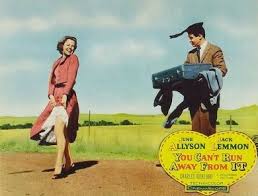
Classic Film Review: Lemmon and Allyson remake “It Happened One Night” — as a musical — “You Can’t Run Away from It” (1956)

“You Can’t Run Away from It” is a comic curiosity from the early career of Jack Lemmon, a musical filmed when studios were scrambling to lure filmgoers away from TV and when musicals were so overexposed — “The King and I,” “High Society” and “Carousel” came out the same year — they almost instantly went out of fashion.

“West Side Story” reset musicals a few years later, returning them to the ranks of rare “event” pictures where the genre remains to this day. And the cinema would find other ways to retain its “date night” place in life — eventually.

But it’s hard to imagine audiences not smelling the desperation and the old fashioned fustiness of this remake of the Frank Capra classic “It Happened One Night” when “You Can’t Run Away from It” hit theaters in 1956.

Leading man turned producer/director Dick Powell had transitioned from musicals to a terrific film noir cynic on one side of the camera. Here, he directs his wife June Allyson in a musical that Columbia Pictures cobbled together from a movie and short story it owned the rights to, with new songs by Johnny Mercer.

Filmed in Technicolor and presented in widescreen Cinemascope, “Run Away” was meant as a song-and-dance star vehicle for Allyson, pushing 40 and years removed from the lesser musicals (“Till the Clouds Roll By,” “Good News,” “Two Girls and a Sailor,””Best Foot Forward”) that made her name.

It didn’t pay off.

The sexy, sassy, downmarket Depression Era edge of “It Happened One Night” was lost in the well-scrubbed, conservative 1950s. A parade of forgettable Johnny Mercer songs, many of them crooned by the not-quite-forgotten Four Aces (pre-doo-wop) quartet, a dopey “Scarecrow Dance” sequence that showcases why Robert Sidney was best known for middling 1960s TV variety show choreography and a bus trip premise that had to seem out of date in the age of “See the USA in your Chevrolet” America had to provoke eyerolls in many a Baby Boomer, dragged to see this by their Liberace/Lawrence-Welk-loving parents.

And no amount of makeup could hide the obvious, that the smokey-voiced Allyson was entirely too old to be playing the gamine whose controlling rich daddy (Charles Bickford from “A Star is Born”) keeps getting her impulsive marriages to gold-digging rakes anulled.

But here’s Jack Lemmon as a fast-talking, hard-drinking, short-tempered and oft-fired newspaper reporter/smart-ass, the Clark Gable role in “It Happened One Night.” He sings, and not just the little bits of humming/crooning he did in many a comedy, but full on solos and duets.

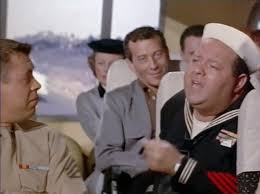
Stubby Kaye (“Guys & Dolls,” “Cat Ballou”) leads a Greyhound busload of extras — and bus driver Henny Youngman (!) in a cornpone “Howdy Friends and Neighbors” tune from Mercer.

And funny folks like Jim Backus pop up, steal a scene, and exit. So it’s not a total waste of time.

Allyson is Ellie Andrews, whom we meet confined-to-quarters on her father’s 60 foot schooner in San Diego harbor. She’s just run off and married somebody new, not her first time.

And considering how much she repeats the phrase “never been alone with a man,” we have to wonder how she manages the meeting, courtship and falling-in-love business, even with ne’er do well playboys like Jacques Ballarino (Jacques Scott, entirely too colorless to register), her latest.

But rather than accept Daddy’s latest anullment, Ellie leaps overboard and swims past the anchored aircraft carriers to freedom. She’ll get back to Texas and “save” this scandalous, newspaper-headline “marriage.”

With Daddy’s minions (Dub Taylor among them) watching the train station and airports, Ellie opts for the bus. That’s how she and we run into Peter Warne (Lemmon), a reporter who just finished a bender/send-off with his colleagues. He’s been fired, and they serenade him with “Old reporters never die. They gradually decline.”

Newspapering. Nothing like it.

The “meet cute” is that she’s in his seat. Peter will shoo her out of it with a boorish “Scoot, scoot, scoot scoot,” but before they’ve crossed one time zone, he’ll have to save her from a “bop talking” hepcat and try to save her bag, with all her money in it, from a snatch-and-grab thief.

Peter figures out who she is, pitches the “scoop” to his old boss in Houston, keeping her out of Daddy’s grasp for this cross-country trek.

“You’re just a headline to me,” he tells the “spoiled brat.”

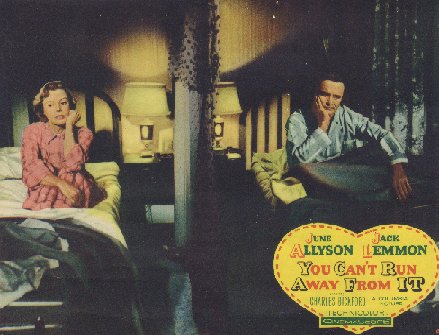
Scenes from “It Happened One Night” are repeated, verbatim — the “walls of Jericho” shared motel rooms (twin beds were all the rage), the hitchhiking, skirt-hiking bit Claudette Colbert pulled off in the original film now has a song to go with it.

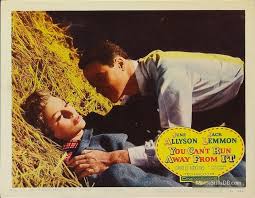
Streams are crossed, wires are crossed and between the location-shot stream-fording and soundstage haystacks and “motor court” lodgings, love is bound to blossom.

Powell makes the best of all that he’s been given, but the script lacks almost anything in the way of snappy dialogue and the wide screen process pretty much swallows character comedies like this one.

Backus had one of the funniest voices in film, and the future Thurston Howell, III and Mister Magoo milks that for all it’s worth in a single scene. Youngman squeezes in a one-liner as both Ellie and Peter insist that he hold the bus and “wait” for them at a dinner stop.

“Sure lady…” “They don’t know, but they’ll never see me again. I just quit!

“You Can’t Run Away from It” wasn’t a hit in 1956. And its relative obscurity is underscored by the lack of color still shots of it floating around the Internet. It was lightly regarded, then and now.

But Lemmon made every role memorable and every leading lady likeable just by his presence. His manic patter early years were made for “screwball,” or its nearest equivalent in square 1950s and early ’60s America cinema.

Check out his “She’s my wife” exchange with sniggering “swingin’ safari” bus riding “daddio” on-the-make George Shapely, played by Paul Gilbert.

“Swing it over’t the other seat, boy. Blow, dad!”

He’d find his “Everynebbish” guise a few years later, in “The Apartment.” But the callous kid/blowhard of “Mister Roberts” grows up and grows an edge in “You Can’t Run Away from It,” a movie that figured out Lemmon was at his funniest when he was at his testiest.

Rating: approved, TV-PG

Cast: June Allyson, Jack Lemmon, Stubby Kaye, Jim Backus, Henny Youngman, Jack Albertson, Howard McNear, Elvia Allman, Dub Taylor and Charles Bickford

Credits: Directed by Dick Powell, scripted by Robert Riskin and Claude Binyon, based on a short story by Samuel Hopkins Adams and the movie “It Happened One Night,” songs by Johnny Mercer. A Columbia Pictures release on Tubi.

Running time: 1:35

Posted in Reviews, previews, profiles and movie news | Tagged , , , , , | Comments Off on Classic Film Review: Lemmon and Allyson remake “It Happened One Night” — as a musical — “You Can’t Run Away from It” (1956)