Movie Review: Finnish Metalheads aim for more face-melting on a “Heavier Trip”

Well, Hell. Now I’ve got to go back and catch “Heavy Trip,” the Finnish metal band comedy from 2018, the movie that inspired “Heavier Trip.”

“Heavy Trip” is on Tubi. Do your homework before catching the sequel in cinemas! It’s free!

The sequel is fitfully amusing and watchable. But you can sense the greater silliness that inspired it in this “Blues Brothers go Metal” road odyssey.

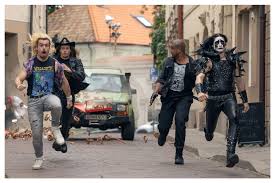
The band’s name is Impaled Rektum, which is pronounced “Im-PALL-ed” Rectum in Finno-English.

“The Most Brutal Metal Band in the World” didn’t make it big in Norway after their “Heavy Trip” from Finland to the land of herring eating A-ha fans. But they caused so much chaos and destruction that they landed in prison.

Ah, but this is a Norwegian prison, famed for “the best seafood buffet in Scandinavia,” for its spa and its pussycat of a warden (Mats Eldøen), whose goal is “a prison people will WANT to come to.”

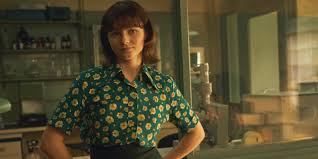
But hardcase head guard Dokken (Helén Vikstvedt) won’t let lead singer Turo (Johannes Holopainen), Dave-Mustaine-worshipping guitarist Lotvonen (Samuli Jaskio), easily-triggered drummer Oula (Chike Ohanwe) and metal purist/KISS cosplaying bassist Xytrax (Max Ovaska) play their “symphonic apocalyptic reindeer-grinding, Christ-abusing, extreme war pagan Fennoscandic metal” behind bars.

When a promoter by the Satanic name of “Fisto” (Anatole Taubman) dangles a spot at Europe’s biggest metal festival, Wacken, they’re tempted to escape. When Lotvonen’s family is about to lose their reindeer slaughterhouse, that cinches it. They need the money.

Impaled Rektum make a break and do what needs to be done to get to Vilnius, then Rostock — “the smell of fish and PILSNER” — and eventually Wacken, with Mephistophelian Fisto changing the nature of their “deal” every stop along the way.

There’s nothing supernatural about the “evil” promoter, which is kind of the joke. They’re all just…evil. Make your deal with the Devil and get on with it.

They’re pursued by the fanatic prison guard for stealing her beloved camo-green ’96 Jeep Cherokee “Armando.” They stow away on the tour bus of metalheads Blood Meter and their artificially-deep-voiced singer Rob (David Brendin), a band that “was” the biggest thing in metal. For a minute.

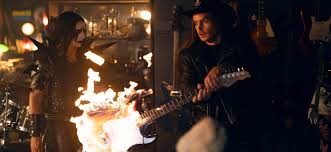
Impaled Rektum stumbles into and torches a metal memorabilia shop and museum in Rostock where one can see Lou Reed’s liver, Dio’s ashes and Jimi’s eternally-burning Stratocaster.

Mr. “That’s not metal enough” bassist Xytrax, who changed his name from “Pasi” in the first film, will hear a J-pop girl group’s take on metal music and be smitten…and compromised.

And lead singer Turo will be tempted by Fisto to leave the band and set up as a growl-shouting solo act.

The jokes start in prison — a guard who begs them (in English, mostly, with some subtitled Finnish) as they escape, “Don’t forget to RATE us,” the endless Metallica references, the chest tattoo quoting what Dave Mustaine thinks of your opinion about his guitar solos, the “metal” makeover they get when they sign on the dotted line.

Some gags work, some don’t. The band is “just one concert from being the biggest thing in music,” and the movie about them is about a dozen jokes from being as funny as the supposedly-serious documentary “The Story of Anvil.”

The first “Trip” film is daffier, with sillier world building — long haired metalheads in rural redneck reindeer herding country. This time there’s no potential love interest, no finding  “our sound” from the noise of a reindeer grinder (a laundromat dryer serves that purpose here), no dead end jobs —  just a Norske prison to flee.

Yeah, I’m cranking up “Heavy Trip” on Tubi to see what possessed them to take another stab at this material. Because if there’s a music genre more thunderously tone-deaf to how funny their mania, mores and rituals are, I’ve never heard of it.

Fennoscandic, apocalpytic reindeer-grinding? Totally there.

Rating: unrated, violence (comic), some profanity

Cast: Johannes Holopainen, Samuli Jaskio, Chike Ohanwe, Max Ovaska, Helén Vikstvedt, David Bredin and Anatole Taubman

Credits: Scripted and directed by Juuso Laatio and Jukka Vidgren. A Doppelganger release.

Running time: 1:36
Posted in Reviews, previews, profiles and movie news | Tagged , , , , , , | 1 Comment

Classic Film Review: Looking for Lean Laughs from “Blithe Spirit” (1945)

The shifting sands of editor-turned-director David Lean‘s career took him through early adaptations of Noël Coward scripts, included some definitive adaptations of Charles Dickens and eventually settled on the sweeping epics which is he best known for today — “Bridge on the River Kwai,” “Lawrence of Arabia” and “A Passage to India” among them.

One thing he was never known for was having a flair for comedy. Romances (“Madeleine,” “Doctor Zhivago,””Summertime”), sure. Casting Alec Guniness produced smiles here and there, but aside from the intermittently amusing “Hobson’s Choice,” Lean never made much effort to film “funny.”

But as Noël Coward was Lean’s champion and mentor, putting him behind the camera (with Coward co-directing) “In Which We Serve,” letting him adapt his play “This Happy Breed” and pitching in with rewrites for “Brief Encounter,” only Lean would do if Coward’s witty drawing room comedy “Blithe Spirit” was to be put on the screen.

Lean’s initiation to filming in Technicolor was such an ordeal that he dove into Dickens adaptations in black and white after “Blithe Spirit.” Technicolor had its own “consultants” on set in films using their cameras and film stock, lighting and relighting and slowing film productions to a crawl so that every Technicolor movie would look as perfect as “The Wizard of Oz” or “Gone with the Wind.” That’s no way to make comedy.

The film’s star, Rex Harrison, returning from years of military service, wasn’t sure he was up to being funny again. It kind of shows, as does his belief that Lean knew nothing about how to film comedy.

If you’ve ever seen the play on the stage, you know how hard it is to keep it moving and the witticisms landing. A 2020 film remake with Dame Judi Dench and Dan Stevens merely reminded one of how dated and musty the material, an upper class British ghost story, can be.

But in ’45, Margaret Rutherford reprised her antic stage portrayal of the “professional” medium Madame Arcati, and Kay Hammond repeated her droll and devious stage turn as the ghost of the first wife Elvira, even though Coward wanted Myrna Loy for the big screen version. The befuddled, rushed maid (Jacqueline Clarke) was a stand-out from the Broadway production of the play and came home to take the film role.

And the famed Coward wordplay crackles throughout, putting everyone on their toes, especially Harrison.

“If you’re trying to compile an inventory of my sex life, I feel it only fair to warn you that you’ve omitted several episodes. I shall consult my diary and give you a complete list after lunch.”

That line, censored from the American release of the film, was pretty racy stuff for 1945, as was the play, with its louche treatment of infidelity, the sexual attraction of one’s first wife and the like.

“Get me to bed, Charles. Then we can talk in peace.”

“A thoroughly immoral suggestion. You ought to be ashamed of yourself!”

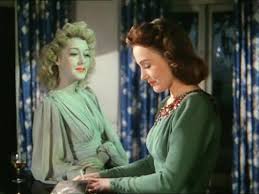
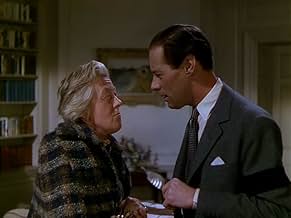
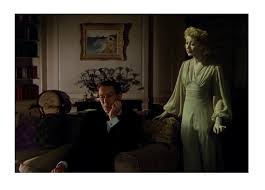
The ghost of a fondly-remembered but faithless ex-wife (Hammond) is summoned up in a seance arranged by novelist Charles (Harrison) looking for material for his new book. His second wife (Constance Cummings), their doctor friend (Hugh Wakefield of “The Man Who Knew Too Much”) and the doctor’s wife (Joyce Carey) are present as Madame Arcati (Rutherford) recites her incantations and makes the table they’re gathered around thump and rise.

But only Charles sees the spirit — a vision in green makeup and ethereal light. Only Charles hears her come-ons, insults and insinuations.

“I’m pained to observe that seven years in the echoing vaults of eternity have in no way pared your native vulgarity.”

That might derail his current marriage, and with Elvira considering other options — pranks and worse — to get her husband back and have a little “fun.”

All the extra care in production design and getting the color lighting right shows. “Blithe Spirit” is a beautiful film. The Oscar-winning effects (the film’s lone Academy Award) are state-of-the-art pre-digital in-camera trickery and hold up beautifully.

And truth be told, after a stodgy, stagey start, “Blithe Spirit” finds its footing, gets up a head of speed thanks to Rutherford, Hammond and Clarkes, and finishes with a flourish.

But one can’t help but figure Lean learned his lesson with this somewhat lumbering outing.

He moved on from Coward and made his mark in period pieces both intimate and on a grand scale. And if ever Lean felt his film needed a lighter touch, he’d cast Alec Guinness, even in blackface (“A Passage to India”), to achieve that effect.

Rating: “approved,” TV-PG (innuendo)

Cast: Rex Harrison, Constance Cummings, Kay Hammond, Hugh Wakefield, Jacqueline Clarke, Joyce Carey and Margaret Rutherford.

Credits: Directed by David Lean, scripted by David Lean, Ronald Neame and Anthony Havelock-Allan, based on the Noël Coward play. A General Film Distributors/United Artists release on Tubi, other streamers.

Running time: 1:38

Posted in Reviews, previews, profiles and movie news | Tagged , , , , , , , | Comments Off on Classic Film Review: Looking for Lean Laughs from “Blithe Spirit” (1945)

Movie Preview: Why make a “live” (CGI) action “Lilo & Stitch?”

Back in olden times, Disney would re-release its animated classics — in theaters, in new video and digital formats — every few years so that new generations of children could discover as parents who grew up on the films introduced their kids to a great memory from their youth.

Granted, they went about as far as they could go with that make-more-money-off-already-produced “intellectual property.”

But this nonsense of remaking “The Lion King,” et al with CGI and “real” settings is head-slappingly cynical, even by “We really need content for the ‘family’ audience in the second quarter” bottom-liners’ standards.

Pixar, Dreamworks, Illumination and Disney Animation have been market-testing their way into a “no new ideas” corner for years — sequels and prequels, each more exhausted than what preceded them.

With audiences slow to respond to the unfamiliar — the charming book adaptation “The Wild Robot” has taking forever to catch on and make money — the inclination is to play it safe — “Minions: The Next Generation,” “The Lion King as a Cub,” etc.

So here we are, remaking a sweet, funny, beautifully-animated action comedy, the high water mark of Disney’s long-closed Feature Animation Florida studio, a film that was a hit when it came out, that spawned a sequel, a TV series and theme park attractions.

May of next year “Lilo & Stitch” is reborn.

Posted in Reviews, previews, profiles and movie news | Comments Off on Movie Preview: Why make a “live” (CGI) action “Lilo & Stitch?”

Movie Preview: A Hardnosed Brazilian History Lesson about Surviving Fascism — “I’m Still Here”

As America abandons the rule of law, the Constitution and common sense in the thrall of a fascist traitor and his Moscow and mob-allied lackeys, the great Walter Salles has just the film to warn the rest of us of what we’re in for.

Posted in Reviews, previews, profiles and movie news | Comments Off on Movie Preview: A Hardnosed Brazilian History Lesson about Surviving Fascism — “I’m Still Here”

Movie Preview: Long live “Wallace & Gromit: Vengeance Most Foul”

The grand old man of “Wallace” voicing fame, and British TV, before he became a voice-acting icon — Peter Sallis — passed away in 2017 just a few years shy of reaching 100.

The Wallace & Gromit filmmakers decided against any AI recreation of his quizzical, comically querullous tones and recast him to revive this long running series of misadventures of a smart dog and the puttering Cockney who shares his life with him. Ben Whitehead fills those comfy shoes now.

Lenny Henry‘s the biggest “name” (the one I recognize) in this voice cast.

“Vengeance Most Foul” premieres Jan. 3 on Netflix, the perfect home for Aardman’s bespoke animated marvels.

Posted in Reviews, previews, profiles and movie news | Comments Off on Movie Preview: Long live “Wallace & Gromit: Vengeance Most Foul”

Netflixable? British doctors invent IVF, facing protests and attacks as they do — “Joy: The Birth of IVF”

Well-cast, well-acted, sentimental and plucky, “Joy: The Birth of IVF” is an encouragingly upbeat account of the labors, trials and attacks endured by the intrepid British team that set out to find “a cure for childlessness.”

It’s a story of science practiced by pioneers and science misunderstood or just plain mischaracterized by those who misunderstood it. And in this case, at least, the smart people got their way and were vindicated and lionized for it.

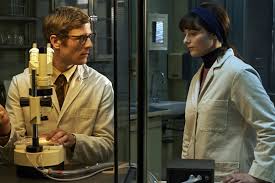
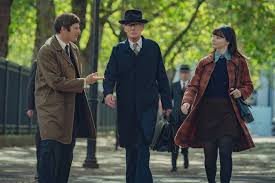
The script smartly shifts the focus from the two men lauded for pioneering pioneered IVF — Patrick Steptoe (Bill Nighy) and Robert G. Edwards (James Norton), who outlived Steptoe and became the sole recipient of the Nobel Prize for this research — to to the single, qualified and contributing childless woman, Jean Purdy, who ran the lab that carried out the study, testing and impregnating.

Thomasin McKenzie brings this not-wholly-forgotten figure to life, a loner by choice and an enthusiastic young researcher who faced shunning by her mother, her church and her community for taking part in experiments the scandal-mongering British press likened to “Frankenstein.”

Jean, a nurse and embryologist, answers an ad for a lab manager with biologist/physiologist Edwards, and having the knack for capturing escaped lab mice gets her the job. As Edwards has spent the late 1960s experimenting with fertilizing mouse, rabbit and hamster eggs outside of the body, and gynaecologist and laproscopy pioneer Steptoe was pushing for less invasive laproscopic procedures for retrieving ova, they team up to begin working on IVF, in vitro fertilization — in an outbuilding of an older hospital in remote Oldhman.

The “forming the team” scenes are testy and amusing, with career outsider Steptoe not suffering colleagues of any sort gladly, Edwards close to pleading and the brash Purdy trying to shame Steptoe into signing up with insults about how no one likes him, anyway.

The script has the three seeing the future, as such screenplays often do — “You’re aware they’ll throw the book at us — the church, the state, the world. We will unite them all against us.”

But Jean sees things different.

“The mothers will back us.”

The film tracks through the glacial pace of shifting public opinion, lopsided televised debates with Nobel Prize-winning DNA pioneer James Watson (Nicholas Rowe of “Young Sherlock Holmes”) pushing his version of common sense alarmism about “abnormalities” in such babies and what would be done about that. The science establishment trots out “overpopulation” as an argument for not funding them.

Tanya Moodie plays the stern head nurse/matron who reminds one and all of what they’re fighting for, in a hospital that performs legal abortions and is working on a “cure for childlessness.”

“We are here to give women choice. EVERY choice.”

Director Ben Taylor, working from a Jack Thorne screenplay, leans into “cute” a tad too hard, playing up the spunky flirt Purdy, the crusty Steptoe and the unscrupulous, knee-jerk press’s excesses. The filmmakers underscore “test tube baby” failures with the “No no no no no no” song (“Nobody but Me”), a swimming outing by “The Ovum Club” (women who agreed to participate in the experiment) with Loudon Wainwright III’s “The Swimming Song” and a moment of trial-by-error success with Lee Dorsey’s original version of “Yes We Can Can.”

When Lesley Brown (Ella Bruccoleri) received the first successful fertilized ovum transplant in ’78, I was shocked SHOCKED that they didn’t use “Knees Up Mother Brown” to musically memorialize the moment.

But cloying tendencies aside, “Joy” is a welcome feel-good movie about science, a “Hidden Figures” for IVF and the sort of movie a lot of people will take comfort in as the world’s anti-science ignoramuses, anti-vaccine rubes and anti-“expert” opportunists control most of the media megaphones these days.

Cast: Thomasin McKenzie, James Norton, Tanya Moody, Rish Shah, Joanna Scanlan, Nicholas Rowe and Bill Nighy.

Credits: Directed by Ben Taylor, scripted by Jack Thorne. A Netflix release.

Running time: 1:55

Posted in Reviews, previews, profiles and movie news | Tagged , , , , | Comments Off on Netflixable? British doctors invent IVF, facing protests and attacks as they do — “Joy: The Birth of IVF”

Movie Preview: Pixar’s “Elio” just wants “to be abducted by aliens”

Hard to get much of a take on what this outer space kids’ adventure will offer. Looks cute. The name choice seems odd, “Elon” odd. But who knows where writer and co-director Adrian Molina’s head was when he was scripting it?

June 13, “Elio” touches down at a cineplex near you.

Posted in Reviews, previews, profiles and movie news | Comments Off on Movie Preview: Pixar’s “Elio” just wants “to be abducted by aliens”

Classic Film Review: Hitchcock’s first take on the dainty and deadly “The Man Who Knew Too Much” (1934)

The earliest signs that the filmmaker would one day to be branded as “The Master of Suspense” in Alfred Hitchcock’s 1927 silent classic “The Lodger: A Story of the London Fog.” But it took the advent of sound, and several outings with the new technology, for him to discover that thrillers could and should be witty fun.

“The Man Who Knew Too Much” (1934) has a lot of ways of showing its age. For a picture that opens on a Swiss ski slope and climaxes with an assassination attempt at the Royal Albert Hall, it’s awfully soundstage-bound. Everybody on set under-reacts to every fright and act of violence they witness or are threatened with. The “fight choreography” of the day is downright dainty.

But it is devilishly funny, such as in the ways an indulged, privileged child (Nova Pilbeam) almost gets people killed and then finds herself kidnapped, with her parents not allowed to let the world know this.

Those parents — played by Leslie Banks of “The Most Dangerous Game” and “Jamaica Inn” and Edna Best (also seen in “The Ghost and Mrs. Muir”) — seem almost relieved.

“Whisky and soda?”

It’s as if the murderous mastermind (Peter Lorre in his first English-speaking role) is wasting his breath on these Brits with his warning, “You should learn to control your fatherly feelings.”

But this daffy, amusing thriller was a template for many a Hitchcock classic to follow, and not just the 1956 remake where he had Doris Day sing for her missing child. An exotic location or two, violence in a theater or very public place, ordinary people entangled in an extraordinarily sinister plot, police who are of little use or outright impediments to justice and a blonde who either drives the action of delivers the coup de grace became as much a part of the Hitchcock brand as his already-established “cameos” and Hitchcockian twists.

St. Moritz is where we meet the Lawrences, “Captain” Bill (Banks), precocious daughter Betty (Pilbeam) and target-shooting champ Jill (Best), who is spending entirely too much time with the French ski jumper Louis (Pierre Fresnay).

“You can KEEP your Betty,” she jokes. “I’m off with ANOTHER man!”‘

She and that other man are on the dance floor when the shot is fired, from a distance and through a window. Louis seems almost embarassed by this turn of events as he is the first character to sink, ever-so-slowly, to the floor, mortally wounded.

There’s a hidden note that Bill must retrieve from Louis’ hotel room, leading to a lot of fuss from the German Swiss authorities. Because Bill and Jill have gotten their own note that warns them they’ll never see their daughter again if they turn over what they’ve procured to British authorities.

Jill’s slow, crumpling faint at reading this is silent cinema silly, drawn-out by design.

The couple returns to London without their little girl, which draws official attention, and not just from the coppers. The foreign office is onto them and wants what Louis wanted to pass on.

Dash it all, there’s nothing for it but for Bill to start his own investigation, based on the note, with his man Sinclair (Hugh Wakefield) in tow.

Sinclair will endure hyponitism, a tooth-pulling from an underworld dentist and arrest for his friend. Bill starts to put this all together when he sees that sniggering Euro-fop Abbott (Lorre) whom he met on the slopes and the sharp shooter (Frank Vosper) who bested his wife in skeet shooting in Abbott’s company.

Comic misunderstandings give way to genuine suspense as that dentist whips out his picks and laughing gas, Betty cries in fear on the phone and Abbott makes threat after threat to avoid having his carefully-planned — right down to the Royal Albert Hall concert crescendo meant to cover the sound of the shot — assassination attempt exposed.

“Tell her they may soon be leaving us. Leaving us for a long, long journey. How is it that Shakespeare says? “From which no traveler returns.” Great poet.

“The Man Who Knew Too Much” was the start of a legendary English-language (and Hollywood) career for Lorre, who was freshly-fled from Nazi Germany when he met Hitchcock, was cast and then learned to speak English for this role.

Hitchcock’s motto that “Good villains make good thrillers” served Lorre wonderfully in a string of classic films, including “The Maltese Falcon,” “Casablanca,” Hitchcock’s “Secret Agent,” “Mad Love” and hilariously sending up his screen image a decade after “Man Who Knew Too Much” in “Arsenic and Old Lace.”

“The Man Who Knew Too Much” trots by in a brisk hour and sixteen minutes, with clever turns and cleverer turns of phrase. Viewed now, it feels like a rough draft for the better thrillers Hitchcock would direct, starting with the crackling “39 Steps” mere months later.

But it remains a primer on thriller scripting, plotting, staging and editing, a movie Hitchcock was wise to return to after his mostly melodramatic and serious early Hollywood outings, a master filmmaker hittting his witty stride in the 1950s, where he gave us “Strangers on a Train,” “To Catch a Thief,” “Vertigo,” “Dial M for Murder,” “Rear Window” and his lightest, deadliest triumph, “North by Northwest,” most of them variations on the bag of tricks he first opened in “The Man Who Knew Too Much.”

Rating: “Approved” (TV-PG), violence

Cast: Leslie Banks, Edna Best, Peter Lorre, Frank Vosper, Hugh Wakefield, Nova Pilbeam and Pierre Fresnay.

Credits: Directed by Alfred Hitchcock, scripted by Charles Bennett and D.B. Wyndham Lewis. A British Gaumont release, a Corinth-restoration on Tubi, Amazon, et al.

Running time: 1:16

Posted in Reviews, previews, profiles and movie news | Tagged , , , , | Comments Off on Classic Film Review: Hitchcock’s first take on the dainty and deadly “The Man Who Knew Too Much” (1934)

Netflixable? Denzel’s sons open up August Wilson’s “The Piano Lesson”

Denzel Washington furthers his efforts to keep his promise to “do right by” the late, playwright August Wilson by producing another film of one of Wilson’s plays, this one he assigned to his sons, actor John David Washington to star in and director Malcolm Washington to film.

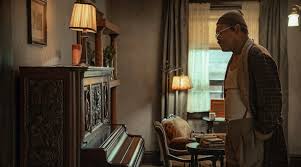
“The Piano Lesson,” already the subject of a fine and far more brisk TV movie 30 years ago built around Charles S. Dutton, Alfre Woodard and Courtney B. Vance, earns a stately and cinematic treatment from the Washingtons, with Danielle Deadwyler, Ray Fisher and Samuel L. Jackson fleshing out the leads.

The limitations of the stage demand that poetic word images to tell the story — anecdotes, reveries, backstory and events of the past recalled in the fictive present. Wilson excelled at this, with this Pulitzer Prize-winning masterpiece relating the experience of the African American diaspora via the story of how an old, slave-decorated upright piano made its way from Mississippi to 1936 Pittsburgh.

For his feature directing debut, Malcolm Washington “opens the play up” by showing us those past events, visualizing the supernatural element of the play — the piano’s white owner’s ghost “wants it back” — and making much that was mystical, magical and metaphorical literal in the process.

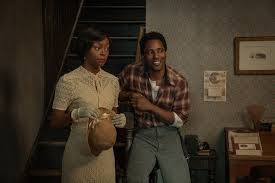
We don’t have to imagine the fraught circumstances of how the piano was stolen in 1911 or the truckload of watermelons Boy Willie (John David Washington) and his truck-owning pal Lymon (Ray Fisher) have hauled to Pittsburgh’s Black neighborhoods for a lucrative sale in 1936.

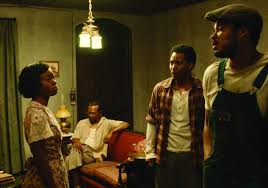
Boy Willie is there to visit his sister Berniece (Deadwyler) and Uncle Doaker (Samuel L. Jackson). And he’s there to talk Berniece into selling that heirloom piano to raise the last of the cash he needs to buy a chunk of the very land their family was once enslaved on.

Old Man Sutter, last of his farming line in that part of Mississippi, has died. “Fell into a well,” Boy Willie crows. It’s the “Yellow Dog Ghost” at work, a bit of supernatural karmic revenge visited upon the morbidly obese old racist for a lynch mob he headed twenty-five years before.

If Boy Willie can just buy that land… At least Uncle Doaker seems to get it.

“As long as Sutter had it, he had us. We was still in slavery.” 

Berniece, whom we learn is widowed, isn’t selling that piano.

“Money can’t buy what that piano cost!” 

Uncle Doaker gets that, too. But he wonders about the “bad luck” that hangs over that keyboard. And their kin, the blues singer-songwriter and drinker Wining Boy (Michael Potts, terrific), sees the instrument as a curse that needs to be banished.

Berniece has a would-be suitor, the Pastor Avery (Corey Hawkins) and a little girl. Is that piano holding her back? The preacher thinks so.

“Everybody got stones in their passway. You ain’t got to carry them with you.”

But through Boy Willie’s storytelling, bargaining and pleading and Berniece’s blunt rebuffs, we pick up on the rift in their relationship and the weight of violence on African American families, then and now.

To my tastes — I’ve seen the play a couple of times, and the 1995 TV movie — director Malcolm Washington gets too caught up in the literal and loses track of the allegorical nature of the events of the play. The words do the work here.

We can duck into a jazz club where the lads try their hands at winning the attention of local ladies as a vocalist croons “Don’t You Feel My Leg,” a ‘sexy ’30s blues tune made famous in the ’70s.

But “opening up” a claustrophobic play tends to undercut the emotional, oppressive weight of the remembered family history, memories that haunt generations and literally close in around characters as the play progresses.

So “Piano Lesson” isn’t as moving, gripping, immersive and polished as “Ma Rainey’s Black Bottom” or “Fences,” two prior Wilson adaptations to make it to the screen.

Our first time director slows the proceedings to a crawl at times, as lively “new” elements in the script make the many conversations and negotiations seem more static. But that doesn’t ruin the show.

And even though I’ve been slow to warm to Denzel’s other “nepo baby” son, John David, as an actor, he summons up the garrulous, not-thought-this-through essence of Boy Willie. Here’s a man a little too anxious to unload a family heirloom that has blood on it, a man who may have blood on himself.

The playwright Wilson sometimes spoke of the meaning of his shows sneaking up on him. And that gives filmmakers a bit of leeway in adapting his work.

The Washingtons have revived an American classic and given it new currency by serving up a visual and visceral taste of the oppression this diaspora fled the Deep South to escape, oppression which scarred such families for generations, and from the looks of things, for generations to come.

Rating: PG-13, profanity, violence, racial slurs, alcohol abuse

Cast: John David Washington, Danielle Deadwyler, Ray Fisher, Michael Potts, Corey Hawkins and Samuel L. Jackson

Credits: Directed by Malcolm Washington, scripted by Virgil Williams and Malcolm Washington, based on the Pulitzer Prize-winning play by August Wilson. A Netflix release.

Running time: 2:06

Posted in Reviews, previews, profiles and movie news | Tagged , , , , | Comments Off on Netflixable? Denzel’s sons open up August Wilson’s “The Piano Lesson”

Movie Preview: Ving Rhames is the trainer who can teach aspiring boxer Luiii the “Uppercut”

Jordan E. Cooper and Joanna Cassidy are also in the cast of this “Girlfight/Million Dollar Baby” drama.

But who exactly is this Luiii? The first person I can find on the interwebs with that one word name is a singer who is the wrong gender for the accented Luiii who wants to be a boxer.

If German actress Luise Großmann wants to bill herself with a single made-up name, she’d be better served coming up with something different. Because Luiii is taken.

“Uppercut” lands or misses its punches Feb. 28

Posted in Reviews, previews, profiles and movie news | Comments Off on Movie Preview: Ving Rhames is the trainer who can teach aspiring boxer Luiii the “Uppercut”