


How might a moviegoer in 1949 have responded to Danny Kaye in the musical version of Gogol’s “The Inspector General?”
Watching it anew, my hot take is “It’s a Marx Bros. musical with Kaye trying to play all four Marx roles” — trying, it’s pretty obvious, entirely too hard.
Blame it on the over-exposure to “White Christmas” as a child, the fact that I distinctly remember being consistently disappointed by broadcasts of Kaye’s classic comedies on TV as a kid, and throw in the legions of tales about what a trial he was to work with, serve, deal with on an airliner or simply meet (Google “Danny Kaye” and “nasty” or “jerk”), but I never warmed to the patter-singing “Court Jester” of his era.
But here’s a Technicolor musical comedy, one of several tailor-made for his talents, capturing Kaye at his peak. “Inspector General” is quintessential Kaye, with mistaken identity, pratfalls and mugging, slapstick and tongue-twisting tunes.
“An Inspector General generally inspects, that is, they expect him to inspect generally, if they’re expecting an Inspector General. But an exceptionally generous Inspector General who made an exception and had no inspection would cause suspicion which in my condition I couldn’t except…”
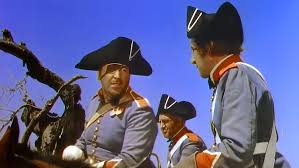
Kaye is Georgi, a performing assistant in the “magic elixir” hustling Roma (Gypsy) Yakov’s (Walter Slezak) sideshow, traveling Napoleonic Europe in the months after the Battle of Austerlitz. Georgi isn’t heartless enough to play their con to the hilt, which starts a riot and sees only those two among their traveling company escape.
And Yakov doesn’t need the “illiterate millstone” that dead-weight Georgi represents. The starving redhead is soon on his own.
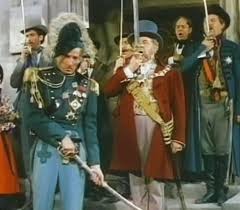
But the corrupt-to-the-core town of Brodney, where every member of the extended family of the mayor (Gene Lockhart) and constable (Alan Hale) is on the payroll and on the take, has gotten word that The Emperor has sent an Inspector General to survey and assess the communities of his new empire. And public stealing, pilfering, robbing from the poor to make yourself rich can get “your neck stretched.”
This Inspector General travels in disguise, learning a town’s open secrets, like the funds raised to buy a new organ for the church that disappear, as does the organ (“It caught fire!”). Paranoid, the collection of character actors playing the town’s inbred ruling class keep an eye out.
That’s how they confuse the starving stray Georgi for a Napoleonic envoy. They wine and dine him, and once Yakov has stumbled into this case of mistaken identity, they bribe Georgi (at Yakov’s suggestion).
The not completely innocent Georgi think he and Yakov are righting a wrong, but Yakov is no Robin Hood. “Grab everything for yourself” is his motto.
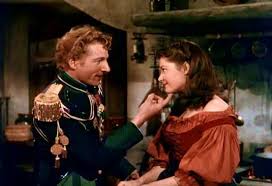
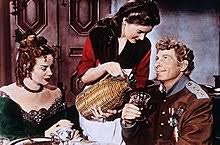
The mayor’s daughter (Elsa Lancaster) sets her cap for the uniformed official who simply must spend his time in Paris and Vienna. But the Inspector General takes a fancy for the proletarian serving maid, Leza (Barbara Bates).
With the town plotting ways to either buy him off or cut his throat, and with Yakov playing the angles so that he doesn’t have to share the looted spoils of their bribery, Georgi barely has time for courting and singing a few tunes, much less for plotting an escape.
There’s a reason Henry Koster isn’t a directing “name” we remember from the era, and that Warner Bros. wasn’t known for musicals. “The Inspector General” looks like what it is, a Technicolor tuner that looks like a Western, because they cut corners on already-standing sets and over-filmed, dusty Southern California settings.
The picture has no pace, at least partly owing to the fact that Technicolor filming was still more cumbersome and static than tracking shot/crane shot inventive
But Kaye throws himself at the material, the movie, the supporting cast and the viewer, all while taking care to never miss his marks. Alas, the dancing and shtick are largely earthbound in the set-piece song and dance numbers, shot entirely on soundstages.
Bits of physical comedy — playing a dismembered but still living “thanks to Yakov’s Magical Elixir” head, a peasant’s problems pulling a sword out of a scabbord, contending with a misbehaving water fountain — play as too puerile to pull off.
The songs, by Sylvia Fine (Mrs. Danny Kaye) and Johnny Green can be amusing in the moment, but there’s not a memorable tune in the lot, even the show-stopping patter number “”Arrogant! Elegant! Smart!”
Kaye enjoyed a long career, turning out many a comedy in the ’40s and ’50s, starring in a TV variety show in the ’60s and achieving “beloved” status thanks to re-runs of his kid-friendly films on TV, his charity work and the occasional twinkling cameo in films and on TV (“The Cosby Show”).
But “The Inspector General,” like “The Court Jester,” “The Secret Life of Walter Mitty” and “Hans Christian Anderson,” fails to make the case for a Danny Kaye revival. If he lives on, it’s thanks to that last generation to grow up on “White Christmas” reruns, even if they’re unable to sell their grandkids on that shiny, stodgy and sentimental song-and-dance nostalgia.

Rating: G
Cast: Danny Kaye, Walter Slezak, Barbara Bates, Alan Hale, Gene Lockhart and Elsa Lancaster.
Credits: Directed by Henry Koster, scripted by Philip Rapp and Harry Kurnitz, inspired by the play by Nikolai Gogol. A Warner Bros. release on Tubi, Amazon, other streamers
Running time: 1:42



