Box Office: “Maze Runner” finally vanquishes “Jumanji,” “Hostiles” opens wide, but not that well

boxThe tide of YA sci-fi franchises has ebbed, but “Maze Runner” has just enough in it to wash “Jumanji” out of the top spot at the box office, which it has owned since “The Last Jedi” did it’s huge opening and steep fade.

“Maze Runner: The Death Cure,” a Fox series which is now a Disney franchise as the Mouse bought out the Fox, finishes off its trilogy with a pop, if not a bang. A $24 million or so opening on a movie they threw a lot of action and production values at isn’t great, but isn’t terrible.

That’s enough to ensure Universal’s “Jumanji: Welcome to the Jungle” reboot is off the top of the heap. Universal’s “Fifty Shades Whatever” will open and take over the top spot next weekend. “Jumanji,” for those keeping score at home, is already over $336 million by weekend’s end, and will make up some ground on the going-going-gone “Last Jedi” over the next month ($610 million for that one).

“The Shape of Water” picked up the most Oscar nominations Tuesday and is benefiting by finally having a big weekend. It’s nudged ahead of Oscar contender “Three Billboards Outside Ebbing, Missouri” as of this weekend, though both are clinging to the fringes of the top ten, back to back. $37 or so each. See “Three Billboards,” if you missed it. “Shape?” See what all the fuss is about. Maybe, like me, you’ll scratch your head over that fanboy fave. 

“The Post” and “The Greatest Showman” are doing well enough to suggest that they’re audience favorites that Oscar ignored, among the supposed contenders. “Showman” will have earned $150 million, when all is said and done. Not bad for an original musical written for the screen. Very good, actually. Hugh Jackman should have been nominated for this or “Logan,” no doubt about it.

Movie theater chains AMC and Regal decided that Hollywood proper wasn’t supplying them with content that brings in Red State America, so Entertainment Studios was born, which will release old white conservative red meat like a “Chappaquiddick” movie about Ted Kennedy’s darkest hour, a godawful “Sharknado” looking “Hurricane Heist” (a “Hard Rain” ripoff — effects heist picture) and this weekend, “Hostiles.”
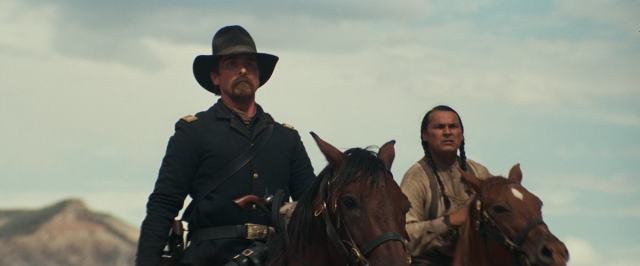
hostiles1It’s a grim, bloody and slow Western starring Christian Bale and Rosamund Pike and Ben Foster and has opened very very wide, to a $10 million reception and passable reviews. Not from me. Most critics saw this on a DVD “for your consideration” screener, and apparently took a lot of bathroom/snack/phone scrolling breaks that made it fly by. I sat in the theater muttering for Bale to stop mumbling and for all involved in this Scott Cooper bore to “Get ON with it. And remember to RELOAD your six-shooters (they don’t).” Anachronistic politically correct speechifying, a noble turn by Wes Studi, and two hours and 14 minutes in a genre I love, and I was bored out of my non-scalped skull.

“12 Strong” and “Den of Thieves” both opened as well as they were going to and have fallen off 50% or so their second weekend. January isn’t typically a month for major releases, just Oscar holdovers and the odd dumped action or horror title.
 

Posted in Reviews, previews, profiles and movie news | Comments Off on Box Office: “Maze Runner” finally vanquishes “Jumanji,” “Hostiles” opens wide, but not that well

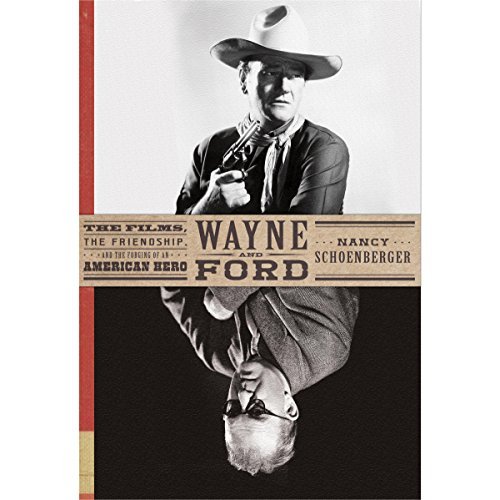
Book Review: A dilettante’s guide to “Wayne and Ford: The Films, The Friendship and the Making of an American Hero”

wayne.jpg

The last line of “True Grit” is, “Come see a fat old man some time,” as John Wayne jumps a fence and rides off into the sunset, one more time. It’s a piece of movie lore, well-known by any Western film fan.

In Nancy Schoenberger’s “Wayne and Ford: The Films, the friendship and the forging of an American Hero,” the line is “Come see a fat old man ride.” Coming as it does late in a book built on two (apparent) interviews and a whole lot of other folks’ scholarship, where such errors of hearing, interpretation and analysis are not uncommon, you might wonder how this William and Mary academic dilettante (A co-written George Reeves bio, Liz Taylor book, more her speed?) ever got a contract to write this far out of her element.

There’s good stuff in here, all of it reported and written by her predecessors, though I had not read the reasons for Ben Johnson’s falling out with the bullying, self-loathing drunk with bisexual tendencies Ford, or the extent to which Wayne threw his weight around in his last major pictures, “The Cowboys” and “The Shootist,” “protecting” his co-stars.

Schoenberger takes Wayne’s (and wife Pilar’s) side on his explanation for dodging the WWII draft and Peter Bogdanovich’s side about Ford’s closeted sexual urges. Personally, if Maureen O’Hara says she walked in on “Pops” making out with Tyrone Power, I believe it.

I do wonder if Wayne’s films with Hawks and Hathaway aren’t always under appreciated and Ford’s a bit oversold, but the history is what it is and Wayne certainly saw Ford as the Big Man in his life.

The best one can say for Schoenberger, who quotes critics no one has ever heard of (academics like herself, and Kael), is that she summed up a lot of others’ great work in just 200 pages.


Posted in Reviews, previews, profiles and movie news | Comments Off on Book Review: A dilettante’s guide to “Wayne and Ford: The Films, The Friendship and the Making of an American Hero”

Movie Review: Jingoistic “12 Strong” lets Bruckheimer re-write 9/11 history


HS-005894.RAF

Jerry Bruckheimer, Hollywood’s leading “chickenhawk” producer since the Ronald Reagan “Top Gun” era, starts his latest movie militaria with a quick history lesson.

“12 Strong” is about Green Berets sent into Afghanistan to start the process of dismantling the Taliban and by extension Al Qaeda, so showing the first attack on the World Trade Center (a truck bomb) and news footage of the U.S. embassies in Africa attacks and the U.S.S. Cole assault is fair game as context.

Unnecessary, but fair.

Stick Bill Clinton’s face on the TV, if you’re of a mind. And then, show us Vladimir Putin recalling his telephone warning to “my friend,” George W. Bush, days before 9/11. Which Bush didn’t do much with, as he was on vacation. Again.

Sorry to point this out, but this propaganda was shoved onto the front of the movie for a reason.

Maybe director Nicolai Fuglslig insisted on that (I’ve never heard of him either), but the whole montage feels like a blatant attempt to shift the blame for a colossal blunder away from the colossal foul-up who vacationed his way into letting it happen, George W. Bush.

Like Eastwood, Bruckheimer knows his audience, and he’s blatantly pandering to them from the start, rewriting history to fit their Fox News twisted point of view. That doesn’t utterly sour this swashbuckling version on the rare bit of good news to come out of Afghanistan during Bush’s tenure. But it makes you question almost every thing you see afterwards, “true story” claims be damned.

  Chris Hemsworth is the young Captain Mitch Nelson, untested by combat and about to start a desk job, allowed to re-assemble a team to lead the first American assault on the failed state that provided safe harbor to Osama bin Laden and Al Qaeda. He convinces his commanding officer (Rob Riggle) to let him get “the band back together,” which means putting a “stop loss” on his retiring sergeant (Michael Shannon) and getting the men who trained with him (Michael Pena, Trevante Rhodes, Geoff Stults, Thad Luckinbill, Austen Hebert, Austin Stowell, Jack Kesy, Kenneth Miller, Kenny Sheard, Ben O’Toole) back in the fold and into the field.

Nelson is smart enough to see the “big” combat picture, which convinces Col. Mulholland (William Fichtner) that he’s the guy to go in, meet up with the Northern Alliance, joining their fight against the Taliban and coordinate American air power to crush those who sheltered America’s enemies.

As the men say goodbye to their womenfolk, Nelson is given a talisman, a piece of the shattered World Trade Center, to carry into battle.

He and his men joke about the longer-than-long odds, “dying with their boots on,” singing “The Ballad of the Green Berets” as they fly into battle. Upon arrival, they hole up in a village the CIA nicknamed “The Alamo.”

“You know everybody died at the Alamo, right?” Might be best to keep that to yourself.

But it’s in-country that “12 Strong” loses some of that Bruckheimer swagger (some) and gets real. It’s a delicate situation, with tribal rivalries and blood feuds that pre-date the Russian invasion there, decades before.

Their liaison, the militia General Dostum, played with flinty flourishes by Navid Negahban of TV’s “Homeland.” Damned if he doesn’t get most of the movie’s best lines, a Pashtun speaking poet who “tests” Nelson, sizes him up and decides he’d rather deal with grizzled Sgt. Spencer, a combat vet with “the killer eyes.”

“Your mission will fail because you fear death…You have the sky, but wars are won in the dust!”

The rules of engagement are, to say the least, a little weird.  Nelson wants confirmation they’re attacking the Taliban and not some other militia before calling in an airstrike Dostum gets on the walkie talkie and trash-talks the murderous, hawk-nosed Taliban leader (Numan Acar).

“Razzan! Son of a dog! The Americans will kill you!”

There’s a brisk, headlong ferocity to the combat scenes as the Americans prod the outnumbered but brave alliance fighters into following their strategy, seizing small strongholds on the way to taking the linchpin town that will let the whole of northern Afghanistan fall to create an American staging area for the main invasion.

The firefights are vigorous video-game shootouts with tanks, rocket launchers and heavy machine guns where legions of the enemy fall and our guys don’t. Which actually happened. The concussive impact of the air raids will shake you in your seat, even as they feed the military myth of the “surgical strike.”

There are cavalry charges, communication breakdowns and a Donald Rumsfeld press conference, reading a situation report live to a compliant press.   strong1

Most of us are a little too jaded or at least sober-minded to swallow this at face value. Carefully limiting the “history” you tell gives the impression of competence, quick victory and a short war.

  “12 Strong” is “We Were Soldiers” in Afghanistan, accurate, flag-waving and intentionally and myopically incomplete. The picture ends before Bush lets bin Laden escape the country, leaves out the Bin Ladens allowed to flee the U.S. after 9/11, and glibly ignores the years-long hunt it took to bring the 9/11 leader to “Zero Dark Thirty” justice.

We’ve seen too much “real news,” too many documentaries and too many better films to swallow this heartland agitprop at face value. Bruckheimer can “remember” this any way he sees fit. And I guess remaking “13 Hours” (at Benghazi) was off the table.

2stars1

MPAA Rating: R for war violence and language throughout

Cast: Chris Hemsworthy, Michael Shannon, Navid Negahban, William Fichtner, Michael Pena, Rob Riggle

Credits:Directed by Nicolai Fugslig, script by Ted TallyPeter Craig . A Warner Brothers release.

Running time: 2:10

Posted in Reviews, previews, profiles and movie news | Comments Off on Movie Review: Jingoistic “12 Strong” lets Bruckheimer re-write 9/11 history

Movie Review: Christian Bale mounts up to chase “Hostiles” in the Old West

hostiles1

“Hostiles” is a funereal, downbeat Western conjured up by a filmmaker with only a passing acquaintance with the genre.

Interminably slow of foot, filled with static, anachronistic and politically correct sermons performed in a whisper, with bloody-minded outbursts interrupting the beautiful scenery photographed like a cut-rate cable TV movie, it is an utterly inept outing from the director who got Jeff Bridges his Oscar.

I love this genre, perhaps more than any other. Hell, I’m reading a new John Ford/John Wayne director-and-his-muse biography right this minute. Any movie with horses, Comanches, sagebrush and six-guns is right up my alley. And while there’s a lot to be said for genre-busting entries in the horse opera vein, I caught myself hating Scott Cooper’s muddle of a movie, more often than not.

The conventional “Searchers” opening depicts an Indian raid, a remote New Mexico farm family slaughtered for their horses. Rosamund Pike plays Rosalie Quaid, who sees her husband scalped and children gunned down right in front of her, including the baby she cradles in her arms. She alone survives, traumatized until the movie abruptly decides she isn’t.

Christian Bale is Cavalry Captain Joe Blocker, about to muster out, a veteran Indian fighter who has absorbed much of the savagery of his “uncivilized” foes. We meet him as his troop brutally drags Apache escapees back to the fort where they were being held prisoner.

His commanding officer (Stephen Lang) may tolerate it, but the sneering, elitist Harper’s Weekly reporter/photographer (Bill Camp) who inexplicably sits in on the CO’s meetings mocks Blocker for his savagery and inhumanity. That’s the set-up for Blocker’s “final” assignment. He’s to take an aged, cancer-riddled Indian chief (the great Wes Studi) “home” to Montana to die.

“That cutthroat,” Blocker hisses.

“That’s an order,” from President Benjamin Harrison, the CO barks back.

“I’m afraid I ain’t obeyin’ it.”

Of course he is/he will. But what we’ve just seen is the most insubordinate exchange in the history of cavalry movies, one that grates as much as the “You know Wilks here, from Harper’s Weekly,” introduction.

That’s followed by Blocker assembling an idiotically composed unit to escort two Apache warriors (Adam Beach of “Flags of Our Fathers” is Chief Yellow Hawk’s son), a daughter, daughter-in-law and a son. A captain commands a green West Point lieutenant (Jesse Plemons),  old comrade sergeant (Rory Cochrane) and African American corporal (Jonathan Majors) and a single, Quebecois private (Timothee Chalamet). Boy, the hierarchy in that only leaves one, maybe two soldiers to do all the work.

hostiles2

They “rescue” Rosalie from her burned cabin, endure ambushes, kidnappings, alterations in their mission (Bale’s “3:10 to Yuma” co-star Ben Foster is a deserter to be escorted back to fort) and a lot of blood-letting, all to get this “cutthroat” and his family from New Mexico to Montana. You know at some point that the shackled natives will have to be freed to save the racist troopers, the one hoary Western convention writer-director Cooper makes sure to honor.

Studi, a regal screen presence since “Dances With Wolves” and “Last of the Mohicans,” acquits himself with honor, though everybody speaking the Cheyenne tongue used here (Q’orianka Kilcher of “The New World” plays his daughter-in-law), including Bale, sounds out the words so slowly as to make one look for the cue cards.

Bale’s performance is dialed down so low his anachronistic “Deadwood” F-bombs barely register through his period-perfect mustache. Pike delivers gulping, gasping shock at the traumas visited upon her, which her character abruptly forgets the minute she gets a change of clothes at Fort Winslow, Colorado. Chalamet (an Oscar nominee for “Call Me By Your Name”) has a French Canadian accent that comes and goes at will.

And Cochrane stands out in the rest of the cast via his mannered, tic-ridden, eyes-shifting line readings, hamming one usually has to visit a community theater to enjoy.

But it’s Cooper’s script that screams “No Researchers Needed” at every turn. Col. Biggs (Lang) warns them to get underway before “the monsoon.” In New Mexico.

One and all speak of Custer as if they knew him. Foster’s character and Bale’s have history, remembering the free-fire slaughter of the Wounded Knee Massacre as “those were the days.” President Benjamin Harrison, who gave them their “Release Yellow Hawk” orders, took office a year before Wounded Knee, and only served one term. So, um, how long ago were those “good ol’days?”

A cardinal sin of such movies is staging a shootout featuring a hail of bullets where nobody re-loads. Such as what we see here.

And if the greatest Western of them all, “The Searchers,” was only two hours long and Eastwood’s “Unforgiven” was just over that, how come Cooper can’t get through his Western gambol in under 2:14?

Oh, right. When nobody involved has any sense of urgency about their mission, when every few moments somebody feels the need to stop and SLOWLY expound on “We took their land from them” and the like, when one and all have to quickly change their socio-ethnic worldview over the course of the picture, your movie quickly outstays its welcome. And then some.

1half-star

MPAA Rating: R for strong violence, and language

Cast: Christian Bale, Rosamund Pike, Wes Studi, Stephen Lang, Ben Foster, Michael Beach, Q’orianka Kilcher

Credits:Written and directed by Scott Cooper. An Entertainment Studios release.

Running time: 2:14

Continue reading

Posted in Reviews, previews, profiles and movie news | 5 Comments

Movie Review: Bocelli learns to sing “The Music of Silence”

music4


The writer and director of “Il Postino” turn their hands to the life of the world’s most popular tenor, Andrea Bocelli, in “The Music of Silence,” an old fashioned, corny film hagiography that may please the most ardent fans, who will be more tolerant of its lax pacing and high cheese content.

It’s based on Bocelli’s autobiographical “novel” of the same title, in which he tells his life story through that of Amos Parti, an alter ego who was also born blind, encouraged to love music and further encouraged to pursue it as a career until, Voila!, he is discovered and becomes famous.

The tale is loosely framed within Bocelli telling his life story, via email, backstage before a concert. That frame is more or less abandoned as the tale tediously unfolds, losing our interest long before its first truly magical moment.

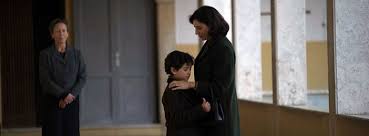
We see his overjoyed Tuscan tractor-salesman father (Jordi Molla) shout “A boy! A boy!” as he abandons a possible sale on hearing the news of Amos’s birth, the mother (Luisa Ranieri) who insists something’s wrong with this baby who will not stop crying.

The doctors suggest it’ll take “a miracle” to let little Amos see, and many operations later, he’s at least able to go to boarding school. A stint as goal keeper (he can see blurred shapes) gets him smacked in the head, and that’s that.

As he grows up, an indulged child (his brother seems to get short shrift), Amos asserts his will, that he will need “no help” (he does) to get through school and into law school, that he won’t accept the sorts of jobs people like him take in the Italy of the 1970s.

“I’m not interested in jobs blind people do — telephone operator, masseuse, musician.”

But an adoring uncle (Ennio Fantastichini) introduces him to opera, the late “genius” Beniamino Gigli, and the child shows an aptitude. He stands out in the school chorus, wins talent shows, doing Neapolitan favorites like “O Sole Mio” and singing “Ave Maria” at weddings.

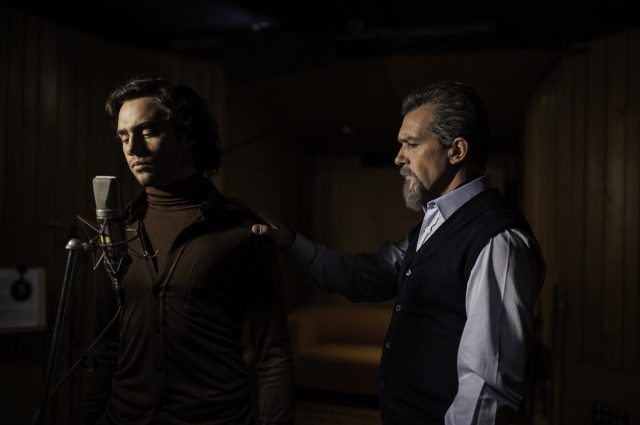
Every big break — the guitar-player who encourages him to co-write pop songs with him, the maestro (Antonio Banderas) who takes him on as a voice student — is highlighted.

“Do you have a girlfriend? Good. Maybe she can appreciate the boring and extremely difficult person you will become after my training.”

It’s that maestro who teaches the smoking, drinking, lounge-singing blind man to protect his voice and to appreciate “silence,” as if a 30something blind adult wouldn’t already know that.

music1

All along the way, beautiful women are smitten by Amos, including the one (Nadir Casselli) who supports him through his second roughest patch. That would be when fame is dangled in front of him, and snatched away. The tougher moments? When his voice changed and the boy soprano had no sense that he would ever come back from that.

Michael Radford cast mostly Italian actors for this Italian TV co-production, and the English language version has them (a few Spaniards tossed in) muscling through heavily-accented English. That should have paid off better, but it lends a comically overwrought tone to every cornball line, as if Father Guido Sarducci was the on-set voice coach.

The first moments that take one out of the movie are when we’re supposed to be enraptured by the boy’s voice, and truthfully, it’s nothing special. Frankly, I’d have tightened-shortened the whole childhood half of the film. As pretty as scenes of boys playing soccer in the snow with a can (Amos can hear it and track it to kick it) or the Tuscan scenery or sequences of Amos driving a Vespa (a friend helps steer) might be, they drag.

The first hair-raising bit of movie magic comes in a club called “Boccacio ’70” (after the Fellini/DeSica film based on “Decameron”), when the lounge-singing Amos  (Tony Sebastian, handsome but bland) is joined, on stage, by an opera singer helping a friend celebrate her birthday. They launch into a lyric opera duet that sends chills.

The plummy, playful Banderas arrives in the third act, too late to lift the picture but not too late to liven up the perfunctory last steps Amos/Andrea takes up that ladder to fame.

Remember “Miserere?” That’s the operatic pop song that made Bocelli famous. Remember the 1950s bio-pic “The Great Caruso?” That, unfortunately, is the singer’s story model Radford hewed to when filming this. “Ray” would have been a better primer.

When Amos’s father apologizes, “I used to call you an idiot,” we wonder why that genuine conflict wasn’t in the film. The singer/auto-biographer doesn’t want to poor-mouth those close to him, and only half-heartedly finds villains in the producer who declares “You will NEVER be a singer!” and the opera critic who notes “Your voice lacks extension, power, color” to sing opera.   Which critics say about the real Bocelli to this day.

Bocelli’s is a triumphant story, even if it isn’t as amazing when you realize how far a blind child from a family of wealth and culture can go with their support, and even if his popularity doesn’t convey the “greatest singer of his day” label his fans want him to wear.

“Music of Silence” can be forgiven all that, but not the generally bland performances and picturesque but dull way his story is told.

1half-star

MPAA Rating: unrated, adult situations, smoking

Cast: Toby Sebastian, Luisa Ranieri, Jordi Molla, Antonio Banderas, Nadir Caselli

Credits:Directed by Antonio Banderas, script by Anna Pavignano and Michael Radford, based on Andrea Bocelli’s book. An Ampi release.

Running time: 1:55

Posted in Reviews, previews, profiles and movie news | Comments Off on Movie Review: Bocelli learns to sing “The Music of Silence”

Another “Pacific Rim” trailer, for those who get excited for this sort of thing

Think I’ll go re-watch “Dunkirk,” myself. But enjoy!

Posted in Reviews, previews, profiles and movie news | Comments Off on Another “Pacific Rim” trailer, for those who get excited for this sort of thing

Preview: Le “Super Troopers 2” features le Brian Cox and Rob Lowe

Here’s the redband trailer for the “sequel” lots of frat houses cried out for, a “Super Troopers” tale for you trigger-happy “Blue Lives Matter” Americans. A Canadian town is found to be on U.S. soil, meaning a crew of Troopers must Americanize it, and Mounties must Quebec their way into Vermont.

Something. I’m sure the plot is like, mega-important. Looks manic and random and comes our way in April.

Posted in Reviews, previews, profiles and movie news | Comments Off on Preview: Le “Super Troopers 2” features le Brian Cox and Rob Lowe

Razzies Nominate another “Fifty Shades,” Jennifer Lawrence, Tom Cruise and “Baywatch” as the year’s worst

mother2The Golden Raspberry nominations for the worst in cinema of 2017 are out, and Darren Aronofsky’s “Mother!” is the surprise entrant.

I mean, Tyler Perry, “Fifty Shades Darker” and “Baywatch” are just bad movie fish we can shoot in a barrel, right? Another “Transformers” (this one pulling down 9 Razzie nominations), and another “Fifty Shades” are no brainers.

“Pirates of the Caribbean” may seem like fair game (not really), but Emma Watson (“The Circle”)? Wahlberg and Gibson for “Daddy’s Home 2,” Javier Bardem (“Mother!” and “Pirates”) and Kim Basinger (“Fifty Shades Darker”) are among the acting lowlights.

Kicking Tom Cruise for “The Mummy” seems mean, as “American Made” was so damned much fun (and Oscar ignored).

Tyler Perry recognized as an actress? That’s novel.

The full list of infamy is here. The full list of infamy is here. 

Posted in Reviews, previews, profiles and movie news | Comments Off on Razzies Nominate another “Fifty Shades,” Jennifer Lawrence, Tom Cruise and “Baywatch” as the year’s worst

Netflixable? Nicolas Cage can do better than “Looking Glass” these days

glass3

When you’re keeping to a movie a month schedule the way Nicolas Cage is, it’s a bit too much to expect every indie outing to be another “Mom and Dad” (January’s dark delight) or the current buzz of Sundance, “Mandy.”

Veteran Cage-watchers know that the vast bulk of the Oscar winner’s output these days, outside of killer cameos in major studio releases, is comprised of Netflix or VOD filler.

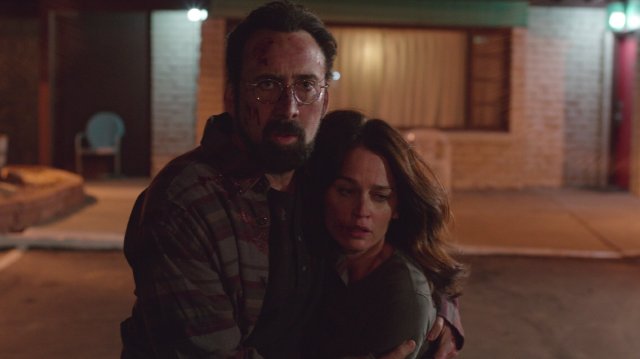
That’s where “Looking Glass” fits into the Cage filmography. It’s a run-of-the-mill paranoid thriller set in a remote motel where Cage, as “Ray,” starts to believe everybody’s out to get him. Because pretty much everybody is.

Nothing supernatural to see here, just a desert southwest chance for Ray and Maggie (Robin Tunney) to “start over.” They need it, for reasons that become clear as the story unfolds.

Or unravels. Because the moment Maggie chirps, “This all feels really good to mem Ray. I think we’re going to be real comfortable here,” Ray starts to have his doubts.

The “regular” customers at the Motor Way Motel give him the willies. The service station across the street is run by the menacing desert cousins of those “Deliverance” Georgians. The old owner of the motel, who fled the moment Ray’s check cleared, cannot be reached.

And there’s this crawl space behind the rooms. At every stop along its path, a one-way mirror is attached to the room’s wall. The creep inside the crawlway can watch truckers and hookers and the local dominatrix ply her trade. They all have their favorite rooms.

Before you know it, Ray’s the creep in question, peeping in on all kinds of “Twin Peaks/Blue Velvet” perversions.

When the guest of one of the paying customers turns up dead on the evening news, Ray is alarmed. Because he knows she was there, and the only way he could know that is if he was checking out her naked activities in Room Six.

So telling the busybody cop (veteran character actor Marc Blucas) is out of the question. Howard the sheriff seems awfully sure that Ray is in touch with the former owner, and that he’s been told…something.

Confronting the dominatrix only gets him in trouble, and a warning.

“You know, the more you watch, the less you feel.”

A dead pig in the pool, a cop asking more questions, somebody knows something and Maggie is both in the dark and in danger, thanks to Ray’s predicament.

Tunney is stuck playing a wife rendered unstable by whatever brought them there and Ray’s role in that. And Cage does a tamped-down version of his Everyman-We-Watch-Come-Unglued, as Ray.

Director Tim Hunter (“River’s Edge”)  has been around long enough to know something about creating atmosphere and mystery. The formula for pictures like this set us up to root for Ray as he faces a town of “Straw Dogs,” hostile locals who know his motel’s dirty secrets, who think he knows them and are determined to keep him quiet and compliant.

The wife is she who must be saved/protected/rescued from those locals.

“Looking Glass” drifts from that formula, but finds nothing that compelling to take its place. Cage is never less than interesting to watch, even in the worst movies, and this is far from that. But Ray is amped up, disturbed and yet passive at the same time.

Some scenes pack a punch (literally) and that sense of doom hanging over it all shows up here and there. But “Looking Glass” fails to be anything more than another make-work project for the cinema’s busiest actor, a man with bills to pay and a conviction that the Devil finds work for idle hands.

It’s just that sometimes, it’s better to leave those hands idle than to take whatever the next offer you can squeeze in might be.

1half-star

MPAA Rating: R for sexual content, violence and language

Cast: Nicolas Cage, Robin Tunney, Marc Blucas

Credits:Directed by Tim Hunter, script by  Jerry RappMatthew Wilder. An eOne/Momentum release.

Running time: 1:44

Posted in Reviews, previews, profiles and movie news | Comments Off on Netflixable? Nicolas Cage can do better than “Looking Glass” these days

Movie Review: Singers bring the healing power of music in “American Folk”

folk2

Strangers, thrown together for a cross-country road trip is how a thousand romantic comedies got their start.

In “American Folk,” they’re both singers, more compatible on the surface than most road comedy couples. Their genre? The vanishing strummed Americana of folk music.

But the kicker is the timing of this trip. The reason they’re driving from California to New York is their flight was canceled. All flights were canceled. Their quest, to sing their way across America and maybe find a connection comes during some of the nation’s darkest hours, the days immediately after 9/11.

Writer/director/editor David Heinz gives us a road picture of sweet anecdotes, kind encounters and little conflict, an America with its rough edges rubbed off. And indeed the country could seem that way in those hours and days right after Islamic terrorists attacked us. Without a little friction, though, your movie is going to flirt with nostalgia and sentimentality, as even a romance needs obstacles to overcome to work.

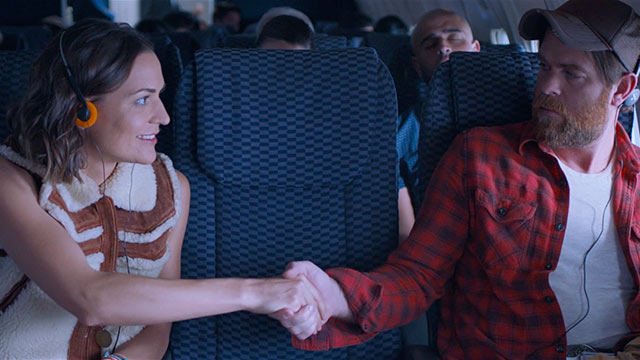
Singer/songwriter Joe Purdy plays Elliott, struggling to finish a song about “This Old Guitar,” apparently unaware that John Denver covered that territory with a song by that title back in the last century. He’s a bit of a grump, insulated from the world by his CD player and headphones on the plane.

It’s just his luck that Joni (singer/songwriter Amber Rubarth) sits next to him. She’s open-faced and open-hearted. When she unplugs his earphones to add a splitter so she can listen with him, it’s presumptuous in the extreme. She makes the gesture charming.

Their abrupt return to LA throws them together, first for a cab ride — the cabbie turns off his meter — then to the A-frame (a “Folk Music” house if ever there was one) where Joni was staying, and finally into an ancient Chevy van full of another and’s gear that they’ll drive to New York where he has a gig and she has a sickly mother.

He’s a professional, always picking away in the passenger’s seat. Her interest and talents only come to light when she starts singing along. She knows the same tunes, “Freight Train” to “Shenandoah.” She can play a little, too. Their duets are lovely, natural.

When an urchin in Arizona asks “Where’s your wife?” Elliott is flummoxed.

“She’s not my wife.”

“Why not?”

“I don’t know.”
folk1

Heinz takes them on the blue highways, off the interstates, as Elliott and Joni experience their first van breakdown, their first duet, and their first fight (kind of forced into the story).

He’s most at home making the case for what folk music used to be, the music of American troubadours like Pete Seeger, Odetta, Joan Baez and John Prine, played to appreciative crowds that joyfully sang along to songs everybody knew.

“It’s kinda not like that any more,” Elliott laments. Then we’ve got to “bring back the Folk,” Joni declares. “Stupid terrorists!”

But in this brief respite, when “everybody’s kind of looking out for each other,” we can’t help notice that none of their encounters, in filling stations and honky tonks, with a comically disturbed hermit veteran who fixes their car in the desert, has the usual culture clash built into it.

They can play a little country, because country music grew out of folk and blues, and that keeps the peace. Except keeping the peace isn’t necessary. They’re accepted, at face value. Now, if they’d been black folk singers or an inter-racial couple traveling the rural Southwest and South…

Heinz has to introduce a couple of bubbly gay hitchhikers (Miranda LaDawn Hill and Emma Thatcher), a sort of inter-racial Indigo Girls, on their way to Bristol, Va. to “come out” to one girl’s parents, to give the film any edge at all.

The filmmaker labels, in bold block letters, every state the trek passes through, but doesn’t take time for any detours to the musical Americana at his fingertips in New Mexico, Texas, Memphis or especially Bristol, the birthplace of country music.

And he’s so hellbent on defying rom-com expectations that he cheats the picture out of some of its heart. When one good ol’boy (named Fargo) tells Elliott, “You don’t marry that girl, I will,” that’s kind of how we feel.

Heinz set out to make a sort of Hillbilly “Once,” but he and his cast don’t have the knack for generating romantic longing, the yearning that should drive the picture, with the “Kinder, gentler America” post-9/11 as merely its backdrop.

2half-star6


MPAA Rating:PG for thematic elements and language

Cast: Joe Purdy, Amber Rubarth, Krisha Fairchild, David Fine

Credits:Directed by, script by . A Good Deed Entertainment release.

Running time: 1:39


Posted in Reviews, previews, profiles and movie news | Comments Off on Movie Review: Singers bring the healing power of music in “American Folk”