“Mamma Mia 2?”

Well shucks, before this past weekend, I’d not given a thought that might be a sequel even in the works for the all-star, Greek location-filmed adaptation of that big, cheesy ABBA musical, “Mamma Mia.”

But you know, they barely cracked the ABBA songbook with the first film. And even though Meryl Streep NEVER does sequels, and Cher was supposedly retired, the gang’s all back for ouzo and good times in “Mamma Mia 2.”

Apologies if you saw the pirated version of this making the rounds of the Interwebs last weekend before Universal pulled them down. I did. Not that I’m all ABBA on the brain or anything. That’s my story, sticking to it, etc.

Sappy, not a laugh in the trailer. But we’ll see.


Posted in Reviews, previews, profiles and movie news | Comments Off on “Mamma Mia 2?”

Movie Review: “All the Money in the World”

money2

What everybody wants to know about “All the Money in the World” is if Christopher Plummer, plugged into the “villain” role when disgraced star Kevin Spacey was edited out, pulls it off.

Of course he does, with venomous, flinty flair.

Movies and performances in them are modular affairs, and even a big part like that of miserly millionaire J. Paul Getty can be replaced, a new actor slotted in for close-ups, a few recreated location shots and the occasional multi-player scene.

Heck, check out Plummer in “The Man Who Invented Christmas.” This was a no-brainer.

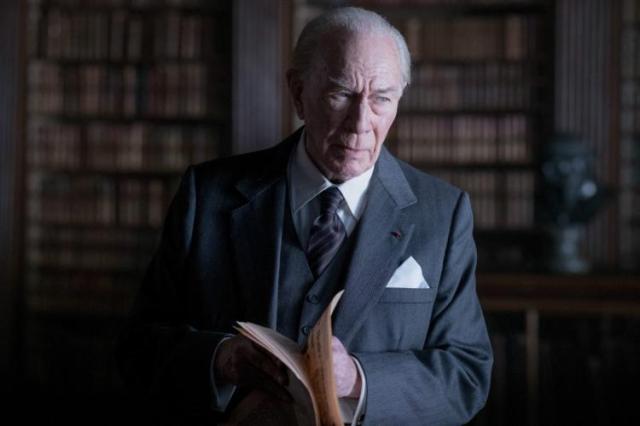
The great, Oscar-winning Plummer, who takes on hints of Ebeneezer in every villainous turn, makes Getty the greatest real-life Scrooge of them all. His Getty is an owlish, avaricious, cunning and cheap SOB not inclined to part with “MY money” — even for a kidnapped grandson and heir.

Ridley Scott’s thriller is about an infamous kidnapping in the even-more anarchic and corrupt of Italy of the 1970s. John Paul Getty III (Charlie Plummer, no relation) is a beautiful teen getting into all the trouble a lad with impulses and the means to indulge them could get into in 1973 Rome.

“Got home, don’t worry your mother,”  a hooker lectures him.

“I can take care of myself,” he sniffs. Yeah, that’s the very moment when he’s kidnapped. The Red Brigades, a terrorist organization, want $17 million for his return.

The trouble with that, we quickly learn and they (Romain Duris is their leader) never do, is that “Paolo” isn’t a teen “of means.”

“There IS no money,” his mother (Michelle Williams, brilliant) shrieks into the phone. Even though she might have BEEN a “Getty,” that’s long-past. Her ex is off, stoned out of his gourd, partying in Morocco with whores and Mick Jagger.

And Grandpa? He’s “the richest man in the history of the world,” ensconced in a vast English manor house, living like the Lord of Oil he is.

“Everything has a price,” in his eyes. “The great struggle in life is coming to grips with what that price is.”

How much WILL the man with “All the Money in the World”  pay for that grandson?

“Nothing.”

Scott, working from a David Scarpa script (based on John Pearson’s book about the Gettys and the kidnapping), paints a quick history of the family’s staggering wealth in broad strokes — ancient deals with the Bedouin of Saudi Arabia — and of Abigail Harris’s history with those same Gettys.

Gail (Williams) married an alcoholic heir (Andrew Buchan) estranged from a father who never made time for his family. Money was and remains J. Paul’s obsession. His few flashback dealings with his son, daughter-in-law and grandchildren are little life lessons in obscene wealth and what comes with it.

“To be a Getty is an extraordinary thing.”

He’s most intent, not on making more money (though he’s pretty intent on that, using the new OPEC cartel to make his holdings more valuable). The trick, he says, is “staying wealthy.”

“If you can count your money, you’re not a billionaire.”

A lot of Getty’s philosophy is imparted to the audience via  his chats with our surrogate in all this, Fletcher Chase, Getty’s ex-CIA “fixer,” a negotiator Getty hurls at every difficult deal or security matter in his empire. Mark Wahlberg gives this guy a compact confidence and easily-accessed cynicism as Chase takes the place of the ransom money, a “gift” from Getty to Gail who will retrieve her son for her.

Chase deals with the overmatched Italian police and the increasingly impatient kidnappers, who spirit young Paul to a semi-abandoned farm in remote Calabria, where the corruption runs deep and no local — cook or cop — can be trusted to do the right thing.

Months and months pass as the increasingly steely mother matches wits and will with a rich old man too cheap to pay for laundry service at the four-star hotels he sometimes visits, much less any ransom that would cut into his art collecting budget.

That time passage works against the picture’s “ticking clock” tension. We dread Paul’s fate, even if we don’t remember the history of how this all unfolded. It’s just that his fate comes at us in slow motion.

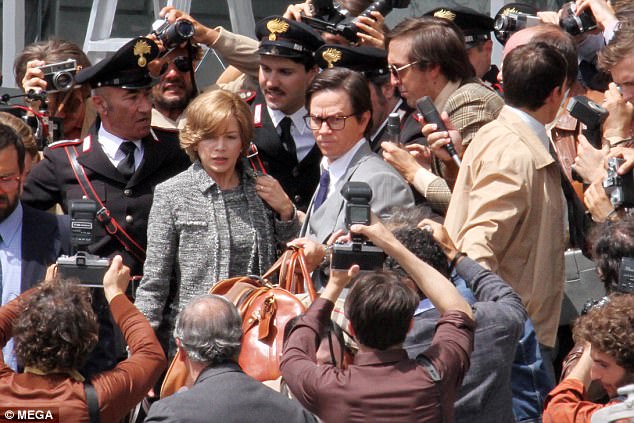
What Scott’s film does well is capture the near-anarchy of Italy in the ’70s, with violent paparazzi, terrorists and criminals run amok and a justice system straight out of a Third World country (It was a kidnapping capital long before Colombia and Brazil got into that game).
 

world

Williams amazingly transforms Gail from the faintly-patrician young woman who married into this empire into an impoverished but defiant negotiator whose accent has grown more posh and her spine stiffer, all from combat and interaction with the richest man on Earth.

Wahlberg, toned-down, underplaying it, still has one lay-it-all-out-there/tell-the-boss-off scene that feels far more Hollywood than realistic. It mars a near pitch-perfect performance.

But Scott and Plummer conspire to give us the ultimate portrait of greed, pettiness and the deep psychological holes in the souls of those obsessed with acquiring wealth and maintaining it.

I love the way Plummer gives us this side of the old man, his grandiloquent sense of self even when he’s being sentimental (in flashbacks) with the grandson he now refuses to ransom.

“You’re a Getty, Paul. You have a destiny.” 

One got a sense, from the early trailers, that Kevin Spacey’s take on Getty was sinister and somewhat the product of makeup. Plummer? He manages his avarice and villainy with nothing but a great performance.

It’s that disconnection from “The Real World,” that sense that “We look like you, but we’re not like you” that makes “All the Money in the World” feel so timely. As the super-rich seize, at long last, absolute power in America, they reveal just what this movie lays out for us — untrammeled greed, and a heartless calculus that allows the top tier of the One Percent to loot without conscience, to accept that the deaths of others are just a price they’re willing to shrug off to achieve that singular desire — “more.”

There have always been Gettys, and the world has always tried to rein them in. But it’s rare in our history that we’ve actually decided to surrender what little control we have over them so absolutely. Expecting anyone with “All the Money in the World” to maintain a conscience is the height of folly.

3stars2

MPAA Rating:R for language, some violence, disturbing images and brief drug content

Cast: Michelle Williams, Mark Wahlberg, Charlie Plummer, Romain Duris, Christopher Plummer

Credits:Directed by Ridley Scott, script by  David Scarpa, based on the John Pearson book. A Sony/Tristar release.

Running time: 2:12

Posted in Reviews, previews, profiles and movie news | 1 Comment

Movie Review — “Jumanji: Welcome to the Jungle”

jumanji

Welcome to “The Breakfast Club” goes “Big,” and gets trapped in Oz, also known as “Jumanji: Welcome to the Jungle.”

It’s a long, violent and jokey reboot of “Jumanji” re-set as a body-switch comedy, with teenagers stuck in a video game as avatars almost wholly unlike their “real” selves.

Right away you can see the advantages of this high concept commodity. You get to re-cast the teens, a quartet forced to do punishment duty cleaning out a high school storage room where they stumble onto and then are sucked into this antique (Late ’80s, early 90s?) video game.

So the lovelorn nerd (Alex Wolff) morphs into a game avatar hero, played by Dwayne Johnson, his towering jock ex-pal, Fridge (Ser’Darius Blain) is reduced to Kevin Hart “sidekick” status (“Where’s the REST of me?”), the sneering, unpopular smart girl (Morgan Turner) is transformed into a Lara Croft (Karen Gillan) bombshell (“Who dresses like this? In the JUNGLE?”) and the vapid, self-absorbed pretty girl (Madison Iseman) becomes the cowardly, “middle-aged” cartographer who looks like Jack Black.

“Where’s my PHONE?”

They’re stuck in a jungle-scape, with character “strengths” and “weaknesses” established,  clues given in rhymes and game levels to be reached on a quest to break a “curse” involving a magical stone, fending off wild animals, a villain (Bobby Cannavale) and his motorcycle-riding minions, all just to “get back home” and back to their real selves.

Clever.

It’s obvious, right on the surface, how that could work. The skinny boy transformed into The Rock, dazzled by his new muscle (listen for the little squeal of delight Johnson lets out upon checking out his pecs) but still a cowardly shrimp at heart, the emerging bully suddenly diminished to Hart’s perpetual “angry little man,” the beauty horrified at disappearing into Jack Black and in need of her first potty-break with a penis (“How do we DO this?”) and the smart wallflower suddenly possessing feminine wiles (Black’s “Bethany” gives her flirting lessons, hilariously).

But the shortcomings of this re-setting are just as plain. Dragging the supernatural terrors of a game into our everyday world is inherently a lot more interesting than hurling a bunch of grown up movie stars (and a scantily-clad starlet) into the game.

“Jumanji” is memorable for the kids trapped playing it overwhelmed when they unleash a tidal wave of monkeys on a house, or a stampede of rhinos on their town streets. Ground-breaking “real” effects let the digital rhinos crush real cars, destroy real houses.

“Welcome to the Jungle” has new and improved digital hippos, rhinos and jaguars, doing what they do in the jungle, but still obviously digital, with no “reality” reference point.

jumanji2

A quartet of screenwriters find a few funny things for Hart to say and Johnson and Gillan to act out. Black gets in touch with his feminine side. And there are a couple of nice “moments” thanks to character arcs that are Yellow Brick Road obvious — loner has to work with a team, narcissist has to learn to sacrifice, smart kid has to become brave and jock has to use his brain.

But the whole affair feels corporate, cooked-up-by-committee, surprising and entertaining only to tweens craving video game violence popped on the big screen and the titillation of a live-action bare-midriff/short-shorts heroine instead of the animated version “Tomb Raider” gives them.

By the time a Jonas Brother shows up, most of us will have checked out and started checking our text messages.

1half-star

MPAA Rating:PG-13 for adventure action, suggestive content and some language

Cast: Dwayne Johnson, Kevin Hart, Karen Gillan, Jack Black, Bobby Cannavale, Nick Jonas, Alex Wolff

Credits:Directed by  Jake Kasdan script by Chris McKenna, Eric Sommers, Scott Rosenberg, Jeff Pinkner . A Sony/Columbia release.

Running time: 1:59

Posted in Reviews, previews, profiles and movie news | Comments Off on Movie Review — “Jumanji: Welcome to the Jungle”

Movie Preview: “Gringo” Makes Fun of all That Could Go Wrong when Medical Marijuana Comes in Pill Form

When you think of the word “Gringo,” the first actor to come to mind won’t be the African actor David Oleyowo. I guarantee that.

But he’s the hapless representative sent to Mexico with the formula for a new “Medical Marijuana Pill” by um, South African bombshell Charlize Theron and Aussie troublemaker Joel Edgerton (Nash Edgerton directed it).

It might take South African Sharlto Copley to get him out. What do you think they’re saying with the casting here?

Amanda Seyfried’s also in it, and Thandie Newton.

Hey, it’s Amazon Studios. At least they aren’t wasting money on alleged pedophile and proven bomb-maker Woody Allen any more.

Posted in Reviews, previews, profiles and movie news | Comments Off on Movie Preview: “Gringo” Makes Fun of all That Could Go Wrong when Medical Marijuana Comes in Pill Form

So is there Actual, Real Pushback on “The Last Jedi?”

jediAs I was one of the first to pan the latest “Star Wars” film in the J.J. Abrams’ universe, “The Last Jedi,” comments on my review have revealed what seems to be a healthy level of discontent on this (thanks heavens) Death Star lacking, more visually dazzling, more expositionally confusing, more verbally clunky, increasingly diverse, increasingly wussy (Kill a principal or two, for Pete’s Sake!) franchise.

I thought little of it. Haters’gon’hate, after all. Critics know that. Sometimes, the critics are the haters (not this time, the cheerleading little dears).

But the blowback from fans who aren’t of the same mind has been ridiculously muted. I expected worse. You know, “You’re LYING, ‘Star Wars’ RULES! Rian for President!'” Stuff like that.

Because I got a lot of heat because I didn’t care for “The Force Awakens,” either, and find both of those “Skywalker” story continuances grossly inferior to “Rogue One,” which had cooler characters, better actors, noble sacrifice, higher stakes and genuine heart. Female heroine or not, it had balls. The J.J. “Wars” are so emasculated that it’s as if the whole affair has devolved into toy selling uber alles.

I thought little of it, even as commentors and others noted the lowering “audience review” scores and anecdotal complaints piling up on the Internet Movie Database (which links to Metacritic reviews, where it has a score of 85) and on Rotten Tomatoes (93% of critics endorsed it, relatively few fan reviews are agreeing).

Deadline.com says that those self-posted “reviews” can be gamed. There’s no guarantee the person actually saw it, and a complainer can post multiple times (that seems like a lot of trouble, and a flaw in those platforms’ review system). And that also sounds like Deadline is parroting Disney’s official “spin” on the reception of this money-minting operation.

Pieces of all sorts are turning up on the subject. 

It’s even got The Times of London running (stealing, as all British newspapers do) a story on it.

The only way to tell is if next weekend is on any sort of scale as the $220 million or so Disney collected on its investment opening weekend.

It’ll be Christmas, people will be off and have the time to take the family (if “Jumanji” doesn’t suck away a big chunk of that business).

And even if the most-interested fans have already been (more than once, in some cases), if they stop repeat viewing on weekend two, the numbers will fall precipitously. 

So we’ll see. Nothing against the studios making money hand over fist, but I have a hunch this blowback is a lot more real than Disney would like the general public believe.

And they’re stuck with Adam Driver, Daisy Ridley, John Boyega, that Asian character actress who made no impression, and a trying-too-hard Oscar Isaac.

Posted in Reviews, previews, profiles and movie news | 3 Comments

Movie Review: One of Modern Art’s Greatest Figures is remembered in “Beuys”

beuys1

The German sculptor, conceptual artist and performance artist Joseph Beuys once secured Japanese funding and legions of volunteers to help him plant “7000 Oaks,” each with a rough-hewn basalt obelisk at its base, in Kassel, Germany.

He wanted to contrast the unchanging permanence of the stones with the growing trees, “a living form of sculpture.”

Adding to the “Situationist” art of this years-long process, the basalt stones were kept in a pile in front of the city’s ornate, gilded-age Museum Fridericianum. Over those years, the pile shrank with each planting, and each planting, the artist proclaimed, was an act of “parking lot wrecking.”

Whatever you think of the various incarnations of modern art, that piece — combining invention, creation, organization, performance and politics — stands out, even if it is little known outside of serious art circles. At least part of that is because of the genius, showman/raconteur who created it.

Filmmaker Andres Veiel uses decades of Beuys TV interviews, profiles and good-natured if combative public debates for “Beuys,” his somewhat meandering and diffuse but still fascinating portrait of the unconventional artist, who died in 1986.

Professor Joseph Beuys was a World War II Luftwaffe veteran whose major combat wounds came when the Stuka dive-bomber he was tail-gunner in was shot down over Crimea. “A screw came loose,” he joked. “I was SHOT into shape.”

And with that, his myth began and he used to say, his art. The artist as poseur was not invented in the 20th century, but artists like Picasso, Warhol and Beuys, who created a fanciful tale of his survival from that crash involving Tartar healing, fat and felt, turned that into a lifetime of art, once this philosopher, lecturer, political activist and sculptor  became famous.

He used felt in installation after installation — felt curtains surrounding a piano, weathered board and thermometer in “Plight,” rolls of felt lashed to 40 tiny sleds tumbling out the back of a VW Microbus in “The Pack.”

And rarely was the man photographed or seen without a felt fedora or porkpie hat, part of a uniform that included a white shirt and ever-present vest, making him easy to pick out at his assorted “happenings.”

Not that you’d miss him. A practioner of the Picasso-perfected “Artist as a Character” school of branding, Beuys came to America for a show at the Guggenheim. For his “I Like America, and America Likes Me” piece, he showed up at an exhibition-space in an ambulance, rolled up in felt, which he unraveled to then interact, on camera (on film) with a coyote.

beuys2

In the scads of interviews sampled here (the only modern interview is with the British newspaper art critic who became his champion and his lover, Caroline Tisdall), Beuys, speaking German and occasionally English, resisted labels of every type, including “artist” but also more pointed jabs like “Don Quixote.”

If we think of “art” as more than “something you hang on your living room walls” today, it has a lot to do with Joseph Beuys. So his influence is undeniable.

If we think of “modern conceptual art” as mostly hype, filled with a lot of artistic explanation for “What I am really saying here,” we can thank Beuys for that, too.

“Beuys” isn’t a film that lays out, in simple, clear terms, what he and his work are about. But Veiel does manage to refresh our memories of Beuys, and let the man — in his own (subtitled) words, re-make the case that art is “a blow against the enemy,” a revolution.

And as he was the first to joke, back in the day, “I want to get my money’s worth out of this revolution.”

3stars2

MPAA Rating: unrated

Cast: Joseph Beuys, Caroline Tisdall

Credits:Directed by Andres Veiel. A KinoLorber release.

Running time: 1:46

Posted in Reviews, previews, profiles and movie news | Comments Off on Movie Review: One of Modern Art’s Greatest Figures is remembered in “Beuys”

Movie Review: Payne Wastes a lot of Talent in the Process of “Downsizing”

down1.jpg

You think about Alexander Payne’s other films, comic satires, a lot during “Downsizing.” You remember the political parody “Election,” the hot-button abortion comedy “Citizen Ruth,” the wine snob pretensions of “Sideways” and the pleasures of “The Descendants,” “Nebraska” and “About Schmidt.”

Because “Downsizing,” a bleak, over-reaching mangled mess of a satire, is none of those. Still, the inclination is to give one of our greatest directors the benefit of the doubt is strong.

It’s a sci-fi comedy about a future in which the logical solution to planet over-population, pollution and over-consumption of limited resources is to “get small.” Literally.

Payne’s getting at half the population, dimwits not “accepting” a coming climate crisis, at do-gooders who embrace the abstract “Save Humanity” vs. those smart enough to deal with hunger, pain and loneliness they see right in front of them. He’s ripping the “laziness” of affluence, and the indolence that settles in when working class folks are within reach of that big brass ring. And he’s puncturing any notion of a Utopian future. Class divisions and the working poor will always be “necessary” to pop up the idle rich.

And if all that sounds like an overreach, it is. Payne’s solution is to waste famous character players in bit parts in a tedious, detailed “history” of Norway’s discovery of this process (Do tiny Norwegians still kill whales?), the lengthy development of shrinkage from lab rats to people, the recruitment/timeshare style sales pitches to lure people to spend their modest savings, which multiply in scale so that they can “live like kings” once they’re five inches tall.

Matt Damon and Kristen Wiig are Paul and Audrey, a struggling couple we follow for years, working at frustrating jobs with too little pay — Paul, looking after his long-suffering (fibromyalgia) mom who wonders how this new discovery will make anybody better off.

“I’m in pain. I can’t breathe. Doesn’t that matter?”

Meeting his high school pal who got small (Jason Sudeikis) convinces Paul, and eventually Audrey, that there’s a better way. They’re not “saving the planet.” “You’re saving yourself.”

But Paul’s angst at a life of lost opportunities is greater than Audrey’s. She bails out on him, leaving her divorced husband in the enclosed, environmentally-controlled community of smalls called Leisure Town, to date dull women and endure the put-downs of his brusque but conciliating party animal/entrepreneur neighbor, Dason, played with his usual sadistically funny flair by Christoph Waltz.

Hong Chau plays an almost stereotyped Vietnamese refugee and village activist whose sing-songy bark “You stupid!” makes him re-assess his priorities.  Activists at that level worry about the small picture, not the big one. Her direct acts of kindness and her perspective dominate the second half of the movie. Her pidgin English is borderline racist.

Rolf Lassgard of “A Man Called Ove” plays the soulful Norwegian who invents this process and begins the “Downsizing” movement.

While I’m at it, I’ll mention that Sudeikis has virtually nothing to play, that Joaquin Almeida has a single scene and single line, as a scientist introducing the Norwegians, that James Van Der Beek plays a single-scene snooty anesthesiologist who went to school with Paul, that Margo Martindale has a single scene as a small reassuring Paul and Audrey that they’re doing the right thing, and that the great German actor Udo Kier plays Dason’s sad-eyed ship’s captain sidekick.

The waste here isn’t limited to the actors. Payne squanders the first hour of the movie with processes– showing the “science,” the vast team of salespeople (Neil Patrick Harris, Laura Dern) and medical technicians it takes to operate this vast new enterprise. We don’t just see Paul undergoing the shaving, enema, etc. to prepare for being small, we see a dozen extras go through it, too. It’s infuriating.

Every scene — the pointed and the pointless — goes on too long. No character is wholly motivated or explained, even the “Me love you LOooong time” stereotype Hong Chau has to play. No actor, save for the scenery-chewing Austrian Waltz, makes much of an impression.

After “Promised Land” and “Suburbicon,” this is the last movie Damon should have signed on for. Satire, even environmentally-oriented satire, hasn’t been kind to him.

But Payne at least has earned the benefit of the doubt, and the freedom to turn out a dud. Let’s hope he’s figured that out for himself.

2stars1

MPAA Rating: R for language including sexual references, some graphic nudity and drug use.

Cast: Matt Damon, Kristen Wiig, Christoph Waltz, Honh Chau, Jason Sudeikis, Rolf Lassgård

Credits:Directed by Alexander Payne, script by Alexander Payne, Jim Taylor. A Paramount release.

Running time: 2:15

Posted in Reviews, previews, profiles and movie news | Comments Off on Movie Review: Payne Wastes a lot of Talent in the Process of “Downsizing”

Movie Review: Hugh Jackman is “The Greatest Showman”

GSOE_D32_013117_9584.cr2

We used to call them “triple threats,” these wonders who walked among us. They could sing, dance and act, and do each equally well.

Gene and Debbie are gone, Shirley and Rita pretty much done with hoofing it. But Hugh Jackman, that “Boy from Oz,” is still belting, hoofing and emoting, a triple talent treat whose chief screen threat has come via a set of knives for knuckles.

If you’ve ever wondered why Jackman moved so fluidly as The Wolverine, what all that physical grace under the sideburns was about, that was your explanation.

“The Greatest Showman” is a Jackman screen showcase like no other. A fellow could get lost in the pageant of “Les Miserables,” take a back seat to the action in “Wolverine.” Not when he’s got the title role in a new musical, written for him and for the screen.

It’s about that first Hero of Hype, Master of Ballyhoo and High Priest of Publicity, P.T. Barnum. And for Jackman, no mere “Barnum” adaptation would do. This musical co-written by Bill Condon, who adapted “Dreamgirls,” and Jenny Bicks, who wrote for “Sex and the City” and “The Big C,” is more up to the minute in its themes, more up to the second in its “American Idol” era anthems.

If Jackman parlayed one last turn as “Logan” for Fox to get this made, more power to him. It’s not a great film, but musicals are all about big dreams, your grasp exceeding your reach, show-stoppers and foot-stompers. This is all that. I’ll bet Barnum himself would have approved.

“Showman” follows Barnum, a shoe-repairman’s son who dares to love above his station, and eventually marry that first love (Michelle Williams). But he doesn’t really find his niche until he spies his first “extraordinary” person, a “star” for his Manhattan “Museum” of “oddities.”

Meeting the dwarf he renames (and uniforms) as “General Tom Thumb” (Sam Humphrey) is a revelation.

“They don’t know it yet,” Barnum says of the paying public, “but they are gonna love you.”

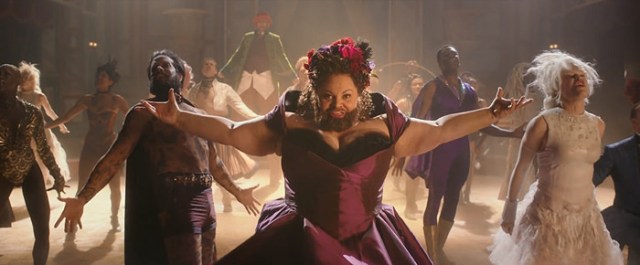
It’s a pitch he repeats to one and all, to the “Dog Boy,” the Siamese Twins and the Bearded Lady (Keala Settle, soulful as the heart of the piece). And it’s irresistible to the people he tells “They’re already staring at you. Why not get paid for it?” and to the paying public.

“Hyperbole isn’t the worst crime.”

As he recruits his menagerie, hypes and becomes famous for what a critic of the day dismissed as “a circus of humbug,” Barnum, his wife and his new “family” of performers sing about “A Million Dreams,” and a visit and revisit their anthem of defiance and acceptance — “This is Me.”

The tunes are from Justin Paul and Benji Pasek of “La La Land,” and lean a tad too heavily on the “anthem” thing, though I found “This is Me” thrilling and everything else a pleasant time-passer, much the way “City of Stars” stood out alone from the “La La Land” lullabies.

We watch the showman’s meteoric rise — entertaining Queen Victoria because “If you want to impress society, might as well start at the top!” — and fictional prescribed fall. The script soft-sells the “freak show” element, but faces head-on Barnum’s arms-length attachment to this “family” as he sought fame in polite society via the “legitimate” theater, partnering with the rich, semi-successful “legitimate” producer Carlyle (Zac Efron).

“I can’t just run away and join the circus!”

“Why not? “You clearly have a flair for show business.”

“There’s a show…business?”

“I just invented it.”

greatest2

The real Barnum got his start with “The Oldest Woman in the World” (she wasn’t) and lived long enough to have a notable career in politics. And that’s where the film’s story, of tolerance and acceptance ahead of its time, is on firm ground — fictionalized or not.

“A human soul, ‘that God has created and Christ died for,’ is not to be trifled with,” the real Phineas Taylor Barnum said. “It may tenant the body of a Chinaman, a Turk, an Arab or a Hottentot – it is still an immortal spirit.”

That statement’s as liberal and tolerant as any made by an American in public life in the late 19th century. It doesn’t matter that the movie ends before this corner of his extraordinary life is explored, that ethos — modern as it seems in the movie (most critics didn’t bother reading up on him), lends a little truth to all the “humbug.”

Art director and digital compositor turned first-time director Michael Gracey is in over his head here (Did being Australian get him the gig?). His picture lumbers along, with a very predictable love story (an inter-racial romance between Carlyle and a trapeze artist played by the singer Zendaya) and even more predictable is the “Great Man’s Downfall” in the form of an all-consuming tour by “the Swedish Nightingale,” Jenny Lind (Rebecca Ferguson).

But Gracey keeps the camera moving, whirling through the cast and the dance numbers, turning several into amusing, athletic “seduction” scenes — Barnum enchanting his wife, Barnum luring Carlyle into the business (a bar-top stomp), Carlyle reaching out for the tiny aerialist, Anne (Zendaya).

It’s not a brand-name musical, not newfangled and hip-hop based and politically edgy like “Hamilton.” But “The Greatest Showman” is, like the singing, dancing, versatile actor who stars in it, larger than life. And if this is the only screen musical we can get out of the last of his peak performing years, it’ll do. Hugh Jackman is too much the showman to promise any less.

2half-star6

MPAA Rating: PG for thematic elements including a brawl

Cast: Hugh Jackman, Michelle Williams, Zac Efron, Rebecca Ferguson, Zendeya, Keala Settle

Credits:Directed by Michael Gracey, script byJenny BicksBill Condon . A 20th Century Fox release.

Running time:

Posted in Reviews, previews, profiles and movie news | Comments Off on Movie Review: Hugh Jackman is “The Greatest Showman”

Movie Preview: “Ocean’s Eight” Lady-Splains the Caper Comedy

First thing that made me laugh here was Anne Hathaway playing around with her hated image. Gwyneth Paltrow wasn’t available? Bullock’s deadpan is as solid as ever, as is her obsession/vanity over her hair.

Blanchett and Helena Bonham Carter and Mindy Kaling — funny on their own.

Using “These Boots Were Made for Walkin'” is, as the comics say, “a little on-the-nose.”

It’s opening in June and is earning all these hot takes that it arrives “just in time.” Could be a hoot, but the trailer doesn’t really do it for me.

Posted in Reviews, previews, profiles and movie news | Comments Off on Movie Preview: “Ocean’s Eight” Lady-Splains the Caper Comedy

Movie Review: History is Written as Democracy is Defended by “The Post”

post3

Harry Truman once said that “The only thing new in the world is the history you do not know.”

And in our inter-connected, up-to-the-moment, instant-gratification seeking culture, what we “do not know” seems to grow by the hour.

As necessary as a history lesson we’ve forgotten and as timely as the day’s latest Trump or sexual harassment (or both) scandal, “The Post” is a newspaper movie about a turning point in political history and the legacy of the news organization whose motto in these trying days is “Democracy Dies in Darkness.”

Steven Spielberg’s sturdy, gripping film is about the “Pentagon Papers,” a secret history of the Vietnam War which the government compiled, laying out the schemes, blunders and lies to cover all that up, and which that government never wanted to see the light of day — especially not while the national nightmare of Vietnam was still going on.

And it’s about America’s loss of innocence, a reminder of the temptations of quaint and parochial Washington, where the powerful enjoyed and sometimes still enjoy entirely-too-cozy relationships with those in the media whose job it is to hold them accountable to the American public.

“Who’s the longhair?” some GIs in Vietnam in 1966 want to know. He’s Daniel Ellsberg (Matthew Rhys), an academic and government analyst embedded with the troops on patrol on this day, eyewitness to an awful ambush, and truth-teller to Robert McNamara (Bruce Greenwood), a clear-eyed Secretary of Defense on a “fact-finding” tour of America’s growing involvement in Southeast Asia.

Troop buildups, vastly increased bombing, more “training” of the South Vietnamese Army — “Are we making progress,” McNamara wants to know?

What strikes Ellsburg, he tells his boss, is “how much things are the same.

Watching McNamara then lie to reporters at a press conference completes Ellsberg’s disillusionment. We see his covert efforts (with other “radicals”) to copy this “secret history” he’s been writing. Americans need to know their government has been lying to them — for decades.

Years later, Washington Post publisher Katherine Graham (Meryl Streep) is struggling to overcome her reputation as a D.C. socialite and hostess and well-earned label of “lightweight” as she takes the newspaper company she inherited public.

We see a woman of power and wealth talked-over by boorish bankers and her boorish board (Bradley Whitford is boor-in-chief). Only her lawyer, ally and confidante Fritz Beebe (Tracy Letts) has her back. Even with his support, she’s still too meek to make her own case to the money men.

So it’s no surprise that her employee, gruff bull-in-a-D.C. china shop Ben Bradlee (Tom Hanks) doesn’t so much as bother to get up when she joins him for their weekly breakfast meeting. Her urging him to “cool it with the White House,” which is denying gossip columnist Judith Martin (later “Miss Manners”) access to a Nixon daughter’s wedding, gets Bradlee’s dander up.

“Katherine, keep your finger out of my eye!”

There it is, centuries of sexism summed up in a single scene. As her dogged, principled and idealistic employee puts Graham in her place, the dynamic of “The Post” becomes clear. Streep plays the character with a story arc, the shallow social insider who grows a spine to become the Iron Lady of newspaper, Watergate and  film (“All the President’s Men”) legend.

What takes us and her there is the tale of how the world-beating New York Times got the scoop on Ellsberg’s “Pentagon Papers,” how paranoid, profane and punitive President Richard Nixon (glimpsed in silhouette, heard on the infamous “tapes”) and his Justice Department stopped it, and how the Washington Post stepped in, found its edge, voice and spine and took up cause, fighting (with the Times) all the way to the Supreme Court for “the public’s right to know.”

post1

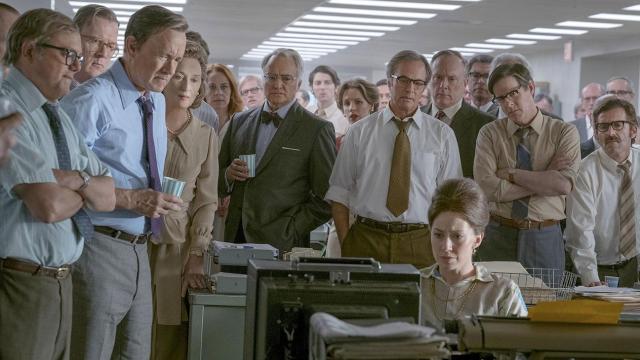
Spielberg’s picture is a shiny showcase of reportorial intrigues. The Post spying on the Times when Bradley realizes he hasn’t seen a story by star Times Vietnam reporter Neil Sheehan in months (something must be up), editor Ben Bagdikian (Bob Oedenkirk) working his own sources to figure out where the leaks came from, a competitive newsroom straining to play catch-up on the biggest scoop of the year.

And “The Post” is about a heroic — yes heroic — intellectual and ethical tug of war, with Graham sentimentalizing the Washington that will vanish for her as she gets tips from and confronts her “old, dear friend” McNamara, endangers her newspaper and its public offering over her newly-realized principles.

A favorite scene — Graham and Bradlee go toe-to-toe over who is more “compromised,” the social butterfly, or the hard-drinking, hard-charging Bostonian who cozied up to Kennedy in the most infamous example of media/government cronyism of the era. (See HBO’s fine documentary “The Newspaperman”HBO’s fine documentary “The Newspaperman” for more on Bradlee and that ethical lapse.)

As the lawyers (Jesse Plemons, adorably cast as in over-his-head) and Old Boys of the Board clash, and tensions and threats rise, we wonder just what it will take for Graham to, in a Shakespearean sense, grow into the crown?

If there’s a failing to the film, which has the frisson if not the urgency of your typical “ticking clock” newspaper drama, it’s the lack of grit. The cinema’s great visual stylist didn’t go for a ’70s cinema film stock look. The cars and costumes are right, but the reporters aren’t sweaty enough, the newsroom not smoky enough, the streets (and street protests) too clean and calm, the gloom just isn’t there.

But Hanks does a splendid Bradlee, or at least Bradlee as Jason Robards (“All the President’s Men”) played him, bluff and profane and antsy (We don’t have to be told his latest wife, Toni — Sarah Paulson — won’t last.). Streep offers another sublimely subtle turn as Graham, making the journey from Julia Child to Margaret Thatcher in such understated steps that we almost can’t see the transformation as it happens.

They, Spielberg and screenwriters Liz Hannah and Josh Singer never for an instant let us lose sight of why this history has to be remembered, and why a trustworthy press is even more important in an era when too much of it is being lumped in with “fake news.”

3half-star

MPAA Rating: PG-13 for language and brief war violence

Cast: Meryl Streep, Tom Hanks, Bob Oedenkirk, Bruce Greenwood, Sarah Paulson, Tracy Letts, Bradley Whitford

Credits:Directed by Steven Spielerg, script by Liz Hannah, Josh Singer. A 20th Century Fox release.

Running time: 1:55

Posted in Reviews, previews, profiles and movie news | Comments Off on Movie Review: History is Written as Democracy is Defended by “The Post”