Preview, “The Darkest Minds” lets Mandy Moore get paid, for starters

Yet another YA sci-fi dystopia about kids hunted and imprisoned and feared for who they are.

Hey, it’s as topical as today’s headlines, right? Even though it’s based on an Alexandra Bracken novel.

These kids have special powers, and no idea who Professor Xavier is. So they’re on the run. Mandy Moore, finally a big star with “This is Us,” is among those helping.

“The Darkest Minds” opens Oct. 5. 

Posted in Reviews, previews, profiles and movie news | Comments Off on Preview, “The Darkest Minds” lets Mandy Moore get paid, for starters

Movie Review: “Bernard and Huey” bring Jules Feiffer’s cartoon characters to the Big Screen

bernard1

Chatty, self-absorbed, streetwise and sex obsessed, even if he wasn’t drawing his quintessential “New York types,” we’d call Jules Feiffer’s characters “cartoons.”

They’re intellectuals on the pseudo-intellectual end of the scale, funny in biting, verbose flashes of self-realization. As in “maybe I’m not as smart as I thought.”

A classic Feiffer gag that turns up in his script for “Bernard and Huey,” the new film based on two of his most famous New Yorkers. Bernard is on the phone (in a flashback), trying to talk a woman the womanizer Huey once set him up with into going out with him.

“There’s a new French film screening — ‘Shoah.’ I don’t know anything about it, but…sounds like a muuuuuuusical!”

Get it? If not, there, I saved you the trouble of watching this or for that matter reading on.

Feiffer’s grand Hollywood statement, filmed in the 1970s, was “Carnal Knowledge,” a coarse and almost-comical sad-faced male wish fulfillment fantasy, and “Bernard and Huey” has something of that about it. It’s a biting midlife crisis  dramedy about two old friends who reconnect after 25 years and struggle to settle back into the dynamic that used to rule their relationship.

Back in the ’80s, Huey (Jake O’Connor) was an omnivorous sexual adventurer, in pursuit of any and all women, but especially New York “urban” women.

“The urban chick is trained for combat…If I had any respect for girls, I’d NEVER make out.”

Bernard (Jay Renshaw) was his bespectacled, already-balding poet-pal, fretting over “not progressing” in his life — at 25. He needs Huey’s little black book to have a prayer of getting a date in the cold, cruel city.

Twenty-five years later, Bernard (Jim Rash) is divorced, living in a permanently-unfurnished apartment and a mid-level functionary at a publishing house. Poetry is out the window, with the rest of his hair. But he’s now attractive to stewardesses (Remember, “male wish fulfillment fantasy.”) and has a beautiful, age-appropriate on-and-off lover (Sasha Alexander of “Rissoli & Isles”), a psychotherapist willing to celebrate “ten years since we started breaking up with each other.”

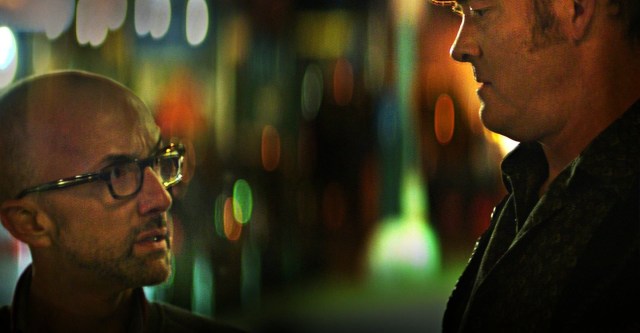
Then Huey shows up — wealthy, lost, “fat bald and old and…defeated.” Naturally, he’s played by David Koechner, the character actor best built for coarse, comically embittered and lovelorn.

They’re hurled back into each other’s lives, and even if you don’t live in New York, you know how this is supposed to go. At least one of them tries to ignore the intervening years and slip them back into their old power dynamic.

That would be Huey, who just “escaped” from Zelda (Mae Whitman), his shrill, man-hating failing graphic novelist daughter. He abandoned her at 10, so she has her reasons. Huey still has the patter, if not the looks and gruff charm of a “challenge” worth taking on — for a woman.

To hear Koechner’s Huey go off and the “80s chicks” and the city he misses (chasing away the stewardesses Bernard has mysteriously lured to their table) is to hear misogynistic, faintly homophobic slam poetry. He cooly rants about the “no frills mean…the mean queers” who wait on you in every store and restaurant, “meanness of a higher sphere” that New York is infamous for. He clears the room.

The situations involve coupling and uncoupling, an old flame (Nancy Travis) and ex-wife (Bellamy Young of “Scandal”) and strained efforts to “right” this universe by putting these old friends back in their former places.

bern3

The casting is spot-on, and one other decision by director Dan Mirvish pays dividends. He has the leads talk in duologues – each muttering narcissistic musings about “MY problems” while the other is talking about is. Occasionally, their topics of interest intersect and they switch the duologue to dialogue.

Huey and Bernard’s flashbacks are where the film gives us flashbacks to the Oscar (for a 1961 animated short, “Munro”) and Pulitzer prize-winning cartoonist, satirist and playwright’s sweet-spot — young guys, sitting in a bar, in an apartment, guys at their most sexist. Be brusque to women you want to pick up, was Huey’s counsel way back when — “Never ask a personal question, never pick up a check.”

He never grew out of that.

“I’m NOT sleeping with you, Huey.”

“Yeah, but 20 years ago you would have. Yeah, you would!”

His daughter? “She treats men just like you treat women,” and yes, that’s fascinating to watch.

As much as I enjoy “faintly repulsive,” like New Yorkers themselves, the movie’s a bit exhausting to be around, even at 90 minutes. All these self-absorbed “types” (even peripheral characters), self-conscious swipes at “hipsters,” self-inflating references to “Shoah” and Bukowski and August Wilson and Tom Stoppard, Black Flag and The Circle Jerks.

That’s a Woody Allen crutch, drop a lot of names and titles to give the script and screenwriter the veneer of cultural currency and seriousness. Not buying it.

This is just two aged sexual opportunists struggling to prolong the fantasy, an anti #MetToo moment that slyly asks, “What will 50ish lechers do when twentysomething young women stop using them to advance their careers?” The jury’s still out on that one, and it may be pure Feiffer nostalgia to go there, but props for still having the guts to ask the question.

2half-star6

MPAA Rating: unrated, sexuality,  profanity

Cast: David Koechner, Jim Rash, Mae Whitman, Sasha Alexander, Nancy Travis, Bellamy Young, Richard Kind

Credits:Directed by Dan Mirvish, script by Jules Feiffer . A Freestyle release.

Running time: 1:31

Posted in Reviews, previews, profiles and movie news | Comments Off on Movie Review: “Bernard and Huey” bring Jules Feiffer’s cartoon characters to the Big Screen

Preview, “Creed II” is more obviously just another “Rocky Redux”

The sleeper boxing hit “Creed” was basically a “Rocky” movie extending Sly Stallone’s franchise into a new, temporally impossible timeline via the son of a fighter who died in 1985.

It’s a boxing picture operating on comic book “universe” rules — time travel, right? “Immaculate conception” and all that.

Michael B. Jordan was OK, I guess, Tessa Thompson made a fiesty foil, the fight scenes gave us a little long-take brio, but the whole thing was recycled, hachkneyed, filtered through a “fresh lens” and critically praised as if all of America’s movie critics had been born years after 1985 as well.

Honestly, I can’t remember much about the plot except for what it stole from.

Now here’s “Creed II,” following that same path with even less in the line of fresh ideas. So, his new moment of truth is fighting the son of the boxer who killed the Dad he Never Knew? And Rocky is there to not talk him out of it?

Yes, one third of America needs to be reminded why we hate Russia (it has nothing to do with boxing). And three quarters of North American movie reviewers need reminding that “originality counts.” But anyway.

Sure. This’ll sell tickets. It did 33 years ago.


Posted in Reviews, previews, profiles and movie news | Comments Off on Preview, “Creed II” is more obviously just another “Rocky Redux”

Movie Review: “Marwencol,” the documentary that inspired “Welcome to Marwen”

marwen1

Mark Hogancamp is a sometime cook, dishwasher and busboy at a bar in Kingston, New York, a man who lives a strange and rich interior life with dolls. It’s not what you think.

Back in 2000, Hogancamp survived a savage beating on his way home from work. The “dolls” are his self-designed form of mental and physical therapy.

Using military dolls and Kens and Barbies he creates vividly-detailed World War II scenes set in the imaginary Belgian town of Marwencol, a place where his alter ego is a heroic airman who also runs a local bar. Marwencol is a place where Hogancamp’s imagination takes flight.

Filmmaker Jeff Malmberg’s “Marwencol” follows Hogancamp as he buys his toy militaria, poses and sets up dolls and wanders the roads near his home, creating combat wear and tear by tugging a model Jeep loaded with dolls, often in uniform and named for friends, co-workers, an ex-wife — people whose alter egos he then puts in harm’s way in “his own world” — “Marwencol.” Then he photographs those dolls and the work becomes not therapy, but art.

Hogancamp, an ex-sailor, uses this modeling (and photography) to “get back my senses, my motor skills.” And without saying so, he also uses it to work out his rage at those who beat him all those years ago.

He creates elaborate tableaux of combat scenes, sexual situations, executions and mass murders. He photographs them. Then he buys and builds more models, comes up with another set of poses and tells another story involving these characters in that war in this place that exists only in his mind.

marwen2

Malmberg presents some of these photos in time lapse, animating the work. He interviews friends, co-workers, the district attorney who handled Hogancamp’s case as well as one person from the art world who can vouch for the aesthetic validity of the artist’s quirky work. The hook here is more the artist’s “real story” than the work, and filmmaker leaves out much of that, saving a big “reveal” for the movie’s third act.

Hogancamp seems a pleasant, offbeat and intuitive fellow who probably takes all this less seriously than those who “discovered” him. He’s a “town character” who had the good fortune to get noticed doing those things town characters do — wandering roads towing a toy Jeep.

I was reminded of the 2004 documentary “In the Realms of the Unreal” about unpublished novelist, artist and mentally-off janitor Henry Darger, who constructed a similarly elaborate fantastical world for himself.

It’s only when those within the art community and filmmakers get hold of them that they are truly transformed. As one publisher says enthusiastically of Hogancamp’s work, “There’s no irony in it.”

That’s also true of the movie, which sorely lacks context and authority in trumpeting these photos of bloodied GI Joes as more than what they were intended, as therapy for a wounded man and his obsessed vision of a world where the wrongs that happened to him can be made right.

2half-star6

See the second trailer to “Welcome to Marwen,” inspired by “Marwencol,” here.

Unrated: Probably worthy of a PG-13 due to descriptions of violence, and depictions of violence using dolls

Credits: Directed by Jeff Malmberg

Running time: 1:24

Posted in Reviews, previews, profiles and movie news | Comments Off on Movie Review: “Marwencol,” the documentary that inspired “Welcome to Marwen”

Preview, Steve Carell loses himself in Zemeckis’s “Welcome to Marwen”

You might have seen the documentary “Marwencol,” when it made the rounds at film festivals almost a decade ago. Or on the “Independent Lens” PBS series.  It’s not a great film, but the story sticks with you.

A man, Mark Hogancamp, is injured in a mugging and copes with his brain damage, PTSD and general depression by creating this vast WWII diorama on his property using toy soldiers, GI Joe dolls and all manner of other toys and dolls to decorate it.

It’s like a melodramatic WWII TV series, filled with personal horror and graphic violence and spread out over this small scale battlefield, with Hogancamp taking Polaroids of tiny tableaux of his imagination –art on a meta and micro scale at the same time.

Jeff Malmberg’s quirky film made Hogancamp and this work of art immortal. But when you’ve got Steve Carell and Oscar winner Robert Zemeckis taking on the story, we’re talking a whole other level of fame.

Leslie Mann and Diane Kruger also star in this holiday (Oscar bait, Nov. 21) release.


Posted in Reviews, previews, profiles and movie news | Comments Off on Preview, Steve Carell loses himself in Zemeckis’s “Welcome to Marwen”

Netflixable? “Ali’s Wedding”

ali1.jpg

“Ali’s Wedding” opens with a guy in a tux, fleeing the Aussie cops on a tractor.

“Pool the veHICLE ovah!”

“Sorry mate, ah’m TRYIN’ t’get to the AIRport!”

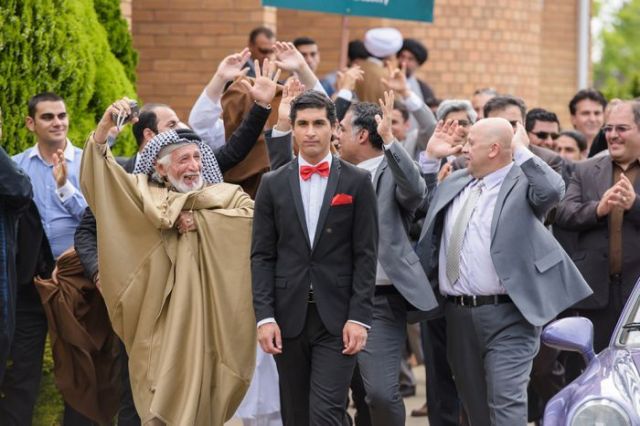
Ali, our Iraqi-Australian hero, is running from his own wedding. And “Ali’s Wedding” is  semi-reverent romp about the lies, the culture and the family that put Ali (Osamah Sami) in this predicament.

Inspired by the real life of its co-writer/star, it’s a bracingly revealing portrait of Muslims transplants in the West, sweet and at times damned funny.

It dares to acknowledge those things that make Westerners blanch at the culture — sexism, rigidity to “the Way of The Prophet,” arranged marriages, a community that sits in judgment, ululating. 

But this Australian comedy finds humor in those, and in the Western ways which the young, and sometimes the old, have embraced. The most daring thing about this movie might be the ways it shows this “quaint” community can be amusing as Greeks, Italians, Jews, Indians, Mormons, African Americans or any other subculture that’s been the subject of screen romantic comedies, and no more threatening. 

Three lies made Ali the man he is. His father is a holy man, the mahdi, of a community of Australian Islamic expats. The lie that saved his father got them out of Saddam’s Iraq, “The second lie was believing we could have a life as Iraqis living in Iran.” And the third, “my biggest lie,” is the subject of the movie.

He’s carried the burden of being the second son and his father’s dream of raising a doctor with him ever since that older brother died, saving him from a minefield when he was a child. But Ali bombs out on his med school entrance exam. He can’t tell his father (Don Hany) because of the shame it will bring him in front of his congregation at the mosque.

Ali is crazy about Dianne (Helena Sawires), the sarcastic and beautiful young fish monger’s daughter who is smart enough for med school, even if her father and their community don’t approve.

“If her father is willing to turn his back on the way of The Prophet and let mix  with Westerners at the university,” is how that community shows its rigidity, and its passive-aggressive side. Ali’s heartfelt congratulations separate him from other possible suitors, and she starts to flirt back.

And that’s another problem. These two may click, but Ali’s parents (Frances Duca plays his over-the-top mom) have a suitable bride lined up. So there’s another lie he has to live. How far will Ali go to maintain these overlapping charades? Who will figure him out?

Director Jeffrey Walker, and co-writers Sami and Andrew Knight, take their cue from comedies about Indian and Pakistani expats in Britain, Australia or America. They populate this world with a wide rainbow of Muslims, from snobbish Arabs and Persians to working class Egyptians and Lebanese.

“Scarface” posters on the walls, thick Oz accents and Australian Rules Football (“footie”) on the telly, these folks are assimilating faster than even they realize.

Ali’s father is a flexible Mahdi, erring on the side of kindness when one of his flock is in tears over a tantrum in which he did the whole “I divorce thee, I divorce thee, I divorce thee” thing and doesn’t want to lose his marriage. When Dianne scores well enough to get into Melbourne U. med school, the Mahdi silences his insulting, whispering congregation with a gentle reminder of which century and which country they’re all living in.

“If she were my daughter, I would be very proud.”

Dad is not just the spiritual leader of his flock, but a playwright whose Koranic parables are elaborate, whimsical productions that involve a lot of the guys (no women) from the community.

Dad’s dream show? “The Trial of Saddam Hussein.’ Believe me, it will be a comedy…with music.”

Ali will be his Saddam. He does a killer whiny-voiced Saddam for all his pals (from various cultures) at the convenience store where he works. Like young men the world over, the guys curse, joke around, look at porno mags and lie about women.

A white Aussie odd-man out among Ali’s convenience store pals wonders, “Can’t you guys have like 72 wives or some s—?”

Ali’s brother has the foulest mouth of them all. He’s a frosted-tips, butt-crack baring mechanic with the purplest Porsche in all of Australia.

“This is my JOB, Dad. I have to speak f—ing Australian!”

Only Ali’s ignored and plainly too-smart-for-this-patriarchy younger sister (Asal Shenaveh) figures out his entrance exam secret, though his snooty rival ((Shayan Salehian) has his suspicions.

That’s a lot of detail, but that’s where “Ali’s Wedding” works best — all these little slices of life, warm inside peeks at the culture and gentle comical jabs at it. Ali is dragged to a tea ceremony, the ritual where future husband meets future wife and the families give their approval. This isn’t who he wants to marry, and a frantic phone call to his more savvy pal Ayub is his lifeline.

“How do I NOT get married?” What decorums can he break, what breaches of tea ceremony etiquette will earn the disapproval of the father of the bride he doesn’t want?

That tea ceremony, by the way? Positively Austenesque.

ali6.jpg

The romance is utterly charming, largely thanks to Sawires’ winsome, aloof manner melting in the presences of this encouraging, kind and generally guileless young man who is plainly infatuated with her (Sami pulls that off with ease). Their chaste courtship, search for work-arounds for the Koran, furtively holding pinkies (not hands) at the movies, is just adorable.

The film is both Western and Middle Eastern, devout and comically blasphemous, praying for miracles, swearing at the heavens for a “bleeping” sign from Allah, which one suspects wouldn’t play in the Middle East.

It’s too long, meanders hither and yon in getting to the ending we’re looking for. The picture takes several detours along the way — flashbacks, the hope that Ali’s grandmother is still alive and might be able to get out of Iraq, a seriously unpleasant side trip to U.S. Border Patrol, power struggles at the mosque.

These just distract us from the thing that works, the love story, and the Arab aphorisms that bind the story together and makes it universal.

“A lie begins in the soul, and then travels the world.”

2half-star6


MPAA Rating: unrated, with profanity, smoking

Cast: Osamah Sami, Don Hany, Helena Sawires, Frances Duca

Credits:Directed by Jeffrey Walker, script by Andrew Knight and Osamah Sami. A Netflix release.

Running time: 1:49

Posted in Reviews, previews, profiles and movie news | Comments Off on Netflixable? “Ali’s Wedding”

Preview, “Boarding School” is no Hogwarts, kids

Will Patton is the headmaster, Samantha Mathis one of the more intense “teachers” in this horror offering, slated for the cinema’s late August dumping ground (the weekend of abandoned movies).

The curious thing about this trailer is the honor it bestows on “acclaimed” director Boaz Yakin, whose career path peaked with “Remember the Titans” and spiraled downward after the Brittany Murphy “comedy” “Uptown Girls” into maudlin war dog pictures (“Max”) and now this.

Posted in Reviews, previews, profiles and movie news | Comments Off on Preview, “Boarding School” is no Hogwarts, kids

Preview, Faith-based “Interview With God” makes David Strathairn the Almighty

Brenton Thwaites is the pretty young reporter haunted by memories of his Afghanistan assignment, a cast of similarly little-knowns as his editor, his fiance.

And then there’s the fellow cast as the young reporter’s toughest assignment, “The Man” who claims he’s the Lord God Almighty. Landing David Strathairn was quite the coup, one of the great character actors of his time, a veteran of John Sayles indie classics, a definitive, Oscar-nominated Edward R. Murrow for “Good Night and Good Luck.”

The sentiments expressed here could be more accessible than the and angry and anti-intellectual “God’s Not Dead” Jeremiads.

“Interview with God” is due out later this year.

Posted in Reviews, previews, profiles and movie news | Comments Off on Preview, Faith-based “Interview With God” makes David Strathairn the Almighty

Movie Review: Same old “Jurassic World, Fallen Kingdom” or Not

jur1

The dull repetition of “Jurassic Park” enjoys yet another dino deja vu outing with “Jurassic World: Fallen Kingdom.”

Sure, give them points for shoehorning Jeff Goldblum, the quirky, cautionary Dr. Malcolm, into a couple of scenes warning a clueless Congress about the consequences of letting once-extinct dinosaurs live on, despite the repeated failures of the “Jurassic Park” business model.

That’s just to set up the next dinosaur dinner buffet, which is all any of these movies amount to. Dinosaurs live! Humans congratulate each other for resurrecting them. Dinosaurs get hungry. Humans dine out on the folly of man.

The failed theme park reboot of “Jurassic Park” has left the Isla Nublar facility a ruin still filled with living, fighting and breeding dinosaurs. And now the island’s volcano is erupting. Bryce Dallas Howard‘s park publicist has turned animal rights activist, running the Dinosaurs Protection Group. They’ve just gotten the bad news — Congress won’t rescue the surviving dinosaurs — when the mysterious partner of the late founder of the park (James Cromwell) throws out a lifeline — another island refuge she can move them to.

The billionaire’s foundation chief  (Rafe Spall) says there’s just one catch. OK, two. She has to do this on the down low. And she has to drag along her ex (Chris Pratt), the expert who raised and tamed the last velociraptor still alive there. It takes drinking and begging to get Owen back on her team.

“If I don’t make it back,” he tells her, tenderly, “remember, you’re the one who made me come.”

With punk veterinarian Zia (Danielle Pineda) and girly-voiced shrieking tech nerd stereotype Franklin (Justice Smith), they’ll help the “great white hunter” (Ted Levine) and his rough customers hunting crew track down and capture the dinosaurs before the volcano swallows the island, the ruined park and the last vestiges of the Jimmy Buffett’s Margaritaville there.

You’ve read that plot description, so you pretty much know what’s going to come. Michael Crichton’s long dead and gone, so Universal is flushing good money after bad on writers Derek Connolly and Colin Treverrow, who shamelessly collect checks for cutting and pasting action beats, situations and even storyboards from all the earlier films into a file and insisting it’s an “original screenplay.”

Like hell.

A novel underwater opening is about all they contribute. It’s easy for any viewer to guess, just by framing and camera placement, which of “Jurassic Park’s Greatest Bites” is coming next, from which side of the frame, from which dinosaur, and with which dramatic dinosaur pose at its climax.

Again and again I found myself stifling a “Didn’t see THAT coming,” which I so wanted to shout out loud.

Pratt’s act is wearing thin, which is saying more than his ability to do his own stunts. All these cut-aways as he hangs from this or clambers over that. The editing doesn’t hide it,  man. Sit-ups. Personal trainers.

But Howard does a dandy job of “selling” the frights here. Together with the latest billionaire offspring to be imperiled by the park (Isabella Sermon), Howard convinces us that whatever non profit her character is running, these toothy monsters sniffing around for redheaded flesh freak her the hell out. I appreciate a good, realistic reaction to horrific beyond belief. Still, when Ms. Howard’s the best thing in the picture, what’s that tell you?

The direction is pedestrian, with only a couple of scenes having any novelty to their set-up — a race against a pyroclastic (eruption) flow, a desperate trapped-underwater moment. My crack about “storyboards” earlier falls on J.A. Bayona, a fine director (“The Orphanage,” “The Impossible”) who just took a paycheck and cribbed set-ups and pay-offs from the earlier films for his dino-bites here.

The villains are generic oligarchs and those who serve the oligarch market (Toby Jones with dentures), standard issue for Trump era thrillers. The cat and mouse games with the stalking raptors have merely changed locales, from a lab to a mansion out of the Harry Potter movies.

I was one of the few naysayers when the franchise was rebooted with “Jurassic World,” yet even with the bar set lower for expectations on this one, I found it “Transformers” boring, a summer movie that however much it earns, fails to justify its existence.

At least there’s Goldblum’s Dr. Malcolm there to speak for those of us who think these movies smell to high heavens.

“When…will we learn? When?”

1half-star

MPAA Rating: PG-13 for intense sequences of science-fiction violence and peril

Cast: Chris Pratt, Bryce Dallas Howard, Justice Smith, James Cromwell, Daniella PinedaRafe Spall, Ted Levine, BD Wong, Toby Jones and Jeff Goldblum

Credits:Directed by, script by . A Universal  release.

Running time: 2:08

Posted in Reviews, previews, profiles and movie news | 1 Comment

Documentary Review: “The King” saves Elvis from Himself, if Only for 100 minutes or So

king2

Eugene Jarecki’s “The King” is a moving masterpiece of music, pop culture montage and Big American Metaphor.

Yeah, it’s about Elvis and race and rock’n roll and America at the Trump Moment.

And it’s packed with interviews, from Elvis friends and Elvis fans to Elvis experts, throwing in a couple of haters — just one, really — for “balance.” Layers of TV and radio news coverage of Elvis and the world we live in today weave in and out of images of the Elvis Era and Beyond, although one of the most pointed arguments presented here is that we’re still in the Elvis Era, 30 years after his death. Performances of Elvis influences and Elvis himself and those who came after him are folded in.

That turns the movie into something the best written biographies of Elvis — both Greil Marcus and Peter Guralnick are among those interviewed — accomplish. It “rescues” him from his legacy, his more backward fans, his impersonators and the “cultural appropriation police.”

Jarecki’s gimmick here was acquiring the use of an Elvis car. No, it’s not one of his legion of Cadillacs, “which would have been poetic,” TV writer David Simon (“The Wire,” “Treme”) complains.

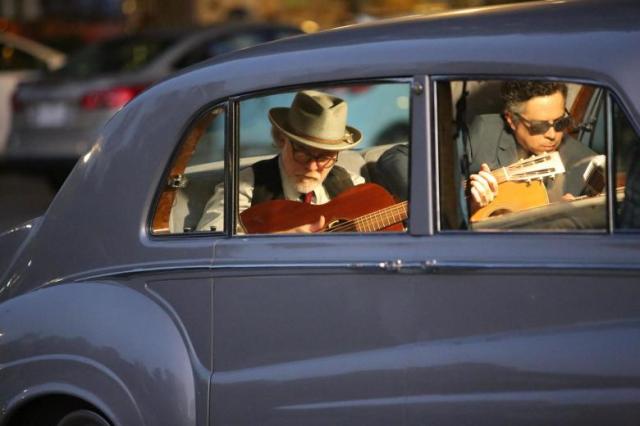
John Hiatt (“The Thing Called Love”), another interview subject, the singer-songwriter of a song about Presley’s “pretty pretty Cadillacs with Tennessee plates,” gets in the back of Presley’s 1963 Rolls Royce to be interviewed and perform a song and breaks down in tears.

Here it is, “the trap” that all that fame, all that money, the times he came up in and the “follow the money” path Col. Parker always insisted that he take, Hiatt suggests. So yes, even the wrong car is the perfect metaphor for the Elvis story arc.

And as we hear newscasters, opinionators and others lament, “What is WRONG with America?” in a 2016 election cycle blur on the soundtrack, the rapper Immortal Technique slides into the backseat, about to perform one of his angry, protest-tinged songs and drops this on us.

America is “Elvis about to O.D.,” he says, a nod to Trump and America’s decline. All that’s left now is dying on the toilet before our time.

Jarecki (“Why We Fight,” “Reagan”) is going for a more hopeful film than that, but it’s hard to shake the feeling that the Elvis analogy that’s been dangling in front of us for decades — taking greedy, cowardly short term gain with catastrophic long-term consequences — is merely writ large and indeed written in stone as “The King” makes its way to theaters.

The movie covers familiar Elvisiana — taking the Rolls (which breaks down, here and there) to Tupelo, the poor (mostly black) neighborhood where Elvis was born, to Memphis and neon-lit fame, New York and glory, the Army, the “Hollywood Years,” “The Comeback Special,” Vegas and The End.


Along the way, musicians walking in his footsteps crawl into the back seat and play, most charmingly, young Knoxville Blue Grass singer Emi Sunshine and Memphis soul-singing teens from the Stax Music Academy.  Some of them have thoughts on Elvis, some just have a song.

And other musicians, biographers, actors (Ethan Hawke, Mike Myers), journalists (Dan Rather), old friends and girlfriends and Memphis Mafia alumni tell his story, often in the front seat of this car that winds from Memphis to New York, and out to Las Vegas and back to Memphis.

CNN’s Van Jones remembers how much his father, another Memphis native, “hated” Elvis, how he’d taken black music and culture and gotten famous and “given nothing back.” Jones challenges Jarecki, “Why do you care so much about rescuing Elvis?” He quotes Public Enemy’s Chuck D and the song “Fight the Power,” with its infamous Elvis “was a straight-up racist” lyric.

Then a mellower Chuck D shows up and recalls thinking that at the time, but softening on the whole cultural appropriation thing as he’s matured. He may be the marvel of all these interviews, ruminating on the crushing weight of that level of fame, the circumscribed choices Elvis was shoehorned into and declaring an appreciation for the singer’s authenticity.

TV writer Simon is more blunt. Haters? “They’re not listening to the records,” the amalgam of country, gospel and blues Elvis channeled into something new.

James Carville talks about how the world changed, in an instant, with Presley’s arrival. Alec Baldwin weighs in on the physical beauty, “the most perfect looking guy ever” that was part of the package, Hawke and Mike Myers (?!) gripe about the fateful decision to “go Hollywood.”

“Celebrity is the industrial disease of creativity,” Myers notes. And he knows.

Jarecki edits in footage of the original “King Kong” to illustrate a performer trapped by fame, includes clips of Presley’s over-rehearsed “keep my opinions to myself” mantra (had to be The Colonel talking) as Jones wonders how different the world might have been had Presley walked with Martin Luther King Jr., just once, or turned up at the “I Have Dream” speech in D.C. (with legions of other celebrities). It might have risked his celebrity, but might have reflected more of who he really was.

We can’t know, the film suggests. We cannot ever know what it was like to, as a late Elvis hit posited, “Walk a Mile in My Shoes.”

“He had it all,” songwriter Mary Gauthier declares, “and he had more of it than anybody had ever had.”

Just like America. And the film argues that just like Elvis, America is stuck in the past, living in “the politics of nostalgia.” Bloated, unable to make the smart decision when faced with the easier, expedient one, unwilling to speak out when the need to speak out was never greater, drug addicted, lost and fat — and not just in the rural Trump-centric places that still worship Elvis, either.

It’s the American Dream we mourn when we focus our mind and not just our heart and ears on Elvis, the opportunities of the country a country boy like him came up in.

Jarecki’s film, his most thoughtful and oracular, had so many interviews and so many musicians that many you see on its IMDB page didn’t make the final cut. Frankly, I’d have lost Baldwin and Myers and a couple of others to get at one guy who hasn’t just followed Elvis, studied Elvis and gone through the dark side of fame with Elvis. Nicolas Cage, who married Elvis’ daughter, would have been a real coup and added something important to an already important, wonderfully-crafted argument and film.

But what’s here is enough, a stand-out documentary in a year already littered with glittering, delightful titles.

It’ll be on PBS at some point, but don’t wait. Seeing it in a cinema has a hint of religious experience about it.

4star4

MPAA Rating: R for language

Cast: Elvis Presley, Eugene Jarecki, Ethan Hawke, Emmylou Harris, Chuck D, John Hiatt, Immortal Technique, Alec Baldwin

Credits: Directed by Eugene Jarecki, script by Eugene Jarecki and Christopher St. John. A Oscilloscope release.

Running time: 1:48

Posted in Reviews, previews, profiles and movie news | Comments Off on Documentary Review: “The King” saves Elvis from Himself, if Only for 100 minutes or So