Preview, Rupert Everett in the role he was born to play, Oscar Wilde, “The Happy Prince”

He’s performed in films of Wilde plays, been an openly gay actor longer than any of his far more timid comperes, so this had to happen. Stephen Fry played Wilde, Everett’s Oscar captures more of the fun, so it would seem.

He wrote and directed “The Happy Prince” as well, which earns US release Oct. 5.

Oscar winner Colin Firth, Emma Watson and Tom Wilkinson also star in “The Happy Prince.” 

Posted in Reviews, previews, profiles and movie news | Comments Off on Preview, Rupert Everett in the role he was born to play, Oscar Wilde, “The Happy Prince”

Netflixable? “Fun Mom Dinner” rarely finds the fun in Moms cutting loose

fun1

It’s generally unwise to complain when something or someone “tries too hard,” because the alternative is always far worse.

But everybody in “Fun Mom Dinner” wanted ever-so-much to make Paul Rudd’s wife’s script funny, that cast and crew must have worn out the film’s insurers with their hernia truss claims.

Land Toni Collette and Molly Shannon for it, let Bridget Everett (“PattiCake$,” “Trainwreck”) steal it, summon Paul Rudd himself for a funny legal pot dispenser cameo, and you’d think this “Bridesmais/Bad Moms” wannabe should spontaneously burst into laughs, right?

Nope. It’s a flute of cheap champagne left out too long, an 82 minute fizzle with barely a giggle in it.

The California Happy Days Elementary moms are single-mom Jamie (Shannon), who has the “Shares too much on Social Media” give-away — divorced and a little sad. Her mantra, “You are not just a mom, but a hot HOT single lady…educated female person with a big set of t–s. ”

Her pal Melanie (Everett) is super-upbeat super-involved mom — on pick-up/drop-off traffic patrol, a wound-too-tight/take-everything-too far matriarch to a brood she exhausts herself trying to cheer up.

Emily (Katie Aselton of “Black Rock” and “The Gift”) is the sad, pretty mom in the withering marriage (Adam Scott plays Tom), constantly on call for two kids including a toddler who gives her a “poop facial” when he’s curious about what’s in his diaper.

Kate (Collette) is the odd-mom out, chased out of her own bed by the kids most nights, not interested in volunteering at school, clinging to a minute of alone time to smoke a cigarette in the tub — then the minute’s up.

“I’m mommed out. I’m over it. Mom yoga. Mom juicing...all of it.”

Emily was her pal in college, but to the other moms she’s just “that bitch Kate with the twins,” self-absorbed and checked-out. Emily has to trick her into joining the others — she HATES Melanie — for a night of “Lotsa wine, NO kids.”

The guys? Well, Tom and Kate’s husband Andrew (Rob Huebel) agree to “baby-sit.”

“It’s not BABY sitting when they’re your kids. It’s PARENTING.”

What ensues is  a night of quarreling and bonding over “a quick one, when Kimmel’s on commercial break,” learning what “rosebudding” and “Vajazzling” and “Youtube boxing” are, setting each other and then restroom smoke alarms off, the joys of a Walgreen’s gift card and late night visits to Kate’s favorite medical marijuana dispensary.

“Anybody have glaucoma?”

Paul Rudd and David Wain are the yarmulke-wearing pot peddlers, purveyors of “Ruth Bader Ganja!” to the giggling, nibbling, vaping and eventually karaoke-singing “No WAY I’m f—–g doing BEDtime tonight!” moms.

“We’re sticking together, like SISTER wives.”

You watch enough made-for-Netflix or dumped-on-Netflix comedies, aimed at teens or 40ish mothers wondering where their youth went, and you pick up on a screenwriter’s crutch. “Sixteen Candles” references abound, “Jake Ryan” lust is re-declared and The Go Gos, The Cars and The Pretenders bounce through the soundtrack. It’s the most exhausted item of ’80s nostalgia of them all. Knock it off, screenwriters.

fun2.jpg

One-liners hang in the air and die of loneliness — “OK, Oprah, Gayle, wanna let us into your ‘friendship circle?'”

The occasional surprise — Everett delivers most of these — are never funny enough. And as cute as the “Dads left alone with the kids” sequences are, they’re a distraction from the alleged mayhem these not-really-buttoned-down, F-bombing mothers aren’t actually creating.

It sounds like an R-rated comedy, but plays like a Disney Channel one littered with profanity, pot and bloodless life lessons about getting older, being a parent and losing yourself.

Rarely has an 82 minute comedy felt more like a complete waste of one’s time.

1half-star

MPAA Rating: R for language throughout, crude sexual material, and drug use

Cast: Toni Collette, Molly Shannon, Katie Aselton,  Bridget Everett, Adam Scott

Credits:Directed by Alethea Jones, script by Julie Rudd. A Momentum release.

Running time: 1:22

Posted in Reviews, previews, profiles and movie news | Comments Off on Netflixable? “Fun Mom Dinner” rarely finds the fun in Moms cutting loose

Movie Review: Nostalgic, melodramatic “Cruise” asks ‘Where were you in…’87’


cruise4

“Cruise” is a coming-of-age melodrama seemingly displaced in time.

It’s a car culture summer romance built around transportation, sex and petty theft and set to the soundtrack of what’s playing on everybody’s car radio — an “American Graffiti” parked in Flushing and Whitestone, Queens, in the late 1980s.

This Cuisinart collection of bits from “Diner” and “Graffiti” and “Saturday Night Fever” and what-have-you never quite gels, for reasons to do with its derivative narrative and those performing it — and one reason that’s as obvious as the setting.

Who out there is nostalgic for say, the Chevy Chevette or anything else of the boxy era in American and international (VW Cabriolet, anyone?) motoring?

Gio, played by Spencer Boldman of TV’s “Lab Rats,” is a “greaser” in all but name. He wears his hair in some faux 1950s pompadour and leaves his spotless white Ts in their packages until he’s ready to take them out, iron them and head out for the evening’s “cruise” around Flushing and environs.

He’s got his “boys” and “the routine” — a cruise past the regular haunts, a drag race out on the edge of the Long Island suburbs, hit the diner and call it a night.

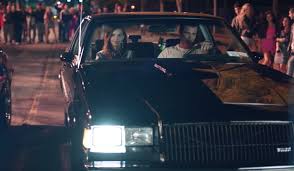
Unless one of the local lasses can talk him into a little parking lot sex in his rare, pricey (even then) turbo-charged Buick GNX.

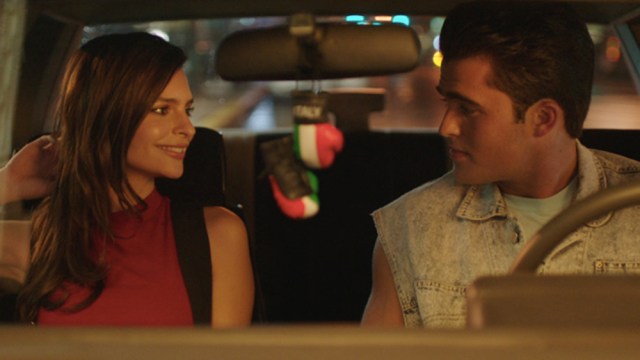
All that changes when he spies the girl who calls herself Francesca (Emily Ratajkowski) with her girls in her Cabriolet. Catching up with her at the Carvel brings out his best “guido” pick-up line.

“That is one…lucky cone!”

Thus does a summer romance blossom between the auto parts store clerk and the college girl who, it turns out, is no “Francesca” at all, but Jessica Weinberg from the high rent district across the Long Island tracks. She’s “slumming,” he figures, although he doesn’t connect those dots right away.

Gio gets to play “your Italian stallion” showing off “The Carvel Crowd,” “The Guidos,” “Bon Jovi Chicks” and “The Nicks” and their various burger, ice cream and baklava hangouts to the college girl.

But while she kept her name and background a secret, just for a bit, Gio’s keeping a bigger one. He and his pal (Lucas Salvagno) like to boost car radios, back when that was a thing, for extra income. They’re experts at it and they never get caught.

So he’s a bad boy? Catnip to the ladies, or this particular one.

cruise2

Writer-director Robert Siegel might be drawing on his own memories of the place and the era, but he’s built his script out of cliches and stereotypes and his soundtrack out of Lisa Lisa and Cult Jam, Stacey Q (“Two of Hearts”) and what the “cool kids/college kids” were listening to — New Order.

Gio’s thick-accented dad gives him, “Gio, you gotta thinka the FUTURE,” the local cops ride him for disconnecting his catalytic converter — “I could hear you in FLUSHING!” — and Gio starts to look at the world’s broader horizons thanks to dating the somewhat rich college girl.

He still hits the diner. But he wants to “look at the MENU” now. His synth-pop soundtrack is really shaken when she turns him on to New Order.

Boldman can’t do much to lift Gio out of the stereotype he seems to be when we first meet him. Ratajkowski, still most famous as the nude dancing model/lust object of the music video to “Blurred Lines,” can’t do much with Jennifer other than make her alluring.

The relationship allows “compatibility” questions to pop up, which Siegel either ignores or gives us the most trite and true answers to.

And the extremely melodramatic third act (robbing “the wrong car”) doesn’t fundamentally improve or even alter the course of this well-worn “Cruise” down streets and narrative byways we’ve traveled many times before.

1half-star
MPAA Rating: unrated, violence, drugs, sex, profanity, theft

Cast: Emily Ratajkowski, Spencer Boldman, Noah Robbins

Credits: Written and directed by  Robert Siegel  A Vertical release.

Running time: 1:30

Posted in Reviews, previews, profiles and movie news | Comments Off on Movie Review: Nostalgic, melodramatic “Cruise” asks ‘Where were you in…’87’

Documentary Review: “Wyeth” on “American Masters” on PBS


Long before his death in 2009, the painter Andrew Wyeth had to deal with “dead white male” dismissals.

A painter of “extreme realism,” whose skill matched his talents, and whose subtlety got lost in mass popularity, high priced sales and the sneering of the New York art establishment, this son of a famous illustrator found himself too often lumped in with the likes of Norman Rockwell — “sentimental,” a “kitsch meister” — at least among the art world’s opinion makers.

The ebb and flow of his critical reputation is aptly summed up by simply checking the running time of the “American Masters” documentary devoted to him (premiering Sept. 7 on PBS) and the recently-repeated 2016 “Masters” on abstract contemporary painter and collage artist Eva Hesse.

Hesse, important in the art world between the East River and the Hudson and really from the years 1965-70, a Holocaust survivor, pretty, died young — merited an hour and 45 minutes of film. Wyeth, the most important American painter of the last 75 years? A humbling 53 minutes.

Nobody “saw” like Wyeth, sitting on the hood of his Jeepster, sketching in the woods, farm fields and shorelines of rural Pennsylvania and Maine. Critics might praise his “un-paralleled draftsmanship,” as if the training, practice and tendency to “work on it until it couldn’t be better,” as his wife put it, was some sort of disqualification for serious consideration.

Glenn Holsten’s brisk film, contrasting with the numberless, repetitive and duller films attempting to fluff and inflate lesser talents celebrated on “American Masters,” generously samples the works, the life story and the ethos of Wyeth, son of illustrator N.C. Wyeth, father of painter Jamie Wyeth.

Painting to him, Wyeth said in a 1970s TV interview, “is a matter of truth…and maybe of memory.”

He rambled through Chadds Ford, Pennsylvania and Cushing, Maine and environs, peeking into stoic, occasionally tragic farm lives, fisherman’s work, at nature and into the psyche of his subjects. His first famous piece, acquired by the Museum of Modern Art later, “Christina’s World,” shows a woman, a disabled neighbor, seemingly crawling to what looks like a haunted, possibly abandoned farmhouse on the horizon.

Wyeth experts — family, contemporaries, scholars and curators — compare his compositions within the frame to the more celebrated abstractionists like Rothko and Pollack, And Wyeth’s personal history is sketched in, his courtship of wife-manager Betsy, the way his art changed when his father’s life was cut short in a car accident that also killed his young nephew.

“Paint your life history,” was his father’s message to him (so he thought). “Paint your life.”

And so he did, from the dead deer he contemplated in the forest the way the poet Robert Frost might have, had he taken up a brush, to his African American friends in Pennsylvania, to the mysterious model “Helga,” subject of a vast collection of scandalized nudes that came out late in his life.

wyeth1

Many many paintings and drawings are shown, a few dissected, their inspirations and antecedents revealed.

His “conversation with” his contemporaries in the art world, carried out via the canon, is a little undeveloped. One can wonder if the Rauschenbergs, Pollacks, Rothko’s, Kusama’s and Hesse’s didn’t chase attention through their more expressionistic/impulsive “express my feelings” works simply because they knew they could never compete with Wyeth, whose works still bring onlookers to tears in the museums where they’re displayed.

Popular or not, it’s an amazing body work, poignant, symbolic and stunningly skilled. And it’s why he’ll be cherished in ways mere market-chasing collectors of his more abstract contemporaries never will.

3half-star

MPAA Rating: unrated, Nudes

Credits:Directed by Glenn Holsten. A Sept. 7 PBS release.

Running time: :53

Posted in Reviews, previews, profiles and movie news | 1 Comment

Movie Review: “Mara”

mara1

Sleep Paralysis, a sort of paralyzing nightmare, is a real phenomenon that affects a very large portion of the population, a graphic at the beginning of “Mara” tells us.

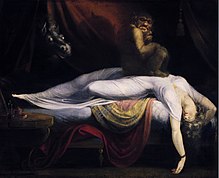
And historically, people in various cultures over the ages have thought it was caused by demons. That was given a visual manifestation when Henry Fuseli painted “The Nightmare.”

So “Mara,” a new horror thriller in the vein of “The Ring,” is parked on firmer footing than most boogeyman horror tales. It’s got cool-enough effects and moderately gloomy Savannah locations. For a genre picture, it’s not awful, which in horror is saying something.

Olga Kurylenko of “A Quantum of Solace” stars as Kate Fuller, a police psychologist called to a crime scene to A) because “You need to understand the reality of what we’re dealing with,” and B) talk a frightened little girl (Mackenzie Imsand) into saying who she saw do it. The cops are sure Mommy  Helena (Rosie Fellner) is the one who twisted Daddy’s neck.

Helena is alternately catatonic and hysterical. Sophie has her own answer to “Who hurt Daddy?”

“Mara!”

The detective (Lance E. Nichols, good) may want to label Helena a “certifiable fruit loop.” But Dr. Fuller hears her out.

“There was something EVIL in the room! And then I heard this awful music. And then I saw her, as real as you’re sitting there. MARA. I KNOW how this sounds!”

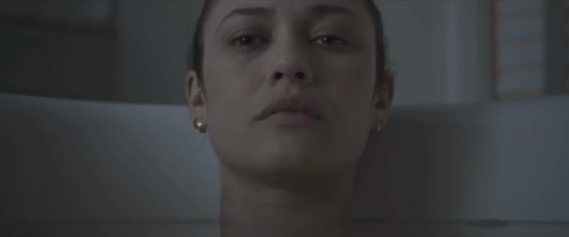
Kate immerses herself in sleep paralysis — talking to experts, sitting in on a support group. And that’s when she starts hearing noises in her house, seeing things in her tub, wondering how that glass of red wine shattered.

Supernatural thrillers like this require an “explainer,” and than man is a suspect. “Dougie” is British, lives like a hermit, “off the grid” and takes over the support group AND the movie as horror veteran Craig Conway (“Doomsday,” Estranged”) goes full-tilt crazy on everybody.

“She’s a DEMON! Whatever you do, do NOT sleep! Mara is REAL!”

Dougie pulls his eyelid down to show a blood blotch on the hidden part of the eyeball.

“Once you’re marked, that’s it. It’s over.

“Mara” stumbles along between loving closeups of Kurylenko sleeping, extreme closeups of her waking in a start, stalked by this hairy skinny/bendy wraith that crawls through sheets and shower curtains.

mara2

The puzzle of the plot is far more interesting than frightening. Dougie has been taking the “Beautiful Mind” approach to “finding the connection.” He’s the one who gives us the etymology of this “demon,” the one who brings up this painting, now at the Detroit Institute of Art.

fuseli

Director Clive Tonge, who also came up with the story, was onto something. The picture has a clever hook.

The deaths are grisly and flashes of closed-circuit TV footage deliver flickers of fright.

But there’s a reason those “Ring” and “Grudge” and many similar pictures make the demon zip into and across the frame. It’s a lot scarier than having this thing walk/stagger via insectoid joints, even if that’s the whole idea behind a nightmare that paralyzes — we see what’s coming, and we’re powerless to flee.

But when you slow everything to sleepwalk pacing, you deflate the frights and strip away the urgency that we and the characters should feel, the sense that something terrible is coming, that time is running out.

2stars1

MPAA Rating:R for disturbing violent images, and language

Cast: Olga Kurylenko, Lance E. Nichols, Craig Conway

Credits:Directed by Clive Tonge, script by Jonathan Frank. A Saban Films release.

Running time:1:39

Posted in Reviews, previews, profiles and movie news | Comments Off on Movie Review: “Mara”

Netflixable? “Garbage” seeks the sicker side of India

garbage

The silly, chaste musicals of Bollywood could not be further removed from “Garbage,” a tedious, tawdry and torturous take on India’s gender wars from the director who bills himself as “Q.”

Qaushiq Mukherjee has written and directed a gruesome and explicit tale of sex slavery, religious fanaticism, torture and revenge. It lives on the cusp of excruciating as Q tries to make us his mind what unpleasantness he’s going to show us next.

“At the peak of India’s gender wars,” an opening title informs us, the “battleground is the vagina.”

What does this have to do with Phanishwar (Tanmay Dhanania), a Goa taxi driver whose main job is taking tourists to the red light district?

He listens to sermons by a blind ultra-conservative Hindu cleric (Satchit Puranik) and puts out a seriously pervy vibe, even to the coked-up foreigners who ride with him. If they only knew. What’s he keep a pickax in his trunk for?

Phanishwar has a woman (Satarupa Das) chained up at home. He doesn’t speak to her, and she doesn’t speak at all. Semi-nude, feral, she is held by a simple snap shackle which makes one question the psychological bonds of slavery, as well as her intelligence.

Rami (Trimala Adhikari) is a young woman on the run. There’s a viral video of her in a threesome flooding over India’s internet. At the very least, we’re seeing her intoxicated and taken advantage of, at worst — assaulted.

She has fled to Goa to hide. Phanishwar picks her up, delivers her to a rental house and lets her lean on him in her time of need. But he’s seen the video. Phanishwar’s favorite hobbies are online porn and posting hateful, judgmental comments on posts by others on social media. A classic fanatic, he’s a flaming hypocrite.

“Flaming” is what he feels when he urinates, as well. It isn’t just misguided religious devotion that makes him what he is. He’s sick, and in a man’s eyes, sick where it counts.

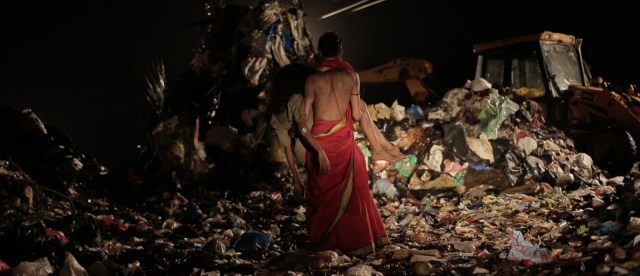
Rami’s odyssey sees her endure harassment every time she goes out. Once, he is rescued from piggishly persistent men by the lesbian Simone (Gitanjali Dang), who before she takes her home for some alone time, motorbikes them to the vast dump.

“Garbage knows garbage,” she says. “I know what I am.”

Rami stares at ceiling fans, as if wonder if they’d hold her weight should she tie a noose She confronts video harassers. And she buys a cage.

Q suggests Rami is being victimized for being modern, sexually active, curious and prone to bad decisions. She is contrasted with Phanishwar, superstitious, patriarchal Old India, a man who relies on faith and absurd (and graphically sexual) folk cures.

We get it. Obvious. We don’t need to return to the toilet, see fresh versions of debasement. We get the message in the parable.

This self-consciously “arty” take on gender roles, sexuality, torture and revenge features a voice of Big Sister a few times in the film. She rails against perfume and judgement, menstruation and masturbation.

A bit more effort on streamlining the plot and adhering to logic would have been a blessing. Q would rather reach for the next cheap, gross shock. As the lady says, “Garbage” knows what it is.

1half-star

MPAA Rating: unrated, graphic sexual and violent content, drug abuse

Cast: Tanmay Dhanania,Trimala Adhikari, Satchit Puranik, Satarupa Das, Gitanjali Dang

Credits: Written and directed by Qaushiq Mukherjee . An Artsploiation/Netflix- release.

Running time: 1:48


Posted in Reviews, previews, profiles and movie news | Comments Off on Netflixable? “Garbage” seeks the sicker side of India

Preview, “Science Fair” documentary celebrates smarts, and offers hope in a nation that’s fallen for “Stupid”

This nerdy doc from Cristina Constantini and Darren Foster opens in limited release Sept. 14.

Perfect time for something like this, I must say.

Posted in Reviews, previews, profiles and movie news | Comments Off on Preview, “Science Fair” documentary celebrates smarts, and offers hope in a nation that’s fallen for “Stupid”

Box Office: “Incredibles 2” just cleared the $600 million mark

inc1

It happened Saturday. It’s keeping “Kin” out of the top ten. Still pulling in viewers on a fraction of the screens it held when it opened. In June.

Posted in Reviews, previews, profiles and movie news | Comments Off on Box Office: “Incredibles 2” just cleared the $600 million mark

Documentary Review — “Kusama: Infinity”

kusama3

In art, the story of the artist, their “journey,” trials and narrative can often overwhelm the work itself.

That was never going to happen to Yayoi Kusama.

She might be an art product of wartime Japan, a publicity hungry provocateur of the New York of the ’60s whose failure to break through led to suicide attempts.

She might have been “rediscovered” in a Japanese mental institution — still drawing, painting, sculpting, collaging and polka-dotting away.

But the scale of the works, the innovations, the stark originality, no matter how many Oldenbergs and Warhols stole her Big Ideas, was never going to drown in “The Artist as Tragic Figure,” “The Creator as Brand.”

Almost. But not quite.

Kusama is an artist of rare obsession,, a woman “traumatized” by something which happened in a poppy field in her youth in Matsumoto, scarred for life by stumbling upon her wealthy father, in flagrante delicto with one of his many paramours. idolizing George O’Keefe, craving attention, recognition and fame so much she risked infamy and humiliation.

“Kusama: Infinity” captures the most famous female artist of the day at her peak — right now. And it remembers the 89 year-old’s half century of struggle, her artistic journey from watercolors to “infinity nets” — vast paintings of dots that challenge the viewer to decide where to look and wonder why may lie beyond. She created mirror rooms to display her soft sculptures (a cloth “accumulation” sofa now at MOMA, white-cloth-covered rowboat), matrices of flashing lights to further her explorations of the visual infinite, human bodies covered in polka dots. We see how she is ending her career as well, with large scale ceramics and the coiled fury of her anti-war collages, created in her twilight years.

At long last, when galleries from Japan to New York long refused to give her the time of day, when the only way she could get into MOMA (Museum of Modern Art) or the Venice Biennale was to crash the show with 1500 mirror balls which she rolled around in wearing first a kimono, then a leotard, when her nude art “happenings” once only got her arrested in New York, her work is selling for staggering numbers — millions.

Heather Lenz’s documentary relies mostly on Kusama, in her own words, speaking mostly Japanese about her life and the trials of her career. Experts, key friends and eyewitnesses to her slow rise recount the desperation, the many stunts she pulled to get her art — gimmicky in size and scope– noticed.

For much of her career, she has been Miró on a Christo scale, at least in ambition.

And while the psychoanalysis of an obsessive-compulsive creative’s mania and outlets for those obsessions is interesting, it’s that primer on “How to become a famous modern artist” that’s most fascinating.

Asexual in the extreme, she shamelessly courted potential patrons, playing up her exotic foreignness — kimonos, Geisha hairstyles — carried on a generally chaste affair with reclusive much-older artist Joseph Cornell for the attention and, in increasing desperation to “break through,” dabbled in nudity and publicity stunts that irritated the power structure she was hoping would embrace her.

She says that “everything is a gamble, a great leap into the unknown.” But her contemporaries — even her champions, recall how “blatant” she was at grabbing notoriety, how “aggressive” she was in pursuing patrons. Still, these are soft-gloved smackdowns, as the film entirely takes her point of view. More contrary voices would have enlivened it.

Visuals vividly demonstrate how the Modern Art Game is played. Whatever medium you work in, you are your greatest creation — hair, costume, trademark “look,” brand and pose, all vital ingredients in getting noticed and getting famous. From Gauguin to Picasso, Pollack to Schnabel, titanic ego, along with obsession and talent, is a fundamental requirement of a career.

So does having a story. Being poor, somewhat unpolished and dying young did it for Basquiat. Being prolific, ironic and an albino marked Warhol for stardom. Genius figured in, of course. But what’s marketable is “story,” and the perception of value, the art world’s embrace of your originality.

With Kusama, the older she gets, the more interesting her “story” becomes. But what makes that story connect is the art itself — dazzling, overwhelming, mesmerizing and playful. All the obsession and depression, brazenness and brass in the world wouldn’t matter if she hadn’t had the goods, all along.

3stars2

MPAA Rating: unrated

Cast: Yayoi Kusama

Credits:Directed by Heather Lenz, script by Heather Lenz, Keita Ideno . A Magnolia release.

Running time: 1:17


Posted in Reviews, previews, profiles and movie news | Comments Off on Documentary Review — “Kusama: Infinity”

Netflixable? Romantic comedy boils down to “The Laws of Thermodynamics”

laws1.jpg

More clever than funny, “The Laws of Thermodynamics” is a feature length Spanish language (Catalan?) “Big Bang Theory,” without the punchlines, rimshots and rhythms of a sitcom.

A lovelorn astrophysics grad student falls for an “It” girl model in Barcelona, and the orbits, entropy, and inevitabilities of their relationship, and those of a handful of friends, are explained by a score of scientists who run through the assorted “laws that nothing and nobody can escape.”

Vito Sanz is Manel, who is working on his thesis and “star” and director of this documentary about all he’s learned and been through, “The Laws of Thermodynamics.”

He puzzles over these laws and how they work on our own emotional behavior, and stands outside the calamity of pursuing and winning — briefly — the fair Elena (Berta Vázquez). She is a model, and here’s how they meet.

Every man on a city square in Barcelona is distracted by the stunning vision of her on a digital billboard. Several notice the real Elena walking, smoking and staring into her phone beneath that billboard. A whole collection of people, including lawyer Eva (Vicky Luengo) and his rival-pal, the hunky womanizing ad-man Pablo (Chino Darín) literally crash into each other and Elena — the men distracted, poor Eva trapped in their collision.

Shockingly, Elena responds to Manel’s average looks and above average brains, and they connect. He bails out of a previous relationship, lured into her “orbit.” Every hetersexual man in that corner of Catalunya is drawn, by gravity, to her.

A clever moment — a special effect/graphic representation pf orbits around Elena on the dance floor of a vast, crowded Barcelona club.

It’s a movie peppered with explanations of the numbered laws of thermodynamics, the Law of Quantum Entanglement by scientists from the University of Cambride, University of Madrid, University of Durham, astrophysicists from the big Canary Islands telescope, etc.

The scientists speak English, Elena, Manel and those in their orbit speak Spanish with English subtitles.

Manel is a teaching assistant in a college thermodynamics course and working on his thesis. Pablo is working on sleeping with a lot of beautiful women.

And Elena chooses Manel, even as we learn that “”energy transforms” in atoms, the universe and love, that “the quality of the energy” changes if not the actual amount of it (quantity), that “inertia” and “entropy” set in as love turns into indifference.

“This bunch of organized atoms has decided it needs to go to the bathroom,” she says.

Einstein and Kepler, Copernicus and Newton are quoted and Elena submits to Manel’s charms, his analysis of the state and position in the energy-cycle of their relationship, until she gets offered first a short film, and then a feature.

We hear about “the degradation of good energy into a form of heat” and see how it plays out in relationships — Pablo and Eva tapping intosexual “heat,” even though it is “random, inefficient” and winds up in “entropy …useless, wasted energy.”

In other words, “Maybe we should try a threesome.”

laws2.jpg

Writer-director Mateo Sanz exhausts us with all these academics, shortchanging the development of on-screen relationships thanks to endless voice-over (and on-camera) analysis.

Maybe on paper, these scientists playing it straight and explaining to the layman this corner of physics while Manel, Elena, Pablo, Eva and Raquel collide, separate, entangle and explode (a nuclear bomb that goes off in the heart, consumes a cafe, then a quarter of the city) was hilarious.

“You’re going a little fast for me. Come up with some laws of physics to explain to me how I am supposed to react.” Elena gets spooked by his second law of thermodynamics theory suggests they’ve reached “peak energy,” and that all that follows will be entropy.

The performances, game as most of them are, cannot overcome this. All this science laid over a romantic comedy is a bit of a bore. There’s too little of Manel’s manic efforts, trying too hard to cook for and keep entertained a girlfriend whose different priorities, narcissism and shallowness mean she is certain to be lured away by another man trapped in her orbit, one as good looking and shallow as she is, one who could help her career.

One winning moment that isn’t followed through rt payoff is Elena, beautiful and thus living a life without consequences, introduces “entropy”into Manel’s ordered, orderly apartment — chaos and disorder ensue.

Another has Pablo dancing on a double decker bus and taking a fall, with graphics illustrating the physics of how various onlookers (his girlfriend, his lover) see his plummet (straight down, or in an arc).

Aside from that, there’s nothing here that takes “Laws” to “peak energy,” even as “Entropy” has prematurely settled in making all that follows just tedious.

1half-star

MPAA Rating: TV-MA, graphic sex, nudity, smoking, profanity

Cast: Vito SanzBerta VázquezChino Darín |

Credits: Written and directed by Mateo Sanz. A Netflix release.

Running time: 1:40

Posted in Reviews, previews, profiles and movie news | Comments Off on Netflixable? Romantic comedy boils down to “The Laws of Thermodynamics”