Movie Review — Brace yourselves for half the laughs and half the frights in “Goosebumps 2: Haunted Halloween”


goose1

Silly me.

From the advertising, I’d assumed Jack Black was AWOL from the “Goosebumps” sequel, and missing his ironic turn as kid’s horror novelist R.L. Stine meant that Columbia wasn’t putting a lot of effort into this sequel to the delightful surprise “Goosebumps” was.

Oh, he’s in “Goosebumps 2: Haunted Halloween.”  In last act, basically, too late to make much of a mark on a movie that has nice effects, Ken Jeong to provide supposedly grown up laughs, decent money spent on effects and some seriously dull child actors as leads.

Just like the trailers and TV commercials. So kudos to Sony/Columbia for truth in advertising.

In a different town, Wardenclyffe, New York, another “Stine story COMES to life,” also involving one of his most demonic and derivative creations — Slappy the “demonic” ventriloquist’s dummy.

Yes, Mr. Stine was a “Twilight Zone” fan, back in the day.

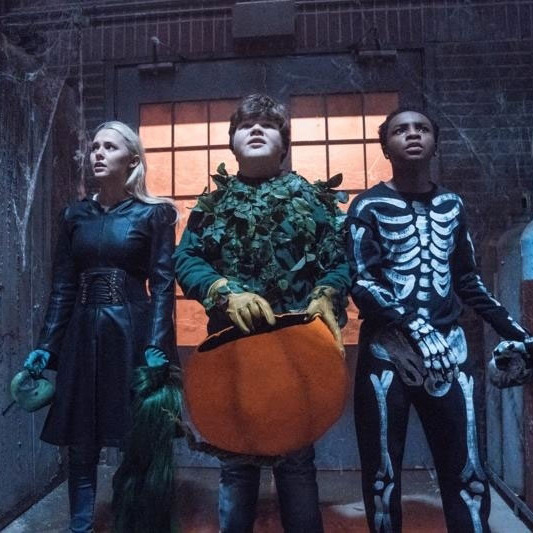
Sarah (Madison Iseman of TV’s “Still the King” and other series) is applying to colleges, younger brother Sonny (Jeremy Ray Taylor of “It”) is the bullied nerd in middle school and Sam (Caleel Harris of TV’s “Castle Rock”) is Sonny’s pal and business partner. The “Junk Bros” will haul away your trash for you.

That’s how they get the call to hit the long-abandoned Queen Anne style house down the street, clean it out. And that’s where they stumble across a hidden compartment with an ancient steamer trunk and an untitled book under lock and key inside.

“Who locks up a BOOK?”

Weird. Not as weird as “Slappy,” the dummy they also pick up.

Slappy comes with a card with an incantation written on the back. Next thing you know, he’s acting out, giving the bullies the business and settling scores with Sarah’s faithless boyfriend.

He just wants a “family,” he says. The kids employed to play these youngsters so under-react to this incredible, supernatural occurrence that you’d swear this happens every day in their families.

But not in Wardenclyffe, New York. Even though, if you remember your history, a certain Nicola Tesla once set up show for his experiments with radio and wireless transmission of electricity.


Events progress the way they do in these movies, abruptly. Slappy turns bad and the kids are hard pressed to keep his evil a secret when he sets out to make “Halloween come to life.”

Character actress Wendi McClendon-Covey adds laughs in her few scenes playing the siblings’ single mom, a nursing home nurse. Chris Parnell plays the pharmacist who flirts with her, a waste of a fine comic talent (he has nothing to play).

And Jeong is the single, childless neighbor a little too INTO Halloween, the sort of grownup still into R.L. Stine books.

“Classic ‘Goosebumps’ moment!”

The 2015 “Goosebumps” film had exactly the same story arc, with all manner of Stine mayhem erupting in the third act. The effects — digital witch costumes, Jack-o-Lanterns, mummies and Werewolves spinning to life — are every bit as good.

But the plot feels played and the stakes feel low. Black’s Stine doesn’t show up early enough to lend credence to the incredible, and perhaps show the kids on set how you react when the bully and his boys are nabbed and yanked into the heavens by witches.

The leading trio may have long careers ahead of them, but collectively, they add nothing to this never-really-scary horror movie for the Stine demographic (12-and-under). And they needed to, because Rob Lieber’s script required any spark the cast or once-promising director (Ari Sandel did “West Bank Story” way back when) could give it.

1half-star

MPAA Rating: PG, mild frights

Cast: Madison Iseman, Jeremy Ray Taylor, Caleel Harris, Wendi McClendon-Covey, Ken Jeong, Chris Parnell, Bryce Cass

Credits:Directed by Ari Sandel, script by Rob Lieber, based on the R.L. Stone books. A Columbia release.

Running time: 1:30
Posted in Reviews, previews, profiles and movie news | Comments Off on Movie Review — Brace yourselves for half the laughs and half the frights in “Goosebumps 2: Haunted Halloween”

Movie Review: Clunky “Kinky” lost its sexual nerve before the cameras rolled


kin2

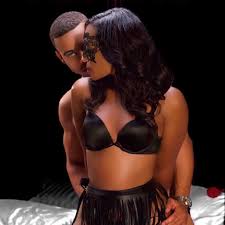
Bad acting by pretty people, chilly sex scenes acted out in mail order S&M wear, laughable dialogue and money money everywhere. What is this, “Fifty Shades of Ebony?”

That’s exactly what “Kinky” is. Flip the gender of the “I like to experiment” partner, give the hapless guy the ineptly-acted “I’m scared, but I’m intrigued/turned on” part, and that’s what “Kinky” is, an unintentionally funny “Whip me, Daddy, whip me hard” sexual melodrama that sets back sexuality 20 years.

Writer-director Jean-Claude La Marre writes really bad dialogue — “This is my…somewhat shy brother,” inane business conference banter and sloppy, unseductive seduction talk. He couldn’t find any big name players to star in this softer-than-softcore tale of an L.A. surgeon (Dawn Richards, billed as “Dawn” in the credits to pretend this never happened) who never, ever breaks a sweat.

Dr. Joyce Carmichael hits the gym, comes out of the operating room and gets busy in the sack with the same exertion-free/emotion-free cool. She’s beautiful, and men hit on her, but as her fey shrink (director La Marre) and her girlfriends note, she’s not one “to give these boys some play.”

Then this comically assertive fund manager (Gary Dourdan) stalks up to the table where the ladies are planning one of their number’s wedding, interrupts, lists his credits and hints at his fortune, and introduces that “shy” brother/business partner (Robert Ri’chard).

Dr. Joyce is into the brother. Fantasizes about him. She’s still into him even after he floods her hospital with flowers, as pushy as his older sibling. Shy? Not really. It’s the lunch date on his boat that seals the deal, and gives  the movie its first starchy attempt at erotica.

kink1

La Marre, who got the not-much-better “Chocolate City” (an Ebony “Magic Mike”) on the screen, has more of an eye for a market opening than for casting and costuming and directing, more of an ear for “Who can I get for the soundtrack?” than dialogue.

Vivica A. Fox shows up and lends a little seasoned “Booty Call” spark as Joyce’s long-married, sexually frank sibling. She just reminds us how this might have gone with sharper performers demanding better scenes and dialogue.

The leads are every bit as bland as those pale “Fifty Shades” bores, the situations trite and everything that comes between them leaden, playing like filler.

Movies are usually chopped down to fit a running time. This one, with boat trips (a funny sexually suggestive moment with a fishing rod), shifting the gears on a plainly-automatic transmission Porsche and Dr. Joyce telling her tepid tales of sex or no sex to a shrink who seems more a gossipy girlfriend than board certified, is padded and padded some more to get it up to its running time.

It’s the filler, from the tepid opening church sermon about sexuality to too much leading up to the finale, that sticks in your mind in “Kinky.”

1star6

MPAA Rating:R for strong sexual content, and some language

Cast: Dawn Richard, Robert Ri’chard, Darrin Dewitt Henson, Jean-Claude La Marre, Vivica A. Fox

Credits:Directed by Jean-Claude La Marre. A NuLite/Patriot Pictures release.

Running time: 1:38

Posted in Reviews, previews, profiles and movie news | Comments Off on Movie Review: Clunky “Kinky” lost its sexual nerve before the cameras rolled

Movie Review: On the lam, hitting roadside attractions along the way in “Better Start Running”

run2

In the movies, the path to “slow” is a precarious one. Such roles can be awards bait, but in these more enlightened times, playing a character described as such is walking a minefield between cute and insensitive, patronizing and simply wrong-headed.

“Better Start Running” is a road picture romance about two slow folk who might just fall in love, if the FBI or the cops don’t shoot them first. It’s a comedy rich in characterizations, broad and mean and satiric around the edges, predictably warm and fuzzy in its leads. A couple of those supporting players make it watchable, all by themselves, and the leads are easy to spend time with.

We meet Harley (Alex Sharp of “How to Talk to Girls at Parties”) as he’s responsibly calling in an incident in which another fellow “got hurt real bad.” There was a girl there, too, he adds, “but she had nothing to do with it.”

The 911 operator would love details, but “I’m sorry. I have to go now. I’m going on the run.”

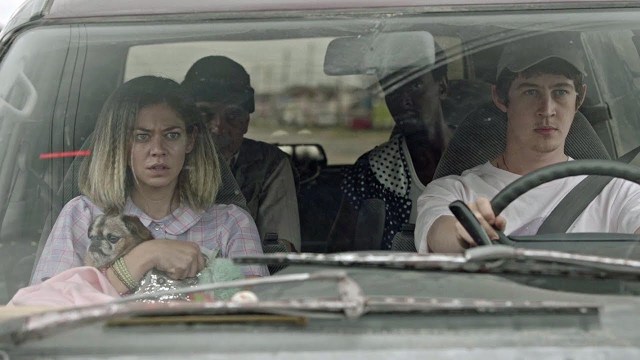
So these two high-functioning special needs colleagues from the big box department store All Shop jump into Harley’s ancient, piecemeal minivan and flee — hitting the roadside attractions stops listed on a kid’s restaurant placemat Harley kept from way back when.

The siren whose predicament inspires this escape is Stephanie (Analeigh Tipton of “Two Night Stand” and “Crazy Stupid Love”). She’s scatter-brained in the extreme, overly fond of a label maker she stole at work, clinging to customer’s babies entirely too tightly, struggling to fit in with her mean girl customers, sexually mature even as she’s dodging the advances of their creeper boss (Chad Faust).

Yeah, he’s the one Harley has to call the cops about after he somehow got “pushed out a window.”

Their quest? Getaway, grab grandpa and dash off to Montana, home of “The World’s Largest Gun” and Grandpa’s pre-Vietnam love of his life.

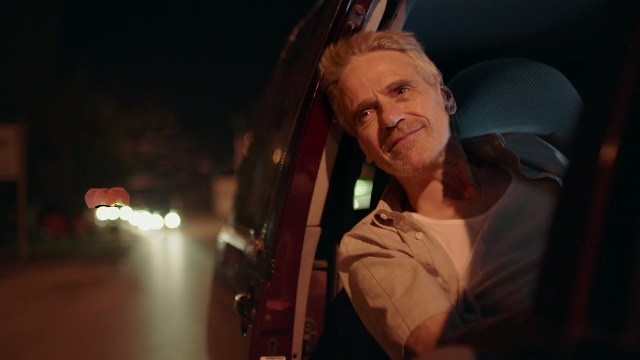
Grandpa booby-traps his room at the nursing home, always talks about “Nam” and is as hilariously colorful as the Great Jeremy Irons can make him.

“If you must come to tomorrow, I need a flash light, concertina wire and buckshot!”

“You gonna honor our deal? I take care’a you, when the time’s right, you take care’a me. Bullet, straight to the head.”

Grandpa has a Kentucky drawl and cancer, and when the kids come by, he’s perfectly willing to head off to Montana on Harley’s crazy quest to find “the one who got away.”

“She’ll be old, now. Probably smells like cat piss…I walked on a taut 17 year old. What’m I gonna do with a saggy 65?”

Harley is a shy romantic and was hoping to take Steph to the Fireman’s Dance in town that night, but things didn’t work out. His crush may be unrequited.

“I’m all about havin’ babies, and I just don’t think you’re daddy material.”

Still, hope springs eternal. Many a romance blossoms on the road and the road, as the song says, “goes on forever.”

The roadside attractions Harley is hellbent on visiting are more often shown, not identified. So hats off to director Brett Simon, driving that battered minivan past the missile defense pyramid in Nekoma, North Dakota, what looks like Paul Bunyan Land in Brainerd, Minnesota, some woodlands dinosaur attraction (Va., maybe? Florida?), Devils Tower, Wyoming from “Close Encounters,” “Sleep in a Wigwam” motels and the like.

They pick up Fitz, a colorful con man played by Edi Gathegi (“X-Men: First Class”) who seems to “find” whatever they need on their journey.

“I didn’t find them, they found me.”

He dances some Girl Scouts out of their cookies, “You steal?”

“Did Robin Hood steal bread? Did Jesus steal the Grace of God?”

He’s an anti-capitalist philosopher, and he isn’t the only pontificator in this picture. Grandpa’s  “My brother went to Canada, got by brainwashed by felatio, flower power and folk music” outbursts are mirrored by the trigger-happy, racist FBI agent (Maria Bello) on their trail.

“A cost of a year incarceration? $50,000. Cost of a bullet? Fifty cents. Do the math.”

Harley running over a flea market “mall cop” in a getaway gets her juices going.

“Hallelujah! We got ourselves a cop killer!”

“Ma’am, he’s not dead.”

“Come on, now. Gotta think POSITIVE!”

run1

“Better Start Running” reaches for “Forrest Gump” cute, and teeters into sentiment. It’s plotted like farce but plays like something sharper, wittier and quotable — if slower.

Irons is worth the price of admission, all by his High Lonesome self. No, the accent isn’t bullet-proof, but his gruff charm shines through scene after scene, even when there are shots fired.

“Hoo-Hah, we’re talkin’ DIRTY now!”

The leads are more tolerable than engaging, but some scenes sing, the roadside stops have a timeworn charm and Irons, Gathegi and Bello make “Better Start Running” move right along, even if it rarely achieves a sprint.

2stars1

MPAA Rating: unrated, violence, sexual assault, profanity

Cast: Analeigh Tipton, Maria Bello, Jeremy Irons, Alex Sharp, Jane Seymour, Ed Gathegi

Credits: Directed by Brett Simon, script by Chad FaustAnnie Burgstede. A Freestyle release.

Running time: 1:32

Posted in Reviews, previews, profiles and movie news | Comments Off on Movie Review: On the lam, hitting roadside attractions along the way in “Better Start Running”

BOX OFFICE: “Venom” sucks up $35, “Goosebumps 2” may edge “First Man” — “El Royale” bombs

box1The earliest looks at this weekend’s box office race had “Venom” falling off 65% or more from its breathless $80 million+ opening, and hitting the $30 million mark on its second weekend.

Lady Gaga fans had a shot at unseating the critically-reviled superhero movie from Sony, so the thinking went. “A Star Is Born” was headed to near $30 itself, and Friday’s numbers bore that out.

But Saturday widened the gap as “Venom” pushed towards a $35-37 million second weekend (What is WRONG with you people? You were WARNED!) and “Star” cooled off more than expected (To $28.1, not bad, it will be over $100 million by Tuesday).

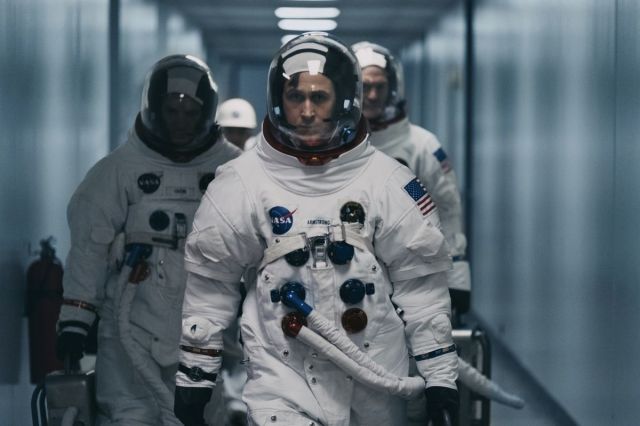
“First Man,” an Oscar-hyped portrait of enigmatic spaceman Neil Armstrong, has to be labeled a box office disappointment. It’s a very good film, but without the action beats and melodrama of “Gravity” or “The Martian,” it was never going to make box office history. It’ll be lucky to manage $17, and that would allow it bragging rights over “Goosebumps II,” which opened opposite it.

“Goosebumps,” being a kids’ film, had a good Saturday and with a decent Sunday will surpass “First Man” in third place.

“Bad Times at the El Royale” had a lot of fanboy hype, but is an empty filmgoing experience, kind of nonsensical, with “names” Jon Hamm and Jeff Bridges and Dakota Johnson not enough to sell it.

“The Hate U Give” did quite well in limited release, cracking the top ten with over $1.5 million on under 250 screens.

Posted in Reviews, previews, profiles and movie news | 1 Comment

Documentary Review: HBO film dissects “The Price of Everything” as pertains to art collecting

price1

The tulip mania of the modern art market gets a pretty thorough going over in “The Price of Everything.” Nathaniel Kahn’s collected interviews with artists, hype-driven dealers, well-heeled collectors and art historians and visits to Sotheby’s and the Frieze Art Fair and elsewhere give us the scale of the business, the birth of competitive modern art collecting and a sense of the recent history of this winner-take-all playground of the richest of the rich.

It’s a movie that begins with a declaration, an admission. “Art and money have always gone hand in hand. It’s very important for good art to be expensive.”

We start to figure out why over the ensuing 98 minutes. While artists and art historians remind us of the role of museums as “gatekeepers,” repositories of what we regard as important art, taste setters for the ages, it is the dealers and their clients with their breathless descriptions of the spatters of Gerhard Richter, the ordered lines of Mondrian, the murkier ones of Mark Rothko or the entombed shark titled “The Physical Impossibility of Death of Someone Living” by Damien Hirst, the artists who are passengers in this dealer-driven runaway train of hype and cash.

Kahn sets up compare and contrast moments that stick and, to a degree, sting as he shows us the soaring prices at auction for the works of Jeff Koons, king of this bubble — up to $50 million for a work that is produced, changes hands and swells in value with each auction. We see the factory where Koons and his crew turn out “gazing ball” pieces, copies of paintings from earlier masters, famous or obscure, with a gazing ball attached altering our perspective and perception of the work.

The viewer can be forgiven for thinking “Thomas Kinkade.”

Koons all but blushes with modesty about how much his work is selling for these days as he oversees an assembly line of “gazing ball” pastiches in the making.

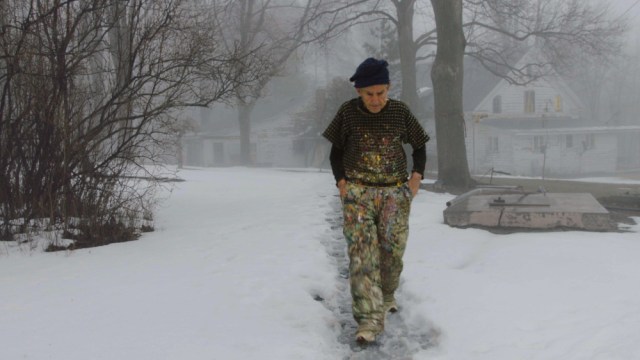
Then we meet Larry Poons, an abstract artist from “James Fenimore Cooper Country” (upstate New York), an aged painter who ponders how money is erasing merit when he isn’t merrily picking at an acoustic guitar.

“Art and money have no intrinsic hook up at all.”

price2

An art historian waxes eloquent, in near tearful reverence in the presence of Rembrandts and Vermeers, chased off the screen by a dealer pulling plaudits out of her nether regions in singing the glories of Gerhard Richter and Mark Rothko.

Kahn gives us archival footage of the seminal Scull Auction of 1973, the selling of the collection of Robert Scull, a New York taxi fleet owner who altered the state of contemporary art in the in the marketplace.

“We are lemmings,” aged Chicago super-rich collector Stefan Edlis says with a chuckle. Others in the realm of the super rich realized, via Sculls, that here was a benign way to “exchange assets,” turning idle cash into collectibles, competitively bidding prices on previously less valuable art skyward, building collections serving as resumes for their good taste, and then bequeathing their collections to museums which put their name on the galleries where their fortunes are on display for all to see.

Edlis is one of several collectors interviewed here, and while some come off as arrogant and aloof (a “We don’t CARE what YOU think about all this” pose.), Edlis seems a bemused enthusiast, acknowledging the comical, possibly misguided use of cash in vast quantities, but loving what he loves and thrilling at the chase.

“To be an effective collector, deep down, you have to be shallow. You have to be a decorator.”

Director Nathaniel Kahn, the son of architect Louis Kahn, is still best known for his “searching for my father” documentary “My Architect.” He keeps “The Price of Everything” in the realm of the real by turning to art historians and sober-minded curators like Paul Schimmel, who acknowledges the “gimmicky” nature of stainless steel copies of Asian bunny balloon toys, encased sheep and “gazing balls.” It works “if you own the gimmick. If the gimmick owns you, it’s over.”

But he’s also the first to tell us “There is no ‘golden age’ without gold.” Money drove Leonardo and Vermeer, Bach and Mozart, or at least motivated them to create. High priced paintings were considered too valuable to lose, and thus were passed through the ages and eventually wound up in museums.

Soberest of all might be artist Njideka Akunyili Crosby, who watches a work of hers auctioned off for a great fortune, smiles and shrugs. When she painted it, she was paid a fraction of that amount. But while she admits financial gain is a dream of most every artist, it is not the be all and end all.

She understands that to build a legacy, an artist must be appreciated and desired, financially, by the taste setters and their dollars, yen, yuan or Euros. To get to “the museum,” living artists have to play this game and hope their work costs enough to be taken seriously after they’re gone.

3stars2
MPAA Rating: unrated

Cast: Amy CappellazzoGeorge Condo, Njideka Akunyili Crosby, Marilyn Minter, Jeff Koons

Credits:Directed by Nathaniel Kahn. An HBO Films release.

Running time: 1:38

Posted in Reviews, previews, profiles and movie news | Comments Off on Documentary Review: HBO film dissects “The Price of Everything” as pertains to art collecting

Movie Review: Aubrey Plaza absurdly longs for “An Evening with Beverly Luff Linn”

linn2.jpeg

Absurdism on the screen is an acquired taste reliant perhaps more than other genres on the viewer being in the mood for something screwy beyond measure.

It can be wearing, or invigorating, novel or intentionally trite, populated by Pythonesque eccentrics and Fellini grotesques trapped in Theatre of the Absurd presented as Cinema of the Weird, Weirder and Weirdest.

All of which apply to the daft “An Evening with Beverly Luff Linn,” a farce with wry giggles scattered through its first hour, followed by the genuinely dizzy and cute “event” itself.

It’s about a woman’s passion for a long-ago love, a love she hopes to rekindle by being in attendance when the oddball Beverly Luff Linn appears in “a one night only event” that everybody expects to be “magical.”

The event’s details are kept from us until the third act. We’re late learning what this Beverly Luff Linn does, but the fact that he grunts and growls rather than speaks and is played by Craig Robinson points us in the general direction of the surreal.

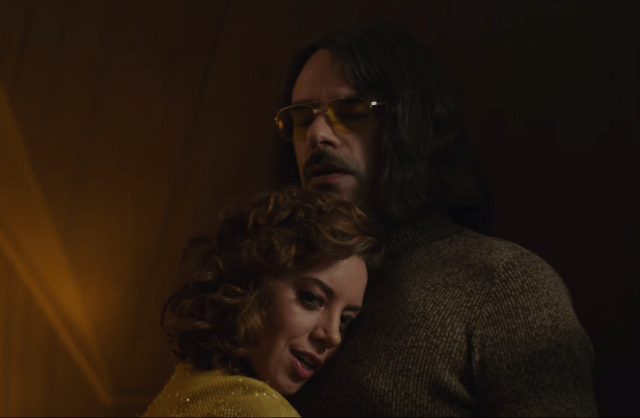
With Aubrey Plaza as the obsessed ex-paramour, Lulu, Emile Hirsch as Shane Danger, Lulu’s coffee bar manager husband and Jemaine Clement as the gun-for-hire she relies on to get her to the “event” on time, we can’t say we sit down for this without being forewarned.

Director Jim Hosking and co-writer David Wike’s script is one you can hear the actors enthusing, “Man, this is NUTS” as they insist they’re doing it to their incredulous agents.

Manic Shane Danger is ordered to lay off one employee at the chain store coffee shop, and he chooses Lulu his wife.

He learns that her profane/insane Indian brother Adjay (Sam Dissanayake) has a full “cash box” in his health food store and enlists a couple of Fellini film flunkies to join him in donning ridiculously obvious disguises to rob it.

Adjay hears a pitch from stranger Colin (Clement) who offers to get the cash back for a fee.

“I promise you I’ll blow out both his kneecaps!”

But when Colin shows up to robs the robbers, Lulu turns the whole debacle around in her favor, takes the money and Colin and Colin’s gun.

She has plans for that cash, plans to buy her way into “An Evening With Beverly Luff Linn.” For days, they hole up in the Morehouse Hotel, waiting for the delicate diva Linn and his “partner…plantonic,” Rodney von Donkensteiger (Matt Berry) to put on their show. Lulu keeps throwing herself in from of Beverly Luff Linn, Colin keeps throwing himself at her.

luff2

They down exotic drinks named “Rumble in the Heather” and the like, bicker, LOUDLY — “OK LULU I’M GOING OUT AND I’M GOING TO FEAST ON SNACKS!” Crazy-eyed bit players stage coughing jag gags, lots of them have melt-downs to rival Hirsch, an old hand at nutty collapses.

Adjay? “He choked on too much breast milk when he was a baby.”

Lulu? A sexual come-on waiting to happen. “I’m going to take a bath. Why don’t you watch…TV?”

Noble and naive Colin? He’s jealous.

“Beverly’s a woman’s name.”

“No, it isn’t, Colin. Beverly is a man’s name.”

“SCOTTISH woman’s name!”

Pages of arch, campy dialogue roll past over a doom-laden electronic score.

The shrieks of profanity, explicit sex, bits of violence and genera;inside joke” nature of the oddness is like a John Waters version of a Wes Anderson farce with Coen Brothers caricatures for characters.

And my reaction veered between “Oh my God,” and “cute” to echoing Lulu’s dismissal of Colin’s way with an anecdote — “This is by far the most uninteresting story I have ever heard.”

Until that finale. It takes an absurdly long time getting here, but with a lot of “Man, that’s nuts” along the way, it’s pretty much worth the wait.

2half-star6

MPAA Rating: R for language throughout, and for some sexuality/nudity

Cast: Aubrey Plaza, Jemaine Clement, Emile Hirsch, Craig Robinson

Credits:Directed by Jim Hosking, script by Jim HoskingDavid Wike. A Universal/Film 4/BFI release.

Running time: 1:48

Posted in Reviews, previews, profiles and movie news | Comments Off on Movie Review: Aubrey Plaza absurdly longs for “An Evening with Beverly Luff Linn”

BOX OFFICE: “Venom” still sucking up cash, “Star” chases it, “First Man/Goosebumps” bring up the rear

first1Film fans are not passing on warnings about “Venom” to their friends with quite the united voice critics offered. So even though Sony’s franchise-launching smash hit/bad film lost 60-65% or so of that opening weekend $80 million take, it’s on track to add another $32 million this weekend, unless Sat and Sunday collapse. As they might.
“A Star is Born” might overtake it, if there’s a Saturday plunge. It’s on pace to clear $28-29 million on its second weekend, a much more respectable 30-35% fall off in ticket sales, week to week.

Anybody who had high hopes that “First Man,” an historical film about enigmatic astronaut/engineer Neil Armstrong, Oscar bait for Ryan Gosling and director Damien Chazelle, will be surprised that despite opening very wide, it’s not going to hit $17 million. Audiences aren’t warming up to it, Deadline.com says. Like Armstrong himself, they’re maintaining arm’s length affection, for it. It’s very good. Don’t miss it. 

The un-previewed yet still critically dismissed “Goosebumps 2” is doing just as well. No Oscar buzz on that one, no Jack Black in that one. It will be over $15, maybe $17 with Saturday’s take. As I am visiting a hurricane-pounded  part of the country checking on aged parents, I haven’t caught it yet. No power until this AM.

The absurdly over-rated incoherent ultra-violence aptly-titled “Bad Times at the El Royale” may clear $8 million. Probably not. And shame on those taste-impaired fangirls and fanboys for endorsing it.

“The Hate U Give” opened a teensy bit wider (limited release last weekend), and cracked the top ten (Hurricane Mikey made me miss this one, too — long story).

“A Simple Favor” is still in the top ten one last weekend, and has cleared $50 million. Nicely done.

Posted in Reviews, previews, profiles and movie news | 1 Comment

Netflixable? New documentary asks, “Feminists: What Were They Thinking?”

fem2

Decades of young women reluctant to identify themselves as “feminist” is explained in just a moment, when artist and feminist Judy Chicago remembers her college years in the ’60s.

She’d say something about women’s rights back then, and she’d get “What ARE you, a Suffragette?”

No no, she’d say. When people thought of Suffragettes, they thought of activist little old ladies 50 years before. “I didn’t want to be thought of like that.”

Same with today, Chicago says with a laugh in the new Netflix documentary, “Feminists: What Were They Thinking?” Young woman don’t want to identify with the “old ladies” who are the icons of the women’s rights movement, or with people her age (and Jane Fonda and Hilary Clinton’s age).

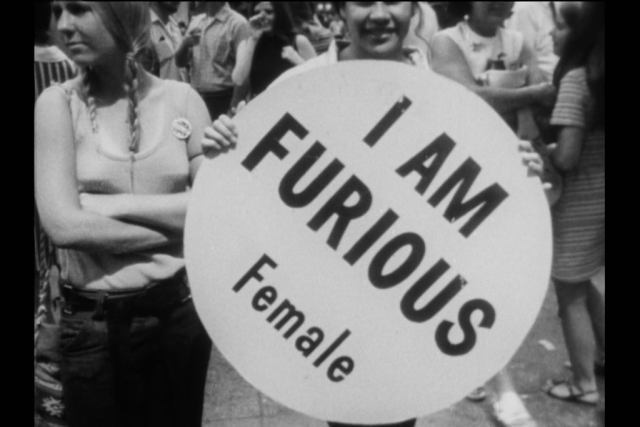
Director Johanna Demetrakas’ “What Were They Thinking” is a sprawling  “then and now” documentary built around a 1977 art photography book by Cynthia MacAdams, “Emergence,” and a retrospective exhibit, Feminist Portraits: 1974-1977, which recalls her work capturing self-identified feminists, famous or young and obscure, during the push for the Equal Rights Amendment.

“They look free,” filmmaker Wendy J.N. Lee says, poring over the book’s pages. “You want to be like them. Its contagious.”

Demetrakas interviews women who appeared in the book then, among them Lily Tomlin, Laurie Anderson, Jane Fonda, Michelle Phillips and Sally Kirkland. They talk about the world they were born into, with girls shoved into lives wholly limited by their gender, with abortion illegal and birth control rigidly opposed by corners of the religious, cultural and political patriarchy.

They wonder, “Why is anger not considered feminine?

One declares “I need to fight to be who I was.”

And young women interject themselves into the conversation by freely identifying with this earlier generation, noting how much progress was made — and how little seems to have been made in the decades since feminism was demonized by the Far Right.

In her film, debuting on Netflix Oct. 12, hot on the heels of the Kavanaugh Supreme Court debate, Demetrakas notes that MacAdams noticing women “looked different because of feminism,” but “their eyes remind us that the challenge is still there.

Screen legend Jane Fonda admits that thanks to the rigid gender roles of her early hears, “I’ve only known for ten years that ‘No’ was a complete sentence.”

fem2

Present day protesters — No, nobody is PAYING them to protest — say, “I’m done. I’m wanna be done fighting, but I can’t.”

Dematrakas, who gave us “The World of Sesame Street” and “Amandla! A Revolution in Four Part Harmony,” covers so much ground and includes so many voices that this feels like a two-night PBS “American Experience” slashed into 85 minutes.

The tyranny of fashion, the battle over abortion and the ERA, feminists made when “putting my husband through medical school” proved to be an unfair bargain, when their marriage to an enchanting foreigner turns out to be slavery in Afghanistan, others who only discover how bad they’ve had it after realizing they’re gay, Phillips recalling the servile nature of her “employment” by her then-husband in The Mamas and the Papas, rotests and art, the special difficulties facing women of color protesting for racial civil rights AND gender ones, personal stories of abortions and divorces — it’s overwhelming.

Having Fonda here is understandable, but she imbalances the film, repeating stories that you might have heard on her the HBO documentary about her that premiered last month.

“All your life, people say ‘Be a good girl.’ That implies that you’re naturally not.”

But Tomlin’s feminist stage shows are sampled, and other plays. The film of “The Children’s Hour” and Germaine Greer’s defiant late ’60s TV interviews all paint a portrait of an almost giddy, determined era when women found common cause, united behind it and changed the world, if only briefly in some ways.

And the inclusion of so many young voices gives “What Were They Thinking?” an optimistic feel. Misplaced? Only November will tell.

3stars2

MPAA Rating: unrated, nudity, profanity, adult subject matter.

Cast: Lily Tomlin, Laurie Anderson, Cynthia McAdams, Jane Fonda, Michelle Phillips, Johanna Demtrakas, Sally Kirkland

Credits:Directed by Johanna Demetrakas. A Netflix release.

Running time: 1:26

Posted in Reviews, previews, profiles and movie news | Comments Off on Netflixable? New documentary asks, “Feminists: What Were They Thinking?”

Movie Review: Life after baseball proves tricky for “Brampton’s Own”

brampton2.jpg

“Brampton’s Own” is a wistful baseball romance that makes its home in the “impossible dream” futility of life in the minor leagues. It doesn’t offer many surprises, but a good cast and a few moments make it a perfectly watchable also-ran, much like the stuck-in the minors hero its story is about.

From its first moments, in a dark indoor batting cage, Aussie actor Alex Russell of “Carrie” and “The Host” makes a perfectly passable almost-big-leaguer. Dustin Kimmel has been chasing that goal for a dozen years in the minors.

He’s treated like the locker room sage, a Crash Davis for the Tacoma club where he tries to hide his years and keep hope alive among the younger, hotter prospects. It’s all about “the call up.”

Even his regular booty call (Riley Voelkel) knows that.

“This is my career. I could be called up at any minute. I have to be ready.”

It’s why he won’t commit to her, which he regards as “no big deal.”

“Any time someone says ‘It’s not a big deal’ it’s a big deal.”

It’s also why he didn’t keep in touch with his friends in the small town where he grew up, where his “Brampton’s Own” exploits, being drafted by the Mariners, etc., are still clippings on the wall in the one bar and few restaurants Brampton has held onto.

His mom (Jean Smart) is the one to remind him “You said you’d give this until you were 30.” His smart-mouthed sister (Spencer Grammer) isn’t hearing “I didn’t have a backup plan.”

“It’s called ‘life.’ Figure it out.”

So Dustin faces “retirement” and starting over, without a clue and without the high school sweetheart who waited and waited, gave up on her own dream of singer-songwriter fame and gave up on Dustin — eventually. Rachel (Rose McGiver, Tinkerbelle on TV’s “Once Upon a Time”) is about to marry the new town dentist.

There’s nothing for it but to hang with the one old friend, an older jock (Kevin Linehan) even more “stuck” that Dustin. He, too, had a Big League dream. Now he’s over 40, still drinking and wearing his 1995 letter jacket to let everybody know when his life peaked, and what little he has to cling to now.

“You can’t quit. I gotta LIVE through you, man!”

You should know where this is going from that brief description, though not necessarily where it’ll go after it gets there. Whatever its charms, “Brampton’s Own” lingers past its payoff, becoming less predictable in scenes that amount to an afterthought/epilogue to a well-worn tale about jocks put to pasture.

The grace notes come from little snippets of humor, Dustin’s “old man” status in a Twitter-crazed clubhouse, his efforts at hiding his bitter disappointment, his attempts to coach kids in the art of hitting when hitting was what kept him out of the bigs.

“You’re casting. You look like you’re fishing. Keep your hands in closer.”

brampton1

McGiver gives the film its few real sparks, showing consequence and heartbreak in someone who’s falling for a man playing a game that keeps him thinking like a boy.

“Brampton’s Own,” like Brampton’s own, is stuck in a kind of limbo, not really grappling with direction, never quite figuring out where to go. The film doesn’t find easy resolutions, though you get the impression first time feature writer/director Michael Doneger was looking for them.

It’s too adult to be a “family” film, not edgy or gripping enough for grownups.

Watchable? Sure. But it’s watchable the way a baseball game involving teams long out of contention is still watchable. You’d rather be seeing a contender.

And unlike baseball, in movies there’s no “There’s always next year.”

2stars1

MPAA Rating: unrated, profanity

Cast: Alex Russell, Rose McIverSpencer GrammerScott Porter, Jean Smart, John Getz

Credits: Written and directed by Michael Doneger. A Dark Star release.

Running time: 1:30

Posted in Reviews, previews, profiles and movie news | Comments Off on Movie Review: Life after baseball proves tricky for “Brampton’s Own”

Gil Scott Heron provides the Best Musical Moment of “First Man”

Actually, actor Leon Bridges plays the famous jazz composer, singer and poet, in “First Man.” It’s in the “Why are we spending all this money on space travel?” montage.

Back in my public radio jazz program hosting days, I’d play this whenever I needed a wry laugh.

For you youngsters out there, here you go — “Whitey on the Moon.”

Posted in Reviews, previews, profiles and movie news | Comments Off on Gil Scott Heron provides the Best Musical Moment of “First Man”