Netflixable? French lad knows Mom is the ultimate “Honeymoon Crasher”

“Honeymoon Crasher” (“Lune de miel avec ma mère”) is a seriously sentimental, seriously tame comedy about a dull guy with risk issues and mommy issues and how he spends his honeymoon.

It’s French (subtitled, or dubbed) and considering the subject, the edge it might have had and the laughs it most certainly does not it’s pretty disappointing.

Honestly, I don’t know why French films advertise this or that star (Julien Frison in this case) as members of the Comédie-Française when they’re parking them in Neflix fare as dull as this.

Frison plays Lucas, a 31 year-old schoolteacher whose wedding to the lovely Elodie (Clara Joly) is interrupted by a cell phone — several cell phones. The ringing is coming from every member of the bride’s posse.

It’s Damien, it turns out. No, not the kid from “The Omen,” but the dashing (Esteban Ocon) and well-traveled motorsport driver.

Not only does opportunistic Elodie take the call (eventually), but when Damien rolls up in a pricy sports car, she flees her wedding and turns poor Lucas into the loser from Ceelo Green’s Greatest Hit.

As our anti-hero has “taken out a loan” for a lavish honeymoon on Mauritius, that’s where he goes. With a little suggestion from Mom (Michèle Laroque from “Ma vie en rose”) and prodding from Dad (Kad Merad), Mom — who never gets vacations — will accompany him to the island paradise.

When the resort’s honeymoon director Gloria (Almodovar discovery Rossy de Palma) lavishes them with a grand suite, there’s nothing for it but to play up the “honeymoon” illusion. Gloria, pursuing a younger man on the hotel staff, sees this younger man/older woman pairing as “inspiring.”

The comically icky possibilities here are many. But aside from Lucas freaking out other honeymooners with tales of how they’ve been together “since birth” (his), little is made of this.

“You wanna give Mommy a hug?”

Potential pratfalls spinning from Mom’s sense of adventure and Lucas’s over-caution don’t fall at all, much less fall flat. A mischievous monkey targets Lucas, and “don’t drink the water” is given the old scatalogical comedy try.

Nothing funny there.

Naturally, there’s a hot adventure staffer (Margot Bancilhon) to tempt Lucas into “forgetting,” and a hunky boat tour sailor (Gilbert Melki) to make Mom fret over the boring marriage she settled into.

The opening wedding turns out to be the best scene, and it falls short.

Cute cast, lovely locations and no comic highlights are the best one can say for this one. There’s “learning,” and even if nobody ever said that was “the best revenge,” it’ll have to do.

Rating: TV-MA, drug abuse, “open marriage” and diarrhea jokes

Cast: Julien Frison, Michèle Laroque, Margot Bancilhon, Kad Merad, Clara Joly, Esteban Ocon, Gilbert Melki and Rossy de Palma

Credits: Directed by Nicolas Cuche, scripted by Laure Hennequart, Laurent Turner and Nicolas Cuche. A Netflix release.

Running time: 1:35

Posted in Reviews, previews, profiles and movie news | Tagged , , , , , , | Comments Off on Netflixable? French lad knows Mom is the ultimate “Honeymoon Crasher”

Movie Preview: Naomi Watts and Bill Murray, but “It’s about the dog” — “The Friend”

Watts and Murray and a Great Dane “in mourning.” In New York.

Carla Gugino, Ann Dowd and Constance Wu also star in this Bleecker St. dramedy.

March 28.

Posted in Reviews, previews, profiles and movie news | Comments Off on Movie Preview: Naomi Watts and Bill Murray, but “It’s about the dog” — “The Friend”

Movie Preview: A Teacher gives his all to Create an Artist — Toby Jones is “Mr. Burton”

Jones, Harry Lawtey and Lesley Manville offer up an origin story for a screen icon.

He’s Welsh, two-fisted. And he might have a taste for drink. And those are the only clues I’ll give you.

April 4, in the U.K.

Posted in Reviews, previews, profiles and movie news | Comments Off on Movie Preview: A Teacher gives his all to Create an Artist — Toby Jones is “Mr. Burton”

Movie Review: Hell hath no fury like the heroine of Mike Leigh’s “Hard Truths”

Pansy is a 50something Londoner in a roomy new flat that she keeps immaculate, married and wholly supported by her plumber husband of many years, Curtley.

And all Pansy does, from morning til night, is “rage, rage against the dying of the light.” Or the coming of the light. At her husband. Or at her depressed, perhaps “challenged” adult son. At her hairdresser younger sister. Or the clerk in the market. Or the other women in line at the market. At the dental hygienist, whose “How could I forget?” reply to Pansy’s hair-trigger furious “I’ve been here before” speaks volumes.

Pansy, one of the great creations of Britain’s working class bard, Mike Leigh and his “Secrets & Lies” muse, Marianne Jean-Baptiste, is a haranguing harpy — always shrill, often loud — her eyes bugging out in fury at the world.

“Hard Truths,” the fourteenth feature of the Grand Old Man of Kitchen Sink Realism, just might tell us what this Black Everywoman in today’s Britain is so very angry about.

Pansy is the polar opposite of laugh-my-troubles-away Poppy, Sally Hawkins’ Oscar-nominated pollyanna whose laughter hides her pain in Leigh’s “Happy-Go-Lucky.” It takes nothing to “set her off” because she’s constantly “off.”

Her listless son, the hulking Moses (Tuwaine Barrett), reads children’s books about airplanes with noise cancelling headphones on.

“Don’t you have any hopes or dreams?” He is “rotting your life away.” He takes long solitary walks to escape her.

“People are going to accuse you of ‘loitering with intent,'” she fumes. “My family’s NEVER been in trouble with the law!”

Sister Chantelle (Michelle Austin) is the last of that family. She’s a popular hair stylist among the women of Caribbean heritage in her neighborhood, a good listener and a single mom who’s raised two positive and positively ebullient career-women daughters (Ani Nelson, Sophia Brown).

Mother’s Day is coming, and Chantelle wants to pin perpetually-pissed-off-Pansy down to visit their mother’s grave. She’s been dead five years. Perhaps that’s an answer to the one question Pansy won’t answer.

“Why are you so angry?”

Her substitute doctor may be onto something when she suggests “Have you ever thought of cutting back on your caffeine intake?” Couldn’t hurt. Or could it?

Leigh has long been Britain’s foremost chronicler of working class life, struggles and relationships. Starting with “High Hopes” and “Life is Sweet,” powering through “Naked,” introducing us to the extended family of an abortionist (“Vera Drake”) in a Britain where that was outlawed, Leigh has let us meet “Career Girls,” families with “Secrets & Lies,” families faced with “All or Nothing” choices and the struggle to get through “Another Year.”

We learn about relationships through vignettes, improvised and then painstakingly rehearsed conversations and scenes he and his actors work out. They and we plumb human foibles and universal human wants, needs and dreams. We make connections with characters both eccentric and perfectly relatable in his films.

Jean-Baptiste’s Pansy is up there with Hawkins’ Poppy in “Happy-Go-Lucky” and David Thewlis’s drunken, raging Johnny in “Naked” — a character we recoil from, then start to understand despite the mystery of her misery.

Leigh, a seven time Oscar nominee, turns 82 on Feb. 20. “Hard Truths” is reminder that filmmaker/artists/observers of his stripe are once-in-a-generation, one-per-culture talents. If you want to take the pulse of a country or a segment of its society, you don’t look to Marvel hacks or the blokes who make Harry Potter’s train arrive on time. You go to an Ozu, a Leigh or Spike Lee, Campion, Holofcener or John Sayles.

And if we’re not producing and celebrating new versions of these indie icons, we’ll all be the poorer for it.

Rating: R, profanity, smoking

Cast: Marianne Jean-Baptiste, Michelle Austin, David Webber, Ani Nelson, Sophia Brown and Tuwaine Barrett.

Credits: Scripted and directed by Mike Leigh. A Bleecker St. release, now streaming on Apple TV, Fandango, etc.

Running time:1:37

Posted in Reviews, previews, profiles and movie news | Tagged , , , , , , , , | Comments Off on Movie Review: Hell hath no fury like the heroine of Mike Leigh’s “Hard Truths”

Movie Review: Eternal love, Faithless love, memories of Dead Love — “Double Exposure”

Let’s summarize the plot to the meandering mess that is the fantasy thriller “Double Exposure.”

There’s this struggling photographer, married and still obsessed with his long lost “first love.”

She was a model/influencer so it’s no wonder his wife isn’t taking this constant “She was in my dream” stuff well. Sure, Peter can feel guilty about someone he split up with who later died. But keep that to yourself, chief.

A near accident has him hallucinate Sara back to life — first via phone call, then in person. The new wife, Lara, takes this…well. Until she sees the dead woman herself.

There are all these flashbacks to how these three met back in college, with a photographer/mentor, a model agent and others involved in the back story.

But was that accident that triggered all this “past” coming back to interfere with the present a “near accident?” And if it wasn’t…

Writer-director Howard Goldberg put some effort into casting and energy into trying to conjure up a twisty plot that wrong-foots the viewer and draws us in.

He’s only half successful, as the picture turns out to be as dull and artless as the art photos our hero (Alexander Calvert) takes with his vintage Nikon.

Instagram influencer Sara (Caylee Cowan) may have the prerequisites of such figures — pardon the pun. But the allure of this knitting-during-photo-shoots bombshell is strictly skin deep, as the character floats up and down the “pretty but vapid” spectrum in every scene.

A marriage is remembered — Kahyun Kim plays the unhappy bride — and marriage counseling is indulged in, professional and romantic photographic rivalries are proclaimed but not developed — pardon that pun, too.

And none of this adds up to a story or characters we invest in, care about or even care to stay with until the bitter end. It’s dry, dull, melodramatic and the only laugh might be the “agent” with his “villa in Italy” shows off his flash and gets a girl by driving a vintage off in a VW Karmann Ghia.

You’d have to be a pretty dim influencer/model indeed to be impressed by that.

Rating: unrated

Cast: Alexander Calvert, Caylee Cowan, Kahyun Kim, Simon Kim, Christian Vunipola and Christopher Maleki.

Credits: Scripted and directed by Howard Goldberg. A Disrupting Influence release.

Running time: 1:33

Posted in Reviews, previews, profiles and movie news | Comments Off on Movie Review: Eternal love, Faithless love, memories of Dead Love — “Double Exposure”

Movie Preview: Cassel, Pearce and Cronenberg’s “The Shrouds”

April 18.

A lot of punch for a mere “teaser.*

Posted in Reviews, previews, profiles and movie news | Comments Off on Movie Preview: Cassel, Pearce and Cronenberg’s “The Shrouds”

Movie Review: Coming-of-Age Asian American — “Didi”

“Didi” is a gentle but sharp-edged tale of a California teen coming to terms with who he is, a movie that invites grimaces of recognition even as it advertises its “different culture” status.

Writer-director Sean Wang’s debut feature fits neatly within the coming-of-age genre, but benefits from a few novel touches.

First of all, the kid’s Chinese American and has to live with stereotypes — the mother and nagging granny who speak Mandarin at home — and cope with stereotypes, the nickname “Wang Wang” and the “You’re so ASIAN” remarks of his middle school peers.

Secondly, he’s a social misfit in the most benign sense. “Wang Wang,” called “Didi” at home and named “Chris” on his birth certificate, is a screwup in the most cringeworthy, recognizable sense. He’s 13, with no clue about girls despite the fact that he has an older sister whom he torments and steals from when he should be getting style, behavior and work ethic tips from her. Didi says the wrong — often vulgar — thing to her, and that tactlessness/cluelessness extends to friends and classmates, all of whom are in a hurry to grow up, most of whom are managing it better than Didi.

The third novel touch in Wang’s film is the cliches it dodges, even if it does that more bluntly than deftly. If this is about “finding your tribe,” it’s also a story of rejecting and then accepting the one you’re born into. Those Sk8tRbois who let you hang because you pass yourself off as a “skateboard filmer” might not be the right hang, any more than the girl you crush on or the gauche pals you’ve held yourself back with since elementary school.

Alienated? Not naturally “talented” as a filmmaker? Maybe the AV Club is for you.

Wang’s period piece is set in 2008, where Didi (Izaac Wang, no relation) is living and learning from his Internet/social media addiction. MySpace is peaking, and there’s nothing that a Youtube tutorial can’t teach you.

“How to kiss” might come up. Especially if he finds a way to seem appealing to the fetching Madi (Mahaela Park) at a “Superbad” watching party at her house.

“How to film skateboarding” would be handy to watch, once he’s stumbled into Donovan (Chiron Cillia Denk) and his older crew of skaters/graffiti-vandalizers. He’s been videoing and posting stupid things he and his friends do online for some time. Delete those and maybe he can bluff his way into something cool.

But for now, he’s got pal Soup (Aaron Chang) and cool poseur Fahad (Raul Dial) as besties, willing and perhaps even able to steer him through the rough waters of early puberty. If they can stop pranking each other and others and get past that tween-to-teen “gross” boy phase, that is.

Mom (Joan Chen) is a frustrated artist raising Didi and college-bound older sister Vivian (Shirley Chen, no relation) and coping with non-stop nagging (in Mandarin, with English subtitles) from her aged mother-in-law (Zhang Li Hua). She’s doing this alone, as the breadwinner/husband is still earning a good living back in Taiwan.

“Didi” is a digital age baby, not the best student, ill-mannered in the extreme, disrespectul of his mother and using the Internet in every way he can think of to connect with Madi, skateboard culture, the vast trove of movies he’s never seen and the like.

But can all that digital stalking and “research” smooth out his rough social edges and help him fit in?

Our young star is just open-faced enough to let us see every stumble, social miscalculation and embarassment Didi experiences, open-hearted enough to make us feel bad for him in the most sincere “been there/messed that up” sense.

Chen gives a soulful fury to mother Chungsing, leaning into cultural peer pressure, but Americanizing in ways that make her tolerant of her son’s many missteps and her rebellious daughter’s disappointing UC-San Diego admission.

Writer-director Wang isn’t splitting the atom or reinventing the wheel here, and the film’s variations from the tropes for this genre aren’t unique or all that revelatory. But “Didi” makes a most relatable tour guide in helping us remember what running straight into a wall as you hit your teens was like.

Rating: R, drug and alcohol use involving teens, profanity, sexual references

Cast: Izaac Wang, Mahaela Park, Raul Dial, Chiron Cillia Denk, Shirley Chen and Joan Chen.

Credits: Scripted and directed by Sean Wang. A Focus Features release on Apple, Youtube and Amazon.

Running time: 1:33

Posted in Reviews, previews, profiles and movie news | Tagged , , , , | Comments Off on Movie Review: Coming-of-Age Asian American — “Didi”

Movie Preview: Paul Rudd unleashes his inner creep — “Friendship”

First, he’s your pal, welcoming you into his circle, his “hang.”

And then he’s not.

We knew Paul Rudd couldn’t be that nice. And ageless.

“Saturday Night Live” alumnus Tim Robinson stars as a man comically, cruelly upended by his brief “Friendship” with his neighbor (Rudd). Kate Mara plays the wife who urges her husband to get out of the house and make a few “pals.”

This A24 release from first time feature writer-director Andrew DeYoung rolls out in May.

Posted in Reviews, previews, profiles and movie news | Comments Off on Movie Preview: Paul Rudd unleashes his inner creep — “Friendship”

Movie Review: Strip off those shirts for “The Demoness”

Kazakh filmmaker Serik Beyeu, an editor turned director, demonstrates one clear talent in his latest film. He’s very good at persuading actresses and extras to take their shirts off.

“Succubus,” a supernatural thriller re-titled “The Demoness” for video distribution, is a show reel of nudity and horror sex, of looped, disembodied voices reading lines from a “doesn’t really understand English” translation of a screenplay that was already bad at plot, suspense, action, character and dialogue.

“Find your partner. Only together you’ll be able to get out.”

It’s all rather apalling, with or without shirts.

There’s this island with a fir tree plantation and an exclusive “retreat” where monied couples go to face their truth and heal their relationships.

Well, they call it a “retreat.” It’s run by a staff of martinets in robes and masks, with a disembodied voice/leader and note cards handed out to the couples in “exercises” designed to make them deal with each other and their “truths.”

Characters helicopter in and after encounter group “truth” sessions find themselves in a forest labyrinth hallucinating scenarios — usually sexual — in a mirror that reveals their “true” passions.

Monstrous forest creatures with arms like limbs of trees grasp them as they switch partners, cheat and refuse to acknowledge the peril they’re obviously in because they’re too busy stripping and getting busy, visiting topless dancer clubs and the like.

“Take me to the MANAGER!”

An ethnographer (Angelina Pahomova, although who knows who dubbed her lines) is there to hunt for a missing sister, and perhaps “discover” the source of this island’s demon myths.

The demoness (Nino Ninidze) reveals herself in a ritual sacrifice scene where her incantations sound scripted by Eastern European AI.

“Kissy, killy, cull-eee ah kay!”

Only “Babylon’s Water of Death” can save them. Because stripping off their tops and having sex isn’t doing the job.

Rating: violence, sex, nudity

Cast: Angelina Pahomova, Polina Davydova, Pierre Bourel, Polina Vorobyova, Artur Beschastnyy, Anton Rival, Victor Mikhailov and Nino Ninidze

Credits: Directed by
Serik Beyseu, scripted by Oleg Kurochkin and Dmitriy Zhigalov. A Well Go USA release.

Running time: 1:36

Posted in Reviews, previews, profiles and movie news | Comments Off on Movie Review: Strip off those shirts for “The Demoness”

Classic Film Review: Jeremy Irons leads a Polish Home Renovation in 1980s London — “Moonlighting” (1982)

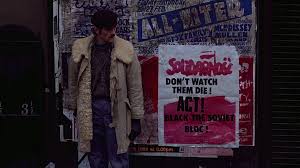
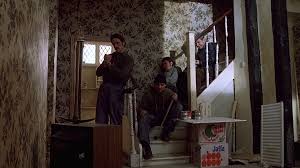
A cut-rate Polish work crew slips into wintry 1981 London to do an off-the-books home renovation in “Moonlighting,” Jerzy Skolimowski’s droll and intimate comment on capitalism, the collapse of communism and the horrors of cut-rate home repair.

It’s one of the great snapshots in time of the early 1980s. Released over ten years before the “one Europe” Maastricht Treaty, it shows us how the East exploited Western loopholes, and xenophobic Londoners turned a blind eye — well, the shopkeepers and better-off homeowners did, anyway.

And the film made a grand star vehicle for Jeremy Irons, fresh on the heels of his “Brideshead Revisited” TV breakout. He plays the one Pole who speaks English in a quartet slipped into Britain by an unseen Polish plutocrat to restore the rich Pole’s three story townhouse in Hammersmith.

Irons may be the most dashing home renovator this side of HGTV, a Pole with the poshest English accent ever. And one can tell from the way Nowak, his character, takes a swipe at demolition and mishandles a saw that here’s one actor who never helped build or strike a stage set.

But as he narrates this misadventure, jotting down details in the ledger book “the boss” insists he keep, we learn exactly why this “master electrician” is here and in charge. He speaks English and will do all the lying to customs, negotiating with vendors and placating neighbors.

“I can speak their language, this is why the boss chose for me for the job,” he narrates. “But I don’t know what they really mean.”

Being the lone English speaker and reader gives Nowak “control,” like “The State,” back home. He keeps the three men — Eugene Lipinski, Jiri Stanlislav and Eugeniusz Haczkiewicz — on a rigid schedule, feeds them on a tight budget and allows them one visit to a phone box on the corner per week to hear from home. But with Poland roiled by the Solidarity movement that would bring about the fall of the Soviet Empire, Nowak’s “control” over these “stupid” men may have limits.

How will they maintain their subterfuge, rush through their one month “no work/no employment” visas project and stay on task when there’s a coup in The Motherland? Will he tell them?

Manual labor notwithstanding, a better title for “Moonlighting” might have been “Shoplifting.” Local Brits take advantage of the Poles, who are in the country under false pretenses, “stealing” jobs from working class Brits and undercutting their prices. They’re able to do that because communist country currencies were nearly worthless as they had no “consumer economy” back home.

Nowak’s “control” of his work crew really starts to slip as the money runs low and he has to start stealing to feed them. They’ve already been ripped off by an Indo-Pakistani used TV dealer. Nowak has the team’s bicycle stolen. So he steals another and repaints it. He can’t get “news” from home, and keep it from the others, without stealing the neighbor’s newspaper.

And if anybody back home expects gifts on this crew’s return, more pilfering may be in order.

The Brits sell them some inferior goods, try to catch Nowak in the act of shoplifting and sneak their own rubbish into the rented “skip” they hire for the demolition. Everybody cheats everybody.

When “Moonlighting” came out, Skolimowski made a big deal out of the fact that his own expat home in London’s Kensington was being renovated while the movie was being shot. That sharpened his script’s sense of the not-exactly-victimless crimes being committed in those lean, hard anti-union Thatcher years.

The movie breaks one of screenwriting guru Robert McKee’s fundamental laws of “story.” Nowak, being the only English speaker, has exchanges with neighbors irate over the noise and mess they’re making, shopkeepers and shopgirls. But the entire “narrative” is related in voice-over.

That emphasizes Nowak’s isolation, his ignorance of how capitalism “works” and his paranoia that the men he manipulates a dozen ways, including resetting his watch to reduce their sleep time, will find him out and either go on strike or have their revenge in more direct means. Nowak’s paranoia extends to his girlfriend “Anna” back home. Who is keeping her company while he is away?

Irons has the right voice to carry this narrative, soft and somber and weary. Nowak carries the resignation of all of Eastern Europe in that voice, trapped in a life that won’t get better, uninvolved and thus hapless with regards to the changes that were beginning as this film was being shot and during its release.

Skolimowski never made another film remotely as good as “Moonlighting.” But with this movie at this moment in history he conjured up a parable for its time that stands the test of time.

East or West, working people who surrender “control” of their work and their lives to others are victims of the limitations and agenda of the State or The Boss. Back then, millions upon millions recognized that as the ultimate restriction on their liberty.

Rating: PG

Cast: Jeremy Irons, Eugene Lipinski, Jiri Stanlislav, Denis Holmes and Eugeniusz Haczkiewicz.

Credits: Scripted and directed by Jerzy Skolimowski. A Universal Classics release on Tubi, other streamers.

Running time: 1:37

Posted in Reviews, previews, profiles and movie news | Tagged , , , , , , | Comments Off on Classic Film Review: Jeremy Irons leads a Polish Home Renovation in 1980s London — “Moonlighting” (1982)