Netflixable? Boy Band Pretty or “Faceless (Shoutai)” he’s too cute to be a mass murderer!

“Faceless” is “I Am a Fugitive from a Chain Gang” or just “The Fugitive” for Japan’s current “Seijin no Hi” generation. The conceit is so clever that the clock is probably already ticking on a Hollywood version of this.

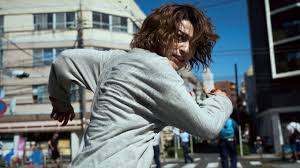
A young man of about 21 violently lunges and lashes and bashes his way out of prison, faking bloody vomit so that he can bust out of the guarded ambulance on the ride to the hospital.

Kaburagi (Ryûsei Yokohama) was convicted of an “In Cold Blood” mass killing as a teen. And now this “monster” is on the loose. A nationwide manhunt is underway. Only the intrepid police detective Matanuki (Takayuki Yamada) can bring him in, but the days and weeks tick by with this menace still on the loose.

There are these witnesses — a couple of young women (Riho Yoshioka, Anna Yamada), a bleached blond young man (Shintarô Morimoto) and others — who talk about the kid’s considerate side, his sensitivity.

When it turns out they’re being interviewed later in the narrative, expressing doubts about Kaburagi — whom they knew as Benzo, Nasu, etc. — and his guilt in a crime and punishment, when we’ve heard a police chief suggest “make an example of him,” we and they wonder if the guy’s been railroaded by a “system” too lazy to “fully investigate.”

Those being interviewed about their encounters with Kaburagi question “what justice is.”

Because the blond, orphaned construction worker Jump (Morimoto) got hurt on the job, and the mop-topped loner known to him as Benzo was the only one who stood up to their bullying boss, insisting a workman’s comp claim be filed.

“I just call out injustice when I see it,” Benzo tells him, in Japanese with English subtitles.

Online editor Ando (Yoshioka) notes the writer/reporter Nasu has a gift for writing and a talent for generating clicks on her company’s news website. She takes note of his inexperience of the world, his haunted look and his tears at watching a TV melodrama and suggests “You never know what somebody’s going through.” That goes for her, too. Her father is a lawyer entangled in a possible legal injustice himself.

Each confesses they figured out their new acquaintance wasn’t really right handed — bad with chopsticks — or didn’t really glasses. But they’re convinced he could not be capable of such a crime.

The viewer, however, is allowed to doubt their judgement. We sense what he’s capable of and wonder if he’s the avenging sort. When trapped, he’s like a mad dog — wrenching and writhing, wild-eyed with terror, breathlessly fleeing.

The intrigues are fairly superficial, as are the snap “He didn’t do it!” judgements from his sometimes smitten but always impressed peers.

But director and co-writer Michito Fujii keeps “Faceless” (“Shoutai” in Japanese) moving just fast (not that fast at all) enough so that we don’t mind the soap opera melodrama and swooning over a skinny hunk in assorted haircuts — many of them stylishly floppy.

And Yokohama gives us just enough of the damaged kid underneath that boy band veneer to keep the kid a mystery. For a while, anyway.

Rating: TV-14, violence

Cast: Ryûsei Yokohama, Riho Yoshioka, Shintarô Morimoto, Anna Yamada and Takayuki Yamada

Credits: Directed by Michihito Fujii, scripted by Michihito Fujii and Kazuhisa Kotera. A Neflix release.

Running time: 1:59

Posted in Reviews, previews, profiles and movie news | Tagged , , , , , , | Comments Off on Netflixable? Boy Band Pretty or “Faceless (Shoutai)” he’s too cute to be a mass murderer!

Movie Review: The terror and heartbreak of life under a dictatorship — the Oscar-contending “I’m Still Here”

A mother and father contemplate sending their oldest daughter to London to study.

It’s 1970 and the family lives in Rio de Janeiro. Brazil has been under a military dictatorship for years. the daughter is college age, rebellious, and the country is enduring a crackdown brought on by the kidnappings of foreign ambassadors. The kidnappers want political prisoners, who are many, freed in exchange for these diplomats.

But the father, Rubens (Selton Mello) wonders if Veroca needs to be abroad, just “until this phase is over.”

Is he discussing Veroca’s (Valentina Herszage) latest “phase?” Pot-smoking, music-obsessed and outspoken? Or are he and wife Eunice (Fernanda Torres) pondering the latest “phase” of an oppresive, arrest-everyone/interrogate thousands/detain hundreds government run by an unaccountable army and pistol-packing plainclothes secret police?

“I’m Still Here,” the latest film from Walter Salles (“Central Station”), is a chilling history lesson where what’s being taught here in Portuguese (with English subtitles) speaks to the universal concern of what happens to civil liberties in a time of oppression, when an authoritarian government controls the military, the courts and the media and can brand anyone it wants a “terrorist,” “murderer” or undesirable.

Salles folds a portrait of a comfortable life, albeit with armed soldiers everywhere, into this story of one family’s trial by secret arrest.

Rubens is an engineer — a designer who has planned a new house for them that he’s laying out on a gorgeous piece of land with a view of the Christ the Redeemer statue overlooking Rio. The family has a car, the leisure for trips to the beach, and has a live-in housekeeper to help clean up after and feed four girls and a little boy.

But Rubens used to be a legislator. And he’s not totally muzzled his “Death to the Dictatorship!” sensibilities. He takes mysterious calls and deliveries. And early one weekend morning, the dead-eyed goons with pistols stuffed down their pants show up and take him away.

“Your husband will be home soon,” they lie. Three of them stay behind to search the house, monitor the phone and intimidate one and all. The others hustle Rubens into a VW Beetle — the cop car of choice — and off he goes.

He wasn’t the first. Veroca faced an alarmingly aggressive gunpoint stop and search on the drive home from the movies with friends. Soon, the ever-questioning and pleading Eunice will have her moment — with a younger daughter — stuffed into a VW, handcuffed and hooded and hauled off for questioning.

Salles builds his film on fear — when the police arrest everybody, they have mug shots of everyone, which they show Eunice to see if she sees “anyone you recognize” — and the aching uncertainty of not knowing.

Unaccountable to anyone, authoritarians don’t even admit they’ve arrested someone, much less the “charges,” their status and location.

Eunice has one daughter in Europe and other kids to keep safe at home, a house to keep with a sexist banker who won’t let her access their accounts without her absent husband (she can’t say he’s been arrested) and a lie to maintain for those kids even as friends and others struggle to question and plead for “justice” that they have to know won’t be coming. Not for years, decades even.

Salles’ film takes place in 1970, 1996 and close to the present day as brief epilogues update on what everyone has done or become and the status of their “case.” “Closure” always hangs out there, in the distance, where no justice can be found. But Mom hung on, and son Marcello (Antonio Saoia) grew up to tell their tale in print.

What’s most chilling here is what we don’t see, the distant screams in the prison, the one young guard who won’t say where her husband is, but who tells her “I just want you to know that I don’t approve.

We hear the drilled dehumanization chants of soldiers in training, an army that exists to control, suppress and oppress the people. We rattle through city streets in tiny cop cars with sirens blaring, remembering the days when VW stood for “the Very Worst car” to have an accident in.

I found the final chapters less moving than intended, and the epilogues anticlimactic — one more than the other.

But Torres is so subtle at portraying a mother unable to show panic or righteous rage that when Eunice finally does let her guard down it’s almost shocking. It’s a great performance and worthy of the Oscar nomination she earned.

The film is also up for Best Picture and Best International Feature at the upcoming Academy Awards. It’s good enough to contend, even if we know that the film’s cautionary message about enduring the democratically unendurable, is what got it nominated. A lot of filmmakers in a lot of countries are thinking about that these days.

Rating: PG-13, violence, marijuana, smoking, nudity, profanity

Cast: Fernanda Torres, Selton Mello, Valentina Herszage, Bárbara Luz, Cora Mora, Guilherme Silveira, Antonio Saboia, Luiza Kosovski and Fernanda Montenegro,

Credits: Directed by Walter Salles, scripted by Murilo Hauser and Heitor Lorega, based on a book by Marcelo Rubens Paiva. A Sony Pictures Classics release.

Running time: 2: 17

Posted in Reviews, previews, profiles and movie news | Tagged , , , , | Comments Off on Movie Review: The terror and heartbreak of life under a dictatorship — the Oscar-contending “I’m Still Here”

Movie Preview: Thirty scintillating seconds of Pitt, Bardem and Condon — “F1”

June 25.

Posted in Reviews, previews, profiles and movie news | Comments Off on Movie Preview: Thirty scintillating seconds of Pitt, Bardem and Condon — “F1”

Movie Review: There’s no feud like an Irish feud over land, fermented guilt and sheep — “Bring Them Down”

Not going to sugar-coat this.

“Bring Them Down” is rough, a movie of wrenching, insensate cruelty, much of it directed at animals.

Writer-director Chris Andrews has made a debut feature that is as hard to watch as any recent film, and an intentionally frustrating experience that mimics real life in a world where “the law” doesn’t figure into things, least of all a search for justice.

Andrews tells the story out of order, showing us horrible things that happen as tensions rise in a feud between neighboring sheep farms in hilly, rocky central Ireland (Connemara is the setting, Athenry is mentioned, the Wicklow Mountains were the filming location). And then he flips back to show us how and why things happen, letting us dread the ugliness that we’ve already seen and know we may have to see again.

The story weaves random encounters and bad blood and vague rumors of “rustling” into specific grievances, causes and effects as it does.

A car accident years ago shows us a tearful mother pleading with her son to take the news of her leaving his father well, and Mikey’s mother and girlfriend in the back seat shouting at him to slow down as he road rages into an accident that kills, and disfigures and emotionally scars those who survive.

Grown up, Mikey (Christopher Abbott, just seen in “Wolf Man”) still lives on the farm with his “waiting for new knees” Da (Colm Meaney, of course), still communicates with the old bully in Gaelic, still tends the the that the O’Sheas graze on a hill they share with a neighbor who doesn’t have their “500 years” of experience, reputation and financial security.

Paul Ready of TV’s “The Terror” is Gary, the burly, bearded and bullying neighbor who has raised his son (Barry Keoghan) in his image. His wife (Nora-Jane Noone) was in the back seat of that car with Mikey, decades before. She bears the scar of that wreck, and Gary isn’t shy about using that to bait Mikey every chance he gets.

We’ve seen Mikey’s temper. We’re allowed to wonder if he’s mellowed, and wonder how wise that approach to a neighbor might be.

Because young Jack (Keoghan) called Mikey to alert him to a couple of dead O’Shea rams on the hill.

“Where there’s livestock, there’s dead stock,” he cracks.

But Jack is evasive and won’t let Mikey see the corpses. and when two re-branded (with spray paint) rams turn up at the local auction, the game is up. Jack stole them. Mikey’s fury is barely contained as Gary does what bullies do — dares him to do something about it.

As there have been stories of rustlers mutilating sheep, lopping off their legs, the threats to the O’Shea’s way of life are concrete and palpable. What does Old Man O’Shea want Mikey to do about it? Bring back the sheep by force?

Nooo. He wants his son to “Bring me their f–ckin’ HEADS!”

Callous cruelty and self-serving behavior permeates this world, where peer pressure — nobody will buy from shifty, crooked Gary — is almost the only recourse available when one family steps completely out of line. There’s no friendly uniformed Garda to keep the peace and see that wrong is made right.

And with no law, escalations can only end in horror.

Shoving and threatening leads to road rage and other escalations. And as the story folds back into itself, we see the desperation and amorality of the malefactors, the cowardice of bullies, the consequences of being a bad neighbor and the burden of being trapped with that bad neighbor — for life.

If you’re easily triggered on pretty much any subject listed above, I’d advise you to steer clear of this brutish Irish saga. It’s too bloody, too depressing and infuriating, and Andrews makes it his business to not give the viewer much relief or satisfaction with any of it.

But it’s also quite good, even if it denies us much that would give the viewer some sense of relief or justice.

Rating: R, graphic violence, animal abuse, drug abuse, smoking, profanity

Cast: Christopher Abbott, Barry Keoghan, Nora-Jane Noone, Paul Ready and Colm Meaney.

Credits: Scripted and directed by Chris Andrews. A Mubi release.

Running time: 1:47

Posted in Reviews, previews, profiles and movie news | Tagged , , , , , , , | Comments Off on Movie Review: There’s no feud like an Irish feud over land, fermented guilt and sheep — “Bring Them Down”

Movie Preview: Bowen Yang & Co. remake “The Wedding Banquet”

Asian Americans gays cook up work arounds for their “traditional” relatives who don’t understand their sexuality, going so far as to fake relationships and a marriage.

Ang Lee’s “The Wedding Banquet” rode the crest of a wave of what we’d come to call queer cinema when it played to enthusiastic reviews in art houses back in 1993, earning an Oscar nomination and a rich afterlife on home video and cable as well.

But for all its repressed emotions and dry humor, the picture has to play as more than a tad quaint thirty years later. So much has changed, even with reactionary efforts to turn back the clock on LGBTQIA visibilitiy and rights.

If anybody can make this fun, it’s “SNL” star Bowen Yang. Lily Gladstone also stars in a film from the director of “Spa Night” and “Driveway.”

The new take on this tale opens April 18.

Posted in Reviews, previews, profiles and movie news | Comments Off on Movie Preview: Bowen Yang & Co. remake “The Wedding Banquet”

Documentary Review: Elder Statesmen of Metal recall “Becoming Led Zeppelin”

Truncated, authorized and sanitized for your protection, “Becoming Led Zeppelin” offers the tamest take you’ll ever see on the hedonistic heavy metal band that started it all.

Director Bernard MacMahon agreed to limit himself to what plays as three grandfatherly English squires, interviewed in the study at Downton Abbey in furniture rescued during The Restoration. It’s as stodgy, stiff and bloodless as it is humorless.

“Becoming” is an “authorized biography,” in other words, with only their voices — and that of late, little-interviewed drummer John Bonham — telling their version of their story.

The average Led Zep fan with any acquaintance with their history and “lore” could serve up more sordid, full-blooded and “lived” versions of their career. The testimony of academics and rock journalists who have studied and covered them is sorely missed.

But when you hear how the already-famous-and-well-off-when-they-formed Jimmy Page had them self-finance and self-produce their first two LPs, you get it. They’ve always demanded “control” and they’ve always gotten it.

So no fish stories here. No drugs. No groupies.

But guitarist Page, singer-and-lyricist Robert Plant, avuncular bassist John Paul Jones and the late drummer Bonham, interviewed on audio tape not long before his untimely death at 32, still manage to paint a picture of how they met, their musical chemistry and the alchemy that created their distinct sound — over-simplified as heavy metal blues, with a blast of bombast and the odd reference to Bilbo Baggins’ nemesis.

The “rare footage” here comprises some stuff an enterprising fan could find on Youtube — Page’s earliest TV performance, as a kid singer/guitarist in a skiffle band, etc. We see Plant as a proto-hippy flower child, trying out groups and music styles and fashions before he and early mate Bonham found their way to veteran recording studio session men Page and Jones’ efforts to remake Page’s disentegrating Yardbirds into a new band.

Jones tells the tale of how Who drummer Keith Moon concocted their name and Plant sums up his melodic blues shouter yowling and blues-simplistic lyrical style as aptly as anyone ever has.

He was “finding the best bits of Black music and putting it through the wringer.”

MacMahon, director of the “American Epic” historic music documentary series, barely scrapes the surface of their innovative, experimental and thunderous early recordings. He serves up lots of concert footage — some of it rare — and full performances of several of their earliest songs to flesh out his somewhat superficial portrait. He gets no sense of what those heady days of recording, touring and exploding on the music scene in 1968 and ’69 were like. And as that’s the limited scope of the film — Led Zep up to 1970 — that’s a problem.

Plant’s “It was just far out. I was having a great time” is about as deep as it gets.

This is why you don’t do an “authorized” biography documentary. I was dial hopping the other day and stumbled into 1985’s “The Beach Boys: An American Band,” an equally opaque, dull “band’s own version” of a group’s history. Seeing Al Jardine and others “perform” their narration, walking and talking across a football field, for instance, tells us everything we need to know about what we won’t know after the film is done.

Far better, less authorized dirt-and-drama-and-strife-and-scandal documentaries about that band came out much later.

If Led Zeppelin’s place in the culture outlives them, later films will plumb the depths of their “real” experience of fame, success, sex, drugs and rock’n roll. This is the coffee picture table book version — grandpa approved.

Rating: PG-13, drug references, and smoking

Cast: Jimmy Page, John Paul Jones and Robert Plant, with an archival audio interview with John Bonham.

Credits: Directed by Bernard MacMahon, scripted by Bernard MacMahon and Allison McGourty. A Sony Pictures Classics release.

Running time: 2:01

Posted in Reviews, previews, profiles and movie news | Tagged , , , , , , | Comments Off on Documentary Review: Elder Statesmen of Metal recall “Becoming Led Zeppelin”

Let’s skip “The Big Game” and Get the “Led” Out — “Becoming Led Zeppelin” doc time

In IMAX, metalheads! Super Bowl Shmoopper Bowl. What’s the over/under on concussions and CTE risk?

“Been a long lonely lonely lonely time” I say. (Updated, my review is here.)

Posted in Reviews, previews, profiles and movie news | Comments Off on Let’s skip “The Big Game” and Get the “Led” Out — “Becoming Led Zeppelin” doc time

Movie Preview: Amanda Seyfried in Atom Egoyan’s “Seven Veils”

It’s good to see one of Canada’s last auteurs still taking his shots, and Seyfried getting another shot at challenging material.

Can’t remember the last Egoyan film that I thought worked, and this one wound up with Distributor of Last Resort XYZ. So let’s lower those expectations.

Maybe it’s just a hard sell, as Egoyan films often are. A thriller set in the theatre, with “suppressed trauma” and symbolism. Egoyan has been known to toy with kinky.

Mar. 7.

Posted in Reviews, previews, profiles and movie news | Comments Off on Movie Preview: Amanda Seyfried in Atom Egoyan’s “Seven Veils”

Movie Preview: Jonathan Majors has “Magazine Dreams”

An obsessed body builder will do most anything to his physique to become famous, a winner on the cover of magazines.

Majors lays it all out there in what could be his comeback from de facto banishment/cancellation based on legal issues.

March 21.

Posted in Reviews, previews, profiles and movie news | Comments Off on Movie Preview: Jonathan Majors has “Magazine Dreams”

Movie Review: Dutch Marines spring into action when “Invasion!” comes to The ABC Islands

A drowning marine being slapped awake — while 25 or so feet UNDER water — may be the silliest event I’ve ever seen portrayed in a combat film.

That’s not enough to ruin the compact Dutch thriller “Invasion!” But it points to a laundry list of other sins.

It’s about a South American assault on the Netherlands’ ABC Islands, three of the premier Caribbean tourist destinations. But cut the film a little (Ok, a LOT of) slack and the almost-ripped-from-the-headlines thriller passes the time easily enough.

It’s about an unstable Latin American regime that is Venezuela in all but name, a place where a teetering strong man invades Aruba, Bonaire and Curaçao, for reasons that at first confuse, then seem more clearly convoluted, corrupt and self-serving.

The Dutch have an ultramodern coast guard patrol ship, with rescue helicopter, on station, or close enough, a nearly empty marine base, and a bunch of marine trainees summoned back from maneuvres in Belize to respond.

But the home government in The Hague is just as thrown as the Curaçao’s tourists, subjected to rocket attacks from a warship off shore, and the caught-flat-footed marines.

One and all shout “What do these guys WANT?” in Dutch with English subtitles.

But one family is impacted by this most of all, and most pivotal to this situation’s resolution. Andy (Tarikh Janssen) is a marine finishing up his training only to learn his resort staffer father has been injured in the assault. Brother Judsel (Jasha Rudge) is on the Zr. MS Groningen, the coast guard ship that deploys and fetches those marine trainees. And Judsel’s wife Isa (Ziarah Janssen) is trapped on the island, staying in the hospital with her injured father-in-law.

The Dutch ambassador (Gijs Scholten van Aschat) to (not Venezuala) is taken as one of the least able and most cowardly members of the diplomatic corps by his superiors in The Hague. So naturally that ambassador flees the “security” of the embassy.

So now there are three islands under assault and occupation, with casualties, and a rogue diplomat to retrieve, all with just a handful of marines, a few trainees, and a coast guard ship with a non-combat chopper.

The training scenes are pro forma, but the combat sequences are competently handled, especially the early scramble by a marine major (Raymond Thiry) to arm and ammo-up his confused handful of soldiers on a base tucked on the port side of the capital of Willemstad.

That’s straight out of “From Here to Eternity.”

The “complications” that seem to comprise this “diplomatic misunderstanding” are credible in an age of deluded “strong man” rulers, rampant corruption and global instability.

And while the film might allow a racially patronizing moment as local lad Andy is ordered to man up, do his duty and not try to “quit” and dash home to his injured father, the whole Dutch colony-turned-“dependency” debate muddies the waters on what other nations might help.

The United States? Not likely. “The one (The Netherlands) who’s stolen” these possessions has to retrieve them, the Dutch guiltily note.

When Andy does make it ashore, one of Curaçao’s many monuments to the shame of the slave trade looms over him. So the messaging suggests that this whole situation is a lot more complicated than the “tourist paradise” repuation of the place, the comically-named Hoegaarden beer served all around and an island decorated with that Dutch Caribbean word for “Everything’s sweet and hunky dory,” “dushi,” which is totally the vibe of that arid, rocky tropical vacation destination.

(Footnote, the logo photo for this blog is of the derelict Cinelandia cinema in Willemstad, taken by me while there.)

But the best one can say for this plot is that while truth may be the “first casualty of war,” melodrama is the last. Too many situations take hokey, predictable turns, from the tests of “first female marine” (Ortál Vriend) to the marine afraid of heights expected to parachute to the rescue to the one that highlights on an ongoing refugee dilemma — Venezuelans flee to the islands, by small boat, in times of turmoil in their country.

The Dutch civilian government is mocked while only military folk seem to have answers, even if rogue members of their ranks have to improvise solutions to crises, and unlikely rescues take on a magical thinking/”infallible military” tint.

The performances are perfunctory, with only the amusingly irritating van Aschat registering. The pace is uneven, lacking the urgency a 90 minute thriller demands.

Director Bobby Boermans and screenwriters Philip Delmaar and Lucas de Waard bite off bits of assorted “behind enemy lines” thrillers and “Argo” and park it all in a lovely location that they get precious little out of.

The point of view shifts from the bridge of the ship, to the jungle to The Hague to combat on Curaçao proper, and guess which one the movie abandons before the halfway mark?

And then there’s the slap heard all around the Caribbean, the one delivered underwater, because you do what it takes to “wake up” a drowning person. Right.

Rating: unrated, combat violence, profanity

Cast: Tarikh Janssen, Ortál Vriend, Gijs Blom, Jasha Rudge, Fedja van Huêt, Raymond Thiry and Gijs Scholten van Aschat

Credits: Directed by Bobby Boermans, scripted by Philip Delmaar and Lucas de Waard. A Well Go USA release.

Running time: 1:31

Posted in Reviews, previews, profiles and movie news | Tagged , , , , , , , | Comments Off on Movie Review: Dutch Marines spring into action when “Invasion!” comes to The ABC Islands