
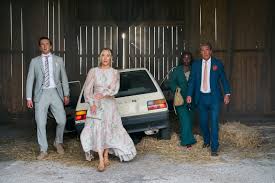
Netflixable? Wedding Mayhem comes to a Swedish Couple promising to “Love Forever”

“Love Forever” is an overpopulated Swedish wedding farce that offers more possibilities than payoffs.

Writer-director Staffan Lindberg throws in lots of tropes and “types” and reaches for plenty of low-hanging fruit in this comedy about city Swedes shoehorned into a country wedding, where “It’s a tradition” trumps pretty much all other considerations.

The tone is jovial and comically irritating in the right ways, but so much and so many are shoved in that this tame tying-of-the-knot tale never quite consummates.

Hanna (Matilda Källström) loves “celebrity chef” Samuel (Charlie Gustafsson) so much that she’s said “Yes” (In subtitled Swedish, or dubbed).

We catch up with her as her Stockholm friends, led by her bestie Linda (Doreen Ndagire), are taking her out for a bachelorette party (a “hen do”).

Samuel’s talked his assistant chef Marco (Philip Oros) into joining him for the jaunt to the quaint island of Gotland for the wedding. Others from the happy couple’s inner circle have booked flights and ferry passage for the weekend ceremony

But Hanna’s rich, self-absorbed jerk Dad (Kjell Bergqvist) and bullied Mom (Anja Lundqvist) won’t be joining one and all the day before to help with any last minute prep. Real-estate broker Dad is too self-important to change his routine. And he’s dismissive of his daughter’s choice for a husband.

And that opens the door to Samuel’s provincial parents to taking over. It starts with complaints about “How can we get to know” the bride’s parents if they don’t come early, and mushrooms into a parade of wedding rituals that dismay the Stockholmers.

Hanna’s sleek designer dress must be shelved, as her future mother-in-law (Barbro ‘Babben’ Larsson) has altered her “traditional” folk costume wedding dress, which “three generations” of brides in their family have worn.

A planned “intimate” wedding is ditched, without the bride and groom’s consent, because his parents “feel sorry for you, having so few friends.”

They’d love to get a preacher to do the “traditional” ceremony, but Hanna and Samuel stand firm on their “civil ceremony” desires. Even when mishaps start piling up on this and other best-laid-plans for the two days and just getting a sane, sober civil servant to officiate seems a lot to ask.

Martin and Helene, the bride’s parents, pay the price for Martin’s haughty refusal to lift a finger to help get them there.

As Marco and Linda — who used to be a couple — cope with that awkwardness and Samuel reveals himself to be a “Mama’s boy” and his older, jealous brother (Vilhelm Blomgren) and his mates kidnap the groom for a rough and tumble “stag do,” we wonder how long this “happy” couple will remain happy, and if they’ll ever tie the knot.

Writer-director Lindberg (“Once Upon a Time in Phuket,” “Love is a Drug”) fills the 90 minute screenplay with complications, coincidences and conflict — handy obstacles standing in the way of “true love.”

But to a one, they’re under-developed, half-baked and left dangling without a decent payoff.

One expects “the last rental car on the island” to be a late model Tercel debacle and a simple punchline. But the many efforts to get someone to officiate at the ceremony waste promising supporting characters and a nice third act twist.

The narrative loses track of the couple and arbitrarily escalates their unhappiness out of turn. Hanna’s fury at her groom’s spinelessness should build into a fury, not simply arrive there.

Supporting cast and throwaway characters and random bits here and there work. But the “Love Forever” whole never gels into anything more than a tiny taste of Swedish “traditions” and an Around the World with Netflix trip that never gets off the ground.

Rating: TV-MA, profanity

Cast: Matilda Källström, Charlie Gustafsson,
Kjell Bergqvist, Anja Lundqvist, Doreen Ndagire, Philip Oros, Claes Malmberg and Barbro ‘Babben’ Larsson

Credits: Scripted and directed by Staffan Lindberg. A Netflix release.

Running time: 1:30

Posted in Reviews, previews, profiles and movie news | Tagged , , , , | Comments Off on Netflixable? Wedding Mayhem comes to a Swedish Couple promising to “Love Forever”

Movie Review: Sexually-attracted StepSiblings in a Rich New Setting — “My Fault: London”

Argentine-born Sevillian novelist Mercedes Ron has made a pretty good living off her rich-stepsiblings-incest intellectual property, the “Culpables Trilogy” — “Culpa Mia,” “Culpa Tuya” and “Culpa Nuestra,” which translates as “My Fault,” “Your Fault” and “Our Fault.”

Being young and affluent and sexually transgressive, these books have been cranked out as streaming service cinema for Amazon and Netflix. The latest adaptation of this material Anglicizes it for MGM/Amazon.

“My Fault: London” makes the heroine a Floridian surfer who gets a “fresh start” in London thanks to her mother marrying a genuine “Daddy Warbucks.”

Mimicking the plot of the first novel, Noah (Asha Banks) loathes the “spoiled Daddy’s boy” Nicolas (Matthew Broome) at first sight. He may be rich and hot, but they’re “complete strangers living together,” albeit in a roomy mansion where they can “stay out of each other’s way.” And he’s just as rude as can be.

“How the lowly have risen,” he smirks.

Their parents (Eve Macklin, Ray Fearon) try to remedy that by throwing them together on social occasions and forcing rideshare app developer Nick to take Noah wherever he’s heading in his McLaren or that hot modified Japanese street racer he likes taking out.

Because Nick is a “bad boy” partyer, a down and dirty street drifter, hanging with a Fast and Furious crowd. And he’s a bare knuckle brawler, risking his pretty face to prove his worthiness among the hoi poloi.

“Any other ‘bad boy’ cliches,” Noah rightly asks?

Did I mention Noah’s the estranged daughter of a race car driver, with quite a bit of NASCAR and Kart training under her belt?

That’s sure to be catnip to Nick, who’s soon all about what’s under her belt.

Yeah, that’s a tacky and trashy way of putting it, but that’s this movie in a nutshell — long, leisurely and louche. What its most sorely lacking is what it sort of aims to be — lurid.

They’re turned-on by their shared sexiness and common pursuits. But the overheated payoffs are tame and tepid — nothing like the build-up.

The melodramatic additions to the plot include the reasons the father (Jason Flemyng) is estranged, the ex-con street-fighter/street racer (Sam Buchanan) who has it in for Nick, Nick’s semi-estranged Mum and the kid “sister” he’s just starting to know, all of which is a lot to lay on a story about two horny young people acting on their impulses, despite the marriage of their parents.

The Brit Banks (of TV’s “A Good Girl’s Guide to Murder”) does a decent job portraying an unimpressable American stuck in London, living in a mansion, weekending in Ibiza, attending charity galas thrown by her stepdad, wondering about acccess to stepdad’s exotic-car-filled garage.

Broome (of TV’s “The Buccaneers”) carries himself like a convincing insolent rich lout.

And the car chases and brawls pass muster, even if the plot turns too-predictable-to-tolerate early on.

But the slick, shiny and cliche’d “romance” they’re trapped in is more “trash” than “pulp,” a story that’s so worn — the played-down “incest” labeling included — as to feel as if we’ve seen other versions of this on Netflix or Amazon Prime. Which we have, or could have sworn we have.

Rating: TV-MA, violence, sexual content

Cast: Asha Banks, Matthew Broome, Enva Lewis, Kerim Hassan, Sam Buchanan, Eve Macklin, Ray Fearon and Jason Flemyng.

Credits: Directed by Charlotte Foster and Dani Girdwood, scripted by Melissa Osborne, based on a novel by Mercedes Ron. An MGM release on Amazon Prime.

Running time: 2:01

Posted in Reviews, previews, profiles and movie news | Comments Off on Movie Review: Sexually-attracted StepSiblings in a Rich New Setting — “My Fault: London”

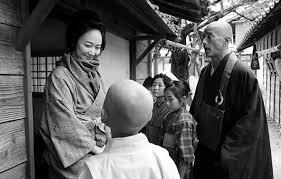
Movie Review: A Scatological Parable where Nothing is Wasted — “Okiku and the World (Sekai no Okiku)”

Attention to detail is one thing we typically celebrate in a cinematic period piece, a movie meant to transport us to a particular corner of the past. But when it comes to the Edo Period Japanese romance “Okiku and the World (Sekai no Okiku),” we acknowledge the limits of such celebrating.

This mostly black and white drama is “Seven Samurai” serious, right down to the scent. A tale of a samurai’s daughter’s attraction to a manure man, you can almost smell the excrement, recreated in diarrhetic detail, right down to the texture.

Writer-director Junji Sakamoto’s 19th century parable is about the real “circle of life” — eat, excrete, fertilize food to eat, repeat — and how that relates to people and class near the end of “feudal” Japan. Shoguns ruled through samurai, schools were run by Buddhist sects and in or outside of those classes, everybody was locked in a world of feces.

That’s what Yasuke (Sôsuke Ikematsu) traffics in. He is recognized by his “stink,” tolerated and accepted within his world, because everybody needs to hit the outhouse on a regular basis. The cesspool needs to be cleaned, and money changes hands — although not necessarily directly “hand to hand.” “Washing” those hands doesn’t go nearly far enough.

Feces, which one and all more bluntly label as “sh*t,” is a going concern (ahem) in an isolated culture lacking other sources of fertilizer. Yasuke buys and hauls, on foot and boat, human waste from temple toilets, tenement outhouses and samurai mansion sh*tters and delivers it for sale to farms on the outskirts of pre-Tokyo Edo.

One and all may look down on Yasuke. But when we meet him, he’s not having that from young Chuji (Kan’ichirô Satô), who collects and sells scrap paper for recycling. He can’t support himself on that, and Yasuke quickly talks him into becoming his new partner. Because his old partner’s sick.

Scooping, toting, storing and spreading human waste is a good way to get sick. A lot.

The two are at their most delicate when they’re stuck in the rain at an outhouse where teacher Okiku (Haru Karoki) takes shelter.

If she has to “go,” they’ll leave. Oh no no, it’s raining, she insists (in Japanese). She’s just taking shelter like you guys. Well, OK. Yes yes. I DO have to. Please PLEASE go.

The humor here never quite descends into the juvenile. But when “poop” is not just your business, but everybody’s business — “We’re SAMURAI! We eat better! Our sh*t is WORTH MORE!” — one and all can have their junior high school sense of humor moments about it.

Okiku is the daughter of an ostracized samurai and any attraction she feels for a kindly manure man will have to transcend more than mere scent.

But as the two dung dealers collect, store — “Just like miso paste, sh*t’s better if you let it age a little.” — and spread their wares, Okiku faces tragedy and the loss of her father (Kôichi Satô) and her voice. The lowly manure men are destined to play a bigger role in her life, if she’s fated to survive and carry on.

Writer-director Sakamoto pays homage to the films of Kurosawa, especially “Rashomon,” in his ode to excrement. Compositions, settings and even the opening scene in the rain intentionally bring that film to mind.

This world is grim, Medieval black and white — sparing us endless sights of crap in living color. But as tiny glimpses of hope and romance are woven in, scenes shift to color, the best way to appreciate Okiku, her pink kimono and her slim hopes for a better life.

Sakamoto needlessly and tediously breaks Okiku’s story into “chapters,” which do little to distract us from the main thrust of the film — waste, not wasting waste and finding the zen nobility in even the lowliest labor and most easily discarded lives.

The world Sakamoto brings back to life — tenements where the residents gripe about the landlord’s more private and thus less likely to overflow in the rain toilet, tale telling told to ease bowel movements, classist bullying met with laughter — and flinging feces — is as vivid as any saga of samurai, shoguns, ronin and clans.

Because at the end of the day, the basest of human needs is not just a great fertilizer. It’s the greatest equalizer.

Rating: unrated, scatological humor, profanity

Cast: Haru Karoki, Kan’ichirô Satô, Sôsuke Ikematsu and Kôichi Satô

Credits: Scripted and directed by Junji Sakamoto. A Film Movement+ release.

Running time: 1:30
Posted in Reviews, previews, profiles and movie news | Comments Off on Movie Review: A Scatological Parable where Nothing is Wasted — “Okiku and the World (Sekai no Okiku)”

Documentary Preview: Andy Kaufman, you think we “get” him yet? “Thank You Very Much”

March 25, a lot of folks who remember, puzzled over and were impressed by Andy K. weigh in.

Posted in Reviews, previews, profiles and movie news | Comments Off on Documentary Preview: Andy Kaufman, you think we “get” him yet? “Thank You Very Much”

Movie Preview: An Intimate and Epic Love Story set against California Horse racing — “On Swift Horses”

The land of opportunity, the state of possibilities and “the love that dare not speak its name.” Or “names.”

Daisy Edgar-Jones, Jacob Elordi, Will Poulter, Diego Calva and Sasha Calle star in this period piece based on a Shannon Pufahl novel.

April 25.

Posted in Reviews, previews, profiles and movie news | Comments Off on Movie Preview: An Intimate and Epic Love Story set against California Horse racing — “On Swift Horses”

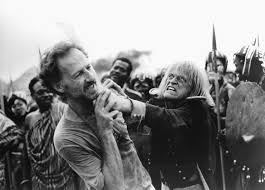
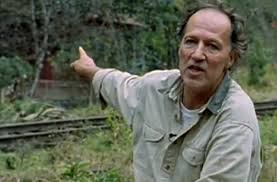
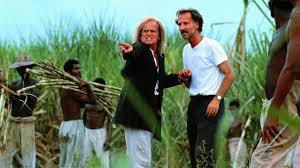
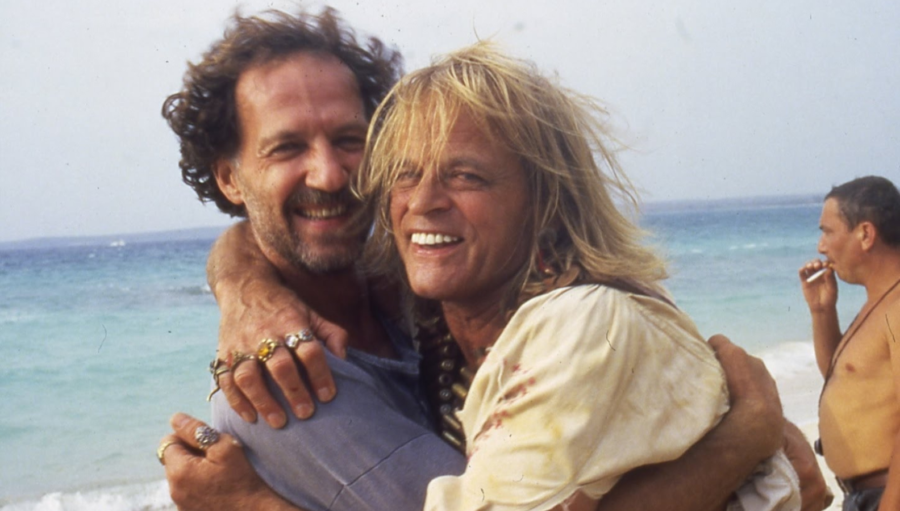
Classic Documentary Review: Essential Herzog, Werner and Klaus Kinski, “My Best Fiend” (1999)

In Billy Wilder’s “Sunset Boulevard,” the deluded, forgotten silent film star Norma Desmond lamented a lost and very different era in cinema — silent films.

“We didn’t need dialogue,” she bellows. “We had FACES!”

It’s a line that comes to mind when considering the quixotic, bug-eyed fury that was Klaus Kinski, a German actor with one of the most expressive faces of the sound film era.

Kinski appeared in some 130 films, and earned a measure of fame in just a few of them — a couple of tiny but memorable parts in the spaghetti Westerns of Sergio Leone, a searing, stand-out turn in a single scene in David Lean’s “Doctor Zhivago.”

But Kinski’s best showcase, he was certain, was as a monologist. Just him, a “role” and a spotlight — always ready for his closeup.

A World War II Wehrmacht veteran, his early post-war acting career established a pattern of firings from theater companies, but “success” doing one man shows. He toured as a largely unscripted, ranting Jesus in such shows in the early ’70s.

His acting career was well-established, if mostly German, by the late ’60s.

But the one filmmaker who truly indulged that need to be seen in camera-dominating closeups playing figures larger than life was the then-young German director Werner Herzog. They did five films together, with the first — “Aguirre, the Wrath of God” — making both men world famous in the mid-70s, formally launching Herzog’s half century career and re-launching Kinski as a star level international talent.

Legends grew up around their hate-love relationship, of violent tirades and threats with firearms, arranged murder and the like, with the actor embellishing this professional feud in his memoirs and Herzog allegedly helping Kinski come up with more “vile expletives” for Kinski to use in referring to Herzog in the book.

That’s helpful to remember in approaching Herzog’s mid-career summary documentary “My Best Fiend,” ostensibly about his relationship with his bug-eyed muse. It’s also an appreciation of Herzog’s epic undertakings with Kinski — movies shot in impossible locations with impossible tasks and impossible budgets, dangerous films where people got hurt and Kinski became one more obstacle to overcome to get “Aguirre,” “Nosferatu,” “Fitzcarraldo” and “Cobra Verde” made.

“Woyzek?” That Czech-filmed period piece, tucked into the end of production on “Nosferatu,” was a piece of cake compared to everything else they achieved together.

Herzog has long made documentaries, and became an Oscar-nominated/Directors Guild of America award winning doc maker after Kinski’s death in 1991. “My Best Fiend” was the world’s introduction to Werner as a top flight documentarian and narrator (in German here, with English subtitles) extraordinaire.

In the years since this film came out in 1999, more has been made of Kinski’s mental illness, his raging narcissism and megalomania. He’s been credibly accused of attempted sexual assault of a leading lady by one director he worked with and accused of molesting his oldest daughter in her memoirs, published years after his death.

Herzog refers to Kinski’s memoirs as “lies” in “My Best Fiend.” But in watching this film anew, I found it helpful to think of Herzog himself as an unreliable narrator. I’ve interviewed him several times over the years, and found him nothing but credible, every time out. But he is a “story teller,” after all. He helped Kinski come up with sorry names to call him on his book? A little self serving, even if it’s true.

There’s lots of on-set footage of Kinski flipping out, and the film begins with a long snippet of Kinski melting down, not wholly in character, in his “Jesus” touring show, before he and Herzog became a team. But Herzog, everybody’s favorite doomsaying German philosopher on film, comes off as more than a little disengenuous in this fond remembrance of his most important collaborator.

Herzog put huge crews and huge populations of Native extras at risk and under hardship making “Aguirre” and “Fitzcarraldo.” More than a few people got badly hurt, something emphasized by using lots of footage from one of the best “making of” documentaries ever, Les Blank’s “Burden of Dreams,” about Herzog filming and endangering himself and everybody else on “Fitzcarraldo.”

The shots of that river boat — NOT A MODEL — careening down a raging river in Amazonia, with a few camera folks and Herzog and crazy Kinski on board, are stunning to this day.

Herzog gives his version of the “getting my rifle” story from “Fitzcarraldo,” threatening his star with “eight bullet holes” before he could get away if Kinski followed-through on his latest threat to quit the film shoot. One bullet, Herzog intones, was saved for himself. Because if this movie — which had already lost original stars Jason Robards and Mick Jagger to sickness and the elements — was not finished, Werner would take his own life, too.

Or so he says. This Indian chief or that producer who offered to “kill” Kinski for him adds to the mythic lore of this relationship. And plans to “firebomb his house” when they got to Germany seem like a grand embellishment.

“We belonged together,” seems more to the point of their psychic connection. “We were ready to go down together.”

They were two crazy guys involved in all those high-degree-of-difficulty projects. And Herzog, the younger man, could call Kinski a bully and a coward once he was dead and gone. But footage on set shows him allowing his volatile star to berate “victims” on the crew without the director intervening.

You were going to fire bomb Kinski’s house? Sure you were, Werner.

Herzog has lived and worked and achieved enough to become cinematic royalty, a beloved figure as a character actor — more sinister than cuddly — lionized “Grizzly Man” documentarian and Grand Old Man of International Cinema, someone famous actors flock to the moment he calls. This documentary reminds us of what he went through to get there.

“My Best Fiend” thus builds two co-dependent legends, with Herzog revisiting their distant past, sharing a boarding house together (the one Herzog grew up in) and recalling the first time he was mesmerized by Kinski’s presence in a movie (sharing scenes with Maximillian Schell in 1955’s “Sons, Mothers and a General”). And Herzog’s tribute film sort of explains himself as he accepts his role in Kinski’s “all used up, spent” demise — at 65 — by refusing to work with him after their last collaboration, another agonizing jungle tale, “Cobra Verde” (1987).

The generous clip samples of their films together make “My Best Fiend” the best primer on prime Herzog, even if he has made Oscar-worthy documentaries and a decent thriller (“Rescue Dawn”) or two since, with new films in the works even today, twenty-five years removed from this revealing and riveting non-fiction film about his years spent managing a madman on the other side of the camera.

Rating: unrated

Cast: Werner Herzog, Klaus Kinski, Eva Mattes and Claudia Cardinale

Credits: Scripted and directed by Werner Herzog. An Anchor Bay release on Tubi, Amazon, other streamers.

Running time: 1:39

Posted in Reviews, previews, profiles and movie news | Comments Off on Classic Documentary Review: Essential Herzog, Werner and Klaus Kinski, “My Best Fiend” (1999)

Netflixable? A Doomed Dairy, a Leveraged Wedding and Polish Racism/Sexism/”Gingerism” — “Death Before the Wedding”

Today’s Around the World with Netflix offering is another cringey-cutesie comedy from Poland, a wish-fulfillment farce about an old industry, a new couple and the “old ways” — which include Poland’s long history of racism.

“Death Before the Wedding” is ungainly and lumbering and rarely funny enough to make Western viewers forget how disastrously dated it is, even if that misogyny, racism and “ginger” phobia here are played for laughs.

Maja (Natalia Iwanska) has just finished her graduate studies in biology (“fungi”) and is ready to tell her parents about her impending nuptials. But mother Regina (Agnieszka Suchora) doesn’t think that’s a great idea. And knowing her dad, Mirek (Tomasz Karolak) gives even the bride-to-be trepidations.

“All my exes still have a stutter because of him,” she complains (in Polish with subtitles, or dubbed).

Dad’s “over my dead body” is a given, a phrase he likes as much as his “You’d all starve within three days if it wasn’t for me.”‘

That one he uses on his wife, his daughter, and the people who work with him — Regina included — at the local branch dairy that’s been the lifeblood of their town for a century.

But the corporate CEO (Antoni Pawlicki) in far off Warsaw has been downsizing operations. He overlooked this one dairy. And yachting vacation or not, he’s got to go TCB to impress his trophy wife (Paulina Galazka) with how he’s a “take charge” guy. They throw their kids in the back of the Bentley and trek to the boondocks to deliver the bad news.

The “Death” is that of the dairy’s drunken manager, who falls into a milk vat. Nothing or almost nothing is made of this, and none of that “nothing” is funny.

The only thing that convinces the CEO to not close the place on the spot is the promise that his wife can plan “the wedding” that Mirek growls about never allowing. Without telling the bride and groom. No, Friday won’t work.

“Friday weddings, lifetime of dreading.”

Mirek’s worst fear, that his daughter is marrying “a ginger” (redhead) is flipped when Milosz (Gamou Fall) the groom turns out to be Afro-French-Polish.

Mirek’s plans to take over as manager of the plant run up against Regina and the women who work there who figure a woman would do a better job.

“You should just leave the men’s business to the men.”

Mirek will need input from college educated Milosz if they’re to figure out a way to “save” the dairy. Regina and her pals could use some help from Maja.

The town cop will try to dig up dirt on the CEO, and the priest is there for the funeral and the wedding.

And there’s barely a laugh in any of this. The idea was to mock Polish provincialism, how “the old ways” still dominate the thinking of those no living in big cities.

The Black guy must play “basketball,” so let’s see if we can figure out the game so he’ll fit in. The yokels take Milosz hunting, playing into his fears and prejudices.

Having seen several Polish comedies on Netflix and a few pre-Netflix, there’s no easy generalization that fits the genre. The darkest ones translate and travel the easiest. The broad and low farces are just corny and show the country as still dealing with a comic sophistication gap, and that goes for the acting as well, which is typically broad and Adam Sandler movie hammy.

“Death Before the Wedding” could have made comic hay with the corpse, could have found more modern “types” to send up, and could have left the whole wedding out of it, thanks to how little attention is paid to the nuptials. And the ways prejudice, provincialism and sexism stand in the way of true love are too trite and tired to summon a giggle.

Rating: TV-14

Cast: Agnieszka Suchora, Tomasz Karolak,
Gamou Fall, Natalia Iwanska, Paulina Galazka and Antoni Pawlicki

Credits: Directed by Tomasz Konecki and Iwona Ogonowska-Konecka, scripted by Hanna Wesierska and Karolina Szymczyk-Majchrzak. A Netflix release.

Running time: 1:41

Posted in Reviews, previews, profiles and movie news | Comments Off on Netflixable? A Doomed Dairy, a Leveraged Wedding and Polish Racism/Sexism/”Gingerism” — “Death Before the Wedding”

Movie Review: Did Anya Taylor-Joy’s agent survive “The Gorge?”

LOL, right?

No agent’s going to get fired for getting her or his client Apple money to make a movie directed by the guy who filmed “Doctor Strange” and “Black Phone.”

But oy. This script. These characters. This dialogue. This setting.

I mean, Miles Teller I get. It’s a LONG time since “Whiplash.” But Anya Taylor-Joy?

“The Gorge” starts out with a certain existential promise in the premise, and then proceeds to cute, glib, explain and EXPLAIN its way out of anything remotely interesting or promising.

To say this goes “generic” in a hot hurry would be an understatement.

Two crack sharpshooters — one a Lithuanian favorite of the Russian kleptocracy (ATJ), the other an ex-Marine (Teller) and sometime “contractor — find themselves hired and assigned to guard this gorge.

It’s a long river valley filled with fog and mystery and darkness. Two towers stand guard over it, along with mines, sensors, automatic sensor-guided machine guns and “cloakers” who hide its existence from the outside world.

The snipers on duty on the east and west rims are cut off from each other and the outside world. Their shift is one year long, four seasons of making certain that whatever’s in this unidentified gasp in the landscape cannot get out.

The Marine is talked into the job by a “high level spook” (Sigourney Weaver) who is awfully vague about what this is all about. The shooter (Sope Dirisu) the Marine replaces thinks this is “the door to hell” and they’re here to “stand on guard at the gate.”

Like a lot of sci fi and horror, that summons up memories of one of the greatest “Twilight Zone” episodes (the Urtext of modern horror, fantasy etc.), “The Howling Man.” But let’s just say that what all this might be about is a lot more mundane and just as far-fetched as that.

The film lapses into “cute” the minute the two shooters realize they’re members of the opposite sex. Their “meet cute” comes through the scope of a rifle.

She’s pale and petite and into “Blitzkrieg Bop” and she packed her leather pants. He’s all about poetry, especially that written on the walls of his tower by generations of earlier guardians at the gate.

Levi resists Drasa’s entreaties as “not allowed,” forcing her to wait a beat or two or three before he realizes she looks exactly Anya Freaking Taylor Joy.

The human sex drive being what it is, they’re sure to find a way to connect on a more personal level. They brag and inhumanly talk shop about their most “impossible ” long distance murders. They might share intel on their duty, puzzle over the nature of the gorge and ponder their fates when things go wrong and all they have is each other to get out of this “hell” — literal or metaphorical — alive.

A top tip — “There’s only one. Jeep.”

Screenwriter Zach Dean had a lot of ways to go with this, ways a lot more interesting and satisfying than cutting and pasting snippets of Sartre and T.S. Eliot and Buddha to read aloud from the walls of Levi’s tower.

But the idea of two amoral mass murderers who can’t sleep at night facing their demons or their sentence to hell for shooting scores and scores of people was too smart, I guess.

You’ve got to hit that second act dilemma and third act crisis and cue a cover of “All Along the Watchtower,” after all. I’m guessing the “Whiplash” and “Queen’s Gambit” gags were invented on the set. But maybe not.

Director Scott Derrickson ensures the action beats are solid enough, that the production design is CGI-assisted gloomy and that the stars looked good in whatever light, fight choreography or romantic interlude they were placed.

But the literal plunge into “explaining” and explaining some more unravels whatever mystery might have made this direct-to-Apple-TV release dramatically challenfing and theatrically releasable.

Perhaps a better agent would have sensed that from the screenplay.

Rating: PG-13, violence, bloodshed, sexual situations, profanity

Cast: Anya Taylor-Joy, Miles Teller, Sope Dirisu and Sigourney Weaver.

Directed by Scott Derrickson, scripted by Zach Dean. An Apple TV+ release.

Running time: 2:08

Posted in Reviews, previews, profiles and movie news | Comments Off on Movie Review: Did Anya Taylor-Joy’s agent survive “The Gorge?”

Movie Preview: Affleck, Bernthal and J.K. Simmons do the books as more bodies pile up — “The Accountant 2”

Golly guys, I still haven’t worn out my t shirts from the original film, which was about a math whiz who knows too much.

April 25.

Posted in Reviews, previews, profiles and movie news | Comments Off on Movie Preview: Affleck, Bernthal and J.K. Simmons do the books as more bodies pile up — “The Accountant 2”

Movie Review: Martial Arts Heirs swordfight over the Academy, “100 Yards”

Arch, stylized and production designed to the nth degree, “100 Yards” is a sort of ramen noodles martial arts Western.

With their harmonica and guitar backed score, sibling filmmakers Hoafeng Xu and Jenfung Xu lean into Leone — Sergio, that is — and his spaghetti Western style with this parable about the rituals and arcane practices of Chinese martial arts academies into the 1920s.

In the anarchic China of the Western-dominated years before WWII, before communist “order” became the rule of the day, cities like Tianjin had thug and bully problems. But martial arts academies, and their students, kept the peace within 100 yards of their front gate. A “circle” of such academies, ruled by committee and dedicated to a rigid and arcane code, might ensure merchants at the market and other swathes of town could be peaceful enough for the locals to do business without hassles.

Whatever the truth, that’s the way this “universe” is set up.

An old master ordains that his best pupil, Quan (Andy On) should “duel” his son, An (Jacky Heung) to see who will inherit his academy.

Quan bests An, who has to decide if he’s going to accept that result or pursue the banking career his now-dead father urged him into. It should be an easy choice, Quan figures.

“Everyone wants to pick a fight to see how tough you are,” he advises (in Mandarin with English subtitles). “Do you really want that kind of life?”

There’s a woman (Bea Hayden Kuo) connected with the bank who offers An a future family. But damned if the imperious, imperialist foreign bankers don’t want to see their clerk fight. An consents, and then quits. The gauche Frenchmen and women have offended his honor.

Thus begins a movie-long quest to have a do-over, to re-fight Quan and perhaps change the order of The Circle of martial arts academies, whose tough-broad, short-haired chairwoman (Yuan Li) dresses in men’s suits and rules by being cooler and sexier than anyone within 100 yards of her.

There are ruffians for hire who enforce their own law — with slingshots — who figure to have a say in all this.

And the two combatants get in each other’s heads by hinting at a mythic “fourth fist fight form” that the old master may have taught one. Or the other.

Might it involve “short sabres?”

The film is a series of set-piece fights involving such sabres, and swords and sticks and fists and feet — sometimes blocked with curved wooden forearm shields.

The entire affair looks movie musical unreal, soundstage-clean, from fancy restaurants and bank dining rooms to spotless walled streets, cleaned and covered in red sand for one thrown-down.

It’s a world of double-breasted suits, fedoras and bowlers and tuxes and white gloves. Wait, China gave up all this for communism?

The movie is both too stylized and cinematic to feel real and lived-in, and not stylized enough to play as “mythic.” It’s watchable between the well-staged and beautifully choreographed brawls, but only barely.

The leads are charismatic enough. But the dialogue is stiff and stentorian, with edicts about how “martial artists marry other martial artists” and the like.

When it works it’s pretty cool. But it’s dull enough between fights that I had time to ponder the great mystery of these cinematic “academies” with their marching legions of fist-foot-way fighters and Broadway-worthy choreography, depicted in martial arts movies from Bruce Lee to Jet Li, Donnie Yen and beyond.

What, exactly, is their business model? How can they feed and house and train and cover healthcare (injuries are common) costs for their “students?” What’s the going rate for minions to a martial arts master?

With or without red ink, rich benefactors or government tax breaks, the martial arts academy of “100 Yards” is worth fighting for when there’s a throwdown, and not so much as we stagger towards the umpteenth renewal of this battle for supremacy without a real “hero” to root for.

Rating: unrated, martial arts violence

Cast: Jacky Heung, Andy On, Bea Hayden Kuo, Shiyi Tang and Yuan Li.

Credits: Directed by
Haofeng Xu and Jenfung Xu, scripted by
Haofeng Xu. A Well Go USA release.

Running time: 1:48

Posted in Reviews, previews, profiles and movie news | Comments Off on Movie Review: Martial Arts Heirs swordfight over the Academy, “100 Yards”