
A legend from history was speculated upon and two legends were made when Werner Herzog and Klaus Kinski shot their breakout film, “Aguirre, the Wrath of God” in the jungles of South America with a stolen camera.
This low-budget 90-minute epic was a slow-motion sensation when it rolled out on screens in the mid-70s, winning awards and giving reputations to the two larger-than-life eccentrics who conjured it up.
Herzog established himself as a filmmaking genius with an appetite for the impossible, and a great teller of tall tales not just on the screen, but about his films, with this career-making jewel. And Kinski, close-to stardom in Europe (he’d done German films, had chewy bit roles in “For a Few Dollars More” and “Doctor Zhivago”) became a bug-eyed screen icon, going on to make such future classics as “Nosteratu, the Vampyre” and “Fitzcarraldo” with Herzog, even dipping his toe in Hollywood for a few films before raging to an early death.
Among Herzog’s many acclaimed documentaries is the deliciously dangerous “My Best Fiend,” about his on-set working relationship and friendship with the crazed Kinski.
The film that made them took up the story of an infamous “madman” among Spain’s 16th centurty conquistadors, Lope de Aguirre. Herzog cast Kinski as the murderous megalomaniac and took a skeleton crew of eight, with a dozen actors and a large ensemble of extras, into the jungle and down the Amazon in a recreation of his expedition to find the mythic city of gold, “El Dorado,” that Incans and others passed on to get the Spanish to stop looting, raping, murdering and pillaging in Peru.
Herzog’s script, allegedly whipped-up in a couple of days, partially lost and then largely improvised on location, sketches in the full measure of the man — a lifelong striver, schemer, coup plotter and adventurer.
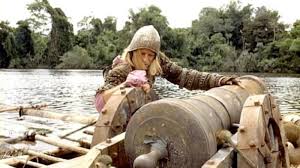
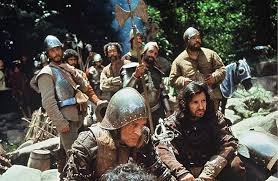
The cinematography of Thomas Mauch is rightly one of the most-acclaimed features of this classic — a broad, brown river, untouched jungles and a motley crew of Spaniards and a freed slave (Edward Roland) struggling with roaring rapids, starvation and attacks by natives (some of them cannibals) on a fool’s errand in search of a mythic city.
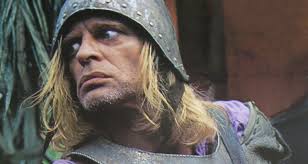
But it is Kinski’s deranged, bug-eyed glare that became the defining image of the film, the face of a man possessed with ambition — he’d arrived in New Spain a mere horse handler — who is third in command of this ill-advised side-expedition, but not “third” for long.
“My men measure riches in gold. But it’s more. It’s power and fame!”
There is a priest (Del Negro) on the trek, our diarist and narrator (the film was shot in English, later dubbed into German for “local” consumption) who tells the tale.
“God’s word must be brought to the heathen.”
Pedro de Ursúa (Ruy Guerra) is the leader, foolishly bringing his wife (Helena Rojo) down river with him through their month or so of hell on the upper Amazon. Peter Berling plays a creature-comforts-craving nobleman who is second in command.
Aguirre, quick to give the orders, discharge the cannon and abandon raftloads of their compatriots when they’re separated, brought his daughter (Cecilia Rivera), perhaps as eyewitness to his rise to glory.
“It won’t be much longer! El Dorado could be only a few days away. No more rust on the cannon. We shall shoot our enemies with golden bullets. And you, Okello, will serve food on golden platters!”
“I am the wrath of God. Who else is with me?”
“Aguirre, the Wrath of God” unfolds as the quintessential “man’s descent into madness” tale, a saga that echoes Joseph Conrad’s “Heart of Darkness.” “Aguirre” became such an art film sensation that it inspired Francis Ford Coppola to finally tackle his “Heart of Darkness” Vietnam epic, “Apocalypse Now.”
Herzog became known, in an instant, for tackling projects with an insane degree of difficulty. Documentaries or features, the tougher the challenge, the more he seed engaged.
“Aguirre” set the bar so high for Herzog that he and Kinski were compelled to make the ultimate overcoming-all-odds epic, “Fitzcarraldo,” under even more formidable South American jungle river conditions.
Today, “Aguirre” remains essential cinema, hand-held footage so vivid it feels like a 16th century documentary, save for the women’s makeup, which is flawless in defiance of heat, weather and hardship.
It was never overcome by its lore and legend, from that stolen camera, to cast and crew living for weeks on those period-perfect DIY rafts and the tale of how Herzog acquired the collection of monkeys who animate its final images. Having interviewed Herzog a few times over the years, I can say that few filmmakers relish relating the challenges they overcame in their past films and how those related to difficulties making “Grizzly Man,” “Rescue Dawn” and other works in his career’s grand third act more than Herzog.
That “camera that I stole” but which he needed to fulfill his dream and make art story never gets old.
“Aguirre” still feels “outlaw” after all these years for all those reasons, and for the uneasy feeling that the phrase “no animal was harmed making this picture” was left off the titles with cause. It’s a classic that could not be repeated and could never be made today.
Not just because of the difficulties, the primitive conditions no cast or crew would stand for now. The movie’s most “special” effect has no peer among today’s batch of cinema stars and character actors. Klaus Kinski died in 1991, but Herzog made him a screen immortal, one of the great faces in cinema history, in this one disturbing adventure that devolved into misadventure back in 1972.

Rating: unrated, violence
Cast: Klaus Kinski, Del Negro, Helena Rojo, Ruy Guerra, Peter Berling and Edward Roland.
Credits:Scripted and directed by Werner Herzog. on Tubi.
Running time: 1:34



