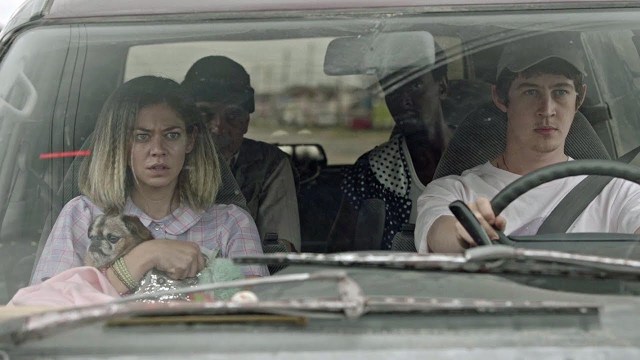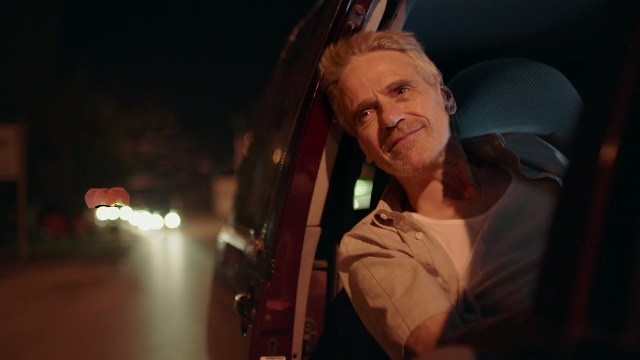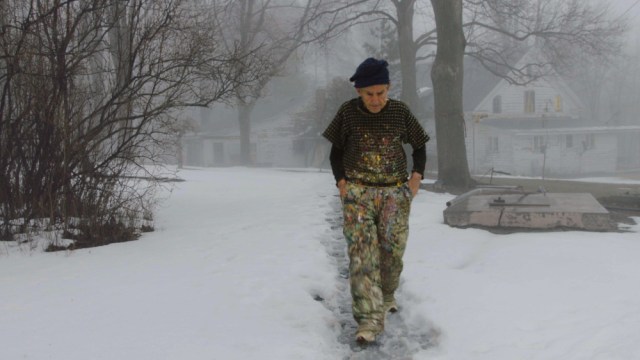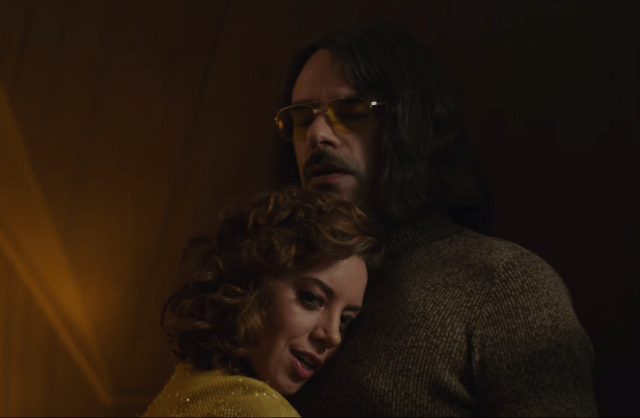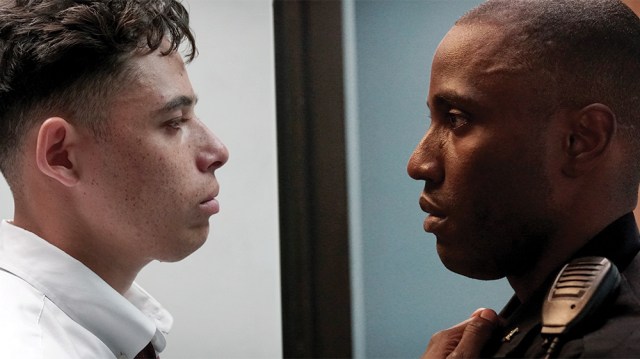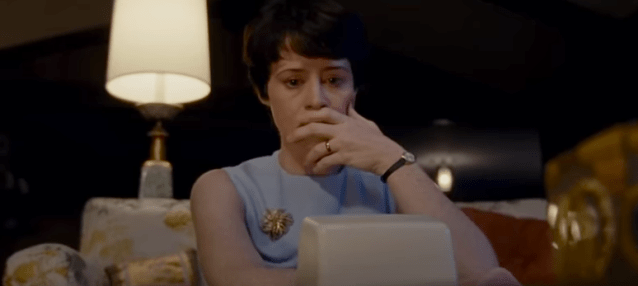
This Indian melodrama and dance fantasia opens April 19. The trailer doesn’t give much away, save for the dance, the setting and the fact that “His Father’s Voice” is in English.

They still eat spaghetti in Italia. And they still make Westerns, though not like in the old “spaghetti Western” days — not with horses, six guns and Sergio Leone theme songs.
“Dogman” is a grim to the point of bleak tale of Italy built on classic Western tropes. A little man is beaten down by the bully who terrorizes his town, ostracized, humiliated. In the Old West, Marcello (Marcello Fonte) would have gotten his gun. What remedies does a man of modern Italy have? Italian justice? That’s an punchline laughed at the world over.
The director of director of “Gomorrah” and “Tale of Tales” (Matteo Garrone) paints a frustrating, harrowing portrait of violent intimidation and the price one pays living under it. We can sense what’s coming, but there’s no guarantee Garrone will give it to us.
Marcello is homely, short, nasal-voiced and vulpine, a 30something dog sitter, dog groomer and animal lover.
“Dogman” is the name of the window of his shop of this run-down coastal town (Castel Volturno, Villaggio Coppola, Caserta). And as we watch his coo and calm a vicious and perhaps frightened pit bull into accepting a bath, it seems apt.
He whistles “Amore!” (“sweetie pie”) at every dog he sees and dotes over the one he lives with and the dogs in his care.
“Everyone in the neighborhood likes me,” he says. “That’s important to me.”
Yeah, he’s a pushover. The other shopkeepers, who play soccer with him, tolerate him but have limits to the respect they give him. He doesn’t merit a second thought.
His sweet little girl (Alida Baldari Calabria) helps dad with his grooming business, feeds him pointers at groomer contests, and loves scuba diving. Divorced dad lets her decide what expensive diving location he must pay for next.
Dog boarding and dog grooming won’t be enough for the Maldives. It’s a good thing he deals a little coke on the side.
But Marcello, like everyone else here, lives under a cloud, a hulking impulsive brute named Simone (Edoardo Pesce, perfectly cast as a brooding behemoth). And the little man’s years of placating the town’s “Mad Dog” with arm-twisted “favors,” saying “Yes” after insisting, pleading and begging to say “No,” and with cocaine, haven’t exactly paid off.
He’s still bullied into driving Simone and a pal to a robbery, still forced to surrender cocaine whenever Simone insists he give it up.
Marcello may realize he’s a victim, but he’s slow to embrace how ridiculous and small Simone makes him. When his soccer buddies suggest hiring somebody to take care of this “problem,” he’s silent. When Simone flips out on his coke supplier, Marcello is complicit. When Simone is hurt, Marcello tends to him.
That’s got to be worth something, right? He’s a “friend,” right?

Garrone makes wonderful use of his diminutive leading man (best known for the film “Asino vola”), and Fonte manages to be both empathetic and pathetic here. The director/co-writer sketches in the moral code of this story in shades of grey. Yes, Marcello cowers. He tries to do the right thing, saving a dog that the robbers joke about stuffing in a freezer.
But unlike your classic Western “hero,” Marcello has few options and no simplistic recourse at his disposal. This is what a kind man trapped on the horns of this ancient dilemma in modern times looks like — lost.
Garrone makes us see that when head-butting might exists without legal restraint, might makes right. It’s not cowardice if you have know for a fact and have plenty of evidence that you’re facing physical injury or death for resisting.
The town has a stark, worn beauty about it — half-abandoned boats, apartment blocks that haven’t been maintained, living space without landscaping or decorating.
And trapped within it, losing his place within it with every shove against the wall, every thuggish demand, is a tiny, simple man with ever-diminishing options.

MPAA Rating: unrated, graphic violence, drug abuse
Cast: Marcello Fonte, Edoardo Pesce, Adamo Dionisi, Alida Baldari Calabria
Credits:Directed by Matteo Garrone, script by Ugo Chiti, Matteo Garrone and Massimo Gaudioso. A Magnolia release.
Running time: 1:43

She gets the life-threatening menace across, just with a glare.
As the actress making this threat, in the guise of abused-woman turned avenger, is that skinny slip of a thing Olivia Wilde, that glare had better be lethal. And in “A Vigilante,” it is.
Wilde first gained great fame as the super-humanly beautiful, digitally perfect “Quorra,” in “TRON: Legacy.” And it sometimes seems as if she’s spent the intervening decade trying to rub that image right out of our eyes.
Movies like “Deadfall,” “Butter” and “Drinking Buddies” played up an earthier, if not always deadlier image. But if you’re tackling an indie American “Girl Who Never Got a Dragon Tattoo,” scary is part of the package.
Sadie is the sort of woman other women call. When we meet her, she’s sitting in the house of a mother cooking dinner, one arm in a sling. The overhead part of the phone call included “He’ll hurt them…if I leave” and a Kingston (New York in winter) address.
We’ve witnessed that woman (Betsey Aidem) help her husband get his coat on as he leaves in the morning. Again, she has her arm in a sling.
We’ve seen Sadie working herself breathless on a punching bag. And as the spaghetti bubbles on the stove that evening, she’s the one there to greet the abusive husband (C.J. Wilson) when he comes home that night.
Her orders are calm, firm and steely-eyed. He is to transfer his assets, put the house in his wife’s name, and following that “you will leave.”
He glowers. She glares.
“I know what you do to her.”
Any hint of objection, any sudden move with the threat of violence is met with a karate chop to the neck. It happens mostly off camera (saving on fight choreography and sparing the actors the risk of injury). But the results are unmistakable.
Sadie beats the living hell out of him.
changing her looks with a wig and bright blue contact lenses
“If you bother her, or the kids, in any way, I will kill you,” she warns her bloodied foe as he sulks out the door. Followed by a whispered “I WANT to kill you.”
Wilde and first-time feature writer-director Sarah Daggar-Nickson have cooked up a strip mall/truck stop Lisbeth Salander for rural New York state, a female vengeance fantasy which, scene by scene, fills in Sadie’s back story, her self-trained bonafides (learning martial arts from books and videos), the big hole in her life that violence against abusive men can barely hope to fill.
Sadie has been doing this enough to have a modus operandi — contact lenses to change her eye color, dye or a wig to alter her hair, blue collar working clothes, black leather assassin gloves, a Honda coupe she keeps under a tarp in the woods.
Payment?
“Food, or money if they have it.”
She is covered in scars. Haunted. Manic panic attacks, at times, tumbling into paroxysms of grief.
“A Vigilante” is a film that revels in the icy quiet of a New York winter, the chilling testimonials of support group women giving details of what happened to them, how it happened, how it continues and the utter horror of it.
Sadie sits in these meetings at a shelter.
“We recognize that we have value…it’s how we got here.”
She isn’t sharing “your ‘leaving story,'” but we can guess she will.
She hits a redneck bar on the way home. “Well whisky, on the rocks.” No makeup, camo jacket and baseball cap, she’s still hit on. She’s pursued into the parking lot. But she expected that. Her pursuers/prey are about to get a nasty, bloody surprise.
Daggar-Nickson fills Sadie’s life with Spartan details — a TV always on, maps on the wall, the odd moment of dancing by herself, sleeping with a bayonet under her pillow. She’s still afraid of something, someone, and not just the men she’s beaten up.

Even though she only reveals Sadie’s back story in the last third, the narrative Daggar-Nickson cooks up is familiar, predictable, even in the way it stumbles off track in the third act. She spares us the worst horrors — violence committed against children, the beatings that bring Sadie to a family’s door. Sadie is the one she doesn’t spare.
But Wilde gives this woman her all. We see her with every freckles and imperfection showing on her cover girl face. And in the couple of scenes that require fight choreography, she handles herself well enough to be convincing.
She puts this generic picture over with a performance that has baggage, damage, history and compassion packed into it — motherly concern for a child she’s just met, wearing the group therapy advice she took to heart and let change her life, advice the Swedish avenger Lisbeth Salander could have given her, dragon tattoo or no.
“You have to fight back. Even if it kills you.”

MPAA Rating: R for violence and language
Cast: Olivia Wilde, Morgan Spector, Tonye Patano,
Credits: Written and directed by Sarah Daggar-Nickson. A Saban Films release.
Running time: 1:31

The pitch has a hint of “madcap” about it.
A teenage spitfire and future rebellious movie starlet goes to New York at 16, accompanied by an older and over-matched chaperone.
But even though “The Chaperone” is coming to theaters, it’s a PBS/Masterpiece Films production. PBS doesn’t do madcap. Nor does esteemed screenwriter Julian Fellowes, of “Downton Abbey” and such films as “Shadowlands” and “Gosford Park.”
What “Masterpiece Theatre” does well is “starchy” and “soapy,” and that’s what this melodrama, “inspired by true events,” manages. It’s a handsomely-mounted, pleasant but dry and almost dull trip back to the Roaring 20s, “Masterpiece” style. Which is it say “Roaring” isn’t really allowed.
The “Downton” connection is underlined by parking Elizabeth McGovern in the lead role. She is Norma, a Wichita housewife who overhears a conversation at a charity benefit and offers to act as chaperone for the talented and vivacious 16 year-old Louise Brooks, played by the effervescent Haley Lu Richardson (“Five Feet Apart,””Split”).
Norma’s husband (Campbell Scott) has no say in the matter, which practically shouts “FORESHADOWING!”
“I hope you won’t go…digging around, when you get there,” is all he says in protest.
And Louise is sell hell-bent on getting out of Wichita that she’ll say anything that placates her indulgent but mistrusting parents (Victoria Hill, Jonathan Walker).
It’s the Prohibition Era, the Jazz Age. And Brooks, with just a hint of the bangs that would anchor her iconic much-copied “bob” when she became the quintessential “flapper,” and a star of such films “A Girl in Every Port,” Pandora’s Box” and “Miss Europe,” is desperate to, as the poet put it, “gather” her “rosebuds” in the big city.
“I don’t intend to live the way I was brought up,” the cocksure dance student declares to Norma. She eschews corsets and is straining at the leash to flirt, drink and romance her way into New York.
“I never worry about anything!” Especially men willing to buy her this or that. Whatever it costs them, “They get the pleasure of my company.”
She’s been accepted at the modernist Denishawn dance school and company, which the real Brooks actually joined — though in Los Angeles, not in New York.
Norma? She’s cautious and provincial. “I have not come here to harass you. I am here to protect you.”
She’s there to put the brakes on whenever Louise, who came to be known as “Lulu,” kind of the first “modern woman,” is about to get out of hand. “It isn’t done…because of the appearance of impropriety.”
And sex?
“Men don’t like candy that’s been…unwrapped,” dear. “They don’t know where it’s been!”
Louise cackles at that. “We’re not all like Marmee in ‘Little Women’ you know.”

But that’s as far as that conflict is developed, really. “The Chaperone” is about the title character’s journey. Norma’s “digging around” is about her past. She was an orphan, from back in the days when nuns ran orphanages and children were loaded onto trained to be adopted out to who knows who in the far reaches of America. Norma wants to know who her birth mother was.
There’s a helpful caretaker (Géza Röhrig ) at the orphanage where Norma wants to get some answers.
The dizzy “Miss Pettigrew Lives for a Day” direction this film might have taken might be light and trite, even. But Louise Brooks is a fascinating figure, and Richardson — seen dancing quite capably in that “Rite of Spring” era style — might have the spark to make that work.
What Fellowes elected to show us instead was a drab melodrama with a few big emotional moments where McGovern gets to show us some fireworks.
Fellowes does his homework and like many a TV screenwriter, “shows his work” with carefully placed historical references to “speak easies” and the “I support Prohibition!” climate of the time.
“Did I tell you? Jack and I are joining the Klan!”
“What clan?”
“The Ku Klux Klan!” a Wichita friend chirps to Norma, complaining about the social changes that have come “since the war” — “laws, customs, morals…Everything’s falling apart!”
Louise and Norma experience their first integrated theater audience (the show is meant to be 1922’s “Shuffle Along.”).
There are revelations — each woman has a painful secret or three — love interests, all rather pallid ingredients to a formula that plays better on Fellowes’ famous Anglo-American PBS soap opera.
The scenes that delight are often in the dance studio, where wife Ruth St. Denis (Miranda Otto) and Ted “Papa” Shawn (Robert Fairchild) lecture their students on dance, movement and propriety — which Louise isn’t hearing.
“”From this moment, you are ambassadors…for DENISHAWN! No drinking or smoking…wear hats and stockings and NEVER roll down (your) stockings!”
Otto, still best known for her ferocious youthful turn in the “Lord of the Rings” movies, is imperious and almost funny — the embodiment of the pretentious artiste.
“Art is not tinsel. It is gold. And it must be handled by the worthy…DAHNCE is…a visualization of divinity!”
It’s pointless to wish for more of this, because that’s not what Fellowes does well. But those flashes of fun might have given the great screenwriter an unsettling moment or two in the editing.
He had to realize he was telling the wrong story, a duller one by design, even if it does star his beloved Lady Grantham.

MPAA Rating: unrated, adult situations, alcohol abuse, mild profanity
Cast: Elizabeth McGovern, Haley Lu Richardson, Miranda Otto, Campbell Scott, Blythe Danner,
Credits:Directed by Michael Engler, script by Julian Fellowes, based on the Laura Moriarty book. A PBS/Masterpiece Films release.
Running time: 1:43
PBS is putting this in theaters at the end of March. It looks very…PBS.
“Downton Abbey Lite,” maybe?A quid pro quo to bring McGovern back for a last blast of the Abbey?
It’s lovely that she’s found an era that suits her and that the “Ordinary People” starlet has made so much of her Second Act.
Teaming up with rising star Haley Lu Richardson was a smart move, almost as smart as Haley Lu signing herself up for the attention of “The Chaperone.”

Alarming, inspiring and yes, laugh-out-loud funny, “Hail Satan?” is a delightful documentary dissection of America’s favorite anti-religion, The Satanic Temple.
Director Penny Lane (“Our Nixon,” “Nuts!”) traces the group from its hoaxer origins, coming to life as political protest performance art, growing into a national movement battling the ever-blurring lines between church and state advocated — adherents say — by evangelical activists intent on creating an American theocracy.
It might be the funniest civics lesson you ever see on the big screen, as clear an assertion of American freedoms as “Mr. Smith Goes to Washington” — and with more laughs.
Lane captures moments of origin, the “church” forming as Florida’s “Tea Party” governor, Rick Scott, called for bringing religion into the state’s schools.
Fine, the future Satanists said. We see them find an actor to be their spokesman, with an earpiece allowing founder Lucien Greaves (not his real name) to feed him lines. They dress him and several followers at a costume shop.
We watch the actor rehearse lines and a special effect (fire flying out of his fingers) for a rally at the Florida State Capital in Tallahassee. A PR person alerts the Florida media.
And then the big day — “Hail Satan! Hail Rick Scott!” It is, our actor declares, “a Great day to be a Satanist!”
Sure, a heckler yells, “You’re gonna go to HELL!”
“I believe it,” our spokes-model improvises. “And I’m very excited about it.”
The idea was to “show the hypocrisy of what Rick Scott is doing,” singling out a religion his backers support for special treatment and enshrinement in Florida law.
Scott, already nicknamed “Governor Voldemort” by much of America, did not realize it. But his efforts to “bring prayer back to public schools” had just launched a global political movement that mocks superstition and super-naturalism, appeals to reason, civil rights and the “religious pluralism” that America’s founding fathers decreed.
All this as they rally, stage self-invented rituals, file civil rights lawsuits and stick a joking thumb in the eye of Evangelical America.
Lane uses interviews, images of protests and rallies, snippets of religious and patriotic films and archival news footage to tell this admittedly lopsided story of The Satanic Temple’s quixotic pursuit of the secular America that, as scholars and historians remind us, only was seriously unraveled by the rise of Billy Graham and political evangelism in the 1950s.
The Satanist’s secret weapon? Demanding, and getting equal time and the equal treatment ensured under the law. Here’s Chris Hayes of MSNBC summing it up nicely with, “Basically, the argument being ‘You open the door to ‘God,’ you open the door to ‘Satan.'”
Want to put prayer in your schools? The Satanists want to lead the prayers, on occasion. Allowing Bible study clubs to hold meetings on campus? The Satanic Temple has comic book reading matter your kids would just love. A prayer opens Phoenix city council meetings? Let a Satanist into the rotation of religious leaders brought in for that.
Lane’s film traces the “Satanic scares” of the 1980s and 90s, when “Satanic rituals,” sacrifices and other boogeyman threats were trumpeted in the supermarket tabloids and local and national news (and didn’t actually exist) to the invention of this new “church” as “a counter-balance to the dominant religious privilege in America.”
Christianity’s Satan, whom the group’s members allow they don’t actually believe in, “is the symbolic embodiment of the ultimate rebel against tyranny.”
“Blasphemy is a declaration of personal independence.”
Satan, in other words, “was the original ‘troll.'”
And they’re out to puncture superstitions, expose hypocrisy and ridicule religious groups that inject themselves into American life and American politics. That “Satanic scare?” “Transference” and projection, one interviewed member declares, comparing it to the then-ongoing Catholic Church pedophilia scandal, covered-up until about the time the “Satanic scare” withered away.
The group, many of whose members appear interviewed in shadows or with their faces blurred, admit to quickly learning how to grab media attention — a rally here, a “pink mass” right there.
That’s how they went after the Westboro Baptist Church’s hate-mongering leader by performing a ritual at the grave of Fred Phelps’ dead mother. Twisting Mormon reasoning, they declared her a “lesbian in the afterlife” announcing that “Satanists…turn the dead gay.”
A Salem, Massachusetts headquarters and gift shop, and bigger protests against a sudden mania for installing religious monuments in state capitals all over the Bible Belt followed.
“I don’t mind when people are offended,” Greaves, the face of an organization of former Goths, outsiders, tattooed metalheads and agitators, says. They want to “force people to evaluate their notions of the United States as a Christian nation. We’re not.” We are, he reminds us, and a scholar or two backs him up, a “secular nation of religious tolerance.”
Where Lane’s film and the group morph from amusing to moving is in their biggest ongoing fight, attempts to put The Ten Commandments into statehouses and courthouses, something a historian traces back to Cecil B. Demille’s promotional efforts for his movie, “The Ten Commandments,” in the Billy Graham-mad, anti-communist 1950s. The producers of the modern “God’s Not Dead” movies would like to do the same.
As we meet cynical legislators and devoutly monomaniacal true believers — some toting Christian and Confederate flags to rallies, and hear the shouting from Christians who get neither the joke nor irony, it’s hard not to take Satan’s side in all this. The alternative just might be, as the Satanists say, submitting to “Christian Supremacy” and the theocracy that implies.
As they create statues of Baphomet (see the photo at top), modeled on the punk rocker Iggy Pop (not the goat’s head, mind you) and demand equal billing next to whatever Ten Commandments this or that cynical politician wants to arouse his base with by placing a religious monument in a public space, as they deal with shouting, protesting mobs at every public appearance, “Hail Satan” gives you a stark choice — the devout, or the jokers who have a point.
“The more hate that was thrown at us, the more important this seemed,” lawyer Stu DeHaan realized.
However it began, whatever some of its more loopy adherents “believe,” American democracy needs the outliers, the agitators, to evolve and weather the regressive changes in the political climate.
As one wag in this church of wags reminds us, “The Devil’s work is never done.”

MPAA Rating: R for graphic nudity, and some language
Credits:Directed by Penny Lane. A Magnolia release.
Running time: 1:35

Take every movie or sitcom gag about the trials of trying to conceive and put them in one movie, and you’ve got “Making Babies.”
It’s a perfectly pleasant sit-through of a couple-trying-to-become-a-triple comedy, even if pretty much every single situation, from first scene to its last, slaps you in the face with “Where’d I see THAT before?”
Eliza Coupe (TV’s “Happy Endings” and “Casual”) and Steve Howey (TV’s “Shameless”) make a genial if not exactly must-see-Moo-vie married pair we follow through the ordeal of a “difficult” conception.
Supporting players Ed Begley Jr. and the late Glenne Headly (in her final film) give better comic value as a fertility doctor and Catholic mom respectively, and first-time writer-director Josh F. Huber creates a few conflict points that show promise.
That it never amounts to much, or anything surprising, is a bit of a shame.
Katie and John take on a new home that’s “a LOT of house” for just two, Katie observes. Let’s do something ABOUT that, John responds. And we’re off — sex (off camera), home pregnancy tests.
He’s a software engineer whose dream is to open his own craft brewery, following “500 year old German beer laws.” Good luck with that, older brother Gordon (Bob Stephenson, never quite funny) grumps. He’s mid-midlife crisis, taking on a motorcycle, joining a dojo.
His wife Maria (Elizabeth Rodriguez) urges Katie and John to go camping and make “a sleeping bag baby,” reassuring them that if that or a fertility doctor can’t help, “I’ll give you one of my kids.”
The first comic spark of life comes from that doctor,, an eccentrically indiscreet California cliche played by Begley.
“Katie, let’s talk about your uterus,” he says,, solemnly. Oh, not to worry, “It’s a real SHOW stopper.”
Thus begin assorted tests and treatments, discussions of IUI vs. IVF, more frustration, consulting a “healer” (Jon Daly, not that funny in a slam dunk part) creating a whole doctor-“witch doctor” conflict. Meanwhile, John is laid off and takes on an Uber job and Katie finds herself confronting “working mom lunch” conflicts at work and a Catholic mom she has to hide their pursuit of scientific solutions to their inability to conceive from.
“A life isn’t something that should be ordered from a CATALOG or online!”

There’s potential all over this picture, but the only real laughs are the “leprechaun” accent Katie/Coupe affects when “assisting” John’s “sampling.” Huber doesn’t do much with the doctor vs. healer conflict, does too little with the sibling rivalry and probably too much with the comically graphic indignities of sperm donation.
That and the general over-familiarity of the topic make “Making Babies” more of a chore than a joy, pun intended.

MPAA Rating: unrated, sex jokes, masturbation scenes, profanity, alcohol abuse
Cast: Eliza Coupe, Steve Howey, Ed Begley Jr., Glenne Headly
Credits: Written and directed by Josh F. Huber. A Samuel Goldwyn release.
Running time: 1:26

All these people calling Jordan Peele “the New Master of Suspense?” On the money.
Two movies into his Hitchcockian thriller/horror career, Peele is a brand unto himself, and “Us” has the opening to show it. A big Thursday night led to a HUGE Friday and early projections of a $40-50 million weekend quickly went by the boards.
$68 is now the top end of expectations, Deadline.com says.
That’s better than most original horror titles — or sequels. Not better than “It!” But heck, in an era of endless comic book sequels, that’s serious coin.
Never bet against an old “Twilight Zone” remake. Hollywood never does.
Saturday’s take will be telling, because as I have been saying and Deadline.com’s reporting of Cinema Score tracking verifies, the picture has people talking — and audiences complaining about the overall pic and the ending in particular. Not great exit interview scores.
That probably won’t suppress the rest of the weekend’s take, as filmgoers in this genre have to see for themselves, but second weekend? Watch out or “Get Out.” Comparing “Us” to Peele’s last film isn’t going to do this one any favors.
And ask the LAST guy everybody compared to Hitchcock — M. Night Shyamalan — what a burden that is. It took “Split” to bring him back. Early kudos tend to go to filmmakers’ heads. They do. People don’t remember how many bad movies Hitchcock made, just the masterpieces.
“Captain Marvel” is falling off, finally, with a $33 million weekend showing a steepening drop (if not in real money…yet). It’s over $300 million, over $320 by weekend’s send.
More interesting to me is the teen weeper “Five Feet Apart,” well-made and well-cast and holding onto audience like gangbusters. It’ll be over $30 by Tuesday.
“Gloria Bell,” the best new release in theaters, has cracked the top ten — over $1.5 million earned from over 600 screens. Not bad.
Love the color palette, here, the brittleness it underlines.
Wilde popped up on the screen (“TRON Legacy”) as the pale female screen beauty perfected and has spent the ensuing years proving she’s a lot more than that.
“Vigilante” opens March 29, in theaters and Direct TV VOD.

It wasn’t “Stop the PRESSES” news last year when racing driver Hurley Haywood came out to the world that not only was he a five-time 24 Hours at Daytona, three-time 24 Hours of Le Mans and two-time 12 Hours of Sebring race winner, but that he did all that as a gay man.
Sports car racing is still regarded as a rich gentleman’s sport in this country, so big “news” there doesn’t reach far beyond the asphalt. In the sporting world, it’s lower-profile, save for the occasional movie star (Paul Newman, Patrick Dempsey) who dips his toe in it.
The wealthy-preppy “movie star handsome” Haywood fit right in with that crowd. And his sexuality rarely came up in his 1970s to early 90s heyday. He wouldn’t let it.
“Pretty quiet” is how he thinks others saw him, when asked about his reputation among others in his sport in the new documentary, “Hurley.”
“I was super shy…almost throwing up if I had to get in front of a microphone.” He admits that in his early days, he even gave thought to driving off the course and losing “so we wouldn’t win” and he wouldn’t have to face the press.
That’s how he comes off to this day, a legend in his sport but a retiring man who shows up at the big races, shakes hands and poses for photos with fans, but keeps his private life to himself.
“It’s not easy to talk about,” he tells filmmaker Derek Dodge, and his mannerisms and demeanor back that up. He makes little eye contact in on-camera interviews, back then (archival footage) and even in the present day.
But behind the wheel, he was something else. Haywood might modestly say he just “keep my foot down longer than the guy next to me” was the secret to his success. But contemporaries, peers and admirers all insist it was more than that.
Patrick Dempsey says “He won in any type of car he could drive…a legend.”
One and all express admiration for Haywood’s “discipline,” which the film never quite links to Haywood’s self-control in keeping his sexuality and lifestyle secret, though Dempsey hints at that.
“He’s the quintessential race car driver,” but “there’s a vulnerability there,” Dempsey says. “He IS different. He’s been different since the moment he was born.”
“Hurley” tracks Haywood’s life, with his former debutante sister Hope filling in the blanks about the early years — behind the wheel at 12 — on through his move to Jacksonville for college, where he won a Corvette autocross race, edging local star driver Peter Gregg. Gregg promptly recruited the young Haywood for his Brumos Porsche racing team and years of glory followed.
Haywood was winning races on the track, meeting his future husband Steve Hill at a Jacksonville gay bar, and keeping it all on the era’s stigmatizing “down low.”
But there were whispers, even back then, winking headlines in stories about Gregg and Haywood, the “Batman and Robin” of sports car racing.
Haywood says “my core people knew,” but he was “indiscreetly” warned by a colleague “You don’t mix business and pleasure.” Hill, his partner and now husband, confesses to feeling hurt by being unable to share in Hurley’s decades of big moments, watching him with friends in the winner’s circle “through a chain-link fence.”
Sister Hope notes the many ways Haywood had to “keep his racing life and his personal life separate.”
Even today, longtime friends and colleagues become evasive when asked if they think Haywood “lost sponsors” or suffered other discrimination back when homosexuality was kept out of the spotlight and “macho” was in on the tracks.
Not every off-camera question screenwriter turned documentary filmmaker Dodge asks — “How did Peter (Gregg) find out?” — earns a straight answer.
“People could just think what they wanted to think.”
The film gets at the sometimes thorny relationship with the abrasive “Peter Perfect” Gregg, which led to the winning team’s breakup. Even that didn’t slow Hurley Haywood’s ascent to the pantheon of his sport — winning big races from the ’70s into the ’90s.
In the film and in life, Haywood got and is still getting his wish, that he be judged for how he performed on the track, “winning with any kind of car they put him in” as Dempsey puts it.
To that end, “Hurley,” like its subject, is most as home at the track. Much of the film was shot at Daytona International Speedway and we see Hurley, consulting with Dempsey and his team, overseeing timed driver-changeover practice, taking us on a tour of Victory Lane, showing us the placard at the track listing his achievements.
Dempsey is here not just as a cheerleader (“a legend of the sport”) who regards Haywood as a mentor, but to explain endurance racing (teams of three drivers sharing behind-the-wheel duties) and deliver context — about how vastly different attitudes towards sexuality have changed.
That may have been the hook that got “Hurley” made. But Haywood’s as in control in the movie as he has been in his life — not giving much away, even his “intimate” life treated with discretion and an arm’s length detachment. He lets Dodge and us in, but not that far in.

MPAA Rating: Unrated, adult subject matter
Cast: Hurley Haywood, Patrick Dempsey
Credits: Directed by Derek Dodge. An Orchard release.
Running time: 1:22