
I trust that there is no financial or ethical penalty for having little urge to rush out and see a mini-series length docu-drama/”documentary” on Elizabeth Holmes, the Theranos huckster and Millennial villain du jour.
The “You Can See Everything” hype around the “performances,” mystery and investigative “storytelling” in this Nathan Fielder/Lance Oppenheim binge-in-one-sitting movie almost matches the hoopla the media ginned-up with Holmes, who dolled-up nicely and made a great magazine cover going up, promoting her “most important invention ever” blood-test gadget, and coming down as her whole house of fraud collapsed around her.
Her case has been litigated. Her personality — unnerving, unblinking eyes, “change the world” or “get that money” ambition and rep as a smart cookie who refuses to apologize for over-selling her “visionary” aspirations — has been been dissected, condemned and sent-up in an Emmy winning Hulu series starring Amanda Seyfried, “The Drop-Out.”
Barring some Martha Stewart “singling out a woman for punishment” story angle, what exactly is the point?
But this Nathan Fielder, Lance Oppenheim film, with Fielder (the series “Nathan For You” and “The Rehearsal” were his) as on-camera interrogator, accuser, close friend and confidante, pokes around the edges of the nature of “truth” and “fact.” Competing agendas of storyteller and subject come into play, and we start to wonder who is pulling whose leg here?
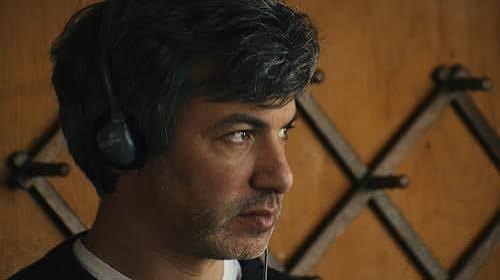
Who do we believe, the adjudicated liar and fraud, or the side-eyeing, confidence-violating all access to “everything” in Holmes and partner Billy Evans’ lives filmmaker? Fielder, an Andrew Garfield/Dermot Mulroney-ish camera presence who listens, hears and tries and tries to trip up his subject, isn’t automatically trustworthy. But he knows that Holmes and Evans picked him to speak to, after a years-long media blackout, for a reason.
Is it because he’s done serio-comic films on “business scams?” Or is it the fact that he’s plainly out of his depth (and knows it) about the “science” of what Holmes claimed and still clings to as her goal even as her company burned through fortunes failing to achieve it?
In a documentary which tracks the last free (pre-prison) 2023 month of Holmes’ life, the nature of filmed “truth” is rehashed as we ponder the impact of a camera and crew on the many supposedly “intimate” conversations between subjects and interrogator. Pulling back to reveal that crew, seeing boom microphones in shots exposes (not for the first time) the lie that every “fly on the wall” documentary lives by.
At least Fielder and Oppenheim have fun with that. Check out the edits of where Fielder’s eyes go when he’s stuck watching “good looking guy” Evans takes a shower. Of course he looked!



Evans is the principal villain in this story of villainy on a huge financial scale. He wasn’t the older-man “partner” that a very young Stanford dropout Holmes hooked-up with to found and build Theranos into a multi-billion-dollar “save the world” company that accomplished nothing of the sort. Evans is the rich (ish) control her/control-the-message “partner” who sought her out AFTER infamy, and who “fell in love” with Holmes without realizing “who she was.”
Fielder speaks for all of us viewers when he probes and picks at that lie and several other holes in Evans’ and Holmes’ stories.
“What’s your definition of a lie,” he asks out of exasperation of this woman who is either “sincere” or “the most manipulative person who ever lived?”
Filmgoers and journalists can appreciate Fielder’s dogged efforts to get to some sort of objective “truth” about who or what Holmes and Evans are and put that in a documentary. A New York Times story quote that suggested Holmes admitted to playing “a character I made up” for the public, investors and the media proves hard to track down, even though Evans insists they have their own tapes that prove it’s a lie and the Times has had myriad credibility problems in recent years.
And then, halfway in, “You Can See Everything” introduces a wild card, bringing in the Emmy-winning star of that “hurtful” caricatured portrayal of Holmes,Seyfried, to ponder and analyze and leap to new conclusions about the “real” Holmes and pitch in to help Fielder get around some limitations of interviewing his now-incarcerated subject.
Should the actress feel guilty for the imprisoned mother of two’s plight? Or does “It’s just TV” excuse the limits of her own search for “truth?”
The film is fascinating for the clues Fielder and Oppenheim let us overhear or experience as they seek “answers” about who Holmes is and “how she operates.” A damning aside uttered by her businessman father detonates like a bomb, and the exhausted despair in her mothers’ unguarded eyes speaks volumes.
We see Evans working tirelessly and with increasing irritation and bravado in focusing the “message” the couple is trying to send. But where is that infamous “first partner” during the Theranos implosion, Sunny Balwi? His presence is sorely missed, especially since Evans and Holmes are seen cooking up a pitch for a new “AI” oriented version of the failed “cloud” backed gadget that landed her in prison.
There is no credited “screenwriter.” There probably should be, seeing as how some of what Fielder reports is reconstructed from remembered conversations and a lot of things (trying to get the truth out of The New York Times) that happen off camera, and Seyfried is “performing” this material.
I wasn’t surprised enough by anything shown here to buy into any “generational masterpiece” hype surrounding “You Can See Everything.” But perhaps that has more to do with one’s “generation.” Yes, the curtains are pulled back on such documentaries and on feature film or TV series “interpretations” of real life people reduced to “characters” for our entertainment. Others have covered that ground before.
Hell, there’s a 36 year-old episode of “Columbo” that dealt with exposing “instant” blood analysis fraud.
The snippets of “The Drop-Out” mini-series sampled here whet the appetite for watching or revisiting that, just as a need for glib closure on something “You Can See Everything” tries to posit as an ongoing “mystery.”
Because there’s no getting around the fact that as a motion picture, “You Can See Everything” is a bit of a slog. It’ll play better as a streaming experience you can pause and even rewind for clarity, than as a seamless story told in 174 minute documentary form.
Thank heavens Seyfried shows up, even if we never quite figure out if she’s playing herself, Fielder’s scripted sounding board or just an actress showing how to make a dull, doe-eyed fraud a riveting screen villain.

Rating: R, full frontal nudity, profanity
Cast: Elizabeth Holmes, Nathan Fielder, Billy Evans and Amanda Seyfried
Credits: Directed by Nathan and Lance Oppenheim. An A24 release.
Running time: 2:54