
It was a gilded age for high-minded British cinema, of larger than life actors taking on epics as heroes and antiheroes — a life of “Lawrence of Arabia,” “Becket,” “Cromwell,” a dash or two of Shakespeare, and “A Man for All Seasons.”
But nothing in the costumed period pieces of the ’60s could match that Plantagent lions rampant catfight that was “The Lion in Winter.” As bawdy and funny as Burton and Taylor could be in their “Taming of the Shrew,” nothing of the age compares to James Goldman’s adaptation of his play about tyrannical Henry II, his scheming estranged wife Eleanor of Aquitaine and backstabbing sons John, Geoffrey and the brawling redheaded fury they’d come to call “Richard the Lionheart.”
“A knife! He’s got a knife!”
“Of course he has a knife! He always has a knife! We all have knives! It’s 1183 and we’re barbarians!“
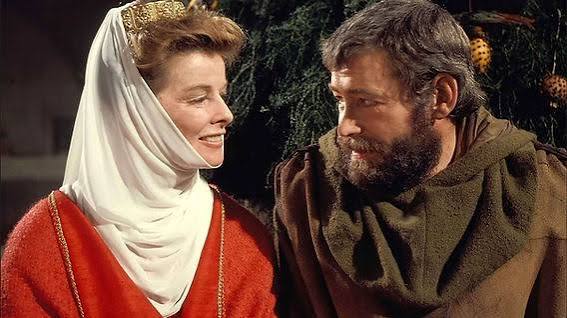
Giving that acrid, sneering bit of self-awareness at how all this will look to history to the formidable Katherine Hepburn hardly seems fare. Peter O’Toole at his grandest gets one and all in the holiday spirit as King Henry II. It’s a story set during the holidays in the French Castle Chinon after all.
“Well, what shall we HANG? The holly, or each other?“
And veteran character player John Castle may not be remembered for much, but giving “extra son” Geoffrey these lines is its own bit of immortality.
” I know. You know I know. I know you know I know. We know Henry knows, and Henry knows we know it. We’re a knowledgeable family.”
I’ve seen Goldman’s play on the stage and this film in cinema society and film festival showings. It plays. It is still laugh-out-loud funny, cutting and mean and boisterous with a parade of despicable characters and a few performances that go right to the edge of “over the top.”
O’Toole is ageing Henry II, who cannot rest on his laurels — or the large pieces of France, along with England and half of Ireland — which he has taken and rules. He has locked-up his rich and powerful wife, Eleanor of Aquitaine (Hepburn), former Queen of France and a bloody nuisance when it comes to Henry’s plan of succession.
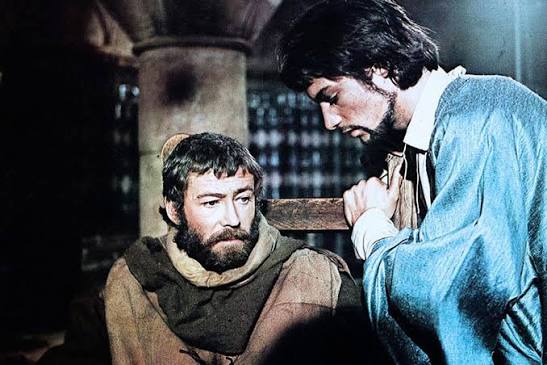
He treats his youngest, John (Nigel Terry) as his “favorite,” but the lad is 16, not so much stupid as naive and headstrong. All the grooming Henry makes time for, and the lad is still unpolished, unimposing and unmannered. Having lost his oldest son, Henry wants to make the youngest John his heir and marry him off to the young French king’s (Timothy Dalton) sister, Alais (Jane Merrow), because Henry craves her county, Vexin, close enough to Paris for Henry to maintain a threatening presence.
As she shares Henry’s bed (talk about “grooming”) we figure the old dog may not just sire his heir, but have ideas of fathering his heir’s heir.
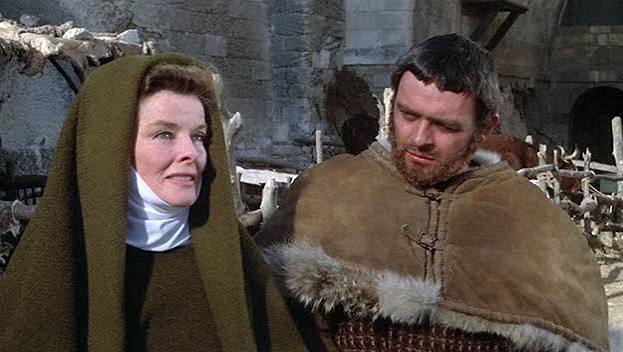
Son Richard (Anthony Hopkins) won’t have it, as he’s next in line, the most martial and imposing of the sons. He was his mother’s favorite. Now, he’s not sure he wants to scheme with her to ensure his ascent to the throne.
“You love nothing. You’re incomplete. The human parts of you are missing. You’re as dead as you are deadly.”
And then there’s Geoffrey, whom we meet as he’s directing other men in a beachside ambush he’s arranged. He’s cunning, but more of a backstabber than a front stabber. He knows he’s an “extra prince.” He has to teach his kid brother “what happens to ‘extra princes.'” What was true later with Richard III is true in 1183, too.
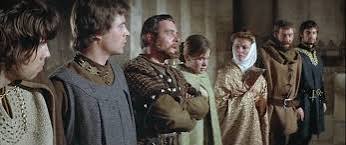
Henry brings all these relations, including imprisoned Eleanor and the teen King Philip of France (Dalton) to Chinon, to hash it all out — who gets what crown, who will marry whom, what Eleanor will have to agree to and what the Pope in Rome or a handy archbishop at hand can facilitate.
Editor turned director Anthony Harvey’s film — “Dutchman” and “They Might be Giants” were his — never quite sheds the staginess of the material, with its many characters entering a room, one at a time, as earlier guests hide in the curtains to overhear the scheming and insults of their rivals.
There’s lovely footage of Eleanor’s procession by barge up the river to the castle, which is as grand, austere and imposing as the players who inhabit it (Abbaye de Montmajour, Arles, Bouches-du-Rhône was the main filming location).
O’Toole is at his most wild-eyed as he shows off his swordfighting skill. He was too young to play a weary 50 year-old Henry II, but his performance has aged beautifully and he more than holds his own with Hepburn, in her most formidable role.
Hopkins gives us hints of a great screen actor in the making. Dalton brings dash and sexual ambiguity to Philip. He’d go on to play the least successful James Bond of them all. And Terry would age into a fine King Arthur for John Boorman’s “Excalibur” a decade later.
The history is more playwright’s fantasy than reality. This “Lost Weekend” never really happened. But the machinations, suggestions of schemes and same sex attraction, the “pawns” moved around by kings, would-be kings and a queen trying to pull a few last strings lines up with history.
Nigel Stock plays the real-life witness to this history, and generations and kings beyond, William Marshal. With another ’60s classic film of Henry II’s relationship with Thomas a’Becket (O’Toole was Henry II there, as well), Marshal, “The Greatest Knight” of all, might be the one character from that period piece-loving era that filmmakers missed the boat on commiting to film.
“The Lion in Winter” may be “a Christmas movie” in the same sense that “Die Hard” is. But this is a classic best consumed in cold weather with a bottle of the “brandy wine” that all involved seemed to crave, by fireside as a means of fortifying themselves for the slings and arrows to come. And the insults.
They all suffer their put downs. But Prince John, remembered in myth as the sniveling pretender who radicalized Robin Hood, is only capable of a “You stinker” and “You turd” or two. Which is why earns the coldest burn of all.
“If you’re a prince, there’s hope for every ape in Africa.”

Rating: PG, profanity, violence
Cast: Peter O’Toole, Katharine Hepburn, Anthony Hopkins, Timothy Dalton, Jane Merrow, Nigel Terry, Nigel Stock and John Castle.
Credits: Directed by Anthony Harvey, scripted by James Goldman, based on his play. An Avco Embassy release streaming on Tubi, other platforms.
Running time: 2:14



