Movie Review: Members are dismembered in “The Cannibal Club”

cann1

The pundits — not the conservative ones, mind you — often joke about the war that the wealthy are waging on the rest of us. And there’s plenty of evidence of that.

In America, they might confine their predations to tax “reform” and a revolution-inciting inequity in the justice system. But what about the Third World? Would they kill and eat us?

That’s the premise of “The Cannibal Club,” a bloody and bloody slow Brazilian satire about that nation’s sequestered, insulated very rich, fair-skinned folk who have all the money and all the power already. Why wouldn’t they start eating  “squeegee punk” poor, the “delinquents” and “scum?”

Classic film fans can think of this slasher pic as “Swept Away” meets “Eating Raoul,” heavy-handed, wallowing in sex and slayings by the bored and depraved ruling classes. The wallowing is substituted for pacing in Guto Parente’s film.

Otavio and Gilda (Tavinho Teixeira, Ana Luiza Rios) love their beachside villa, their seaside pool. They want to keep it, which is why they have a bodyguard as well as a maid and caretaker/pool-boy.

When boss Otavio entrusts the latest caretaker with the run of the place while he runs to town, that means its playtime for Gilda. It’s just that she likes her sexual dalliances to climax with Otavio taking an ax to her paramour in mid-coitus.

Otavio gets his rocks off overhearing her frolics, and on the ax-whacking he gets to administer.

Those rare cuts of meat served every meal have don’t grow on trees, you know.

They’re a part of a whole “club” of super-rich killers in and around Forteleza, donning evening wear for midnight rites which involve watching and videotaping chained sex slaves going at it, butchered by an executioner hiding in the shadows awaiting their finish.

They gather for parties, brag about their travels — “I like First World countries so much better than Third World ones. Clean.”

“Tell me about it. It’s so depressing to come back.”

They self-righteously bloviate about “family, faith and work,” and hiss at the less fortunate.

“They should all die.”

But then a secret that this crowd regards as even darker than “We lure and kill working class Brazilians for sport” gets out, one involving Borges, Otavio’s powerful boss (Pedro Domingues). Somebody from their ranks is going to be killed.

“We’re not MURDERERS!” Otavio declares, in Portuguese with English subtitles and utterly without irony. The poor pawns they kill and consume? They don’t count.

cann2

Parente lets his sex scenes — including masturbation — go on and on. He has the camera linger over the newly ax-chopped or throat-slashed, has his “club” members stand around, nude, covered in blood as if this rite is their right.

A close-up of a rotting dog corpse is thrown in for metaphoric shock effect.

And Gilda goes to the toilet in front of us, and DOESN’T WASH HER HANDS. Savages.

There’s a funnier, more biting movie in this premise, this cast and their treatment of it. But Parente never lets his picture get up a head of steam, never lets it take off.

Suspense? Surprise? He doesn’t handle those elements with a deft hand, either.

Gore alone is not enough to recommend any movie, much less one with a bit of gruesome promise to it. Perhaps Rob Zombie will attempt a Hollywood remake and find pace that will make the dark humor play and give this politically potent premise its proper payoff.

1half-star

MPAA Rating: graphic violence, explicit sex

Cast: Tavinho Teixeira, Ana Luiza Rios, Pedro Domingues, Ze María

Credits: Written and directed by Guto Parente. An Uncork’d release.

Running time: 1:20



Posted in Reviews, previews, profiles and movie news | Comments Off on Movie Review: Members are dismembered in “The Cannibal Club”

BOX OFFICE: How High can “Captain Marvel” Fly?

marvel5

Marvel Studios’ “Captain Marvel” may be another somewhat generic superhero pic, forgettable in spite of its Oscar winning leading lady. Or it could be this year’s “Black Panther” or “Wonder Woman,” although lacking the novelty of those films’ — it’s not the “first” female-fronted superhero franchise — probably not.

But it’s already out-performed “Panther” in its first test — Thursday night’s opening. A 118% improvement over BP, says Deadline.com. Maybe as high as $24 million.

That, combined with the fact that it’s opening on over 3000 3D screens alone (well over 4,000 overall) should make this an instant blockbuster — $100-120 million opening.

Its reviews are not the grade-on-the-curve gushers that “Panther” and “Woman” earned, breaking gender or race barriers in the genre, at least as far as critics are concerned. Metacritic’s aggregate rating is just above lukewarm —  we all liked it, as Rottentomatoes confirms (almost all of us, 82% or so). Just not all that much.

I am guessing $120 million.


Posted in Reviews, previews, profiles and movie news | Comments Off on BOX OFFICE: How High can “Captain Marvel” Fly?

Documentary Review: Girls pedal across the “Graveyard of Empires” in “Afghan Cycles”

afghan1

The bicycle is one of the most liberating inventions in the history of humanity. Its not just the exhilarating thrill of the ride, the exercise and sensation of speed that makes it addicting. Lives are changed and worldviews expanded simply by virtue of the freedom it affords, especially the young, who use this simplest form of personal transportation to experience places beyond their immediate experience, out of the reach of family control.

That has to be what freaks the mullahs of Afghanistan out about girls riding bikes. “We don’t like it,” men will say. Even in the most modest clothing, wrapped in scarves and long pants, the conservatives of this embattled, backwards country still call the act “shameful” and the girls daring to ride “infidels.”

“Afghan Cycle” is about ongoing efforts by the mostly-city girls in their country to drag it into the modern day, striking a tiny blow for gender equality as they ride in packs through city streets and on suburban highways, part of a national girl’s cycling team.

The girls in the film — Frozan and Zahra, Nahid and Mosama and others — enthuse about the “feeling of joy…I don’t want to get off” that cycling gives them.

They have been featured in TV news reports in the West, “training in secret,” “athletes who “risk our lives” when they train.

As Afghanistan struggles to put its Medieval “Taliban” years behind it, with city dwellers noting that women have “regained the right to work, travel and take part in sports,” you’d think Sarah Menzies’ documentary would be an upbeat celebration of teens striking a blow for freedom in a part of the world that leaves a lot to be desired when it comes to women’s rights.

But as they ride in uniforms of headscarves, matching long-sleeve jerseys and gym pants, they talk of “death threats” and “fighting the stubborn taboo” that so many men outside of Afghanistan’s few cities cling to. The movie isn’t the “feel good” story you’d hope it might be.

Frozan, the daughter of a dedicated cyclist who grew up before Afghanistan’s communist takeover and Soviet occupation and thus learned to ride, tries to balance the rituals and mores of her culture with her yearning to do the simplest things, forbidden by mullahs and their hold over the fundamentalists there.

“I don’t have the freedom to go outside and ride any time I like, or to go outside at all,” she complains (in Pashtun, with English subtitles).  “I want that for the future.”

“Security” is the team’s biggest concern. “The Jihadists put a stop to women’s rights…Girls who want to ride have a lot of enemies.”

The fundamentalist dogma there decrees that “Girls should not do sports, not have educations.” The riders are lectured (we’re told, not shown), hassled by passing drivers, jeered for ruining their “future” (reproductively) by riding and risking injury.

“This is not (your) right,” an Imam says on camera.

And yet, they persist. Masoma was the first in her family to ride a bicycle, and she and her sister Zahra are supported in their pioneering efforts by their father.

“We are role models for other girls, showing them they can live free.”

Menzies probably set out to show just that, and ran up against the same headwinds facing female cyclists in Afghanistan. Her film has little dramatic arc to it, and little uplift. It plays as flatly as the desert valleys the girls pedal through. A filmmaking tip — when your settling is as sunwashed and sand colored as this, white subtitling is a terrible choice. White words over white backgrounds, people wearing white shawls and jackets, is like putting no subtitles at all in the film.

The girls don’t come off as future Olympians, riding their mix of road bikes, city bikes, mountain bikes and hybrids over flat desert highways and down dusty trails. That’s not the goal of most, though some harbor dreams of professional careers.

Younger rider Nahid lost a brother to a suicide bomb attack, and as the team rides past the home of what used to be two ancient, gigantic statues of Buddha — which the redneck culture-fearing Taliban blew up in 2001, we’re reminded of just how monumental the change they want to effect change.

Coach Abdul Sadiq Sadiqi remembers first trying to get this team going in the 1980s — pre-Taliban. It’s proven nearly impossible.

One young present day Jihadist wonders why they don’t “machine gun them all” and a seemingly reasonable mullah explains to the filmmaker that “girls are “precious gems,” that “Eyes are absorbent of all badness” and that he will not tolerate uncovering the girlish parts of their bodies of riding in groups.

His fear, their fear, is palpable. Let girls ride in groups and you can’t harass them as easily. Let them ride bikes, and next thing you know, “Islam will be weakened.”

afghan2

But as we see them mount up on their Giants and other global brand bikes, check out the smiles from younger girls they pedal by, the viewer can take comfort that the tide of history is against the oppressors, that girls craving freedom might flee their homeland to find it now, gone with their Schwins.

Someday, though, given time and TV and exposure to a world much wider than the daily calls to prayer, change will come.

2half-star6

MPAA Rating: unrated

Credits: Sarah Menzies. A Let Media release.

Running time: 1:28

Posted in Reviews, previews, profiles and movie news | Comments Off on Documentary Review: Girls pedal across the “Graveyard of Empires” in “Afghan Cycles”

Movie Review: Great Art inspires nightmares and crime in the animated “Ruben Brandt, Collector”

ruben2

If nothing else, animator/writer-director Milorad Krstic has done the world’s “Art Appreciation” teachers and professors a great service. Why bother writing up a final exam when “Ruben Brandt, Collector” becomes available on video?

Here it is, a history of art primer packed into a light, brisk animated caper thriller. Hundreds of paintings and painters are referenced. So teachers, grade on the curve. First five students to list fifty references get the A, second five the B and so on.

The Serbo-Hungarian artist and filmmaker designed “Ruben” to have an Art Moderne/Klimt look, as interpreted by anime and manga artists obsessed with Picasso, Chagall and Dali and rendered in CGI animation.

It’s a gorgeous film about an art therapist who discovers art can also be maddening.

Dr. Ruben Brandt uses art to cure textbook cases of mania, obsession. In take-up-an-art-form solo sessions and group therapy, he convinces his patients to channel their dysfunction into work.

But Dr. Brant (voiced by Iván Kamarás) has nightmares. It might be Andy Warhol’s pistol-packing “Double Elvis” silk screen image from Presley’s “Flaming Star” Western, challenging him to a public gunfight, or Velazquez’s “Infanta Margarita Teresa” chewing his arm off as she drags him through a rail car window while Frank Duveneck’s “Whistling Boy” whistles at him tauntingly.

And all of them — including many characters within the movie — have multiple eyes on one side of their face, multiple breasts, “people” that might have been dreamed up by Picasso and Dali.

The art is out to get him, and that’s got him seeing a shrink himself.

His new patient might offer him some peace. Mimi (Gabriella Hámori) is a svelte, backflipping, parkour-practicing cat burglar who hits museums on the orders of a mob boss. She’s a “kleptomaniac” she confesses — not to the DC detective (Csaba Márton) chasing her through Europe, but to Dr. Ruben.

She does it “because beauty shouldn’t be locked away.”

rubem2.jpg

As Brandt’s nightmares take on a pattern — the strands of hair of Boticelli’s “Birth of Venus” become tentacles to yank him into the painting, at one point — perhaps this unrepentant thief, with help from a few other patients, can “help” the good doctor — provide him some peace, if not a cure.

Flashbacks suggest his “Men don’t cry” father might be the key.

Off we go, dashing into museums across the globe, hunting down Hopper’s “Nighthawks” and Van Gogh’s “Postman Joseph Roulin” and escaping, always in the most aesthetically gorgeous vintage cars — Tatra, Mercedes 300SL a Citroen DS.

The dream psychology matches the film’s muted color palette and flat visual aesthetic. And even as interest in the story waxes and wanes — “What do we need to steal next?” or the mob and cop pursuers guessing “Where will they STRIKE next?” — the visual puns and witty homages to famous art and artists keep “Ruben Brandt, Collector” interesting.

It’s more clever than smart,  but here’s an animated film for adults (violence, nudity) that challenges and rewards the viewer who — yes — paid attention in class, and whose bucket list includes MoMa, the Louvre, the Musée D’Orsay, the Reina Sofia and Prado, Met and Musée Rodin.

3stars2

MPAA Rating: R for nude images and some violence

Cast: The voices of Gabriella Hámori, Iván Kamarás, Csaba Márton

Credits: Directed by Milorad Krstic, script by Milorad Krstic and Radmila Roczkov   A Sony Pictures Classics release.

Running time: 1:36

Posted in Reviews, previews, profiles and movie news | Comments Off on Movie Review: Great Art inspires nightmares and crime in the animated “Ruben Brandt, Collector”

Movie Review: In the Old West, “The Kid” can only have one first name — Billy

kid1.jpeg

It’s the way many a Western legend begins — a boy recognizing a somewhat older boy, a famous outlaw.

“You’re…you’re Billy the KID! I read about you in the paper!”

“Lies, mostly,” the kid will drawl — hard and impulsive and wise beyond his years, thanks to a life by the gun, on the run.

Thus does “The Kid” come to life, a dusty, blood-stained Western built on gritty performances of archetypal characters, flinty dialogue and just a dash of sentiment.

Veteran character actor Vincent D’Onofrio steps behind the camera for this fictionalized account of the last days of Billy the Kid, when his “nasty, brutish and short” life crossed paths with another kid whose life was blood-stained before he ever met William Bonney, and only gained purpose thanks to his time in the presence of the West’s most infamous outlaw.

D’Onofrio takes a small, pivotal role in his film, and delivers his customary fair value in the part — that of a sheriff hellbent on leading Billy to a lynch mob’s noose. But the actor turned director’s real gift here was calling in favors among the acting community, casting well and sometimes against type and knowing a tight script (by Andrew Lanham ) when he sees one.

Newcomer Jake Schur is the “other kid” in this tale — Rio, a farmboy whose efforts to save his mother from his murderously abusive father don’t save her. But at least the dead man won’t be coming after Rio’s sister, Sara (Leila George), or him.

That doesn’t take into account the dead man’s sadistic, unforgiving brother (Chris Pratt), a neighbor who storms in to take his revenge on the 14 year-old boy and his older sister. Only a handy knife and even handier shovel save them.

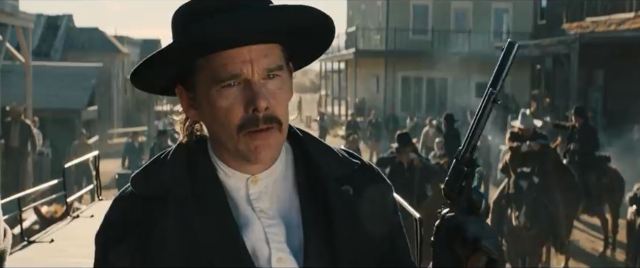
It’s when they’re on the run that they stumble into Billy the Kid’s New Mexico gang. But being around Billy means the law can’t be far behind. And Sheriff Pat Garrett (Ethan Hawke), two weeks on the job, knows where to find his man.

As Billy, Dane DeHaan has perhaps his first “perfect” role, all smudged and peach-fuzzed, yellow-teeth and a worldly growl that belies the character’s 22 years. DeHaan finally shakes off that “Leonardo DiCaprio Lite” label slapped on him in his youth. He just turned 35 and has darkened into the man who can play the “Kid” — manipulative and self-martyred, sentimental and utterly ruthless –aged beyond his years.

If you know your Western history, you’ll remember Billy and his captor Pat had history back in the Lincoln County War. So there’s residual respect, a desire to bring the outlaw to justice and not shoot him to death — with the rest of his gang, and two teens that they just met.

Hawke’s Garrett is classic Western cool — a confident gunman who doesn’t interrupt his shave as the stand-off begins, but rides in to cut off Billy’s last chance of escape.

“You shot a goddamned horse, Pat. Who DOES that?”

It is during the trek to trial that Rio bonds with Billy, who knows his secret and sees it as something they had in common. Billy’s first violence came when he was all of 13.

Garrett, “my own specially assigned sheriff,” is less sympathetic.

“You murdered men.” Ah, but Billy’s famous, even if the newspapers print “lies, mostly,” he tells the boy.

“You know what it means when they start writin’ about ya?” Garrett adds “It means you’re already dead.”

The story beats –shootouts and attempted escapes — are timeworn, but screenwriter Lanham (“The Shack, “The Glass Castle”) concocts the occasion good line and the cast and director make them work.

“I hope you’ll rightly understand I had to at least try,” Billy apologizes after one failed attempt. He may have squandered his “last chance at decency,” to Garrett. But he has his reasons. Nature and nurture did him in.

“Ain’t no good moment I ever had weren’t a lie.”

The bonding scenes have the odd tin-eared line. One of Billy’s speeches plays like, well, a speech. The picture falters in the late acts before rallying for the only finale you can imagine, given the circumstances.

Hawke is on his game now. Ignore his Oscar-worthy “First Reformed” performance if you want. Watch him bellow his way around a lynch mob as Garrett and you’re seeing the definition of a “star turn,” focused, resolute and not given to sentiment when it comes to violence — larger than life, right down to the way he wears his hat.

But I cannot get over how satisfying it is to see Chris Pratt as the heavy. The sadism fits better than the (fake-ish) beard. If Westerns are to be believed, the lawless just-closing frontier was filled with murderous misfits like this guy — bullies whose violence was generally aimed at the weak, whose bravado was wholly based on how they stood up when faced with a “genuine celebrity” in the rough justice of a “count to ten” duel on main street. Pratt makes him feel real, without his usual wink at the camera.

“The Kid” isn’t a perfect Western, but D’Onofrio briskly walks his mostly-on-the-money cast through its classic plot, tropes and archetypes. Who knew Brooklyn’s own Mr. “Law & Order” was a fan? I only see one horse opera (“The Magnificent Seven”) in his acting credits. “The Kid” shows us he’s a lot more at home in the genre than most any of his co-stars in that one. And that he took notes.

2half-star6

MPAA Rating: R for violence and language

Cast: Ethan Hawke, Chris Pratt, Dane DeHaan, Leila George

Credits:Directed by Vincent D’Onofrio, script by Andrew Lanham. A Lionsgate release.

Running time: 1:44

Posted in Reviews, previews, profiles and movie news | Comments Off on Movie Review: In the Old West, “The Kid” can only have one first name — Billy

Preview: Let’s take a gander at J.R.R. the Hobbit Master in the new trailer to “Tolkien”

More of the life and those who influenced the Man Who Made Middle Earth is in this new trailer to “Tolkien,” opening May 19.

Nicholas Hoult and Phil Collins’ daughter Lily Collins star in it.

World War I, an eye and ear for language, storytelling and magic all figure. This REALLY sells the movie, I must say.


Posted in Reviews, previews, profiles and movie news | Comments Off on Preview: Let’s take a gander at J.R.R. the Hobbit Master in the new trailer to “Tolkien”

Preview: “Midsommar” serves up Scandinavian scares from the director of “Hereditary”

Ari Aster’s latest fright-fest is a creepy suggestion of cultish witchcraft set in a Scandinavian festival that happens every 90 years.

Ancient rites, a young woman (Florence Pugh) brought into all this Nordic weirdness by her boyfriend. Did he (Will Poulter) lure her there? For…something?

Guess when “Midsommar” opens.

Posted in Reviews, previews, profiles and movie news | Comments Off on Preview: “Midsommar” serves up Scandinavian scares from the director of “Hereditary”

Preview: “Hail Satan?” hits those who would impose religion on politics where they live — right in the pitchfork

Oh, I am DYING to see this one. Probably need to get around to repenting before I do, come to think of it.

“Hail Satan?” opens in limited release April 19.


Posted in Reviews, previews, profiles and movie news | Comments Off on Preview: “Hail Satan?” hits those who would impose religion on politics where they live — right in the pitchfork

Documentary Review: “Time for Ilhan” gets past the controversy revealing Islamic Congresswoman’s Life story and values

omar1

This might seem an odd moment to be releasing a documentary about the meteoric rise of freshwoman U.S. Representative Ilhan Omar from Minnesota’s Fifth Congressional District.

Forget the fact that the almost-worshipful “Time for Ilhan” was directed by Norah Shapiro. Because the Somali-American Muslim, a groundbreaking politician already, has been outed as an anti-Semite. Right?

I mean, Trump says it. And Fox News. So it must be true.

But Shapiro’s film puts a human face on a woman demonized by the far right and criticized by those reluctant to declare that all Israel — save for its Palestinian non-citizens — walks on water, even in her own party.

We meet her in “Time for Ilhan” braiding her daughter’s hair.

“My mom is PRESIDENT!” the kid says. The mother of three doesn’t so much correct her as want to know how she arrived at that conclusion.

“You have to work hard. And you have to do pushups like boys!”

And there it is.

“Time for Ilhan” is mostly about Omar’s scrappy 2016 race for the Minnesota State House, a black Muslim Somali-American running for a “safe” Democratic seat in the most liberal district in the most liberal corner of Minnesota (Minneapolis).

As such, it is both dated and revelatory. We see the community organizer, most active in the city’s Somali-American community.

In late 2015, she decided that those “voices in my head telling me I can’t” were wrong. “A mother, black, a Muslim woman and a new immigrant” could and should run for a state seat held by the same woman since 1972.

Phyllis Kahn, the longtime representative of a district that has seen a large influx of immigrants added to an electorate that also included a sea of college students, seemed, on a superficial level — “out of touch.”

We see her speaking before the legislature on behalf of a park allocation, for instance. Older, white, more socially conservative.

Omar saw a woman being “comfortable with constituents who are consistently unhappy”  as a reason for taking her on in State House District 60B. And we see an entrenched politician letting the brash newcomer get under her skin.

Shapiro’s film documents the endless canvassing, the grass roots democracy of caucuses, a district convention, begging for votes, debating her opponents in the primary (a solidly Democratic district) and leaning on the Somali-American man, Mohammad Noor, who had come close to unseating Kahn one election cycle earlier.

We see the woman who would go on to become the first-ever Somali-American member of Congress inspire college kids (student debt is one of her cornerstone issues), women and Somali women in particular to take control of the race.

But we’re also treated to the ways the deck is stacked against relying on those constituencies. With caucuses running into business hours, only older, activist white retirees are able — most of the time — to stay the course and hold on.

Omar jokes about the button she invented, “I wear a Hijab. I’m a feminist. Deal with It.”

We hear from her sweet-natured husband Ahmed, who allows that “She is the boss around here.”

And we hear about her personal story, a motherless child of the Somali civil war, four years in a refugee camp, allowed into America, but NOT the America of beaches, palm trees, skyscrapers and movie stars — Minnesota.

ilhan2

As Shapiro’s film sums up Omar’s follow-up election, her move to Congress as part of 2018’s “Blue Tsunami,” in just minutes, along with the firestorm of criticism — much of it made up, some of it true but not-quite-messy-enough to warrant describing as “skeletons in her closet,” we’re left with an incomplete picture, considering the headlines she’s generating for her criticism of the Israeli lobby AIPAC.

Is she an Anti-Semite? Might she hold the views her fiercest, most unscrupulous foes ascribe to her?

Probably not. But Israel and its politics and policies toward the Palestinians within its borders are a classic “third rail” in American politics. You don’t criticize Israel without withering pushback.

And seeing her reaction to the first “scandals” attached to her by lying rumor mongers, you do get the sense of how scary being a lightning rod can be and how ill-equipped anybody would be to have her or his entire life dissected, discussed and exaggerated.

She’s almost certainly sticking her foot in it, or at least seems wholly capable of that.

The portrait that emerges in Shapiro’s brisk, revealing (but not all-access) film is of an inspiring figure, a classic American immigrant underdog making good and making her mark in the Melting Pot.

The ugly stuff? Worth looking into, and worth considering the source, too.

2half-star6

MPAA Rating: unrated

Cast: U.S. Rep. Ilhan Omar

Credits: Directed by Norah Shapiro. A Flying Pieces release.

Running time: 1:29

Posted in Reviews, previews, profiles and movie news | Comments Off on Documentary Review: “Time for Ilhan” gets past the controversy revealing Islamic Congresswoman’s Life story and values

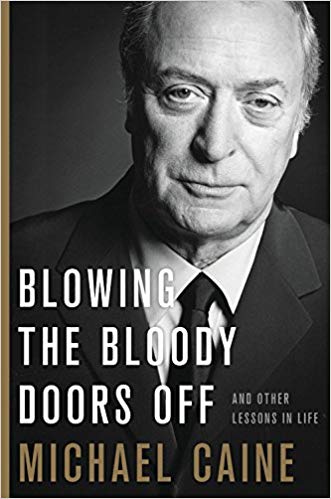
Book Review: Michael Caine charms with another memoir, “Blowing the Bloody Doors Off”

MC.jpg

Funny thing about that Cockney bloke, Maurice Micklewhite, aka Michael Caine.

The raconteur you’ve seen on TV chat shows for half a century is pretty much the fellow you get on the printed page. He’s a polished storyteller, great with an anecdote, something you pick up on in his three memoirs, “What’s It All About?”, “The Elephant to Hollywood” and his latest — “Blowing the Bloody Doors Off,” in which he relates “lessons in life.”

“Never do a dangerous stunt on the last day of a picture,” he says. And then explains.

In chapters titled “It doesn’t matter where you start” and “Getting Old and Staying Young,” “Being a Star” and “Don’t Put Yourself above anyone Else” and “Being Decent,” he tells funny little stories — the more well-worn the better — to illustrate an approach to life that’s won him fame, riches and Oscars.

The acting tips, scattered throughout the book, are little nuggets of pure platinum. Actors love adding little “bits of business,” fidgets, mannerisms, tics. Think of James Dean in most scenes, nervous energy captured by fiddly, twitchy performances.

Caine says that once you know how stuff like that drives the editor mad, you eliminate it. Acting opposite the Emperor of Upstaging, Lord Olivier, cemented this view.
“You will usually need to repeat any sequence at least three times: once for a long or master shot, once for the medium shot and once for a closeup. If you fiddle around in the long shot you will have to be able to repeat that fiddle EXACTLY (emphasis added) in every shot — or the long shot will have to be shot again.”

Help the crew help you, in other words. Warn the sound tech if you’re adding a shout at the end of a few lines delivered at a whisper, etc.

John Huston helped him “find” his character in “The Man Who Would be King” with the only direction he got from him. “You can talk faster. He’s an honest man.”

How’d he get his (dreadful) Southern accent in “Hurry Sundown?” Got a tip from Vivien Leigh on the night John Gielgud introduced them in the mid-60s. Say “Four door Ford” over and again, she said. “Foah-doah-Fohd.” Yeah. That happened.

He talks about movies, favorite scenes, “little darlings,” edited out — stinkers. He’s got a long memory for publications that put out “The Ten Worst Michael Caine Movies” and the like, and a longer memory for every warm moment. Even in his advanced years (he turns 86 March 14), he remembers little kindnesses, the lessons his working poor (gambler/drinker dad, plucky mum) imparted, in words or by example.

“Retiring” to Miami in his early 60s, being told to “reinvent yourself as a movie actor,” not a movie star, by Jack Nicholson, what he did with the money from “Jaws 3D” and how he regards film failures — pithy pronouncements delivered with modesty and the confidence of a man who accomplished much, earned much, and got smarter in the process.

“I may not get the girl, but I’m still getting the parts.”

And stayed married to Shakira a very very long time. That’s part of “staying grounded.” That, and the 50 year old cabbie who says, “My grandfather loved you! He saw all your films.”

“Blowing the Bloody Doors Off” has memories his favorites among his “best” films — “The Quiet Man,” “Alfie,” “Sleuth,” “Educating Rita.” They’re slim anecdotes, mostly, and make you wish the book was indexed so you could get a taste for what makes him Christopher Nolan’s good luck charm (he was even in “Dunkirk,” his second shot at playing a WWII Spitfire pilot. I was the first to report that cameo.). His horse “and I did not see eye to eye on ‘Zulu'” which often ended with Caine on his keister, sitting in mud.

He tells stories about George Harrison singing playing “Leaning on a Lamp Post” and more tellingly — “When I’m Cleaning Windows” (a working class classic of taking pride in one’s work) on a ukulele in his living room, on advice about not wearing “suede shoes” when you become a star from John Wayne, upon Caine’s arrival in Hollywood (has to do with what happens when a fan recognizes you at a public urinal) and on his long friendship with the likes of Quincy Jones (they share a birthday, and have shared a joint party celebrating their special day, on occasion) Sean Connery and especially, Connery’s successor as James Bond — Roger Moore.

Caine has a perfect memory for every person who ever encouraged him, who ever tipped him that “You are going to be a star.” Moore, who arrived at that point earlier via “The Saint,” was one of those.

I’ve interviewed Caine several times over the years, and I am sure my name gave me an “in” with making those happen. Every conversation — in person or on the phone, began with gales of Michael Caine laughter on hearing my name — again.

He was full of Roger Moore (as my friends like to call him, “The REAL Roger Moore”) anecdotes, and as unfailingly generous in talking about him as he is about most everybody he describes in his latest book. I’ve reviewed other Caine memoirs, and his gentility and discretion are what you remember, time and again. He won’t “name names” about the biggest jerk/drunk/diva/heel he ever worked with. Might make a mention, won’t burn them, even if they’re dead. OK, director Norman Wisdom (“The Bulldog Breed”) is the exception — “What a conceited, nasty man.” And Hitchcock shunned him until the day he died for turning down “Frenzy.”

But I had one Roger Moore anecdote for Mr. Caine, which we always finish the chat with. Moore came to Orlando as part of his UNICEF Goodwill Ambassador work — public speeches in which his pay went to Audrey Hepburn’s favorite UN charity.

Moore opened his speech to an amusement park suppliers’ convention about how he and Caine were pals, and how they started out together with similar backgrounds, identical accents etc.

“Back then, he was Maurice Micklewhite,” Moore began the joke, “and I was Roger Moore. He changed his name and kept his accent. I kept my name and changed my accent. Michael Caine went on to fame and two Academy Awards. And I,” Moore pauses a beat for comic effect, “stand here before you today.”

Cracks me up every time I think about it. And it has cracked Michael Caine up a few times, too.

That easy laugh and sentimental smile run all the way through “Blowing the Bloody Doors Off” especially in the laugh out loud moments, mostly remembered at Caine’s expense.

There aren’t a lot of stars that are genuinely charming enough that you can say “What you see is what you get.” Caine is one of the last of those. And that goes for his memoirs, too.

“Blowing the Bloody Doors Off: And Other Lessons in Life.” By Michael Caine. 274 pages. Hachette Books.

Posted in Reviews, previews, profiles and movie news | Comments Off on Book Review: Michael Caine charms with another memoir, “Blowing the Bloody Doors Off”