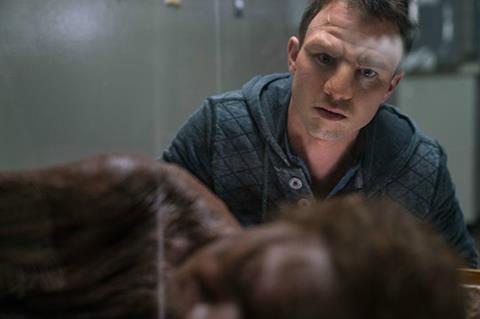
A little late August horror for your late summer viewing pleasure?

Like a fine wine, Louis Garrel‘s “A Faithful Man” needs to be opened to the elements, to “breathe.”
Because if there’s ever been a more airless, so-dry-one-hesitates-to-label-it “romantic comedy,” I’ve yet to set parched eyes upon it.
It is very French, with a ménage á trois, naturellement. It has a few laughs, or at least chuckles. But the deadpan has only 75 minutes to pay off. Letting in a little air would not have unraveled the script’s peculiar, cultural difference qualities. But it might have made it funnier and let it go down easier.
Garrel, an actor (“The Dreamers”) turned actor-director (“Two Friends”) plays Abel, and we meet him as he narrates his oddly emotionless college breakup with Marianne (Laetitia Casta, who is married to Garrel).
They were together three years, and “Things were fine, until one day” she tells him (in French, with English subtitles), “I’m pregnant.”
It’s not his. It is to be the baby of his best friend, Paul. Oh, and Paul wants you to come to the wedding.
Perhaps Garrel just isn’t a funny enough actor to make Abel’s under-reaction to all that score.
“When is it?”
She adds, “I’m glad you’re taking this well.” And “Can he call you today?”
“Maybe not today.”
I mean, we know the French are supposed to be oh-so-sophisticated about things like this, even in their 20s, but come on.
Abel saves his heartbreak for his icy, nosebleeding, “What a loser” exit.
The one person who sees that is Paul’s little sister. Years pass, Paul dies, leaving Marianne with a son (Joseph Engel) Abel meets at the funeral.
Because, naturellement, he shows up. He narrates his continuing love for Marianne and wonders how he can wangle his way back into her life.
But there’s Paul’s baby sister Eve (Lily-Rose Depp).
“I knew her as a child, she had become a woman.”
So even though he’s all-in on Marianne, our story shifts narrators (all three principals eventually narrate), and Eve tells us of her childhood crush on “the most attractive man alive.”
Beware co-writer/directors who script such a description of themselves to be delivered by the beautiful daughter of Vanessa Paradis and Johnny You-Know-Who. It might be ironically intended, but it doesn’t play that way.
And that doesn’t lessen the picture’s inherently iffy — from an American #MeToo point of view — crush to have Eve tell us, “I did only one thing well…I grew up.”

The leading ladies outshine the leading man in “A Faithful Man,” with young Ms Depp showing promise if not a lot of spark, here.
Voice-over narration, the cinema’s laziest storytelling device, is meant to move this along by EXPLAINING all that is happening — “We chatted during lunch. About Paul, of course.” — when the actors as characters could be SHOWING us with their performances, the situations and witty dialogue.
There’s a little of that here. The funniest thing in “A Faithful Man” is all the scenes that paint Abel as a gullible, passive drone, borderline “on the spectrum.”
Girlfriend of three years is preggers with your best friend’s baby? And she’s marrying him?
The kid is plainly playing Abel when the first time Marianne leaves the two of them alone, he whispers, “Mom poisoned dad” and the reason nobody found out is “she was sleeping with the doctor” who signed off on his father’s death.
Garrel could be playing around with the cliches of French romances — ducking into the cinema to watch classic Hollywood film noirs (“The Strange Love of Martha Ivers”) — or maybe not.
I couldn’t decide if he was having us on, even if he gives us a hint he might be, here and there.
I couldn’t decide because his movie’s too brief to flesh out the stories, find funnier lines or beef up the comedy. And never once, in all the characters’ incessant narration, does anybody say, “Drôle, non?”

MPAA Rating: unrated
Cast: Louis Garrel, Lily-Rose Depp, Laetitia Casta
Credits: Directed by Louis Garrel, script by Jean-Claude Carrière, Louis Garrel. A Kino-Lorber release.
Running time: 1:15

Perhaps it’s a national stereotype played out on the big screen. But the beginning of “Kidnapping Stella” is a veritable “How To” guide to carrying out such a crime, for the detail-oriented.
A bearded tough (Clemens Schick) steals the Citroen Jumpy van they’ll use for the job. Together with blonder, younger Tom (Max von der Groeben) they make the necessary hardware store run.
Let’s see, we’ll need soundproof foam insulation, rope, a saw, drill, fiberboard, locks, plastic sheeting.
They sound and lightproof the van, install some U-bolts to, you know, handcuff the victim in place.
Then they soundproof an abandoned flat, bolt a bed to the floor, plastic sheet it for toilet or torture “accidents.”
They go digging in the woods.
No, they don’t show us EVERYthing. They sourced handcuffs, a gun, masks, hypodermics and drugs elsewhere. But they’re being thorough, grabbing their victim (Jella Hasse), screaming, on a remote city industrial block she walks on her way home.
The violence has a clinical, heartless feel. Vic slaps her to get her father’s email address and cell number.
“We are your only friends, now,” he tells her, in the least-comforting way possible — in German with English subtitles. They snip off her clothes for photos to send her father, leave her gagged and keep her degraded.
But Tom quavers at some of this. He won’t eat his chicken nuggets afterward. That’s when Vic shoves some in his mouth and calmly, cruelly, keeps them on task.
“Your emotions are suppressing your appetite. Means you’re thinking too much. You are having second thoughts.”
Thomas Sieben’s thriller has a few surprise twists, which I won’t give away here. Most, but not all, are well within the realm of possibility.
More than a few are melodramatic — mere plot devices designed to complicate a seriously simple tale — and melodramatic enough to make you roll your eyes.
There’s history between the two thugs, and history between one of them and the victim, who has inner resources that her crying and pleading for her life (she fully unloads in the video they send to her father) don’t cover.
And the deeper we get into it, the more violence we expect from “Kidnapping Stella.”
It’s just that the script lets us get two steps ahead of it, long before the midway point. And it never catches up and gets ahead of us again.
The performances carry it, with Schick suggesting a ruthless, callous Mark Strong villain in his turn and Hasse deftly managing to keep Stella’s cunning something she’s able to hide from her tormentors.
But the players can’t sprint ahead fast enough to keep us from getting to the finish line minutes and minutes before “Kidnapping Stella” does. It’s not bad. But it’s not surprising either.

MPAA Rating: TV MA (violence)
Cast: Jella Hasse, Max von der Groeben, Clemens Schick
Credits: Written and directed by Thomas Sieben. A Netflix release.
Running time: 1:29
Irate Conan O’Brien fans — both of them — boycotting “Stuber” over Kumail Nanjiani being a no-show on TBS this week were not enough to kill the opening weekend of the action comedy co-starring Dave Bautista.
It is on pace to clear $9 million.
“Crawl” is the winner between the two new wide releases opening this weekend, with a $1 million Thursday, and a $5 million Friday set it up for a $12 million weekend.
Both films are performing right up to pre release expectations, according to Deadline’s early AM take on the numbers. “Stuber” was picked to hit $7.5 so maybe standing up Conan paid off.
“Spider Man: Far from Home” should hit $40, “Toy Story 4” maybe $20. Yes, it is fading quicker than is usual for that franchise.
“Yesterday” is holding audience and it’s place in the top five, another $5-6 million this weekend. “Avengers” is clinging to it’s last place in the top ten.
https://deadline.com/2019/07/spider-man-far-from-home-crawl-stuber-weekend-box-office-1202645451/
Two-time Oscar winner Christoph Waltz is set to return as James Bond adversary Ernst Stavro Blofeld in #Bond25 https://t.co/PLHS0YJ6rk https://twitter.com/DEADLINE/status/1149813809139163136?s=17
For some reason, Universal chose to post this “long fight” clip from the cult classic “They Live” up on Youtube today.
Alien pod people have taken over the government, and the people are helpless to deal with them.
Can’t imagine why this clip from a 1988 film would show up at this moment in time.
It is the finest big screen outing of wrestler Rowdy Roddy Piper.
“I have come here to chew bubblegum and kick ass… and I’m all out of bubblegum”
He’s the two-fisted tough guy out to foil these election-stealing, treasonous dealing pedophile aliens out to destroy our democracy.
OK, some of that I added.
Look at how young Keith David was!

Father Morris walks into the small office behind his church’s confessional, dons the thin purple stole (vestments) of his office, and explains what he’s about to do.
“Confession,” he says directly to the camera, “the reconciliation of the penitent.”
It’s when he gets to professing his respect for the sacrament, “this profound act of blah blah blah,” that he gives up his game.
“I hate it.”
He knows what it’s for, “contrition,” knows its role in Catholicism, unlike many of us whose “sole source of information on Catholicism is the movies.” But three hours of “extra confession tie every Friday night,” decreed by his bishop, means he’s “trapped in this box for hours on end listening to the inane regurgitation of rote sins.”
And that doesn’t prompt boredom. Oh no. “Genuine hate” is more like it.
After watching “Surviving Confession,” I empathize with this padre in personal crisis. From its “Bachelor/Big Brother” style priest “confessing” to the camera, to Father Morris’s (Clayton Newrow) asides, “translating” the “inane” lists of pseudo sins his parishioners recite — road rage, etc. — with “He also cheats on his wife.” — “Surviving” journeys from surviving boredom to seething resentment.
Which is to say, it goes way wrong long before the melodrama dissolves into bad — REALLY bad — arch, soap-operatic theater in the third act.
“Hate?” I’ll see your “hate” and ante up to “despise.”
It’s a profane, loopy and misguided “priest’s moment of truth/moments of crisis” drama under the illusion it’s witty. Things are off the rails in an instant with the lazy/cutesy “address the camera” devices, the cloying admission that “It doesn’t take ‘Father Brown’ to figure” out the guy who is cheating on his wife, and insipid insistence on explaining who created “Father Brown” for the G.K. Chesteron/PBS-phobic and juvenile.
As if anybody under 70 would be drawn to this. And anybody over 70 would figure out life’s too short faster than you can say “Three Hail Marys.”
Jesus.
The Nathan Shane Miller script treats us to a little dry drollery, Father Morris trying to cajole an admission of adultery out of the adulterer, a quick-motion montage of sleepily-lit face-to-face (nobody uses the confessional “booth”) confessions.
And then the “teen” girl who says she’s 21 (Jessica Lynn Parsons) shows up and upends the Good Father’s night. She’s in a skimpy top with most of her brassiere showing, ripped jeans, Converse high tops, pierced nose, tattoos, snapping gum.
She’s got questions.
“You have rules, though, right? You can’t tell anyone what’s said here, right? Even if it’s illegal? Even if I was like, Hitler?
“The seal of confession is absolute.” Then, because Father Morris has a sense of humor, “Have you been…killing a lot of Jews?”
Priests are good at sizing people up, and he’s pretty sure of what she’s full of straight away. Might even tell the camera, as Father Morris has no qualms about profanity.
But the young woman refuses to leave and takes a stab at annoying him — “What’re you gonna do about it?” And when his pleading turns to ordering, she feigns sexual excitement — loudly — “You dirty boy!” Let’s give those waiting to confess a reputation-ruining treat, shall we?
So begins an evening where the young woman probes the priest’s reasons for taking up the cloth, his repressed sexuality and sexual experience.
And the priest tells her, this pushy, obnoxious, troublesome girl, because that’s what priests do in really bad theater.

As the night wears on, the priest picks up on what her real reason for being there is, in between other confessions he must hear — the wife (Jayne Marin) of the cheater, the woman (Sarah Schreiber) the cheater is cheating with.
There’s barely a moment in it that doesn’t play false, not a sequence that doesn’t feel contrived and dramatically flat, with only the odd line, here and there — glib sarcasm about rituals from the guy who chose a life of repeating them, endlessly — that has something going for it.
Yes, you can joke about priests and altar boys and no, there’s no prurient thrill to hearing other people’s secrets because A) “It turns out I’m not a 13 year old girl” and B) “It’s not gossip if you hear it directly from the source.”
All of the promise of this premise is in the exposition-heavy opening act. All of that promise evaporates when “Amber” shows up. And any third act efforts to raise the stakes and have the priest go full “Bulworth” — telling one and all how he REALLY feels — just grate.
The hard truths about this misbegotten debacle are that it began to go seriously wrong in the script stage, and that production compromises sealed its fate.
I’m not Catholic, but I know the drama inherent in that “anonymous” booth, and how hard it is to shoot around that, maintaining the proper pitch of performances, staging and lighting and doing many more set-ups. So they didn’t bother building it around that shadowy box.
It’s too coarse to be “faith-based,” too thin to attract “name” talent and too crudely melodramatic to work. So who was this for, exactly?
Because even if “Surviving Confession” makes it to streaming, will anybody stick with it to the end?
It’s a priest-in-crisis melodrama that commits the cinema’s cardinal sin. It’s boring.

MPAA Rating: unrated, violence, adult subject matter, profanity
Cast: Clayton Nemrow, Sarah Schreiber, Jessica Lynn Parsons, Misty Baileys, Kevin Ging
Credits: Directed by Matthew Tibbenham, script by Nathan Shane Miller. A Happy Sisyphus release.
Running time: 1:31

There are two ways to go with a story about a toddler left alone to fend for herself — tragedy or comedy.
The’90s slapstick farce “Baby’s Day Out” was an example of the latter, the touching French little-girl-lost drama “Ponette” a classic of the former.
You’d be hard pressed to find a version of this tale darker than “Pihu,” an Indian melodrama based on a true story about a child of two left to her own devices in a modern, electrified and cluttered high rise condo.
It’s a horror movie, with a hint of exploitation about it, premised on that old adage that parenthood is basically “being on suicide watch for 18 years.”
Pihu (Myra Vishwakarma) is an adorable two-year-old imp whom we hear before we see.
The sounds of her second birthday party play behind the chalkboard drawing animated opening credits. She’s a smart child, speaking Hindi (with English subtitles), singing “Happy Birthday” to herself in English.
She awakens the next day, crawls out of bed with Mummy all bright-eyed and raring to go, collecting the paper (she recognizes Gandhi’s photo on the cover), counting every step as she walks up and down the flight of marble stairs in the apartment.
But chaos surrounds her. The walls are covered with a child’s magic marker scrawls. Decorations, including strings of lights, are entangled left and right. Balloons randomly pop, alarming Pihu. There is party debris everywhere, with breakables scattered all over the floor, booze bottles on every table and counter-top.
The sink is running. The TV has an astrologer droning on and on.
Calling for “Papa” is in vain. He’s nowhere to be found. And Mummy? She won’t wake up.
Pihu calls for “Mummy” repeatedly, and occasionally breaks out bawling — sometimes with good reason, sometimes randomly. Because she’s two.
She can’t quite reach the faucet, even though she’s found something just tall enough, and teetering, to get her close. She can’t reach the door knob, which considering the accidents waiting to happen all around her, is tragic. Or not.
At her height, we can see cords plugged in, willy nilly, wiring violations and nothing-absolutely-nothing has been “child-proofed” in that Western “helicopter parent” tradition.
No dear, that bottle of white liquid you fetched from the cupboard isn’t milk.
“Pihu” tracks the child through a long day, almost falling off this, almost tipping over that. For the Love of Mercy, you think, DON’T go on the balcony!”
Dad calls to chew out Mummy, but “Mummy is asleep.” He doesn’t figure this out right away.
“You females are the worst things in any man’s life!”
He calls back to apologize. He is distracted, trying to deal with an airline, a business meeting and later a taxi, struggling to cajole Pihu into putting Mummy on the phone every time he calls. Something went down after that party.
There’s a nasty, lengthy screed scrawled on the bedroom mirror in lipstick. Uh oh.
We can see that we’ve come at a bad time, that this is a climactic act in a domestic tragedy that can only get worse with a child too young to know any better fending for herself. The microwave’s a dangerous place to heat up your toast. A gas stove?
Don’t get me started.

Writer-director Kapri Vinod is better at playing with the anticipation of peril than doing much with the suspense built-in to this situation. There is no music to heighten suspense, just the terrors of daytime Indian TV for a soundtrack.
He has us one step ahead of Pihu, seeing the potential disasters in every climb up a counter, every trip out to that balcony, every blithe, barefoot stroll through a minefield of potentially debilitating cuts.
Dad barking on the phone that he rushed out and “left the iron on” is an easy one.
“Mummy, what’s that smoke?”
Spilling Mom’s prescription bottle all over the floor, overloading the notoriously DIY in-house power grid, blowing at the flames trying to toast bread on a gas burner has produced trying to put them out? That’s mayhem-in-the-making of an altogether higher order.
Vinod nicely folds all this within the clever child’s daily routine — brushing her own teeth, potty breaks, etc. Keeping the camera in tight, filming most everything from Pihu’s close-to-the-ground point-of-view, Vinod manipulates and toys with us, veering his picture from frightening to just-plain-cute.
The little girl is utterly natural and amazing, as they all are at that age. Vinod had the child’s real parents on set playing her Mummy and Daddy on the phone.
Too much of this any parent anywhere in the world would recognize, a string of your worst paranoid fears about what could go wrong if you turn your back or get distracted when there’s a toddler in the house.
There’s not a lot to “Pihu,” but as Vinod’s waking nightmare plays out, he drags us into the story simply by dint of recognition. Yeah, we had this or that close call in our house. Did we child-proof that cleaning fluid cabinet? And who needs irons, anyway? A few wrinkled shirts and skirts, and a whole lot less risk.

MPAA Rating: TV-14
Cast: Myra Vishwakarma, Prerna Vishwakarma
Credits: Written and directed by Kapri Vinod. A Roy Kapur/Netflix release.
Running time: 1:29
The film came out on July 14, 1969.
Fonda, Toni Basil, Roger McGuinn, Henry Jaglom, Roger Corman.
Over the years I’ve interviewed most everybody in this story and many of those involved in the film. Not Jack, alas.
But at some point in the conversation, no matter what movie we were scheduled to talk about, they’d bring up “Easy Rider.” Fonda, at a little cocktail party for “Ulee’s Gold,” pondering his Hollywood rep and his “legacy” when two bikers outside in traffic, rev their engines.
He just grinned, turned to the window and held his arms open wide. THERE is his legacy.
Damn, look at the scale of this.
A manga period piece turned into an action spectacle of the sort that might normally turn up in anime form.
Not keen on the period-inappropriate music. But…
Look for this one, subtitles and all, Aug. 16