
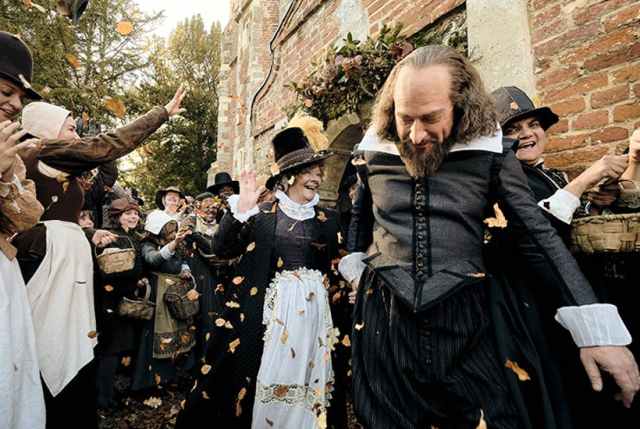
Movie Review: Shakespeare retires and comes home in “All is True”

true1.jpeg

“All is True” is not all true, as we know precious little about the personal life of one William Shakespeare of Stratford-upon-Avon.

But if anybody in the movies has the license to speculate on that life, it’s Sir Kenneth Branagh, whose “Much Ado About Nothing” and “Hamlet” and “Henry V” and “Othello” and other adaptations make him this generation’s Olivier, or better still, Orson Welles when it comes to passing on his love of the Immortal Bard to the movie-going masses.

So here’s a speculative film; stately, handsome — Wellesian, even — about Shakespeare in Retirement. And if it’s not a witty dazzler or moist-eyed appreciation, it’s still a warm homage to the Greatest English speaking playwright, and lovely to look at, to boot.

The title comes from the “alternate” title of “Henry VIII,” the last play Shakespeare produced in London, an opening title reminds us. After the fire that a prop cannon caused that burned down his beloved Globe, the poet and playwright gave up writing, and although not yet 50, retired to the little town where he was born.

Will (Branagh) is resigned to resting on his laurels and his profits.

“You tell stories?” a boy asks.

“I used to.”

He returns to a woman he left at home, his older wife, Anne Hathaway (the peerless Dame Judi Dench, the heart of the film), his two daughters, Judith “the spinster” (Kathryn Wilder) and the married Puritan Susannah (Lydia Wilson).

He returns to mourn the little boy, Hamnet, who died decades before, to settle his affairs (having no male heir) and create a garden for the child, an aspiring poet.

The conflicts that greet him and us are over the family’s reputation in these Puritanical times, a scandal that might engulf Susannah and the insults and accusations hurled at Will by Hamnet’s surviving twin.

Judith describes herself as “an angry bitch,” and wails “Why did the wrong twin die?” as if she believes that’s what her father has always thought.

Hadley Fraser plays Susannah’s pious to the point of self-righteous husband, a Puritan’s Puritan who almost appreciates the irony that a man who does not condone acting or the theater stands to inherit most of his father-in-law’s estate.

Shakespeare plays with his granddaughter and the neighbor’s dog, and plays at being a gardener, digging and planting flowers in memory of a son whose funeral he was too busy to leave London to attend.

It’s all rather dry and seriously mundane dramatic material, and all of Branagh’s Wellesian scene-compositions — deep focus shots placing characters in pools of candlelight at different points-of-focus — cannot spice it up.

The best scenes pair Branagh with Dench, for brittle reminiscences over a marriage that lost its fire long ago, and with Sir Ian McKellan and Gerard Horan.

McKellan plays Henry Wriothesley, the Earl of Southhampton, a patron of Shakespeare, the person to whom several of his most romantic poems are dedicated. He was much younger than Shakespeare in real life, the “fair youth” of his love sonnets.

But even though McKellan is thus miscast, their fireside chat has the warmth of intimacy and wit that much of “All is True” lacks. The Earl wants to know why “the greatest man in the Kingdom, after His Majesty, of course,” is “so small,” why he has “lived the smallest life.”

That’s a perfect commentary on this under-educated man who in truth, lived large and cast a giant shadow, but who left London and retired to a life that was everything the Earl said it was — small.  His genius, revealed in his irritated answers to “How” and “Where” questions from a fan, was his imagination and his ability to read widely and adapt history and earlier plays freely in creating a stunning string of timeless comedies, dramas and tragedies.

Horan plays Ben Jonson and brings a nice twinkle to their fireside scene, two great writers, friendly rivals, with Jonson freely admitting to being the lesser of the two “equals.”

None of those grand moments are enough to remove the air of disappointment the whole affair wears, the sense that screenwriter Ben Elton (“Blackadder”) should have found a few more crackling exchanges, given Shakespeare more of the wit we hear in the plays.

But as funereal as it all can feel, “All is True” manages the wistfulness that must have been Branagh’s design, the director of “Thor” and “Murder on the Orient Express” returning to his first love, his idol, for an affectionate if somewhat perfunctory portrait.

Perhaps he has “King Lear” in him, and perhaps the upcoming “Artemis Fowl” and “Death on the Nile” will give him the capital he needs to attempt it. Until then, he’s managed a perfectly pleasant if not wholly satisfying Bard in Winter, and that’ll have to do for now.

2half-star6

MPAA Rating: PG-13 for thematic elements, suggestive material and language

Cast: Kenneth Branagh, Judi Dench, Ian McKellan, Jack Colgrave Hirst, Kathryn Wilder

Credits: Directed by Kenneth Branagh, script by Ben Elton. A Sony Pictures Classics release.

Running time: 1:43

Posted in Reviews, previews, profiles and movie news | 1 Comment

Preview, “Rambo: Last Blood”

“Why?” you might rightly ask.

Stallone, looking more like a national monument than ever, revisits his second biggest franchise, as you folks convinced him revisiting “Rocky” was such a good idea (Nope).

Lionsgate has “Last Blood,” Sept. 20.

Posted in Reviews, previews, profiles and movie news | Comments Off on Preview, “Rambo: Last Blood”

Movie Review: “Rocketman” never quite takes flight

rocket1.jpeg

“Rocketman” is a proper musical, with lots of tunes, big production numbers and the actors doing their own singing.

As the songs are from the extensive, radio-dominating Elton John songbook, there are scores of them most of us know by heart. And as star Taron Egerton is better at enunciating than Elton ever was, Bernie Taupin’s lyrics pop out to great effect.

The lead is a reasonable facsimile of the former Reginald Dwight turned Elton Hercules John. And if Egerton’s singing voice isn’t exactly a chart-topper, he’s an acceptable singing alternative at least faintly resembling the real thing.

Elton John’s life and dirty laundry are hung out, and “Rocketman” is far more open about the singing sensation’s sexuality than say, “Bohemian Rhapsody” was, as indeed Elton was and Freddie Mercury wasn’t. He taught a generation the word “bisexual,” and how it could be used to soften the news of a famous person “coming out.”

But damn, “Rocketman” is a slog, a nearly joyless musical that threatens to take flight at several near-tingling moments and never does.

It’s as if the “miserable Elton” of his alcoholic years, and his latest years (the grumpy tantrum tossing concert-quitter) was final arbiter of the tone of this. And so it’s all “I’ve had an unhappy time of it, now it’s YOUR turn.”

Little Reggie (Matthew Illesley) can show off his uncanny ear and piano score memory and burst into an underage “The Bitch is Back,” and you grin and think, “Here we GO!” Teen Elton (Egerton, of “Kingsman” and the godawfulest Robin Hood on record) can play, dance and duck through a pub as director Dexter Fletcher’s camera chases him into the streets belting out “Saturday Night’s Alright” (for fighting), and you lean into the picture, expecting more of the same.

Nope. It’s more about a little boy’s “When’re you going to HUG me?” to his priggish, heartless dad (Steven Mackintosh), a tween Reggie (Kit Connor) stumbling across his cheating, self-involved Mum (Bryce Dallas Howard at her beady-eyed, Brit-accented best) or a drinking, lonely superstar Elton hearing “Nobody’ll ever love you” from that same Mum, or the seductive, handsome but faithless lover-manager John Reid (Richard Madden)

And Taupin? As portrayed by Jamie Bell, who almost steals the picture with a single alternative take on “Goodbye, Yellow Brick Road,” Taupin is Elton John’s savior, champion and the movie’s patron saint.

“Rocketman” is told in a flashback his first visit to AA, in a Satanic vamp stage costume, perhaps the corniest framing device in the history of musical bio-pics. The film tracks his story from piano prodigy, with only his beloved grandmother (Gemma Jones) keeping the faith and encouraging him as he dazzles the family, then a Royal Musical Academy teacher by repeating the “Rondo Alla Turca” (by Mozart) she just played, even though he’s never heard it before.

We get a taste of his first rock band, a moment of touring in a van, a not-their-real-names bit of backstage advice and seduction from an American 1960s soul music tour — “You’ve got to KILL the person you were born to be in order to become the person you WANT to be!”

How…screenwriterly.

That magical first meeting with the man who would become his real life partner, “the brother I never had,” his lyricist Bernie, is held in freeze-frame. So is that first “I’ve got some lyrics that need music” passing of a manila envelope.

There’s just a touch of the young agent (Charlie Rowe) who hears and sees something in him, and the crusty grump (Stephen Graham) who doesn’t.

A favorite sequence in such movies is that “breakout” moment. For young Elton, who stole his name from a bandmate and John Lennon, that was a canny booking (by that crusty old agent) at LA’s Troubadour, run by the flirtatious, hip and “Far out!” Doug Weston, given a laid-back charm by Tate Donovan.

Fletcher, who did “Eddie the Eagle” with Egerton, lets his star get away with a few too many closeups jammed with bad, hammy, mannerisms. And he can’t keep this picture moving forward to save his arse. “Rocketman” lurches along between songs.

But what songs. You may be startled, as I was (and I owned a lot of these records in my youth), at the breadth and complexity of what this duo composed and recorded, something brought out in the tempo changes to some of the performances and Egerton’s care in making every word heard.

We get precious little of the “magic in the studio” stuff that “Bohemian Rhapsody” made its bread and butter. A little “Border Song” here, a bit of Kiki Dee there.

The film rearranges the chronology of the tunes to use them as devices to fill in the biography, and that highlights the Achilles Heel of the Elton/Bernie songbook, their maudlin streak, a tendency to lapse into bathos.

The film, likeable though it generally is, despite having the best possible screenwriter (Lee Hall of “Billy Elliot”) on board, echoes that. It actually resembles “A Star is Born” more than “Rhapsody” in that crawl-into-a-bottle-and-cry regard.

And its celebration of sobriety, rehab and AA meeting therapy is commendable, if dramatically blasé and nothing new.

Which begs the question, as the closing credits celebrate the triumph over that old agent’s warned pitfall — “Don’t kill y’self with booze and drugs!” Which is better, a posthumous hagiography presided over by the adoring and investment-protecting surviving members of your band, or a downbeat, supervised/subject-approved “my version” big screen “autobiography?”

2stars1

MPAA Rating: R for language throughout, some drug use and sexual content

Cast: Taron Egerton, Jamie Bell, Bryce Dallas Howard, Richard Madden and Tate Donovan, Steven Mackintosh

Credits: Directed by Dexter Fletcher, script by Lee Hall A Paramount release.

Running time: 2:01

Posted in Reviews, previews, profiles and movie news | Comments Off on Movie Review: “Rocketman” never quite takes flight

Preview, “The Goldfinch” let’s Nicole and Sarah Paulson give Ansel adult drama cred

Nicole Kidman, Sarah Paulson and Ansel Elgort star in this uplifting or disturbing drama about a lost boy. Looks fascinating, though I can’t get a handle on what they’re going for. MOT a bad trait for a trailer to have

Posted in Reviews, previews, profiles and movie news | Comments Off on Preview, “The Goldfinch” let’s Nicole and Sarah Paulson give Ansel adult drama cred

Golden Trailer award winner? “John Wick Chapter 3”

‘John Wick: Chapter 3’ Wins Top Prize at Golden Trailer Awards https://t.co/9KPMgntH0o https://t.co/l0HesC44w9 https://twitter.com/Variety_Film/status/1133992956220678144?s=17

Posted in Reviews, previews, profiles and movie news | Comments Off on Golden Trailer award winner? “John Wick Chapter 3”

Luke Evans of “Ma” makes time for Sir Ian on The Master Thespian’s birthday

Tweet from Cool Hand Luke Evans…
“Last night in Bolton, we got to surprise this incredible man for his 80th birthday. A magical night, full of laughter, tears and a bit of singing too! Happy birthday to you @ianmckellen You are my Hero!! you do so much for so many, you make me proud to call you a friend! ❤️😚 https://t.co/kJMqlD7RSW https://twitter.com/TheRealLukevans/status/1132203274835288064?s=17

Posted in Reviews, previews, profiles and movie news | Comments Off on Luke Evans of “Ma” makes time for Sir Ian on The Master Thespian’s birthday

Movie Review: Documentarian gets tangled up with “cam girls” in “Use Me”

useme4.jpeg

Here’s an intriguing spin on the whole “found footage” mockumentary genre, a thriller built around a documentary filmmaker’s misadventures with online “cam girls.”

As depicted in “Use Me,” these are dominatrixes who make money off humbling, using and humiliating men with very particular sexual peccadilloes.

Actor and sometime documentary-filmmaker Julian Shaw plays himself, an Aussie obsessive who films “everything” — whose next subject is to be the porn performers/sex workers of America’s online sex trade. He will immerse himself in this world and get close to the queen bee of this universe, porn actress and “cam girl” Ceara Lynch.

Lynch, in the film and in real life, bills herself as a “humiliatrix,” a nubile young woman who play-acts and interacts with male clients via video. In various states of undress, she fulfills assorted unconventional fantasies, be they tongue-sucking or cuckolding, being bossed around and insulted –each and every one billed extravagantly for the privilege.

She’s been written up on Salon.com, bills herself as having a psychology degree and insists she’s “helping” these men by showing off her thongs and cleavage, teasing and taunting them to fulfillment with come-ons in her distinctly coquettish vocal fry.

“People pay her vast sums of money, basically for the privilege of being used,” Shaw explains to an interviewer. It’s an online shortcut for those who don’t have the time to court, marry, buy a woman a house and get used the old fashioned way, in other words.

He flies to Portland, Oregon (of course) to meet her, to “find the truth behind me” for this woman who purrs, “The Internet is my dungeon.”

Shaw’s film purports to show 71 days of his immersion in this world, leaving behind his ex girlfriend, whose break-up with him he taped (pausing camera so that she could video his reaction, too), kickstarter funding the film when he and Ceara burn through his cash too quickly, and generally crossing all sorts of moral and documentary-ethical lines as they do.

Shaw rather clumsily sees this as an “American Dream” story — hers, getting rich by providing a service no one else can provide as well as her, using her sexuality to entice “clients” (interviewed in masks or shadows) to give her money and baubles for her sexual attention.

She sells her used panties and excrement to the more monied of her weirdo clientele, which her lawyer says makes her “a genius of capitalism.”

And “everything’s virtual,” she insists. She “never meets a client in person,” which is why her dad, interviewed on camera, is OK with it.

Assorted randoms of the “vox populi” persuasion are interviewed about what “The American Dream” represents, and an Australian therapist differentiates between Ceara’s clients fetishes,”paraphilia,” and sexual or behavioral addictions.

“These are all male desires, they aren’t my desires,” Ceara adds.

Trotting out her psychological bonafides (sort of), the “humiliatrix” gives us her guidelines. No full nudity, no sexual intercourse on camera and no “in person” sessions. Those are Ceara Lynch’s rules.

Julian Shaw’s “rules” as a filmmaker are to “never cut,” never let his camera operator shut down. Ignore everybody who says “You’re not recording this” and “Please stop recording.”

These two, the film implies, were made for each other — at least in that compulsive/”services” compulsives way. And as Julian tumbles into her world, burning through cash, having hot tub romps and lewd limo lust-offs, we watch the narcissist moviemaker indulged by Ceara and her friends in “the biz,” all of them very pretty people rolling around doing what comes naturally, in assorted payment plans.

Her “whole brand is that I’m unattainable,” but we’ll see about that. The entry-button on her Cearalynch.com website is “Use Me” but we’ll have to figure out who is using whom here.

Because that’s the game “Use Me” plays. The leads use their real names, but not much of what we see is real — actress playing a girlfriend, actor playing a shrink, etc.

Where “Use Me” goes off the rails is in the contrivances Shaw pieces together out of “Thrillers for Dummies” to set up the third act melodrama that takes over the film.

The mockumentary stuff, with Ceara purring on camera “If you didn’t have money, I wouldn’t even spit in your general direction…Do you want to be my dog?” to clients, the costumes, contortions, writhing and lip-licking exhibitionism of her sex trade “acting” on camera? That’s fascinating.

So is the accounting part of her business — billing clients while she leaves them on hold, “my ignore line,” $5 a minute.

The “actress” Ceara comes off as confident, with the right setting, revealing wardrobe and makeup taking her from pretty to “bombshell.”

Shaw ably plays the eager obsessive, always taping, often lying, keeping his distance but plainly into being around Ceara and her leading competitor and protege, “Princess Cassie” (Jazlyn Yoder of “Chicago P.D.” and “Chicago Justice.”).

And by “being around” I mean naked in a bed, a tub, wherever with these compliant “professionals.”

Hearing Ceara’s stories, seeing where and how she grew up, compels Julian to “open up” himself — about sexual experiences, his mania for filming his entire life and the like.

That interaction, with the sobering transgressions of inventing your own ethical lines in this ever-evolving situation, with the documentary-real treatment of the business, was a pretty good movie.

But Shaw had to muck it up with a corny, under-developed and over-explained riff on “The Grifter” that doesn’t surprise, inform, delight or appall in the later acts.

This was never going to become “a thriller.” Its first, best destiny was to find its way as a pair of character studies, with mystery and intrigues dropped in along the way.

“Use Me” is a mockumentary that works only as long as its still mocking.

2stars1

MPAA Rating: unrated, adult sexual subject matter

Cast: Julian Shaw, Ceara Lynch, Jazlyn Yoder

Credits: Written and directed by Julian Shaw.   A Green Light release.

Running Time: 1:30

Posted in Reviews, previews, profiles and movie news | Comments Off on Movie Review: Documentarian gets tangled up with “cam girls” in “Use Me”

Next Screening? “Rocketman”

A lot of love out of Cannes for this one, decent enough reviews aside from those who got caught up in the Eltonmania over there.

Tonight, we see for ourselves, right?

Not a huge fan of Taron Egerton, but he seems to have a handle on this. Looks enough like the real thing, sings well enough, plays the piano.

Jamie Bell is Bernie Taupin, so there’s that.

Posted in Reviews, previews, profiles and movie news | Comments Off on Next Screening? “Rocketman”

“Drunk History” on the big screen? About f#@&in time

“Wild Nights with Emily” was close, but not canonical “Drunk History” in feature film form. Deadline.com says the producers/creators are talking about having a go at making a movie themselves.

https://t.co/a7c4TZUDiN https://twitter.com/DEADLINE/status/1133816548777316352?s=17

Posted in Reviews, previews, profiles and movie news | Comments Off on “Drunk History” on the big screen? About f#@&in time

Movie Review: A fable of fascism from Civil War era Spain, “The Bastards’ Fig Tree”

fig1.jpeg

With Europe and America flirting with fascism in ways we haven’t seen since the McCarthy Era, here’s a sour and generally unsatisfying parable set in the Spanish Civil War to remind us of how these things go down and how quickly their lessons are forgotten.

Ana Murugarren’s Spanish film, “The Bastards’ Fig Tree,” based on a Ramon Pinilla novel, is about a members of a fascist murder squad so shaken by a child who watched him kill his parents that he becomes a hermit and nurtures the fig tree the boy planted over their graves — for decades.

The promise of that title, of a modern man becoming a hermit to spare himself the revenge of a child who will grow up determined to avenge his family, is one of poignant reflection, repentance and maybe a hint of whimsy.

But it’s hard to lighten the tone after we’ve watched Rogelio, played with a guilty grimace and a twinkle by Karra Elejalde of “Timecrimes,” dispatch multiple “Reds” in the brutal late-night murder missions Franco’s Falangists carried out against teachers, activists or anybody else fingered by a snitch whose motives were never questioned.

Rogelio wasn’t an officer, he was just one of the trigger-men. The rich hidalgo in charge (Mikel Losada) did the driving. And sniveling Ermo (Carlos Areces) was the snitch, who denounced anybody whose land or house he coveted.

Don Pedro Alberto may declare, “We don’t kill kids, and that’s that,” (in Spanish, with English subtitles) sparing the little boy (Marcos Balgañón Santamaría). But Rogelio knows knows better. He insists they shoot the child as well.

“You’re going to kill me…in six years, when you turn 16, aren’t you?” Rogelio demands of the child. “Have you chosen a method?”

The boy just fixes him with a “Danny doesn’t live here Mrs. Torrence” stare — hate and accusation incarnate.

When the right wing hit squad took his brother and father, he slipped out after them. When they gunned them down in the rain, he watched. And when they left, the ten year-old spent all night digging their graves. He planted a fig sapling there to remember them.

fig2

Rogelio isn’t exactly wracked by guilt and doesn’t show a great deal of fear. But he takes the implicit threat in the child seriously. It’s the wife of the newly-converted (insincere) Falangist mayor, Cipriana (Pepa Aniorte of “Volver”) who gets in his head. She’s sure he’s had a graveside conversion.

“Our Lady spoke to you tonight?”

No, she didn’t. No, he hasn’t repented. No, the kid isn’t speaking. So Rogelio fixates on that damned tree, which cows or wildlife might munch to death and Ermo is anxious to pull up. He takes on the job of ensuring it gets watered and becomes round-the-clock guardian of a fig sapling in a remote field outside of Getxo, Bilbao.

He abandons his murderous duty, but not his Make Spain Great Again hat, uniform or pistol.

He’s entirely too profane and trigge- happy to admit it, but Cipriana knows.

“You’re a hermit paying for your sins!”

Murugarren, an editor turned writer-director, finally hits on a tone that suits this dark but potentially comic subject in the ensuing decades of the story, as Rogelio becomes a famous “tourist attraction” hermit, adopted by the town but keeping the dark secret of why he’s really guarding this fig tree.

His beard grows, the kid leaves home to go to seminary (at Rogelio’s desperate, self-serving insistence) and festivals and fairs are thrown on his hermitage, this plot of land with the fig tree and two ugly reminders of Spain’s past hidden beneath it. Pilgrims seek “miracles” at the hands of this cynical assassin, who never really reforms.

There are many places she could have taken this story of guilt, redemption, the lack of remorse of the “winners” and the short memories of everybody else. Perhaps they were all too conventional for the novel and the script she wrote from it.

What all concerned wound up with was a parable without a righteous payoff, a frustrating film that seems more aimless than it rightfully is, that plays darker than it wants to be.

As Rogelio takes on the hermit’s rags, he almost grasps the search for truth that comes with the job. Questioning a priest is as close as “The Bastards’ Fig Tree” (“La higuera de los bastardos”) comes to delivering a moral to the story.
“What do priests do when they get the urge to kill?”
The priest answers, “Cause a war so others kill for you.”

Mururgarren has made a “Belle Epoque” for time too dark to support it, a grim grasp at whimsy that isn’t there and probably not the fable about fascism that Western Civilization needs or even wants to see right now.

2stars1

MPAA Rating: unrated, graphic violence, nudity, sexual situations, profanity

Cast: Karra Elejalde, Pepa Aniorte, Carlos Areces, Mikel Losada, Andrés Herrera

Credits: Written and directed by Ana Murugarren, based on a Ramon Pinilla novel. A Dark Star release.

Running time: 1:43

Marcos Balgañón Santamaría
Posted in Reviews, previews, profiles and movie news | Comments Off on Movie Review: A fable of fascism from Civil War era Spain, “The Bastards’ Fig Tree”