
Two young couples, with patriarch Sterling K. Brown holding the family together as it is tested by life these days.
It’s from A24, so chances are it’s very good.
Two young couples, with patriarch Sterling K. Brown holding the family together as it is tested by life these days.
It’s from A24, so chances are it’s very good.

Let’s get the “icky” part out of the way up front.
“Scarborough” is a drama about two teachers showing up at the same British coastal resort town, off-season from the looks of it, for a weekend with their student-lovers.
They know what they’re doing is wrong, “illegal.” None of this French/Continental indulgence on a sliding Polanski perversion scale. This is Britain and each teacher is paranoid about prison.
As they should be.
Barnaby Southcombe’s film, based on Fiona Evans’ play, makes its intentions clear. One teacher is male, another is female. This is going to be an exploration of how we look at this sort of imbalanced, improper coupling between the allegedly mature and “ought to know better” and impulsive, hormonal teens who don’t know better.
Is it more wrong for a woman to seduce or be seduced by a teen boy than for a man to seduce or be seduced by a teen girl? And how have those attitudes evolved over time?
“Scarborough” asks us to get past the nudity, the sexual heat and blatant titillation and consider the dynamics and consequences of these situations. Go beyond the #MeToo passions of the day, the amorality, and consider the psychological damage to the kids and the broken souls who know right from wrong, but insist on carrying on such affairs anyway.
Liz (Jodhi May of “Last of the Mohicans”) looks guilty the moment she furtively sidles up to the front desk of the Hotel Metropole.
She’s over 40, and her hair and dress suggest “lonely” and “plain.” Not that the desk clerk isn’t picking up on something else. He (Daniel York) wonders about her solo reservation, mentions that “extra guests do incur a surcharge,” and winks at the fact that she’s booked the bridal suite.
The hunky young jock (Jordan Bolger of “Peaky Blinders”) who slips into the elevator with her is awfully cocky. And when the doors slide shut, “eager” enters into the description.
Their silent arrival in the room has a brisk role-playing to act out, standoffish and nervous vs. dress-lifting impatience. Whatever 16 year-old boy Daz has on his mind, she’s acting out some sort of fantasy.
“The act” is about as sexy as a road accident, and just as quick.
Aidan (Edward Hogg of “Anonymous,” the Shakespeare “expose”) is just as nervous at that self-same front desk. Only he gets more than a wink from Mr. Concierge. It’s practically a leer of approval, once the clerk has spied the teen sneaking upstairs with him.
Beth (Jessica Barden of “Far from the Madding Crowd” and TV’s “Penny Dreadful”) is a hyperactive pixie, tarted up for the occasion, reckless in her public displays of affection.
“That’s not why I brought you here.”
One of the tricks to Evans’ play is how dialogue and gestures are repeated with each couple. “We need to talk” and gifts (from the kids to their older lovers) of photos which the adults warn “You know you can’t SHOW anyone.”
“I’m not STUPID,” the kids protest. Naive in that “I didn’t think about that” way, both of them.
This “We need to talk” weekend has snatches of dialogue underscoring visits to the picturesque empty beach and boardwalk, a Punch & Judy Show or an arcade, underlining the age and maturity difference with lighter moments that don’t hide the weight of what’s going on and what’s to come.
Beth bounces on the bed, literally. Daz makes mock loud sex noises that anybody near the room could hear. She wants to see the puppets, he wants change to play the arcade games.
The kids trivialize what they’re doing, feigning how they just saw “the Headmaster,” sending their partner in crime into a panic. The adults are desperate, clawing for an escape.
There are complications. One is cheating on a would-be fiance, the other on a husband.
The kids?
“Five minutes of something wonderful is better than a lifetime of nothing special.”

I know nothing of the playwright Evans or her agenda, which gives “Scarborough” the necessary remove from the likes of Woody Allen and Luc Besson, whose predilections are well-publicized and whose movies often “normalize” such “consensual” couples.
That lets us mull over what’s going on, what brought them all here, even if we can guess the melodramatic turns that will point the stories towards their resolutions.
May brings a brittle fragility to Liz and lets us see the youth that one relives when involved with somebody much younger. She has a downtrodden quality, but gives us flashes of giddy when she’s with Daz and not worried sick about…everything.
Hogg’s Aiden is less shaded. We regard such affairs as vampire-like for a reason — the older person sucking the youth out of the younger. Is this nerdy/artist 30ish teacher getting the “hot girl” he never had a shot with in high school? What else could be in play?
The kids? They’re here for the adventure, the play-acting at being an adult with none of the responsibilities and nothing but an open future in front of them. They have no idea, either of them. Bolger gets across Daz’s callowness and inability to see past the next meal or “shag,” and Barden dazzles with a Lolita-ish native cunning. Beth may be dizzy, may call on her high school brain to attempt manipulations no adult would fall for. But she knows what she wants.
The theatrical feel of it all excuses the viewer from the need to immerse oneself in the situation, to imagine him or herself in one of the roles. That allows us to wrestle with the psychological issues like a shrink, hearing about these affairs in the course of a day seeing patients.
It’s as if we need inoculation against the disease portrayed here, one that we and the world turned a blind eye too just a blink-of-an-eye ago. Thinking about that too much lets “Scarborough” get under your skin, and we mustn’t have that, must we?

MPAA Rating: unrated, adult themes and sexual situations involving minors
Cast: Jessica Barden, Jordan Bolger, Edward Hogg, Jodhi May and Daniel York
Credits: Written and directed by Barnaby Southcombe, based on a play by Fiona Evans. A Level 33 release.
Running time: 1:27
This full trailer for Taika Waititi’s “JoJo Rabbit” has whimsy (“What We Do in the Shadows”), scope (“Thor: Ragnorak”) and darkness, heart and pathos.
It’s like a Wes Anderson movie about Nazis, without a grand hotel. And a German cover of The Monkees.
And it opens in October.

The Western world, much of it anyway, is growing lonelier by the plugged-in/logged-on day. But is technology destined to serve up virtual solutions to the real-world human disconnect it has created?
That’s fascinating fodder for science fiction, and we’ve already had a films about lonely men, younger and older, supplementing their shrinking world of companionship with digital “friends.”
So the deja vu you feel when watching “Auggie” is justified. Actor turned first-time feature-director Matt Kane’s film straddles the middle ground between “Robot & Frank” and “Her.”
Take away Scarlett Johansson’s voice and the romantic longing of “Her,” and let our retired, neglected and depressed “hero” (Richard Kind) see a beautiful young woman when he converses with the digital ether, and you’ve got “Auggie,” a retiree tumbling for a digital fantasy who only has eyes and ears for him.
Creepy? Yup. We can see it straight off. How long will it take Felix, if indeed he wants to figure that out?
We meet him on the day he’s put out to pasture, an architect eased out with a joyless going away party. Felix doesn’t even get a gold watch. He’s handed a pair of glasses, a “digital assistant” that only he can see and hear.
“Auggie, where seeing is believing” is the video commercial tagline. The glasses tap into your brain, “anticipate your needs” and the virtual person you chat with responds to them.
Or so he’s told. Felix isn’t interested. But as he putters around the lonely house, as his wife (Larisa Oleynik) carries on with her career — which contrary to America’s ageist present — offers her a promotion and new responsibilities in a media marketing business where she has a work crush on the boss, Felix puts those wonder glasses on.
Man, is he in for a shock. “She” (Christen Harper) looks to be 20ish, with that fetching blush of youth — doe-eyed, with those eyes riveted on his, her smile warm, genuine and alluring.
“I know everything about you, Felix…I’m just kidding.”
“That’s kind of creepy.”
“There’s nothing creepy about it.”
His vague plans to open his own firm, consult, to narrow the widening gulf with his increasingly distant wife, to “find a reason to get up in the morning,” vanish.
He pops on the glasses, and he’s got stimulating conversation on subjects of interest to him — mainly himself.
And like any good digital company, the makers of Auggie have upgrades to upsell you. Three words tell you where this is going.
“Intimacy on demand.”


Harper’s winsome smile and eagerness to please come off as apt, but mainly she reminds us of what Johansson was able to get across with just her voice in “Her,” a real connection, longing, concern and troubling AI self-awareness.
For those of us most familiar with Kind’s lovable losers in scads of TV shows and films, it’s nice to see the shadings he’s able to give Felix, whose own self-awareness takes on “American Beauty” undertones.
There’s guilt and regret, longing and escape in this performance, and mainly in the performance, as there’s little else to this slight, faintly thought-provoking (but nothing more) drama. The supporting work is colorless, and the film itself has a bloodless chill much of the time.
That’s the chief shortcoming in “Auggie,” another sci-fi indie that reminds us you don’t have to break the bank showing us the tech and look of the future to get at interesting, current problems extrapolated into the digital great beyond in a movie.
Here, an image does that, one that bookends the film. A lonely old man in glasses, chattering into nothingness, on an empty beach in winter.
“Auggie” isn’t “Her,” but it’s short enough to hold our interest, even if it’s not engrossing enough to manage anything more.

actor turned first-time feature director Matt Kane
MPAA Rating: unrated, adult situations
Cast: Richard Kind, Larisa Oleynik, Christen Harper
Credits: script by Matt Kane, Marc Underhill. A Samuel L. Goldwyn release.
Running time: 1:25

There are many “issues” weighing down the “inspired by true events” thriller “The Red Sea Diving Resort,” starting with its generic action pic dialogue, patronizing “white saviors in Africa” messaging and cliff-hanging story beats borrowed from films as varied as “Argo” and “Machine Gun Preacher.”
But the timing of it was what first struck me as odd, on seeing the first trailers to this Netflix release. Why are we seeing a film that celebrates Israeli tolerance and triumphalism, and Israeli-American ties, right now?
It’s very existence raises those endless “Raid on Entebbe” remakes invite. Who is behind it and what do they want American viewers to take from it, politically?
Just answered my own question, so I’ll move on to talk more directly about “Captain America Saves Ethiopian Jews” as that was almost certainly the film’s working title.
Chris Evans is the sometimes-shirtless dreamboat Mossad agent Ari Levenson, raised in America, moved to Israel to defend “my people,” a man devoted to a mission that his government and his bosses only reluctantly support — saving the African Jews of Ethiopia from persecution and slaughter in the civil war that led to Africa’s first great modern humanitarian crisis.
Levinson is involved at the very beginning of “Operation Brother,” in 1979, aided by an Ethiopian Jew (Kenneth Michael Williams) in smuggling hundreds of this impoverished corner of international Jewry out of Ethiopia, into Sudan and from there into Israel.
Sudan is on the verge of civil war itself, so the game is basically up. It is for Ari’s medico sidekick, Sammy (Alessandro Nivola), who gives the obligatory “I’m done” speech a little pathos, calling Ari “a lucky man.”
“When the luck runs out, you’ve got to have a plan. You never have one.”
Ari is that “leave no one behind” hero, always reaching for one last kid, whom he boosts on his broad shoulders for every river crossing.
Their boss (Ben Kingsley) is tired of “this job (that) pays in migraines.” He’s shutting it all down. Then Ari has a cunning plan.
There’s this long-abandoned Sudanese diving resort hotel. They could lease it for a song, use it as a coastal cover to smuggling Jews out by sea. Ingenious.
“The Red Sea Diving Resort” is born, with Ari flying to Belize to track down an agent and expert diver, Amsterdam to round up a sniper, and Pan Am to pick up a stewardess (Haley Bennett) who kicks ass and keeps an eye out on passengers who are problems for Mother Israel.
Most of the characters are seriously shortchanged, most of the logistics are skimmed over, odd for a film with a two hour-plus running time. The resort’s a wreck, the bribes that get it open mean the government is too-quick to send adventure toursts (Germans) there, before the water is running and the roof is fixed.
The Israelis see the irony of “Nazis” providing cover for them.
But you’ve got to get good word of mouth for the cover story to work, so let’s go diving! Hire some locals to cook and fish, and draw lots for who has to teach Jazzercise and tai chi.
Evans has a gift for giving a double-take or a cute line a flippant turn, but this script is too immersed in cliches to give him many chances at those.
His best moment might be explaining to his estranged little girl the story of Solomon and Sheba, noting that’s why “part of our family is in Africa (the Ethiopian Jews).”
Kingsley is all dire warnings that “if this goes wrong, you’ll all be hanging from cranes in Khartoum.”


Greg Kinnear shows up as the local CIA agent, only half-wise to what they’re up to, leading to promising scenes where the two spies get all cagey with one another.
Evans and Kinnear put these over with charisma, because the damned script by writer-director Gideon Raff never gives them chewy lines to play.
Yes, we get that Talmudic quote about “who saves one life saves the world entire,” again.
The tone is never too light, and the action beats are servicable. You just have to get over the fact patronizing nature of what we’re seeing, the way the Africans are shoved into the background.
And the whole affair is so rushed and half-assed — they have Duran Duran songs on the soundtrack, years before the band released its first LP — that it brings one right back to that opening question.
Why rush this out now? Who stands to gain? What political game is being played by serving up Israeli agitprop in the summer of 2019?

MPAA Rating: TV-MA, bloody violence, nudity, profanity
Cast: Chris Evans, Kenneth Michael Williams, Alessandro Nivola, Haley Bennett
Credits: Written and directed by Gideon Raff. A Netflix release.
Running time: 2:10
From Orion Pictures, a twisted take on a Grimm tale.
A 2020 release.


Nobody is likely to reinvent the biographical pop music documentary, so the difference between good films in the genre generally just boils down to taste.
You love Bill Withers, or Streisand or Hendrix, Dylan or Keith Richards or Linda Ronstadt, that increases your engagement with the film.
Maybe not Neil Young, or especially David Crosby. But as has been proven, you can make a pretty good film about how nobody loves David Crosby.
So for a fan, “Linda Ronstadt: The Sound of My Voice” is a lot more than a quick trip through her career and her life, even if it offers few deep insights into her psyche and to others might seem just an exercise in Boomer musical nostalgia.
For the Beastie Boys/Beyoncé/Kendrick Lamar and Taylor Swift generations, she probably barely moves the needle.
But man, there was no bigger star of her day, no greater interpreter of pop, folk, country and even Mariachi standards spanning many generations, no bigger voice than Linda Ronstadt.
“Linda could literally sing anything,” her “Trio” colleague and admirer Dolly Parton says. And yes, she could.
She did it with little of what today passes for “showmanship” — a little girl-next-door sexiness, the occasional Cub Scout uniform stage costume. Ronstadt became a superstar, a pioneering Woman of Rock, with just that voice — big and soft, a multi-octave range, glorious phrasing, a “song stylist” so “sharp” as onetime rock critic turned filmmaker Cameron Crowe puts it, that it didn’t matter who actually composed the songs, Ronstadt took “ownership” of them.
And at the peak of her fame, she backed away from Arena Rock tours and dabbled in operetta, Mexican folk ballads and classics from the Big Band Era “Great American Songbook.”
Kevin Kline, her co-star in “The Pirates of Penzance” on Broadway and in the movie, recalls hearing her at the first rehearsal, this “bel canto soprano…celestial, yet Earthy…She made me cry.”
He wasn’t alone.
“The Sound of My Voice,” made for CNN Films and reaching theaters through Greenwich Entertainment, tracks Ronstadt’s life in the standard ways. The now 73 year-old retired singer goes back generations to her Mexican grandfather and father, singers both — to her maternal inventor-grandfather, and the maternal grandmother who had the illness that ended Ronstadt’s singing career — Parkinson’s Disease.
That’s the bittersweet arc of the story — a musical childhood, a circuitous path to fame, glory topping glory, then an abrupt end to life on the stage.
Rondstadt was a wondrously versatile folk rock/country rock star who grew up on operetta and “Canciones de Mi Padre,” left Tuscon for LA so that she could form a band, had a hit and promptly broke up the band to become a solo superstar, always marching to a “Different Drum.”


Filmmakers Rob Epstein and Jeffrey Friedman (“The Celluloid Closet”) didn’t find much controversy in her story, just a woman who sang for years before getting a foot in the door and who achieved fame as an adult, poised, articulate and quite smart woman. How else could she have fronted an all-male band, held her own with pushy record companies and producers?
Yeah, she backed into many of her hits (she hated the arrangements of “Different Drum” and “You’re No Good,” and others). That she owns those miscalculations just adds to her lifelong disarming charm.
Look at these old TV interviews, fencing with interviewers, politically astute (especially while dating California Governor and presidential aspirant Jerry Brown), getting her way in a sexist, male-dominated business.
And then there’s the music, the songs that made her “The Queen,” Bonnie Raitt marvels, “the Beyoncé of her day.” Lilting love songs such as “A Long, Long Time,” growling covers of “When Will I Be Loved?” and the like — duets, trios, Mariachi, all leading to record-setting sales and Grammy after Grammy after Grammy.
She wasn’t the greatest torch singer ever, but she didn’t embarrass herself by tackling ballads and torch songs made famous by Sinatra and others on a couple of “Great American Songbook” CDs, released just as digital recording arrived to preserve that wondrous tone and range for all time.
I used to take her “What’s New?” compact disc around to electronics stores, choosing audio gear and speakers for myself and friends just by how well the brand reproduced Ronstadt and the Nelson Riddle Orchestra.
Her contemporaries, a critic or two, and many many collaborators show up in “The Sound of My Voice,” with Don Henley recalling how The Eagles basically formed out of her road band in the early ’70s, record label chiefs such as David Geffen suggesting the shy Ronstadt “lacked confidence” (as if), collaborator/songwriter and former lover J.D. Souther delivering anecdotes about her eclectic musical tastes and her approachable, exotic allure.
We forget that she used to sing barefoot on stage, a hippy-folkie who got rich and famous a decade after the ’60s were buried. We can’t fathom an era where female singers in the field were rare enough that they didn’t compete and back-stab, but bonded and became lifelong friends.
But we remember the songs, the albums full of material she heard, uncovered and made her own — tunes by the McGarrigle Sisters, Karla Bonoff, Warren Zevon and even Roy Orbison, The Everlys, Buddy Holly, The Eagles (“Desperado”) and The Rolling Stones.
Come to “The Sound of My Voice” for the nostalgia, if you must. But come away impressed by her decades of expert dissection of the singer’s craft in TV interviews, her unpretentious sophistication, and her defiant pursuit of work that that displayed artistry and artistic and personal integrity.
In the Golden Age of the singer-songwriter, she never really got her due. Industry acclaim, sure. “Cool” and “hip?” Not so much.
She earns even that cachet here, and so much more.

MPAA Rating: PG-13 for brief strong language and drug material
Cast: Linda Ronstadt, Bonnie Raitt, David Geffen, Dolly Parton, Don Henley, Cameron Crowe
Credits: Written and directed by Rob Epstein, Jeffrey Friedman A Greenwich Entertainment/CNN Films release.
“Netflixable” is a movie fan’s euphemism for “time killer” or, in literary terms, “a beach book.”
It’s what we used to say when we’d see a movie with iffy prospects and mixed reviews.
“I’ll wait for it on cable…Redbox,” etc.
It’s the difference between a film that’s worth our trouble, going out and devoting the time and cash to seeing, and one that’s perfectly watchable in just “there,” “there” being “on Netflix,” terms.
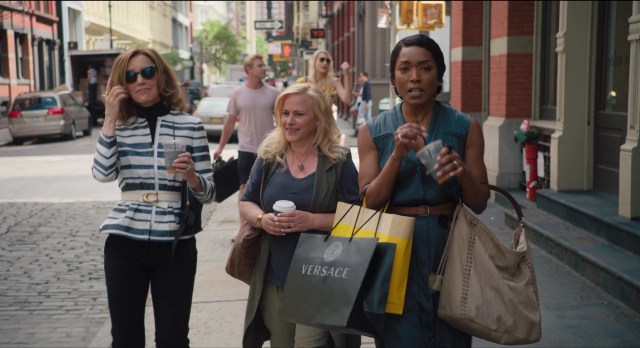
That’s “Otherhood,” sort of a mash-up of “First Wives Club” and “Mom’s Night Out,” a comedy of too-easy one-liners, mother-to-mother bonding and mother and child reunions.
Drop a few F-bombs, show off a little cleavage and you’ve got “edge.”
Oscar winner Patricia Arquette, Angela Bassett and Felicity Huffman are three mothers who met in a playground in Poughkeepsie, decades before. They’ve stayed close, through a divorce, widowhood and into their AARP years.
But their boys? They’re at the can’t-even-bother-to-send flowers on Mother’s Day.
“I texted you!”
“I BIRTHED you!”
That omission sends widowed Carol (Bassett), piano teacher Gillian (Arquette) and affluently-remarried Helen (Huffman), after a few drinks, on a dash into New York, “pops in” on their adult sons being the perfect way to mend fences, right?
Carol’s son Matt (Sinqua Walls of TV’s “Power” and “The Breaks”) is doing OK, designing what he’s told Mom is a “sports magazine” but which is actually a “lad mag” — T & A tarting up whatever content they pack into it.
It’s called “All Balls.” Clever.
Mom catches him with some borderline underage model.
Helen’s son Paul (Jake Lacy of “Obvious Child”) never came out to her.
“Did you ever ask?” his lover (Frank de Julio) snaps back.
Gillian, who converted to Judaism when she married, has become a smothering Jewish mother stereotype, not seeing her failed-novelist son Daniel (Jake Hoffman) unhappiness, alcoholism and fresh break-up from Erin (Heidi Gardner) as signs of trouble.
“Stop dating shiksas!”


The sons all have screenplay shorthand stereotyping about them — Jewish writer, black jock, gay white window dresser. Thank heavens the movie isn’t really about them.
“Do you need directions home? I can show you how to Waze!”
It’s about the ladies. And after a GROANER of a start — “The key to a clean house? A DEAD husband!” — “Otherhood” settles into their situations, the limbo of motherhood once you hit your ’50s.
Ignored by their sons, subjected to a form of “inhumane emotional waterboarding,” by offspring who have “broken up with us,” they bond over bourbon, take action — have confrontations, confessions, meltdowns and makeovers.
Bassett plays a cute drunk scene in the club. Huffman has a nice hissy fit. And Arquette gets a little Jewish mama pushback that, being a stereotypical Jewish mama, flies right over her head.
“The problem is not that I meddled. It’s that I should have meddled SOONER!”
The stars, and the occasional winning one-liner, keep us interested, or as is the case with a film that’s “Netflixable,” at least keeps the TV on.
So none of this running yourselves down, MILFs.
“We’re middle-aged women in New York. We’re practically invisible!”
I chuckled here and there, got a kick out of Carol’s encounter with a transgender bouncer (showing baby pictures of “my son” in the tub gets you Instagrammed). And there are some touching moments in the finale.
The moral to the story? Don’t forget Mom on Mother’s Day or her birthday.
Would I go out to see “Otherhood?” No. Nor should you. And we don’t have to.
It’s not all that, but it’s perfectly “Netflixable.”

MPAA Rating: R for language, sexual references and brief nudity
Cast: Angela Bassett, Patricia Arquette, Felicity Huffman, Jake Lacy, Sinqua Walls, Jake Hoffman
Credits: Directed by Cindy Chupack, script Mark Andrus and Cindy Chupack, based on a William Sutcliffe novel. A Neflix release.
Running time: 1:40
Michael Waltrip is an affable NASCAR retiree and Fox Sports color commentator, much like his older brother, NASCAR legend Darrell Waltrip.
And like Darrell, Michael has a tendency to wear his heart on his sleeve. That, and Michael’s connection to one of the star-crossed moments in NASCAR history, makes him a somewhat compelling subject for a documentary, “Blink of an Eye.”
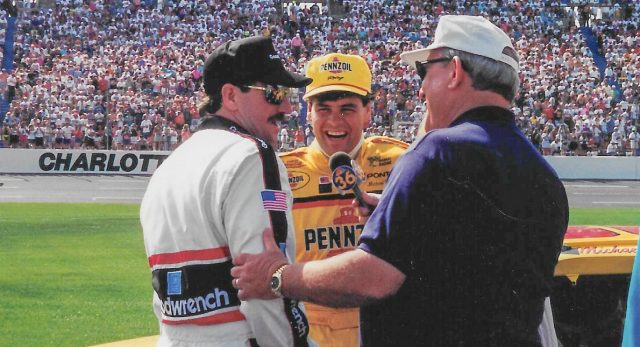
That’s how long Waltrip had to celebrate his unlikely victory in the 2001 Daytona 500, breaking an epic 462 starts-zero wins streak that, let’s face it, if not for his magical surname, might have ended his career before he ever got his chance.
The fact that as he crossed the finish line at that 2001 race, just ahead of Dale Earnhardt, Jr. that Jr.s dad — Waltrip’s idol and the team owner who finally gave him the chance to drive a winner — was having the wreck that killed him, make Waltrip’s breakthrough victory the most bittersweet moment in NASCAR history.
Dale Earnhardt, #3, died on the track on Feb. 18, running interference, blocking other drivers who might have caught Waltrip, “The Intimidator” being intimidating one last time.
“Blink of an Eye,” directed by a veteran of documentaries about surfing (“The Lost Wave”) and motorsports (“Unchained: The Untold Story of Freestyle Motocross”), focuses on Waltrip, his home movies, his reminiscences, those of his curmudgeonly but proud older brother, and of other motorsports figures (Richard Petty, Richard Childress, etc.) who watched Waltrip’s career and remember that fateful way he finally landed his first win.
Waltrip has a self-effacing candor that engages, remembering his brother dismissing his racing dreams, “lightning rarely strikes twice” — until the kid started winning, right from his first outing in a go-cart — and almost admitting that his name opened a lot of doors for him.
“I showed up as Darrell’s little brother!”
Mentored by Richard Petty, jumped into a NASCAR Winston Cup career where he became a hard-luck driver and something of a self-described punch line — Mr. Third Place — Waltrip’s last great bit of good fortune was befriending the rough and tumble “blue collar” champion Earnhardt, the driver who took over the sport when “The King” (Petty) retired.
“Blink” touches on Earnhardt’s life, and one of the film’s shortcomings is that it doesn’t give us more of that. But that’s another film, you say to yourself. This one is about one day, one season, and three men — one who didn’t survive the year’s opening race. That season provided another memorable moment which longtime NASCAR fans can get teary-eyed about, one that also involved Waltrip and the younger Earnhardt and Daytona.
Oddly, Waltrip is the one who gets choked-up talking about Dale Sr. Dale Jr. has more control of his emotions, which might separate the two as drivers. That makes one wonder if Jr.’s experience of his father was radically different, or if Dad brought on Waltrip to push the kid.
That points to the biggest shortcoming of “Blink of an Eye.” It’s a seriously unchallenging documentary, one that has no contrary voices suggesting why Waltrip never won before Earnhardt took him on (More hard luck? Nobody says so, nobody asks.) and as it lapses into hagiography, the film borders on “NASCAR Sanctioned” and “Official Myth-Burnishing.”
Because the biggest challenge missing from the film is one involving that day, m the series and “the company” itself.
The film sugar-coats, glosses and does not dwell on Earnhardt’s grisly death, and none of its narrow range of interview subjects sits far enough removed from the subject to address any of this.
Journalists? One who cozied up to Earnhardt Sr. and became an employee is the only one here.
This is another subject one can lump into the “That’s another film” category, and give filmmaker Paul Taublieb a pass on that, as well.
Then he sticks a grating closing credit on how “NASCAR redoubled its safety efforts” after Earnhardt’s death, and thus, no driver has died on the track since.
The Intimidator, as loyal a company man/driver as he was, would have almost certainly used a phrase about bovine excrement over that.
The newspaper I used to work for all but predicted Earnhardt’s death in stories about NASCAR’s foot-dragging over the HANS neck-protecting device published a week before that fateful race.
All of NASCAR was shocked at the accident that all but-decapitated Dale Earnhardt. Not reporters, editors and readers of the Orlando Sentinel.
NASCAR’s reaction to those stories and Earnhardt’s death was to strong-arm Florida’s legislature to change laws regarding open public records, so that nobody would know exactly how Earnhardt died, and the NASCAR/France Family empire could escape culpability (HANS was widely used in other racing circuits).
Laws regarding death certificates and the like were bent to shape NASCAR’s ass-covering, using Earnhardt’s widow as their public face for this assault on watchdog journalism and safeguarding the public.

That example just highlights how myopic, “officially sanctioned” and white-washed “Blink of an Eye” is.
Sure, the fans get the myth that they want to believe. That doesn’t mean it’s true, or that it’s good for them, for corporate accountability and for the role of a press in a free society.
This unchallenging “Hollywood” version of that tale is too incomplete to be definitive.
MPAA Rating: unrated, violent death in a car race, the 2001 Daytona 500.
Cast: Michael Waltrip, Richard Petty, Dale Earnhardt Jr., Darrell Waltrip
Credits: Written and directed by Paul Taublieb. A 1091 Media release.
Running time: 1:28
He’s older now, pushing 50. And if Mr. “Black don’t Crack, we smoke it” hasn’t matured — not a lick — so be it.
Marlon Wayans remains a screen comic in search of a sketch comedy show that can contain his special gifts. Those would be mimicry and the ability to “sell” himself as a woman, a tiny man and even — when the movie called for it — one of two “White Chicks.”
“Sextuplets” is a star vehicle which has him playing a husband awaiting, with his wife, on the birth of their first child. As he is adopted and has no “family history” in terms of genetics and health prospects, his cranky judge of a father-in-law (Glynn Turman) tracks down his birth records for him.
Turns out Alan was one of SIX kids his birth mother had. He has just enough time to tell wife Marie (Bresha Webb), allowing just enough time for us to get our minds in that “Klumps” frame-of-mind, before Alan is meeting the five siblings he never knew he had.
“Maybe one of them changed his name to Idris Elba! We do have strangely similar features. ”
“Sextuplets” is about Alan connecting with the doltish lump Russell, whom his mother kept, and convict and sometime pole dancer Dawn, terminally ill hustler Little Pete, crooked identity thief Ethan, and so on.
Wayans had a hand in the script, which features limp “Jeffersons,” “What’s Happening” jokes, and a “Different Strokes” sing-along.
“It’s like a Tyler Perry movie in here!”
We learn that the siblings share a loathing of avocados –“Tastes like soft-boiled silly putty” and that “Black people don’t wear flip flops.”
Alan’s white pal (Michael Ian Black) is here to use outdated African American slang — “On fleek,” “The Bomb,” “off the chain.”
“We don’t say that!” Anymore.
Gold-toothed thug Ethan is all about “white people credit” and “You got REPUBLICAN money,” because he’s all about the cash.
The film is, sadly, rarely funny. Wayans and his screenwriters roll out his least-interesting, most Eddie Murphy as a “Klump” character first, and saddle the picture with him. That horse is lame.
Dawn is the stand out, a hilarious impersonation of an easily-affronted African American big screen stereotype. Oversexed, unethical and damned if she’s going to be “judged” by the likes of you, she is too many Leslie Jones characters on “Saturday Night Live” to count. More to the point, she’s funny.
The rest of “Sextuplets?” Played, no matter how much verve brings to his various roles.
MPAA Rating: TV-14, adult situations, sexuality, mild profanity
Cast: Marlon Wayans, Bresha Webb, Glynn Turman, Debbi Morgan, Michael Ian Black
Credits: Michael Tiddes, script by Rick Alvarez, Mike Glock and Marlon Wayans. A Netflix release.
Running time: 1:38

 Movie Nation