
Yes, this NSFW trailer is the one that almost sells this re-imagining of “Shaft” in action-comedy Samuel L. Jackson-speak.
Yes, this NSFW trailer is the one that almost sells this re-imagining of “Shaft” in action-comedy Samuel L. Jackson-speak.
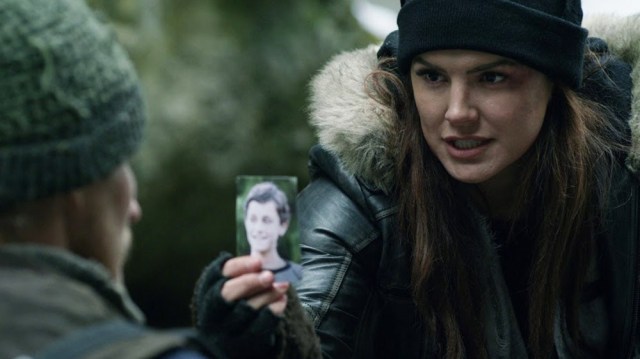
I still have faith that Gina Carano is going to land good action film roles. Even though she’s trapped in B and C thrillers like “Daughter of the Wolf,” she has presence, and her fist-fighting bonafides remain impressive.
She’s had bit parts in a “Deadpool” and a “Fast and Furious” picture, and she’s a long way from her thrilling break-out film, “Haywire.” But she can take heart that Jason Statham went through such a lull, movies where the best reason to sign up is you need the work and the stunt coordinator and fight choreographer are impressive and will keep you from getting hurt.
She and we are hurled into “Daughter of the Wolf.” We meet her character as she’s fetching a shotgun and a stash of cash from her family’s long idle (British Columbia) lumber mill.
It’s the dead of winter, and she’s got a snowy rendezvous with three kidnapping thriller cliches — “You want to see your boy again?” thugs in masks.
Her kid’s been kidnapped and she is paying the ransom.
“We had a deal.”
“Deals change.”
The plan, of course, is to get the cash and kill her. No kid returned. But Clair Hamilton is, of course, “ex-special forces.”
Bad screenwriters always want to explain away somebody’s “particular skills.” There’s very little that follows that suggests Clair has “particular skills.” She can fight, but there are other reasons that can be. She can shoot, but she’s from the rural mountain Northwest.
And she’s not shy about threats. Again, that doesn’t require military training, but screenwriters love their crutches.
After an impressive SUVs-on-snow chase and spectacular crash, Clair gets the drop on the last surviving bagman. And Larsen (Brendan Fehr), bullet in his leg, is still more scared of this ringleader “Father” than he is of the woman pointing a gun at his “good” leg.
Father is played by Oscar winner Richard Dreyfuss as a crusty, profane old coot with a grudge and a cult-like gang of followers, only some of them family.
He’s got Clair’s kid (Anton Gillis Adelman), a child he’s inclined to school, a bit, on the ways of the world.
“Boy, I HATE t’raise my voice…stupid kid.”
He grouses at his underlings.
“If they’re not dead, they’d better G–D—ed WISH they were!”
The script gives us three threads to follow — Clair’s trek, with Larsen, over the mountain to the villain’s lair, the goings-on in that lair and flashbacks showing the inevitable neglectful “You were never HERE when I needed you!” mom guilt Clair feels.
When she’s not fighting on a frozen lake, or trying to crawl out of it, or brawling at the top of a waterfall, dodging bulle, Clair tries to figure out why the wolves, which are EVERYwhere, seem not as interested in her as they are in Father and his minions.
Yes, nature wants its revenge, too.
Ex-MMA star Carano has the sturdy build of a brawler, and acquits herself well in the fights, and the stunts are upscale and realistic for a modest-budget thriller.
The narrative is built on oddly theatrical twists, a film that begins in mystery and then sheepishly sets out to EXPLAIN every mystery away in the middle acts.
David Hackl, a production designer (“Outland,” a “Saw” sequel) turned director, gets the look of the film right even if the pacing is slack and the script a few rewrites shy of being pretty good.

But that script was good enough to get one and all, including the 70something Dreyfuss, out in the snow of British Columbia in late winter, so give them that. And the stars, to a one, acquit themselves admirably in this frostbitten script.
It’s just that in thrillers starring martial artists, it’s the action that counts, the speed it comes at you, the violence in your face thanks to a tight, intimate camera frame. It’s how cool the fights look and how cool the star handles herself in them.
Production design and endless explanatory motivations are for sissies.

MPAA Rating: R for violence and some language
Cast: Gina Carano, Richard Dreyfuss, Brendan Fehr, Sydelle Noel, Brock Morgan
Credits: Directed by David Hackl, script by Nika Agiashvili. A Vertical release.
Running time: 1:28
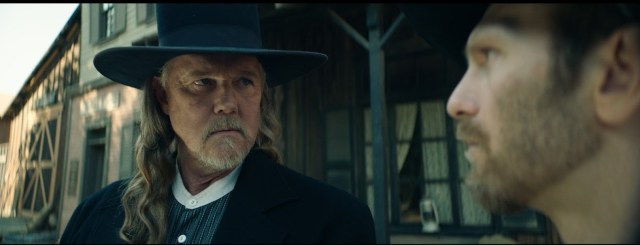
You can see why country singer Trace Adkins would be a natural to cast in a Western.
He’s got the growl, the tall-in-the-saddle stature, the ability to wear a hat like he’d be naked without it.
And his first moments in “The Outsider” cash in on all that promise. He strolls into the frame, in profile, a man in black in a black flat-brimmed hat and maybe a little too much hair-care in evidence.
“You’spect me t’believe one man, on UNARMED man, did all’a this?” he says, surveying a saloon with bodies scattered about.
It’s a rainy night — there are lots of them in this corner of the dusty Southwest, and all Marshal Walker wants to know is “What happened?”
“All hell broke loose,” the bartender mutters, cleaning up the crime scene as if it’s just another Thursday.
This slower-than-slow, sordid and sour Western is about “The Outsider,” an ostensibly unarmed Chinese railway worker (Jon Foo) who unleashed the hell that broke loose, and his reasons.
It’s a “Kung Fu” tale of racism, rape and revenge built on bloodless performances, limping longueurs between brief blasts of action, sexual violence and unsavory sex slapped in for good measure.
So it’s a lot rougher than the stuff Adkins usually ties himself to on the screen — the faith-based “Moms’ Night Out,” “I Can Only Imagine.”
There’s a “Chinaman” Jing, played by the Sino-Irish British-born martial artist Foo, whose adoring wife Li Phang (Nelli Tsay) waits for him in the laborers’ camp while he lays track all day.
They don’t speak Chinese on camera and don’t sport accents that suggest they’re recent arrivals. Their public displays of affection feel modern and out of place. And yes, it’s less than historical to suggest a common laborer would be able to get his wife into this country while still doing this itinerant work.
The marshal’s son Frank (Kaimi Lyman of the malnourished Western “Hickok” by the same production team) is a deputy, and all the deputies have the bullying swagger of “a law unto themselves.”
“I have ‘yellow fever,'” Frank purrs, spying Li Phang. “And I’m hoping that she’s the cure.”
You can guess what happens, and yes, it’s both graphic and oddly passive.
And you can guess what Jing, the stereotypical “man of peace,” does. He starts in on the deputies. And he sends a note.
“This stop when James Walker dies!”
Director Timothy Woodward Jr. (of “Hickok” and other B-movie action pictures starring folks like Dolph Lundgren) and screenwriter Sean Ryan basically turn their backs on Foo to focus the movie on the father-son dynamic and the army of deputies this small town is able to muster as fodder for Jing’s vengeance.
Frank can protest his innocence to Daddy all he wants.
“You are many things, but ‘innocent’ is not one of’em, boy!”
Daddy is even moved to go to church to pray for the kid, for a “quick” resolution to this mess, explaining his intentions to God, even though he knows his boy has “no good in’em.”

Sean Patrick Flanery is the tracker hired to hunt down Jing.
“I’m retired.”
“Not today, you’re not.”
Danny Trejo has a glorified cameo as a Hispanic deputy who rides herd on the tracker.
“Do we have a PROBLEM Señor?”
“Well, ain’t you mad enough to fight a barr with a hickory switch!”
The dialogue is a strong suit of this teeth-grindingly slow picture, as is the use of shadows — dimly lit saloon to dimly-lit barn.
The central conflict, immigrant faces off with rural, racist cruelty in the form of murderously cruel “law enforcement,” is a solid foundation.
But “The Outsider” lurches along, a film that makes its compromises to quality painfully apparent in every scene.
Can’t get a charismatic star? Shoot around the guy you end up hiring. Realizing the horse opera audience they’re making this for might not take to its message of “Be nice to immigrants, or else?” Play that down. Put Trace in a church.
“God turned his back on us a long time ago!
The lofty place “Kung Fu” still enjoys in our culture suggests this is a movie that could have/should have worked.
But the pace is dispiritingly slow. The action bits are uninspired and rare. And the performances — only Flanery escapes unscathed, and Adkins would have been an asset had the picture not required him to carry it — have nothing about them that make us want to take “The Outsider” in.
MPAA Rating: unrated, rape, other violence
Cast: Trace Adkins, Danny Trejo, Jon Foo, Nelli Tsay, Sen Patrick Flanery
Credits: Timothy Woodward Jr., Sean Ryan. A Cinedigm release.
Running time: 1:26
Williams is an aid worker dedicating her life to orphans in India.
Moore is rich.
Billy Crudup plays Moore’s artist-husband, a guy who has…a secret.
I’ve often wondered about this, long before #metoo made us question the comfort level actors, all the way down to nude extras and bit players, have with this work. Many a review I’ve written has included a shot at pointless strip club scenes and gratuitous sex scenes, all there for pervy predatory producers who prey on starlets cast in such scenes. Just a theory, mind you.
Good Hollywood Reporter piece about establishing standards for such scenes.
https://t.co/4U2eZldr3x https://t.co/s85r22Vr7n https://twitter.com/THR/status/1137606017137676289?s=17
Bill & Ted 3 (@BillandTed3) Tweeted:
Bill & Ted Day has arrived. PARTY ON, DUDES!
https://t.co/27BJmzrds8 #BillandTed #BillandTedDay https://t.co/kAdjz1BPqT https://twitter.com/BillandTed3/status/1137615410612842496?s=17

Slight, dark, daft and right on the edge of “twee,” “Say My Name” takes a demand uttered in a moment of passion, an unusual setting and a long night of missed communications, misunderstandings, unlikely escapes and violence and turns it into something funny, something almost romantic.
It’s set on an island off the coast of Wales, South Mouse, reachable only by ferry.
That’s where Mary (Lisa Brenner) and Statton (Nick Blood) are going at it, hot and heavy. That’s when she hits him with that deal-breaker bit of sex talk in a one-night-stand.
“Say my name!”
He hems. He haws. He’s um, busy.
“I just need to hear your ACCENT!”
He doesn’t have it. He tries, but in the heat of the moment…
Mary’s outrage spills over into pop psychology, Statton’s defense gets into the mnemonic devices he uses to recall names. It goes from bad to awkward.
“So you were TESTING me during sex? That’s entrapment! Sort of.”
They barely have time to disentangle from her outrage, when two armed goons — played by Mark Bonnar and Celyn Jones — bust into their room at the scenic Royal Grand Hotel. South Wales.
“We like shiny stuff!”
Statton cowers. Mary? She takes it in stride.
“Can I get dressed?”
“D’ye HAVE to?”
The robbers bicker, a gun goes off. Somebody is hurt. Somebody is the island’s last piano tuner. Somebody once aspired to be an opera singer.
“Don’t stereotype ME, mate!”
SOMEbody used to be a nun, and her “real” name isn’t Mary.
“You wanted him to call you by your ‘nun’ name during sex?”
And thus the night begins, with tables-turned and turned-back-again, cops, paramedics, “The Pirates of Penzance,” a “nurse,” a club, a church at dawn that’s the “House of the Rising Sun,” and a jail cell.
The banter — the script is by Deborah Frances-White — is quite often quite witty.
“Are you a chartered MORON? THIS is why you’re the sidekick!”
The story leans on winning anecdotes — Statton’s failed marriage, Mary’s odd journey from America to Wales, the robber’s opera singing ambitions.
The structure’s a bit stodgy — chapters. “I. At the Hotel with Mary…II. In the Lockup with Carol.”
But director Jay Stern and the cast keep this featherweight-with-firearms farce on its feet, skipping along if not actually galloping.
Brenner, a screen veteran with mostly bit-part credits, makes Mary/Carol etc. a font of surprises and world-weariness. Blood’s Statton may be mousey and rattled, shocked at what’s going on, but Breener gives her character an antsy, angry “What fresh hell is this?” attitude.
Statton makes a fine go of being “mild mannered” enough to pass for a piano tuner. His character is the one that makes a journey, to somebody braver and more assertive.
Bonnar has a hint of Robert Carlyle’s “Trainspotting” rage, and Jones plays a plump, sensitive Nick Frost lite here. Amusingly.
As the story scampers about, everybody has something funny to say or play. Peter Davison’s a lawyer with no real interest in “getting involved,” a club goer has a ready-made pick-up line for Mary.
“Wanna Brexit? Come back to my place?”
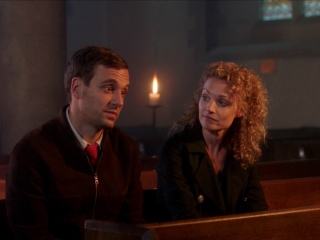
It’s so slight and silly that when it hits you with some real heart in the third act, that may be the biggest surprise in this comedy of surprises, twists and moments of faint, feigned shock.
“It’s all kind of funny when you think about it.”
Indeed it is.

MPAA Rating: R for language throughout and some sexual content.
Cast: Lisa Brenner, Nick Blood, Celyn Jones, Mark Bonnar
Credits: Directed by Jay Stern, script by Deborah Frances-White. Am Electric Entertainment release.
Running time: 1:23
Jeffrey Katzenberg is behind Quibi, and nothing doubles down on “This guy has been ahead of the curve before” more than signing Soderbergh. Short films piece together into a feature? Sounds like the old serials, or the shortest episodes ever folded into a series. https://t.co/fi4reWtob3 https://t.co/g19vcQbZmu https://twitter.com/DEADLINE/status/1137521710519836672?s=17
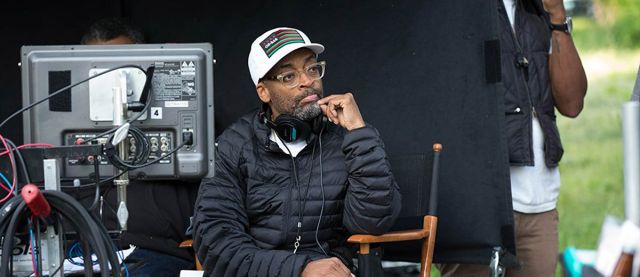 Not the voice of Hollywood, not really the conscience of it. But drawing a line in the sand when you have clout and reactionary states might be forced to listen is the right play here. Spike’s adding his voice to many others.
Georgia has turned itself into “Hollywood East.” Turning off the spigot might get the voters’ attention. They’re the ones who stayed at home and let the agitating minority run the state into the sexist, wrong-side-of-history ditch.
 We’ve seen enough of Kevin Hart’s “little man” tantrums to think this could be a novel take on Mr. Scrooge.
And God knows, he’s rich enough to “relate.”
I wasn’t nuts about the Bill Murray take on Dickens, so “Scrooged” is not a sacrosanct comedy to me.
Another remake, another lame holiday movie, sure. Paramount could use a hit.
Still, it Could be funny. https://t.co/F8DiMHJbWG https://t.co/rarql0TI4M https://twitter.com/THR/status/1137109193641648131?s=17


