
A period piece starring Samuel L., Nia Long and Anthony Mackie and opens Dec. 6.
A period piece starring Samuel L., Nia Long and Anthony Mackie and opens Dec. 6.
Steven Amell from “Green Arrow” stars in this Dec. 13 release.
Kind of X-Men ish, no?

“Cousins” is a hamfisted and campy gay romance from Brazil, the sort of gay rom-com North American indie cinema moved on from decades ago.
The broad characters, the eye–rollingly obvious come-ons may produce a few laughs…in between the groans. And moans.
Lucas (Paulo Sousa) is a shy, orphaned lad who has been living with his devoutly religious aunt (Juliana Zancanaro), practicing his music, switching his Yamaha keyboard into organ mode to serenade her friends at the end of their weekly Bible study.
Those friends wonder about Lucas, who is handsome and talented, but seems to have no friends or prospects for friends.
Then Aunt Lourdes gives him news straight out of a gay porn comedy. There’s this handsome cousin that Lucas has never met. He’s coming to stay with them. He’s just been kicked out of his parents’ house, thanks to a short stretch in jail.
“I don’t want to know what he did,” Auntie says (in Portugeuse with English subtitles). We practice unconditional “forgiveness in this house.”
They’re a little pressed for space. Mind sharing a room with him?
Oh, and one other thing, Aunt Lourdes will be away on a Catholic retreat when “Mario” arrives.
Mario, played by writer and co-director Thiago Cazado, has a swagger and a cigarette when we meet him. He hugs a little too hard, “for all those years we have not hugged!” He’s amusingly eager to walk about with no trousers, making this a “bulging underwear comedy.”
He’s full of stories about the sorts of “games” cousins play, suggestions that “we push our beds together” because “I’m afraid of ghoosts.
Yeah it’s like that.
A little piano serenade, a little air guitar rocking out, a little alcohol and then it’s naked time, sex scenes set to insipid English language pop.
All the while, Lucas is fending off Bible study Julia (Duda Esteves), a coming-on-strong beauty who seeks piano lessons, even though her screeching shows her to be tone-deaf, and whose ditzy flirtation means every lesson end with her bouncing on the lad’s lap.
Give “Cousins” a couple of points for attempts at “cute.” That hugging line made me laugh, and the fact that even the devout in the household curse like sailors, turning to apologize to the nearest crucifix (they’re everywhere), is worth a grin.
Poor Esteves has to vamp through a character so broad you’d swear she was created in the 1940s, and performed by somebody yanked from a community theater stage in mid-mugging.
“Cousins” may be a cinematic novelty in Brazil, but aside from the nudity (more or less tastefully handled), there’s little novel or entertaining for film audiences this far north, just titillation.

MPAA Rating: Unrated, with nudity, sexual situations, profanity
Cast: Thiago Cazado, Paulo Sousa, Duda Esteves, Juliana Zancanaro
Credits: Directed by Mauro Carvalho and Thiago Cazado, script by Thiago Cazado. A TLA release.
Running time: 1:22

Projected to open over $40 million, “Dark Fate” suffered a worse fate.
“Harriet” earned $12 million, “Arctic Dogs” scored $3.1.
Via Variety, which is reporting that the film could end up losing $100 million, all in.

England’s “warrior king,” Henry V, earns a beautifully detailed period piece biography, a martial showcase for Timothée Chalamet, best known for fey roles that play up his beauty and sensitivity.
As “The King,” he twirls a mean broadsword, draws his dirk and wrestles armored French noblemen into the mud where they writhe until he stabs them in the neck until dead, the way it was done in the 15th century during the Hundred Years War.
But period piece detail aside, it’s a pedestrian, sodden film. It’s not Shakespeare’s “Henry V.” The odd good line aside, without Shakespeare, there is no poetry to it.
Not one moment thrills or moves.
A quick trip to Wikipedia reveals the degree of dramatic license and downright historical poppycock.
And if it’s not history and it’s not thrilling Shakespearean poetry, what the hell’s the point?
The idea behind Aussie David Michôd’s film is making Henry a reluctant warrior, a man who counsels peace, does not get along with his paranoid, power mad father (Ben Mendelsohn).
“You will NOT inherit this crown,” his father growls.
“Nor have I SOUGHT it!” the kid bellows back.
Henry engages in single combat to prevent battles, struggles to guard his younger brother, the newly-anointed heir, and spare the army slaughter in the process, and is slow to anger at French provocations when he takes the throne.
He’s almost embarrassed at his coronation, telling his nobles “You shall suffer the indignity of serving me, the wayward son you despise.”
The “man of action” that’s been the traditional way of presenting Henry V is made more thoughtful, more in conflict with the temper of the court and public opinion (the English always spoiling for a fight with the French).
The middling mini-series style script mashes up the history that Shakespeare drew on — Holinshead’s Chronicles — and Shakespeare’s “characters.” We see the same callow partying Prince Hal of Shakespeare, the drunken whoremonger who had to grow up to fill his father’s crown, and his mentor during his wastrel years, Sir John Falstaff (Joel Edgerton, who co-wrote the script). But Hal becomes “Henry” without denying Falstaff, with no “I know thee not, old man.”
And Falstaff? The comical coward of Hal’s youth and Shakespeare’s showcase comedy for him, “The Merry Wives of Windsor,” becomes a humorless and brave old soldier whose many war stories aren’t whoppers, after all. Heck, even the sharp-tongued Shakespearean innkeeper who lets him run a tab (Tara Fitzgerald) has been neutered.
“The King” tells a version of their story that falls somewhere between “Henry V,” most recently filmed to great and glorious effect by Kenneth Branagh, and Orson Welles’ 1960s compression of the “Henriad” plays about Hal and Falstaff, “Chimes at Midnight.”
The climactic battle draws heavily on “Chimes'” depiction of the grisly, grimy and unromantic nature of hand-to-hand combat in armor in the mud. It’s as realistic as any medievalist might want, even if the events of the battle are pure poppycock.
The only laughs in the film’s 140 minutes are provided by Robert Pattinson, the “Twilight” veteran and future Batman milking his turn as the French dauphin (prince) who taunts Henry, goads him into battle and slings a wicked French accent during his many atrocities and insults.
“Please speak English,” he teases. “I ENJOY to speak English. So…simple and…dirty!”

His trash talk-threats are the best lines in this Michôd (“Animal Kingdom,” “The Rover”) and Edgerton script.
“I ‘ave come to de-SCRIBE for you your end days,” he purrs. “ze SCREAMS of your men…I will DRAIN your blood from your body and bury you under a tree, a tiny French tree!”
Pattinson is more fun than Chalamet, and more instantly credible, I have to say. None of this pop idol mop top and chicken-chested machismo that Chalamet brings to the young king.
I love a funny French accent more than most, treasure most any period piece and revel in Medieval historical pics like this.
But “The King” is something of a tin-eared bore and a massive waste of time. It so wants to follow “Henry V,” without the grace notes of Shakespeare’s “Saint Crispin’s Day” speech and Henry’s courtship of the French princess (Lily-Rose Depp). Lacking those linguistic flourishes, the damned thing just plods along, and brings me back to my original complaint.
What the hell’s the point?

MPAA Rating: R for some strong violence, and language.
Cast: Timothée Chalomet, Robert Pattinson, Joel Edgerton, Sean Harris, Ben Mendelsohn, Tara Fitzgerald and Lily-Rose Depp.
Credits: Directed by David Michôd, script by Joel Edgerton, David Michôd. A Netflix release.
Running time: 2:20
Yes, it’s take Mom to the preview of a family film Saturday, firefighters caring for unruly kids. John Cena in “The Pacifier/The Game Plan” mode,

The only folks toasting the “good news” of the box office take from the first weekend in November are over at Focus Features, where “Harriet” — opening wide — is sprinting to an impressive $11 million or so debut.
It was projected to earn $8 or 9 million, tops. But the marketing of it worked, even if it made the film look like “A Lifetime Original Movie.” I caught it in the only multiplex in “The Last Capital of the Confederacy,” with a decent sized audience, who talked back to the screen and laughed at the most moving moments. The heroine deserved a better movie.
“Terminator: Dark Fate” should end this franchise, even though that was never the intention (damned finale hints at more “story,” the greedy bastards). It was projected to clear $35-44 million, with one prognosticator noting that $30 million would be the definition of “bombed.”
It is staggering towards $28 million and change. A deathly dull sci-fi thriller, it deserved even worse. It will make enough money overseas to tempt Paramount to release another. But they shouldn’t.
Edward Norton spent 20 years getting this New York version of “Chinatown,” “Motherless Brooklyn,” adapted and on the screen. Truth be told, he’s a little old to be playing the young gumshoe with Tourette’s, trying to solve the murder of his mentor and boss (Bruce Willis). Not the biggest failing of the picture (rubbing some of the villainous edge off its version of New York “planning” overlord Robert Moses, played by Alec Baldwin, hurts), but Norton is not the star he was 10 years ago and the box office reflects that.
“Motherless Brooklyn” will be lucky to bank $3 million by midnight Sunday. That’s one third of the already lowball projected take.
Entertainment Studios threw together an animated film with a big-name voice actor cast, and the result looks it. Audiences are avoiding “Arctic Dogs” for the dog it is. It won’t clear much more than $2, maybe close to $3 million.
The fourth weekend of the middling “Addams Family” cartoon will do triple its business, and it’s not like that one was made by a major animation house.
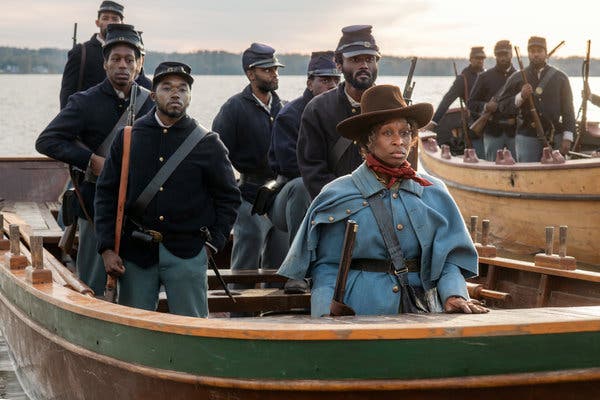
The grace notes almost outnumber the grimaces in “Harriet,” an insistently melodramatic and sometimes affecting film biography of Abolitionist and heroine of the Underground Railroad, Harriet Tubman.
Edit out the theatrical, eye-rolling third act, and Cynthia Erivo‘s fiery, righteous turn as the escaped slave who led scores of other enslaved Negroes to freedom in the mid-19th century, would stand tall — or at least taller than she does in the closing credits of director and co-writer Kasi Lemmons’ film.
The fact that the enterprise never looks as epic as its heroine, that too many supporting roles show a production short of cash to hire “names” and charismatic villains, wouldn’t matter as much. The speechifying, predicting the near future (the Civil War) and other excesses of Lemmons’ (“Eve’s Bayou,” “Talk to Me”) and Gregory Howard Allen’s (“Ali,” “Remember the Titans”) script only truly grate in that never-ending finale.
We meet Araminta “Minty” Tubman (Erivo, of “Widows” and “Bad Times at the El Royale”) just as her husband (Zackary Momoh) is presenting their claim, drafted by a lawyer, for freedom to their Maryland “massa.” John Tubman was a free man who’d hired a lawyer, seeking to enforce a will that should have granted Minty and her parents freedom.
Their owner (Mike Marunde) isn’t having it, and his cruelest son Gideon (Joe Alwyn) counsels selling Minty off to head off the trouble she was stirring up.
“Harriet,” the film and the heroine who will wear that name, leaps into action, putting her on the run to avoid “being sold South.” The local Negro preacher (Vondie Curtis-Hall, best of the supporting players) may lead hymns about keeping “your hands on the plow,” and sermonize Biblical obedience. But when Minty shows up at his door, he is the man with the plan.
Illiterate Minty sprints into the night, makes her way 100 miles (via the preacher’s connections) and escapes to discover the “colored” elite of Philadelphia, where “The Committee” runs the Underground Railroad, William Still (Leslie Odom Jr.) publishes their Abolitionist broadsides and the prim and ladylike Marie Buchanan (Janelle Monae) shows escaped slaves how to fit into white society.
“Walk like you got a right to!”
Minty takes a new name, her mother’s real name — Harriet. And before too long, Harriet, a pious woman who has “spells” in which she communes with the Lord (a head injury may have caused these), decides those she loved must experience the freedom she has claimed.
She starts making treks South to free her husband, her family and others.
The grandest conceit of this telling of her epic story is the way Harriet, who wore disguises and used fake papers to make her way into the South, came by her nickname “Moses.”
It wasn’t just the fact she was leading her people to “the promised land.” In the film, she hides in the woods just off the fields where the hands are working, and sings (Erivo played a jazz singer in “Bad Times at the El Royale,” and is Aretha Franklin in the upcoming TV miniseries. Yeah, she’s got pipes.). She sings “Go Down, Moses,” with its lyrics demanding the Pharaoh “let my people go.”
The field hands hear her, drop their tools, and follow her.


These moments are electric, up to a point. Repetition eventually wears out even this intensely moving and magical device.
Erivo runs as if her life depended on it, flashes her eyes as if she Talks with The Lord and “The Lord talks back,” as one convert to her cause puts it. And that’s a good thing.
Because the villains here are almost silent-movie dastardly, with Alwyn looking like he took time off from a Lynyrd Skynyrd tribute band to blast us with some Old Time Racism.
“Having a favorite slave is like having a favorite pig. You can play with it, give it a name. But one day you might have to sell it or eat it!”
The word “Negro” never figures in the script. Everybody, Abolitionists and Harriet herself, labels the black folks they’re dealing with by the Biblical-age term for less than human property — slaves. That’s tin-eared screenwriting, and you would have expected much better, given the credentials of the writers.
Slave hunters and slave owners keep staking out the same wooden bridge to intercept their escapees on their flight north across the Mason-Dixon Line. It never works. They never learn.
Versions of Frederick Douglas and John Brown turn up, the rising tensions and Congressional stop-gaps that pushed the country toward Civil War are addressed.
And while there’s a historical exclamation point to one event depicted in the third act, it all plays as dramatically-flat, subtlety-abandoned theatricality, and takes the wind right out of whatever forward motion the first two acts had.
Tubman’s case to be on the $20 bill, as a heroine straight out of American myth, is made, a brave Christian woman sprinting down the path of the righteous. “Harriet” stumbles when it makes her more mythic than human, and less the woman of action than she was.

MPAA Rating: PG-13, violence, racial epithets, profanity
Cast: Cynthia Erivo, Janelle Monae, Vondie Curtis Hall, Leslie Odom Jr., Joe Alwyn and Tim Guinee
Credits: Directed by Kasi Lemmons, script by Gregory Allen Howard and Kasi Lemmns. A Focus Features release.
Running time: 2:05

Competently animated — OK, competent “ish” — and heartlessly scripted, “Arctic Dogs” plays like an Entertainment Studios production not written and drawn so much as engineered, contrived by market necessity.
Give theaters something animated to drag kids and parents to in between Pixar, Dreamworks, Sony, Laika and MGM (“The Addams Family”) releases.
Terrible? Kind of. “Joyless” is much more apt, though. That’s usually what you get when you try to fix an awful animated script by hiring big names to read it into a microphone for your cartoon.
Jeremy Renner voices an Arctic Fox who dreams of being “Top Dog” in the Arctic Circle overnight delivery business. Michael Madsen voices one of those delivery huskies.
“Swifty” the white-camoflaged and too-tiny-to-pull-a-dogsled fox is consigned to package sorting at ABDS, Artic Blast Delivery Service. His boss, Magda the Moose (“I am CARIBOU!” she hisses in an Anjelica Huston Russian accent) will never let him move into deliveries.
Until that day all the huskies quit. Actually, they were dog-napped. And it’s not until Swifty realizes the red fox he crushes on (Heidi Klum), an inventor, has been taken that he figures out that they’re all being held in an evil Doc Oc styled walrus (John Cleese) in his self-described “lair.” Evil walrus has minions — puffins — and a big mouth, barely concealing “the secret of my nefarious plans.”

Swifty may be “just a fox” to the other residents of Taigaville, where “the only thing I’ll be remembered for is not being memorable.” But he’s on the case, and PB, his Polar Bear pal (Alec Baldwin) might help, even if dimwitted slacker-albatross Lemmy (James Franco) can”t.
There’s precious little action, and beavers with Italian accents, weasels with German and French ones (“Vive l’resistence!”) and zero laughs spread over 92 minutes.
As I said, “Joyless.” Any questions?

MPAA Rating:PG for some mild action and rude humor
Cast: The voices of Jeremy Renner, Heidi Klum, Alec Baldwin, John Cleese, James Franco and Anjelica Huston
Credits: Directed by Aaron Woodley, script by Bob Barlen, Cal Brunker and Aaron Woodley. An Entertainment Studios release.
Running time: 1:32
Good cast, properly dramatic, poetic and action-promising trailer for this 2018 film, earning a Nov. 22 release.

 Movie Nation