
A fresh angle, a modern take. Let’s hope it doesn’t have as much voice over narration as the trailer.
A fresh angle, a modern take. Let’s hope it doesn’t have as much voice over narration as the trailer.
A franchise (sort of) horror movie opening under $20 million? How could this be?
Decent reviews for “The Shining” sequel did not give it much of a turnout Thursday night, or anything like an epic Friday. Deadline.com may be erring on the lean side, but $17-18 million is what they’re now projecting “Docto Sleep” to earn on its opening weekend.
That’s not even “Amityville” money. It was expected to hit $30.

“Midway” is overperforming its predicted take. But hey, Veteran’s Day Weeken, right? As things stand Saturday AM, it is on track to clear $19 million. Roland Emmerch brings the big bangs to the big screen, and as I said in my review, the film isn’t awful and it is damned accurate, historically. Good on Lionsgate for getting this $100 million effects spectacular onto screens.
“Last Christmas” is doing mid teens, right in line with expectations. Poor reviews didn’t kill it. Word of mouth might.
John Cena and his “Playing with Fire” are heading into the $teens. Terrible movie, bit kids need something other than cartoons to go to. Projectile poop jokes sell tickets.
“Terminator” is facing a “Dark Fate” indeed. It is falling to fifth this weekend. Fallen, never to get up.
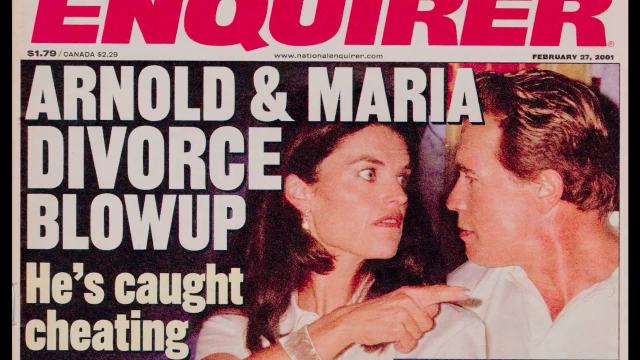
“Scandalous” is a documentary that tracks the history of American tabloid journalism’s most infamous scandal sheet, from its origins to its Elvis death photo/Gary Hart with Donna Rice on his lap heydays, to the ways it help put a tabloid figure — Donald Trump — in the White House.
Mark Landsman’s film charts the steady progress, with short bursts forward, of the “tabloidization” of journalism which Lantana, Florida’s National Enquirer heralded, and often willed into being.
Using archival footage from an ancient “60 Minutes” story, a “Nightline” profile and the like, fresh interviews with many of its most famous employees and sage pronouncements from mainstream journalism critics to provide context, it’s a thorough telling of “The Untold Story of the National Enquirer,” and an often entertaining and chilling one.
“Scandalous” is a journalism expose that lives up, or down, to its hype.
As Mike Wallace pointed out way back when, it was mob money that allowed Generoso Pope Jr., son of a “made man,” to buy the failing New York Enquirer in the 1950s, and by focusing on crimes and gory accident photos, turn it into a national publication.
He and his staff tinkered with the formula that would make it sell — stories of celebrities, pets, psychics, of Jackie O. and UFOs. And by the late 1960s it was the most widely read weekly in America.
Former reporter Judith Regan recalls Pope’s mental picture of “the ideal reader,” whom Pope called “Missy Smith” and who lived in Kansas City.
She couldn’t get enough of Elvis, of Jackie Onassis, of Farrah Fawcett and Liz in a “newspaper” that was their escape from the real world of Vietnam, Watergate, inflation and the 1970s Arab Oil Embargo.
Seeing Wallace interviewing elderly white women who had picked The Enquirer up at the checkout counter at their supermarket — Pope’s stroke of marketing genius — and hearing them cluck, “They couldn’t print it if it wasn’t true,” you understand how Nigerian princes and TV preachers get rich, and how Donald Trump is president.
Landsman (he did “Thunder Soul”) gets retired staffers to tell the tales of unlimited expense accounts, “checkbook journalism,” where they paid sources to rat out their famous employers or relatives for stories. The lengths The Enquirer went to in order to obtain that famous shot of Elvis in his coffin is a hilarious, and a trifle appalling.
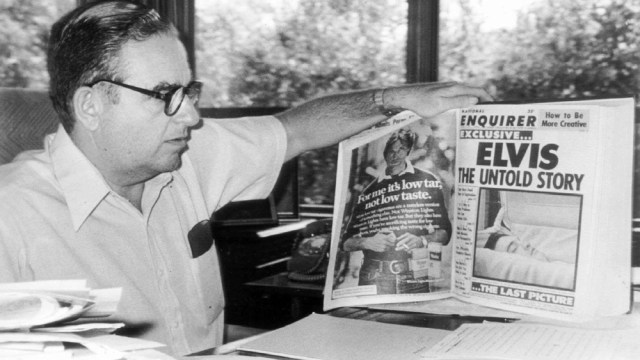
Pope kept his publication somewhat apolitical (he was described as a “conservative Democrat”). But it was under his stewardship that blackmailing celebrities became a common practice, that killing stories on Bob Hope’s lifelong womanizing and Bill Cosby’s sexual appetites led to puff piece “exclusives” that built the magazine’s “legitimacy.”
The die was cast under Pope. And after his death, other publisher/owners took that practice and created the “catch and kill” technique — buying “exclusive rights” to somewhat with Arnold Schwarzenegger’s secrets at her command, or Donald Trump’s, so that their stories couldn’t be told elsewhere.
The result? One lecherous groper became governor of California, another groper/assaulter and womanizer became president of the United States, both with the help of “a short man wanting to be tall,” then publisher and GOP booster David Pecker.
The veterans of the publication, for all the derision they took over the years — many of them ruthless, ethically-challenged Brits, veterans of Fleet Street tabloids in the UK — for all of their own shortcuts, invasions of privacy (wiretaps, stalking, mail-theft), profess shock at seeing this tactic.
Burying a good story? That’s blasphemy to an authentic hack. But once you’ve covered for Bob Hope and Bill Cosby, once you’ve started down the slippery slope of corruption, the only real wonder is why it took them so long to seize the reins of power.
As Watergate legend Carl Bernstein notes, we’re in “a bad time for the truth.” And once you’ve seen Jackie Kennedy Onassis push a supposedly long-dead John F. Kennedy around in a wheelchair on some Greek Island, in an Enquirer photo I recall seeing in an issue I perused at a neighbor’s house in the ’70s, once you’ve seen aliens checking the landing gear of their saucer, once you’ve heard famed journalist Ken Auletta decry the ethos that “facts were not important,” how we got here is no longer the question.
There’ve always been rubes, and there’ve always been fooled by the right hustler with the right approach and the chutzpah to tell a whopper, and sell it to them, right there at the supermarket cash register.

MPAA Rating: unrated
Cast: Judith Regan, Steve Coz, Barbara Sternig, Carl Bernstein, Maggie Haberman, Ken Auletta
Credits: Directed by Mark Landsman. A Magnolia/CNN Films release.
Running time: 1:37

If you travel to dive or snorkel around coral reefs, you probably hear the same refrain I do when I hit the water in Key West, St. Croix or Curacao.
“You should’ve seen it 20 years ago!”
Actually, the guide or dive boat operator missed out, too. They and we should have seen the world’s reefs 50 years ago. In that time, Peter Coyote narrates in “Saving Atlantis,” “more than 50% of them have vanished.”
“Saving Atlantis is a documentary that takes us around the world for a State of the Coral report, and a survey of some of the efforts being made to study and save the “vanishing” bleaching reefs.
We’re shown the Great Barrier Reef off Australia, reefs in the Red Sea, in French Polynesia, reefs off Oregon and a huge one in the mouth of Cartegena Bay, Colombia.
Fishermen talk about how important they are to their livelihood and the world’s fish stocks. Scientists talk about their role in fostering healthy life in the sea, and in protecting shorelines from destructive shore erosion during storms.
The water’s getting too hot, too acidic, for reefs. But some corals can withstand it, and if enough is done to combat pollution and climate change, others say, the reefs will come back.


That’s the hopeful part of “Saving Atlantis,” the scientists around the world mapping the coral gene pool to help determine which corals are the hardiest in this warming climate, capturing samples of corals that might go extinct before we do enough to save them.
“We should continue to act until it’s too late,” one marine biologist declares. “You should never give up on reefs.”
This Oregon State University coral reef documentary doesn’t have the impressive visuals of the BBC’s “Nature” series, or that of the gorgeous films shot in large format video for IMAX movies shown in science museums and the like.
But it’s a fairly thorough survey of all that’s going wrong, and many of the efforts underway worldwide to save, seed and repopulate eco systems that are vital to our diet and the safety of our shores as the seas rise and the storms surge.
Oregon State — it’s not just about football.

MPAA Rating: unrated
Cast: Narrated by Peter Coyote.
Credits: Directed by David Baker and Justin R. Smith, script by David Baker. A Gravitas Ventures release.
Running time: 1:30

Writer-director Rian Johnson, of “Brick” and “Looper,” briefly escapes the stranglehold the “Star Wars” universe has on him with “Knives Out,” a cutting and clever “Clue” murder mystery treated as a lark and played for laughs by a Big Name cast.
It’s the kind of movie where the cinema’s James Bond, Brit Daniel Craig, slings one of those “MO-lasses” Southern accents that Brit actors adore, and is openly mocked for it by others in the movie. On camera. In character.
Playing “the last of the gentleman sleuths,” a private investigator with the unlikely (except in New Orleans) name Benoit Blanc, he is called “CSI: KFC” and “Foghorn Leghorn” by the rich New Yorkers he’s treating as suspects in the murder of their family patriarch. To his face.
The indulgent cop (Lakeith Stanfield) who is ostensibly in charge of the case announces, at the end of a hot pursuit, “That was the DUMBEST car chase of all time.” Yes, there’s a Hyundai Elantra involed, and yes, he is correct.
The patriach’s nurse (Ana de Armas of “War Dogs” and “Blade Runner 2049”) has this condition, a “regurgative reaction to untruths” is how Benoit Blanc puts it. Ask her a question, and if she tries to lie or let another’s lie stand, she throws up.
That may be the silliest plot device ever parked in a whodunit — and the funniest. Johnson deposits a human lie detector in the midst of a family with motives for murder, and an aversion to the truth.
And for politics, there is the pale, Hitler-haired grandson (Jaeden Martell of “St. Vincent”) who sits in the background, staring at his phone, trolling the “snowflakes” and every so often hissing a little anti-immigrant rhetoric — “Dirty ‘anchor baby!'”


Famed mystery novelist Harlan Thrombey (Christopher Plummer, of course) had gathered his family in his suburban Massachusetts mansion, a Victorian estate decorated with all manner of lethal bric a brac and other souvenirs from his decades of publishing.
The centerpiece might be his “throne” of knives, a chair with a gigantic fan of cutlery spread out behind it. Nobody points this out. It’s just there.
Harlan was found in his bed with his throat cut the morning after the party. And even though son (Michael Shannon) and daughter (Jamie Lee Curtis) might have motives, and his son-in-law (Don Johnson) and widowed and dependent daughter-in-law (Toni Collette) and her daughter (Katherine Langford) could as well, the police have ruled the death a suicide.
But I guess when the famous (thanks to a New Yorker profile) Benoit Blanc shows up, it’s “Let go through that night once more” time.
A clever touch — Johnson gives Craig’s sleuth a hidden “star” entrance. He is in the background of the re-interrogations conducted by Lt. Elliott (Stanfield). Every time the questions or the answers drift off topic, we hear a single note struck on the piano. Benoit is interrupting without interrupting, disapproving and redirecting the questioning.
“Who IS this guy?”
As motives start to pile up and various members of the family cast suspicion on each other, we see Nurse Marta — “like a member of the family” the family insists, although each has her or his own idea of where she moved to this country from — Paraguay, Brazil, Ecuador, Uruguay. She’s a walking ball of nerves, and her immigrant mom watching “Murder, She Wrote” in Spanish isn’t calming her at all.
It’s “Columbo” that Johnson takes his story structure from. Flashbacks show us what REALLY happened that night. We know “whodunit,” and what we’re watching is the famed detective, who could be a dolt, try to figure this out via interrogations and magnifying glass walks around the grounds of a writer “who practically lived on a ‘Clue’ board.”
Blanc is forever drawling about “the inevitability of truth” and the “trajectory” of how the crime unfolds as he ever-so-politely grills the gathered family.
“Ah’m sorry t’press, buuuut…”
The plotting here is iffy, and it takes a whole new level of suspension of disbelief to accept the reality (ish) of this scenario. But the cover-up, as with most crimes, is far more interesting and suspenseful. The flurry of jokes, delivered as a blizzard of throw-away lines about what “the reading of (a) will” is REALLY like, for instance, tickle.
And Johnson keeps finding new players to sprinkle over the proceedings and deliver a smirk or chuckle. M. Emmet Walsh plays a technophobe caretfaker and Frank Oz a comically-dismayed but firm-handed lawyer.
He’s managed a couple of neat tricks, luring us in and amusing us so that we don’t notice over two hours have passed, letting us see “the crime” and puzzle out how it will be covered up, exposed or unraveled implicating others.
And he’s given free rein to our once and future Bond, who wrings every laugh he can out of a detective trying to find what fills not just “tha hoooole at the center of this donut” of the mystery, but the “hole in the middle of the DONUT hole,” to boot.
That adds up to “Knives Out” as a proper whodunit, as twist-turny as you might expect, and as amusingly edgy and cutting as its title suggests.
MPAA Rating:PG-13 for thematic elements including brief violence, some strong language, sexual references, and drug material
Cast: Daniel Craig, Jamie Lee Curtis, Toni Collette, Chris Evans, Ana de Armas, Lakeith Stanfield, Michael Shannon, Don Johnson, Katherine Langford and Christopher Plummer
Credits: Written and directed by Rian Johnson. A Lionsgate release.
Running time: 2:10

Here it is, that “lost” chapter of “Love, Actually” that we’ve been rummaging through the vaults for. “Last Christmas,” they’re calling it. “Dull, Actually” is more accurate.
It’s a mopey holiday romance leaning heavily on the “Game of Thrones” charms of Emilia Clarke and the music of George Michael.
And if you’re not ready to question her ability to play comedy and second guess the value the world puts on the George Michael songbook by the time this has burned through 102 minutes you’ll never get back, you never will be.
Clarke tries to sparkle every line the Emma Thompson/Bryony Kimmings screenplay gives her. She laughs. A lot. But she’s the only one guffawing and showing a lot of teeth as she does, because there’s virtually nothing here that will tickle anybody else.
Clarke stars as Kate, “Katerina” to her Croatian family. She’s 30ish, has just moved out of her parents’ duplex and is schlepping her suitcase all over London Towne, still wearing her costume for work. She’s unintentionally made a career out of being an elf-clerk at Yuletide Wonderful, owned by the Chinese emigre who goes by the name “Santa” (Michelle Yeoh).
“Time to sparkle,” Santa growls.
It’s a tacky yet quirky shop, and it doesn’t pay enough to let Kate set up housekeeping on her own. So she imposes on one friend after another, thoughtlessly and clumsily breaking this and sullying that, and picking up guys in bars that she brings “home” for a little pre-Christmas coitus.
We’ve seen her as a child, warbling a George Michael song with her choir back in pre-breakup Yugoslavia. That’s her goal — singing on the London stage. The auditions she tumbles into suggest how unlikely that dream is — pleasant (ish) but untrained voice, pathologically tardy, self-absorbed. Maybe delusional.
Hell, she should try New York.
Santa seethes at Kate’s carelessness on the job. Her thick-accented mother (Emma Thompson) leaves her voice mails by metric tonne. And losing one more set of friends by being the roommate from Hell might be her wakeup call.
Ours? Well, we’re going to stick around to see how she ever made friends in the first place.
Then the tall handsome stranger, Tom, strolls into her life. Henry Golding of “Crazy Rich Asians” plays this patient, eccentric and very-interested-in-Kate Londoner. He’s obsessed with getting her to take a walk with him. She chuckles how much he’s “not my type” and how the places he wants to walk have a “serial killery” vibe.
But he’s always looking up. And as she looks up with him, she notices the glories of London in all its holiday splendor, and its quirky architectural history. He shows her his secret garden. And even though she’s still doing the barfly-hookup thing after they meet, she continues to take walks with Tom — appreciating the beauty, checking in at the homeless shelter where he volunteers.
“Might as well have ‘SAINT’ tattooed on your forehead!”
She takes an interest in the only way she knows how. She comes on to him. Tom brushes that off in a “we just met” way, and the walks continue.
Kate, of course, has a secret. She’s been sick, we’re told. She meets her doctor with her mum and gets read the riot act over her unhealthy lifestyle.
Tom has his own secrets. And if you sit there pondering, as I did, “WHY are they together?” well, you’ll figure both secrets out before the first one is revealed.


Golding has an effortless charm here that we haven’t seen in his other performances. But his inability to spark chemistry with any leading lady is an ongoing issue, and that makes the gears grind in this syrupy Paul Feig (“Bridesmaids,” “Ghostbusters”) confection. It’s why we sit and wonder why these two are “together,” because the script and performances don’t make their connection organic or believable.
Clarke’s character arc is that she develops compassion being around Tom, starts helping with the shelter, going easier on her mom, matchmaking for her lonely boss. She’s not awful as Kate, but the strain shows. At least her green eyes match her elf costume, damn near perfectly.
But like a lot of Feig’s recent work, it’s the “woke” elements of “Last Christmas” that seem to get more attention than the BASIC dramatic/romantic/comic/sentimental stuff. Anti-immigrant bigotry (a subtext in a couple of movies this holiday season, “Knives Out,” for instance), the ugly underpinnings of Brexit, and a gay couple just needing family acceptance, all are here and designed to deliver the warm fuzzies.
So is the heavy reliance on the George Michael Songbook. Repeating his “Last Christmas” title tune ad nauseum does him no favors, and removing his performance from many of the songs emphasizes his inadequacies as a lyricist — with that song, in particular, standing out as insipid. And the ultimate spoiler.
After a while, though, we get ahead of the editors, recognizing “Oh, this’d be the PERFECT place to use ‘Faith,'” etc. Kate, of course, dozes off and we ALL know what song will awaken her before she go goes.
The banter is, first scene to last, awful. Delivering bad dialogue at top speed doesn’t make it better, Ms. Clarke. Why does she keep saying she’s from “The Former Yugoslavia?” NO emigre would refer to her homeland that way. Her mother doesn’t.
Yeoh looks perplexed enough to mutter “This is supposed to be FUN?” between takes.
Still, there’s one great thing Tom and “Last Christmas” have to teach us. Kate wants to give him her digits. “Where’s your phone?”
He locked it in a cubbard, he says. And once he did, he stopped looking down and started looking up at the city. A lovely sentiment. Not the only one in the film, mind you. But the only one that stuck with me from this instantly forgotten treacle.

MPAA Rating: PG-13 for language and sexual content
Cast: Emilia Clarke, Henry Golding, Michelle Yeoh, Emma Thompson
Credits: Directed by Paul Feig, screenplay by Emma Thompson and Bryony Kimmings. A Universal release.
Running time: 1:42

And will “Playing with Fire” light up?
So many BO headline questions.
But if there’s anything the post “It” universe has taught us, don’t bet against Stephen King. His “Shining” sequel has good reviews, real horror and a few frights and could clear $30, some say. Box Office Mojo says $25.
Deadline.com is throwing a $23 to $30 rabge out there. CYA much?
“Last Christmas” is testing how much we want to see a holiday romance in early November. Emilia Clarke of “Game of Thrones” and Henry Golding of “Crazy Rich Asians” pair up. Indifferent reviews won’t hurt it, but Mojo says $18 million is its ceiling. Maybe. I am about to tap out my review and can’t wait to use the phrase “Dull, Actually” in it.
“Midway” may find an audience, but World War II movies have iffy BO prospects. A CGI driven Naval battle epic, it should clear $10, $13 says Mojo.
And John Cena paired with kids has limited prospects. Terrible reviews won’t help “Playing With Fire” and Mojo saying it will make $8 million seem a tad generous.
https://www.boxofficemojo.com/article/ed3798991876/?ref_=bo_at_a
Yeah, Starz cable channel is a part of the equation. But cheap movies that out perform expectations do, too.
A winning formula.
Via Variety.
Lionsgate Beats Wall Street Forecasts for Revenue, Operating Income https://t.co/28E5kjUQUu https://t.co/I5eOLcbCem https://twitter.com/Variety_Film/status/1192558113317982208?s=17
“I’m not…CRAZY!”
A February movie, Moss lets her late spouse get in her head. Or maybe he really is “The Invisible Man.”
“Soul” has a little jazz, and a little “Inside/Out” metaphysics. Jamie Foxx and Tina Fey are the voice acting stars of this June 20 release, which looks like a fairly significant departure for the animation house.
What’s the afterlife like?

 Movie Nation