

Movie Preview: DiCaprio, Penn, Benicio and Teyana in Paul Thomas Anderson’s “One Battle After Another”

“The Revolution” doesn’t begin here. It’s ongoing.

Well, it stopped for a while. And now we’ve got to “get the band back together” to save one of their own.

Oscar winners DiCaprio, Penn and del Toro are joined by Regina Hall, Teyana Taylor and Wood Harris.

And Alana Haim (“Licorice Pizza”) is in this nearly three hour epic to remind us that sometimes, Paul Thomas Anderson swings and misses.

Sept. 26, this awards-bait comic thriller opens wide and invites us in.

Posted in Reviews, previews, profiles and movie news | Comments Off on Movie Preview: DiCaprio, Penn, Benicio and Teyana in Paul Thomas Anderson’s “One Battle After Another”

Movie Review: Jason Statham takes care of business in Ayer’s “A Working Man”

The Brotherhood, the elders of the Russian mafia in America, solemnly gather for a war council in Chicago.

“We are facing a devil,” the mobster called Symon (Andrej Kaminsky) intones. And those gathered round him pause to hastily themselves — pious murderers, drug dealers and sex traffickers fearing the worst.

They’ve crossed Jason Statham. And we all know what that means.

Welcome to David Ayer World at the movies, a thriller where the mayhem is masterly, where guns are fetishized, sex traffickers sell to perverts in cape, ponytail and top hat, where the Russian villains aare in charge and the cops are on the take, where old military comrades get three scenes and the pub, nightclubs and bars are production-designed to death — pulsing lights, beautiful dancers and drugs, where gaudy mobsters mix and perhaps mate.

Ayer, of “Harsh Times” and “End of Watch,” co-scripted “A Working Man” with Sly Stallone, who would have certainly taken the starring role in this “Taken” variation 25 years ago. Their embellishments on Chuck Dixon’s novel render this vengeance/rescue thriller both more and less than standard issue Statham.

Statham plays Levon, a construction site supervisor for the Garcia family construction company, the guy whose daily pep talk to the crew is “Let’s all go home with the same amount of fingers we came with.”

He sleeps in his F-150 pickup, as often as not. Widowed, he’s spending all his money on lawyers in a custody fight with his father-in-law over his little girl (Isla Gie).

But there are signs that he’s more than the sum of his circumstances. A gang shows up to intimidate a co-worker, Levon gives them a beating with whatever is at hand — a bucket of nails, for instance. The street-sweeper shotgun? Hey, it’s Chicago. Don’t leave home without it.

So when we see the daughter (Arianna Rivas) of bosses Carla (Noemi Gonzalez) and Joe (Michael Peña), targeted, stalked and kidnapped on a night of celebrating completing “one semester” of college, we know who they’re turning to.

He can protest “I’m a different person, now.” But we know Royal Marine Levon will be kicking ass and taking names, not selling “cartoon balloons in town.”

He consults with his blind archer mate Gunny, a fellow veteran (David Harbour) for reasons only a cut-and-paste screenwriter can justify.

And things get ugly in a hurry as Levon waterboards a complicit bartender, meets his first Russian (Jason Flemyng) and crosses every line there is to cross, and faces the wrath of The Brotherhood.

“Who are you?” and “What are you?” will be asked as he kicks, knocks, slices and dices every Ivan who isn’t on the White House payroll in search of plucky coed Jessie.

The violence is in-your-face the sets are striking and the villains are cartoonishly-dressed clowns even as the plot features gaps and lapses that upend any logic the journey from A-to-B that the formula demands.

And the one-liners are “thought we would have a little chat” canned, but delivered with Statham relish.

“Do you know who I am?”

“No. Should I?”

It works, in that arch-action-vehicle-built on-cliches sort of way.

And Statham delivers the requisite sadistic beatings, stabbings and shootings as he and we walk the predictable primose path down to the morgue, or the sex traffickers’ abandoned mansion hook-up party where it all comes to a head — one of them wearing a bedazzled festive top hat.

Rating: R, violence, sex trafficking, drugs, profanity

Cast: Jason Statham, Arianna Rivas, Jason Flemyng, Eve Mauro, Noemi Gonzalez, Michael Peña and David Harbour.

Credits: Directed by David Ayer, scripted by Sylvester Stallone and David Ayer, based on a novel by Chuck Dixon. An MGM release.

Running time: 1:56

Posted in Reviews, previews, profiles and movie news | Tagged , , , , | Comments Off on Movie Review: Jason Statham takes care of business in Ayer’s “A Working Man”

Movie Preview: Russian Journalist tries to tell the truth about Putinism — ” Words of War”

Lot of Brits in this May 2 wide release. Truth in a time of conflict and fascist propaganda comes at a cost.

Posted in Reviews, previews, profiles and movie news | Comments Off on Movie Preview: Russian Journalist tries to tell the truth about Putinism — ” Words of War”

Movie Review: Tony Jaa & Co. bring on the brawls in “Striking Rescue”

Muay Thai master Tony Jaa is back in action in “Striking Rescue,” a clumsily titled, ineptly subtitled and generically plotted Chinese thriller where the fights are to die for, the characters and plot not so much.

Twenty-plus years since his break-out in “Ong Bak” and Jaa still brings the muscle to brawling martial arts revenge thrillers like this one. Thicker and more solidly built, when he throws a punch drops a kick these days, we believe the damage it’s going to cause. And how.

Jaa plays Ann Bai, whom we meet as Kun Tai, as the Chinese media and authorities have named him, a wanted man in connection with events that killed his wife and child.

But he wasn’t the killer. And naming him Kun Tai, from Tai Chi, is a blunder. An Bai, from the punching martial art Baji Quan, is closer to who this real “wanted man” must be.

A street level mobster may have some answers about who killed his wife and child. That’s where Ann Bai’s hunt begins. He stalks the sunglasses-and-cigarettes villain through the market, only to have the guy’s whole gang descend on him with machetes and fists.

“Don’t grill the fish,” Boss yells at his lunch hour mob in Chinese (with subtitles, and a smattering of English). “Grill the guy coming up behind me!”

That’s kind of how the movie goes. A bigger boss, Yinghua (Philip Keung) is ID’d and pursed and targeted, with mobs of henchmen to overcome. Then a bigger boss (Michael Mao). And a cackling martial arts minx (Wang Chenxim) sizzles her way towards a showdown.

Yinghua has a rebellious teen daughter (Chen Duo-yi) whom Ann Bai locates, then tracks to get to her dad. But before he can set off his planned roadside bomb and tear through Yinghua’s gang to get to him, others ambush the mobster and Ann Bai finds himself rescuing the punk daughter, who has a grudge against Daddy.

“We can work together,” Te Hing teases. “Don’t you want revenge?”

Junjia Hong plays the dashing, two-fisted bodyguard who lets the teen Te Hing slips out of his protection. Bo Peng plays the boss’s trusted number two, who might be his older daughter. A lot of stuff like that is as muddy as the translation.

“Follow me or die here,” Ann Bai snaps at the girl when he just wants her to jump in his pickup. “I told you to fight back and NOT cause trouble,” dad Yinghua contradictorally snaps at Te Hing when he sees she’s been brawling at school again.

“Now you are getting more NONSENSICAL” he barks when she talks back.

Wang Chenxin is the standout of the supporting cast, a stylish dragon lady with rose colored glasses and a taste for blood, a harpy handy with ice climbing axes in a fight.

I pretty much checked out of the story, which presents Ann Bai a master of martial arts master, a master of surveillance, unraveling criminal conspiracies and whiz with electronics, the moment he beats “Tell me the LICENSE plate number” of a car out of a thug who has mentioned Te Hing has a regular ride home.

Who remembers their own plate number, much less another?

But the fights, choreographed by Guo Yu Long, are brilliantly staged, shot and cut-together. We see blows delivered from a fist-eye-view, from shoulder shots and everywhere else, all of it cut into a visually coherent blur of blows. Brilliant.

Lashing a camera to a motorbike’s front fork is a great way to amp up a chase scene, and director Chen Si Yu — the martial arts fantasy “Fists of Fure: Soul” was his — takes care to at least showcase the action if not the logic and suspense in the “nonsensical” story.

Somebody killed his wife and kid. Tony Jaa is on their trail and out for revenge. A little back story and a parade of bigger and bigger villains to fight through is all that’s necessary beyond that.

Rating: unrated, bloody violence, drugs

Cast: Tony Jaa, Chen Duo-Yi, Philip Keung, Michael Mao, Bo Peng and Wang Chenxin.

Credits: Directed by Chen Si Yu, scripted by A Well Go USA release.

Running time: 1:48

Posted in Reviews, previews, profiles and movie news | Comments Off on Movie Review: Tony Jaa & Co. bring on the brawls in “Striking Rescue”

Classic Film Review: Serious and Seldom Seen Sellers — “The Blockhouse” (1973)

Filmed on the whim of a liquor empire heir, a “true story” whose German Army WWII victims were changed to French and citizens of other occupied countries, “The Blockhouse” is one of the strangest titles in the later, quixotic career of British funnyman Peter Sellers.

The legendary French singer and actor Charles Aznavour was also in the cast, along with a selection of top drawer character actors of the ’60s and ’70s. The British TV director behind the camera would only make one other feature film, the not-quite-as-obscure “When the Whales Came.”

This minimalist, existential melodrama, set in the dark, silent bowels of a sealed coastal military fortification on D-Day, had a delayed release that made not even a ripple at the box office.

Unheralded video releases notwithstanding, “The Blockhouse” was fated to be forgotten, barely mentioned even in the most thorough Sellers biography, a curiousity from the last years of his career, but something of a table setter for “Being There,” the picture which should have brought him an Oscar.

Sellers’ somber and serious turn in “The Blockhouse” is one of the few things to recommend this too-dark, too-myopic, too-superficial plumbing of the psyche under stress. But while Seagram heir, one-time MCA/Universal mogul and current Time-Warner Music CEO Edgar Bronfman Jr. may have been the very picture of the rich dilettante when he undertook this production, casting Sellers and Aznavour in this modest-budgeted WWII tale wasn’t the craziest gamble.

Director Clive Rees gives us a splash of pre-“Saving Private Ryan” chaos and combat realism in the film’s opening scene.

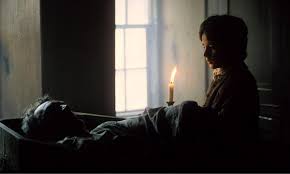
Slave labor from all over Europe has been working on Hitler’s Atlantic Wall defenses against the Allied invasion sure to come. The French “section leader” Aufret (Peter Vaughan of “Straw Dogs,” and later “Brazil” and “Time Bandits”) takes his status and work seriously, waking his fellow inmates and half-leading them as they flee the naval and aeriel bombardment.

Seven men make frantically make their way into the concrete-encased structure they’ve been building. And when the shelling intensifies, they tumble down a steep “escape shaft” to escape what, as far as they know, is just a more-intense-than-usual air-raid and naval shelling on this day in early June, 1944.

Jeremy Kemp, as believable as a German WWI fight pilot in “The Blue Max” as he was as Jean-Luc Picard’s father on “Star Trek: The Next Generation,” is the Eastern European Grabinski, the one guy in this crew who knows the structure they’re hiding in, inside and out.

Lund, whom we gather is from Norway, is played Per Oscarsson (later of “The Girl Who Played with Fire”). Nicholas Jones, most recently seen on TV’s “House of the Dragon”) is Kramer,
Leon Lissek is Knozek, Aznavour is the Italian Visconti and Sellers the French school teacher Roquet.

Fumbling around by matchlight gets them deep enough into the blockhouse to be safe. They stumble over storage rooms filled with wine, cheeses, sausages and candles.

“This is the best time we’ve had since the war started!”

But the starving slaves have barely gorged themselves when Grabinski gives them the bad news. Their various means of exit have been bombed shut. There is no way to dig themselves out.

The “collaborator” Aufret insists “the Germans will rescue us,” and attempts to reassert his “authority” as he does. Nobody’s buying it.

The “gimp” Visconti drinks and bickers his way into full rebellion. The teacher Roquet works out a means of guessing how much time has passed. That is useful, for a moment or two.

But as the futility of their situation, their resignation mixed with half-hearted efforts to try and get out and the limited-light gloom of it all settle in, “The Blockhouse” stiffens into a cinematic corpse.

Sellers, Aznavour, Kemp and the others have moments that might have animated this narrative and piqued interest. But those moments are fleeting as the film settles down into a sort of Pirandello (“Six Characters in Search of an Author”) absurdist play.

It’s all talk and the talk isn’t that interesting. Eating, drinking, playing chess, feuding and fighting, it’s all blandly predictable and kind of aimless without the drive of “goals” — to work the problem and find a way to dig or get the attention of those on the surface — to keep the narrative moving.

The Guernsey (in the Channel Islands) setting is striking and colorful players were cast and give us hints of the movie this might have been, even with them playing war movie “types.” But this fictionalized account of a tale of survival and death is too brooding, theatrical and limited in scope and aims to pay off.

They thought they were making an art film, which is the way Sellers talked it up (briefly) at the time. But the John Gould/Clive Rees script broods and mutters and staggers and bores, like a play that needed another month of tinkering during out-of-town tryouts before opening night.

Bronfman would produce only one other film before using his family fortune to buy into the top tier of entertainment. “The Border,” with Jack Nicholson, is a far better movie, but also a box office bust. Bronfman, who dabbled in song-writing in the days when all oligarchs really wanted was to make it in show biz, has fared better as a production company executive.

Aznavour made movies right up to his death in 2018, and his romantic crooning — performed in a dazzling range of languages — turns up on film soundtracks to this very day.

Sellers’ “experimental” (“The Magic Christian”) and indulgent years would wind up with “The Optimists,” his next film. He’d get back to multi-role straight comedies (“Undercovers Hero”) and his most popular character, Inspector Clouseau, before nursing “Being There” to the screen, only to die shortly after losing his last shot at an Oscar in 1980.

“The Blockbuster” showcased him as a true ensemble player, serious without a hint of even sinister or devilish wit (“Dr. Strangelove,” “Lolita”), that rare moment when the funniest actor of his generation took a role where he couldn’t find a laugh, even if he’d wanted to.

Rating: R, violence

Cast: Peter Sellers, Charles Aznavour, Jeremy Kemp, Per Oscarsson, Leon Lissek, Nicholas Jones and Peer Vaughan.

Credits: Directed by Clive Rees, scripted by John Gould and Clive Rees, based on a book by Jean-Paul Clébert. A Hemdale/Cannon Films release on Tubi.

Running time: 1:33

Posted in Reviews, previews, profiles and movie news | Tagged , , , , , , , , , , | Comments Off on Classic Film Review: Serious and Seldom Seen Sellers — “The Blockhouse” (1973)

Movie Review: All Cuisine’d up, “Waiting for Dalí “

The quality of twee is often strained, the Bard wryly noted.

A tragedy, a comedy or even a romantic comedy is within the reach of some writers and screenwriters. But hitting that feather-weight sweet spot between droll and cute is a rare talent, making “twee” comedies the cinema’s unicorns.

“Waiting for Dalí” circles all around twee and never quite hits the bullseye.

It’s is a period piece romance built on the “Big Night” formula, tested and re-proven over the years since that 1996 film’s release. “Big Night,” set in the ’50s, blended comic obsession with fine Italian cuisine with frustrated ambitions, romantic and otherwise, and helped launch the “foodie” crazy and made creator and co-star Stanley Tucci a famous actor and even more famous culinary expert and wine enthusiast.

The twee hook to that picture was the belief that a restaurant owned and run by two brothers could be rescued by the simple appearance of the famous singer and band leader Louis Prima. One “Big Night,” pulling out all the culinary stops, and they’d be set.

David Pujol’s “Waiting for Dalí” is about a restaurant in 1974 Spain. It’s the end of the represssive Franco era, and young people’s protests have crossed borders and rattled the by-then-wheezing regime.

Alberto (Pol López) has gotten himself mixed up in street marches, which sometimes turn into vandalism and riots. He’s wanted by the corrupt and hidebound Guardia Civil, the Spanish police hellbent on maintaining order until the elderly fascist dictator dies, and beyond.

This attention derails brother Fernando’s (Ivan Massagué of “Pan’s Labyrinth”) plans of becoming head chef at the posh Barcelona fine dining eatery where he works. With the aid of the the culinarily-connected revolutionary pal François (Nicolas Cazalé), they escape to the country, to the coastal Catalan village of Cadaqués.

That’s where the brothers will meet and work for the eccentric, obsessive Jules (José Garcia of “The Take,” a hoot). He’s built and runs a restaurant dedicated to honoring and serving the town’s most famous resident. He’s even named his establishment El Surreal and decorated it with Dalíesque melting clocks, eggs and nude manikins seated at tables or the bar. The place specializes in French cuisine, Dalí’s favorite, with a snobby French chef to ensure the finest quality dishes.

The only problem? The mercurial epicurean Salvador Dalí won’t come. Jules can beg the Catalan chauffeur of the great artist’s Cadillac Sedan DeVille, Arturo (José Ángel Egido) all he wants. But he’ll never get past the true gatekeeper, Dalí’s imperious, insufferably snobbish Russian wife and “protector” Gala (Vicky Peña), doing her best “Soup Nazi”).

Every pleading encounter with her ends with a demand of “10,000 dollars” or “$15,000” for them to dine in El Surreal, and suggestions that Jules become a “fishmerman” (in Spanish and in French, with subtitles) instead.

When Fernando is forced to take over the kitchen of this impossibly impractical restaurant, his experiemental Catalan/French cuisine just might be surreal enough to change Gala’s mind and Jules’ fortunes.

Pujol, who did documentaries on Spanish cuisine and Dalí himself before making this his feature film writing and directing debut, immerses himself in the setting and sets up colorful peripheral characters to provide a possible love interest — Clara Ponsot plays Jules’ pragmatic and earthy daughter Lola, a local diver — and town “character.” Francesc Ferrer plays Tonet, a beloved local art vandal who insists on painting everything blue, even the house and/or works of the eccentric genius Dalí’. The Guardia Civil is always chasing him.

Every little bit helps and every colorful touch is needed because “Waiting for Dalí'” is basically the somewhat insubstantial sum of all these flourishes.

We meet cute characters, but little is done with them. Interior lives and backstories are disregarded. Romance, when it arises, feels abrupt and tacked-on. We revel in extravagant, anachronistically modern cuisine (“foams” and the like). Catalonia was one of the birthplaces of molecular gastronomy, but that didn’t happen under Franco.

But every so often, Jules and his charges hurl themselves into and at Dalí’ — styling their facial hair into elaborate curls, pursuing him and knocking on his door — or standing in his defense, a “surrealist” “sell-out” who shallowly praised Franco’s fascist regime as he flittered to and fro, coasting on artwork that peaked and passed that peak thirty years before.

Some of what’s tossed in the air here pays off, but the whole never quite comes off. I’ll go to any museum, any “Dalí’ and Disney” exhibit, and review any movie about the only surrealist most of us remember. “Waiting for Dalí'” gets by on charm, settings and set-ups. It’s a pity more of those set-ups don’t deliver the “twee” the picture promises.

Rating: 16+, smoking, sexual situations, profanity

Cast: José Garcia, Ivan Massagué, Clara Ponsot,
Nicolas Cazalé, Pol López, Varvara Borodina, Alberto Lozano, Francesc Ferrer and Paco Tous.

Credits: Scripted and directed by David Pujol. A Music Box release on Amazon Prime.

Running time: 1:54

Posted in Reviews, previews, profiles and movie news | Tagged , , , , , , | Comments Off on Movie Review: All Cuisine’d up, “Waiting for Dalí “

Netflixable? Crime and Christian Supernaturalism collide in Korea — “Revelations”

“Revelations,” the new thriller from the director of “Train to Busan” and “Peninsula,” has no zombies. But this collision of crime and punishment, Christianity and psychology is as suspenseful and satisfying as any thriller to come our way this year.

Writer-director Yeon Sang-ho — the AI thriller “Jung_E” was also his — immerses us in a single crime, perhaps committed by a notorious ex-con, in the psychology of trauma and the psychosis of people who believe they’re seeing “signs” that tell them what “God wants me to do.”

Tf we learn nothing else from this slow-moving, big twists ticking clock tale, it’ll be the psychological definitions of Apophenia and Pareidolia and how they apply to the connection between madness and “belief.”

A young girl is missing, and we’ve seen her possible abductor stalk her to her church on a rainy day. That’s how Pastor Min Chan (Ryu Jun-yeol) catches the creepy, haunted gaze of Kwon Yang-rae (Shin Min-jae). Let’s sign him up to our tiny start-up congregation!

But the stalker is also being stalked. Violent Crimes Unit Det. Yeon-hee (Shin Hyeon-bin) seems just as haunted, and not just by Kwon. She pops pills to deal with her anxieties. It takes a while for us to notice there’s another young woman just over her shoulder, just behind this door or in the next bathroom stall. That’s her sister. That’s why she’s taking those pills. Her death is what haunts the detective and her ongoing obsession with Kwon Yang-rae.

The distracted but devout pastor has a lot on his mind. There’s a new mega church being built in this underserved corner of the city. It’s being constructed by his mentor/pastor, and Min-chan knows this corner of Christianity is quite “corporate.” He might be up for a promotion, or Pastor Jung could simply assign the new facility to his son.

It’s not exactly the best time to hear from that private eye Min-chan hired to follow his wife that there’s conclusive proof that she (Moon Joo-yeon) is cheating.

Our pastor looks for “signs” of “what God wants” because “God’s will must be done.”

Flashbacks showing Yeon-hee at Kwon Yang-rae’s earlier trial reveal that the convicted rapist/kidnapper/”monster” was tormented by supernatural quasi-Christian visions (his mother was fanatically-religious) that directed him, visions created by childhood trauma.

Our detective is also seeking “revelations,” clues about what’s to come, where the missing girl is, what her quarry might have had to do with it and what her dead sister wants her to do about that.

Yeon Sang-ho and Choi Kyu-seok’s script takes us down the rabbit hole of interconnected lives and extreme responses that spin out of when those lives collide. All will be tested and all will snap, to some degree.

But will anybody pull it together in time to save the missing girl?

Ryu (“A Taxi Driver”) has the most bizarre character arc to play, a man whose faith is tested from all sides who stumbles and falls as he faces those tests, growing more fanatical as he does.

Shin Hyeon-bin must show us a cop observant and canny enough to earn her new promotion, but a daughter whose father worries about her because of the weepy guilt she carries over a dead sibling.

Shin Min-jae gives some interesting shades to the guy set up to look like a killer — scars, dead-eyed stares, the works.

And Kim Do-yung brings a conflicted gravitas to his characeter, a psychologist who tried to understand our traumatized criminal when he was on trial and weathers sincere, strident “This is all YOUR fault” accusations because he has a role to play in this fresh case as he defines (for the viewer, mostly) what everybody involved seems to be suffering from.

Yeon immerses us in this world and this case with all its psychological and supernatural subtexts. Crucifixes are everywhere — neon ones in or on churches, heavenly visions of crosses or Jesus in the day or night sky. That ghostly sister shadows our pill-popping cop and our suspect acts more and more suspicious.

It may be obvious at times and far-fetched at others. But these “Revelations” played for me, and drew me in. Yeon Sang-ho has conjured up a tale whose twists trip us up often enough to make its fraught payoff satisfying.

Rating: TV-MA, violence

Cast: Ryu Jun-yeol, Shin Hyeon-bin,
Moon Joo-yeon, Kim Do-yung and Shin Min-jae

Credits: Directed by Yeon Sang-ho, scripted by Choi Kyu-seok. A Netflix release.

Running time: 2:03

Posted in Reviews, previews, profiles and movie news | Tagged , , , , | Comments Off on Netflixable? Crime and Christian Supernaturalism collide in Korea — “Revelations”

Movie Preview: Hildebrand and Abel, Cusack and Sorvino peek through the “Fog of War”

Brianna Hildebrand was one of the pretty young players on the periphery of the “Deadpool” franchise, and was featured in Netflix’s “Lucifer.”

Jake Abel was in “Supernatural” and played Mike Love in the Brian Wilson biopic “Love & Mercy.” He might have met John Cusack on that set, as he played the older Brian.

Cusack and Oscar winner Mira Sorvino are supporting players in this WWII pic of spies, intrigues and fighting “pure evil,” aka “fascism.”

April 4.

Posted in Reviews, previews, profiles and movie news | Comments Off on Movie Preview: Hildebrand and Abel, Cusack and Sorvino peek through the “Fog of War”

Movie Review: “Ed Kemper: The True Story of an American Psycho”

“Ed Kemper” is a serial killer portrait that’s as pitiless as it is artless.

This feature film, no doubt inspired by Netflix’s “Mindhunter” series bringing attention to the “other” notorious mass murderer named “Ed” (“The Butcher of Plainfield” Ed Gein inspired “Texas Chainsaw Massacre,” etc.), it’s a simple “How he went about it” account of Edmund Kemper’s crimes attached to simplistic “Mommy made him do it” psychology.

There’s no suspense. We don’t see the California police missing early ’70s clues or closing in on their quarry, because they didn’t.

The plainly fortyish Brandon Kirk is meant to play the hulking Kemper — he’s six foot 9 and still in prison — who was 24-25 when killed female hitchhikers around Santa Cruz in the early ’70s. Kirk is joined by the worst John Wayne impersonator you ever saw (for delusional manhood lectures) and a teenage girl (McKenna Ferry) cast to play “Eddie” as an unbalanced child locked in the basement with Satan (in his nightmares) during the kid’s cat-torturing childhood.

If you mutter “WTF” at that last stunt, you’re not being gender phobic. There’s absolutely no resemblence between her, teen Kemper (Benjamin Philip) or adult Kemper.

Susan Priver plays Clarnell, the hippy-hating failed actress harridan who raised Kemper, a three-times-married hard-drinker and generally twisted sister who is presented as the “cause” with 10 dead victims as the”effect” in the film’s telling.

“Hey, Mom,” teenaged Edmund says when he calls her after shooting and stabbing his paternal grandparents. “I hope you’re happy now.”

The “monster” was hospitalized for killing his grandparents as a teen, and was released by an out-of-its-depth prison mental health establishment only to slaughter others as an adult. That makes mental health workers sort of secondary villains, here.

Ed is lectured by the “You’re going to be fine, just fine” shrink leading him out of Atascadero State Hospital as he’s released five years later to “stay away from your mother.” Naturally, he moves in with her because he has nowhere else to go.

A job as construction crew flagman for the state highway department supports him, and his mother’s insults and jabs drive him as he takes note of hitchhikers and plots what he’d like to do to them.

As his name rings a bell with a workmate, Ed admits that he’s the same guy who killed those two people up in North Folk a few years back.

“I just wanted to see what it felt like to kill grandma!”

Director and co-writer Chad Perrin is mainly interested in the MO of the heartless murders, and in the perversion that Kemper inflicted on the corpses.

Whatever lip service Kemper pays to his lack of remorse and those he “hurt” — who don’t include the people he admits he “slaughtered — doesn’t lend insight to his broken thinking or ways we might recognize his “type” in others.

Tip to parents, far and wide. If they abuse animals, they’re going to hurt people. And that’s not exactly a secret.

As this isn’t a fictional horror film, where violence is but a challenge, and often a jokey “creative outlet” for genre filmmakers, I found “Ed Kemper” grim going, and nothing more. Insights into a sick psycho’s psychology? Not really. Entertainment value? Nope. None at all.

Rating: unrated, graphic violence, sexual content, profanity

Cast: Brandon Kirk, Susan Priver, Benjamin Philip, McKenna Ferry and Brinke Stevens.

Credits: Directed by Chad Ferrin, scripted by Chad Ferrin and Stephen Johnston. An Epic/Dread release.

Running time: 1:31

Posted in Reviews, previews, profiles and movie news | Comments Off on Movie Review: “Ed Kemper: The True Story of an American Psycho”

Classic Film Review: Kingsley, Mirren and Dance scheme their way across “Pascali’s Island” (1988)

The decade after Ben Kingsley won the Oscar for his performance in the title role “Gandhi” was one of the most interesting of his storied, four-Oscar nomination career.

He’d been a respected but mostly unknown player on Brit TV for years when his life and career arc changed with that one epic role. But the movies were not his oyster, necessarily, immediately after that. So he set about building a career off that blockbuster by taking on a string of mostly smaller but prestigious productions that afforded an exotic looking actor who might have been typecast in “ethnic” roles a way out of that trap.

“Turtle Diary” was an understated English romance (Glenda Jackson co-starred) borne from rescuing captive turtles from a British zoo. “Maurice” was a literary period piece gay romance remembered mostly for introducing Hugh Grant to the world. “Testimony” had Kingsley starring as the Soviet era composer Dmitri Shostakovich, creating great art despite the cruel whims of Stalin and the dictators who followed.

And “Pascali’s Island” was an intimate, bejeweled period piece that parked the future Sir Ben in a love triangle cast opposite Helen Mirren and Charles Dance, trapped in the Game of Nations in the comatose years before WWI finally killed off the long-dying Ottoman Empire.

Kingsley has the title role, a little man under the illusion that he’s a big player on this small, Turkish-occupied Greek island. It’s 1908, and the dapper Pascali makes his living “translating” and “teaching” on the tiny island. But that’s just his cover. He watches all the comings and goings here asks questions and takes notes.

And this “secret observer” reports back to his boss in Constantinople, Abdul Hamid II, the sultan of the empire, “emperor father, lord of the world” in long, increasingly despairing letters that he figures no one has read in 20 years.

As he meets, befriends and becomes increasingly suspicious of an English “archeologist” (Dance) who visits the island and starts poking around, his formally informal letters lose some of their decorum.

“Lord of the World, why have you abandoned me?”

Dance’s Anthony Bowles is curious about a particular corner of the island, which he’d like a lease to explore. And he is plainly charmed when Pascali — who has offered his services as a guide, interpreter (and fixer) — introduces him to the exotic Viennese expat artist, Lydia Neuman (Mirren at her most beguiling).

As Pascali is asked to stick his neck out in translating negotiations for that lease with the local pasha (Nadim Sawalha) and his mistrustful aide (Stefan Gryff), as he faces warnings and bribes from a German (George Murcell) with “interests” on the island and the ear of the pasha, the ever-cautious, delusionally influential — “Everyone here knows me!”– Pascali starts to fear he’s being tricked and set-up to take a fall for whatever the Englishman is up to.

It’s bad enough that a rich American is anchored in the bay, supposedly arming Greek rebels there for a revolt.

If heads roll, will Pascali’s be one of them?

Writer-director Basil Dearden — he scripted “Fatal Attraction” — takes his time setting up the world of Barry Unsworth’s novel. He introduces us to Pascali’s routine, and lets him over-share in every introduction — son of a Maltese father he never knew, a half-French mother who got around. We see him questioning a dismissive desk clerk and sneaking off to search Bowles’ room even as he’s sharing ouzo with him and Lydia, whom he’s just introduced.

Many of his exchanges, in Turkish, with the pasha and others, are left untranslated. Kingsley lets us see the direction such negotiations, with hints of contemptuous disregard for him and outright threasts, are going, just with the barely-concealed panic in Pascali’s eyes.

A syp too-long-undercover, Pascali is lonely for friendship and “relationships” of any sort. But as Pascali spies on his “friend” Bowles, catches him skinny-dipping with the free-spirited Lydia, whom Pascali adores, and makes arrangements for the man’s archeological investigation, he warns him.

“The pasha is not a man to be crossed.”

Dance reveals Bowles’ English arrogance not just in his patented hauteur, but in the way he upends a pleasant series of arrangements with the pasha, and with the odd remark about Turks in need of being “taught a lesson.”

Pascali’s place in this power dynamic has him indiscreetly protesting his frustrating connections with Constantinople, as if seeking Bowles’ pity as the situation turns more complicated and more fraught.

His “world” is ending, the “empire” that’s employs him is dying. And the Anglo-German intrigues are beyond his control, hinting at the horrible conflagration to come.

And through it all, Kinglsey puts on a master class in acting understatement. The coiled fury of “Sexy Beast” and sublimated rage of “House of Sand and Fog,” high water marks in the glorious third act of his career, were to come. And hints of this subtler turn would echo in under-appreciated later-career films such as “The Spider’s Web.”

Honestly, I’ll watch the man in anything as Kingsley classes up quasi-epics such as “The Physician” and delights in his rare comedies — “Learning to Drive” and “Daliland” among them.

It is “Pascali’s Island” that I always go back to as a yardstick. Kinglsey made better films, but the understatement and solitude of this role makes this film my favorite.

The intrigues are reasonably well-handled. The finale is grimly anti-climactic. But the performances are to be relished the way the actors, no doubt, relished their working vacation on the Greek islands of Symi and Rhodes all those years ago.

Rating: PG-13, violence, nudity

Cast: Ben Kingsley, Helen Mirren, Charles Dance, Nadim Sawalha and Kevork Malikyan.

Credits: Scripted and directed by James Dearden, based on a novel by Barry Unsowrth. An Avenue/Lionsgate release on Tubi, other streamers

Running time:

Posted in Reviews, previews, profiles and movie news | Tagged , , , , , , , , , | Comments Off on Classic Film Review: Kingsley, Mirren and Dance scheme their way across “Pascali’s Island” (1988)