Documentary Review – “Moonlight Sonata: Deafness in Three Movements”

moon1.jpeg

A child’s hearing-loss is “corrected” by cochlear implants, leading to him wanting to perform Beethoven’s “Moonlight Sonata.

The boy’s deaf grandfather faces the perils of old age, adding new maladies to his lifelong one.

And the boy’s filmmaker-mother ponders them both, the meaning of it all, the rewards that losing one’s hearing can offer your focus versus the challenges and even prejudices that historically face the hearing impaired, and presents their story and her conclusions in a documentary, “Moonlight Sonata: Deafness in Three Movements.”

Irene Taylor Brodsky wrote, directed and narrates this very personal documentary, sharing the story of when she and her husband (never named or mentioned, but on camera) discovered that “family genes have a way of arriving unannounced.”

Their first-born was going deaf in toddlerhood, just as her own mother did.

Brodsky’s camera captures little Jonas, singing or humming to himself, bonding with his very-understanding (both deaf) grandparents, learning to speak but talking in the indistinct enunciations of the hearing-impaired.

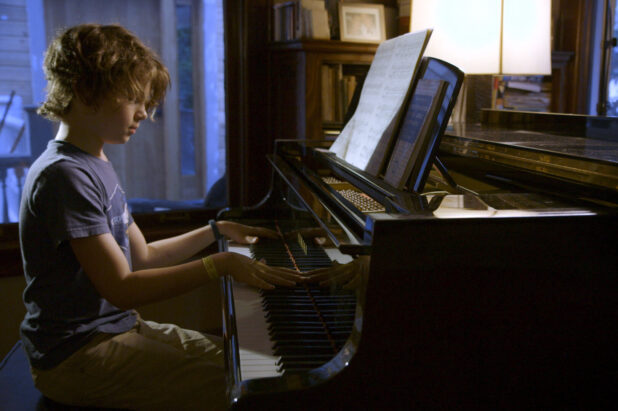
But Brodsky’s parents had cochlear implants, and even doing that at an advanced age changed their lives. The daughter ponders what they gained and what they lost as Jonas has the operation and takes up the piano, ambitiously wanting to learn Beethoven’s “Moonlight Sonata” (one movement of it, anyway) before The Big Recital.

Brodsky uses the example of Beethoven, who lost the distractions of the world as he lost his hearing, composing works based on what he could hear in his head, and of her father, who invented TTY (a means for deaf people to use the phone), in opining that “silence gave us all something really valuable… It shaped who we were.”

Dad is more sanguine. “You can’t understand the world through your ears,” so you adjust. He had a fruitful career, married and raised a family (none of their children were deaf). But as “Moonlight Sonata” was filming, he faced new adjustments — a life shrinking around him due to his advancing years.

moon2.jpeg

Brodsky uses music, animation and simple footage of Jonas trying to practice the piano in a house with noisy younger siblings and a puppy to make her point. Being able to tune that “storm” out, literally by pulling the magnet plug off his skull, must be a blessing to Jonas, who is a cute, mop-topped and precocious kid. He still has good piano lessons and bad ones. He acts out like any 11 year-old, even one who has taken on the daunting task of learning a movement of this subtle, emotional sonata.

The kid’s other grandfather, a pianist himself, foreshadows how the film will treat the boy’s performance at that recital, explaining to Jonas the difference between playing to please oneself as opposed to playing in public.

It’s a meditative movie, as one underscored with Beethoven’s solo piano pieces “Moonlight Sonata” and “Für Elise” would have to be. Brodsky isn’t the first to get across what it feels like to experience the world without hearing it, so she doesn’t dwell on that, even if it is her central thesis.

The “Three Movements” are as arbitrary as you’d expect a framing device like that, mimicking the “Sonata” itself, to be.

Mostly, what she gives us is an appreciation for the progress science has made in diagnosing and remedying hearing disabilities, and the merest hint of the way not hearing shapes how the mind works when forced to confront the world without aural stimuli.

In that portion of the film, she asks more interesting questions than “Moonlight Sonata” can really answer, leaving this “Sonata” incomplete.

2half-star6

MPAA Rating: unrated

Credits: Written, directed and narrated by Irene Taylor Brodsky An Abramorama release.

Runing time: 1:29
Posted in Reviews, previews, profiles and movie news | Comments Off on Documentary Review – “Moonlight Sonata: Deafness in Three Movements”

Movie Preview, “Wrinkles The Clown” shows Pennywise how it’s done

This is an October release about a real life clown hired to show up and scare the kids — grownups, too.

And it looks revelatory, in terms of why folks are scared of people in facepaint and wigs.

Posted in Reviews, previews, profiles and movie news | Comments Off on Movie Preview, “Wrinkles The Clown” shows Pennywise how it’s done

BOX OFFICE: A $92 million “bust?” ‘It Chapter Two’ underwhelms

The first half of the “It” saga opened at a horror film record $123 million+ two years ago.

“It Chapter Two” is now on track to come in a whopping 20% below that.

Thursday showings were the first sign at least some of the public was done with the scary clown.

Friday added to that, putting the film on track towards $90-92 million.

Reviews are leading the “bad word of mouth” parade.

And at nearly 3 hours in length, you can bet the bank that there won’t be repeat customers by the theater full.

Box office this year is down about 6%, and while this won’t add to that downturn, you have to feel audience fatigue is promoting the fall off.

Too many comic book sequels, still making bank. Too many remakes, also cashing in.

It’s tainting the whole movie going experience for casual fans, who are checking out of moviegoing, hopefully not permanently. All this repetition is wearing out the collective patience and muffling enthusiasm and turnout.

“Spider Man” and “Avengers” and “Lion King” and “Aladdin” all made a $billion. Damned if we acted happy about it.


Posted in Reviews, previews, profiles and movie news | Comments Off on BOX OFFICE: A $92 million “bust?” ‘It Chapter Two’ underwhelms

Movie Preview: Imogen Poots copes with “Black Christmas”

Sorority vengeance fantasy.

Love that Imogen. The fact that she Poots is irrelevant.

Posted in Reviews, previews, profiles and movie news | Comments Off on Movie Preview: Imogen Poots copes with “Black Christmas”

BOX OFFICE: So how many tens of millions will ‘It: Chapter Two’ pull in?

It’s stupidly long. And no, New Line/Warner Brothers–length does not add gravitas or importance. It just means you chose not to give your movie pace, that you were too scared to edit anything out.

Reviews have poor to middling. I found “It Chapter Two” a drag, not excruciating, just muddled, pandering, repetitive.

It did $10-11 million Thursday night, meaning it could easily hit $100 million+ on its opening weekend.

But that’s a drop off from the first “It,” and reviews may or may not tamp down turnout. That running time won’t be a factor as “Chapter Two” has all the screens. All of them.

That will not likely put this film I to tje record books. The first “It” opened with $123 million+.

This time, it’s adults so aving Derry, Maine from the evil clown, outwitting Pennywise and cursing a blue streak as they do.

The “cute” is gone, the novelty of children foiling a supernatural monste is gone.

And again, reviews have been far weaker, even in the new and seriously watered down (adding hundreds of “critics” will do that) Rottentomatoes.

$105 million says Box Office Mojo. I concur.

“Angel has Fallen,” “Don’t Let Go,” Overcomer” and other summer holdovers will pick up the mere scraps that are leftover.

https://deadline.com/2019/09/it-chapter-two-opening-weekend-box-office-birds-of-prey-teaser-1202713529/

Posted in Reviews, previews, profiles and movie news | 1 Comment

Movie Review: “It Chapter 2” becomes “The Never Ending Story”

it2

What’s that old saying about too much of a (mediocre) thing?

That’s the second half of Stephen King’s “It” saga, an everything horrific but the kitchen sink thriller destined to be a blockbuster, treated — by virtue of its excessive length — as “an event,” a signature moment on big screen horror.

Derivative, a veritable catalog of the author’s “greatest horror hits,” “It Chapter Two” is overloaded with characters, filled with flashbacks, with endless dollops of exposition, right up to the absurdly drawn-out, fan-servicing finale.

The dialogue is laced with profanity that has a gratuitous “Just because we can” R-rated air. We get a couple of genuinely chilling moments and one or two touching ones (There are MANY supposedly emotional scenes that fell flat, for me.), a couple of actual movie stars delivering fair value in the cast — and Bill Hader. But the best scenes and character are handed to a pretty good supporting player.

“It Chapter Two” plays like any of the lesser Harry Potter pictures, all over the place, overlong, where there’s actual market-researched fear in “leaving anything out,” for the fans.

So when a character eventually declares, “Nothing lasts forever,” feel free to keep “Except this f—–g movie!” under your breath.

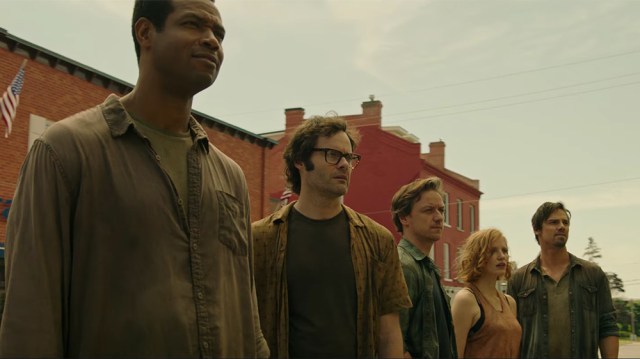
Twenty-seven years have passed since “The Losers” of Derry, Maine, killed Pennywise the Supernatural Clown (Bill Skarsgård) and took a pact to return “if ‘It’ ever comes back.”

Considering how all of them eagerly fled the town where they were abused, beaten and bullied, where one lost his brother, and most have led full lives since “forgetting” most of what happened that summer of ’89, this “pact” thing doesn’t strike one as anything any of them would feel obligated to keep. Wouldn’t stand up in court, in any event.

But when Mike (Isaiah Mustafa), the one who stayed behind, kept the flame and kept a vigilant eye out calls each in turn with a “You need to come home,” they do.

Almost all of them, anyway.

Bill (James McAvoy) is the writer of the lot, the “Stand by Me” success, a successful horror author and screenwriter married to an actress (Jess Weixler), trying to write a new ending for director Peter Bogdanovich, in mid-production of their latest film.

A running gag? “Your endings suck.” Everybody says so, including his wife and the shopkeeper who reads his books back in Derry (a Stephen King cameo). And by the time we get to the second anti-climax at the conclusion of “It,” we might agree.

Beverly (Jessica Chastain) runs a fashion line, but is in a miserable, abusive marriage.

Ben (Jay Ryan) is no longer fat, no longer a poet, but a successful builder of architectural marvels.

Eddie (James Ransone) is a “risk assessment” expert for Big Insurance, still accident and injury prone, still a hypochondriac, still afraid of his own shadow.

Richie (Hader) is a neurotic stand-up comic made even more nervous by Mike’s call.

Stanley (Andy Bean)? He’s the one who’d rather die that “go back there.”

What Mike has seen as a “sign” is the film’s opening murder, a horrific homophobic hate crime finished off by Pennywise. The damned clown is back to his snatching and dismembering ways. Let’s skip by the real crime by four thugs (Cops are basically a non-presence in the Big Little Town of Derry) and focus on the supernatural one!

Andy Muschietti’s film folds flashback upon flashback into the proceedings as these characters, who vow to “stay together” because that’s how they foiled the clown the first time, are separated and each faces her or his fears in search of “artifacts” (talismans) from their youth that will help them repeat their defeat of Pennywise.

One thing those flashbacks accomplish is showcase Jaeden Martell’s growth spurt between the first film and this one. He plays the young Bill, and he’s already taller than McAvoy, and looks little like his original self in many scenes.

It’s a film of close-ups — used to make a laugh pay off (they rarely do), a fright bigger or that lump catch in your throat longer when the once-bantering teens rebuild their childhood pecking order and go all Stephen King gooey in their devotion to one another.

Ransome’s Eddie is the best match between the young Eddie and his adult guise, and he gives us lots of touches that show the boy who turned into the same sort of man he was as a child.

Characters not only have solo confrontations with Pennywise, they pair up a couple of times, facing him in teams of two. This helps survivability, even if it does nothing for the narrative.

King’s favorite themes of remorse, guilt and savage bullying are much in evidence, as is his inabilty to conjure up a love story — tomboyish Bev flirted her way through all the possible beaus, way back when, and hasn’t quite shaken that “the band’s sex symbol” thing as an adult.

The flashbacks rob the picture of its flow, even if they give characters noble moments — publicly rebuking the life-expectations of one’s family and faith at a Bar Mitzvah, for instance — or ones that further illuminate how this person turned out that way.

The picture feels cluttered, with the big set pieces outlined and diagrammed and arriving at precise moments in the 160 minutes of the movie.

“It Chapter Two” isn’t awful, especially by King in the late ’80s standards. It’ll make a mint, and congrats to one and all when the checks clear.

But if The Great Stephen King revival won’t end here, we can sure see the beginning of the end of it. Whatever the virtues of his books, they’re repetitious, derivate and bloated, and often turn out that way on the big screen, too.

So coming up with a good “ending” is only the tip of the narrative iceberg, as far as the reasons why are concerned.

1half-star

MPAA Rating: R for disturbing violent content and bloody images throughout, pervasive language, and some crude sexual material.

Cast: Jessica Chastain, James McAvoy, Bill Hader, Isaiah Mustafa, Jay Ryan, James Ransome, Andy Bean and Bill Skarsgård

Credits: Directed by Andy Muschietti script by Gary Dauberman, based on the Stephen King novel. A Warner Brothers release.

Running time: 2:49

Posted in Reviews, previews, profiles and movie news | Comments Off on Movie Review: “It Chapter 2” becomes “The Never Ending Story”

Netflixable? A Middle School reunion goes very French, and very wrong in “Back to School/La Grande Classe”

classe2

For those of us who have longed for a “Romy and Michelle’s High School Reunion” meets “Wedding Crashers” in French, Netflix is here to fill that void.

The streaming service has had decent luck with French farces (“I Am Not an Easy Man” is their best), so “Back to School,” aka “La Grande Classe,” seems like a safe bet for them, and for we the paying customers.

And one this indifferent Gallic romp finally gets up to outrageous speed, there are laughs and just enough surprises to tide one over. Waiting until the movie is over halfway done before providing its first real laugh? Must be a French thing.

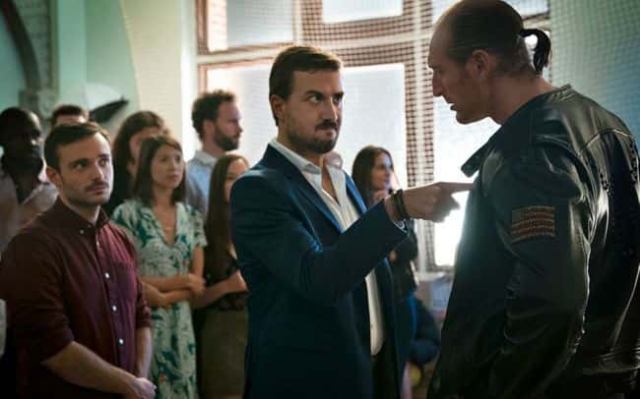
Pierre-Yves and Jonathan, played by Ludovic Day and Jérôme Niel, are lifelong friends who just closed the deal that insures the success of their internet marketing company. Jonathan (Niel) is the tech whiz, short and uncertain of himself in public situations. Pierre-Yves, or “PYC,” is the tall, cocky blowhard whose off-color joke makes the sale.

But back in middle school, “Jon” was the plump runt nobody noticed. PYC? He was “Bozo the Clown” (as funny in French, with subtitles, as it is in the English dubbed version). He was bullied, like Jon and other chess club nerds.

Oddly enough, Diderot Middle School (snort) back in Brétigny is holding a reunion, which they learn about by accident. Nobody remembered to invite them. Nobody remembered them, period. A little social network research convinces the one-bullied duo to return to the scene of the crime and lord it over their inferiors.

“It’ll bring up bad memories!”

“EXACTLY!”

Robert Palmer’s line that “Wise men know that revenge does not taste sweet” must lose something in translation. Because as soon as they return to Brétigny and borrow Jon’s dad’s BMW to make their “entrance,” things start to go wrong.

That “You haven’t changed” (Since MIDDLE SCHOOL?) lie doesn’t help. Nobody knew them, then. Nobody remembers them, now.

Jon came, reluctantly, because he has a mission. There was this letter expressing his feelings for the fair Linda “all through sixth grade.” He plans to give it to her tonight.

And Linda (Caroline Anglade), a blonde beauty who bites her lip in lascivious interest, just might be willing to read it.

But she’s made a mistake. This “Jonathan” is not her “Jonathan,” the punk who led Les Dragons, a gang of middle school toughs who tormented PYC and Jon. She thinks he’s Jonathan Lopez, who “burned down the gym” and was expelled, who fled to Thailand and became a kick-boxing legend.

And with the lust in her eyes and purpose in the come-ons, Jon isn’t quick to correct her. Oh no, not at all.

This is when “Back to School/La Grande Classe”) gets off the ground and on its feet.

PYC is the first to see how the provincials are just as provincial as ever, sneering at the Paris swells he and Jon have become. The headmaster’s daughter (Joséphine Draï) has staged this reunion as an ego trip, because inheriting your father’s job in a small town is the greatest measure of success.

The mean girls are still mean, the chess club nerds Jon and PYC hung around with still debate semantics and which characters in “The Lord of the Rings” were gay.

“Read the Elvish version!”

And the bullies still judge their lives by the brutish standards of adolescence, none moreso than car wash assistant manager Hervé (Nicolas Berno). He’s as brawny and bull-necked as ever. Thank heavens he thinks his brother in bullying, Jonathan Lopez, is the guy Linda has just dragged over to get reacquainted.

Linda clings to Jon like the Big Man on Campus he once was, and any distractions — Les Dragons have some hash they stashed 20 years before that they want to smoke with him — freak her out. She searches the empty school rooms with a pal, storming in on a couple having sex on lab table in science class.

“That should be ME on that table!”

And bullies being bullies, the old pecking order quickly and cruelly reasserts itself.

classe1

Will these nerds have their revenge? Will Jon fess up to Linda, Hervé and the gang? Every time he’s about to, Linda does something that stops him short. Like calling her husband on her cell.

“Ferde? It’s me. I’m LEAVING you!”

Day, Berno, Anglade and Draï — the last a Jami Gertz “goodie two-shoes” with a dark side type, if you know your late model American teen comedies — are the stand-outs in the cast. Taken together, they lift “Back to School” close to a passing grade.

A word of warning, though. In these sensitive times, a movie with this much stomach-churning bullying can said to be “triggering.”

And for all the third act twists that point toward tying this comedy up in a bow, it’s that age-old universal message that is really the point here.

“Vous ne pouvez pas rentrer à la maison.” No, “you can’t go home again.” Or at least, you should know better. Especially if you’ve ever seen a movie or TV show about the perils of class reunions, even middle school ones.

2stars1

MPAA Rating: TV-MA, some violence, drug use, sex, profanity

Cast: Ludovik Day, Jérôme Niel, Caroline Anglade, Nicolas Berno, Joséphine Draï and Pauline Deshons

Credits: Written and directed by Remy Four, Julien War, with additional dialogue by Florian Assous. A Netflix release.

Running time: 1:23

Posted in Reviews, previews, profiles and movie news | Comments Off on Netflixable? A Middle School reunion goes very French, and very wrong in “Back to School/La Grande Classe”

Movie Preview: African American life, love, hope and trauma, “Waves”

Two young couples, with patriarch Sterling K. Brown holding the family together as it is tested by life these days.

It’s from A24, so chances are it’s very good.

Posted in Reviews, previews, profiles and movie news | Comments Off on Movie Preview: African American life, love, hope and trauma, “Waves”

Movie Review: “Hot for teacher” is no longer “cute in “Scarborough,” or anywhere else

scar3peg.jpg

Let’s get the “icky” part out of the way up front.

“Scarborough” is a drama about two teachers showing up at the same British coastal resort town, off-season from the looks of it, for a weekend with their student-lovers.

They know what they’re doing is wrong, “illegal.” None of this French/Continental indulgence on a sliding Polanski perversion scale. This is Britain and each teacher is paranoid about prison.

As they should be.

Barnaby Southcombe’s film, based on Fiona Evans’ play, makes its intentions clear. One teacher is male, another is female. This is going to be an exploration of how we look at this sort of imbalanced, improper coupling between the allegedly mature and “ought to know better” and impulsive, hormonal teens who don’t know better.

Is it more wrong for a woman to seduce or be seduced by a teen boy than for a man to seduce or be seduced by a teen girl? And how have those attitudes evolved over time?

“Scarborough” asks us to get past the nudity, the sexual heat and blatant titillation and consider the dynamics and consequences of these situations. Go beyond the #MeToo passions of the day, the amorality, and consider the psychological damage to the kids and the broken souls who know right from wrong, but insist on carrying on such affairs anyway.

Liz (Jodhi May of “Last of the Mohicans”) looks guilty the moment she furtively sidles up to the front desk of the Hotel Metropole.

She’s over 40, and her hair and dress suggest “lonely” and “plain.” Not that the desk clerk isn’t picking up on something else. He (Daniel York) wonders about her solo reservation, mentions that “extra guests do incur a surcharge,” and winks at the fact that she’s booked the bridal suite.

The hunky young jock (Jordan Bolger of “Peaky Blinders”) who slips into the elevator with her is awfully cocky. And when the doors slide shut, “eager” enters into the description.

Their silent arrival in the room has a brisk role-playing to act out, standoffish and nervous vs. dress-lifting impatience. Whatever 16 year-old boy Daz has on his mind, she’s acting out some sort of fantasy.

“The act” is about as sexy as a road accident, and just as quick.

Aidan (Edward Hogg of “Anonymous,” the Shakespeare “expose”) is just as nervous at that self-same front desk. Only he gets more than a wink from Mr. Concierge. It’s practically a leer of approval, once the clerk has spied the teen sneaking upstairs with him.

Beth (Jessica Barden of “Far from the Madding Crowd” and TV’s “Penny Dreadful”) is a hyperactive pixie, tarted up for the occasion, reckless in her public displays of affection.

“That’s not why I brought you here.”

One of the tricks to Evans’ play is how dialogue and gestures are repeated with each couple. “We need to talk” and gifts (from the kids to their older lovers) of photos which the adults warn “You know you can’t SHOW anyone.”

“I’m not STUPID,” the kids protest. Naive in that “I didn’t think about that” way, both of them.

This “We need to talk” weekend has snatches of dialogue underscoring visits to the picturesque empty beach and boardwalk, a Punch & Judy Show or an arcade, underlining the age and maturity difference with lighter moments that don’t hide the weight of what’s going on and what’s to come.

Beth bounces on the bed, literally. Daz makes mock loud sex noises that anybody near the room could hear. She wants to see the puppets, he wants change to play the arcade games.

The kids trivialize what they’re doing, feigning how they just saw “the Headmaster,” sending their partner in crime into a panic. The adults are desperate, clawing for an escape.

There are complications. One is cheating on a would-be fiance, the other on a husband.

The kids?

“Five minutes of something wonderful is better than a lifetime of nothing special.”


scar2

I know nothing of the playwright Evans or her agenda, which gives “Scarborough” the necessary remove from the likes of Woody Allen and Luc Besson, whose predilections are well-publicized and whose movies often “normalize” such “consensual” couples.

That lets us mull over what’s going on, what brought them all here, even if we can guess the melodramatic turns that will point the stories towards their resolutions.

May brings a brittle fragility to Liz and lets us see the youth that one relives when involved with somebody much younger. She has a downtrodden quality, but gives us flashes of giddy when she’s with Daz and not worried sick about…everything.

Hogg’s Aiden is less shaded. We regard such affairs as vampire-like for a reason — the older person sucking the youth out of the younger. Is this nerdy/artist 30ish teacher getting the “hot girl” he never had a shot with in high school? What else could be in play?

The kids? They’re here for the adventure, the play-acting at being an adult with none of the responsibilities and nothing but an open future in front of them. They have no idea, either of them. Bolger gets across Daz’s callowness and inability to see past the next meal or “shag,” and Barden dazzles with a Lolita-ish native cunning. Beth may be dizzy, may call on her high school brain to attempt manipulations no adult would fall for. But she knows what she wants.

The theatrical feel of it all excuses the viewer from the need to immerse oneself in the situation, to imagine him or herself in one of the roles. That allows us to wrestle with the psychological issues like a shrink, hearing about these affairs in the course of a day seeing patients.

It’s as if we need inoculation against the disease portrayed here, one that we and the world turned a blind eye too just a blink-of-an-eye ago. Thinking about that too much lets “Scarborough” get under your skin, and we mustn’t have that, must we?

3stars2

MPAA Rating: unrated, adult themes and sexual situations involving minors

Cast:  Jessica Barden, Jordan Bolger, Edward Hogg, Jodhi May and Daniel York

Credits: Written and directed by Barnaby Southcombe, based on a play by  Fiona Evans.   A Level 33 release.

Running time: 1:27

Posted in Reviews, previews, profiles and movie news | Comments Off on Movie Review: “Hot for teacher” is no longer “cute in “Scarborough,” or anywhere else

Movie Preview: “JoJo Rabbit” will be unlike anything else at the movies this fall

This full trailer for Taika Waititi’s “JoJo Rabbit” has whimsy (“What We Do in the Shadows”), scope (“Thor: Ragnorak”) and darkness, heart and pathos.

It’s like a Wes Anderson movie about Nazis, without a grand hotel. And a German cover of The Monkees.

And it opens in October.

Posted in Reviews, previews, profiles and movie news | Comments Off on Movie Preview: “JoJo Rabbit” will be unlike anything else at the movies this fall