



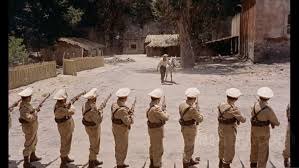
Of all the “star entrances” the classic cinema has given us, from the “Stagecoach” rolling up on stranded John Wayne to Orson Welles, glimpsed in the shadows in “The Third Man” and Marlene Dietrich, dolled up and ready to sing and take a swing in “Destry Rides Again,” it’s hard to top George Marchal‘s first moments in “Death in the Garden” in establishing just how tough our tough guy antihero might be.
Corrupt, trigger happy colonial soldiers have just fired a warning volley, dispersing a mob of angry miners who’ve been ordered to abandon their diamond mining claims in dusty, backwater 1940s French Guiana. The troopers’ attention is distracted as a lone figure, leading a horse on foot, strolls across the scene as the smoke clears.
They shout at the slouching, dirty “foreigner” who pays them no heed. “Almost” no heed. Prospector or “adventurer,” the man we will learn goes by the name “Shark” doesn’t break his weary stride as he flips the armed company the bird, to their outrage. Only an officer’s intervention keeps them from leveling their guns at him.
Filmmaker Luis Buñuel, with his friend Salvador Dalí, invented cinematic surrealism with “Un chien andalou” and “L’Age d’Or” in 1929-30. A Spanish born writer-director who filmed in Spain, Mexico, Central and South America and in France, he moved into the cinematic mainstream in the 1950s, taking on thrillers (“Los Olvidados”), adventure tales (“Robinson Crusoe”) and religious melodramas (“Nazarin”), but always with higher-minded, psychologically savvy and politically aware and insightful scripts.
“Death in the Garden” (1956) or “La mort en ce jardin,” is a politically-charged adventure yarn, with hints of “Wages of Fear,” “The Treasure of the Sierra Madre” and “The African Queen” folded into its story of colonialism’s corrupt excesses, which are visited not just upon the hapless natives being exploited, but taken out on the disreputable French nationals venturing to these hinterlands.
A colonial edict ends diamond prospecting in a remote town on the edge of the jungle. The miners, almost all of them armed, are enraged. Even grandfatherly Castin (Charles Vanel from “Wages of Fear”) is put out. He’s found diamonds, put some aside for himself and his deaf-mute daughter Maria (Michèle Girardon, later to appear in “Hatari!,” “The Lovers” and other films from the French New Wave) to open “a restaurant by the sea in Marseilles” (in French with English subtitles). Has he earned enough to ensure that dream?
Protesting to corrupt Captain Ferrero (Jorge Martínez de Hoyos) gets the miners nowhere. With all the guns in this crowd, shoots are sure to be fired. Soldiers and protesters die.
And that’s when “the foreigner,” Shark (Marchal) wanders in, a convenient outsider target with a money belt that will be split up by the madam of the local brothel, Djin (Simone Signoret) and the captain when she turns Shark in.
An ineffectual missionary priest (Michel Piccoli, later of “Belle du Jour”) preaches peace and mercy, but the miners rightly see him as an instrument of the corrupt “exploitation” of the natives and working poor. Blundering into aiding Shark’s escape may be his finest moment. Not that he meant to do that.
With the army unit shot up and their headquarters blown to smithereens, many will need to escape to Brazil to avoid “justice” in the form of army reprisals. But catching a ride with the venal and bribe-taking riverboat skipper Chenko (Tito Junco) is no certain thing, as he’s in cahoots with Captain Ferrero.
With Castin delusionally hoping Djin will marry him and care for his daughter “if anything happens to me,” the mercenary Djin angling to get her hands on Castin’s diamonds, the priest skipping town and Shark laying low until the Eustolita casts off, will “escape” be that easy?
Continue reading





















 Movie Nation