
An Oklahoma pastor took this rarer than rare footage shortly after D.W. Griffith put actors in blackface so that the KKK could chase them away from the South of his youth.
Eye opening.
An Oklahoma pastor took this rarer than rare footage shortly after D.W. Griffith put actors in blackface so that the KKK could chase them away from the South of his youth.
Eye opening.

It is, in many ways, the Original Hate Crime, Conspiracy Theory Number One. The fact that it hasn’t gone away suggests that AntiSemitism is the hate crime that can evolve, mutate to match the conditions and shift in groups that buy into it and revive it.
“Viral: AntiSemitism in Four Mutations” is a brisk primer on the modern faces of hatred for “the Jews,” the “viral” way it spreads at the speed of the Internet, and the consequences of this renewed outbreak.
Documentarian Andrew Goldberg takes us into American hate crimes and visits with an outspokenly anti-Semitic N.C. politician. He then travels to Hungary, Britain and France for chapters titled “The Far Right,” “Blaming the Jew,” “The Far Left” and “Islamic Radicalization” — the four “mutations” this social ill has adapted in recent years.
We hear from survivors of the 2018 Tree of Life Synagogue shooting in Pittsburgh. Experts then relate how Donald Trump’s nationalism, embraced by the far-right/”Alt Right,” amped up the anti-Semitic rhetoric, with Trump’s own “dog whistle” use of tropes that Jews have “conflicting loyalties” and therefore aren’t patriotic Americans, set the stage for violent harassment nationwide, and attacks on synagogues in Pennsylvania and California.
A rabbi laments the end of America’s post-war “Jewish golden age” that events like this signal. Racial slurs all but disappeared, opportunities widened. But even now, “We will always be ‘the other’,” he says.
Goldberg visits a rural N.C. candidate for the State House, Russ Walker, who seems reasonable — liberal even — in his repeal drug laws, end “stop and frisk” platform. Then he gets into his feelings about Jews and other folks who aren’t White Like Him.
We’re treated to a history, in quick brush strokes, of the major anti-Semitic conspiracy theories of the recent past that have not gone away — from the “Rothschilds” as manipulators of capitalism, conflicts and even the weather, to the loony, fictional “Protocols of the Elders of Zion,” made famous when Henry Ford published a newspaper and pamphlets that spread the idea of a global Jewish conspiracy to control politics and the world’s wealth.
And we see how that has become official policy and out-in-the-open campaign rhetoric in modern day Hungary. If you think philanthropist George Soros is a boogeyman only as a Fox News talking point, you are mistaken. Hungary’s de facto dictator, elections manipulator and court-stacking Viktor Orban, has been running against Soros (a native of Hungary who has given billions to Hungary since the collapse of communism) in every election campaign since 2010. “Blaming the Jew” is his favorite stump speech.
Britain’s ongoing Labour Party (“far left”) version of anti-Semitism ties into hatred of capitalism, and of Israel and its Apartheid-like policies toward the Palestinians whom Israeli Jews have been displacing in Palestine for a century.
Then there’s France, where millions of Islamic immigrants from former French colonies have been raising children who feel limited, dispossessed and are ripe for Islamic radicalization and anti-Semitic violence.

Goldberg knows the lay of the land, even if the perpetrators are a little different. This is his second film on the subject. He did “Anti-Semitism in the 21st Century,” and has made films on Jewish culture and Jerusalem as well as the Armenian Genocide and “Out in America.”
The experts he rounds up for interviews range from Tony Blair and Bill Clinton to journalists, academics and those left behind after a murderous hate crime attack in the U.S. and in France.
The film has informal “personal” touches — visiting a Goldberg relative in the UK to hear why he left the Labour Party — which lighten the parade of expert witnesses and their grim tidings. But the lack of news footage taking us more back to those terrifying crimes in a more immersive way is felt.
It’s not the deepest dive into the subject, either, barely hinting at the tribalism that’s red meat to anti-Semites looking for stereotypes that ring true and feed the “powerless” impulse that drives the conspiracies people buy into. Just a “perhaps we’re over-represented in the financial services industry” and “a bit better off” from one interviewee. One British Jewish media personality appears on camera, none from America, where that disproportionate presence is a constant criticism of the Alt Right.
But “Viral” is a sobering reminder that hatred of “the other” didn’t disappear after Pogroms and The Holocaust, and that it isn’t limited to jihadists and skinheads.

MPAA Rating: Unrated, disturbing, racist images
Cast: Tony Blair, Bill Clinton, Deborah Lipstadt, Fareed Zakaria, George Will, narration by Juliana Margulies and Andrew Goldberg.
Credits: Written and directed by Andrew Goldberg. A Dark Star release.
Running time: 1:23

“Fronteras” is a stunningly stupid, talky, meandering Border Patrol thriller set in Arizona, a movie that sets itself up as a war of wills between a righteous Mexican-American agent and the racist, rogue “Ends Justify the Means” special team that he is assigned to.
That could have been interesting, a man conflicted by the many fronteras (frontiers) he must cross, personally. But first-time writer-director Andrew Dean couldn’t decide which side he was on, or where to take this slow-walk/lots-of-talk tale.
And first-time leading man Steve Oropeza isn’t any more up to the task at hand than Dean.
It sets up well, even if it begins in a heavy-handed “Mexicans stick together” ambush staged by smugglers against the “traidor” (traitor) that they see when Reyes Abeyta confronts them in his Border Patrol Agent uniform.
And then we hear about this new drug, “Kroc,” that the bad guys are bringing into the American Southwest. As a bonus, it carries “flesh-eating bacteria,” and there might be no cure.
Give me a break.
The writer-director’s sympathies lie with the out-of-control, murderous “any means necessary” special agent Ivan (Steven Sean Garland) who makes speech after speech about how “patriotic” he is and what “these people” are doing to “MY country.”
Him? He’s just “protecting our country from those who threaten our way of life.”
Reyes is needed for their team because he knows the lay of the land “and you speak ‘bean’ better” than any of the other trigger-happy psychopaths. He bristles at every shortcut they take, every drug they “sample,” every prisoner they kill rather than bring back for questioning.
He stands up to Ivan and the gang repeatedly, only to cave because well — he’s picking his spot? Gathering evidence as um, children are murdered? Looking for his cajones?
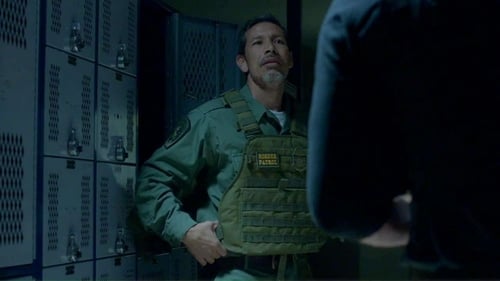
There’s a lot of Spanish spoken here — by the assorted Chacal Cartel functionaries, by the agents questioning them, by the boss of the cartel (Larry Coulter). It’s all spoken so slowly and deliberately that I could understand it.
Even the charisma-starved leading man, cast as a native speaker, sounds like he’s just learned the lingo. Garland has the most conversational fluency, on camera.
There are all these speeches ladled into all this slow-walking action, trash talk that’s slow-talked too.
“That hole in your chest hasn’t affected your ability to cut me down!”
Man, who talks like that, much less thinks that’s good dialogue?
Andrew Dean, that’s who. Take a bow, pal. This smells like a first-and-LAST feature film writing/directing job.

MPAA Rating: R, graphic violence, drug content, profanity
Cast:Steve Oropeza, Steven Sean Garland, Wade Everett, Randy Green and Larry Coulter
Credits: Scripted and directed by Andrew Dean. A Vertical release.
Running time: 1:44

What’s the best way to make your C-movie instantly awful? Open it with this line in voice-over.
“The lengths we go to for family are infinitely immeasurable.”
Kids, “infinite” is by definition “immeasurable.”
“Emerald Run” is the oddest action picture of the winter, a smuggler-gets-double-crossed tale that tries to get by on a busload of faith.
Our hero (David Chokachi), a “family man” who isn’t “out of work. I’m between jobs,” takes on a “run” from his Italian mob boss father-in-law, played by veteran character heavy Chris Mulkey.
“Customs? They might think we’re smugglers!”
It’s all among good Catholics, here. We visit a church where the priest has a haircut and neck-tattoo that suggest he just got out of the joint. Crufixes abound.
And when the hand-off, cash-for-emeralds, goes wrong South of the Border, John (Chokachi) is given a test in the desert and a shot at redemption by a religious fanatic hermit (Vernon Wells).
Just like Jesus?
The boss? Hey, he was just trying to line up “pentance” for John, who is losing his faith — going through the motion, not paying attention in church, never shaving. John doesn’t even know to correct the father-in-law’s pronunciation of “pennace.”
John and his Mexican (Catholic, family man) guide (Sean Burgos) are wounded and stranded in the border country, hunted by thugs in a Baja buggy with John hallucinating a little bit of everything, including a preacher he once met (Steven Williams).
Wait, is John considering converting to Protestantism?


John “Dukes of Hazzard” Schneider plays a missing man seen only in flashbacks. There’s a teen girl drifting into drugs.
Whatever was going on on the set, incoherence duels incompetence in the finished product.
Technically, the editing plays up the sloppiness of the scriipt, and there’s a scene where there is “hair in the gate” flickering on the screen. I didn’t know that booboo was possible in the age of digital filmmaking.
Tense scenes are undercut by the clumsily telegraphed machinations that will get our heroes out of peril, much of the acting is blase, with one stand-out sing-songy “Never acted in a movie before” flash of utter incompetence.
Something tells me “Emerald Run” won’t be seeing much green.

MPAA Rating: PG-13 for some violence, bloody images and drug material
Cast: David Chokachi, Yancy Butler, Sean Burgos, Steven Williams, Michael Paré, John Schneider, Vernon Wells and Chris Mulkey
Credits: Directed by Eric Etebari, script by Anthony Caruso and Marialisa Caruso. A Magnifacat Media release.
Running time: 1:30

“Portrait of a Lady on Fire” is a sumptuous period piece about passion, feminine independence and painting set in a world of bustles and bodices and ladies wearing Empire waist.
Like the process of portrait painting it depicts, it’s a patient, drawn-out affair, a tale with an ending we see long before the last brush stroke is applied to canvas.
Noémie Merlant is Marianne, a painter we meet as she poses for the young ladies studying under her what to notice, what to sketch next, details they need to pick up on to paint.
Such powers of observation have served Marianne, who learned from her father, well. In a long flashback, we see when those skills of observation served her best — taking on the portrait of a reluctant bride intended for her Italian husband-to-be.
There’s a mystery to this place and this young woman. Marianne arrives by ship’s longboat, having had to rescue her crate of canvases when they fell overboard. Her subject has just come home from a convent. Her subject’s sister just died. And her subject refused to pose for the previous painter who attempted a portrait, which he abandoned — headless — before he disappeared.
“She wore out one painter before you,” the young woman’s mother (Valeria Golino of “Rain Man”) warns (in French and occasionally Italian, with English subtitles). So the daughter cannot know why Marianne is here other than to be a companion. She will have to walk, talk and visit with Heloise (Adèle Haenel) and enlist the help of the only servant (Luàna Bajrami) if she’s to pull this stealth portraiture off.
Heloise is introduced from behind, her head covered on first meeting. Over the course of weeks, Marianne must study her and recite her studies in interior monologues about “the ear, its cartilage” and the like, surreptitiously sketching when her back is turned or sketching from memory back in her room.
When she complains “I haven’t seen her smile,” to Sophie the maid, Sophie’s response changes everything.
“Have you tried to be funny?”
Heloise misses the “equality” of the convent she was yanked out of, is sad that she’s lost her sister but furious that her death means “leaving me her fate” — marrying some Milanese noble she’s never met.
Their interactions grow more sympathetic and unguarded, even as Marianne continues to hide her true purpose. The remoteness of the house, the intimacy of the conversations, the prolonged “study” of each other’s mannerisms, tics and “tells” set the stage for love.


French writer-director Céline Sciamma doesn’t rush any of this, but that doesn’t keep us from leaping ahead in the story. Heloise declaring she likes to “bathe” in the sea, but doesn’t know if she can swim adds a touch of danger, but just that — only a touch.
She’s trying to create a sensual experience, but her shot selection doesn’t emphasize and aid that until the film’s third act. We watch Marianne paint, but the camera doesn’t mimic her eye for Heloise’s eyebrows, neck and eyes.
The painting stays in the foreground, even as the masquerade breaks down. Marianne has trouble getting her countenance just so, and Heloise knows it.
“I didn’t know you were an art critic!”
“And I didn’t know you were a painter!”
“Portrait of a Lady on Fire” spreads its “independence” and “equality” messaging over several characters and gives these themes many forms. As you’ve probably heard, the 18th century’s methods for abortion come into play.
But even those scenes lack much in the way of emotion. Drama is here. You just have to concentrate to pick up on it.
The performances are subtle, rarely giving in to simmering. That and the film’s literal reliance on art, as it is made, slows the picture to a crawl.
It’s still a lovely character study in a lovely setting, even if the romance rarely achieves the urgency or heat to truly animate this “portrait.”
MPAA Rating: R for some nudity and sexuality
Cast: Noémie Merlant, Adèle Haenel, Luàna Bajrami and Valeria Golino
Credits: Scripted and directed by Céline Sciamma. A Neon release.
Running time: 2:01
Another version of “The Most Dangerous Game” with “liberal elites” hunting “red state conservatives” for sport.
It was delayed after assorted gun nut mass shootings last year. “Conservative” elites?
It’ll dominate Fox “news” coverage in March. Betcha money.
Film critics and other “elites will be spending the weeks after March 13 explaining “satire” to the uninitiated. And repeating the fact that this is a fictional movie, not a documentary.

“Fantasy Island” is showing in a Florida beach town cinema filled with retirees.
It doesn’t matter that they don’t know from “Blumhouse,” and have no idea what they’re in for. This is the way it meant to be seen, not so much because they’re old enough to remember the soapy, has-been star-studded TV show of the ’70s, but because horror studio Blumhouse has re-imagined it as a grim tale of grappling with regrets.
“Regret is a disease,” our host, Mr. Roarke (Michael Peña) tells his guests.
And whatever young horror fans have among the things in life they wish they could do over, it takes some years to compile genuine remorse over misdeeds, paths not taken and the like.
I didn’t hate this slaughter-at-the-soap opera reboot. Not until it goes seriously off the rails in the third act, anyway. But don’t get your “torture porn” hopes up with the word “slaughter.” It is PG-13, after all. And this isn’t “Hostel.”
The guests are a lonely woman (Maggie Q) dwelling on the man she turned down and the life that got away, the cop who was a soldier’s son and longs to play-act like he’s in the military (Austin Stowell), two brothers by different mothers (Jimmy O. Yang and Ryan Hansen) who want to sample the hedonism and excess of great wealth with an epic pool-party filled with models and the embittered 20something (Lucy Hale) who wants revenge on her high school tormentor (Portia Doubleday) ten years after the fact.
The rules are that they must “see the fantasy through.” They can’t bail, even as they find themselves learning things they don’t want to know about who they are.
“I’m sorry, is this a vacation or a therapy session?”
“It can be BOTH…This is Fantasy Island. It’s as real as you make it.”

What they experience are a collection of fairly humdrum life do-overs or facile dreams of excess. Mr. Roarke is always there, hands in his white linen pockets (Peña has none of Ricardo Montalban’s smarmy, menacing elegance), offering pithy aphorisms as teachable moments.
“I am afraid that the problem with ‘having it all’ is that other people want to take it!”
I am afraid the biggest problem with “Fantasy Island” is the screenplay’s fixation on EXPLAINING how all this is possible. The arriving guests may speculate on drugged drinks and LARP (live action role-players) and “holograms, just like Tupac!” The “answer” is far dumber and eats up the entire third act.
The characters are blandly interesting, the engineering of how their fantasies might overlap is clever right up to the moment it isn’t, but the dialogue is flippant and often funny.
“Oooo, a ‘panic room.’ I feel like Jodie Foster in that Jodie Foster movie!”
The moments of peril seem like “Saw” outtakes, and the big “EXPLANATION” could bring Harlan Ellison back from the grave for another lawsuit.
Will there be a sequel? Don’t bet against it. Me? I’m just waiting on Blumhouse’s “The Love Boat.”

MPAA Rating: PG-13 for violence, terror, drug content, suggestive material and brief strong language
Cast: Michael Peña, Lucy Hale, Maggie Q, Austin Stowell, Portia Doubleday, Jimmy O. Yang, Ryan Hansen and Michael Rooker
Credits: Directed by Jeff Wadlow, script by Jillian Jacobs, Christopher Roach and Jeff Wadlow A Blumhouse/Columbia Pictures release.
Running time: 1:50

Silly Germans. Don’t they know only Judd Apatow can get away with a comedy with a two hour run time?
And even he only pulls it off every third or fourth movie.
“Isi & Ossi” is an old fashioned screwball romance about two crazy kids from different classes who “date” to rub her rich parents the wrong way.
That’s straight out of 1930s Hollywood. And in case you’ve forgotten what was going on in Germany in the 1930s, the older characters in this farce remind you.
“Democracy is crap, and I was around for Hitler!” is slightly funnier in the original German, although you can watch/listen to this dubbed, if you so choose. It’s disorienting to hear African-American English speaking voices dubbing the Aryan rappers in a Mannheim rap battle, but to each her/his own.
Isi (Lisa Vicari) is a pretty young rich thing — real name, Isabel — who “has the brains of a gummy bear.” She’s just finished high school and is resisting her “trust fund” parents’ efforts to shove her into college. Her only talent is cooking, which she picked up from the staff at home.
Finding out Mom Felicity Huffman’d her high school degree and her admission to college settles it. She’s in open revolt. She takes a job at Tommy’s Burgers, where “It’s been proven our food makes people blind and impotent.”
That’s where she meets Osi — real name, Oscar (Dennis Mojen) — a brutish working class East German who sees a way out of his family’s money-losing gas station with his fists. He’s a boxer who needs sponsor cash to get his “big break” fight.
Isi comes on to him to rattle her folks and open their wallets for New York culinary school tuition. She’s not very good at this throwing herself at a guy thing, and he’s no good at courtship. Too crude, coarse, profane and hot-headed.
His Arabic pal (Walid Al-Atiyat) counsels the “Rocky” approach — “Can you give a compliment? Rocky smothered Adrian in compliments! ADRIAN!”
But when Isi and Ossi come clean with their schemes, the die is cast. They’ll scam her parents by being the Couple from Hell, scaring them into paying him off and sending her to New York.

How you stretch that thin, worn-out comedy concept to two hours is you let almost every scene go on past its comic payoff, you shove in a little tender confessional moment or two with the parents, and you remember the best thing about The Beatles’ “Hard Day’s Night.” You add a hilarious grandpa.
Ernest Stötzner plays Oscar’s Gramps, fresh out of prison, hellbent on becoming a rapper.
“Didn’t you SEE ‘8 Mile?'”
Give the old man a shot at a rap battle, find your movie’s biggest laughs. Get Grandpa drunk and ranting about “Hipsters” and “A-rabs” and “that fairy, Hitler,” and at least you’ve got what passes for comedy here.
The bull in the China shop Ossi “courtship” stuff has a chuckle here and there — Tschüchin, the Arab friend, turns an art gallery show inside out in the crudest “Everybody’s a critic” way.
But mostly, “Isi & Ossi” is a reminder that the Germans aren’t famous for their sense of humor, even if they have finally gotten around to making their own Hitler jokes.

Rating: TV-MA, violence, profanity
Cast: Lisa Vicari, Dennis Mojen, Ernest Stötzner and Walid Al-Atiyat.
Credits: Written and directed by Oliver Kienle. A Neflix release.
Running time: 1:53


