
Documentary Review: Addicted to devices, our health and our democracy imperiled — “The Social Dilemma”

“Blow up your TV,” John Prine sang, in one of his most famously whimsical songs, an early plea for abandoning media and focusing on what’s personal and important. “Throw away your paper.”

Half a century later, “media” is more insidious and omnipresent than ever. It’s in every person’s pocket, a mere click away — monitoring, enticing, persuading and manipulating.

And John Prine? He’s dead thanks to a pandemic whose impact has been magnified by our devices’ ability to prey on our doubts, manipulate our choices and magnify our foibles.

Those foibles are manifested in a “leader” who represents the very worst impulses in our culture but whose crimes fall on deaf ears to social-media-manipulated lemmings in “media bubbles” of their/our own creation. Our lives and our very democracy teeter on the brink, thanks to the irresistible algorithms of Google, Facebook, Twitter and the like, and the heartless, amoral and greedy technocrats who created all this and shrug off any responsibility for the crisis they’ve IPO’d into being.

“The Social Dilemma” is a very clever Netflix documentary that lays out the scope of the problem and the few real solutions for it in the words of scores of Silicon Valley insiders — ex-employees and honchos from Facebook, Twitter, Google, Firefox and their ilk.

It covers familiar ground, to anybody who’s seen or read of the “dopamine” rush that having a post shared or “liked” is engineered to deliver, the addictive qualities of the endless long-scrolling “feeds,” the “predictive” nature of “surveillance capitalism” where our Internet devices figure out what we like and are likely to want to buy or believe, and manipulate us by giving it to us.

In a flash, social media have created a world “where each person has his or her own reality,” we’re “2.7 billion (strong), each living in our own ‘Truman Show.'”

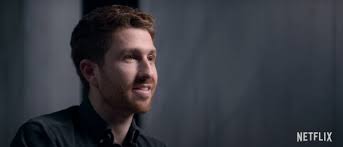
The anchor interview here is Tristan Harris, former Google “design ethicist” who left tech for a career as a TED Talk guru as “the conscience of Silicon Valley.” He remembers the “good things” this technology brought to the world, and frankly admits to “being naive about the dark flip-side of that coin.”

Many others echo those sentiments, and expand on them. And being insiders now outside “the beast” of Big Tech, they enlighten us on the “growth” that capitalism dictates that the companies need to survive, and break down the three “goals” of a Facebook, Twitter or what have you.

There’s the “Engagement Goal,” getting people to use your service, the “Growth Goal” where you and they persuade others to use it for that all-important exponential expansion in reach and influence, and the “advertising goal,” where you use those customers and what you know about them to sell to them.

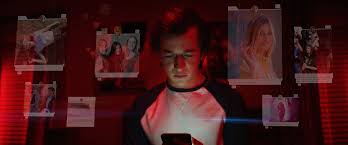
A clever touch here is using actors to depict a family confronted with the addictive power of devices and social media (Skylar Gisondo is the most famous face in that group), illustrating the isolation, manipulation, relative deprivation (everybody else is having a better time/better life) that drives up suicide rates.

Just as clever? Showing us what’s going on inside “the cloud” or AI hive mind, with actors embodying the one-user-at-a-time attention that enables the algorithms to hook us and manipulate us. The face of this unseen, sinister force? Vincent Kartheiser of “Mad Men.”

As I say, a lot of this is material that’s been covered elsewhere. And the focus on only Silicon Valley insiders (with montages of news coverage, snippets of Congressional hearings) narrows the thinking to people who know the scope of the problem but can’t see the forest for the trees, when it comes to solutions.

And then VR expert, “computer philosopher” and Big Algorithm Jeremiah himself, Jaron Lanier shows up and drops a take-away truth on us all.

The Internet used to be more like Wikipedia — a version of (reasonably) objective truth, presenting the same “facts” (crowd-sourced, edited) to every person who used it. Google came along and abandoned any obligation to objective “truth.” Your search via Google is manipulated by the geographic location where you search from, your prior prejudices as revealed by your search history, and by Google advertisers who get their “search results” a place of priority in your “results.”

Google is “not the truth, it’s telling you the truth it wants you to see.”

“Social Dilemma” is a good film, probably too little too late to play a role in saving democracy or healing a nation so divided half of it won’t do the most basic things to stop a pandemic. But there you are, and there we are.

MPAA Rating: PG-13 for some thematic elements, disturbing/violent images and suggestive material

Cast: Tristan Harris, Aza Raskin, Tim Kendall, Rashida Richardson, Jaron Lanier, Shoshona Zuboff, Skylar Gismodo, Kara Edwards and Vincent Kartheiser.

Credits: Directed by Jeff Orlowski, script by David Coombe, Vickie Davis and Jeff Orlowski A Netflix release.

Running time: 1:31
Posted in Reviews, previews, profiles and movie news | Comments Off on Documentary Review: Addicted to devices, our health and our democracy imperiled — “The Social Dilemma”

Movie Review: Schizophrenic and “I Met a Girl”

It’s a thin line filmmakers must walk when depicting mental illness in a movie. The line is thinner when the genre you’re working in is a romance, one that flirts with being a romantic comedy. The risk is, that you’ll cross over into “cute,” and there’s nothing cute about being mentally ill, or coping with someone who is in your life.

The Aussie romance “I Met a Girl” doesn’t get into much trouble, in that regard. We meet our schizophrenic hero — Devon — just as he’s decided to forgo his pills and quaff a few. I mean, it’s his brother Nick’s wedding day and Devon’s written a song that he and his band, And They Said it Wouldn’t Last, are performing.

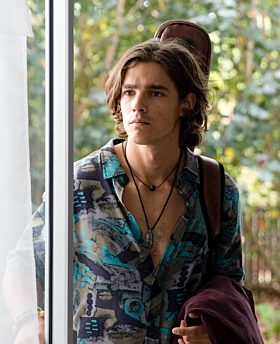
He wants to “be there,” right? The song is charming, and boy-band handsome Devon (Brenton Thwaites of the last “Pirates of the Caribbean” movie) pulls it off with ebullience and talent.

But as they do, things go manically, violently wrong and Devon winds up in a hospital.

“I was twelve when I first hear the voices,” he narrates. We have our diagnosis, and the scope of Devon’s problem. Being beautiful and talented doesn’t inoculate you against schizophrenia.

Five years later, and he’s living with Nick (Joel Jackson) and his expectant, tolerant wife Olivia (Zahra Newman). But Devon is still dodging his pills, when he can. Manic episodes mean he can’t keep a job. Working at a pet store, he reacts to a born-bully/animal abusing kid by flipping out and freeing all the budgies.

He totes his guitar everywhere, but he can’t get the band back together.

“Time to grow up, mate,” they tell him.

And the two voices in his head prey on him when he’s unmedicated and having a bad day. Mr. Rocket is a superhero “protector” who pushes him into risks. Miss Needle is a Nurse Ratched menace, terrorizing him with injections, tormenting him over his failings.

They drive him up on a roof and off it.

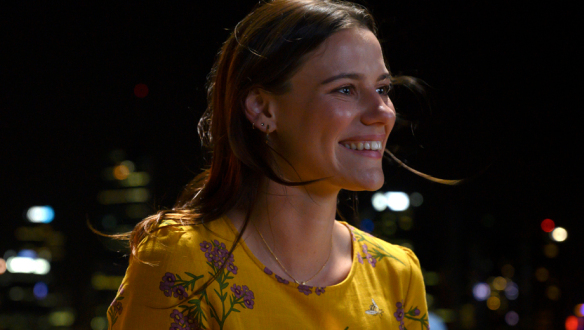
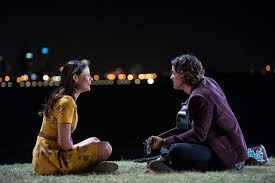
Only he doesn’t die. He wakes up in a beautiful woman’s clawfoot tub. She “dragged” him there, she says. Her name is Lucy (Lily Sullivan of TV’s “Picnic at Hanging Rock”). She’s flirtatious, kind, open and direct.

“Like, were you trying to kill yourself?”

She has one of those glorious “only in the movies” flats that nobody whose employment is dressing up like Marilyn Monroe as a waitress for a ’50s themed diner. She drops everything she’s doing to spend the day with Devon, and they fall in love in a flash.

We think it long before he says it. “It’s like I’ve dreamt you.”

Is she all in his head, a fantasy that his mind has created to fill one of the many voids in his life? We’ll know when joins Nick and Devon for dinner. Only she doesn’t show up.

Her flat is empty. And real-estate agent Nick, with a baby on the way, has no patience for Devon’s mad fantasy.

“She’s as real as you and I” isn’t convincing.

But Devon has a clue, and on or off his meds, he’s going to pursue it. He’ll leave Perth and cross Australia to Sydney and find his Lucy. And on or off his meds, he’ll have adventures all along the way.

Filmmakers Luke Eve and Glen Dolman, Aussie TV veterans, come up with a few cute episodes for Devon’s trek, and a few harrowing moments as his demons literally chase him cross country, with frantic Nick trying to figure out where his crazy kid brother’s gone.

Visualizing Devon’s illness — with actors playing his two “voices” — is a lot less scary than aurally simulating what’s going on in his head. But taking care to never let us forget the seriousness of his condition shortchanges the “cute” encounters he has on his “road comedy” journey.

Meeting someone just like himself is a plus, but the other meetings are hit and miss.

Thwaites, who apparently does his own singing, has to carry the picture with his charm, and he almost does. He’s charismatic and cute and doe-eyed in his scenes with Sullivan, who seems older (she isn’t), world weary and wiser.

The players give “I Met a Girl” a warm and fuzzy romantic lilt. But the best one can say for the script is that it gives the charming stars a nice moment or two, and that it generally doesn’t fall for the “Love can cure what ails you” mental health rom-com trap.

Every now and then? Sure. But “generally,” no. Take your meds and hope for the best. Male wish fulfillment fantasy girlfriends are only in the movies.

MPAA Rating: unrated, adult situations, violence

Cast: Brenton Thwaites, Lily Sullivan, Joel Jackson, Zahra Newman

Credits: Directed by Luke Eve, script by Glen Dolman. A Gravitas Ventures release.

Credits: 1:48

Posted in Reviews, previews, profiles and movie news | Comments Off on Movie Review: Schizophrenic and “I Met a Girl”

Netflixable? “A Girl like Grace” is going to make some mistakes

Sometimes you wonder how a movie with a couple of “names” in it got past you. And everybody else.

“A Girl Like Grace” is a 2015 teen drama starring Ryan Destiny, who went on to do Fox’s “Star” TV series, with Raven-Symone and Meagan Good in top line supporting roles.

It’s about bullying and its consequences. So you’d think it’d conjure up a little buzz.

What held it back? The producers claim a PG-13 rating, even though there’s a gang rape scene in it, sexual content and drug abuse. Did the MPAA ever even look at it?

Maybe the notion of screen veteran Meagan Good, playing a former Vegas dancer whose sister killed herself, coming home and buddying up to her late sibling’s high school BFF-with-benefits, Grace, was the hard sell. Good was 34 when she made this, and the idea of a drug-loving, loose-living stripper palling around with a girl half her age feels…off.

Ah, but that’s nothing to seeing Raven-Symone, a high-mileage 30 year-old (then) playing the meanest mean girl of all at the unnamed (Gulfport, Miss.) high school where all this takes place. Jayzus.

“Grace” is a grim, brooding gay girl’s coming-of-age drama about a would-be writer,a seemingly college-bound teen who withdraws into her shell after her bullied friend Andrea (Paige Hurd) kills herself.

“Lazy” is what we label screenplays the lean on that most exhausted of screen shortcuts, voice-over narration. “Never ‘tell’ it if you can ‘show’ it,” they teach you in screenwriting classes. Amazing how few screenwriters even bother take a stab at dropping this tiresome crutch. Do we need to hear anything, in VO, after Grace (Destiny) tells us she was named that “to remind me of who I am?”

No. We do not.

Grace sulks through her life with a vain, short-tempered Haitian-American single mom (Garcelle Beauvais), a bombshell who plows through an Army regiment of lovers, looking for a man who will take care of her…uh them.

Grace is a high school senior, keeping her sadness to herself. Even the mean girls keep their distance. They don’t want Mean Queen Mary) Symone to break a hip, do they?

Sorry, last “She’s too old to be in this” crack.

Grace’s special pain is glimpsed in flashbacks, but explained to a new boy in school by one of the jocks.

“She won’t be cheering for OUR team,” he says, impressed at how subtle he’s being. The oher fellow wonders “Huh?”

Because “she’s on the OTHER team.” As in gay. As in she lost more than just a friend last summer.

The oddest invention in this is the arrival of Lisa (Good), home to “take care of my grandmother” but hellbent on making Grace her new “best friend.” Grace is abruptly yanked from her home and homework solitude and hurled into Lisa’s drama — sketchy boyfriend, drugs, “partying” with people far beyond “school night” curfews.

I don’t buy that dynamic at all, and that’s mainly due to Destiny’s performance. She plays one note for most of the movie, and so monotonously that when she cuts loose with Lisa and boys and drinking and whatnot, it seems wholly out of character.

Her sexuality climbs back up on the fence during this dive into hedonism. She’s a teen. They experiment. Fine.

It’s the ugliness that comes out of left field, the ugliness remembered from Andrea’s last days, the ugliness that screams “No WAY this was PG-13” that takes over the movie.

“A Girl Like Grace” plays like a picture built on compromises, edited into an endless parade of undeveloped loose ends. Grace’s “future,” hinted at by her Honors English class teacher? Her mother’s sudden bout of motherly concern? Grace’s writing?

She laments the “tears I cry inside, the misery of my own reproducing pain,” in voice-over. And maybe we grimace.

Not as much as when we see Raven-Symone lead a vampy cheer squad through a routine that looks more “Showgirls” than “Bring it On.”

Director and co-writer Ty Hodges, who plays a just-graduated friend, has a run of completed films that peaked in 2015. He hasn’t made a feature since.

Go figure.

MPAA Rating: PG-13? With drug abuse, teen drinking, sex and a gang rape scene? Sure.

Cast: Ryan Destiny, Garcelle Beauvais, Raven-Symone, Ty Hodges and Meagan Good.

Credits: Directed by Ty Hodges, script by Jacquin Deleon and Ty Hodges. A GVN release on Netflix.

Running time: 1:33

Posted in Reviews, previews, profiles and movie news | Comments Off on Netflixable? “A Girl like Grace” is going to make some mistakes

Movie Preview: Yeah it looks, sounds and feels like “Dune”

Posted in Reviews, previews, profiles and movie news | Comments Off on Movie Preview: Yeah it looks, sounds and feels like “Dune”

Movie Preview: Oscar winner Sally Hawkins and David Thewlis star in “Eternal Beauty” — coming in Oct.

Posted in Reviews, previews, profiles and movie news | Comments Off on Movie Preview: Oscar winner Sally Hawkins and David Thewlis star in “Eternal Beauty” — coming in Oct.

Movie Preview: It’s not Thanksgiving without “Friendsgiving”

Malin Akerman and Kat Dennings and Wanda Sykes and Jane Seymour and Aisha Tyler. There’re some guys in it, too. But I hit the highlights. “Friendsgiving” is out before Halloween. Not that they’re rushing things.

Posted in Reviews, previews, profiles and movie news | Comments Off on Movie Preview: It’s not Thanksgiving without “Friendsgiving”

Movie Review: Hang your mementos of love-lost in “The Broken Hearts Gallery”

A good romantic comedy is like a happy love affair. Even when our couple faces obstacles, they should feel “easy” to overcome, even if they aren’t. Even if every relationship requires work, we shouldn’t see the effort.

“Gossip Girl” veteran Natalie Krinsky’s “The Broken Hearts Gallery” is not without its charms — likable leads, amusing sidekicks (mostly), built around a cute conceit.

But the 110 minute running time is a dead giveaway that what should flow by breezily and happen without a strain are labored. Scenes that should play in shorthand are repeated, beaten to death to get across a point, and even the “cute” can feel forced.

That conceit? Lovelorn Lucy (Geraldine Viswanathan) keeps mementos from every failed relationship she’s ever had. And not just concert ticket stubs and photos, but a rubber ducky here, a retainer there. A bike tire? Espresso machine?

Her cluttered apartment is, her BFFs Amanda (Molly Gordon, funny) and Nadine (“Hamilton’s” Phillipa Soo, funnier) lament, “a cove of sorrows.” She is “a hoarder,” she is told, and not for the ony time. She needs to “Marie Kondo” her life, toss out that which does not “bring joy.”

“We do not SPEAK her name in this house!”

When Lucy gets dumped and loses her job in a posh New York art gallery on the same night early on in the film, we’re treated to the film’s “meet cute.” She drunkenly hops into a random Prius, which isn’t an Uber. And the nice-enough guy (Dacre Montgomery) driving it takes pity on her and takes her home.

Their banter is a lot of glib instant psychoanalysis — Lucy the “hoarder” vs. Nick the “minimalist.”

He’s cynical — “Everyone either leaves, disappoints or dies.”

She’s sentimental — “When love crumbles, how do you preserve its ruins?”

Turns out Nick is opening a boutique hotel, doing the work converting an old YMCA himself. Turns out he has no plans for the balcony over the entry lobby. In a flash, she’s inspired to place her “collection” of “no value” in it, a “broken hearts gallery,” with every item curated and linked to an ex-lover.

And others, they quickly discover, have such mementos too — and sad or bitter or bittersweet stories to go with them. She’ll be “the CFO, chief feelings officer” of the Hotel Chloe.

The hotel isn’t finished and hasn’t even opened, and already it has buzz, Lucy has purpose and Nick just sort of rolls in her wake.

Krinsky writes glorious banter, a must in any rom-com. It’s a blend of cutesy and coarse, with riffs on mourning by “masturbating and braiding your hair for three weeks” and someone who’s as “tight as a Mormon teenager.”

A lot of the quips comes from the BFFs, bitchy lawyer-to-be-Amanda who sports a silent, earbuds-always-in six year boyfriend, and lesbian Lothario (Lothari-a?) Nadine.

There are so many asides and semi-novel touches — Lucy’s “secret” that we sort of see coming, Nick’s which we don’t — not one but TWO cloying karaoke moments, that Krinsky’s script has a hint of “a season’s worth of a sitcom” ideas about it. A little winnowing was in order, even if this or that random bit “brings joy.”

For instance, Nick has to “save” Lucy from creating a scene with an ex and she barks at him for “manhandling” her on a New York public street. New York being New York, a pushy stranger intervenes, assuming assault has occurred.

“Being a woman is like being in a God—–d ‘Nobody BELIEVES Me’ movie!”

Moments and amusing rants aside, the leads are rather pleasantly bland and don’t set off much in the way of sparks or heat. Kind of “The CW” that way. Nick is pointlessly given a best friend with little funny to contribute. Even the villain, the guy who last-dumped-Lucy (Utkarsh Ambudkar) is just pretty and pretty boring.

The casting is a landmark in representation, although few characters make much more than a passing impression. Bernadette Peters is the gallery-owning idol Lucy looks up to.

“I’m not one of these bitches who doesn’t empower women!”

And the very hook that all of this hangs on, the “gallery” of mementos, is far more interesting in its acquisition (videoed testimonials from the donors) than in curation. Kind of a non-starter as an idea, more of a website than an installation.

But the film has merits and wit mixed in thanks to the the now-30something Canadian Krinsky, famous since she was a tween typing out “sex columns” as her entre to show business.

Yes, there are too many “random” “good talk” attempts to shove fresh (ish) slang into every crack and crevice. And yes, the “Gallery” is entirely too cluttered, literally and in a make-work-project-for-a-lot-of-bland actors way. Charm is forced to fill in for charisma and players that pop.

But even if it plays like a sitcom pilot that might get picked up after a little recasting, “Broken Hearts Gallery” is never unpleasant and only rarely a drag. In rom-com starved Hollywood, call that a “win” and call it a day.

MPAA Rating: PG-13 for sexual content throughout and some crude references, strong language and drug references

Cast: Geraldine Viswanathan, Dacre Montgomery, Molly Gordon, Phillipa Soo and Bernadette Peters.

Credits: Written and directed by Natalie Krinsky. A Sony Tristar release.

Running time: 1:48

Posted in Reviews, previews, profiles and movie news | Comments Off on Movie Review: Hang your mementos of love-lost in “The Broken Hearts Gallery”

Movie Review: A colorful city myopically seen via “A Tramway in Jerusalem”

A tram on Jersulem’s Red Line makes its way from east to west, through an important city of many religions and cultures, revealing itself through the passengers who get on at various stops at many different times of day.

But does “A Tramway in Jerusalem” really manage that? And forget the idea that Amos Gitai’s spotty anthology film is a travelogue or “Visit the Holy Land” tourist advert. The myopia of seeing the city, glimpsed here and there, via a clean, modern and safe train is never less than sterile.

The occasional hints of friction, embittered Palestinians either grousing “the Jewish state” or rapping “Your bullets don’t scare us,” don’t really tell “the story” or even “a story.”

A lonely Catholic priest (Pippo Delbono) drones on incantations and homilies with a touch of madness about them. And the fact that he’s going on in Italian about adultery and Jesus saying “Let he who is without sin cast the first stone” sitting next to a woman (Yuval Scharf) who’s just guiltily dished to a friend about the affair she’s having with a married sugar daddy would be funnier if we thought she understood Italian.

It can’t have been the intention of veteran director and co-writer Amos Gitai (“Kedma,” “Berlin-Jerusalem”) to serve up a collection of “types,” but at least they’re not broad enough to label “stereotypes.” Usually.

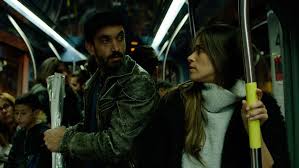
Sure, a yenta (Hana Laslo) nags her 30something son about getting married and giving her grandchildren, joking with and engaging a Yeshiva student and anybody else there in her case. A reporter tries to interview the new European football coach who’s just taken over Beitar Jerusalem and cannot get a word in edgewise as his boorish, cheerleading Israeli assistant breathlessly interrupts and answers for him, the train’s creeper of a security guard (Liron Levo) harasses attractive women, and at the behest of a Jewish Israeli “Karen,” profiles and assaults a Palestinian man who has had the temerity to stand next to her with a bouquet of store-bought flowers.

Golly, get my travel agent on the phone.

It’s a movie of music — a singer’s untranslated aria opens our vignettes, an Orthodox man serenades a traincar with his jumbush (Cümbüş), a mandolin/banjo hybrid common in the region, a Yeshiva class sings, and later a Palestinian rapper raps.

But the monologues and dialogues are supposed to carry it. The famous French actor Mathieu Amalric (“The Diving Bell and the Butterfly,” “Quantum of Solace”) is the most accessible “See this ride/this city through his eyes” character, a tourist with his tween son (Elias Amalric), absorbing the jumbush playing singer’s song, half-recoiling from two very pushy locals who get smilingly defensive about anything sound like a criticism of “The Jewish State.”

He reads (in French) from a long letter, written in 1850, by the French writer Flaubert, relating his experiences traveling in The Holy Land long ago. Sometimes flattering, sometimes profane, Flaubert’s descriptions, the father illustrates to his son, still resonate.

“Jerusalem feels like a fortified mass grave.”

You find yourself wishing, as a non-Israeli watching this, that Gitai had built the movie around these two rather than limiting them to two scenes. The stranger-in-a-strange-land getting this world explained to him is an old trope, but it works.

Quarreling couples and parting lovers (he’s a soldier going on duty for a stretch), the “Tramway” sees all, but reveals little. I found this anthology-as-collection-of-types indulgent and annoying, not a complete waste of time but an infuriating one.

MPAA Rating: unrated, adult conversations, profanity

Cast: Mathieu Amalric, Achinoam Nini, Mustafa Mazi, Hana Laslo, Liron Levo, Pippo Delbono

Credits: Directed by Amos Gitai, script by Amos Gitai and Marie-Jose Sanselme. A Film Movement release.

Running time: 1:34

Posted in Reviews, previews, profiles and movie news | Comments Off on Movie Review: A colorful city myopically seen via “A Tramway in Jerusalem”

Netflixable? Zombies hit Korea…again — “#Alive”

Zombie movies are challenging Kia and K-Pop as Korea’s major export, these days. “Train to Busan” and “Peninsula” were big budget theatrical entries, and “#Alive” arrives as the Netflix version, lower stakes, smaller scale, more intimate by design.

It doesn’t have the thrills of “Busan,” and its moments of pathos never quite achieve lump-in-the-throat status. But it’s a sturdy enough study in isolation in survival mode and the despair that comes with it.

COVID19 timely? You bet.

Jun-u (Ah-in Yoo) is a 20ish slacker who wakes up to an empty apartment and a note from his mother. He needs to hit the market as they’re low on food.

OK, maybe after a few hours playing his online combat game. Damned if one of his teammates doesn’t doesn’t blurt out “Turn on your TV” as another asks, “Is that CGI?”

The zombie outbreak begins, “aggressive” people attacking the uninfected, mass hysteria which he can see from the balcony of his high-rise apartment. His first encounter with a stranger amid all this mayhem doesn’t go well. The guy’s been bitten. We see him jerk, bleed from the eyes, and spasm into full out “BRAINS” attack, thanks to some clever editing.

A final voice mail from his family tells him to “Just do what they say on TV” and “Just make sure have enough food and water to survive for 60 days.”

Plainly, they expected him to shop rather than go first-person-online-shooter.

Snippets of the pandemic come in via TV, as long as it lasts — and social media, as long as that’s up. Selfies still shots, begging for help, or doing something stupid. Jun-u vlogs into the void, forgetfully suggesting “Don’t forget to subscribe (in Korean, with English subtitles)” after every entry.

There’s little to eat, too much risk outside his door. And maybe a short-attention-span/instant-gratification gamer isn’t the best-equipped bloke to manage this. All it takes is a single TV ad for ramen to have him devour “The last meal,” an instant ramen bucket meant to help him make it through two months.

He despairs at the the horrors he’s seen on the streets below, resolves to “never go out” and as the days pass, loses hope.

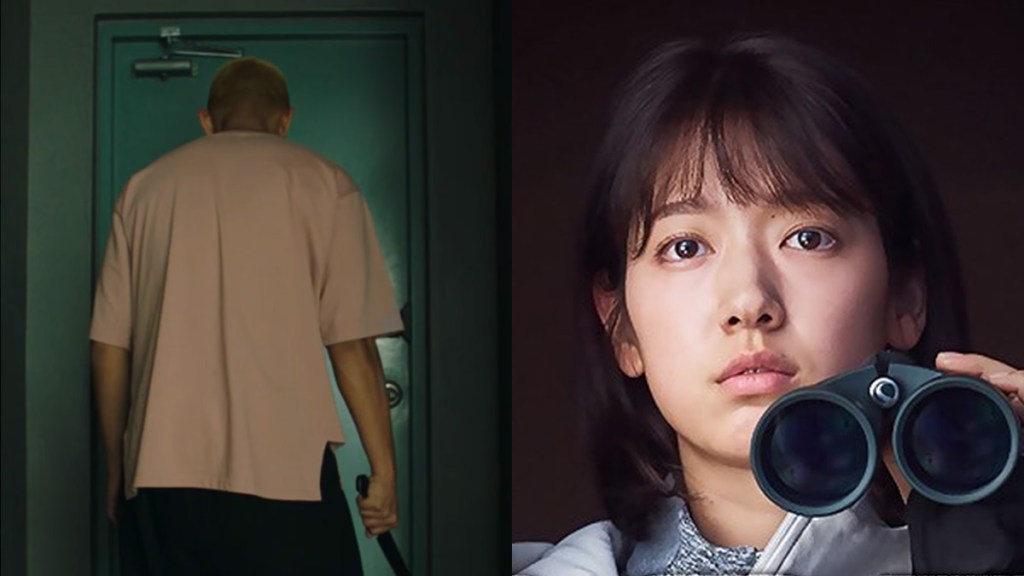
And then he’s “contacted” by a stranger in the apartment tower across the way. Kim Yu-Bin (Park Shin-hye) is just as alone, but more mature, resourceful and better-prepared for this. Or so it seems. But how can they team up?

This isn’t a particularly ambitious zombie film, but the scriptural problem-solving makes good use of the sorts of toys/gear young people might have on hand, at home.

The leads make their characters just quirky enough to hold our interest. We root for them as a couple, quarantining a hundred yards or so apart. There’s survivalism in every zombie film, but the “relationship” stuff reminds me of the German film “Rammbock” from ten years ago.

There truly is nothing new under the sun of the Living Dead, so don’t come to “#Alive” expecting to be dazzled, just favorable impressed. And don’t expect to be surprised. Even the third act “twist” has turned up in other zombie fare — films and/or TV.

This is a zombie film as comfort food, predictable but just satisfying enough to come off.

MPAA Rating: TV-MA, gory violence, profanity, smoking

Cast: Ah-in Yoo, Park Shin-hye

Credits: Directed by Il Cho, script by Il Cho, Matt Naylor. A Netflix release.

Running time: 1:38

Posted in Reviews, previews, profiles and movie news | Comments Off on Netflixable? Zombies hit Korea…again — “#Alive”

Documentary Review: Redneck offroaders are “Red, White and Wasted”

There have been a lot of documentaries about Donald Trump and Donald Trump’s America, and more will show up between now and election day 2020.

But the only one on that subject that strikes me as “essential viewing” is “Red, White & Wasted,” an eye-opening peek into the psyche, intellect, folkways and values of “the Trump base” we hear so much about these days.

Filmmakers Sam Jones and Andrei Bowden Schwartz access this world via the “mudding” community of Central Florida. They dive into a subculture of Confederate flag-flying rednecks who like nothing better than throwing a cooler into the aged pick-em-up truck they’ve spent their time and dimes modifying, and tearing up some bit of swampland, drinking, littering and whooping it up with their tribe as they do.

With every glimpse into these lives, every hedonistic excess — twirking, stripping bikini clad mudder molls — every disagreement settled with fists, every drunken “accident” that no one, save for anyone with a lick of common sense “could’a seen coming,” we come to understand the “live like you’ll die young” mindset.

With every racial slur, every suck on a beer, drag on a bong and gap-toothed Trump endorsement, we grasp the helplessness of lives of the white, low income, “low information” and low tolerance for anybody not them. We grit our teeth and wonder how many millions of votes it’s going to take to chase them back under the rocks they crawled out from under.

Our tour guide here is a grand old man of mudding, Matthew Burns, who used to be known as “Video Pat” back when there was lots of undeveloped/unmonitored land for this weekend pastime. Before cell phones, Pat would camcorder your Sunday mishaps and trucking triumphs ruining Florida watershed by tearing up wetlands.

Burns is, by the standards of a lot of the angry, intolerant and/or morbidly-obese men we hear from in the film, a decent enough sort. He’s a scrapper/scavenger, scraping out a living dumpster-diving for scrap metal, with two daughters, a junk-filled yard and manufactured home to match.

“Mud is like a drug to me,” he waxes. “But it’s not worth going to jail for.”

Pat rather cluelessly laments the diminishing access he and his kind have to public lands and undeveloped private property that they’ve trespassed on for decades. He bitches about what’s being “destroyed” by developers, without seeing the destruction and desecration mudders bring to their weekend brews-and-big-trucks bacchanals.

Then we meet his daughters and hear our first racial slurs. And the n-word happy young women symbolically open the floodgates — “foreigners” are favorite whipping boys of the good’ol boys and gals of Greater or Lesser Orlando.

“I like Russia, though,” one dead-end-at-25 cretin bellows. “I have a lot of respect for Vladimir Putin.”

The Budweiser flows and the belligerence grows. “The Confed’rate flag,” one tipsy pre-diabetic “country boy” expounds, “ain’t about SAL-very (sic),” in between hiccups.

We see gun tattoos and bumper stickers and hear screeching, shirtless tirades about “second ‘mendment” before we see the first firearm. For the godless and amoral, guns are their religion.

The filmmakers use some of Pat’s old videos and a stunning amount of access and embedding to get racist “redneck stereotype” confessions and reckless offroad moments that explain every “offroading fatality” we hear on the news.

This isn’t “Vernon, Florida,” Errol Morris’s classic dissection of small-town cracker Florida. But what Jones and Schwartz give us here is jaw-dropping in ways that make you think, “Oh, THAT explains EVERYthing” about America today.

We appreciate Pat’s plight, that “makin’ a living off other people’s garbage ain’t easy,” but see the distressing environment he’s raised his kids in, despair at seeing one of them pregnant, and shake our heads at how hellbent Pat is on “getting (the baby) in the mud” with them.

Their “don’t give a f—” ethos is in every utterance, their delusions are deep and wide. Self-reliant, handy with tools but blind to the poverty programs that they so deride but which have to be paying for an epileptic daughter’s medicine and the pregnant daughter’s childbirth, venomous about “foreigners” until Mario, a neighbor, helps fix a lawnmower and proves “Spanish people can be all right.”

One telling crack from one of the assorted testimonials reveals how much as a group they like doing things that “piss a lot of people (especially ‘libruls’) off.”

We think, for a moment, that maybe Pat — with a new grandkid, a life plan that hasn’t worked out, kids that are staggering into the same pothole he did — will have a “Come to Jesus” moment, visiting the vast Red Neck Yacht Club mudder park at Punta Gorda, and seeing the chaos that putting thousands of people just like him in one place creates.

Maybe the development of the ironically-named “Swamp Ghost” land, mudder trespassing property right off Orlando’s tourist-trap International Drive, will wake him up.

Why is the swamp there a “ghost,” Patty-boy? Because you all helped kill it.

But nah, self-reflection isn’t big with this crowd. He’ll be dreaming of his old trucks and looking for a back-way into a state wetlands sanctuary in no time. Maybe before the closing credits.

MPAA Rating: unrated, violence, nudity, drug and alcohol abuse, smoking, profanity, racial slurs

Cast: Matthew “Pat” Burns, Kristi Burns, Jessi Burns

Credits: Directed by Sam Jones, Andrei Bowden Schwartz. A Dark Star release.

Running time: 1:29

Posted in Reviews, previews, profiles and movie news | Comments Off on Documentary Review: Redneck offroaders are “Red, White and Wasted”