A little Paul McCartney animated holiday bauble — “When Winter Comes”

So it’s Farmer Paul this time around, a guise he adopted way back after the Fab breakup?

Stripped down, spare and basic and not quite folksy, and going the animated route for his “official” music for this times.

Lovely, water-colorish animation from Geoff Dunbar.

Happy holidays.

Posted in Reviews, previews, profiles and movie news | Comments Off on A little Paul McCartney animated holiday bauble — “When Winter Comes”

Movie Preview: Studio Ghibli goes CGI for “Earwig and the Witch”

Kind of takes away what made them special, to be honest. Story looks seriously “meh” too, but we will see.

Posted in Reviews, previews, profiles and movie news | Comments Off on Movie Preview: Studio Ghibli goes CGI for “Earwig and the Witch”

Netflixable? Friction generates teen heat “After We Collided”

The only fair way to approach “After We Collided,” the sexed-up sequel to the romance novel adaptation “After,” is on its own terms with its intended audience in mind.

If you’ve any attention to Netflix’s selection of self-produced or acquired teen romances, you know they’ve got the data to back up what common sense and memories of your own teens tells you.

Teenagers want to watch movies about affluent, beautiful people their age hooking up, running through the Kama Sutra in parties, in the shower, in cars, parks or offices. And maybe these exotic creatures — often with no visible means of support — after all that sweat and coitus, find true love.

Fighting that voyeuristic impulse is like trying to hold back the tide. Not. Gonna. Happen.

So as tempting as it is to recycle my review for “After” (“Much ado about absolutely nothing.”), let’s look in on these lovelies and see where they stand — or sit, lie down or mount — in the running count of that famous Indian book of love I cited above.

Tessa (Josephine Langford) has a paid internship with a publishing house this time, a college freshman/sophomore who is such a perky go-getter that the boss drags her to a meeting/club outing with a Chinese financier who might make Vance Publishing a bigger deal than it is.

She’s still mad at classmate/ex-lover Hardin, the willowy Brit covered in tats played by Hero Fiennes Tiffin. He cheated on her, basically on a dare. And as much as he pines and texts and voice-over narrates “a story you’ve heard before,” she’s not having him back.

This cute metrosexual accountant (Dylan Sprouse) might have her eye, now.

But a drunk dial after too many shots of “Sex on the Beach” reignites the flame. And showing up and trying to collect her things from “our place” gives his visiting Brit-mom (Louise Lombard) the wrong idea, so she pretends they’re still together to spare Hardin’s “long talk” with Mummy about the breakup.

And it’s on like Donkey Kong all over again, no matter how “toxic” the hard-drinking, haunted and stalkery Hardin is, no matter how much Tessa wants to dazzle in this fantasy world internship.

Novelist Anna Todd, who had a hand in the script, knows better than to let reality intrude much here. The libidinous, foul-mouthed and forward coeds (Inanna Sarkis dazzles as their queen, Molly) may mimic the current fashion in that subculture.

But hot-tempered Hardin keeps shoving around others like he’s hard and maybe weighs fifty pounds more than the beanpole he is. Tessa’s every problem is solved with a wave of a magic money wand.

The entire nonsensical plot is cut-and-pasted together just to make her mad again and prompt him to plead for make-up sex again. Having them independent of means takes away the challenge of teen sex — procuring a safe, comfortable and sexy place for it to take place. So director Roger Kumble and the screenwriters compensate by having lots of it, mostly teased, with just a bit of nudity and ever so much bumping and grinding.

Sure, it’s pervy to note this in a review, unless you accept that I’m just talking about the movie’s sole focus.

The moony magic of other romance novels for this YA crowd, the high stakes of starting a revolt against sci-fi fascism or overcoming “He’s a vampire and I’m not” are dispensed with for makeovers, dressing up, hitting the soundstage-sized club and going “commander” (she’s too drunk to remember “commando”).

Tessa’s mother, played by former teen icon Selma Blair, is limited to a single scene this time. That leaves the movie ripe for stealing, which bad girl Sarkis pretty much does. “Molly” is a provocateur, temptress and fly in the ointment — or whatever — of Tessa and Hardin’s happiness.

And she’s the better half of the best scene, the only good scene, in this empty-headed confection of copulation. It’s a cat fight, and of course it’s in the third act.

So, worse than the first? A little bit.

MPA Rating: R for sexual content, language throughout and some drug material

Cast: Josephine Langford, Hero Fiennes Tiffin, Dylan Sprouse, Louise Lombard, Selma Blair

Credits: Directed by Roger Kumble, script by Anna Todd and Maria Celaya, based on the Anna Todd novel. A Netflix release.

Running time: 1:45

Posted in Reviews, previews, profiles and movie news | Comments Off on Netflixable? Friction generates teen heat “After We Collided”

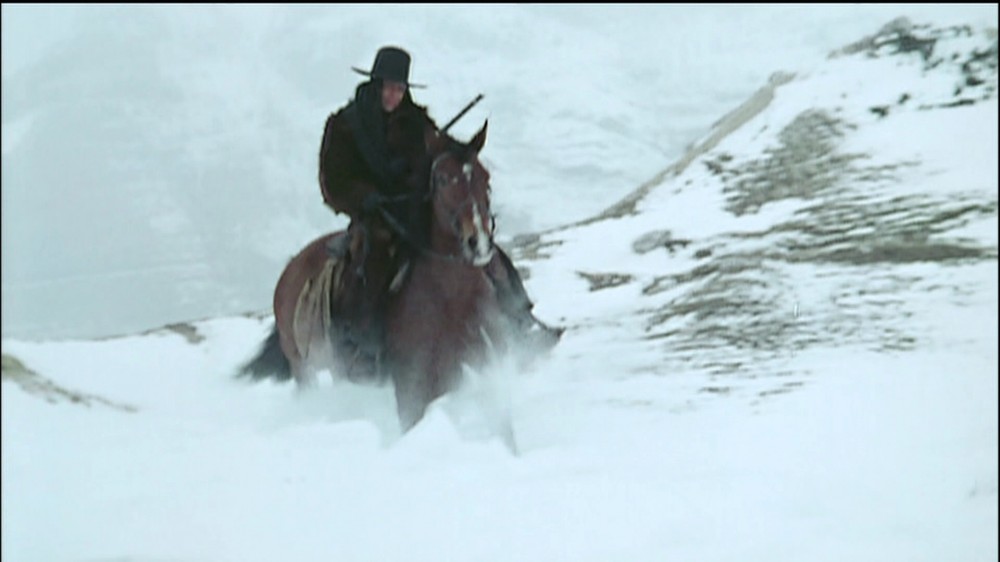
Classic Film Review: “The Great Silence,” a Wintry Spaghetti Western from the director of “Django”

The archetypal camp and iconic macho of Sergio Leone’s 1960s and ’70s classics dominate any discussion of “Spaghetti Westerns.” But leaving out rival Sergio Corbucci’s is not something Quentin Tarantino, for one, takes sitting down.

Corbucci’s “Django” and the downbeat snow-covered slaughter “The Great Silence” were the biggest “influences” Tarantino leaned on for his Westerns, especially “The Hateful Eight.”

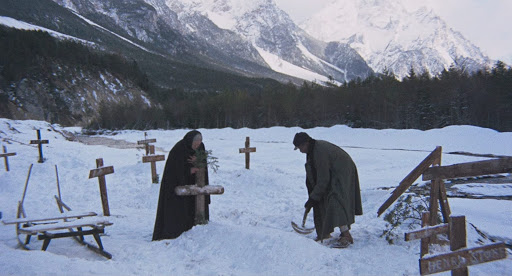
There’s something about hard men bundled up on horses struggling through snow, the visual contrasts and whiter-than-white palette that all that blood will be spilled on that makes films set in that season memorable.

The snowy stagecoach ride opening of “The Hateful Eight,” the battle over mines and the high Sierra town of “The Claim,” “McCabe and Mrs. Miller,” “Day of the Outlaw,” the John Wayne farewell scene in “True Grit,” winter alters the Western landscape, closes the world in around characters and adds to the perils faced by the desperate and desperados alike.

“The Great Silence” is Corbucci’s best film, if not his most famous, a story of a mute hired gunman brought in to defend and avenge a community of accused men and their families from an 1890s Utah onslaught of pitiless bounty hunters.

It’s gorgeous to look at, “Shane” lean in its narrow focus and romance and Peckinpah-bloody in its violence. It’s on Film Movement+ and if you’ve seen every classic American Western too many times and never warmed up to most of the hundreds of Audie Murphy/Randolph Scott filler films that flesh out the lineup of The Western Channel, Grit-TV, etc., it’s a must-see.

Jean-Louis Trintignant, later to star in “Amour” and turn up in films as varied as “Z” and “Stranger than Fiction,” is “Silence,” the tall dark avenger who shows up in Utah’s high country, summoned to defend assorted outlaws and their families, hiding beyond the reach of the law, from the summary justice of “bounty killers.”

Right from the start, Corbucci is flipping the script — a hired killer is hunting hired killers on behalf of wrongdoers.

A wealthy town boss (Luigi Pistilli) is using the bounty hunters as a means to an end. The governor wants it stopped, and has appointed a new sheriff (Frank Wolff) to take over in Snow Hill and curb the violence. Not that the sheriff isn’t capable of handing out rough justice.

“He kept complaining about the cold. I gave him an overcoat…made of wood.”

But he’s too late to save many, as the killer known as “Loco” (the great Herzog muse, Klaus Kinski) has been littering the snow with corpses, ordering locals to “leave him be,” (in Italian with English subtitles). “I’ll be back to collect on him later.”

But widow Pauline, played by African American Euro-star Vonetta McGee of “Blacula,” “The Eiger Sanction,” “Shaft in Africa” and “The Kremlin Letter,” is taking matters into her own hands. She summons Silence personally.

A confrontation is coming thanks to the quiet man who watches, notes and plots his moves and keeps his fancy new semi-automatic Mauser pistol dry.

What’s so striking about the Italian Westerns of this pre-Internet era is how much detail they got right, and how much just looks alien, fresh and in some ways wrong. A later John Wayne Western featured the intrusion of “modern” German pistols like this into the world of six-shooters and Winchesters.

But Corbucci and Leone both went nuts with the ordinance they shoved into “Django” and especially “The Good, The Bad and The Ugly.” Anachronistic European artillery in a Civil War setting just adds to the disorienting Spanish settings of many of these films.

“Silence” was shot in the North of Italy, in the deep snows of an Alpine winter. The hats the men wear, their fondness for scarves, fancy thigh-high riding boots, the types of buildings the settlers live in all feel more Swiss than Salt Lake City.

Check out the Matterhorn pitch of the roof of one barn Silence and his new crush Pauline hide out in. Even the stagecoach looks more at home on the Vienna to Salzburg run than trundling between Salt Lake and Snow Hill.

The violence — Silence is fond of shooting off the fingers of foes he never wants to fear again — is more graphic than in Leone’s films. Instead of humor, he gives us a sex scene more in step with European mores than what Hollywood dared show at the time.

And at the end of all this unnerving break from Western formula, he leaves us with a finale so grim and troubling it sticks with you. No Eastwood one-liners, no Eli Wallach or Lee Van Cleef smirk, just a brutal reality in a fictional Western filmed half a world away from where it’s supposed to take place.

MPA Rating: unrated, graphic violence, sexuality, nudity

Cast: Jean-Louis Trintignant, Klaus Kinski, Frank Wolff, Marisa Merlini, Luigi Pistilli and Vonetta McGee.

Credits: Directed by Sergio Corbucci, script by Sergio Corbucci, Vittoriano Petrilli, Mario Amendola and Bruno Corbucci. A Film Movment+ release.

Running time: 1:45

Posted in Reviews, previews, profiles and movie news | Comments Off on Classic Film Review: “The Great Silence,” a Wintry Spaghetti Western from the director of “Django”

Movie Preview: Denzel, Rami Malek and Jared Leto, a serial killer thriller — “The Little Things”

A serious story, seriously Oscar-studded cast and a serious director (John Lee Hancock of “Blindside”).

This Warner Brothers release probably would play as well on your great home HDTV at home, which is where you will most likely see it.

Posted in Reviews, previews, profiles and movie news | Comments Off on Movie Preview: Denzel, Rami Malek and Jared Leto, a serial killer thriller — “The Little Things”

Netflixable? Get around to “Hunt for the Wilderpeople”

The daft, stylized and quasi-surreal comedy of “Eagle vs. Shark” and “What We Do in the Shadows” may have made Taika Waititi’s reputation in his native New Zealand and at film festivals far and wide.

But the sweet, goofy and sentimental “Hunt for the Wilderpeople” is what sealed with deal for Hollywood.

A Thor sequel followed, “Mandalorian” episodes and oh yeah, the Oscar-nominated whimsy of “Jo Jo Rabbit.” That picture that could have pigeon-holed him as the Kiwi Wes Anderson forever, had he not shown more commercial/conventional inclinations before that one.

I missed “Wilderpeople” during its limited North American run, and in my mind had built it up into something more in fitting with Waititi’s Jemaine Clement collaborations than the almost straightforward comic adventure it actually is.

It’s funny, with colorful, exaggerated characters and a near outlandish situation or two. But in the end, it’s just an unwanted “problem” teen on the run in the woods with his “uncle,” the surviving half of the couple that finally took him in and lent him the promise of a happy “normal” life.

Ricky, played with a just-go-with-it ease by Julian Dennison, is an unwanted kid with a history of vandalism, arson, car theft and running away with he’s dropped with farmer Bella (Rima Te Wiata) and her grump of a “Crocodile Dundee guy” husband, Hector (Sam Neill).

He’s dropped off with a lengthy list of his “issues” by his bluff social worker (Rachel House), who leaves with an “Ok, he’s all yours. ‘No returns!’ Just joking.”

Ricky’s parked in a farmhouse high in Hobbit country, the New Zealand “bush,” with The State’s reassurance that “There’s no one else who wants you, Ok?”

And aside from not talking for a day or two, and running away every night, Ricky adjusts. He’s bonding with their dog and with nurturing Maori Earth mama Bella in a flash, even sharing his obscene would-be rapper haiku with her.

“This one’s called ‘Kingi, You Wanker.'”

Hector? “Something you want me to do?”

“Yeah. Leave me alone.”

That changes the moment Bella drops dead. Hector is devastated, Ricky is all about fixing his situation and avoiding “juvie.”

“Why don’t we just get you a new wife? There’s all sorts of women on the Internet!”

Rebuffed, the kid takes matters into his own hands, faking his death and fleeing into the bush with the dog Bella just got him, Tupac.

Yeah, Ricky may be out of his element. But dude is hard.

That’s when things go totally wrong, Ricky and Hector become wanted criminals — well Hector does, anyway. He’s confused for a “molesterer.” Damned if there isn’t a nationwide manhunt for them. As social worker Paula (House) assures a worried nation that “No child left behind” is her policy, Ricky and Hector stumble off the grid and into legend.

Waititi touches abound in this adaptation, taking chapter titles from (one assumes) the novel — “Famous,” “Broken Foot Camp” — a hilariously off-putting eulogy by Waititi playing the priest at Bella’s funeral, and violence involving kids played for laughs.

But what sticks with you from this “Hunt for the Wilderpeople” is the sweetness, the soft edges Neill gives to his bush-savvy curmudgeon, the kid’s street “smarts” that’re really just naivete. Because he’s just 13, no matter what crimes he has “the knack” for.

Dennison went on to have a key part in “Deadpool 2” and sadly in the obnoxious “Christmas Chronicles 2.”

House has become a popular animated voice actress (“Soul,” “Moana”).

And Waititi? He’s got an Oscar, another “Thor” sequel in the works and a “Time Bandits” TV series in the works. In an era when “star directors” have become an endangered species, he’s become a brand — not just for offbeat humor, but for making even “sentimental” kid-friendly goofs like “Hunt for the Wilderpeople” go down easy.

MPA Rating: PG-13 for thematic elements including violent content, and for some language 

Cast: Sam Neill, Julian Dennison, Rachel House, Rima Te Wiata, Rhys Darby and Tioreore Ngatai-Melbourne

Credits: Directed by Taika Waititi, script by Taika Waititi and Te Arepa Kahi, based on the novel by Barry Crump. An Orchard release on Netflix.

Running time: 1:41

Posted in Reviews, previews, profiles and movie news | Comments Off on Netflixable? Get around to “Hunt for the Wilderpeople”

Documentary preview: Smart sniffing dogs take the spotlight as “The Truffle Hunters”

Who’s a good boo boo dog? Who?

Posted in Reviews, previews, profiles and movie news | Comments Off on Documentary preview: Smart sniffing dogs take the spotlight as “The Truffle Hunters”

Netflixable? Clooney loses himself in the melancholy of “The Midnight Sky”

It is time?

Can we say this now, after his disastrously-off “Catch-22” on TV, his satiric misfire “Suburbicon” and the sentimental slog of “Monuments Men?”

Behind the camera, the magic that was George Clooney most definitely was George Clooney, at this stage. As a filmmaker, he’s lost his fastball and curveball, if not his slider.

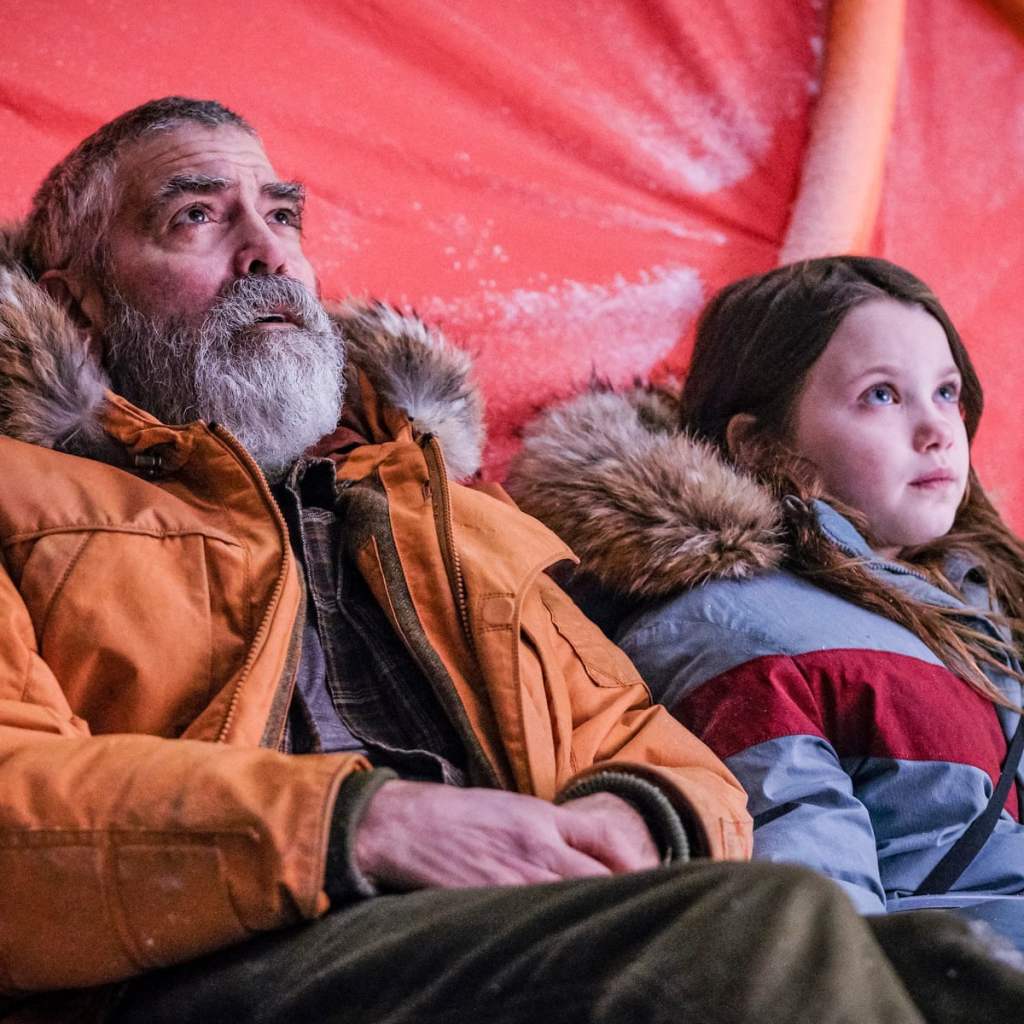
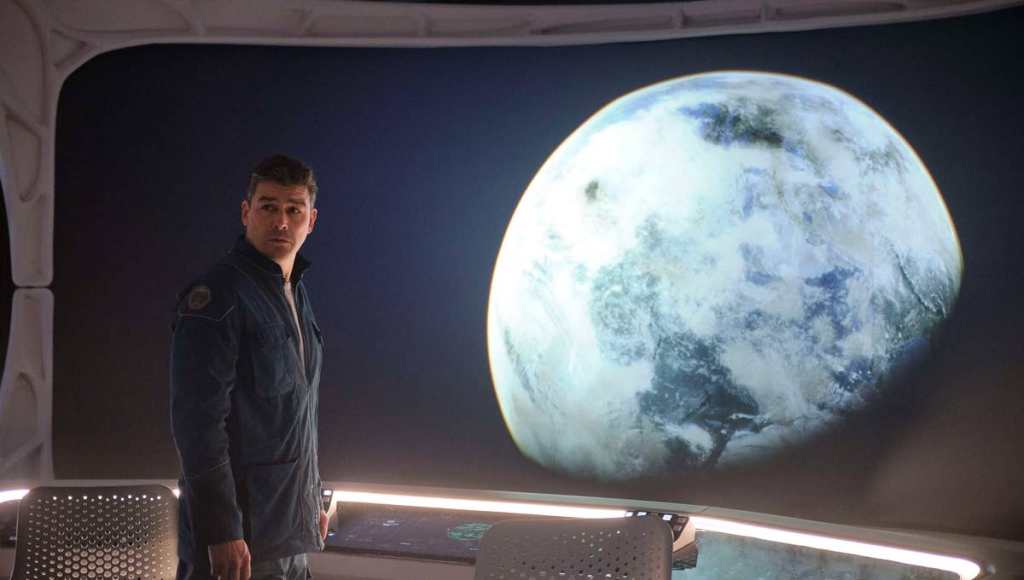
“The Midnight Sky” is a gorgeous, handsomely-mounted piece of post-apocalyptic sci-fi that lured a stellar cast, which surrounds Clooney — Letterman bearded in this outing.

It’s a downbeat tale of a dying Earth “after the event,” a dying scientist (Clooney) and his efforts to save a foundling left behind at his research station and the spacecraft he had a hand in sending off to explore a new “exoplanet” suitable for terra-forming for the human race to settle.

But “Midnight” is “Martian” without the whizbang humor and optimism, so downbeat it’s like the saddest parts of “Gravity” and all of “Solaris.” The pathos he reaches for and not one actor manages to summon up is contained in another film we catch a character watching — the post-nuclear war weeper “On the Beach.”

While Clooney & Co. make “Midnight Sky” watchable, it’s so emotionally drained, derivative and over-familiar as to be akin to watching paint dry — richly-tinted, shiny acrylic paint, if that’s any consolation.

A lovely, dark and spare opening sets the story up. In 2049, our scientist is the last holdout at a research station above the Arctic Circle. He stayed there by choice when “the event,” which plays out like a pandemic on his digital global maps, struck. Flashbacks show the evacuation, warnings about keeping up with his “transfusions” (it looks like he’s on self-administered dialysis).

In between flashbacks that depict a life uninterrupted by science and work, save for one failed love affair, he has the brainstorm of trying to contact a spacecraft sent to a distant moon in the Solar System to check out its habitability. No answer.

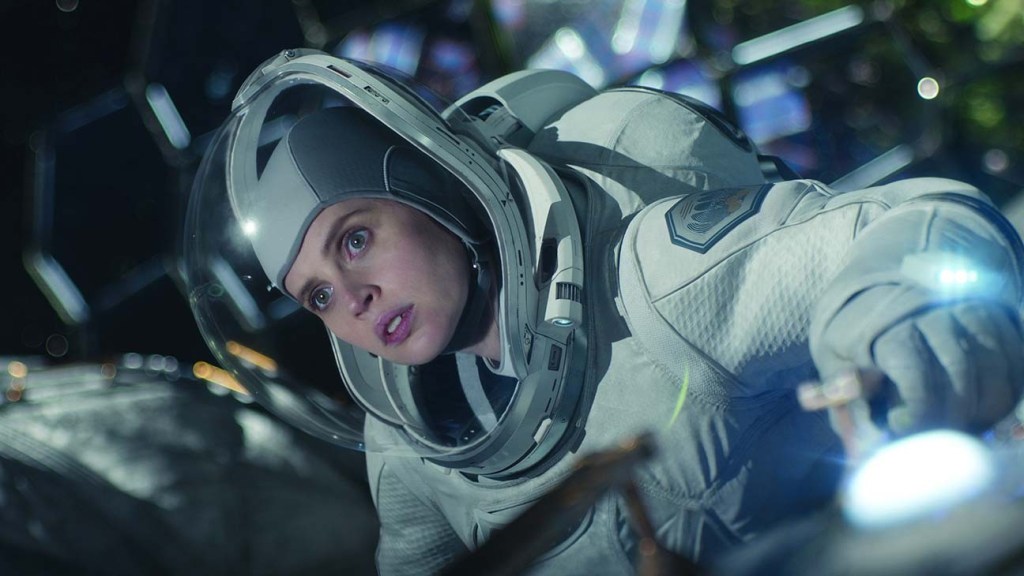
On that “2001: A Space Odyssey” vessel (with Architectural Digest interiors), the crew is in the dark about Earth. Sully (Felicity Jones) notes all the communications they’ve tried to reestablish. The captain (David Oyelowo) and crew (Kyle Chandler, Tiffany Boone, Demian Bichir) lose themselves replaying old holographic chats and visits as they make their way “home.”

The silent seven year-old “left behind” at the Arctic station (Caoilinn Springall, spitting image of “My Girl” era Anna Chlumsky) becomes a new problem for our survivor scientist. And while he doesn’t let us see him “work the problem,” there is a powerful radio transmitter across the Arctic that they can try and reach.

The story signposts start out familiar and venture onto a well-worn path in writer-for-hire (“Vacancy,” “The Revenant,” “Overlord”) Mark L. Smith’s adaptation of the Lily Brookes-Dalton novel. You have an idea what the crew of the ship will go through, although a “Sweet Caroline” sing-along takes you by (unpleasant) surprise. On Earth, the good doctor’s quest puts him in peril in ways he and we cannot necessarily trust as “real.”

The obstacles to our two narratives are as predictable as an Alabama/Ole Miss point spread. The waypoints of the ship and the scientist-with-child journeys are pro forma to the point of pro formula.

And did I mention what a gloomy bummer of a movie it is?

Which brings us back to our original assertion, that Clooney, a fascinating figure, articulate spokesman for human progress and a Righteous Dude, is a lot more interesting off set than on, these days.

And putting him in charge behind the camera doesn’t remedy that, and hasn’t in some time.

MPA Rating: PG-13 for some bloody images and brief strong language

Cast: George Clooney, Felicity Jones, David Oyelowo, Kyle Chandler, Tiffany Boone, Caoilinn Springall and Demian Bichir.

Credits: Directed by George Clooney, script by Mark L. Smith, based on a novel by Lily Brooks-Dalton. A Netflix release.

Running time: 1:58

Posted in Reviews, previews, profiles and movie news | Comments Off on Netflixable? Clooney loses himself in the melancholy of “The Midnight Sky”

Meet the “Real” Ma Rainey of “Ma Rainey’s Black Bottom”

Whatever Oscar dreams Netflix has for “Mank” (meh) or “Da’ Five Bloods” (You’re kidding, right?), they’re pulling out all the stops for George C. Wolfe’s film of August Wilson’s most accessible play.

There’s a doc on the making of the film, featuring Denzel Washington’s (star of the film of Wilson’s “Fences”) role getting it on the screen. Another documentary about schoolkids learning Wilson monologues for a national competition is also on the streaming service.

This featurette? It’s on Youtube. Rainey is such a rich, layered and theatrical character in the play that it’s easy to forget that she’s the “real” character here. A good piece to watch, before or after seeing “Ma Rainey’s Black Bottom.”

Posted in Reviews, previews, profiles and movie news | Comments Off on Meet the “Real” Ma Rainey of “Ma Rainey’s Black Bottom”

Netflixable? Mulligan and Gyllenhaal set off sparks in “Wildlife”

“Wildlife” feels like the sort of movie Paul Dano would have begged to star in back in his teens.

The “There Will Be Blood” co-star’s adaptation of Richard Ford’s novel captures a marriage falling apart and a doted-on, confided with teen son witnessing all, struggling to hold things together and suffering for it in ways present and we can guess future.

Jake Gyllenhaal is personable, athletic Jerry who has taken on sole “breadwinner” duties in their latest town, Great Falls, Montana. He’s a golf pro, with all that entails in Great Falls, Montana in 1960. He gives lessons, caddys and does course maintenance.

Of course he’s “coaching” 14 year-old son Joe (Ed Oxenbould) in the all American game he must take up to make friends at his new school.

Carey Mulligan plays chatty Jeanette, the polished, put-together wife and mother — not working now, but someone who has held a variety of office jobs at other stops along their marriage journey.

We’re not surprised to learn that they met at college. And at the first sign of trouble, we’re less surprised to learn that they’ve been sort of failing their way eastward for years.

Jerry isn’t exactly subservient enough at his golf club job and we see his firing coming before he does. His son witnesses the cause and the effect.

“They just don’t want people like us to get ahead,” Jerry explains, grabbing a six-pack on the way home.

Jeanette’s sunny, upbeat and supportive optimism crashes against Jerry’s embittered sense of being trapped in a place where he’s been shamed. He won’t take the job back (his glad-handing ways made him popular) because “I won’t work for people like that.” And he won’t take any gig just to prop them up.

“I didn’t come to Montana to bag groceries.”

Jeanette’s smiling work-arounds mean she’ll go out and find a job in the interim. And Joe, with schoolwork, pointlessly attempting football and making what could be his first girlfriend (Zoe Margaret Colletti) will find a part-time job, too.

The fissures were there and already starting to crack when Jerry abruptly announces his next gig. He’ll join the crews fighting the distant wildfires that darken their skies and dominate the Great Falls news, a decision Jeanette regards as dangerous, rash, juvenile and pretty much the last straw.

“What kind of man leaves his wife and son in such a lonely place?

Dano focuses on the trauma of all of this, and how it registers on the face of young Oxenbould (“Alexander and the Terrible, Horrible, No Good Very Bad Day”). The kid even looks like younger Dano, a sensitive child gut-punched by his Dad’s decision and utterly deflated by his mother’s mercenary “A girl’s gotta do what a girl’s gotta do” reaction.

Scenes in which Mom brazenly revives her dormant feminine wiles to pursue a rich divorced car dealer/entrepreneur (Bill Camp) are as quietly disturbing as anything Mulligan has played, and I’m seeing this AFTER “Promising Young Woman.”

Gyllenhaal gets across a kind of repressed, depressed haplessness. In an era where men didn’t talk about their problems, Jerry’s reactions are all he knows to do, a pattern set in stone by his upbringing, the unspoken parameters of his marriage and past behavior.

And Oxenbould lets us see what Joe has absorbed from both parents, a kid rooting for his father, whom he desperately misses, trying to smooth things over with his mother when mere guilting her about her desperate, vindictive turn doesn’t work.

At 14, “Wildlife” lets us see the awful lessons that will scar this kid for life.

Dano gets much of this across without giving the son many lines, without fleshing out his school life and the budding friendship/romance that “things at home” are snuffing out.

Yes, “Wildlife” is yet another “broken home” movie where the child acts more like the adult than the adults. But Dano and his cast make this period piece more real and subtly disturbing than many a memoir of the “Glass Castle” and “Hillbilly Elegy” variety.

MPA Rating:  PG-13 for thematic material including a sexual situation, brief strong language, and smoking 

Cast: Carey Mulligan, Jake Gyllenhaal, Ed Oxenbould, Zoe Margaret Colletti and Bill Camp.

Credits: Directed by Paul Dano, script by Paul Dano and Zoe Kazan, based on the Paul Ford novel. An IFC release on Netflix.

Running time: 1:45

Posted in Reviews, previews, profiles and movie news | Comments Off on Netflixable? Mulligan and Gyllenhaal set off sparks in “Wildlife”