Movie Review: “The Road to Mandalay” ends in Bangkok for these Burmese immigrants

They meet in a minor act of gallantry. Both are to pile into a pickup truck that will smuggle them deep into Thailand. One will ride in front, others have to hide, lying flat, in the false bed in the truck’s back to avoid detection.

Even though Guo has paid the higher priced fare to the mule, he will swap places with Lianqing.

At the end of their harrowing journey of checkpoints and bribes, he urges her to take a ride into Bangkok with his sister. She declines, but accepts his phone number and his gallantry, and gives him hers.

After all, they’re both from the same city in Myanmar. They’ve shared an ordeal together. Little do they realize that they’ve just finished the easy part.

“The Road to Mandalay” is a quietly understated and cautionary migration drama, two people cross a border on their way to better lives. Lianqing (stoically played by Ke-Xi Wu) hopes to make it to Taiwan. But she has a support system in Thailand. Maybe things will work out well enough here, as she tries to work and raise the money to move on. Things don’t.

This Taiwanese/Thai co-production carefully observes a working underworld in a country where fake work permits are expensive to come by, and useless — and real ones impossible to get. Those in the know — Chinese expat business folk and locals — have mastered the way to get by — bribery.

A checkpoint inspection of the mule’s pickup? Fixed with a bribe. A police raid/roundup of all of Lianqing’s friends and relatives, sharing an apartment? Fixed with another.

She is 23, innocent to the point of naive. Helpful colleagues and roommates guide her, but a couple of acquaintances embittered and frustrated by the barriers to getting by here are just as instructive.

Sure, learn the language, ride the bus, hit the markets, take any job that will hire you (most won’t).

“But don’t wear a (Burmese) sarong,” in Burmese with English subtitles). “It’s a dead give-away.”

Guo (Kai Ko) has made his interest in Lianqing obvious. But she is focused enough to want to stick to her plan, ands wary enough to decline Guo’s help and almost rebuff his advances. She’s scrubbing dishes at a busy restaurant, not quite off the books, but close. She is paying the restaurant owner rent, and sending much of the rest of her cash home to her impoverished mother.

Guo, who has taken a job in a cousin’s textile factory, shows up at her work, gathers her pack and possessions and insists she quit and join him there.

She declines.

But as the narrow path to success in this new life turns out to be a dead end, Lianqing faces unspoken choices — tie her fate to Guo’s, or join some of her roommates in Thailand’s most infamous trade — sex work.


Writer-director Midi Z lets his camera linger over details of this world — the inflatable raft that takes Lianqing across the Moei River into Thailand, which turns out to be a brief journey made utterly routine by the first team of human traffickers she has to pay off on her trek. Then, a motorbike ride, then the pick-up, then piling into a three-wheeled Tuk Tuk (taxi).

Meals are viewed in real time — Liannqing brings jars of Burmese pickles and hot peppers into Thailand in her pack, and virtually no clothes. Conversations are spare and work is tedium itself — cleaning dishes and washing them, dozens at a time, clearing the threads on a loom.

There may be subtexts on ethnic ties and Taiwanese involvement in the larger trade and smuggling schemes that I didn’t pick up on. But Guo’s behavior is redneck patriarchy at its most universal.

He has a crush, a motorbike and family connections. Lianqing should embrace all that and cling to the piece of “home” he represents, or so he thinks.

Midi Z’s symbolic/dream rendering of sex work for a virginal innocent like Lianqing is symbolically blunt — a water monitor lizard crawling over her.

But that at least is dramatic and earns a reaction from the poker-faced Ke-Xi Wu. Incidents are few and far between in this movie of “situations” our heroine finds herself in.

“Road to Mandalay,” which has nothing to do with a Hollywood silent film of the same title, is slow cinema — lingering takes to set a scene, put us in a factory of in the rural town Lianqing travels to to bribe a local Army officer for fake ID papers.

The pace makes the few things that “happen” feel more dramatic, and heightens the reaction to the final act, which is tense and fraught.

I found this parable a tad pokey for my tastes, almost sleep-inducing in the middle acts. The title promises a picture with more momentum, a longer “road” journey, and I was disappointed when it settled into how hard it is to get work and get by in Bangkok.

But every immigrant taking such a journey, courageously dealing with unsavory characters every step of the way, is inherently fascinating, and “Road to Mandalay” benefits from that. As “real” as this is, a heroine proactive and assertive enough to take these risks would certainly be more interesting than the passive way Ke-Xi plays her, or that Midi Z paints into this woebegone dilemma.

MPA Rating: unrated, adult situations, violence

Cast: Ke-Xi Wu, Kai Ko

Credits: Scripted and directed by Midi Z. A Film Movement Plus release.

Running time: 1:48

Posted in Reviews, previews, profiles and movie news | Comments Off on Movie Review: “The Road to Mandalay” ends in Bangkok for these Burmese immigrants

Movie Preview: A plague period piece — “The Reckoning”

Creepy looking horror tale headed our way in Feb.

Posted in Reviews, previews, profiles and movie news | Comments Off on Movie Preview: A plague period piece — “The Reckoning”

Movie Review: A quirky, quizzical “Taxi Driver” for the Incel Era — “Wade in the Water”

Murder, pedophilia, blackmail and morbid obesity figure into the plot of “Wade into the Water,” an odd and intriguing debut feature from director Mark Wilson and screenwriter Chris Retts.

It’s “Taxi Driver” meets “Napoleon Dynamite” — a quirky, dark mystery-thriller. And it’s a poster movie for the genre known as “Film Festival Movies,” as in distributors wouldn’t rush to buy it because “What theater would book it?” or know how to advertise it.

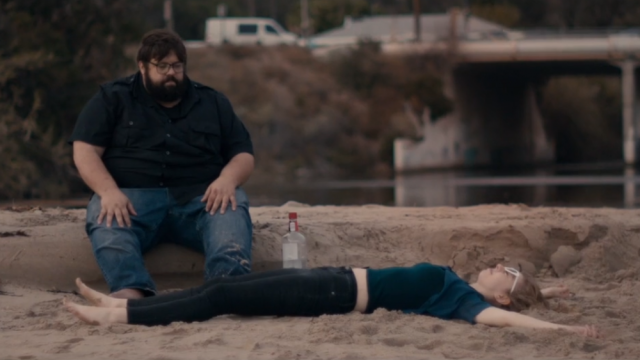
Veteran bit player Tom E. Nicholson plays our grumpy loner “hero,” an overweight giant in tent-sized shorts, beard and glasses. And when we meet him, he’s wheezing, covering his face in a mask and his head in a hoodie, pulling out a pistol and breaking in.

Our unnamed protagonist is a work-at-home medical billing specialist, alone save for his pet guinea pig and his TV, where he consumes a steady diet of free TV old movies. He has a “usual” at the local Chef Burger, a bad temper and a court-ordered shrink that he’s got to see about that.

But the thing that triggers that opening breaking-and-entering is a misdelivered piece of mail. It’s a DVD. And on it, child pornography.

For reasons he doesn’t reveal at first, our plump dyspeptic digs into who that disc was intended for and what sort of “monster” that person might be.

Every transaction in this guy’s life, from mental health center receptionist to the fellow who serves him his burgers to a mail clerk to the fellow behind the counter at the gun shop, is fraught. We never know what will set our man off, even if we know his four favorite profanities.

“Gun shop,” you say? Why yes, there’s that “Taxi Driver” thriller element here, remember.

“What’s it for?” “What the f–k does THAT matter?”

And that’s what throws him in the path of the strange young woman named Tilly (Danika Golmbek, odd and interesting).

Retts’ script has edge, a hint of blackmail and perversion and guilt and a troubled past for these two to talk about, or around.

But the center of this, its core appeal, is in Nicholson’s low-grade irritation at life, how every little thing — just getting in and out of a compact car, just getting his burger the way he likes it — is maddening.

Whatever made him this way might be what he wants the gun for, after he’s done his detective work — approaching possible victims of a pedophile, narrowing down his options, avoiding “the cops.”

And the girl? She’s no slouch as a gumshoe herself.

“Thriller” doesn’t quite fit here, because no matter what the stakes, nobody seems that worked up about them. It’s more disquieting than fun, but more amusing than troubling.

And Nicholson makes this Incel life of quiet, slovenly desperation fascinating to look in on, if not embrace.

MPA Rating: Unrated, violence, profanity

Cast: Tom E. Nicholson, Danika Golombek, Samuel Whitehill

Credits: Directed by Mark Wilson, script by Chris Retts. An Indie Rights release on Amazon Prime, Tubi TV.

Running time: 1:28

Posted in Reviews, previews, profiles and movie news | 2 Comments

Movie Review: “Stars Fell on Alabama” — But laughs? Nope.

Here’s a charmless little nothing riff on “Sweet Home Alabama” starring nobody you ever heard of and filmed in everybody’s second-favorite Beaufort, the one in South Carolina.

“Stars Fell on Alabama” takes its title from a Big Band era ballad, its plot from every laugh-and-heart-starved “high school reunion” romance.

Set in a filmmaker’s fantasy version of Alabama, where line dancing and “breaking into the old school” and racial harmony are plot points, it makes the journey from indifferent to intolerable at a slow saunter.

A Hollywood agent (colorless James Maslow), given to casting “fans” to interrupt Zoom meetings to create buzz around his rising-starlet client (Ciara Hanna, Kaley Cuoco-lite), is taking a weekend to go home to Willow Valley, Alabama for his 15th reunion.

Drawling classmates jab Bryce, aka “Dixie,” for being “33, not married, no kids” and thankfully don’t jump to any same sex conclusions. But Dixie takes the bait, lies about bringing a “famous actress” girlfriend, and next thing you know he’s begging starlet Madison to “play the part” for the weekend.

This timeworn comic situation is hard to screw up — the “begging” bit, I mean. The script and actors render it so bland as to not be worth the bother.

Madison is a good sport about giving up her “Yoga Boxing” for a couple of days, teases Bryce — who is Mr. “Never Mix Work with Pleasure.” She flirts, half-heartedly.

And they go through the generic, never-been-to-Alabama rituals filmmaking outsiders associate with “LA, lower Alabama.”

Will these two crazy LA transplants find a love connection amid all the covers of Philip Phillips’ “Home” and The All-American Rejects’ “Gives You Hell,” “beer chugging, annual tradition” flag football, all the “Welcome to the South” and “ROLL Tide” drawling and boundaries-blind pals of Bryce’s not-remotely-funny classmates?

When Bryce isn’t being pitched scripts or “my granddaughter” the actress, “a natural?”

Even the “twists” in the plot are tired — “TMZ photos,” Madison’s Brit-rocker ex (Zebedee Row, almost funny)., the “big dance.”see

The differences between pretty actors and “stars” are many, but all spin out of charisma and that ability to make a half-written, half-improvised, half-assed scene play cute, funny and/or romantic.

Tell your players stop at a costume shop to do competing Charlie Chaplin impressions, hope for the best and get...nothing at all. Zero spark. No whimsy. No laugh. Not even competent.

“I can’t forget the glamor,” the title tune (never played in the movie) goes. “Your eyes held a tender light, and stars fell on Alabama last night.”

But they never do.

MPA Rating: PG-13 for some suggestive material 

Cast: Ciara Hanna, James Maslow, Andrew Rush, Lesa Wilson, Jaclyn Betham, Johnnie Mack

Credits: Directed by Sourav Kumar and V.W. Scheich, script by Robert Windom. A Samuel Goldwyn release.

Running time: 1:43

Posted in Reviews, previews, profiles and movie news | Comments Off on Movie Review: “Stars Fell on Alabama” — But laughs? Nope.

Netflixable? A tragic childbirth leaves behind “Pieces of a Woman”

A young woman’s flinty, brooding recovery from the devastation of losing a baby is the beating heart of “Pieces of a Woman,” an intimate if somewhat problematic melodrama from the Hungarian filmmaker Kornél Mundruczó (“White God”) and his frequent collaborator, Kata Wéber.

It lives on a riveting, introverted turn by Vanessa Kirby and a bravura early scene — a single-shot “long take” that captures a home childbirth that goes wrong. “Problematic” and “melodrama” fits most everything else.

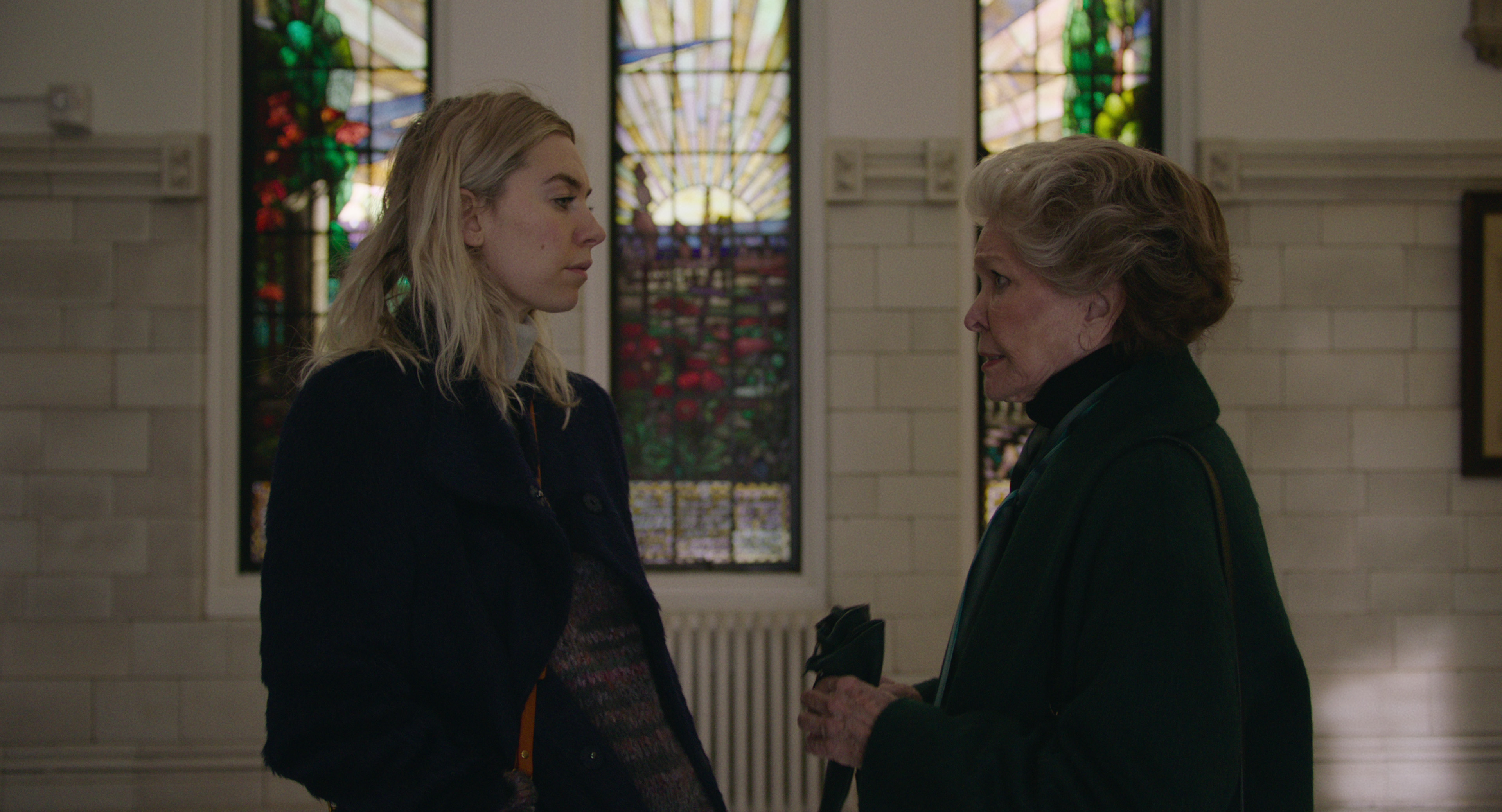
Kirby is Martha, very pregnant when we meet her, making her goodbyes at an office baby shower, heading home to give birth soon with maternity leave to follow.

Shia LaBeouf is her rough-hewn partner, Sean — a bearded, blustery construction worker building a Boston bridge, somebody we instantly sense is beneath Martha’s class. Her mother (Ellen Burstyn) buying them a minivan reinforces that.

The birth scene that follows is a quiet exercise in rising, single-shot tension. The planned midwife can’t make it. A substitute (Molly Parker) arrives and things progress, in realistic detail, to that instant when it all goes wrong.

Months later, Martha is back at work, brushing off Sean, who insists “We’ve gotta FINISH this,” and pushing back at her pushy, controlling mother.

“Don’t you want someone to answer for this monstrosity?”

They’re arguing for a civil suit. They want the midwife to pay. Martha, still in shock, still silently grieving, seethes at their interference. The viewer is naturally on her side.

But as months pass and the pressures mount, we see Martha withdraw more and more from the event even as she never really comes to grips with it. And even as she doesn’t, the wheels of justice are turning. Sean and her mother and their lawyer are getting their way.

Mundruczó and Kata Wéber, reworking a stage piece they did and based this on, give the film a European flavor, a disconnect that mirrors Martha’s own unmooring. She is pulling away from Sean and her mother, even her sister (Iliza Shlesinger) as this dark winter of her life passes.

But other issues introduced here play like the naked plot contrivances they are, twists and layers to the melodrama that feel like afterthoughts.

And then there is the casting, which makes it hard to lose oneself in her story in some cases.

LaBeouf’s trademark antic aggression paired with his dressed-down/grunged up look and mien feels off. What’s this tall, willowy blonde from money — Jewish to boot — doing with this “rough” and “poor” and “boorish” — words he’s heard from her mother and Martha herself — doing with her?

Everything we learn about him adds to that impression.

Burstyn is an 88 year-old screen legend, and she’s supposed to be this 30ish woman’s mother? That bit of tricky math is ignored to accommodate a Holocaust survivor speech, which Burstyn knocks out of the park, in the shaky voice of very old age.

But come on.

Cinematographer Benjamin Loeb deserves kudos for that single-shot that doesn’t look like a single-shot childbirth scene, a camera in close and backing out, following the stages of labor from room to room with realistic interior lighting.

Montreal, and Oslo and other Norwegian locations substitute for Greater Boston in a mildly disconnecting way.

It’s Kirby who makes this worth watching, and even that performance is nothing anyone would call “warm.” If “The Queen” and a “Mission:Impossible” villain didn’t make her a star, this certainly will.

It’s all the “pieces” around Kirby that let down this “woman.”

MPA Rating: R for language, sexual content, graphic nudity and brief drug use

Cast: Vanessa Kirby, Shia LaBeouf, Ellen Burstyn, Iliza Shlesinger, Benny Safdie and Molly Parker.

Credits: Directed by Kornél Mundruczó, script by Kata Wéber and Ansuman Bhagat . A Netflix release.

Running time: 2:07

Posted in Reviews, previews, profiles and movie news | Comments Off on Netflixable? A tragic childbirth leaves behind “Pieces of a Woman”

Book Review: “The Dead Are Arising: The Life of Malcolm X”

Yes, this is an interesting biography to finish off in the middle of a racist/treasonous coup attempt, but there you go. And since Spike Lee and Denzel’s bio-pic hagiography on the same subject is still worth watching, I thought I’d review it here.

Pulitzer-prize winning journalist Les Payne spent decades tracking down and interviewing friends, relatives and colleagues of Malcolm X. He wanted to basically fact check “The Autobiography of Malcolm X,” dictated by Malcolm and turned into prose by Alec Haley. Whatever Malcolm’s reputation for unflinching truth telling, Haley was quite the yarn spinner and never above passing off fiction as fact. So it was a righteous project.

Payne never finished the book, but after his death, his daughter Tamara — who’d done some of the research and fact-checking along the way — undertook the task as a tribute to her father. The result is a sometimes fascinating, sometimes hero-worshipping (of her Dad and Malcolm) and overall impressive piece of scholarship that in many ways, moves beyond the self-manufactured myth.

The structure of the book is heavy on context and highlighted by some serious new scholarship. It may take a while to get to Malcolm Little, who grew up in Omaha and Michigan in the lynching-happy 1930s and ’40s, but the context provided is important.

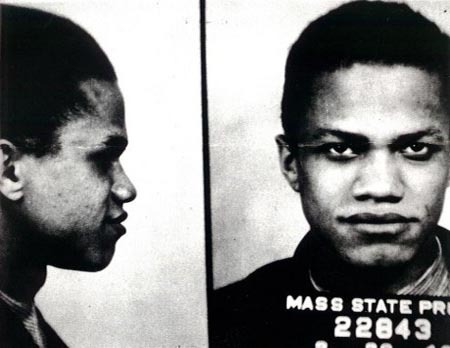
We’re treated to sketches of the America that Malcolm was born into, the early lives of his parents and their deep involvement with Black separatist Marcus Garvey’s organization in the years right after World War I. That’s important, considering the Black self-help “cult” (their words) Malcolm was drawn into while in a Massachusetts prison, encouraged in this direction by his siblings, some of whom had fallen in with the ever-evolving Nation of Islam back in Michigan.

The charismatic leaders of assorted Black sects of an Islamic bent are profiled, those which fell by the wayside and one — a New Zealand white man passing himself off as Black who founded the movement that morphed into the Nation of Islam — later led by an uneducated, soft-spoken manipulator/operator from Georgia who came to call himself The Honorable Elijah Muhammad.

Malcolm Little, renamed Malcolm X, became the Nation’s most riveting speaker and best recruiter, and eventually came to be seen as a threat within the organization, which led to his murder in the mid-60s.

The Paynes correct the record of Malcolm’s youth, digging deep into an adolescence and early adulthood which Malcolm, for all his ownership of past evils, sugar-coated in the “Autobiography.” He told audiences his father was murdered by racists, but he died in a tram accident, everyone else in his family agreeing with what they saw and the way the dismemberment was covered in police reports and local newspapers at the time.

With his widowed West Indian mother struggling to feed a large family in the couple of years that followed, Malcolm and an equally guilty sibling shamelessly robbed her blind They were stealing the money meant to feed them all and keep a roof over their heads, money sent by his oldest brother who found decent-paying work back East, money two teen brothers blew on cigarettes and marijuana and the pleasures of Mason, Michigan. Their mother went insane under the strain, the family was broken up and that’s all on Malcolm.

He tried to pimp out a brother’s ex-wife, used women so awfully that some ended up broken, addicted and in prostitution. And then he fell in with a cult, given to chanting “gibberish” prayers in faux Arabic to Mecca five times a day and preaching racial separation.

The big piece of reporting here is an extensively reconstructed secret meeting that took place in Atlanta between Malcolm and the KKK, which saw common ground in the NOI’s “separate the races” ethos, and distrust of “the Jews.” Malcolm’s agenda, to reject this cooperation, was brushed aside by the naive Elijah Muhammad, and was the first indication that their rift would grow and be permanent.

That long, almost pointlessly-detailed chapter hijacks the book, and everything that comes afterward suggests one needs to read or re-read the “Autobiography” to feel fully filled in on what they Paynes dash through. Perhaps Les Payne was rushing to get it wrapped up. A first reference to Malcolm’s connection to Muhammad Ali indicates earlier references that were omitted, and things like that mar the slapdash last third of the already-labored “The Dead are Arising.”

But if you’ve seen Spike’s epic and want a taste of the boy who became the man the movie star played with such grace, force and righteousness, “Arising” is well worth picking up.

“The Dead Are Arising: The Life of Malcolm X,” by Les Payne and Tamara Payne. 612 pages inc. index, LiveRight Press. $35.

Posted in Reviews, previews, profiles and movie news | Comments Off on Book Review: “The Dead Are Arising: The Life of Malcolm X”

Documentary Review — The whimsical, dark life and art of “M.C. Escher: Journey to Infinity”

The camera tracks down what is unmistakably a young woman’s naked back as the voice of Stephen Fry, throwing himself into an amusing dudgeon, reads from the letters of the puzzle print-maker M.C. Escher, griping about “the hippies in San Francisco” who are “printing my work clandestinely,” turning it into “place mats” and color-tinting it for posters and what not.

Beneath all this grumping is a rasping buzz. And then the camera reveals that this young woman is getting a grand tattoo based on the works of one of the most widely disseminated, appreciated and posterized artists of modern times and all times.

Fry vamps Escher’s quizzical, mocking words on 1960s “California” kids and “their addiction to narcotics,” and rocker Graham Nash recalls his early fandom moving him to call the Great Man at home in the Netherlands.

But but, Escher complained, “I am not an artist. I’m a mathematician!”

Fry performs a rejection letter to a certain Rolling Stone who inquired about acquiring unseen Escher art for “a record sleeve” (album cover), ending with a huffy “please inform Mr. Jagger that I am not ‘Maurits’ (his first name) to him, but, respectfully, ‘M.C. Escher.'”

Escher’s bemused incredulity with the generation that discovered and popularized his work, late in life, reminds one of J.R.R. Tolkien’s shocking realization of what hippy fans figured was “pipe weed” in his Middle Earth novels, embraced by the same tuned-in/turned-on generation.

That sets the tone for Robin Lutz’s delightful documentary, “M.C. Escher: Journey to Infinity,” a playful but serious look at the life and work of a wildly popular woodcut printer, lithographer, painter and mezzotint print-maker Maurits Cornelius Escher.

Using animation, interviews with his surviving family (and Graham Nash), archival footage of Escher at work and old family photographs, with Fry narrating from Escher’s own writings, Lutz paints a most entertaining if somewhat limited (No art experts, art world fans, etc.) portrait of the man, his mathematical obsessions, his travels and his work.

We hear about his childhood, learn that he abandoned architecture in school, see early sketches and landscapes — unmistakably his, with an architect’s polished, fine lines — and visit the places that formed his eye and informed his art.

He went to Tuscany as a young man and met his wife there. And no one who knows Europe and Escher’s work will be surprised that the man was transfixed by the Alhambra in Granada, Spain, an ornate Moorish castle covered in mosaics, frescoes, archways and gardens, “the whole” of it, Escher enthused, “a work of art.”

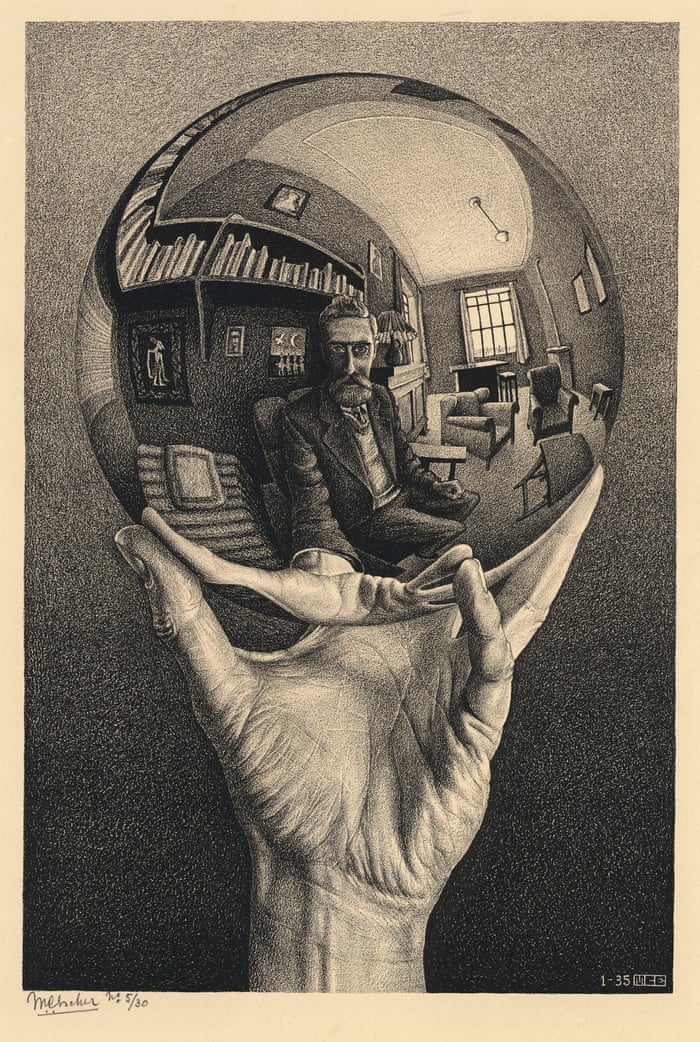
Escher, often doing his drawing in one of the towering, white-walled Reformation churches in Belgium or the Netherlands where he lived, conjured up perspective-challenging puzzle pictures where “you don’t where where to begin, or end.”

The repeating patterns of “tessellation” fascinated him, and generations of young fans lost themselves in his most famous works, which were turned into millions of posters in the ’60s, ’70s and beyond.

The film, coming to New York and LA Feb. 5 ( streaming thereafter) visits a Milan retrospective of his work with the cleverest “put yourself in an Escher selfie” gimmick I’ve ever seen in an art exhibit.

Escher brings that out in creative people, from rock stars and black light poster purveyors (who put color in his art) to filmmakers who saw a “Labyrinth” of a movie in a single Escher print.

If Ben Stiller’s getting lost in artwork in a “Night at the Museum,” you can bet your bottom Guilder that it’s in an Escher maze.

As I noted, the one shortcoming here is the lack of artists, collectors and academics to place him within the ranks of great artists, or dismiss him as another faddish creator of “Big Eyes” or pop art or multi-dimensional hanging jigsaw puzzle posters for teenagers wanting something trippy to stare at as we conduct the chemical experiments of youth.

No matter. The people have spoken, as has the marketplace, and we know what we like.

So much so that a lot of us are willing to get M.C. Escher’s masterworks needled into our skin fifty years after his death, sixty years after the first Tommy Chong to take a long gaze at an intricate picture that hinted at infinity and noted, “Far out, man.”

MPA Rating: Unrated

Cast: George Escher, Jan Escher, Graham Nash, Liesbeth Escher, narrated by Stephen Fry.

Credits: Directed by Robin Lutz, script by Robin Lutz, Marijnke de Jong. A Kino Lorber/Zeitgeist release.

Running time: 1:21

Posted in Reviews, previews, profiles and movie news | Comments Off on Documentary Review — The whimsical, dark life and art of “M.C. Escher: Journey to Infinity”

Movie Review: “Cicada Song,” a mystery half-unraveling now on Amazon

“Cicada Song” is a sometimes compelling mystery-thriller set in America’s heartland, a missing persons story set in remote, rural Missouri.

The feature debut of writer-director Michael Starr has many of the requisite ingredients of a solid indie outing — a little-filmed setting, missing children, and adults, ethnic tensions surrounding the “Mexican” farm labor, with small town small mindedness on ready display.

What this 77 minute movie lacks is anything like a remotely satisfying, or even comprehensible solution to the mystery, and an ending that doesn’t look like “Let’s wrap it up in post (production) because we’re out of money.”

Rushed, “pat” in its summing up, and yet under-explained, the finale is where this uneven, almost-passable picture drops the ball.

Somebody left for dead is coming to in the woods, somebody female. The back-story of who she is and how she got there, awakening to the “Cicada Song,” is our story.

Hispanic convenience store clerk Annabelle (Jenny Mesa) and farm manager Karen (Lyndsey Lutz) are a couple, which ruffles a lot of feathers in tiny Hermann, Missouri.

Annabelle’s ex (Rob Tepper) is downright hostile. Any time he sees either one of them, he can’t let go of the d-word, the one that rhymes with “bike.”

Karen’s estranged from her father. “Dad!” “Don’t CALL me that.”

And then there are the older, sullen jerks like Bob Wilkes (L.R. Hults) who remind us that farmers are basically small businessmen, inclined to take shortcuts and skip out on loans, and not necessarily the hearty, self-sufficient stereotypes America pretends they are. At least Bob’s mentally-challenged son (Stephen Blum) seems nice. When he’s not gawking at Annabelle.

Karen’s bosses (Kim Reed and Joseph Bottoms) are indulgent, prone to giving generous bonuses. She keeps their farm in the black, plays hardball with suppliers and learned Spanish to deal with the hired hands — and win Annabelle’s heart.

But now, the workers are telling her a little girl is missing. Her employers seem unconcerned. Nobody wants to involve the authorities. Karen starts digging around, learns of another missing kid, starts to wonder if a local creeper is responsible, and if that connects to out of town land speculators.

And then an adult goes missing.

What Starr gets exactly right is the intimacy of shrinking small towns, how everybody knows everybody else, everyone has history. Richard, who used to date Annabelle, went to high school with Karen. When farmer Bob blows a wad of cash on a new combine, that’s gossiped around town and certain to irk Karen, whose employers loaned him money he still hasn’t repaid.

But not everybody in the cast is a polished professional. And the story’s many holes, leaks and lapses in forward motion throw the clumsier performances into sharp relief.

The gay romance at the heart of the movie works, the glowering faces of the beer guts at the town bar when one of them walks in rings true.

But Starr overreaches for something bigger than the classic small town crime and tragedy this movie wants to be. The few twists that are here aren’t much, and the better twists we anticipate don’t come to pass.

And then that ending, which reminds one of David Lynch’s “Dune,” a movie that’s sauntered along suddenly rushes to get to some sort of conclusion — “whatever we have the footage to cover.”

Try again, folks.

MPA Rating: unrated, violence, profanity, slurs

Cast: Lyndsey Lantz, Jenny Mesa, Kim Reed, Joseph Bottoms, Rob Tepper, Cesar Ramos, L.R. Hults and Stephen Blum

Credits: Scripted and directed by Michael Starr. An Indie Rights film on Amazon Prime.

Running time: 1:17

Posted in Reviews, previews, profiles and movie news | Comments Off on Movie Review: “Cicada Song,” a mystery half-unraveling now on Amazon

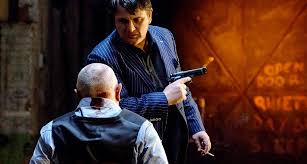
Netflixable? Craig Fairbrass machos up “London Heist (aka ‘Gunned Down’)”

As I’ve said before, that Craig Fairbrass is a proper British villain. A hulking, brutish mug, everything about him says Man of Action/Bloke-who-doesn’t-muck-about.

He makes solid British B-movies — thrillers with a caper, cash, some cars, some cuts and gunplay, calling foes “c–ts.”

That’s all “Gunned Down” (re-titled “London Heist” for distribution on Netflix) is. It’s a formula thriller about heists and betrayals, with a twist here and there, and all of it co-written by Fairbrass — who knows his brand — and based on a novel he also co-wrote.

Nice work if you can get it, right? But in sticking to formula yet dispensing with a lot of details common to the genre, it’s not nearly as satisfying a heist picture as you’d hope.

The “formula” makes itself obvious in the first scene, a framing device that sees Fairbrass as Jack, bloodied and hurtling down some backroad, making one last getaway. The story is tucked inside that, what happened some weeks before.

That was the “last score” heist that he and three other “geezers” — in the British gangland sense (any tough guy) and American one (they’re mostly over 50, a couple over 60).

But the big haul is snatched from them after Jack’s Dad (veteran character actor Steven Berkoff) is grabbed, tortured and killed before he can launder the money. His mates (Tony Denham, Eddie Webber and Roland Manookian) won’t let him see the state Dad’s body was in. But after the funeral, Jack realizes the killers left his Dad’s cell in the garage where they ambushed him. Who’d he call? Who called him?

That sends our wronged robber and grieving son on the prowl. Lenny (Mem Ferda) is one suspect, a venal crime boss. Jack’ll need help from an old mate (James Cosmo) retired to Marbella.

And of course, the cops (Nick Moran) are on his trail the whole time.

It’s difficult to make a formula feel fresh every time out, and that’s what the formidable Fairbrass has run into in the films I’ve seen him in. Here, we see no plan-the-job scenes. We’re robbed of “getting the band back together” bits, the fussing over blueprints.

Fine.


Don’t bother trying to reason through how he keeps getting away, skipping the country, fleeing an island for a continent and then another island, because that’s not-exactly-explained either.

The women are merely pawns — Jack’s wife (Nathalie Cox) and a young woman on his Dad’s phone (Katie Clarkson-Hill) — or faceless strippers at the club where a couple of confrontations are set.

What we’re left with is a couple of capers, a couple of shootouts and a bloody, to-the-death fight in the finale. And slang, lots of Brit-villain-speak about “blags” (jobs), trash talk about having the gall “to come in here and give it large” and Cockney rhymes about “dipping the Jack & Jill” (stealing from the till).

Moran, a veteran of the Harry Potter pictures and decades of character actor work, gets off the best line, about his long pursuit of “Jack Cregan and his merry band of piss-takers.” But aside from the slangy stuff, the dialogue is stock material — “overstocked” — the obligatory “We’re the same, you and me.”

Bloody hell, lads. You can’t come up with better “Dicky birds” (words) than that?

Come on, old son. I’m running out of patience that Ray Winstone-the Next Generation will ever make a movie that lives up to your screen presence.

MPA Rating: R for violence, language throughout and some sexuality/nudity 

Cast: Craig Fairbrass, James Cosmo, Mem Ferda, Nick Moran, Steven Berkoff, Nathalie Cox and Katie Clarkson-Hill

Credits: Directed by Mark McQueen, script by Craig Fairbrass, Alexander Soskin and Chris Regan, based on a novel by Craig Fairbrass, Frank and Harper and Simon Eldon-Edington. A Lionsgate film on Netflix.

Running time: 1:35

Posted in Reviews, previews, profiles and movie news | Comments Off on Netflixable? Craig Fairbrass machos up “London Heist (aka ‘Gunned Down’)”

Movie Preview: Hathaway and Ejiofor, with a side of Sir Ben — a heist while we’re “Locked Down”

Jan 14 on HBO Max.

Posted in Reviews, previews, profiles and movie news | Comments Off on Movie Preview: Hathaway and Ejiofor, with a side of Sir Ben — a heist while we’re “Locked Down”