
First time I ever saw “Saturday Night Live” this band with Hitler on keyboards appeared. I thought it was another comedy element of the show. This film just premiered at Sundance.
First time I ever saw “Saturday Night Live” this band with Hitler on keyboards appeared. I thought it was another comedy element of the show. This film just premiered at Sundance.
I see this stacked in my “warm clothes” collection at my mother’s place in frigid N.C., a studio-provided turtleneck from the days when critics were critical, films were shot on celluloid and Michael Palin might be just the priest to comfort fallen women.

The message on back…

Shudder has this one, which starts streaming Feb. 4. Creepy?

Good storytelling skates by on the tension between what we see, read or hear unfold, and what we hope or fear might happen as the tale unfolds. Dickens or “Dumb & Dumber,” it’s all about meeting or willfully defying our expectations, great or otherwise.
“Happy Cleaners” is a Korean-American immigrants and their children drama, a story of the Korean dream transported to America and burdens passed from generation to generation. It’s a movie built on expectations that it lets us cling to, even if we fear the filmmakers have no intention of giving we the viewers our wish or their characters an easy way out.
It’s about a Flushing, N.Y. dry cleaning business run by first-generation immigrants. Mom (Hyang-hwa Lim) is the driven one, Dad (Charles Ryu) is somewhat hapless, clinging to his pride and his masculinity in the face of a lifetime of hard, low-margins labor.
Their daughter Hyunny (Yeena Sung) is a nurse, resigned to how they are, propping up their struggle as best she can. Son Kevin (Yun Jeong) is in open rebellion. He’s dropped out of college, abandoning Mom’s dream of “a medical degree.” He’s into food, works in a food truck and longs to try his hand in Los Angeles.
“It’s not my fault you work this this,” is how a lot of their arguments end, followed by Kevin storming out.
The sexism here is masked in “traditional gender roles,” with the petulant, indulged son refusing to carry the weight of what his family wants and the daughter left to pick up the slack.
Hyunny is in love, but she’s furious that beau Danny (Donald Chang) is letting his own family’s struggle — they have a liquor store — put his education, and any future he might have with Hyunny, on hold.
“Are you gonna work like this forEVER?”
It may be pragmatic, but it’s certainly not helpful of Mom to weigh in on that, in Korean (with English subitles).
“Break up with him immediately.”
The dry cleaning business is a struggle, with equipment failures, a new landlord and the debts of a previous business gamble — a restaurant venture years before — still hanging over them.
Danny may seem buried under responsibilities and Kevin all-too-eager to shed his, but Hyunny, the “success” in this story, hears herself parroting her parents’ work-ethic mantra, one that you can also hear in the Korean American drama “Minari.”
“Anything is possible if you work your ass off.”
It was always thus. It takes a generation or two for newcomers to America to realize that while much is indeed possible here through hard work, “anything” is an overreach. Some never stop struggling and never get their heads above water. Some drown.
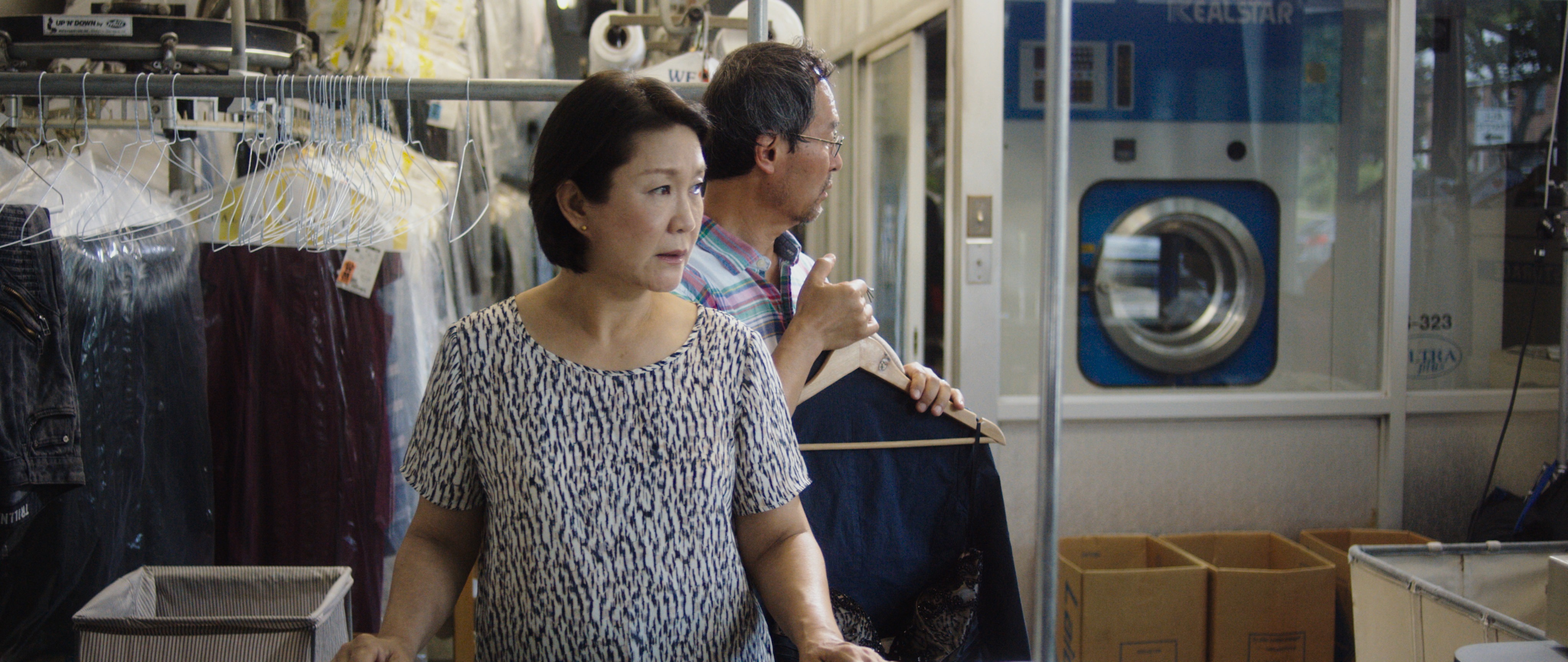
First-time feature co-writer/directors Julian Kim and Peter S. Lee create character “types” and then set out, with the aid of a pretty good cast, to upend our expectations of these people and what would appear to be their fate — good or bad.
Lim’s Mom is brittle, judgmental but no harridan. She’s never so outspoken that Kevin won’t come back after storming out, and Kevin is never so angry that he can’t see himself back under their roof, learning cooking tips from Mom and when she visits, Grandma (Jaehee Wilder).
Dad is close to pitiable, cowed by a jerk landlord or irate customer, deferring to his wife but stoically staying on task and maintaining their current course, even if the ship is taking on water.
Sung’s Hyunny is the character many of us will identify with, straddling the middle ground between her parents’ “work hard and it’ll work out” notions and Kevin’s realizations that this life isn’t worth repeating. She’s just as trapped and smart enough to realize that, even if her lashing out is only at her overwhelmed boyfriend.
The arrival of “Happy Cleaners” at almost the same time as the Oscar-buzzed “Minari” (Feb. 12) reinforces “Tiger Mom” and “work hard” cultural stereotypes, and the stories sync up on with a “gamble everything for a chance to get ahead, even if you fail” theme as well.
The honesty of these stories, and 2017’s “Gook,” is filmmakers’ staring without blinking at the generational schisms, the ongoing sting of “YOU people” racism and the inevitable realization that whatever parents went through to get them here, the expectations they saddle their kids with don’t always pay off with achievement. Sometimes, their only benefit is giving you the courage to defy them.

MPAA Rating: unrated, profanity, smoking
Cast: Hyang-hwa Lim, Yun Jeong, Yeena Sung, Charles Ryu, Donald Chang and Jaehee Wilder.
Credits: Directed by Julian Kim and Peter S. Lee, script by Julian Kim, pat Kim and Peter S. Lee. A Passion River release.
Running time: 1:38
A little song, a little prance, a little Patsy from “AbFab” in her cups and in your hands.
Joanna Smith Rakoff’s memoir about working in a New York literary agency that represented J.D. Salinger becomes a break-out vehicle for Margaret Qualley and a reminder that nobody knows that New York/Old Money world better than Sigourney Weaver, who rarely goes back to it on screen.
A March 5 release.

“First Blush” is a Millennial Dance with the Tiger romance, another generation’s flirtation with the “Threesome that Works.” Victor Neumark’s film posits that maybe this time, with this generation, we can stop the dance without the tiger eating us.
Hey, it could happen!
It’s obvious the first time we see them together that Nena (Rachel Alig) is a little controlling, maybe a tad highly strung. And Drew (Ryan Caraway) both defers to her and dotes on her.
Her little rant about keeping her 30th birthday quiet, about “hating” surprise parties earns a gentle, non-confrontational “How do you know?” Because she’s never had one, until now.
Their chatterbox pal Carrie (Jordee Korpanski) has invited a lot of people Nena doesn’t even know to this surprise. And the biggest surprise of all is how quickly she clicks with the young, slightly glamorous (she used to model) Oliva, played by Kate Beecroft.
Alig, who has an Aubrey Plaza look and vibe, nicely captures how rattled Nena is at what she tells this stranger on first meeting, how her marriage’s bottom line is that she knows she won’t “die poor and lonely.”
But no worries. Moving on. Her goal is that she hopes to “say yes” a lot more in her 30th year. Carrie and her fiance (Christopher Moaney-Lawson, funny and droll) convince Nena and Drew to come camping with them. So. “Yes.”
And when they get there, who should be the fifth wheel but Olivia, who doesn’t have her own tent?

Writer-director Neumark doesn’t fall into the titillation trap that most “threesome” movies do, making it all about the sex. He’s more interested in how the addition of Olivia to this marriage opens people up and opens cans of worms, some of which can never be closed.
The warnings are there, echoed by people privy to this little “arrangement” (they try to keep it secret). This “always” ends in “drama.” But sure, you kids go ahead and find out for yourselves.
No, “We can’t go back to the way things were.” Or can we?
The willowy Beecroft nicely embodies the laid-back-about-life confidence of “beautiful and I know it.”
Alig brings an antsy, analytical and confused energy to Nena.
Caraway’s character makes the longest journey, the guy whose too-honest wife talks about her first encounter’s sparks with Olivia and responds, hopefully, “We’re together forever, right? We’re solid? Right?” His undemanding “I live for your happiness” motto might not be all Nena wants out of life, but it plays well to them both. At some point, what’ll he expect in return?
The not-quite-comical squirming discomfort of some of scenes remind the viewer that Neumark cut his producing teeth on TV’s “Portlandia.” It’d be easy to see these characters, in more cartoonish form, on that show. But whatever tone he was going for, the thin sprinkling of laughs makes “First Blush” drag on more than it should.
He hits his serious points with just the right touch, here. Even if every generation has to figure out relationships on its own, and every generation looks for ways to, as the writer Tom Robbins pondered, “make love stay,” there’s enough evidence that maybe these three are foot soldiers in a post-binary world of sexuality, commitment and happiness.
Or maybe they’re like everyone who came up with this “solution” before them — kidding themselves.

MPAA Rating: unrated, sexual situations
Cast: Rachel Alig, Ryan Caraway, Kate Beecroft, Jordee Kopanski and Christopher Moaney-Lawson
Credits: Scripted and directed by Victor Neumark. A Gravitas Ventures release.
Running time: 1:47





The Cold War comedy had become its own genre by the time Mel Brooks and Buck Henry put in on TV with “Get Smart.”
The idea that Russian spies, Russian authoritarianism and “The American Way” could collide for laughs should have been a stretch for a generation that survived the biggest Hot War, WWII. But by the time films like Billy Wilder’s “One, Two, Three” and Norman Jewison’s “The Russians are Coming, The Russians Are Coming” came out, American audiences had bought in.
But when did we first start to laugh at the whole idea of a war of ideas, of a clash that was deadly earnest and deadly serious but without (much) shooting, was hard to take seriously?
I’ll bet it was “The Big Lift,” a just-after-it-happened, docudrama-real and often laugh-out-loud funny account of the Berlin Airlift, the first major confrontation of The Cold War.
I’d never seen this pre-Korea 1950 dramedy, with Montgomery Clift and Paul Douglas as Hawaii-based Air Force crew suddenly shipped to Germany to keep Berlin from being starved to death by the Soviets. George Seaton, who went on to write and direct “Airport,” and “The Country Girl,” wrote and directed “Miracle on 34th Street” and scripted a couple of Marx Brothers romps, wrote and directed “Lift.” And if he’s not parked in what Andrew Sarris loftily called “The Pantheon” of cinema stylists of that era, the record reflects the writer-director knew where to find laughs in even the grimmest of settings.
It’s dark — set mostly in a ruined, rubble-filled Berlin, with war criminals wandering the streets and even the local “schatzis” (friendly frauleins) a dubious proposition. The work was dangerous, flying food and coal in via C-57 transports through a narrow air corridor, harassed by Russian fighter planes, into an airport surrounded by apartment blocks (“Like landing in the Rose Bowl” one pilot cracks.).
But as serious as it all was, this mad scramble (20 minutes between landing and the next takeoff) to save survivors of a genocidal regime from another genocidal regime, had to seem a tad ridiculous.
The bluff Sgt. Kowalski (Douglas, of “The Maggie” and many a comedy or drama of the era) has a “This is where we SHOULDA used the A-bomb,” a sentiment that can’t have been unique at that time.
Sgt. Danny McCullough (Clift) isn’t quite that cynical. But he probably didn’t serve in the European theater. And when he’s singled out for a hometown profile by an Associated Press reporter, and honored, strictly by chance, at a “thank you” ceremony for the work they’re all doing, he warms to the first woman (Lithuanian-German actress Cornell Borchers) he’s seen during this service.
As McCullough and Kowalksi explain their jobs and the milieu to the AP reporter, McCullough steals away to spend time with the widowed Frederica. That’s how he sees the city, up close, with its ruined buildings, civilians pressed into labor gangs to remove rubble to rebuild it and the patently-absurd four-power arrangement that divided Berlin into “zones” occupied by the victorious Allies and the liberated French.
Seaton, mixing his cast with real-life fliers and GIs, creates a swaggering, bantering world of inter-service rivalry, with the Air Force guys razzing Navy crews who come to pitch in, with MPs (working in teams, with one soldier from each of the four occupiers) struggling to keep the peace and the “fraternizing” to a minimum.
Newsreel coverage opens the film, and is cleverly folded into the proceedings as Seaton has it interrupted by the Hickam Field (Hawaii) airmen watching it as they’re given their orders to report for “45 days” of “training.” In Berlin.
The script is patriotic without being heavy-handed, with the brutish Kowalski explaining to his bullied fraulein (Bruni Löbel) the virtues of democracy with a cute “Dewey Defeats Truman” anecdote and a defense of a society with its own anti-Semitism (and race) problems.
The Germans our heroes meet include Strieber (O.E. Hasse), a survivor and hustler and freely-admitted “Russian spy” who documents the comings and goings of Berlin Airlift flights. He’s a comical cynic who jokes of the 15,000 Germans the Russians have spying for them in Berlin, and the 10,000 the Allies have on their payroll.
Travel between “sectors” has a certain peril that Seaton finds comical. Russians hassle tram riders for food and coffee, and we see an older German man counsel a weeping woman to hide her little bag of coffee under her hat.
When he rats her out, it’s a jaw-droppingly funny shock and the entire tram turns on him. When he laughs and opens his coat to reveal a year’s supply of coffee, and gives her a couple for her service (she took suspicion away from him), the joke has the perfect punchline.
Both leads have arcs, with Clift’s Danny turning a bit more jaded about the Old World and Old Enemies that can’t be trusted, and Douglas’s Germa-phobic Kowalski warming up from the guy who doesn’t hesitate to glower the “Krauts” off their own sidewalks as he stomps down the street he was when he arrives.
“They belong in the gutter. If they don’t get outta my way, I’m gonna push’em there.“
“The Big Lift” is a film that takes us back to a simpler time, America at its most confident, not yet wholly wrestling with the Civil Rights Movement and thus self-righteous in ways that made us overdue to be knocked down a peg or two.
And it’s a stand-out film in the career of a filmmaker whose deft hand with comedy and drama “(The Country Girl” was an Oscar winner) made him a go-to choice of the studios, even if he was no Hitchcock, Huston, Wilder or Wyler.
Wilder may have made the funniest Cold War comedy of them all. But Seaton got there ten years ahead of him in a classic film well worth tracking down on Tubi, Roku or your favorite classic film channel of choice.

MPAA Rating: Approved
Cast: Montgomery Clift, Paul Douglas, Cornell Borchers, Bruni Löbel and O.E. Hasse
Credits: Scripted and directed by George Seaton. A 20th Century Fox release on Tubi, Amazon, etc.
Running time: 2:00





A friend posted a Facebook link to a New York mag Vulture column, “An Oral History of Disney’s ‘The Emperor’s New Groove'” the other day, and that got me feeling nostalgic, remembering when Disney had a Feature Animation Florida division in Orlando, where “Mulan,” “John Henry,” “Lilo & Stitch” and “Brother Bear” were largely animated.
And I remembered Disney’s downbeat and little-seen documentary about how a planned animated musical epic “Kingdom of the Sun” became a rush-romp do over, “The Emperor’s New Groove.”
“The Sweatbox” showed at a couple of film festivals, including the hometown Florida Film Festival. It’s largely the basis for the Vulture piece, with a healthy dose of post-mortem embellishment from a few of those who lived through what was the tail end of a glorious era for Disney Animation.
The deal was that Disney’s “Lion King” director Roger Allers was offered the chance to make a film built on ancient South American culture, and settled on the Incas and a “Prince & the Pauper” story starring the voices of David Spade, Owen Wilson and Eartha Kitt. Sting was carefully courted to create the music for this epic, sort of his chance to do “what Elton John had done with ‘The Lion King.'”
And a part of that deal included Sting’s wife Trudi Styler, who would get to film a “making of” documentary about the process– with her natural access to her husband’s process, his collaboration, and unprecedented access to Disney Animation’s process and creators.
Disney learned with “Beauty and the Beast,” which they showed as a rough cut to critics and audiences at the New York Film Festival a few years prior, that people LOVED seeing how the magic was made in the hand-drawn (with digital assistance) animation style.
So just as “Kingdom” could be seen as a natural progression coming from a studio that mined Native American culture for “Pocahontas” and Chinese legend for “Mulan,” giving Styler & Co. access wasn’t so terribly out of the ordinary.
But as “The Sweatbox” makes clear and the Vulture article makes even clearer, “Kingdom” lost its way and went wrong in ways Disney cartoons almost never do. They all but started from scratch and rebuilt the damned thing in a rushed year and a half (not one year, as in the Vulture article) to try and meet their release date.
And the film, with Happy Meal tie-ins, evolved into a light and light-on-its-feet comedy, “The Emperor’s New Groove,” released to decent-enough box office in 2000, but a picture that grew fans exponentially once it hit DVD. It’s OK, but far from the studio’s best in that “Little Mermaid/Brother Bear” run of “traditional” animation hits.
Still, I rewatched “The Sweatbox,” a film Disney has never released to theaters or on video, but which is on and off Youtube in various states of polish.
As fascinating as it is to see the bruised egos in mid-bruising, it’s also a nostalgia trip for anybody deep into Disney animation of that era.
Sting smiles wistfully at “Kingdom,” which was “destroyed in ten minutes” at a meeting after a screening in the “sweatbox” (animation dept. theater) “by the very entertaining deconstructionist(s) who run the place.”
We see that meeting, and remember the role Disney’s team of Peter Schneider and Thomas Schumacher played at the studio during those glory years. They were witty, almost-interchangeable musical theater folk who oversaw a glorious run of cartoons that revived the movie musical. And they’re the ones who said of “Kingdom,” “It’s not working.”
These guys were the best in the business, the real geniuses behind that run, and having both of them in a room with the creative staff telling them to start over must have been a gut punch for the ages.
“The Sweatbox” doesn’t have the clarity of the Vulture piece in breaking down just how much had to change, how quickly and at what emotional cost — although each of those topics is addressed.
There’s a lot of Sting’s lost (in the vault) music, either in rough form with him doing the vocals in his home studio, or with the fabulous Eartha Kitt belting through this and (in the final cut) Tom Jones belting through that. Seeing and hearing the former bassist for The Police self-consciously ripping off Lerner and Lowe’s “Why Can’t the English?” from “My Fair Lady” for a “Why can’t humans be more like rocks?” is just precious.
And here’s animator Andreas Deja, smiling and suffering through what Disney was doing with his creation, Yzma — Kitt’s character — as she grew and shrank in importance as the film was retooled and remade into a buddy comedy with Spade and co-star John Goodman (replacing Owen Wilson). Deja lived in Orlando for a while, working at the Disney World studio, turning the state’s omnipresent geckos into “Stitch” among his other inspired creations.
There are story flow and coherence issues that may have given Disney pause about releasing “The Sweatbox.” But there’s also the “We messed up and don’t want to remember that” element to it. Still, it’s not a “banned” film as such. At this point, it’s just that the only people who’d want to see it or own it (Disney “completists”) have already seen it online. “Sweatbox” makes more sense watching it after reading the Vulture “oral history.”
The Vulture piece just adds to the number of theories about why this film went wrong, and gives no clue about why “Emperor’s New Groove” enjoys cult status — “Generational thing?” Disney had a talent drain, led by Jeffrey Katzenberg’s defection to start Dreamworks, etc. Allers got lost in all the elements he kept adding to the picture, everybody got too wedded to the idea that they’d be working with Sting, Sting got started on the music before the story was locked my and burned-out, etc.
Here’s my contribution to that discussion. A couple of years later, when “Brother Bear” came out, I got to talk with Phil Collins. He did the music for that and had earlier done a masterful re-invent-the-animated musical turn with his songs (which he sang) in “Tarzan,” which came out in 1999.
Collins related to me how Sting had called him, curious about what working with the Mouse was like, maybe getting an early vibe that this wasn’t going to be as much fun as he hoped.
Phil gave him the lowdown on composing and recomposing songs for Disney to get them to work within the movie. Years of that, sometimes. And then, Collins says, there was this pause on the phone, and Sting says “Well, F—K that. I finish a song, it’s finished!” And Phil says to himself, “Uh-oh, Mate…”
MPAA Rating: PG-13 for brief strong language
Cast: Sting, David Spade, Eartha Kitt, Roger Allers, Andreas Deja, Thomas Schumacher and Peter Schneider.
Credits: Directed by Trudie Styler and John-Paul Davidson. A Disney (not quite) release.
Running time: 1:35
This one has the male stars given second tier status in the ads — which is A) only fair and B) because SOMEbody has been in the news for his alleged cannibalistic tastes of late.
And we’re not talking about Luke, Lily, Oscar winner Oldman or Divine M. Rodriguez, are we?

 Movie Nation