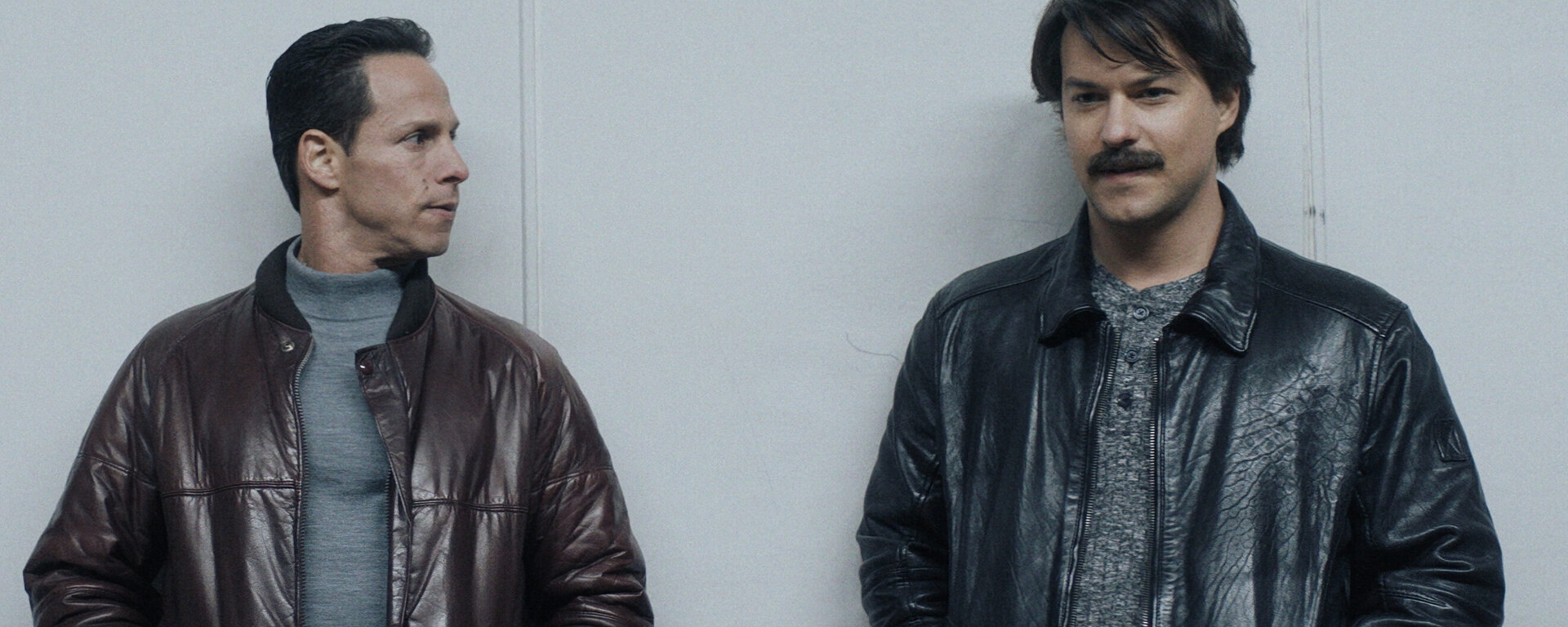



Movie Review: Swedes under siege? “The Unthinkable”

There’s a grand tradition in disaster movies, one revived by “crazy” “conspiracy nut” Björn in the Swedish thriller “The Unthinkable.”

At some point, this would-be Jeremiah, who years before ran off his family with his mania, looks out over a Sweden descending into chaos, under assault by the boogeyman he always saw, and utters the words every “crank” throughout history longs to say.

“Why am I always right?”

“The Unthinkable” is a nervy paranoid thriller structured like a disaster movie. We see Björn (Jesper Barkselius) try to share his obsession with his musically-inclined teen son son, flying his small plane over tankers smuggling Russian crude through the Baltic, snapping photos. And we see the damage caused by his mercurial moods, a man never taken seriously by officialdom raging at his family, pushing them away in the process.

Years later young Alex (Christoffer Nordenrot) has become a famous experimental musician, long-estranged from his father. He’s chilly, closed-off emotionally. But a chance encounter with that first love who moved away, Anna (Lisa Henni) could change that.

It’s too bad this happens just as Sweden experiences huge terrorist attacks — on transport, then communications and you-can-guess-what-comes-next, because, dammitall, Björn did.

His long-ago military service taught him what millions of MAGAs and NRA nuts in America forgot. When bad things happen in the world, it’s usually something the Russians did. Tension over a canceled pipeline suggests that maybe “IS” or “jihadists” aren’t behind this violence.

Always neutral, always above-it-all Sweden is under assault, Crimea-style. Secret commandos, black helicopters and hell’s bell’s, the whole country has forgotten how to drive their Volvos in safety.

Is there something in air, the drinking water, the rain?

Alex, Anna and Anna’s bureaucrat mother (Pia Halvorsen) wait for answers and seek shelter in bunkers. Government has been decapitated. Cell phones are silent. The military is unprepared for this asymmetric warfare.

But Björn? His rising suspicions and actual evidence that, as even Alex has noted, “something’s up” (in Swedish with English subtitles) hasn’t made him any more convincing to eye-rolling colleagues and the authorities. He finds himself in his underground hydropower station, facing commandoes with his own brand of asymmetric warfare.

Director and co-writer Victor Danell has taken to billing himself as “Crazy Pictures,” because why should pop stars have all the fun? He’s made a thriller calculated to keep us as in the dark as everybody but Björn, puzzling over the chaos breaking out all over their orderly society. He succeeds, more often than not.

The domestic tragedy prologue and Alex/Anna melodrama that tracks through the film personalize the story, but add little as they slow it down.

Alex as a character is on-the-spectrum problematic. Working with him or carrying a torch for him seems…ALMOST unthinkable.

It’s the depictions of social breakdown, Swedish tempers exploding, soldiers questioning their priorities in an absence of orders and the action beats — Björn’s crackpot defense of the power station — that drive the narrative, punching through one Big Effect, crash or firefight right into the next.

American viewers may be grateful to catch this picture now, and not in 2018 when it was finished. Tiny Sweden forced to stand alone against Russian aggression seems a little less likely since Jan. 20.

Sure, the paranoia that makes “The Unthinkable” plausible would have worked better back then. But who’d have had time to stress over a movie about what Russian puppets would allow, when there was so much else to worry about at the time?

MPA Rating: unrated, violence

Cast: Christoffer Nordenrot, Lisa Henni, Jesper Barkselius, Pia Halvorsen

Credits: Directed by Victor Danell, aka “Crazy Pictures,” scripted by Victor Danell and Christoffer Nordenrot A Magnet release (May 7).

Running time: 2:09

Posted in Reviews, previews, profiles and movie news | Comments Off on Movie Review: Swedes under siege? “The Unthinkable”

Movie Review: Trapped on the farm and in the grain — “Silo”

In farm country, “We work in acres, not hours” lives are lived in small social circles on a big, underpopulated canvas. “Everybody knows everybody” is a double-edged sword, as people grow up with each other, remember failures and expectations harden into stone.

And a shrinking, aging workforce, beyond the reach of or exempted from OSHA protection, wrestles with bigger and more complex machines as “scale” becomes the only way to survive.

“Silo” is a quietly gripping “trouble in farm country” thriller wrapped in tragedy, a story of a “grain entrapment” in a corn storage silo. It’s a common occurrence wherever grain is farmed, weary old men or unwary young ones make one mistake, or a series of them, and often-futile hopes of help are the nearest volunteer fire department or another one in the next town over.

It’s a finely-detailed, sharply-observed drama from a team that made a documentary — “Silo: Edge of the Real World” — that provided their research. They’ve made a smart, layered and serious-minded melodrama where text, context and subtext collide.

Junior (Jim Parrack of “9-1-1 Lonestar” and “True Blood”) runs Adler Grain & Feed now. He’s 40ish, and took over for his aged father (Chris Ellis) who has dementia, who still lives at home. He’s got one experienced set of helping hands, and a couple of teenagers on the job, too.

Valerie (Broadway and TV actress Jill Paice) is a single-mom/nurse practitioner at the local nursing home. Her boy Cody (Jack DiFalco) dreams of heavy-metal glory, but works at Adler’s as farm jobs are all that New Hope offers to kids his age. His pal Lucha (Danny Ramirez) is also learning the ropes there.

When tragedy strikes, the last person Valerie wants to see is the convenience store owner and volunteer fire chief Frank (Jeremy Holm of “House of Cards” and “Mr. Robot”), the one man who might be able to save her son when the corn collapses around him inside a silo.

The text is the tragedy, the context is an “amber waves of grain” rural America that is emptying out, where the hard, righteous work of farming grows more dangerous by the year. And the subtext is this shrinking, aging populace, with nursing homes the only local growth industry and the only people available to grow and harvest the food are the green kids who can’t wait to get out.

Junior embodies the stoicism of an illusory sense of self-reliance. He can’t care for his father, doesn’t know where to turn for help and doesn’t really want to ask for it. Valerie’s one piece of experienced advice — “When he goes back to the past like that, let him stay there.” — is no more a solution than Junior’s declaration that “It is what it is.”

“Trust” is something Frank lost sometime back, and only the shortage of warm bodies could explain why anybody would leave him in charge of a tiny corps of first responders.

And the kids? They’re looking at the overwhelmed, weary adults, hearing a deputy mutter “I hope he ain’t drunk” when firefighter Frank shows up, and seeing a trap that isn’t limited to the on-the-job quicksand that will suck them down if any one thing goes wrong while they’re in the “Silo.”

Director Marshall Burnette maintains suspense, but is straightjacketed by the reality of such tragedies. Nothing happens fast in the boondocks. Firefighters with the proper gear are miles and miles away, real expertise is limited, but egos aren’t.

Farm belt integrity and honesty doesn’t include accepting blame when things go wrong, although the instinct to place blame is hard to fight, even among those you know well.

The acting here has a hardscrabble truth to it, with Parrack and Paice standing out.

There’s a lot to digest in this 77 minute thriller, and all this “waiting” for help leaves room for monologues that explain, calm or brace everybody involved against the harsh truths staring them in the face. They also slow it down.

But I love indie films that are “about something,” and “Silo” checks that box in several ways.

We’re pulled into the drama, moved by the melodrama and sobered by the subtexts that are right out there in the open, insights that give tragedies like this added meaning. These people aren’t just “those people,” and getting them help with the confluence of catastrophes descending on their lives will do more good than any lecture on how their politics aren’t exactly helping matters.

MPA Rating: unrated, some profanity

Cast: Jeremy Holm, Jill Paice, Jack DiFalco, Jim Parrack and Chris Ellis.

Credits: Directed by Marshall Burnette, script by Jason Williamson. An Oscilloscope Labs release (May 7).

Running time: 1:17

Posted in Reviews, previews, profiles and movie news | Comments Off on Movie Review: Trapped on the farm and in the grain — “Silo”

Movie Preview: Redgrave and Christoph Waltz star in a murder thriller that Waltz directed — “Georgetown”

Annette Bening plays the daughter of the murdered wife, played by Vanessa Redgrave.

Waltz? He’s a gold digger, a “charming” eye-patched hustler whose marriage to an older woman raised eyebrows right up to the moment she turned up dead.

Lot of talent in front of the camera here.

Posted in Reviews, previews, profiles and movie news | Comments Off on Movie Preview: Redgrave and Christoph Waltz star in a murder thriller that Waltz directed — “Georgetown”

Movie Preview: Pacino defends an “American Traitor”

Nah, don’t get your hopes up. He’s not playing Guiliani.

This seriously malnourished courtroom thriller, previously titled “Axis Sally,” stars Pacino and Thomas Kretschman, Lala Kent, and Meadow Williams.

Not a package deal that ensures much box office pull, and I see no release date yet. But maybe it’ll surprise. Pacino got just enough of a haircut to pass post WWII muster.

Posted in Reviews, previews, profiles and movie news | Comments Off on Movie Preview: Pacino defends an “American Traitor”

Movie Review: Cringe and cringe with Tony Hale, “Eat Wheaties!”

“Cringe-worthy” comedies aren’t my favorite way to get a laugh, and “Eat Wheaties!” has a lot more in common with TV’s “The Office” than I’d typically care for.

But Tony Hale makes an interesting “Variation on a Character Played by Steve Carell,” and there are a few laughs mixed in with a lot of cringes and endless examples of callous cruelty. The ending pulled this one off the fence for me, and it was barely on that fence to start with.

Sid Straw is a socially awkward clod who teeters between faintly-annoying and simply irritating with all who know him.

Colleagues at the tech firm where he’s a cubicle drone barely tolerate his quasi-tactless, social-signals-missed interactions. His secretary (Sarah Goldberg) barely looks up from her phone to note that yes, his mail got delivered to the wrong colleague — again.

His very-pregnant sister in law (Elisha Cuthbert) barely tolerates him, and seems to think it’s cute that “Sid who ruined our wedding” takes her insults with a smile and a shrug. That Sid wants to make a little speech at brother Tom’s birthday earns a brusque “No Sid. No speeches tonight.”

When Tom (David Walton) insists, Sid’s blend of sweet praise and tactless “celebrities who died at 34” list is yet another black mark against a nerd who just “tries too hard.”

Dating only goes so well for so long before he’s dismissed. Always. The one “friend” (Alan Tudyck, a bit subdued here) he has from Penn seems to barely tolerate him.

But the day we meet Sid is a good one. He’s been selected co-chair for the West Coast Penn alumni reunion. That means he’s got to join social media for the first time. That means he can reconnect with his most famous classmate, whose sorority sister he went out with in college.

That classmate? Elizabeth Banks. Her catch-phrase in college, which he remembers and adores to this day? “Eat Wheaties!”

It’s just that when social media naif Sid reaches out to Banks’ “fan page,” and then her management, and posts these long, detailed memories of their shared college experience, her “people” freak out. And her manager is quick to conflate “kind of annoying and clueless” with a “restraining order” level threat. That’s when Sid’s life —  lonely and 40something but tolerable — unravels.

Based on a novel by Michael Kun, “Eat Wheaties!” is an essay in the confusing “intimacy” of social media and the blood-in-the-water nature of viral “piling on” that goes on there.

I’ve not read Kun’s book (Heather Locklear was the celeb Sid matriculated with there), but one take-away from the film is that social media has made us meaner. Sid mentions his Banks connection at that same party where “No speech, Sid” was the rule, and prompts another person a bit annoyed with him to offer to fact-check his modest Banks claim with a classmate of hers “at Harvard.”

It’s a pointless bit of cruelty, and the only “correction” to her vocalizing bitch face comes from her date/husband who cracks, “Oh, I’d forgotten you went to Harvard. You hadn’t mentioned it today.”

Sarah Chalke turns out to be perfectly-cast as power-drunk Hollywood management with zero-tolerance for the Sids of this world.

Paul Walter Hauser (“I, Tonya”) is haplessly amusing as the online-degree lawyer Sid retains to regain his life, a guy who might see a little of himself in Sid.

Sid may have “loser” stamped on his forehead. His Mustang may be from The Ugliest Years. But he’s functional and pleasant enough, if seriously tone-deaf.

And yet here are threats from his boss. Here’s another from his bank. Life, thanks to overblown blowback on social media, will never be the same for him because mean people take the mean option at every turn.

Banks? She’s just a beautiful, glamorous face on a Facebook “fan” page, silent and mysterious, never responding to Sid’s friendly casual intimacies, his notes that end with “Eat Wheaties!”

Truth be told, I found this painful to watch, “cringe-worthy” on a whole other level. “Redemption” seems a futile hope. And there simply aren’t enough laughs in those first two acts to lessen the discomfort that this Michael Scott Lite generates and the wincing recognition that “Yeah, that could totally happen.”

But Hale (of “Veep”) and his light touch with the guy make us appreciate why others would be put off, and he lets us see a sweetness that makes Sid’s pain our pain as his harmless dorkiness is met with “the nuclear option” from all sides.

And you know what else keeps you watching? It’s the predictability built into making Elizabeth Banks the elusive classmate all this is swirling around. Her screen persona suggests something is coming, something righteous. Invoking her name makes you hope this meanness will not stand. Just don’t run it by her agent first.

MPA Rating: unrated, adult situations

Cast: Tony Hale, Sarah Chalke, Paul Walter Hauser, Elisha Cuthbert, David Walton, Danielle Brooks and Alan Tudyck.

Credits: Scripted and directed by Scott Abramovich, based on the novel by Michael Kun. A Phillm release.

Running time: 1:28

Posted in Reviews, previews, profiles and movie news | Comments Off on Movie Review: Cringe and cringe with Tony Hale, “Eat Wheaties!”

Movie Preview: The Japanese WWII thriller “The Great War of Archimedes” — coming in May

What an interesting pitch for a movie. Pre-war Japan fights over the MATH of building superbattleships like the Yamato and Musashi.

Color me “intrigued.”

Posted in Reviews, previews, profiles and movie news | Comments Off on Movie Preview: The Japanese WWII thriller “The Great War of Archimedes” — coming in May

Classic Documentary Review: “The New Deal for Artists” (1976)

“The New Deal for Artists” was a mid-70s documentary for public television that gathered many of the folks who benefited from Franklin Roosevelt’s assorted New Deal work projects to talk about how that Great Depression “put people back to work” program benefited themselves, American art and America in general.

From New York theater types to Navaho painters, poets and writers sent out to interview Real America to the photographers who documented the Dust Bowl, the impoverished, segregated South and the plight of inner cities, the alphabet soup of acronyms that these assorted programs fell under changed the country, and in a breathtakingly short period of time.

Although Wieland Schulz-Keil’s film reflects the cultural biases of the ’30s, still evident in the ’70s — most of those interviewed are white and male, as indeed many of those benefiting from the programs were back in the Depression — it’s an earnest attempt at getting at the cultural changes such a program turned the tide on.

African Americans and white Americans took to the stage together for the first time in great numbers, Black theater was boosted and celebrated, women and Latin and Native artists were subsidized.

And all over America, post offices and other Federal buildings were adored with brawny, historic populist murals, “forgotten” America was remembered and chronicled and kids who’d never seen a play, often the children of parents who’d never seen live theater, were visited by trailered traveling shows like “Revolt of the Beavers,” a comical allegory about fascism and worker exploitation.

“I played a Gestapo type of beaver,” a chuckling actor John Randolph (“Heaven Can Wait,” “Prizzi’s Honor”) recalled of the agitprop dramedy about beavers going on strike against greedy capitalists.

Here’s Howard da Silva (“1776”) rattling off rhymes and singing a verse or two — from memory — from the controversial Federal Theater Project production of leftist composer Marc Blitzstein’s labor opera, “The Cradle Will Rock,” a show he performed in briefly almost 40 years before he was interviewed for “New Deal.”

Artists such as Andy Tsihnahjinnie recall how they were able to feed themselves, and create art that wasn’t just for the “Navaho trading posts,” art that came to reshape American painting and sculpture for generations.

Writer Meridel Le Sueur recounts the history of populism on the Northern Plains that surrounded her work on the Federal Writer’s Project, the stepdaughter of the former socialist mayor of Minot, N.D. recalling “Non Partisan League” politics of the region testing the idea that became Social Security years before FDR came into office.

And we see hundreds of photographs from the likes of Dorothea Lange and Arthur Rothstein recounting the poverty, the economic and environmental destruction of the Dust Bowl, exposing the rest of America to how little-known corners of it were struggling to survive.

The work “gave the country an unprecedented artistic renaissance,” narrates Orson Welles, remembered for his Federal Theater Project work casting African Americans in the celebrated “voodoo” version of Shakespeare’s “Macbeth,” reset in Haiti and a Broadway sensation when it opened.

We also see the downfall of such projects, hounded and attacked by the racist Klan-defending Texan Martin Dies Jr., who started the infamous House Unamerican Activities Committee ostensibly to defend the country against fascism, but used it to silence those who spoke out against exploitation, fascism and racism too vigorously.

IMDb has this film clocking in at three hours, at one point, something that would have devoured an entire evening of PBS programming in the ’70s. If so, it’s been whittled down to 90 lean minutes for this new Corinth Films release.

An interesting history lesson, as the late author and radio host Studs Terkel enthuses in the film’s introduction, particularly timely as we hear the phrase “New Deal” bandied about again with America in another economic and social crisis wrought by the conservatives who always seem to drive it into inequity and depression in the name of fighting “socialism.”

MPA Rating: unrated

Cast: Narrated by Orson Welles, with Meridel Le Sueur, Will Geer, Carlton Moss, Howard Da Silva, Harrison Begay, Nelson Algren, Bernarda Bryson Shahn, Andy Tsihnahjinnie, John Houseman, John Randolph and Studs Terkel

Credits: Directed by Wieland Schulz-Keil, script by Olaf Hansen and Wieland Schulz-Keil. A Corinth Films release.

Running time: 1:30

Posted in Reviews, previews, profiles and movie news | Comments Off on Classic Documentary Review: “The New Deal for Artists” (1976)

Movie Preview: Statham and Ritchie, Red Band “Wrath of Man”

May 7, a heist goes wrong and vengeance is mine, sayeth the Stath.

Posted in Reviews, previews, profiles and movie news | Comments Off on Movie Preview: Statham and Ritchie, Red Band “Wrath of Man”

Movie Review: Jordan dives into Clancyland, “Tom Clancy’s ‘Without Remorse'”

Heroes with skills, stealth and unimpeachable integrity, able to access vast Intel resources without a whole lot of effort, “ops” that go like clockwork until that moment they don’t and murky values and motives from those “On High” — welcome back to Tom Clancyland.

“Jack Ryan” morphing into a TV franchise gave Hollywood the idea that dead Cold Warrior-thriller novelist still has what it takes to entertain. That’s how Clancy’s long-gestating novel “Without Remorse” made it to the big screen.

Michael B. Jordan plays our hero, John Kelly, a special ops commando whose “extraction” mission in Syria turns out to be not what his CIA intermediary (Jamie Bell). Those aren’t Syrian “contractors” they’re shooting it out with. They’re vodka drinkers.

“I don’t see any Russians,” Mr. CIA declares.

“Tom Clancy’s Without Remorse” is about the blowback from that Aleppo slaughterhouse. Other members of Kelly’s team meet with “accidents” when they get home. Kelly’s own house is invaded and his pregnant wife (Lauren London) is murdered.

His raging grief threatens to drown him, but his capacity for revenge is great, thanks to relentless training, vast experience and the endless latitude and luck built into this script.

With Mr. Secretary-of-Something (Guy Pearce) in his corner and his former CO (Jodie Turner-Smith of “Queen & Slim”) watching his six, there’s going to be ad platit’, as they say in Mother Russia — “Hell to pay.”

Director Stefano Sollima, who did a decent job with the “Sicario” sequel, keeps his shootouts good and brutal, his fist-choke-and-knife fights to the death.

Kelly’s first murderous reach for answers involves a gas can and a diplomatic SUV, and the stakes just get higher — absurdly-so — after that.

Jordan, who can still get into “Creed” fighting trim when the need arises, is an arresting presence and a believable “man of action.” Turner-Smith, Pearce and Bell were solid casting choices, too.

But this story exposes lapses in Clancy’s logic, giving the viewer jolts of “Wait, how’d they/he get there/escape that?” And the screenwriters saddle the late author’s story with racial subtexts that play as jarring dead-ends. A righteous speech about serving “a country that didn’t love us back” doesn’t advance the plot or explain Kelly’s enlistment, or even his “We’re playing by MY rules, now” actions.

Clancy wasn’t the most racially enlightened writer, so this casting could be taken as a timely updating and another way to open up a story whose mysteries become too obvious before the second act has settled in.

Still, the longer it goes on, the more over-the-top the set pieces get and the more dated the “geopolitics” of it all seems. Clancy has one big theme that turns up in almost all of his adapted-into-scripts novels, and it’s front and center here, served up without apology by a deliriously successful writer whose every book had a whiff of “His Greatest Hits” about it.

MPA Rating: R for violence

Cast: Michael B. Jordan, Jodie Turner-Smith, Jamie Bell, Lauren London and Guy Pearce

Credit: Directed by Stefano Sollima, script by Taylor Sheridan and Will Staples, based on the Tom Clancy novel. An Amazon Studios/Paramount release.

Running time: 1:49

Posted in Reviews, previews, profiles and movie news | Comments Off on Movie Review: Jordan dives into Clancyland, “Tom Clancy’s ‘Without Remorse'”

Classic Film Review: “The Lady Vanishes (1938),” Hitchcock films a farce

The director later known as “The Master of Suspense” never lost his sense of humor. But it rather curdled into something dry and droll by the time he filmed “The Trouble With Harry” and his last “action comedy,” “North by Northwest.”

Just before he wound up the British portion of his filmmaking career and was lured to Hollywood by Selznick and good ol’greenback dollars, Alfred Hitchcock pulled out all the stops for the closest he ever got to a knockabout door-slamming farce.

“The Lady Vanishes” is packed with one-liners, stuffed with insufferable Brits Abroad (and those damned “foreigners” they so loathe) and almost frantic in its dive into amusing, implausible situations.

Soundstage-bound, with models and beautifully-rendered painted Alpine backdrops, it gives you the sense that this is about as far as a master-in-the-making could go in the malnourished British cinema, and that he knew it. And that knowing it, dammit-to-heck, he was going to have some fun with it before flying the coop for La La Land.

The first act is genuine farce, a bunch of avalanche-stranded travelers are packed into a snowed-in pan-European hotel in Mandrika, some sort of Austro-Italo-Swiss winter wonderland that to British snobs is just another “third rate country…Fortunately, I’m used to squalor.”

There’s the English “playgirl” (Margaret Lockwood) bound for home to be married because “I’ve been everywhere, seen everything” and done all there is to do — save marriage.

The fussbudget traveling companions (Naunton Wayne and Basil Radford) fret over the lack of “news” from home, “England on the brink” and all. What they mean is, of course, the “cricket test” in Manchester. Let’s just say their relationship isn’t explained, and they use the word “queer” in its traditional sense often enough for modern audiences to chuckle and notice.

There’s a tetchy, married (not-to-each-other) couple on some sort of Grand Tour fling, and this “complete cad,” a snide musicologist (Michael Redgrave as a “blue-blooded chick chaser,” never funnier) who gets under the skin of playgirl Iris.

Then the snow is cleared, they all pile onto a train, including a new friend Iris has made, an elderly English expat (May Whitty) who becomes Iris’s on-train confidante. Until, that is, “The Lady Vanishes.”

Iris asks about her and no one seems to remember Miss Froy ever being aboard. As we’ve seen Iris has had a window-ledge houseplant dropped on her, maybe she’s imagining it.

“If you must know, something fell on my head!”

“When, in infancy?”

And that’s rather the way of things from here on out, Iris and a first-reluctant bounder Gilbert (Redgrave) questioning, finding clues and wondering just what the heck happened to Miss Froy, with other passengers either oblivious or sinister in their reasons for not saying she was ever there.

Paul Lukas, later famous for “20,000 Leagues Under the Sea,” plays the exotically-accented brain specialist who offers opinions and endures jokes, uniformed Mandrikans intervene, pistols are drawn, discharged and never really reloaded.

It’s all a lark and all good, clean (ish) fun, sort of a British take on the “screwball” farces common in Hollywood in the ’30s, with Hitchcockian mystery and villainy.

The director’s cameo comes very late, FYI, the moment our cast arrives back in Blighty.

But if you only know “The Master” for “Vertigo” and “a boy’s best friend is his mother,” this “Lady” is a corker, still hilarious after all these years.

MPA Rating: unrated, “approved”

Cast: Margaret Lockwood, Michael Redgrave, Paul Lukas, May Whitty, Linden Travers, Naunton Wayne, Emile Boreo, Mary Clare and Basil Radford.

Credits: Directed by Alfred Hitchcock, script by Sidney Gilliat and Frank Launder, based on a short story by Ethel Lina White. An MGM release.

Running time: 1:35

Posted in Reviews, previews, profiles and movie news | Comments Off on Classic Film Review: “The Lady Vanishes (1938),” Hitchcock films a farce