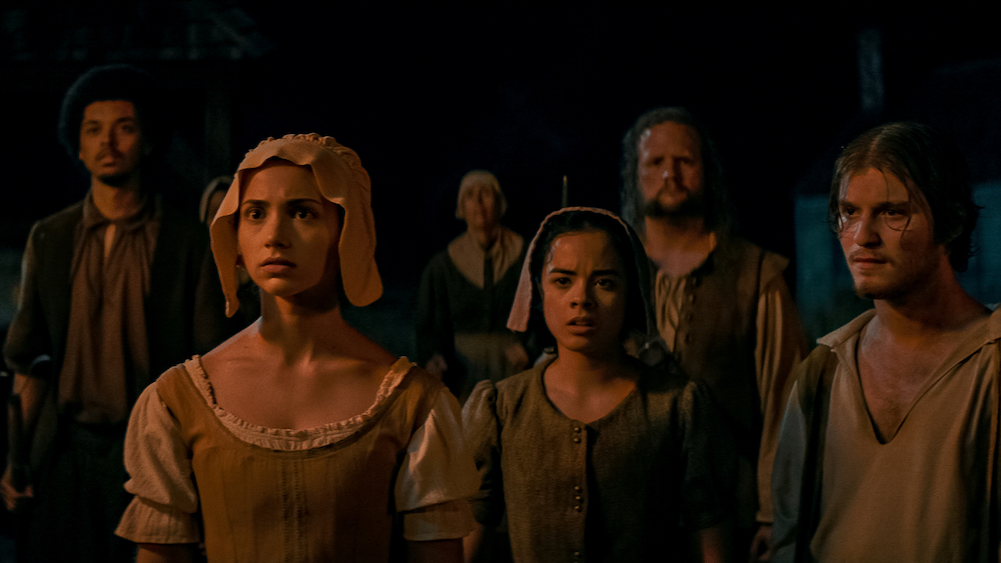


A tangled, convoluted and over-explained horror tale, “The Secret of Sinchanee” goes kind of wrong — dare I say it? — from its opening title.
If you need a full page of credits explaining an ancient blood feud between a mixed-race Indian tribe, the Sinchanee,” and a pagan cult hell that wanted to “eradicate the bloodline,” and never quite succeeded but still haunts this corner of snowy Massachusetts all these centuries later, you’re already buried in script clutter before a single scene plays out.
The feature directing debut from writer/director/star Steven Grayhm takes forever to get going as he struggles to tie together that age-old battle with events from a troubled guy’s childhood and his haunted, murder-investigated present-day.
And all this third act shouting and over-acting (at least they’re “acting”) by the two cops (Tamara Austin, Nate Boyer) on the case doesn’t translate into “exciting.”
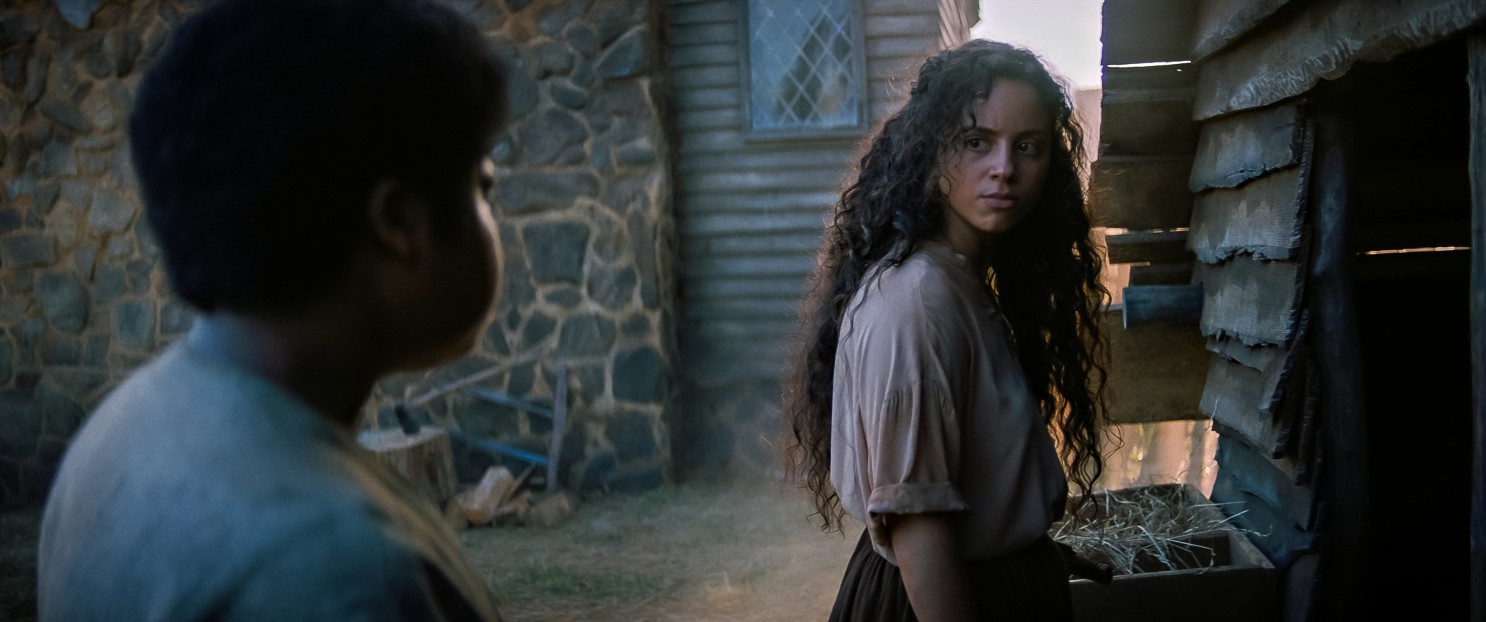
Will (Grayhm) has just lost his father. And because of an infamous crime decades before, the family house out in the woods of Deerfield just won’t sell.
Will has trouble with nightmares and visions, things he saw as a child that relate somehow to weird occurrences hitting him now.
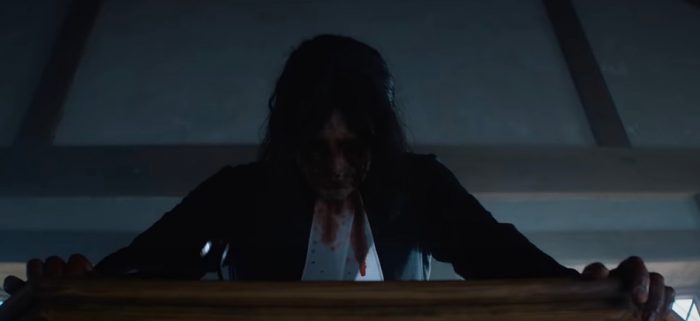
The spooky piano player tells him to “return it to its rightful place,” meaning a talisman he acquired long ago.
And the cops? They’re digging into his involvement from Will’s childhood that might tie him to the murder of somebody he used to know.
All this connects to the Sinchanee, the “new” tribe of intermarried Natives and white settlers, and the cultish Atlantow, who vowed to wipe them out. Somehow. I mean, the facepaint gives that away.
The film spends over an hour showing Will slowly — oh-so-slowly– cracking up at the strain, the cops looking at old interrogation footage from “The Starke/Cotter Murders” case long ago and people wandering in the snow, searching in the snow, finding a body in the snow.
The odd arresting candlelit sequence, fireside shadow scare show bit or attempted chase doesn’t add up to a two hour movie.
The director/star deemed that Will looking for his missing dog was worth 15 minutes of screen time, so you can see what we’re up against here.
Rating: unrated, violence
Cast: Steven Grayhm, Tamara Austin, Nate Boyer, Laila Lockhart Kraner and Rudy Reyes.
Credits: Scripted and directed by Steven Grayhm. A Vertical release.
It’s bloody, it’s chilling, it features the voices of Richard E. Grant, Lucy Lawless, Joe Manganiello and Patton Oswalt and comes to theaters and streaming on Oct. 29, via RLJE.
Lots of fanboy and fangirl — mostly fanboy — buzz for this one.
“The Last Duel,” Ridley Scott’s “Rashomon,” is a brutish, well-acted and stunningly-detailed account of an infamous scandal from the supposed “Age of Chivalry.”
It’s a tale of rivalries, royal favor and rape from the Caroline era of the Hundred Years War, that 14th century blood feud between England and France over royal succession in their until-then Norman-entangled royal bloodlines.
And as Scott’s film — cleverly adapted from Eric Jager’s book into the “Rashomon” three-points-of-view storytelling style by Nicole Holofcener and Oscar winners Matt Damon and Ben Affleck — makes nakedly clear, “Chivalry” had little to do with any of it.
Scott and his collaborators find the ugly human foibles underneath the armor, court finery and gowns and make this story from an age when the one percent had the power of life and death over everyone else, when women were literally “property,” topical and timely.
It won’t be for everyone. But if you like your Middle Ages dark, dingy and dastardly, it’s quite the bumpy, blood-stained ride.
Damon stars as Jean de Carrouges, a scarred and battle-hardened illiterate of the Norman French nobility. Carrouges knows combat and isn’t particularly deft at anything else. He has a fortress and stands to inherit a bigger one and the captaincy of the region when his father dies.
But The Black Death took his wife and young son, his heir. It’s depopulated Europe to such a degree that one and all complain of the rising cost of labor, the inability to make their serf-master land use tradition pay (Sound familiar?).
We meet him as the headstrong Carrouges leads his friend and fellow squire Jacques Le Gris (Adam Driver) in a charge to “save” hostages being butchered in front of them by their foes.
Carrouges saves the dashing Le Gris, who courteously pauses to thank him in mid-battle. But they lose the city of Limoges, which they were supposed to defend.
A sidenote here. Scott and his screenwriters can’t bear to name the cutthroats with long bows that these French fellows are facing — “The English.” Hilarious.
Damon makes Carrouges a fiercely loyal bulldog of a man, simple and brave and blunt enough to rub the more courtly the wrong way. His bluntness helps him bargain for the fair daughter (Jodie Comer of “Killing Eve” and “Free Guy”) of a rich traitor (Nathaniel Parker). But it’s no help at all in dealing with the king’s greedy libertine cousin, Count Pierre d’Alençon, played with decadent dash by Ben Affleck.
Over the course of several years, Carrouges runs up against the high handed Count time and again and faces humiliations even as he spends his blood in defense of their king, the foppish, not yet “mad” but seemingly inbred Charles VI (Alex Lawther) in France and Scotland.
That erodes his relationship with Le Gris, who being literate and mathematically capable, always has favor in the Count’s employ, a place at his table and a standing invitation to his fellow libertine’s orgies.
That quarrel, complete with lawsuits, sets up “The Last Duel” we see about to take place in the film’s opening scene. A rape charge, a lady wronged and more importantly, a husband suffering injury to his “property” calls for the ancient justice of trial by combat, a fight to the death so that “God will prove” who is telling the truth by letting the just defeat the unjust.
That story — spanning some years leading up to the 1386 duel — is told three times, from three points of view in three chapters — “The Truth according to Jean de Carrouges,” “according to Jacques Le Gris” and “according to Lady Marguerite de Carrouges.”
We’re left with a little doubt about what actually happened, the lies and manipulations and the mortal stakes involved when The Lady Marguerite makes her accusation and begs for justice and “right.”
“Right?” her viperous mother-in-law (Harriet Walter) hisses. “There IS no right. There is only the power of men!”
The casting here is shockingly effective, with Damon looking stocky and battle-beaten, at home on a war horse and in armor. Affleck, dyed blond — soul patch (not quite a Van Dyke) included, is a revelation, managing the menacing, aloof and vulpine Count with droll ease.
Driver’s Le Gris is a little of both of those men — a dark inversion of the historic myth of a “courtly ideal,” an able soldier (if not a leader), a tall, dashing and well-read charmer of court, catnip to the ladies.
Comer, benefiting from the contributions of veteran screenwriter (and sometime director) Holofcener (“Friends with Money,” “Can You Ever Forgive Me?”), navigates a tricky “stay in her lane” character, a victim, powerless in who her father chooses for her to wed, with no Hollywood hope of fighting off a man of war intent on assault. There are just enough scenes of her with other ladies of her class to suggest their recognition of their “chattel” status, but smart enough to chafe at the injustice of it and the many shortcomings of the men who rule them.
The three “chapters” let us see that in action, with Carrouges deluded into seeing noble bearing that others do not, Le Gris viewing his “friend” differently and seeing nothing wrong with his many provocations and the Lady Marguerite seeing their flaws and perhaps misjudging her own.
The dialogue hits a droll Middle Ages sweet spot now and again, but the performances are as immersive as the film’s flawless production design. Irish and French locations capture the age when Paris was little more than a hovel, a few buildings and bridges with this gigantic cathedral slowly rising on the Île de la Cité in the Seine.
For decades, the gold standard for gory, accurate recreations of Medieval hand-to-hand combat have been Orson Welles’ “Chimes at Midnight,” which inspired Mel Gibson’s even more brutal and bloodier “Braveheart,” and Akira Kurosawa’s “Ran.” “The Last Duel” joins them in its depiction of the desperate, unsentimental savagery of bludgeoning, stabbing and slicing someone to death before they just as desperately try to do the same to you.
The “Rashomon” structure is repetitive by design, and that weighs down this two and a half hour plunge into “The Real (Unchivalrous) Middle Ages.”
But I found it fascinating, first scene to last — stunningly detailed in its snowy combat in the “Gladiator” tradition and intriguing that Affleck and Damon, Holofcener and Scott would see this long-ago event as relevant, “A Distant Mirror” to our troubled, sexist and reactionary present day.
Rating: R for strong violence including sexual assault, sexual content, some graphic nudity, and language
Cast: Matt Damon, Jodie Comer, Adam Driver, Marton Csokas, Alex Lawther, Tallulah Haddon and Ben Affleck.
Credits: Directed by Ridley Scott, scripted by Nicole Holofcener, Matt Damon and Ben Affleck, based on Eric Jager’s book. A 20th Century Studios release.
“Fever Dream” is a vaguely unsettling horror parable about the ties of motherhood, tragedy and the environmental legacy we’re leaving our children.
Peruvian-born writer-director Claudia Llosa, adapting Samantha Schweblin’s novel, masters the messaging and mournful tone. But the movie never delivers the chills it might have and and her latest — she did the similarly moody and subtle “Maidenusa” and “Aloft” — never rises above “vaguely unsettling.”
A mother, Amanda (Spanish actress María Valverde of Ridley Scott’s “Exodus: Gods and Kings”) seems to be on a psychotherapist’s couch for most of the movie. We hear her, in voice-over, quietly interrogated, remembering the days when she and her little girl Nina first came to this corner of Chile for the summer.
“Details, details,” and “that’s not important” another gentle admonishments from the person doing the questioning. He’s a little boy, perhaps in his tweens. And he’s insistent. He could be the villain, the hero or the victim in this story. So he sees something at stake.
“David” is mostly glimpsed, and then rarely, as his tattooed, chain-smoking mother, Carola (DoloresFonzi) tells the new neighbor of “the worst day of my life,” the night that her horse-breeding husband’s prized stallion collapsed and her little boy David (played by Emilio Vodanovich and Marcelo Michinaux at different ages) took ill.
Amanda has confused notions of “worms” in her mind, of being paralyzed and dragged somewhere, powerless to alter her fate.
And as her endless narration goes on, we hear how David’s story tied into hers and Ninas, how David’s illness and Carola’s desperate trip to “The Green House” to see someone who is more conjure-woman than doctor didn’t so much seal all their fates as provide the form of the parable we see play out.
Llosa works with dreamy extreme close-ups, characters glimpsed through nature or in it, with furtive phone arguments (Amanda’s husband hasn’t left the city for the country house they’ve rented) and nightmares. She serves up warning after warning from Carola, who can’t stop talking even after she’s said (in Spanish, with English subtitles, or dubbed), “If I tell you, you won’t let him play with Nina,”
Llosa seeks to cast a spell with this story of “the invisible thread” that ties a mother to her child, a thread that wraps her in guilt when things go wrong. But while I admire the picture’s funereal tone, Llosa’s rare attempts at cheap shocks spoil the larger jolt, the one that would make the viewer recoil as we figure out the too-thinly-hidden Bigger Message here.
Fonzi and Valverde are intriguing, but neither gives us much to grab hold of with their characters — who might be crazy, who might have ulterior movies, who might be leery of buying into what she’s told or what she’s figuring out for herself.
The movie’s tedious overuse of voice-over cripples it, a device best left to the printed page of a novel. The constant questions-and-answers do nothing to reveal what we don’t see and hear play out on the screen. Even in the most literary of screen adaptations, voice-over is best used sparingly.
Because at some point, somebody’s got to scare somebody else. The droning on and on, more mesmerizing than urgent or creep — “Am I going to die, David?” — sucks the urgency right out of “Fever Dream.”
The little we see of David at his most troubled and alarming (young Vodanovich looks like Emile Hirsch or River Phoenix at that age) isn’t enough to get us past “vaguely unsettling.”
Rating: R, for brief sexuality and nudity
Cast: María Valverde, Dolores Fonzi, Emilio Vodanovich, Marcelo Michinaux, Germán Palacios, Guillermo Pfening
Credits: Scripted and directed by Claudia Llosa, based on a novel by Samanta Schweblin. A Netflix release.
This Dec. 31 musical adaptation from Joe Wright (“Atonement,” “Darkest Hour”) stars Dinklage, Haley Bennett, Kelvin Harrison Jr. and Ben Mendelsohn.
The music? Aaron and Bryce Dessner of The National did it, and there’s little here (other than Bennett’s solo) that grabs me. But maybe they’re saving the better stuff for the next trailer.
True stories of kidnappings of Westerners in the Middle East are rarely resolved with heroics.
There’s little defiance by the helpless, tortured captives, rare opportunities for pithy one-liners, even if you could come up with one under such duress.
The Danish thriller “Held for Ransom,” released as “Daniel” elsewhere, is a sober, unglamorous and moving account of one man’s ordeal as he was held by the disparate Syrian factions that became known as Daesh or ISIS.
There would be no Seal Team Six coming for Daniel Rye. All he could do was endure, hope for luck because he couldn’t expect mercy from his brutal captors, and hope too that his family would come up with the ransom demanded, a ransom his government would neither help pay nor facilitate.
We meet Daniel (Esben Smed of “Summer of ’92”) on the day his life took its first blow. We see the gymnast injured at an exhibition, just before the 2012 Olympics, which he’d been training for since 2006.
He’s keenly aware that he needs to move on and find work, because his large middle class family can’t afford any more indulging of his dream. The job he finds promises its own fame. He’ll be assistant/apprentice to a Copenhagen photographer.
“Got a passport?” Sure. So he’s on a plane to Mogadishu. His new boss is a conflict photographer.
It’s when Daniel tries to pull together a freelance job on his own shortly after that that he gets in over his head. Despite hiring a guide, a driver and a bodyguard, despite sticking close to the Syrian-Turkish border, despite taking innocuous shots of civilians trying to carry on their lives in a bloody Syrian civil war, he finds himself with a gun to his head.
“Held for Ransom,” a story told in Danish, English, Arabic and French, follows Daniel’s torture at the hands of various parties, and then imprisonment with other foreigners– most of them journalists — where the torture continues as ransom demands are made and mostly left unmet.
One who shows up later in his captivity is an American journalist, James Foley (Toby Kebbell) that the CIA and others are frantically trying to locate.
But in addition to the familiar scenes of cruelty of the “sadistic monsters” holding them (carried out by four British expats nicknamed The Beatles), “Held for Ransom” tracks the efforts to get Daniel out by his family via an ex-special forces go-between (co-writer/director Anders W. Berthelsen), a man who warns his mother and father (Christiane Gjellerup and Jens Jørn Spottag) that their efforts to negotiate a release “needs to stay secret.”
They can’t tell anyone he’s been kidnapped, otherwise the terrorists will be exposed as simple criminal thugs, and not “freedom fighters” to be taken seriously. Somehow, you know Daniel’s hotheaded older sister (Sofia Torp) isn’t going to take that approach well, after she eventually and furiously finds out.
The stand-out qualities in this straight-no-chaser Middle East kidnapping thriller start with the relentless cruelty depicted. Demeaned, beaten on the soles of his feet, dragged out for “proof of life” photos, alarmed at every pound on the door and shouted “AGAINST THE WALL,” we get a serious dose of how spirits are broken in such situations. Begging for death isn’t unheard of.
“You have to EARN the right to die!”
Sympathetic performances alternately show us terrified captives and distraught and frustrated relatives, and from a terrific first act set piece where we see the risks to kidnappers when they don’t realize their new hostage is a gymnast. Smed is great at getting across an athlete with a young, nimble, highly-conditioned body and high threshold for pain improvising an escape plan the moment the slight chance of getting away presents itself.
Berthelsen makes a rugged, no-nonsense negotiator, and Torp is quite good as the sister who leaps from concerned to enraged at the lack of help her “We don’t negotiate with terrorists” government will give.
No, nothing much that turns up in “Held for Ransom” holds the possibility of surprise, even if you don’t know the true story it’s based on. It’s alarming how well most of us know the drill — the van that rolls up, the men who hustle a captive inside, the blindfolds, handcuffs, beatings and starvation that ensues.
It’s common, too, to take the aloof view that governments declare and many of us parrot whenever someone who goes into trouble spots meets this fate — “They should’ve known better than to go there.”
Daniel is the youngest of those being held — who include a Frenchman, an Italian, a Russian, an American and Spaniards, some of them journalists, some aid workers. And he is the one who repeats the conflict journalist’s credo, reminding us that they do “know better” and go anyway.
“If we don’t dare to come here, how will the world know what happens?”
Rating: unrated, violence
Cast: Esben Smed, Sofia Torp, Sara Hjort Ditlevsen, Anders W. Berthelsen, Christiane Gjellerup KochAmir El-Masry, Ardalan Esmaili and Toby Kebbell.
Credits: Directed by Niels Arden Oplev and Anders W. Berthelsen, scripted by Anders Thomas Jensen and Anders W. Bethelsen and based on a book by Puk Damsgaard. A Samuel Goldwyn release.
If Hollywood isn’t offering you the roles you want, the advice to screen actors always goes, “Write something for yourself.”
So it was with Annika Marks, a familiar face (“The World Without You,” TV’s “Goliath,” “Waco” and “The Last Tycoon”) if not a marquee name. But with “Killing Eleanor,” she’s written not just a plum role for herself — an ex-dancer/junkie trapped in the lies she’s built her life around — but a lovely curtain call part for veteran character actress Jenny O’Hara (“Mystic River,” and TV’s “The Mindy Project” and “Transparent”).
“Eleanor” is an indie dramedy with weight, biting wit and heart, a movie that generously offers meaty roles for Jane Kaczmarek and Camryn Manheim, who help this “road comedy/caper comedy” turn, on a dime, into a film of substance and one that’s kind of heartbreaking.
The end, when it comes, is rarely pretty. Eleanor’s old enough to know that. Living in a nursing home, medicated, her life prolonged in ways that make no sense to her, all she wants is control over her end.
That’s why she (O’Hara) seeks out Natalie (Marks) in Natalie’s mother’s (Kaczmarek) nail salon. Fresh from an AA meeting but still using Adderall, back to living with her parents in her 30s, lying about everything and to everyone she meets, Natalie’s at the narcissistic end of the “rehab” spectrum, wrapped up in her own mess.
And then this stranger with a nursing home ID bracelet stalks in and barks, “It’s time. You OWE me.”
An ancient IOU has come due. Yes, she knew Eleanor years ago. Her plea, spat out with a splattering of profanity, is presented as a demand.
“I want you to help me die.”
And Natalie, distracted by her family’s “intervention,” her harridan sister’s (Betsy Brandt) political campaign demands and her drug cravings, says “OK” for reasons that make no sense until you consider the bad decisions, impulse control and lies meant to cover lies way she gets through her day.
“Killing Eleanor” invites us to consider, through messed-up Natalie, whether we’d grant such a wish, and where’d we begin if we expect to go through with this. Not that we’re sure lying Natalie will.
Marks briskly sketches in Natalie’s “issues” and her family’s range of reactions to them. Mom is mistrusting behind an upbeat and supportive face, Dad (Chris Mulkey), is a doctor too distracted to dig in, and sister Anya (Brandt)? She is WAY past over Natalie’s nonsense.
We’re treated to the blizzard of lies it takes for Natalie just to get in to see Eleanor once the nursing home has taken her “home.” We see the DIY way Eleanor effects her escape and the impromptu road trip they take through the Upper Peninsula of Michigan, ostensibly to “buy drugs” in Canada, where “assisted suicide” is supposedly easier to pull off.
The dialogue is peppered with flippant cracks about death and old age, from Mom’s “if I ever get like that, shoot me” to nervous nail-biter Natalie’s many jokes about what Eleanor wants and ways Eleanor might accomplish it.
Eleanor hisses “Those things’ll kill you” about Natalie’s smoking.
“Want one?”
They run out of gas, so let’s flag down a trucker. Get into a semi “with a complete stranger?”
“Maybe he’s a psycho killer and he’ll solve our problem for us.”
Better let the service station attendant fill the gas can rather than risk Natalie “soaking us all with gasoline.” Pause. “Although…”
But a stranger (Manheim) who picks them up understands their quest and puts it in perspective. Natalie’s personal journey to redemption steps to the fore and “Killing Eleanor” finds its heart.
Marks’ performance begins with a series of tics — nervous, smoking, nail-biting, ransacking the family’s vacation condo for drugs (as antic drum solos accentuate her mania) — and evolves into a sort of stages-of-death-and-dying “acceptance.” Nice and subtle.
And O’Hara’s Eleanor travels from grousing, bitter old woman to vamping, over-the-top Christian “sponsor” to cover up another of Natalie’s lies, and beyond — a compact, lived-in turn that never feels false.
Yes, the screenplay gives away twists and points to an obvious finale early. But Marks, O’Hara & Co. never let us forget that whether of not you wind up “Killing Eleanor,” it’s the journey, not the destination, that matters most.
Rating: unrated, drug abuse, profanity
Cast: Annika Marks, Jenny O’Hara, Jane Kaczmarek, Chris Mukley, Betsy Brandt and Camryn Manheim
Credits: Directed by Rich Newey, scripted by Annika Marks. A 1091 release.
The hardboiled gumshoe likes his cigars skinny, his razor dull, his women curvaceous and compliant and his sex with spanking.
Must be British.
A meandering, dawdling murder mystery two and a half bloody hours long? Must be a TV movie edited down from a British TV series.
There’s something almost but not-quite-laughable about “Silent Hours,” a plodding, newfangled/old-fashioned thriller about a lady killer Royal Navy vet who swears that all these women who keep getting cut up are not dying by his hand. Because he’s not that kind of lady-killer.
Women throw themselves at John Duvall (James Weber Brown of “Coronation Street” and “Detectorists”), showing off their exotic lingerie and indulging his passion position from the dog-fancier chapter of the Kama Sutra.
Also very British?
“Silent Hours” — it takes its title from “Navy slanguage” for nighttime on a ship — has lots of exotic underwear, lots of sex and a dash of death. It’s built around a hero with “a past” and absolutely no scruples about whom he beds.
In 2002 Portsmouth, the quintessential “Navy town,” Duvall spies on cheating spouses for a fee. One client might be a fish factory owner. Another is a ship’s commander (Hugh Bonneville).
We meet him in therapy where a shrink (Indira Varma) questions his Navy record and his “voyeuristic” line of work and wonders what it’s done to him. As the story jumps back and forth between “sessions” and his detective work on the docks, ships, seaside and old fortifications of Portsmouth.
I mean, if you could stage a meeting with a “source” on an old gun emplacement nibbled over by llamas, wouldn’t you?
As clients, or their wayward wives, start dying, Duvall starts snooping around, even if he’s not letting anybody see the concern setting in. The coppers (Dervla Kirwan) smile and start looking at Duvall as a suspect.
“Are you withholding evidence from a police murder investigation, Mr. Private Peeping Tom Detective?”
Maybe. As the bodies pile up — including Duvall’s girlfriend (Elizabeth Healey), he starts to sweat. Well, he would, if it wasn’t so damned cold.
Turning a three-episode TV series into a movie isn’t unheard of. But this editing job results in a lurching, convoluted thriller that never gets on its feet and up to speed.
Here’s a newspaper reporter “source,” and an old friend whose radio expertise might help decipher an old answering machine tape. Introduced and forgotten. There’s an old girlfriend who gets “flashes” and senses things from people and objects. Supernaturalism? On top of everything else?
The film has a vivid sense of place, with all the gulls and crisp mornings and fish.
But the “Portsmouth Ripper” case that should grip the city never delivers suspense or much that I’d call a mystery, even though it is a favorite British TV genre and thus, they should be good at it. All involved got lost in the salacious — sex and sex and sex — and never come up for air.
“She certainly has a thing for naughty underwear.”
“Silent Hours” is a lot of stuff about Naval procurements, undersea stashes, real estate, troubled pasts and double entendres and women throwing themselves at a grizzled, 50ish retired sailor.
Very film noir, to be sure. But not set in 2002. Maybe in 1952 this would fly.
Rating: violent imagery, sex, profanity
Cast: James Weber Brown, Susie Amy, Dervla Kirwan, Indira Varma and Hugh Bonneville
Credits: Scripted and directed by Mark Greenstreet. A Gravitas Ventures release.
The movie production instincts are on the money, as far as “There’s Someone Inside Your House” goes. Every generation needs its “Scream,” so let’s adapt YA novelist Stephanie Perkins’ book and get it on Netflix where all the YAs’ll see it.
That’s why the biggest names on this project were producers James Wan, the “Saw/Conjuring/Malignant” horror mogul, and Shawn Levy (“Free Guy”).
The movie? Well, it’s a “Scream” knockoff, all right. “Scream” without the horror movie jokes. “Scream” with a lot less terror. “Scream” without much we could call “fun.”
It’s not half bad. But it’s not quite half-good, either.
In Osborne, Nebraska, the parents and their kids are all about corn, “God, His game (football) and his glory.”
That’s what a football player (Zane Clifford) sings through the tears — the Osborne High fight song — in tribute to his dead teammate (Markian Tarasiuk) whom we’ve seen trapped in his house and butchered in the somewhat blase opening scene.
The school and even the town are littered with suspects. But it’s not until a second death that anybody gets truly concerned.
That’s a big of-its-moment take-away from “There’s Someone Inside Your House.” This is America today, and school and football must go on — violence, pandemic, attempted coup, crisis actors invading school board meetings be damned.
The “outcast” kids — Makani (Sydney Park), her BFF Alex (Asjha Cooper), trans pal Darby (JesseLaTourette), rich kid Zach (Dale Whibley) and Rodrigo (Diego Josef) have their theories. Everybody in school does.
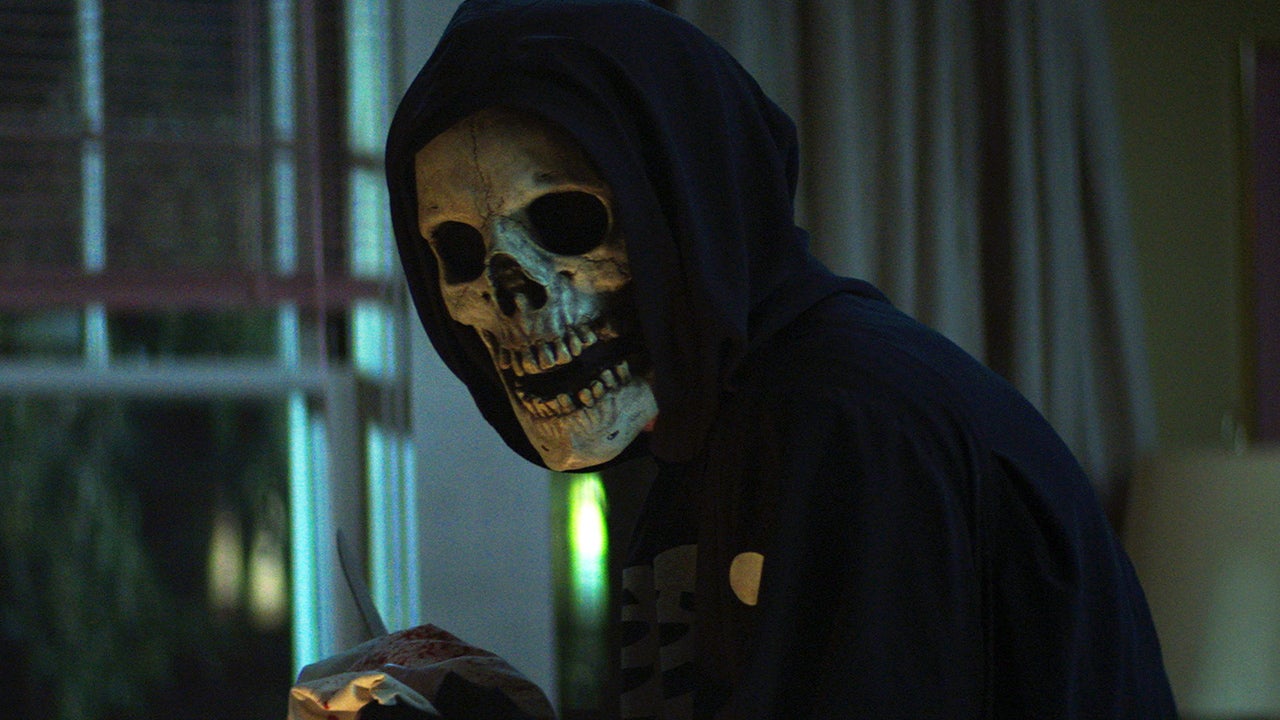
But as classmates keep dropping, their “secrets” exposed on email blasts just as they’re hacked up by a nut-with-a-knife in a mask (custom made to match the victim’s face) and hoodie, the “whodunit” here never gets traction. We’re all distracted by the “secrets.”
No, not the gay footballer or the trans teen. Everybody knows them. It’s the “secret” bullying, the hazing rituals that got out of hand, the closeted white supremacist and the nervous kid on medication who have something to worry about.
Whatever the virtues of the source novel, screenwriter Henry Gayden and director Patrick Brice (“Creep,” “The Overnight”) miss a lot of opportunities to riff on this latest “Me” generation and its excesses.
Surely the student council president (Sarah Dugdale) isn’t the only one who makes this tragedy, and the organized mourning for it, all about “her.”
“There’s Someone” can be praised for its inclusion. A Pacific Islander lead (Park), a gay kid, a trans kid, the Hispanic classmate, the brassy African-American who gets to declare “I’m DONE talking about who I think did it. I KNOW who did it!” But when you do little with the characters, or with who they “represent,” your movie looks an awful lot like “checkbox casting.” You’re populating your picture with “types,” not people.
Even the set piece murders — in a cathedral, in a “secrets” party where the kids are to reveal their secrets and thus disempower the killer, in a corn maze — all play as flat, like a balloon that the air went out of just before “ACTION!”
That makes the entire enterprise feel like, well, an “enterprise,” a thriller “produced,” not cleverly scripted or directed, or compellingly acted.
Rating: TV-MA, bloody violence, drug use, sexual situations, profanity
Cast: Sydney Park, Asjha Coooper, Jesse LaTourette, Théodore Pellerin, Dale Whibley, Sarah Dugdale
Credits: Directed by Patrick Brice, scripted by Henry Gayden, based on the novel by Stephanie Perkins. An Atomic Monster film on Netflix.