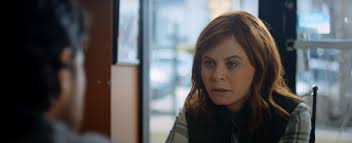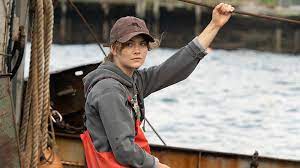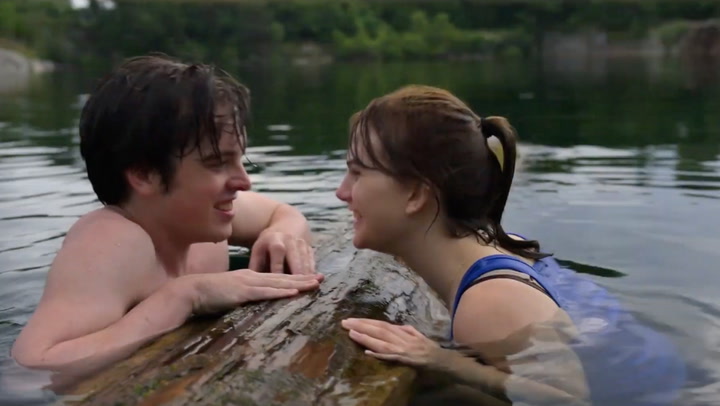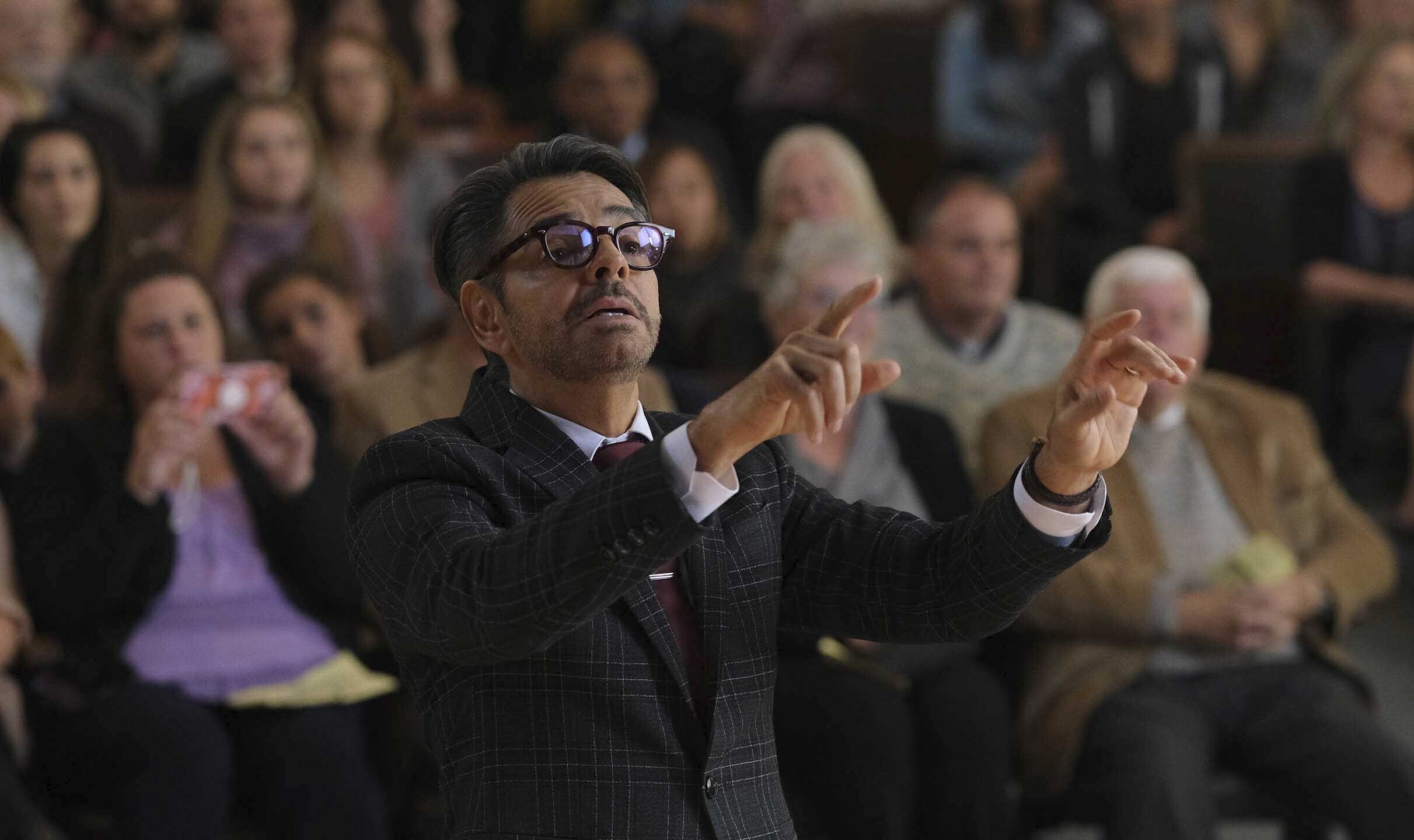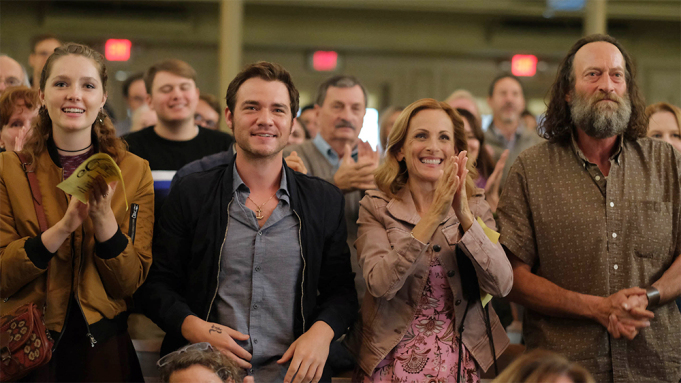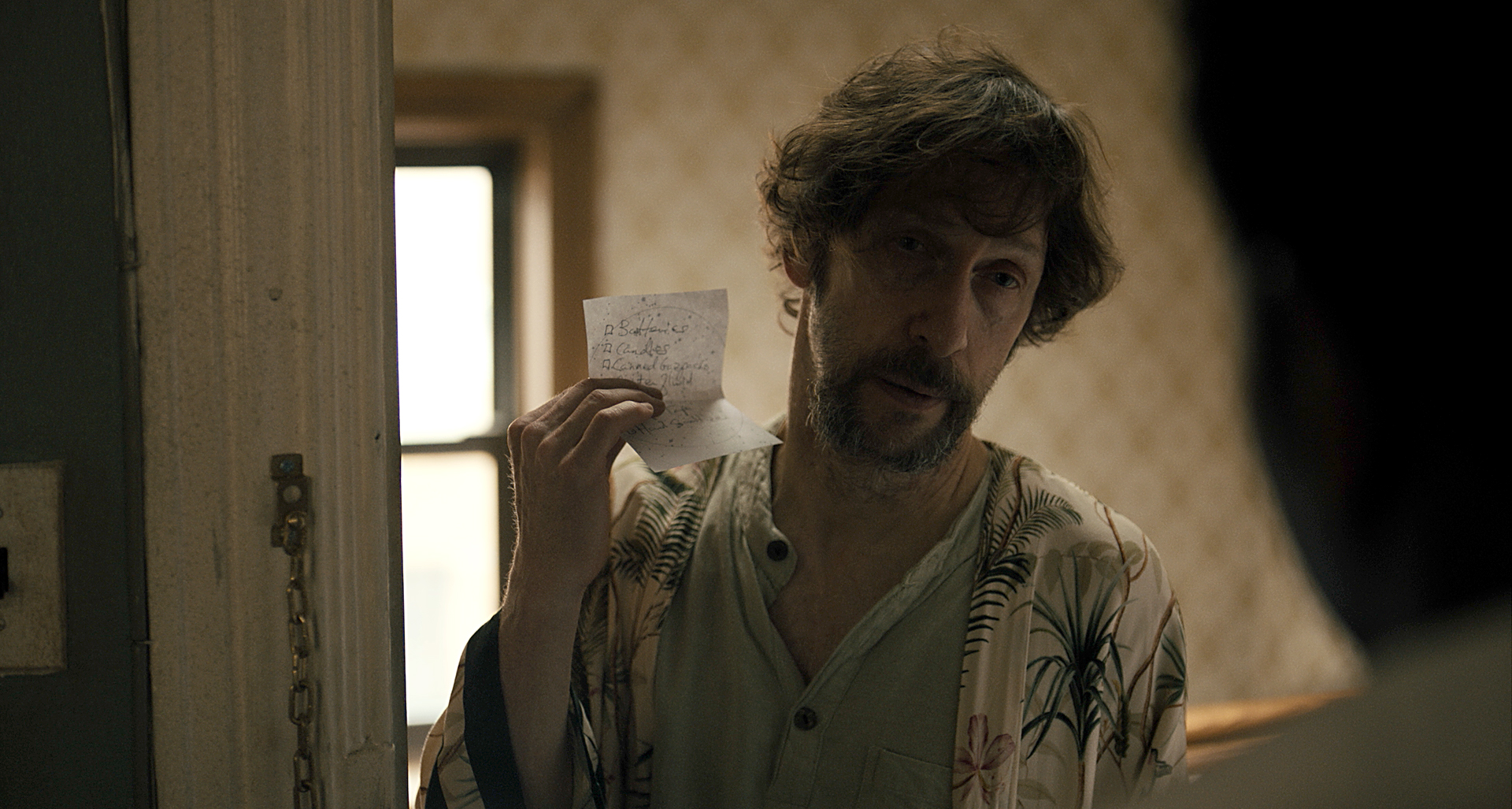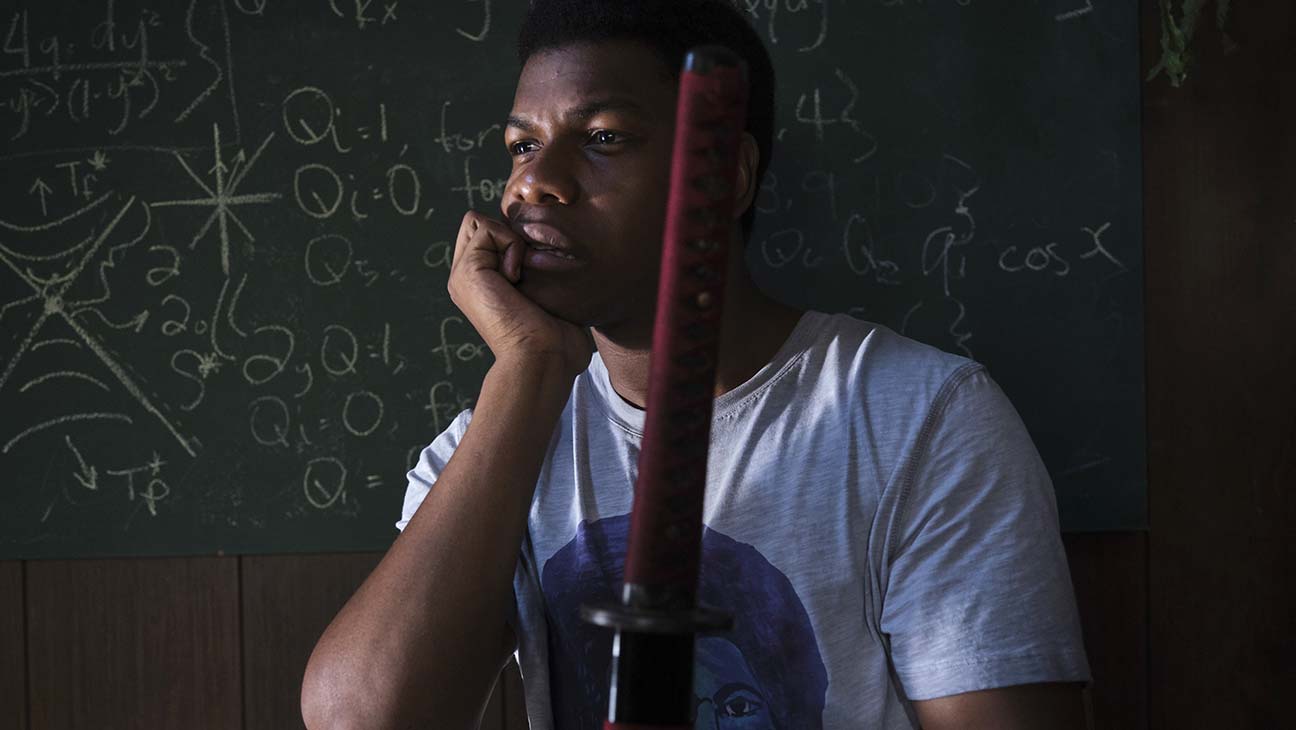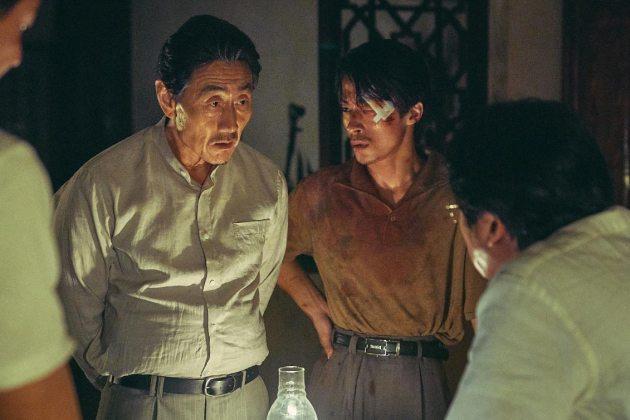


A dark “midlife crisis” satire starring Jim Cummings, “The Beta Test” spoofs “the current climate (post #MeToo), an anonymous solicitation to a married man, and all that unleashes.
It pops out Nov. 5.
A dark “midlife crisis” satire starring Jim Cummings, “The Beta Test” spoofs “the current climate (post #MeToo), an anonymous solicitation to a married man, and all that unleashes.
It pops out Nov. 5.


Hand it to “Antlers” director and co-screenwriter Scott Cooper. The guy who finally landed Jeff Bridges his Oscar (“Crazy Heart”) and tried to win Johnny Depp one (“Black Mass”) delivers the goriest horror movie to make it to theaters this Halloween.
Sorry, Jamie Leigh.
“Antlers” is another of those “ancient curse awakened” thrillers, this time an Earth Mother demon known to Native Americans who avengers him/herself on meth cookers and miners, cops and schoolkids, all for the crime of despoiling the land.
And it’s got a hint of “The Babadook” about it, as this spirit is chiefly targeting a 12 year-old boy.
I don’t know if the short story it’s based on (by Nick Antosca) has a child abuse subtext. But that makes this grisly slaughter of the just and the unjust a genre thriller that’s about something, and that something gives it a tone as sad and gloomy as the dead, rainy and overcast Oregon mining town that is its setting.
Cooper casts a spell in the film’s slow first acts, then breaks it by over-explaining the threat, and shows little flair for the suspense-building element of the horror film equation.
There are few things more unsettling in a thriller than a child (Jeremy T. Thomas) haunted by the supernatural, and coping, all-alone, with the horrors of living with a meth cooking widowed dad (Scott Haze) and a little brother he can’t protect from the tidal wave of threats, loss and misery that has washed over their lives.
That’s Lucas, a skinny, grimy, wide-eyed urchin in soiled, tattered clothes who shows up in Julia Meadows’ (Keri Russell) class every day at Cispus Falls Elementary. He sits in the back and draws as she tries to teach the kids about myths and legends and how they relate to storytelling.
Lucas knows a little something about that. We saw him ride with Dad to the abandoned mining operation that his meth-mouthed father and a colleague have turned into a meth cooking factory. Lucas heard the unnatural growls. He saw something, and sees what that something did to his still-living/crab-walking cadaver of a father.
That’s what he draws, and when Ms. Meadows coaxes him into telling his idea of a folkloric tale of myth, he “reads” those nightmarish drawings to his class.
He’s laying out the hell his young life has become, describing it in ways more personal than the books teacher finds in his desk (on animal trapping and legendary monsters) possibly could.
But Julia, who recently returned to town after decades in LA, sees something else, “textbook” child abuse. And she’s “an expert.” We realize she lived through something similar, something that drove her away and only her brother (Jesse Plemons), now sheriff, could lure her back.
Ms. Meadows takes an overly-keen interest in Lucas and his home life. She sees his family’s ruined shack with no power, mysterious growls and thumps coming from inside, a long abandoned Trans Am among the debris surrounding it. She alerts the principal (Amy Madigan).
But Lucas has more immediate problems. He’s tiny and bone-thin, and one wonders if young Master Thomas was perhaps cast for his resemblance to the blind banjo player in “Deliverance.” Lucas is a magnet for bullies.
And something that lives in his house needs to be fed — animal meat, bones and entrails (graphically depicted). That’s why Lucas is out trapping and killing wildlife.
But his secret is a secret only until the first body turns up. As Sheriff Paul and his tiny department slow-walk to this or that crime scene, it’s clear that something is eating local, and eating locals. And the only guy who might know who or what is doing it is a former police chief (Graham Greene) of Native American descent.
One piece of evidence is dropped in front of him with an, “Is that from a buck?”
“Nope.” He knows exactly what these “Antlers” come from.
That’s a pivotal scene in the film, the moment where it breaks away from the gathering gloom and has Chief Stokes (Greene) “explain” this creature/demon/phenomenon to the incredulous Paul and the skeptical Julia. It’s a badly-written exposition-packed speech and from the looks of it, Cooper only gave the wonderful character actor Greene one rapid, monotoned recital of it.
All the little lapses into “horror movie illogic” that preceded it we might let slide, the way locals take in on themselves to “investigate” this on their own — not calling the sheriff, or if there’s a deputy or sheriff involved, them not calling for back up.
I can’t remember a horror movie that had this many “DON’T go IN THERE!” prompts from the audience clumsily hard-wired into it.
And here’s a petty gripe. What does everybody in America know about cooking methamphetamine? We know where the raw materials are sourced, and learn about labs usually after this EXTREMELY FLAMABLE process run by people not nearly “Breaking Bad” smart or careful, burns their “lab” to the ground.
How does meth-cooker Frank Weaver make his way down a (coal) mining tunnel to his and his partner’s lab? He lights a FLARE and wanders through coal-dust saturated (and gaseous) air, leaving cinders left and right, until he gets to the lab.
Well, stupid as that is at least it looks good on camera. At least Cooper has a flair for flares.
The cast, playing varying degrees of morose or in mourning, is fine, save for that clunky speech that Greene can’t finesse. The funereal, wet and decaying tone is terrific.
But the “explanations” set up a long, gory and eye-rolling third act in which we finally get a good look at this beastie, which is convincing enough, but presented wrong and photographed worse.
The child abuse subtext is introduced as a motivation for Julia taking extra interest in little Lucas, but it’s never confronted as an issue, leaving her character’s protection instincts somewhat under-motivated.
Plemons plays Paul as a reluctant sheriff with some notion of duty, but almost dimwitted in the ways he faces this existential threat. No thought of calling in the state police?
“Antlers” left me with the feeling of being the work of a top drawer craftsman who never quite reconciles himself to the job, who forgets the “nature’s revenge” theme and leaves he child abuse subtext under-explored, never builds suspense or any sense of rising panic in the town, the school or the sheriff’s department, and yet still manages to deliver a gruesomely good looking film despite all that.
Rating: R for violence, gruesome images and some language (profanity)
Cast: Keri Russell, Jesse Plemons, Jeremy T. Thomas, Amy Madigan, Scott Haze, Rory Cochrane and Graham Greene.
Credits: Directed by Scott Cooper, scripted by Henry Chaisson and Scott Cooper, based on a short story by Nick Antosca. A Searchlight release.
Running time: 1:39

“Heart of Champions” is a “big game” sports drama, a formula picture peopled with character “types,” many with “secrets” that are obstacles that the hero/heroes must overcome to triumph.
It’s set in the world of college rowing, “crew,” the province of clean-cut preppies —“Winklevii”— Ivy Leaguers living in a world of privilege, with or without the “ivy.”
That setting serves up the slang and jargon of the sport, which hasn’t been the focus of nearly as many films as football, hoops or, well, college debate.
You may know the lightweight teammate who sits in the back, steering and calling out cadences as he/she cajoles “the eight” to victory is called the coxswain. But you probably don’t know who the “stroke” is, or the “seven,” or what summoning up the guts for a “power 10” is about.
“Catching a crab” and “swing” as defined in rowing will be new concepts for most.
But the almost-saving grace of this pre-fabricated sports drama is that a lot of those concepts are barked by the great Michael Shannon. He plays the new no-nonsense coach of fictional Belleston U. through the races, ups, downs and “power 10s” of its fictional 1999 season.
Why 1999? Because when you need to pass your 40something coach off as a Vietnam vet, you’ve got to be better at math than Spike Lee and his “Da Five Bloods Too Damned Young to Have Served.”
Alexander Ludwig of “Vikings” is the rich rower whose father (David James Elliott) is ensuring will make the 2000 U.S. Olympic rowing team. Dad is a piece of work. “Alex?” He’s a bullying, finger-pointing brat, “captain” in name only.
“Riverdale” and “The Sun is Also a Star” alumnus Charles Melton is Chris, “the transfer” from U. Wisconsin, the guy with the “secret” burden of grief. He’s a loner who “hates f—–g rowing,” and just catnip to Anglo-Indian coed Nish (Ash Santos). But not at first.
She’s got to get from “Alcoholic dumb jock misogynist pig!” to “What was his name again?”
And Alex MacNicoll is John, the guy with better rapport with his teammates, the “natural leader” old alumnus/new coach Travis (Shannon) has to put in charge for these lads to punch out assorted Ivys to get to a national championship. His “secret” is the most obvious of all.


Screenwriter Vojin Gjaja, who has some connection to the film’s star (he was a producer of the Shannon-starring “The Quarry”) works in a lot of rowing “lore” and college life cliches into the script to lend it some authority.
The business of a defeated rowing team surrendering its jerseys to the victors, the notion of “the ghost in the boat,” assorted Belleston U. “old (fake) college traditions” such as “appeasing the river gods” the old river locks and the “nude Olympics” played out with every “first snow” pad out a movie that billboards its third act with just a few clumsy “Foreshadowing 101” touches in the first.
The “training exercises” scenes and montages of scenes involve “team building,” and just enough novelty to stave off utter boredom.
But Shannon fans should show up for the barking. The man has “No Nonsense” stamped on the bottom of his Hollywood head shots. He’s a natural at this sort of role.
“Why are you here?” he demands of a team he just saw blow the national title race, after taking a lead. “No man is an island,” he intones, never letting on how corny that line was on the page, much less performed aloud. Even in 1999.
Still, “Leadership is measured in the hearts of those who follow” is a good line, especially the way Shannon delivers it.
As film subjects, college romances and the trials and tribulations of college life may be mundane in the extreme, even set against the Sport of Winklevii. But Shannon is always so good you tend to lose track of all that when he’s on screen. He’s just not on it enough to save the movie.
Rating: PG-13 for some violence, suggestive material, partial nudity and brief strong language (profanity)
Cast: Michael Shannon, Alexander Ludwig, Charles Melton, Ash Santos, Alex MacNicoll
Credits: Directed by Michael Mailer, script by Vojin Gjaja. A Vertical release.
Running time: 1:59

“They Say Nothing Stays the Same” is a melodramatic, stately and beautiful Japanese period piece.
A sedate and painterly parable about “progress,” it unfolds as a dreamy fantasy about a ferryman rowing villagers back and forth across a river in a place that hasn’t yet met the automobile, but where a bridge is under construction to make life more “convenient” to everyone but Toichi, the solitary boatman.
Akira Emoto plays the stoic 70ish Toichi, an old man who remembers (in Japanese with English subtitles) it took “three days to learn the oar, but three years” to master the oar-pole that he uses to work his tiny flat-bottom boat back and forth across the river.
Some trips he overhears gossip, others he indulges passengers who want to make small talk. But many of the folks he rows from the riverside near the village to the rocky shore where his pauper’s shack lies on the way to “town” are old acquaintances, or even friends.
His antic, chatterbox younger pal Genzo (Nijirô Murakami) brings him potatoes, shares his simple meals of fish and vegetables and frets over his friend’s fate with this bridge being built just downstream.
“That bridge will be bad for you,” he tells Toichi, who already knows the obvious. “Let’s destroy the bridge before it’s done!”
In darker moments, when he’s been taunted by loutish bridge-building workers who still need his boat to get to town, Toichi fantasizes taking Genzo up on his offer and joining him for a little destruction and wanton slaughter.
Other friends are more philosophical in their worry for the very old man who doesn’t have any other means of support in what looks to be 1910s-early 20s Japan.
Toichi contemplates the water-striders, tries to ignore the “noise” of the distant construction and carries on — rowing a hunter friend, an inquisitive old woman, a local doctor, men trying to get their prized bull to market and a band and acting troupe on tour.
“A bridge will be more convenient” even the most tactful say. “Useless things disappear” the workmen joke.
And then Toichi finds a girl’s body floating in the dark and “They Say Nothing Stays the Same” (“Aru Sendo No Hanashi”) takes a turn towards melodrama and fantasy.
The melodrama comes from the fact that this injured teen isn’t dead, and Toichi nurses her back to life, with only Genzo in on their secret. And fantasy enters the story in a ghostly apparition Toichi starts seeing, a child in white rags haunting his thoughts and making him fret even more about his life, his past and his and the girl’s uncertain futures.


Actor-turned-director Joe Odagiri (“Adrift in Tokyo”) keeps the pace slow, serene and meditative. He finds his movie in the details of such a man’s life — the ritualistic way Toichi splashes water on the old wooden boat each morning to keep the planks from drying out, warping and leaking, the twig he picks up to brush his teeth in the river, the simple stick-down-the-throat manner he roasts his fish.
Each boat ride is an idyll, the conversations one-sided and spare, the suggestions of what brought Toichi here and what keeps him here oblique.
The impatient “town” folk and bridge builders might bark at him as they fling coins into the boat as payment, but we never see him spending any of that. The film limits its story to life by and on the water, to brides or children crossing with him and an old friend making one last journey to fulfill a post-mortem wish.
Odagari, an actor and musician who made his writing/directing debut with this feature, goes for a mournful mood here and somewhat undercuts that with a more violent and melodramatic third act. But even then, Christopher Doyle’s camera lingers on the snow of winter and Armenian jazz pianist Tigran Hamasyan’s plaintive score underlines the tone that even the most jarring incidents can’t disturb.
They make “They Say Nothing Stays the Same” much more than a “stop and smell the chrysanthemums” homily, an immersive movie with a timelessness that makes up for any diversions the director dreams up for this ferryman on his last journeys.
Rating: unrated, bloody violence
Cast: Akira Emoto, Nijirô Murakami and Ririka Kawashima
Credits: Scripted and directed by Joe Odagiri. A Film Movement release.
Running time: 2:17
Sure is good to see a person we knew was very sick seem to get better and use public appearances as part of his “cure.”
This Beach Boy Today profile comes out Nov. 19.
I was thinking about PTA’s ouvre the other day and wondering why I rarely if ever bother seeing one of his films twice. This coming of age tale, set during the Streisand/Jon Peters romance of the mid ’70s, has Bradley Cooper, Sean Penn and Tom Waits in supporting roles, and some marvelously ordinary looking “kids” as the leads.
Nov 26 from MGM.
Back when it first had a release date, “Fox” Searchlight pictures was chomping at the bit to get this monster movie/myth into theaters.
Disney bought Fox, a pandemic hit, dates were moved and moved.
And here comes “Antlers,” Keri Russell and a terrorized kid and “something in the woods.”
It opens Friday, from Searchlight Pictures in the US, 20th Century Studios elsewhere (this is the NZ trailer).


It takes its title from the duration of a tornado passing through an Oklahoma town — “13 Minutes.”
And the twister, when it supercells its way in, is hellishly real and a damned sight better than anything managed in the big budget disaster movie of many years back, “Twister.” The state of the digital weather-disaster mimicking art has advanced that much.
There’s no attempt at sugar-coating what happens to people caught in a Fujita scale tornado. The injuries range from grim to gruesome, so don’t go expecting movie stars to come out looking like they just came from the makeup trailer. Even though they did. Because Hollywood doesn’t actually beat people up for “realism” in “disaster of the week” movies like “13 Minutes.”
The formula for this melodrama will be familiar to anyone who remembers the “Disease of the Week/Disaster of the Week” era of what we used to call “TV movies.” Assorted strangers, family or friends deal with the problems of their everyday lives — here those include relationships, jobs, saving the farm, an unplanned pregnancy and immigration status — until the BIG problem drops out of the sky and nobody’s life (providing they survive) will ever be the same.
Co-writer/director Lindsay Gossling rounded up a good but affordable cast and spent the big money on effects and set dressing.
Cast and crew turn various parts of Oklahoma — Oklahoma City, El Reno and Minco — into fictional Minnennewah, Oklahoma, flattened into a pancaked landfill by a line of twisters that go through. It’s damned impressive work.
Gossling (“Un traductor”) and co-writer Travis Farncombe give the story a modern twist on an old formula. The people in this town are, by and large, an unpleasant lot pre-twister
Paz Vega plays a Latina immigrant juggling jobs as a maid, ready to make that down payment on a house for herself and her just-across-the-border beau (Yancey Arias). Her racist boss doesn’t approve of the boyfriend or the house purchase or her “people” in general.
Sofia Vassilieva plays a pregnant 19 year-old hairdresser who figures she needs an abortion, and has the hardest decision of her life insensitively assaulted by the doctor she visits, played by Anne Heche.
“Babies are a blessing from GOD.”
Plainly, she never met the cowardly heel of a baby daddy.
Dr. Tammy and her husband Rick (Trace Adkins) are about to lose the family farm, unless they can lease a bunch of windmills for part of the land. Rick isn’t the most tolerant of the “No hablo inglés” cut-rate workers he exploits to keep the farm going.
Neither realizes that their slacker son (Will Peltz) is gay. But when push comes to shove, Luke is as quick as his Dad to threaten to “call ICE” when his employee/lover (Davi Santos) gives him backtalk.
Thora Birch plays pregnant Maddy’s single mom, who endures sexual harassment at the car, truck and tractor repair shop just to keep a roof over their heads.
Laura Spencer is the EMT who waited until the last minute to get her ambulance serviced.
And then there’s Minnennewah’s weather power couple. Amy Smart is the town’s emergency services chief, and husband Brad (Peter Facinelli) is a local TV weatherman on the job when “there’s going to be weather.”
Most melodramatic touch? They have a little deaf daughter. You can imagine what dilemma that’s going to create.
Weather watches and warnings are the background noise in everybody’s morning the day of the twister. Locals know when to start paying attention, or so they think — “Tornado WARNING.” But what about the Hispanic newcomers?
And when the storm hits — “13 Minutes” worth at about the one hour mark — who will live, who will be caught out in it and who will know what to do?
The characters have story arcs. Some make the journey from intolerant to something almost tolerant. Hey, it’s America. Baby steps.
Nice touches abound. Facinelli (“Twilight”) drawls his way through some great, off-the-cuff TV weathercaster advice — “Don’t waste time trying to open up windows like they told you in the ’60s,” get your butt into an interior room — into a tub if possible, and duck.
Gossling wisely hangs his film on some really good actresses for the heart-tugging moments, and Vega, Birch and Smart all do their damnedest to make you cry.
Heche gets the most out of her character’s sentimentality over babies and lack of sentiment about anything else, using the actress’s own “difficult” baggage to good effect.
For a movie that probably leans too heavily on those thirteen trucks-tossed-about, roofs torn off and skin assaulted “minutes,” Gossling never loses track of the humanity of the characters and the “There but for the grace of God” empathy that bubbles up for our fellow Americans tested this way.
Maybe “13 Minutes” isn’t a box office or Oscar contender. But for an emotionally-grounded disaster movie, I found it a harrowing recreation of the real thing, emotionally affecting and not bad. Not bad at all.
Rating: PG:13 for peril, bloody images, thematic elements and some strong language (profanity)
Cast: Paz Vega, Thora Birch, Sofia Vassilieva, Amy Smart, Yancey Arias, Peter Facinelli, Will Peltz, Laura Spencer, Davi Santos, Anne Heche and Trace Adkins
Credits: Directed by Lindsay Gossling, scripted by Lindsay Gossling and Travis Farncombe. A Quiver release.
Running time: 1:48

The Polish comic thriller “In for a Murder” only finds its sweet spot briefly, and then only very late in the third act.
Veteran writer-director Piotr Mularuk (“Zuma”) was going for something light, a frothy murder mystery which has been a staple of Hollywood and international cinema since before “The Thin Man.” But his picture only gets a little bounce in its step when a group of Polish housewives from a Chinese fan-dancer class take on a murderous villain with their fans as “Kung Fu Fighting” rings in from the soundtrack.
The basic ingredients are here. The amateur, intuitive and “involved” housewife/sleuth, Magda (Anna Smolowik) figures things out before the somewhat hapless and clumsy police inspector (Pawel Domagala), whose chief qualification for the job seems to be his neato Columbo trench coat and very big badge.
There’s inept, lie-on-the-fly undercover work, the funny best friend (Olga Sarzynska) who teaches that fan dancing class, and a hustling “Psychic Therapist” (Piotr Adamczyk) who assures one and all that he can’t track down a long-missing friend of Magda’s until she throws a lot of money at him, “rules of the cosmos,” he says — the harder the psychic demands, the higher the price.
So this could have been funny.
What cast and crew have to content themselves with instead is a barely-involving mystery with assorted intrigues, twists and threats to our Magda, who when asked by her inspector friend if she thinks she’s “C.S.I. or something” (in Polish with English subtitles, or dubbed), tells him “Agatha Christie, positively.”
Magda is a mother of two with a distracted, control freak of a husband (Przemyslaw Stippa). She used to work as a veterinarian’s assistant, which is the main reason the hunky family vet (Jacek Knap) seems so flirtatious around her. He could use some help.
But Magda has a secret ache. Her friend Weronica disappeared 15 years ago, and whatever the cops say about “case closed,” she still wants to know.
And when she stumbles across a dead woman in a vacant lot while walking the family dog, Magda starts to see connections and begins looking for answers.
A photo of the dead woman shows her wearing Magda’s late friends’ necklace. She starts snooping around, questioning a jeweler, getting info from the missing woman’s parents and telling our inspector that he’s on the wrong track for solving this rare, new murder in suburban Podkowa Lesna.
She’s part of the investigation, whether he likes it or not. Magda even goes so far as the sneak around interrogating people as she second guesses the police rush-to-judgement in declaring “case closed.”

“In for a Murder” is a slow-moving thriller that tries to hit a fast-moving target — finding laughs in a murder mystery that for Magda, is very personal.
Smolowik plays her heroine as too straight to be very entertaining. And Domagala seems to be fighting the idea that his “inspector” isn’t just a clown, but is capable of a competent moment here and there.
Those approaches are both defensible and wrong. This movie wants to be a goof on the genre, with Magda’s rising paranoia (she thinks she’s been targeted) played broadly for laughs, and the police inspector’s clumsiness keeping him two steps behind his unauthorized “helper” and embarrassed by it, as all comic movie cops are.
And wherever they were going with this, writer-director Mularuk ensures that the journey is slow and seems even slower.
Rating: TV-MA, adult subject matter, profanity
Cast: Anna Smolowik, Pawel Domagala, Piotr Adamczyk, Przemyslaw Stippa, Jacek Knap and Olga Sarzynska
Credits: Scripted and directed by Piotr Mularuk, based on a novel by
Katarzyna Gacek. A Netflix release.
Running time: 1:45


“The Spine of Night” is a reasonably good-looking — and gory — animated sword and sorcery saga for adults, a movie set in a wholly-realized fantasy world, but lacking a story or characters that invite us to invest ourselves in their fate.
Filmmakers Philip Gelatt and Morgan Galen King and King’s Gorgonaut animation operation have conjured up a movie reminiscent of “Heavy Metal,” still something of a watershed film in this animated genre, and attracted a fan-service-friendly voice cast that includes TV’s “Xena,” Richard E. Grant, Joe Manganiello and horror mainstay Larry Fessenden.
They’ve given them D&D portentous dialogue that mentions “the Pantheon,” “the Night of a Thousand Suns” where “noble scholars…have amassed all the knowledge in the world” and one of their number has been corrupted by it.
“Inquisitor! Cease your necromancy!”
I mean, the fans would expect nothing less, right?
But its somewhat shapeless, despite a simple quest narrative, much of it presented in flashback, a film that changes points of view and never sets the viewer up to identify with any of them.
That’s very “Heavy Metal,” as well, I might add.
A swamp witch (Lucy Lawless) survives a massacre of her “wretched Mud People” and makes her way across the swamp to the Guardian (Richard E. Grant) where they debate the merits of saving, hiding or stealing “the bloom,” a magical flower our witch Tzod wears as a lei.
“The bloom is the last light of the gods,” the Guardian intones. “Would you die to take it?”
She’s already died, and more than once, she’ll have him know. Let the zaftig, could-not-be-more-naked Tzod tell her story.
The witch had to scheme her way out of a prison cell that the minions of megalomaniacal Lord Pyrantin (Patton Oswalt, of all people) held her in. But that’s where she met the sympathetic Asher scholar Ghal-Sur (Jordan Douglas Smith). Once he’s seen the magical powers of the leaves of “the bloom,” he overpowers her, takes possession of her lei and proceeds to take over this darkest of the Dark Ages.
He will rule as a wizard-emperor, all powerful and immortal. His corruption spreads to others, but not all of the Asher Scholars — warrior monks (Betty Gabriel and Malcolm Mills voice a couple of them) who may or may not organize to stop Ghal-Sur.
As the crimson squishy-slicey sound-effects slaughter spreads, the film brings in other characters wielding magic tech and invites us to place our bets on whether any of them will foil our supernatural supervillain by trickery, force of arms or suicide mission.
The animation is of the fluid but limited (TV quality) movement characters parked in front of arresting, gloomy, expressionistic Mount Doom settings. Moments here and there summon up memories of animator Ralph Bakshi’s take on “The Lord of the Rings.” But they’re just moments.
The story plays like the mashup so much of this genre is these days. It’s slightly more sophisticated and somewhat less polished than your average anime action fantasy, to throw in a comparison with the probable fanbase this could appeal to.
It didn’t quite get there for me, but I’m curious to see what these folks come up with next, perhaps after spending some money on a good screenwriter.
Rating: unrated, graphic gory animated violence and nudity
Cast: The voices of Lucy Lawless, Richard E. Grant, Betty Gabriel, Patton Oswalt, Joe Manganiello, Jordan Douglas Smith, Larry Fessenden and Malcolm Mills
Credits: Scripted and directed by Philip Gelatt and Morgan Galen King. A Shudder/RLJE Entertainment release.
Running time: 1:34