Disney’s Next “Star Wars” spinoffs?

The gold mine that George Lucas first tunneled keeps paying benefits to the House of Mouse that bought it, which has found leftover value in the whole bounty hunter supporting character thing with “The Mandalorian” and “The Book of Boba Fett,” in addition to animated takes on clones and the further adventures of heroes that Lucas created a long time ago in a Hollywood far, far way.

Which makes one wonder who else Disney and Jon Favreau will turn into streaming series sure to please the fans and become another hit on the pipe Lucas first lit way back when?

A few ideas…

“Jawa Jive” –– The runty, dangerous but adorable desert scavengers let their cowls down for an Inside the Crawler series on scrapping and scrappiness. Think “Minions” meets “Sanford & Son!” Think of the TOY sales!

“Lando the Rising Son: The Calrissian Chronicles” — We learn about earlier hijinks and seductions of the smooth and suave hustler, fighter and lover of a “galaxy far, far away.”

“Young Leia: An Alderaan Quincenera” — See the Princess before she earned her buns!

“Cantina Band on the Run” — Follow the plucky musicians of the “Star Wars” universe as they scramble from Mos Eisley to Mos Epsos and every Mos in between, playing their One Hit Wonder hit, bitching with their slippery, unsympathetic manager, preferably played by Mos Def.

“The Reeducation of Jar Jar Binks” — A “misunderstood” hero, an unfairly criticized racist caricature, Jar Jar starts over slinging drinks in a swampy Dagobah saloon, the watering hole where Yoda knocked back Singapore Slings, laying low, waiting for his final student to make an untimely appearance.

“Greedo’s First Move” — A Bob Odenkirk “Nobody” take on the hapless “also-ran” of Bounty Hunters, an under-estimated Inspector Clouseau that is actually a pretty dangerous dude when he’s cornered and actually gets to take the first shot.

“Call Me Mister Hutt!” — The slimy formative years of a Tatooine kingpin, back when Jabba was svelte and Tony Soprano-hungry, a gangster on the make.

Yes, you read’em all here first. Have at it, Brother Favreau.

Posted in Reviews, previews, profiles and movie news | Comments Off on Disney’s Next “Star Wars” spinoffs?

BOX OFFICE: “Spider-Man” sticks, “Sing 2” sings, “Matrix” plunges, “West Side” is a sad, sad story

“Spider-Man: No Way Home” added another $52.7 million this New Year’s weekend, clearing the $600 million mark domestically, more than doubling that worldwide.

It has changed the box office in a pandemic year in a huge, lifesaving way, even if it is is too soon to say it’ll save the big screen exhibition side of the business, single-handedly.

“Sing 2” belted out a robust $19.6 million on its second weekend. Nice.

“The King’s Man’s” second weekend was a slight (under 25%) falloff, mainly based on the fact that the prequel nobody asked for didn’t earn that much when it opened. It added another $4.5.

“American Underdog” added another $4 million and loose change.

That’s still better than the nosediving “Matrix Resurrections.” It earned $3.82 million, taking the “Tyler Perry Plunge” (movies that drop over 65% on their second weekend), a nearly 70% falloff.

“West Side Story” is sinking without a trace, domestically and abroad. No “Christmas Bounce” for the remake nobody but Steven Spielberg asked for. Another $2.1 million means it may hold onto screens with no new releases overwhelming it for the moment. A little over $30 million, all in. Bomb’s away.

“A Journal for Jordan” didn’t cost much, didn’t have a big name cast (Michael B. Jordan can’t open a movie…yet), and didn’t make much money at all on its second weekend –$1.17, per Box Office Pro.

“Ghostbusters: Afterlife” added another $1.42, “Licorice Pizza,” finally in wide release, a bit over $1.24, “Encanto” another $1.05.

Posted in Reviews, previews, profiles and movie news | Comments Off on BOX OFFICE: “Spider-Man” sticks, “Sing 2” sings, “Matrix” plunges, “West Side” is a sad, sad story

Netflixable? Superheroines with “Fast Color” can’t save this sluggish tale

An outstanding cast and an artificially upbeat ending had some Sundancers soiling their Underoos over “Fast Color” in snowy Utah some four winters back. And that finale had just enough wriggle room to tempt Amazon into putting a series based on the film into pre-production.

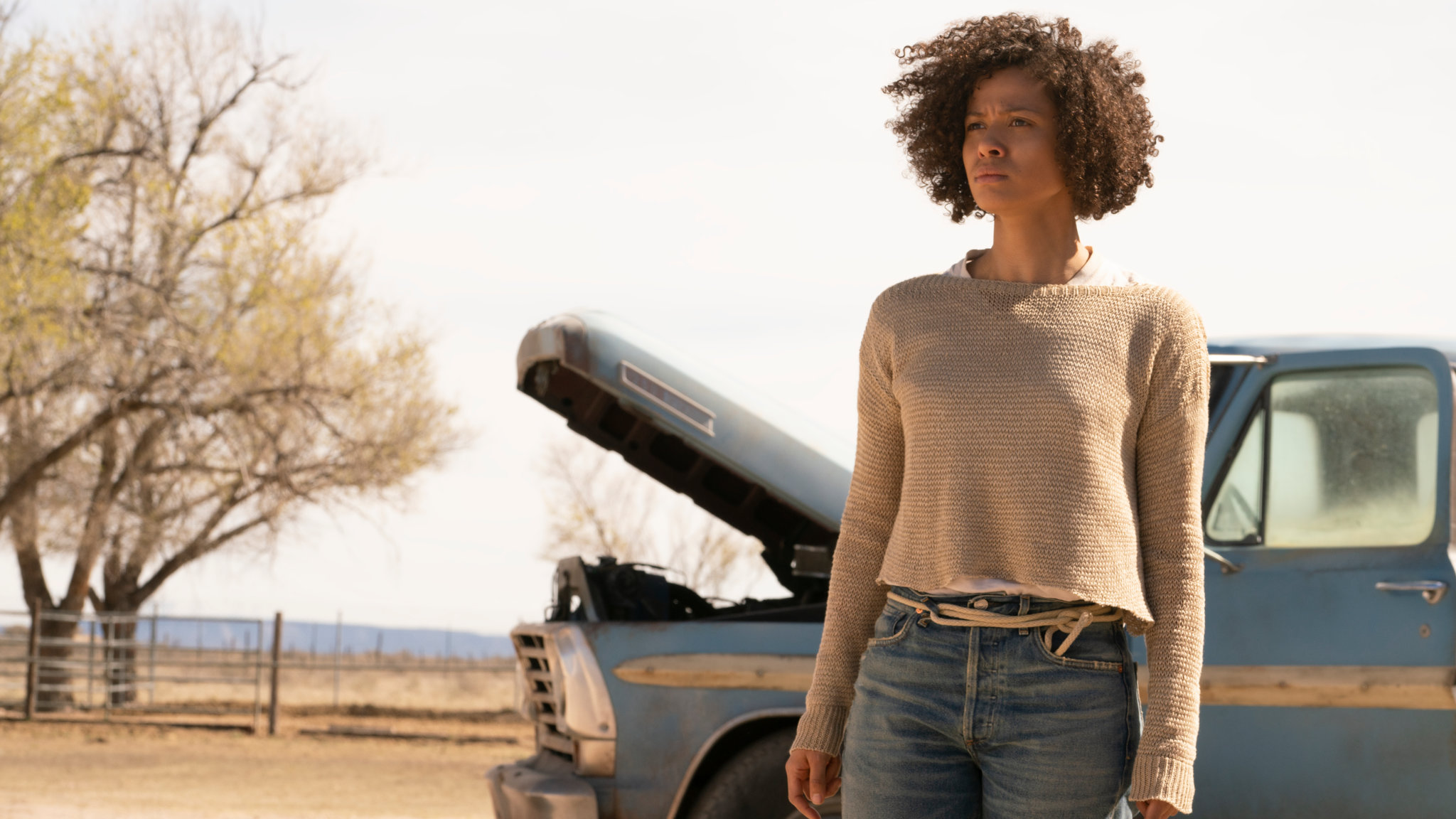
One suspects that it wasn’t just a pandemic, but saner heads prevailing, that stalled that Amazon adaptation. It’s not that a female African-American superheroine tale couldn’t work, or that the wondrous Gugu Mbatha-Raw or “Belle,” TV’s “Loki,” and “The Morning Show” couldn’t carry it. It’s that perhaps no one could get this dead weight across the finish line.

Director and co-writer Julia Hart of “Miss Stevens,” “I’m Your Woman” and Disney TV’s “Star Girl” serves up a fine dystopia and three generations of supernatural women “trying to get by” as End Times take civilization down the drain. But Hart is so sparing with her action beats and so staid and self-serious in her supernatural touches that the picture never sparks to life.

This version of the climate crisis endgame captures a rural America desultorily going through the motions as years and years pass without rain. Drinkable liquid is dearly bought and highly-priced.

Ruth (Mbatha-Raw) is on the lam, a somewhat tortured soul making her way from cash-only motel to not-yet-dry bar, haunted and hunted.

A “seizure” she feels coming on explains half of that. Something in her makes her cause earthquakes. And that “friendly” stranger (Christopher Denham) at the diner where she finishes the lone fried egg she can afford might not be so friendly.

“Where you headed?” “Oh, I’m just going.” “What does THAT mean?”

Even his “rescue” when Johnny Law shows up looking for her has strings attached.

“I’m a government scientist…We just want to run some...tests.

Elsewhere, a little girl (Saniyya Sidney) tinkers with electronics and fixing a pickup truck, listening to the stories and guidance of her grandmother ( Lorraine Toussaint of “The Equalizer” and “Orange is the New Black”) Bo.

There’s something mysterious about these two, their shared “powers.” Seeing the “colors” is a sign that they’re able to atomize objects as they see fit, even though putting things back together again is an iffier proposition.

“If something’s broken, it stays broken,” Bo intones, laying our big societal/environmental metaphor out for all to see.

Ruth of course is the little girl’s mother, Bo’s daughter. And her homecoming is fraught, with those “scientists” and assorted cops looking for her, cops including a sheriff (David Strathairn) whose pleas for “some semblance of order” seem as despairing as everything else about this desertified landscape.

After a promising start, “Fast Color” comes to a dead stop in its ponderous, exposition-packed middle acts. Toussaint and Mbatha-Raw bring plenty of gravitas to their explanations of their gift, its coming and going nature and their fractured family history, all provided more for the benefit of the child than the viewer.

Hart never gives her film a sense of urgency, which may suit the funereal “We’ve all given up” tone, but it sucks away what little life there is to “Fast Color” the moment Ruth finds her way “home.” A good rule for screenwriters, “the quest narrative is your friend. Abandon it (‘get there’ too soon) at your peril.”

Denham is only modestly effective as the villain of the piece. The effects are equally modest, a tad underwhelming.

As is every one of the later scenes leading up to the unearned Big Finish, which the only thing that really explains this picture’s “Sundance Moment.” As for the series to be based on it? That faint “whooshing” in the background is the air going out of that balloon.

Rating: PG-13 for a scene of violence and brief strong language

Cast: Gugu Mbatha-Raw, Lorraine Toussaint, Saniyya Sidney, Christopher Denham and David Strathairn

Credits: Directed by Julia Hart, scripted by Julia Hart and Jordan Horowitz. A Lionsgate release on Netflix, Youtube, Hulu, Amazon etc.

Running time: 1:40

Posted in Reviews, previews, profiles and movie news | Comments Off on Netflixable? Superheroines with “Fast Color” can’t save this sluggish tale

Documentary Review: Archeologists, veterans and others search for MIAs of WWII — “To What Remains”

“To What Remains” is a film about the work of Project Recover, an organization devoted to finding and identifying the remains of American airmen lost in the South Pacific, primarily in and around the island of Palau, during World War II.

Dr. Pat Scannon’s non-profit research organization, formerly called the Bent Propellor Project, digs through National Archives materials such as combat “action reports,” looks for surviving eye-witnesses to add to what they know and sets out in search of MIA Navy, Marine and Army Air Force airmen from the more than 200 bombers, fighters and fighter bombers lost in the waters around The Republic of Palau, specifically the island Peleliu. the site of bloody island-hopping battles the U.S. and its allies fought on Japanese-held territory on their push toward Japan.

Christopher Woods’ film follows Scannon, an MD and PhD and amateur archeologist, and his team of veterans, enthusiasts and experts from the Scripps Institution of Oceanography on their quest, diving the “blue corners” and “blue holes” and coral heads of some of the most beautiful islands on Earth, piecing together the puzzle of where a lost airman and his plane might be. Woods uses silent combat footage from the actual battle, with sound effects, to take the viewer back to 1944, showing us many air crashes as they do. And Woods tags along as descendants of the missing in action learn that their long lost loved-ones have been found, or in some cases, why they haven’t.

It’s a somber movie, with an emotional musical score to match, that traffics in ceremony, sentiment and that combat veteran’s “leave no man behind” code. Descendants and members of the search team, like former Navy SEAL Marcus Luttrell, talk about sacrifice, the futures lost when this or that service member died saving democracy from fascism.

The film meanders a bit, taking some understandable detours that amount to “mission creep” as Project Recover excavates a “killing field” where the Japanese executed captured aircrew and Navy UDT (pre-SEALS Underwater Demolition Team members).

Those distractions highlight the oddly-narrow focus of Project Recover — air crew. Scannon talks of developing his “obsession” with the subject after hunting for and finding a Japanese trawler future president and WWII Grumman Avenger (bomber) pilot George. H.W. Bush sank in battle. Scannon’s ongoing obsession is finding a missing pilot friend of Bush’s, a former Naval air division mate and roommate who parachuted out of his downed plane, and disappeared.

That gives this sentimental (literal, at times) flag-waver an unintended, seriously elitist bent — skydivers/skindivers taking donations to finance searches in a Pacific Paradise for officer-pilots, most of them college men. Woods including infantry and combat-footage and speaking to veterans from that side of the battle comes off as a way of giving balance to the film in ways that Project Recover might lack.

“To What Remains” can’t help but find poignance in the sacrifice of the “Greatest Generation,” with reminders of the grim nature of the combat in the Pacific and the Japanese tendency to murder prisoners of war, and then try to cover those murders up.

But there’s just enough screen time devoted to the changing technology of MIA hunts, especially those requiring underwater searches, to make one wish the “science” side of the story was played up more.

The 75 years that have passed mean that showing touching reunions with anyone who remembers those lost has become a near mathematical impossibility. The film’s focus on people a couple of generations removed from those lost, some of whom were inspired to take up the Project Recover mantle, has a watered-down “Finding Your Roots” feel, and can even play as self-serving.

It’s still an intriguing History Channel-ready look into a hobby/obsession and the ways technology makes uncovering even the simple personal tragedies and individual sacrifices in a vast conflict possible and worthwhile.

Rating: unrated

Cast: Dr. Pat Scannon, Mark Moline, Marcus Luttrell, Jo Schumacher

Credits: Directed by Christopher Woods, scripted by Mark Monroe. An Abramorama release.

Running time: 1:21

Posted in Reviews, previews, profiles and movie news | Comments Off on Documentary Review: Archeologists, veterans and others search for MIAs of WWII — “To What Remains”

Movie Preview: Is “Peacemaker” a deal-maker for HBOMax?

Violent and profane, with a Deadpool-ish sense of self-mockery, here’s the John Cena superhero vehicle that John Cena’s been waiting for.

Jan. 13, laugh along with the mayhem, “inappropriate” vulgarity and general goofiness of the tone-deaf American Fanboy Id as it sees itself — “Peacemaker.”

It’s always a good sign when there’s a laugh or two in the trailer.

Posted in Reviews, previews, profiles and movie news | Comments Off on Movie Preview: Is “Peacemaker” a deal-maker for HBOMax?

Who didn’t love Betty White? A national treasure passes — 1922-2021

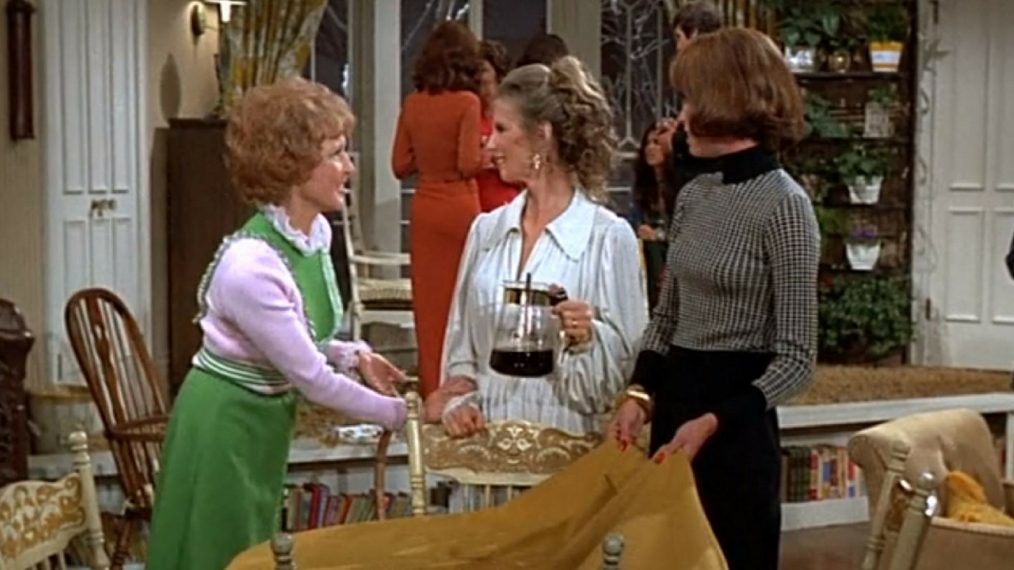
The last of the three incredibly funny women who made “The Mary Tyler Moore Show” legendarily hilarious has died.

The only woman who could have stolen Ryan Reynolds away from Sandra Bullock is gone.

A brassy broad who transitioned into her dotage with “The Golden Girls,” and went on to have the Greatest Fourth Act in American acting history, facing down a giant crocodile in “Lake Placid,” lifting “Hot in Cleveland” and half a dozen other series out of the doldrums in the past twenty years, hitting her marks and landing her zingers well past the point most grannies have their car keys taken away, we’ll never see another like Betty White.

Ninety nine years old, dying days short of her 100th, Emmy winner, a legend who made her mark over eight decades in show biz, funny and saucy to the very end.

RIP, Queen Betty. What a resume, what a career. And below, please find a story I wrote from an interview related to “The Proposal,” where that whole Ryan Reynolds meets his first TRUE love thing began. “The Proposal” and Reynolds played huge roles in White’s cool late life cachet, which in turn led to her attaining icon status.

By Roger Moore/McClatchy-Tribune News Service

Betty White has been stealing scenes for more years than most people can remember. In the new Sandra Bullock- Ryan Reynolds comedy, The Proposal, she stole a puppy.

“Oh, that little Samoyed was so adorable I just walked in for a rehearsal and just automatically, without even thinking about it, took the dog away from Ryan,” White says with a chortle. “I thought, ‘They’re never going to let me get away with that.’ But nobody said anything so that’s the way we shot it.”

There’s something so natural about seeing Hollywood’s most famous animal lover with a puppy, almost as natural as hearing something outrageous come out of that sweet, grandmotherly face. White, 87, has been in show business for over half a century and may very well be the busiest she’s ever been. She was just in Love’N Dancing, just this week signed to co-star with Kristen Bell and Jamie Lee Curtis in You Again, and lent a voice to the animated Ponyo due out in August.

“My life is divided absolutely in half — half is my animal work and half is show business. I have to stay in show business to pay for my animal charity work.”The Proposal has White as the too-helpful Alaskan grandmother of Reynolds’ character, a man who has been cornered into marrying his boss (Bullock) so that she can get a green card. They don’t make the work easier just because you’re 80something.

“I had to learn a song in Eskimo. And that ain’t easy, honey. There are no syllables that you can relate to. Learning the song was hard, and by the time we got to filming that dance scene it was 3:30 in the morning. It started to rain. Singing and dancing in the rain is fine for Gene Kelly, but it doesn’t work at 3:30 A.M. in the woods.”

The sassy act has stood White in good stead since the role that defined her, as snarky, man-crazy “Happy Homemaker” Sue Ann Nivens on The Mary Tyler Moore Show. When she filmed Love’N Dancing in New Mexico, “even the Teamsters had their cameras out to get a picture with Betty,” says Sylvia Caminer, a Central Florida-based producer on the film. “She turned grown men into giggling schoolboys!”

But White’s charitable side is just as evident. Her commitment to the animal healthcare Morris Animal Foundation goes back more than 40 years, as do her ties to the Los Angeles Zoo.

“Everybody who ever said ‘I belong in a zoo,” I agree!”

Caminer witnessed that when she drove White to the Albuquerque Zoo on a day off during Love N’ Dancing.

“Word reached the zoo before we even arrived, and she was greeted like a rock star by man and beast alike,” Caminer marvels.

Posted in Reviews, previews, profiles and movie news | Comments Off on Who didn’t love Betty White? A national treasure passes — 1922-2021

Classic Film Review: Anthony Mann’s take on Erskine Caldwell’s sordid Southern Gothic “God’s Little Acre” (1958)

The thing that sticks in the memory is that jaunty Elmer Bernstein (with lyrics by Erskine Caldwell?) title tune.

“Diggin’ in the moonlight, diggin’ in the sun,….Diggin’ in the ground till the diggin’ was done — Come over to God’s Little Acre, Come over to God’s Little Acre.”

It seems to promise something a lot lighter than any adaptation of Erskine Caldwell’s scandalous, salacious “Cracker Gothic” novel “God’s Little Acre,” could possibly be. Maybe that’s why it stuck with me, even if I never watched the rest of the movie, which first turned up on TV back in the ’70s.

It opens like “Lil’ Abner,” but crawls right into a hole of sex, sin, obsession, madness and murder. And I was plainly too young to “get it” way back when.

What Tennessee Williams was to the theater, Erskine Caldwell was to literature — a droll, drawling observer and savvy satirizer who leaned into Southern stereotypes entirely too much for my taste.

Williams was too genteel and courtly to really wallow in what I call “Cracker Gothic” — quaint, backward Southerness as a slur — although “The Fugitive Kind,” adapted from “Orpheus Descending,” “Baby Doll” and “Cat on a Hot Tin Roof” certainly have a whiff of ridicule about them.

The Georgian Caldwell, most famous for “Tobacco Road” and “God’s Little Acre,” may have dabbled in religious superstition, class prejudice, labor oppression and racism as explanations for “backwardness” in his fiction. But whatever his intent, “mockery” is something that always slipped through on the screen.

Anthony Mann, best-known for his Westerns (“Winchester ’73”) and action pics (“The Heroes of Telemark”), dabbled in every film genre over the course of his career, with epics like “El Cid” and “The Fall of the Roman Empire” a hallmark of his later years. Here, he guides a stellar cast that hurls itself into accents, melodramatics and stereotypes in a story of fake piety and pointless poverty, sex, lust and sin in 1950s Georgia.

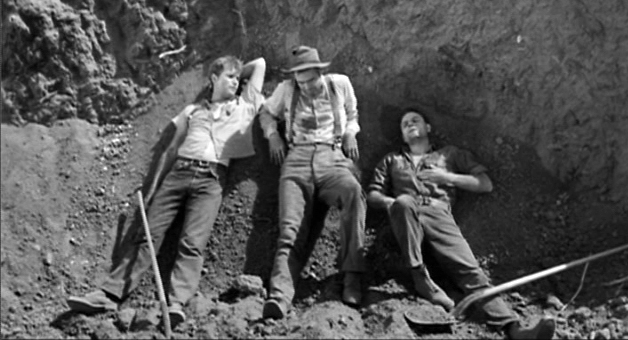
The plot, which plainly inspired Louis Sachar’s YA novel “Holes,” concerns a patriarch obsessed with treasure his grandaddy told him was buried on the family farm.

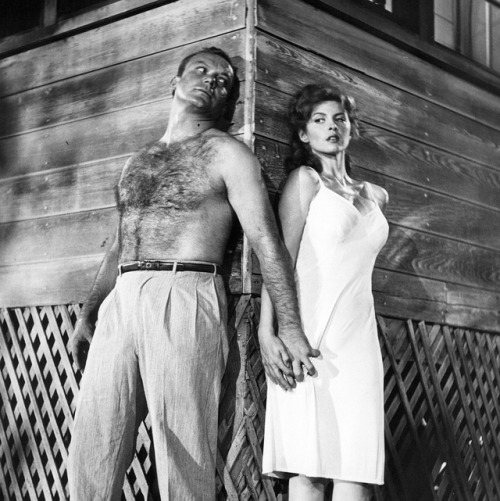
Robert Ryan is one of those Hollywood stalwarts who never gave a bad performance, and he brings a gusto and physicality to Ty Ty Walden, a would-be farmer too busy driving himself and two sons — played by Vic Morrow and Jack Lord –– to exhaustion and mania, digging deep holes all over their property, looking for the loot.

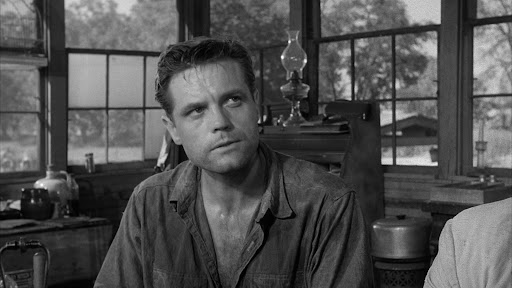
The handsome Buck (Lord, who went on to fame in “Hawaii 5-0”) is openly bitter about these circumstances, and given to unfiltered lashings of his beautiful young wife Griselda (Tina Louise, headed to “Gilligan’s Island”). Younger sibling Shaw (Morrow, soon to star in “Combat!” on TV) does what Daddy says and parrots whatever Buck blurts.

Griselda likes her dresses diaphanous and her sexual cards always on the table. Buck’s furious jealousy doesn’t phase her. She keeps her temptation in the family. Factory worker brother-in-law Will (Aldo Ray) has her attention, and Buck knows it.

Will is unhappily married to Walden daughter Rosamund (Helen Westcott), and out of work. And one of the many ways Hollywood watered-down the novel — sex, suggestions of incest, etc. — is playing down the fact that he’s a labor leader, an organizer of the strike that led the owners to close the local cotton (textile) mill. Will figures people “look up to him,” and when he’s drinking, he fumes about “turning the lights back on” in that just-closed mill, as if that alone will bring it and the “bankrupt” town back to life.

To Buck, Will’s just a “lousy lint-head.”

Ty Ty, who has Black hired hands (Rex Ingram and Davis Roberts) working the parts of the farm actually producing something, is sure that salvation will come from this buried treasure. He maintains a pious pose whose only real evidence of “faith” is the acre that he keeps a cross on, “God’s Little Acre,” land that he’s promised the Lord will be tithed to a church if anything of value comes out of that soil.

Ty Ty moves that “acre” cross marker any time he gets a notion that the treasure might actually be buried on God’s Little Acre. Piety and faith are flexible on this stretch of the Georgia/South Carolina state line, apparently.

Buddy Hackett plays a rotund oaf, Pluto, running for sheriff and desperate to marry the other sexpot under Ty Ty’s roof, his teasing, taunting daughter Darlin’ Jill (Fay Spain). Pluto rides around the county, allegedly canvassing votes in his white linen suit. But he’ll lay down on the dirt pile to jaw with digging Ty Ty when it comes to talking about Darlin’ Jill. His one suggestion? Find an albino, because they have “magical powers” when it comes to divining things hidden under the ground.

That’s how the patriarch and the boys come to kidnapping Dave (a pre-stardom Michael Landon) to help them with their search.

Whenever Ty Ty runs low on cash — there’s not much money in digging pointless holes all day — he and the others fantasize about hitting up the one son (Lance Fuller) who left the farm, moved to Augusta and made his way to a comfortable life as a cotton broker.

There’s little that’s subtle going on here, although Ryan, Louise, Lord and Landon deliver performances that pop.

Hackett is cartoonishly grating and Ray is brought in to give the picture a primitive blast of animal testosterone.

Strips of fly-paper dangle into the frame on shots around the table where water melon is discussed and savored. A bar is seen, from outside. The inhabitants of a New Orleans style brothel inject themselves into the proceedings.

Characters don’t so much argue as bray at one another. Because pretty much everybody hits their accents hard in that ancient Hollywood way of turning Southern speech into Elizabethan English. Ty Ty’s colloquialisms may be cute, but they’re as thick as molasses.

“Well dawg my cat!” “What in the pluperfect Hell!”

One and all never give a care into filtering their innermost thoughts of outermost lust.

“Darlin’ Jill, you in here. Stand up. Let me look at you in the light. Well, well, baby’s a full grown woman. Plump as a peach on a branch, ripe and ready to pluck!”

Watching this 60+ year old film of an almost 90 year-old novel, I wondered if anyone still reads Caldwell or visits the little museum dedicated to him in the sleepy Georgia hamlet where he was born. You never hear him mentioned in the same breath as Faulkner, Harper Lee, Capote, Zora, Flannery, James Dickey, Cormac McCarthy or Pat Conroy.

The subtexts Caldwell wrote about — Southern “indentured servitude,” the reluctance to challenge the patriarchy via labor organizing, the constant Protestant religious lip service and superstition that public education is never allowed to fix (the REAL “critical race theory” is what rich white folks don’t want working class white folks to learn about) — are in the movie and still in Southern life, if you’d care to see them. The film almost buries Big Ideas under its Original Sin fixation, because sex sells.

Whatever the literary merits of “God’s Little Acre,” the film (a Blacklisted screenwriter had a hand in it) pulls too many punches and lacks the dramatic subtext of Tennessee Williams’ works. It feels quaint, dated and cartoonish, so much so that seeing just how much Robert Ryan could commit to a part and how terribly confining a hit sitcom was to the gifted Tina Louise isn’t reason enough to sit through it.

And the fact that for all its sex and sordid goings on, no streamer or cable channel has seen fit to remake it under “uncensored” conditions is further damning, a book whose time passed and a movie that had no prayer of having its moment, much less outlasting it.

Rating: General audiences, pretty racy for its time

Cast: Robert Ryan, Tina Louise, Aldo Ray, Jack Lord, Vic Morrow, Fay Spain, Buddy Hackett, Rex Ingram, Helen Westcott, Lance Fuller and Michael Landon.

Credits: Directed by Anthony Mann, scripted by Philip Yordan and Ben Maddow, based on the novel by Erskine Caldwell. A United Artists release on Tubi, Amazon and other streaming platforms.

Running time: 1:58

Posted in Reviews, previews, profiles and movie news | Comments Off on Classic Film Review: Anthony Mann’s take on Erskine Caldwell’s sordid Southern Gothic “God’s Little Acre” (1958)

Netflixable? Another winner of a murder mystery from Argentina — “Blood Will Tell (La Misma Sangre)”

I get through a lot of Spanish language cinema in pursuit of something out of the ordinary in my “Around the World With Netflix” browsing. And as I do, one opening credit always gets my attention and raises my hopes.

A flag appears, and “Produced with help from the Argentine Ministry of Culture” pops up in Spanish. Not everything with that label is a dazzler. But what Korea is to supernatural thrillers, zombie and monster movies, Argentina is to mysteries, murder tales and the like.

From “The Secret in Their Eyes” and “Furtive” to “Rock, Paper, Scissors,” “Black Snow,” “The Son” and even “Beer, Pizza and Smokes,” Argentine filmmakers often produce movies that keep us guessing or surprise us with their deadly twists.

The bizarre, particularly gruesome death that “Blood Will Tell” circles around and the clever way it is hidden and then revealed make this latest film from the husband-and-wife team of Miguel and Ana Cohan (“No Return”) stand out, and provides a great hook for a tale of deaths and debt in an old Argentine Jewish family.

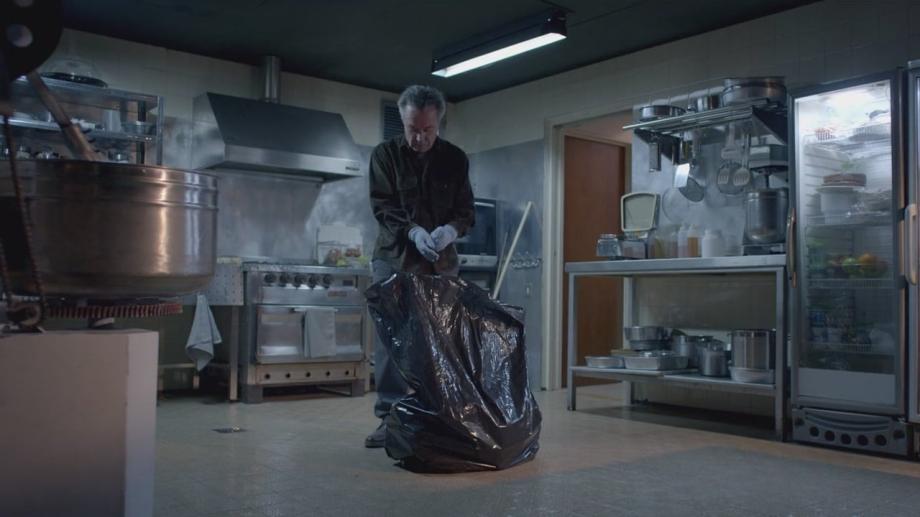
“Blood,” titled “La misma sangre” (“The Same Blood”) in Spanish, opens with one death and recollections of another. An old rancher, working on a well’s water pump on the farm, calls his son (Oscar Martínez) to complain about it, and rant about how “useless” his other “city” son is in matters about the family cattle ranch.

The old man isn’t ranting to Yako, the ranch-savvy son, about the son who plainly isn’t his favorite, Elias. “Yako died thirty years ago,” Elias testily explains (in Spanish with English subtitles) for the umpteenth time. We don’t see his reaction to the windmill climbing accident that kills his dotty dad after he hangs up the phone. But we can’t imagine many tears.

Seven years later, Elias is patriarch, the don of the family and the ranch. He’s converted their stock to buffalo, getting ahead of the curve on a new healthier meat trend that just might hit red-meat-mad South America. And then, after a family celebration, his wife (Paulina García) dies in a bizarre accident.

His daughters weep, but don’t question how it happened. But son-in-law Santiago (Diego Velázquez), a doctor, notices “strange” things about Elias’s behavior, a chill to his mourning. After snooping around just a bit, he starts sharing his unease with his wife, Carla (Dolores Fonzi), who isn’t having it.

We’ve seen a couple of clues that Santiago stumbled over. We’ve seen Elias lock eyes with him over them. We know that Elias knows that Santiago knows, and that Santiago knows that Elias knows he knows. “Blood Will Tell” is about letting us in on the details, the back-story and the further “blood” that might have been spilled and that will be spilled because of what happened.

The Cohans — Miguel directs from scripts he and wife Ana write — fold this story in on itself, revealing pieces of “that night” and the chilling manner of death. Everything, piece by piece, that plays into motive and points to consequences, will come out.

They don’t lean on Santiago as “sleuth” to tell this story, which comes from a more neutral, omniscient narrator’s point of view. They put together a puzzle for us, and let us speculate on mysteries left hanging that could just as easily expand that puzzle.

Through it all, Martínez (“The Distinguished Citizen”) suggests a man struggling to keep his burdens from his family, hellbent on proving his dismissive dead Dad wrong and juggling — investors, government bureaucrats, his wife (pre-death, in flashbacks) — all in an effort to not have his and their world crash down around his ears.

“Blood Will Tell” isn’t so much about what drives Elias to do something as it is about a man in over his head, and determined never to admit it. He is in a quiet fury over his predicament and his inability to remedy it on his own. Even discovering what he’s capable of suggests a passivity that is no credit to whatever machismo one might attach to his actions.

His subsumed fury spills over to others as they start to pick up on what Santiago figured out that moment, way back in the first act, when he and his father-in-law “had a moment,” one so disquieting that it drives this narrative and locks the viewer into this generally riveting story as it does.

Rating: TV-MA, graphic violence, profanity

Cast: Oscar Martínez, Dolores Fonzi, Paulina García and Diego Velázquez

Credits: Directed by Miguel Cohan, scripted by Ana Cohan and Miguel Cohan. A Netflix release.

Running time: 1:53

Posted in Reviews, previews, profiles and movie news | Comments Off on Netflixable? Another winner of a murder mystery from Argentina — “Blood Will Tell (La Misma Sangre)”

Classic Film Review: Walter Brennan’s a tyrannical farm dad breaking “The Green Promise” (1949)

The loveable old coot screen image that Walter Brennan took to his grave tended to gloss-over his wonderfully villainous turns over the years.

A prototype for what Hollywood would come to revere as “a character actor,” he won three Oscars, with the most memorable of those performances coming in “The Westerner,” where he played the mercurial, mean and corrupt Judge Roy Bean opposite Gary Cooper.

Long before “The Real McCoys” or “Darby O’Gill and the Little People,” Brennan wasn’t shy about playing cold-blooded patriarchs (“My Darling Clementine”) along with his usual amusing “sidekicks” (“Meet John Doe,” “To Have and Have Not,” “Red River”).

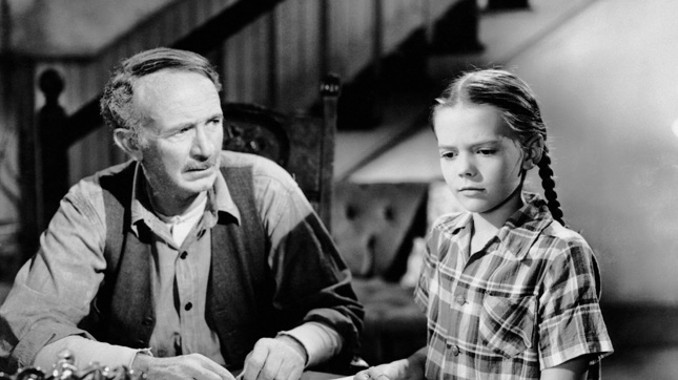
He brings a bitter, self-destructive edge to “The Green Promise,” a trouble-on-the-farm film intended to preach the virtues of the teach-teens-to-farm-better organization, 4-H. Brennan and little Natalie Wood give the stand-out performances in this indifferent melodrama with a message from director William D. Russell (“Bride for Sale,” “Best of the Badmen”).

The first hint that farmer Matthews isn’t just the chipper, upbeat salt-of-the-Earth he appears to be come in the first scene. He’s a widower with three daughters and a son and all their possessions piled into their truck, “Grapes of Wrath” fashion, come to California to buy another farm.

His banter with the realtor and the local agricultural agent (Robert Paige) tells them that his last farm “blowed away,” but it’s over a decade past The Dust Bowl. He’s not sentimental about leaving it behind, grouses about not missing the neighbors, and intimates that the only reason they have cash to buy another was that insurance his late wife “insisted” they take out.

Oldest daughter Deborah (Marguerite Chapman) tries to interrupt his version of their recent history and his impulse to buy the first farm that the real estate man (Irving Bacon) shows him. “Papa” shuts that down.

But there’s the appearance of “democracy” in this family. He makes a big show of “holding a vote,” with most of the kids (Connie Marshall, Ted Donaldson and little Natalie Wood) easily bullied into “voting” his way.

Practical Debbie frets over his rash decisions, careless debts and prioritizing buying tractor and a pig when they need a milk cow, with three younger children under their roof.

And there’s an arrogant “I know best” streak that keeps him from listening to the agricultural agent’s advice on crops, what land to keep fallow and the perils of cutting a timber stand on the fragile watershed overlooking their fields.

The foreshadowing couldn’t be more obvious.

But that ag agent is persistent, because he’s sweet on Debbie. The preacher (Milburn Stone, later “Doc” on TV’s “Gunsmoke”) might as well be calling Matthews out by name when he talks about man’s flaws and the “green promise” the Almighty makes with the farmer. And the kids just might have a chance of breaking this “ruin another farm” cycle thanks to this club the other farm children in their valley belong to — 4-H.

The “head, hearts, hands and health” ethos of smart farm investments, hard work and good farm practices sparks something in all the kids, but especially in the youngest, Susan (Wood). She’s determined to buy some lambs and raise them for wool and resale profit.

Heedless Papa won’t hear of it, but events conspire to bring this doomed dictatorship into a full fledged family confrontation.

The Monte Collins script lacks much in the way of subtlety, and is so ham-fisted that we’re never sure if what we’re seeing — Agent Barkley’s gruff chewing out of Debbie as a “coward,” for instance — is some reflection of “the way things were back then” (like a child dressing up as a blackfaced “Mammy” for a costume party), or just scriptural clumsiness.

What’s striking about this film decades later is its frank treatment of farmers as flawed folk. The Dust Bowl, partly a product of poor farm practices, wasn’t the distant memory it is now. Film and media treatment of farming as a righteous profession practiced righteously by the righteous these days rarely acknowledges farm debt, land-use issues, ag consolidation, tyrannical Monsanto seed-patenting or anything else as being the least bit the fault of the folks doing the farming. Back then, Hollywood wasn’t shy about showing the flaws of folks set in their ways, looking for shortcuts (DDT) and still losing new generations who wanted easier lives off the land.

Brennan brings a devilish glee to Matthews, a man so hell-bent on doing things his way that he lashes out, self-destructively, just to spite Debbie and the other children.

But “The Green Promise” is chiefly valued today for reminding us of what a remarkable child star young Natasha Zacharenko (Wood) was. “Miracle on 34th Street” was no fluke. She pops off the screen in this film, even today, more “natural” in some scenes than others, but never less than magnetic, sympathetic and real.

Wood became a big star ten years later, after “Rebel Without a Cause” and then “West Side Story.” But she never lived long enough to become the formidable character actress her later years might have turned her into.

Brennan, who experienced a comeback on TV with “McCoys” and “The Guns of Will Sonnet,” and who made his mark in Disney films and sending up his most famous villains in “Support Your Local Sheriff” in his last years, had the career that generations of actors who followed him envied. He excelled in every character part, was always employed, always distinct and honored for that work back then and by film buffs even now, a half century after his death.

Rating: approved, peril

Cast: Walter Brennan, Marguerite Chapman, Robert Paige, Connie Marshall, Ted Donaldson, Robert Ellis, Milburn Stone, Will Wright and Natalie Wood.

Credits: Directed by William D. Russell, scripted by Monte Collins. An RKO release on Tubi, Amazon, other streaming platforms.

Running time: 1:33

Posted in Reviews, previews, profiles and movie news | Comments Off on Classic Film Review: Walter Brennan’s a tyrannical farm dad breaking “The Green Promise” (1949)

Movie Review: Fading porn star tries to re-light the “Red Rocket” in Texas City

Simon Rex? Sorry mate, that sounds like a porn star’s name. Not that this can’t be put to good use,.

Rex, who first gained notice on TV’s “Felicity” back in the last millennium, plays an aging not-exactly-a-household name porn actor named Mikey Sabers, clever enough to hustle up a career out of “the one thing I love,” not clever enough to know how to spell “Sabre” as his “swordsman” stage name.

Mikey is a “user,” first scene to last, a guy who can talk himself into and out of a lot of things, but somebody who quickly outstays his welcome with almost everyone –rather like the movie Sean Baker (“The Florida Project”) wrote about Mikey.

“Red Rocket” is a sordid dive into down-market down-and-outers in the hellscape of Texas City, Texas — home to oil refineries, oil workers and people slow in figuring out it’s where dreams go to die. It makes its points, takes the intensely-unlikable guy where he was always headed, and then sticks around a full half hour after the climax, another 15 minutes past the anti-climax.

No porn director would ever make that mistake.

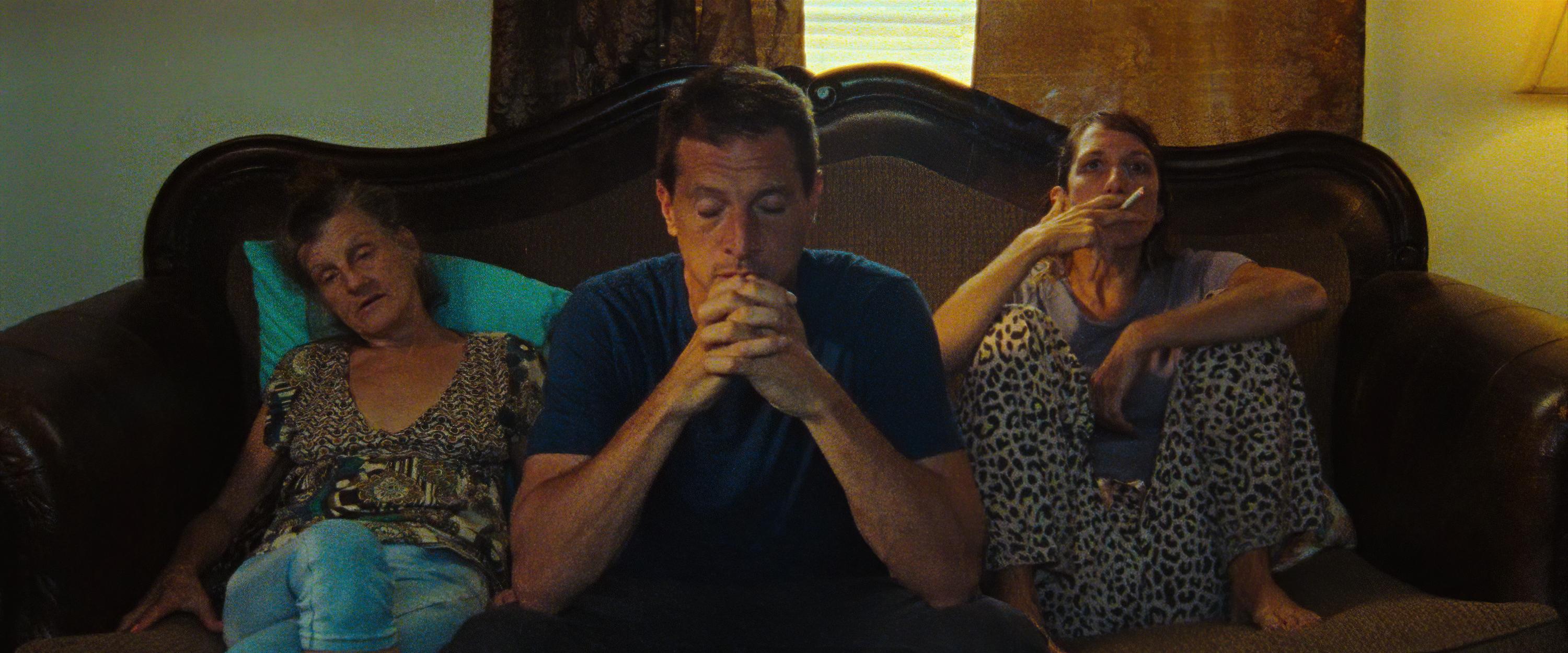
Rex plays the fit but well-over-40 Mikey as a childish satyr, a man always on the make and often on the run. That’s how we meet him, battered and bruised and fresh off a Greyhound, fast-walking through the time capsule of Texas City with just the battered tank top on his back, his worn and stained jeans covering the rest.

He beats on the door of a battered frame house, gets past the elderly Miss Lil (Brenda Deiss) and pleads his case to Lexi (Bree Elrod of “Sometimes I Think About Dying”). She has the same question her mother does.

“Why are you HERE?”

Mikey wants something. He and Lexi have history. They were married. “We’re STILL married.” Something happened. He was in Los Angeles. She came home to live with Mama.

Over the course of “Red Rocket,” we pick up on what happened. Pornography was involved. That’s not the sort of thing Mikey can put on a resume when he’s trying for work waiting tables.

Because at some point, his “You need a man around the house” pleas won them over. Can he get a job, pay a share of the rent, make their lives better? Perhaps atone for whatever he did in the past?

Maybe. If, for instance, Leondria (Judy Hill) lets him start “moving” weed for her again. That means getting past her butch and seriously disapproving daughter June (Brittney Rodriguez).

A little help from the neighbor kid (Ethan Darbone) who grew up to driving age while Mikey was gone might help. Mikey needs rides to places Lexi’s old yellow bike won’t take him — the mall, strip clubs.

But dang it all, then he has to go and take Lil and Lexi to “celebrate” at the local donut shop. The borderline underage sales clerk, a redhead nicknamed “Strawberry” (singer and actress Suzanna Son), seems awfully receptive to Mikey’s over-age come-ons. Scheming, “I’m going to be straight with you” Mikey is dreaming up a comeback, and not one wholly dependent on the little blue pills he pops to meet Lexi’s needs, either.

It’s 2016, and Mikey’s efforts to get back on his feet, get back “in the business” and back to LA are set against the bizarre presidential election, party conventions, the works, unfolding on TV around him.

Can he keep all the balls he’s juggling in the air? Is it in the cards for Mikey to triumph? Or did he show up with just the tank-top on his back, battered and bruised, for a reason?

Rex’s bubbly, almost manic take on Mikey make the character come off as an oversexed, amoral version of “Extreme Makeover’s” Ty Pennington — chattering away, optimistic, flattering but making a sale and never letting us or anybody listening to his patter see him as anything but a toxic narcissist.

Perhaps that’s what writer-director Sean Baker (“Tangerine,” “The Florida Project”) was going for in his Texas City project. Follow this delusional, self-absorbed bottom-of-the-ladder bottom-feeder through a few weeks of the life that parked him as his ex’s front door with just the clothes on his back. Is he meant to be a repeat offender and serial failure like the unlikely con artist who got into the White House?

But Baker loses himself and his movie in this latest dalliance in down and out. We see plenty of visuals of another of America’s “s—hole towns,” follow another aspirational, deluded loser (“Tangerine”), this time one who had a taste of something resembling “fame” (“2000” screen appearances, boasts the no-longer-popular Pornhub participant).

Rex’s Mikey can be fascinating to watch as he uses everybody around him, with varying degrees of success. He talks cocky, confident and tough but lets us see he’s none of those. He has a youthful exuberance without the youth, a “plan” that is nothing of the sort but a charisma that makes people do what he wants.

We fear for the teenager who falls into his thrall, at least partly because we don’t buy it. We see Baker leaning pretty heavily on this picture’s gimmick, Rex’s full frontal nudity, a little too hard. And we wonder why Baker is having so much trouble figuring out how to wrap all this up.

It’s still safe to say that nobody makes indie films like Baker, and few filmmakers of any stripe are seeing the subcultures that he not only sees but wants to explore. But as “Red Rocket” fizzles and stumbles towards a finale that’s both melodramatic in the extreme and unavoidably inevitable, there’s no getting around that this coarse and callous comedy is quite the comedown from the acclaimed and Oscar-feted “Florida Project.” “Red Rocket” makes noise and shows moments of (sexual) flash, but never achieves lift-off.

Rating: R for strong sexual content, graphic nudity, drug use and pervasive language.

Cast: Simon Rex, Bree Elrod, Suzanna Son, Brenda Deiss, Judy Hill, Brittney Rodriguez and Ethan Darbone.

Credits: Directed by Sean Baker, scripted by Sean Baker and Chris Bergoch. An A24 release.

Running time: 2:08

Posted in Reviews, previews, profiles and movie news | Comments Off on Movie Review: Fading porn star tries to re-light the “Red Rocket” in Texas City