
Movie Review: Ukrainian teens hang onto childhood while staring down adulthood playing “Stop-Zemlia”

Ukrainian filmmaker Kateryna Gornostai reaches for docu-drama reality with her debut feature film, “Stop-Zemlia,” a peek inside the lives of high school teens facing final exams and “the future” with childish obliviousness and adult concern and uncertainty.

The ground covered, the high school “types” glimpsed or followed, are too familiar for a Western viewer to be as fascinated with these kids as she is. And the film’s structure, formatted as a “mockumentary” with the kids being interviewed at graduation, with all their living through that last year covered as flashbacks, is wearily confessional.

But it’s an intriguing sort of stream-of-consciousness drift through one’s teens, demonstrating a universality of experience that anybody who attended high school in the developed West would recognize.

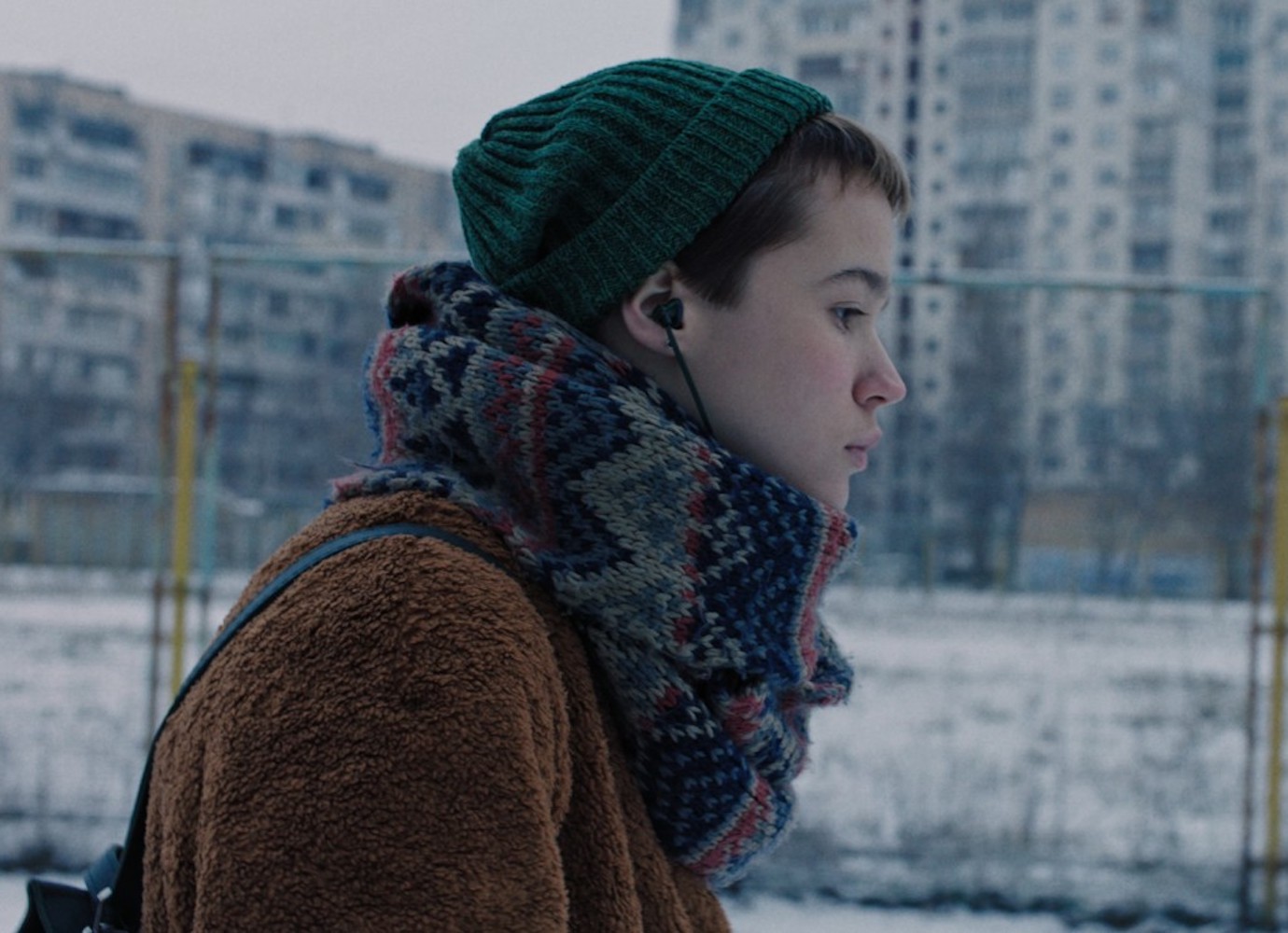
Masha, played by Maria Fedorchenko, is the primary focus, although we drop in on half a dozen or so lives during the course of this year. She is pretty, model-thin with short hair that she’s not shy about coloring, but a kid wracked by anxiety. Masha is working a lot of things out, mostly out of sight of her concerned parents, sometimes with the help of her two besties.

Yana (Yana Isaienko) is her primary sounding board, cute and given to crushes that she impulsively judges and rules out once the actual “date” arrives. The Culkin-stocking-capped Senia (Arsenii Markov) is friendly, with a hint of “haunted” about him. Masha has to take him out of shooting class (teenagers breaking down and reassembling AK-47s, etc.) because “there was shelling on my street” and he’s understandably triggered.

We are in Ukraine, after all, which Russia has coveted since time immemorial.

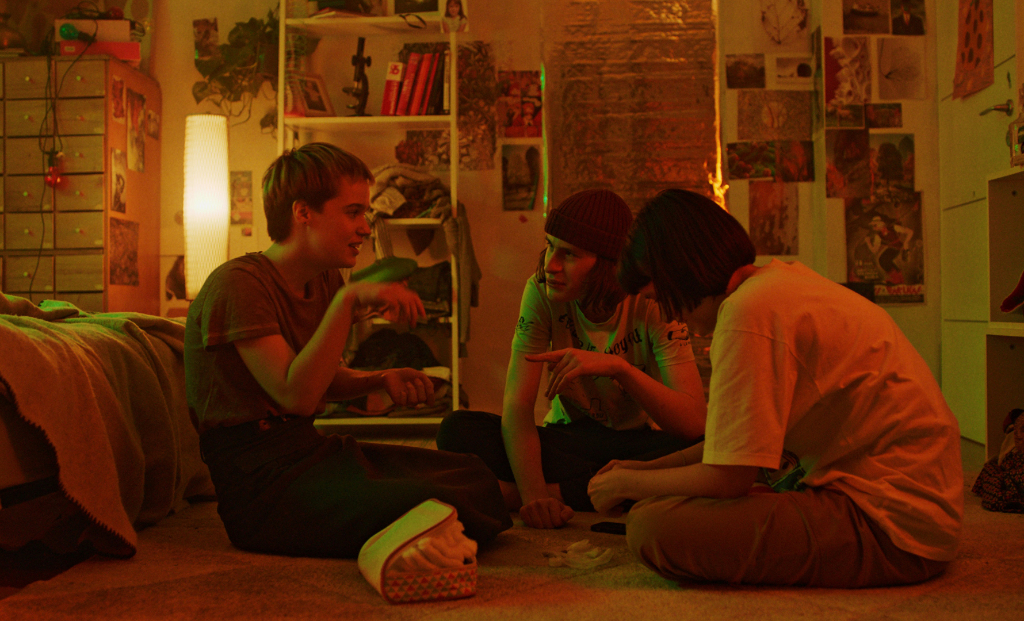
As the kids study and take class trips and drink and smoke various substances and flirt and play Blind Man’s Bluff and Spin the Bottle, you get the sense there’s a lot of “experimenting” going on. Which is handy, because Masha likes to have sleepovers with her friends.

But this isn’t really that kind of movie. Gornostai is more interested in creating a texture, a milieu, and populating it with “average” (but generally quite attractive, and all clear-skinned and thin) teens than in giving us the big John Hughes romantic “destiny” coming-of-age moments.

Masha might be right for sexually noncommittal, lonely, distant and handsome Sasha (Oleksandr Ivanov), who is being raised by his doting (he’s her only company) single mom. But don’t bet on it.

The interviews, interspersed throughout this two hour ramble, probe what the kids think about “love” and “being in love” and “life after school” and the like. The answers are revealing only in the most generic sense.

And the classroom and field trip scenes have a “seen this in the US, Canada, Britain, France and elsewhere” quality as well. Well, there’s less security in science museums (with spacesuits, spacecraft) in the former U.S.S.R. than there is here.

As interested as Gornostai is in showing us “types” — the giggling, teasing pretty girl who’s a bit of a bully, the tall, handsome boy (Andrii Abalmazov) whose smile gets him what he wants, but whose wants are limited and dull (he’s a bit of a bully, too) — she does almost nothing with them.

No one is “that” mean, that confused, that bullied or that in love.

It’s kind of refreshing that Gornostai has chosen to show how less-obsessed-with-sex Ukrainian kids are than the average Hollywood film insists American teen are. But you have to wonder how accurate that is. She’s asking them about love and romance and relationships, and it could very well be that these 17-18 year-olds are more grown up than their American “Kissing Booth” counterparts. Still, this is just as scripted as any California teen rom-com or sex farce. Who’s to say how accurate it is?

And lacking a more coherent organizing principle than “fly on the wall/slice of life” renders “Stop-Zemlia” — which takes its title from a sort of long-running game of slap-tag — somewhat colorless, if not entirely pointless.

Rating: unrated, nudity, teen smoking and drinking, profanity

Cast: Maria Fedorchenko, Yana Isaienko, Arsenii Markov, Oleksandr Ivanov, Andrii Abalmazov

Credits: Scripted and directed by Kateryna Gornostai. An Altered Innocence release.

Running time: 2:02

Posted in Reviews, previews, profiles and movie news | Comments Off on Movie Review: Ukrainian teens hang onto childhood while staring down adulthood playing “Stop-Zemlia”

Movie Preview: A thriller about making a porn film in Texas –“X”

Rural Texas, 1979, maybe not the best place and time to film your X-rated feature film.

I mean, where would you get your dailies processed?

Not a state known for tolerance and they have lots of chainsaws down there.

March 18, this Ti West thriller starring Jenny Ortega, Brittany Snow and Kid Cudi, an A-24 release (their brand is “out there”) makes its way to a screen near you.

Posted in Reviews, previews, profiles and movie news | Comments Off on Movie Preview: A thriller about making a porn film in Texas –“X”

Next screening? A cop makes a mistake, “A Shot Through the Wall”

This one, opening Jan. 22, could be ripped from any given day’s headlines. Looks compelling.

Posted in Reviews, previews, profiles and movie news | Comments Off on Next screening? A cop makes a mistake, “A Shot Through the Wall”

Netflixable? “The House,” a dark comedy of stop-motion animated horror in three acts

“The House” may be the most delightfully strange project Netflix has ever put its money behind.

They’re calling this Nexus Studios stop-motion animated tale a darker-than-dark “comedy series,” but don’t you believe it. It’s a warped anthology, with three separate directing teams, one for each chapter. Irish playwright Enda Walsh scripted the macabre and whimsical “House,” which plays as a movie, 98 minutes of the odd history of a British home of mysterious origins.

It begins with “And heard within, a lie is spun,” a Dickensian tale of how the house was built. The growing country family of Raymond (voiced by Matthew Goode) and Penelope (Claudie Blakely) have just enough time to absorb the insults of his snobby visiting relatives (Miranda Richardson voices one) at his and Penny’s modest adobe when a mysterious benefactor offers to build them a new house on a nearby hill.

Raymond can put down the bottle and give his family the life they deserve, and Penny has a new sewing machine to keep her busy. But little Mabel (Mia Goth) and toddler Isobel see workmen and others, hiding behind the scenes. They hear the weeping of the benefactor’s factotum, Mr. Thomas (Mark Heap). They recognize the peril, the “trap” this house is, before their parents.

In “Then lost is truth that can’t be won,” a new owner/developer (voiced by Jarvis Cocker) has renovated the place on the cheap in the present day, and is scrambling to flip the house — it’s now surrounded by the city — the day of its “open house.”

The developer is a mouse, as are the many visitors to that open house. But they’d all be more impressed if he could keep other vermin — insects — at bay.

And in “Listen again and seek the sun,” in the future, the land around the house is flooded — climate change? The latest owner, the talking cat Rosa (Susan Wokoma) has subdivided the ancient pile into studio apartments, and she too is renovating it. But her tenants Jen and Elias (Helena Bonham Carter and Will Sharpe) only pay in barter — fish he catches, “crystals” she consults.

Perhaps a visiting hippy handyman friend (Paul Kaye) of crystal-loving Jen is the answer to Rosa’s prayers. Or not.

The animation, which begins with felt doll-like “people,” yarn-covered trees and includes creative uses of wool and cotton (simulating fire in a fireplace), meshes together brilliantly. Doll “people” give way to fuzzy rodents and then to fuzzier “Fantastic Mr. Fox” style cats, each chapter with similar production design, although the opening episode/act is largely set in sinister darkness.

The dialogue can be ominous or hilarious. Consider this pearl from Cosmos, the Tibetan hymn-chanting hippy “traveler” and house-repairer who sails up in a boat.

“There are never any ‘plans’ with me. There’s only moments snatched from the wind!” Cosmos isn’t into “invasive” work like plumbing. He wants to “nourish the soil of the house, enlighten its chakra!”

The picture opens creepy, transitions to icky-funny and finishes light and amusing, with all the stories seated neatly on one big theme — a house is a “trap.” Whatever Raymond & Family gain from moving up, the demands the place makes and the closing-off means of escaping it hardly make it worth it.

Later owners just confirm that prognosis.

I was spooked and tickled and nodding in recognition of a “dream house’s” hidden nightmares, the cash-sucking burden of needing a quick and sloppy refit and re-sale and the bigger one of renting to deadbeat tenants.

If they’d presented this as a movie, it could have been an Oscar contender. The best thing about labeling “The House” a series is the prospect that we’ve just caught Season One of something extraordinary and wonderful.

Rating: TV-MA, animated gore, profanity

Cast: The voices of Helena Bonham Carter, Matthew Goode, Susan Wokoma, Jarvis Cocker, Will Sharpe, Paul Kaye, Mia Goth and Miranda Richardson.

Credits: Directed by Emma de Swaef and Marc James Roels, Niki Lindroth van Bahr and Paloma Baeza, scripted by Edna Walsh. A Nexus Studios film for Netflix release.

Running time: 1:38 (a tale told in three chapters of @:33 minutes each.

Posted in Reviews, previews, profiles and movie news | Comments Off on Netflixable? “The House,” a dark comedy of stop-motion animated horror in three acts

Next screening? Netflix’s daring and darkly funny stop-motion animated “The House”

This is kind of Roald Dahl dark, only not for kids. Three eras of Brit-folks involved in/trapped in “The House,” animated in felt and wool, cotton and paper and whatnot, stop-motion.

Helena Bonham Carter, Matthew Goode, Miranda Richardson and Marcos Cocker are among those providing the voices in this parable of home ownership.

Review to come in the wee hours. Weird and kind of wild, and grimly funny. Especially if you’re a homeowner.

Posted in Reviews, previews, profiles and movie news | Comments Off on Next screening? Netflix’s daring and darkly funny stop-motion animated “The House”

Movie Review: Undecided and on a deadline, “I’m Not In Love”

“I’m Not in Love” is a forlorn, lovelorn and woebegone romantic comedy has little interest in going for laughs, which isn’t necessarily a bad thing. Here, there’s just not enough heart or story to make up the shortfall that the viewer feels, first scene to last.

The director and writers of 2006’s “Someone Else” return to the basic plot of that rom-com — a commitment-phobic guy has his moment of truth — and have no better luck this time round.

Al Weaver of Brit TV’s “Grantchester” and “Press” stars as Rob, a lad with lifelong issues with women, which we’re meant to gather was caused when his Dad left him when he ditched his “unstable” Mum.

“I don’t WANT to stay with Mum.”

“No one does.”

Thirty years later, Rob is three years into a live-in relationship with Marta (Cristina Catalina), unwilling or unable to commit, even though we can see that they have little in common.

She prays before going to sleep. He’s an atheist. She’s 38 and ready for marriage, or at least a baby. He’s not.

“Maybe you’re just a nicer person than me,” London nutritionist Rob speculates.

“That’s what my friends tell me.”

She has her no-nonsense bestie Lena (Sinead Matthews), he has his “mates” — married Tony (John Henshaw) and Sunil (Sunil Patel), neither all that happy, and carefree womanizer Chris (Morgan Watkins). None of them are all that much help, with Chris and Lena filling the bill of “toxic to the relationship” sounding boards.

With Rob mooning over one who got away, and others who Chris tries to set him up with, or much younger women who throw themselves at him, this looks like “hard times for lovers,” as the old song goes.

Co-writers Radha Chakraborty and Col Spector (he also directed it) seem as undecided about Rob as he is about settling down. Is he fundamentally decent, a heel or just “damaged?” Meeting his mother (Tessa Peake-Jones), we’re expected to lean towards the latter. I mean, he’s almost 40 and his self-involved mother refuses to remember or accept his lifelong nut allergy, to the point where she’s literally and thoughtlessly shoving a forkful of Waldorf Salad in his face.

Marta comes off as passive until it’s almost too late for her to speak up for herself.

And chinless, stubble-bearded, wimpy and indecisive Rob having women all but lining up for him is a British twist on the male wish-fulfillment fantasy that has to be seen to be disbelieved.

As undecided as the filmmakers are, Weaver doesn’t do enough to tip the scales towards “Let’s root for this bloke.”

So we’ve left with an indecisive movie about an indecisive leading man, a movie I’ll spare you from by saying decide to skip it. Kind of wish I had.

Rating: unrated, some profanity, sexual situations

Cast: Al Weaver, Cristina Catalina, Morgan Watkins, Tessa Peake-Jones, Sinead Matthews

Credits: Directed by Col Spector, scripted by Radha Chakraborty and Col Spector. A Gravitas Ventures release.

Running time: 1:24

Posted in Reviews, previews, profiles and movie news | Comments Off on Movie Review: Undecided and on a deadline, “I’m Not In Love”

Movie Preview: One last pitch for “Jackass Forever”

Get all teary-eyed, if you must. And not out of sympathy for the gratuitous crotch shots, either.

Feb. 4.

Posted in Reviews, previews, profiles and movie news | Comments Off on Movie Preview: One last pitch for “Jackass Forever”

Netflixable? A down-and-dirty French farce with “Mommy Issues” — “Dear Mother”

Dark, twisted and a tad bizarre, the film adaptation of the French farce “Dear Mother” goes places no Hollywood production would dare.

Any movie whose entire later acts concern the efforts of her self-absorbed son, his wife and his veterinarian best friend to get a snapshot of that son’s 80 year-old mother’s vagina is going to be “out there,” and Laurent Lafitte‘s film is that.

This Around the World With Netflix production, the directing debut of star Lafitte (“Elle,” “Tell No One”), whom the credits make sure to remind us is a member of the legendary “Comedie francaise,” may be uneven and a little sluggish out of the gate, with some of the silly simply not translating or not coming across. But you will laugh, if only occasionally. There’s no denying that.

Lafitte plays Jean-Louis, an attorney in a brittle, “Do you still love me?” marriage with Valerie (Karin Viard) that leaves him unsatisfied and lost.

No, that transvestite hooker in the park who he bumps into, says “I don’t think that’s my…style” (in French with English subtitles) is no help.

Then something happens at the gym, on the exercise treadmill. He’s not seeing his pulse register there. His pal Michel (Vincent Macaigne), a veterinarian, wants to rush him to the hospital — after stumbling through his animal medical bag for something that will let him hear his friend’s heartbeat.

“You heart isn’t beatiing.”

“Is it SERIOUS?”

“It’s…worrying.”

But Valerie, noting that her husband is ambulatory, thinks a visit to her “holistic guru and life coach,” Margaux (Nicole Garcia) is in order. Margaux SEES things, senses them.

“You life is in a python’s belly,” she says, getting to the “heart” of the matter. “How can the python throw you up?”

He’s got mommy issues, she figures. And to get his heart to beat again, he’s got to resolve those…and fetch Margaux a photo of Mom’s genitals. That entails a lot of kvetching, a lot of lies, trickery and begging. First and foremost, though, Jean-Louis has to visit the seemingly sweet little old lady (Hélène Vincent) he hasn’t seen or even talked to on the phone for four years.

Working from a script adapted by actor/playwright Sébastien Thiery from his own play, Lafitte swings and misses at more laughs than he should, considering the whole “Comedie francaise” connection. Jean-Louis keeps referring to his unhappy life as “a farce.” But farce’s are quick, and “Dear Mother” is not.

The set-ups for big laughs are laboriously spoiled by the slack pacing. But as the lies pile up and the veterinarian’s efforts to “just get a smear” from Brigitte, and she doesn’t fall for the “Neighbor’s Day” stunt (everybody walks around nude, hoping Mom will join on), well, we didn’t bring that Polaroid for nothing.

“I’ve always loved you, Brigitte.”

The unexpected laughs are what worked for me, though perhaps others will find more mirth in the droll, deadpan and not-quite-kinky set-ups — the dream sequences in which Jean-Louis imagines himself reeling in his mother by their shared umbilical cord, for instance.

Comedy is the most subjective genre, and to each her or his own. “Dear Mother” didn’t quite get there for me. But if you give it a try, you must stick with it through the credits. Polaroid snaps take a full minute to develop, remember?

Rating: TV-MA, sex, full frontal nudity, etc.

Cast: Laurent Lafitte, Karin Viard, Vincent Macaigne, Hélène Vincent and Nicole Garcia

Credits: Directed by Laurent Lafitte, scripted by Sébastien Thiery, based on his play. A StudioCanal film on Netflix.

Running time: 1:38

Posted in Reviews, previews, profiles and movie news | Comments Off on Netflixable? A down-and-dirty French farce with “Mommy Issues” — “Dear Mother”

Classic Film Review: Long before “Minari,” Lee Isaac Chung went to Rwanda for “Munyurangabo” (2007)

You can see some of the themes and interests of future Oscar-nominated writer-director (“Minari”) Lee Isaac Chung in his debut feature, a quiet immersion in the open wound that is post-genocide Rwanda.

A film festival darling of 2007, “Munyurangabo” takes us on an understated but fraught journey, a young Tutsi man’s quest for revenge on the Hutu who murdered his father. Along the way, he finds himself ensnared in the touch-and-go “embrace” of his best friend’s Hutu family, which can’t set aside its prejudices, testing the friendship on this already tense quest.

Munyurangabo (Jeff Rutagengwa), who mercifully goes by “Ngabo,” is a tall, thin street vendor-hustler in Kigali, sharing the work and the profits of their sales with his pal Sangwa (Eric Ndorunkundiye).

One day, Ngabo swipes a machete from a stall in the street market where they work. It’s a totem of obvious power for this haunted young man, and that isn’t lost on us either. This cheap (Chinese) import was the weapon of choice in the 1994 blood-letting Hutu nationalists unleashed on the Tsutsi minority, with some 800,000 people murdered.

One of those killed in that way was Ngabo’s father. Without a lot of overt discussion, he decides he now has his mission. He’s going back to where his father was killed and avenge himself on the man he knows killed him.

Sangwa goes along, and as he’s the one who takes most of the money and gets the backpack they’ll need for the journey, he’s key to Ngabo’s plans.

But first, they’ll hitchhike to Sangwa’s village. He left his family three years before. When they get there, we see why. His mother (Narcicia Nyirabucyeye) welcomes their prodigal son with open arms, hand-feeding him as if the teen was still a small child. But Sangwa’s father (Eric Ndorunkundiye) isn’t so welcoming. He shames the boy for leaving.

“And who is this you’ve brought with you,” he wants to know (in Kinyarwanda with English subtitles)?

Dad warily eyes the “sad-looking” Ngabo, eventually questioning him. Mom declines to share the family meals with him. Their son’s friend doesn’t put much effort into helping hoe the family’s fields, and when he’s confronted, we see him nervously fondling the machete handle.

As a short visit stretches to days, Ngabo and the father keep us on edge, and Ngabo’s impatience with his sentimental, homesick friend grows so much that he says the quiet part out loud.

“Did you forget we’re on our way to kill a man??”

Chung, working with Rwandan film students, lets us see early glimpses of what would become his style — long stretches when images alone, and subtle performances, do all the storytelling for him.

There’s a jarring long poem recited by a man (Edouard B. Uwayo) who sizes Ngabo up and seems to guess his quest, a poem that sums up Rwanda’s horror and shame in explicit ways the film generally avoids.

Chung goes to such effort to avoid melodrama — predictable, artificial or over-the-top confrontations — that “Munyurangabo” never alters its sedate, almost somnambular pacing. That’s a gripe I had with “Minari” as well, even though the Oscar-nominated drama has many more incidents and more standard issue dramatic moments.

But this debut feature shows the promise that “Minari” realized and is certainly worth checking out. Just as we’ve seen precious few movies about the Korean immigrant experience in rural America, there haven’t been many movies at all about the reconciled and unreconciled people and strife of Rwanda.

Rating: unrated, violence

Cast: Jeff Rutagengwa, Eric Ndorunkundiye, Jean Marie Vianney Nkurikiyinka, Narcicia Nyirabucyeye and Edouard B. Uwayo

Credits: Directed by Lee Isaac Chung, scripted by Samuel Anderson and Lee Isaac Chung. A Film Movement release.

Running time: 1:38

Posted in Reviews, previews, profiles and movie news | Comments Off on Classic Film Review: Long before “Minari,” Lee Isaac Chung went to Rwanda for “Munyurangabo” (2007)

Movie Review: A hookup becomes a permanent lockdown thanks to “The Pink Cloud”

The Brazilian lockdown drama “The Pink Cloud” can pretty much be reduced to the simplest mathematics of all.

How much credit do you give this film, finished in 2019, for “anticipating” the pandemic and what life under a long lockdown might be like? A bit? A lot? Now subtract how much of a bummer it would be to relive that via a science fiction relationship story.

Writer-director Iuli Gerbase’s debut feature beat “Locked Down,” “The End of Us” and other actual pandemic-inspired movies to the punch simply because she thought of what that sort of life would be like before it actually happened. There are things she anticipates that are right on the money, and elements of that life that don’t match the reality of what most of the world went through.

And she doesn’t fret about how, if no one can go outside without near-instant death, the electricity and water will stay on, food will be grown and harvested and who exactly installs the “tubes” that shove boxes of food right through your window. Nor does she dwell on how one puts that tube through your window without the deadly “pink cloud” getting inside.

Drones? OK. Kudos for all that.

But as the depression of confinement that goes from months to years sets in on screen, the viewer might rightly wonder if sitting through this no-longer-a-fantasy is good for one’s mental health.

A mysterious “pink cloud” appears in the sky. Civil defense sirens wail, and Giovana (Renata de Lélis) and Yago (Eduardo Mendonça) interrupt those post-coital bliss to rush inside and “close all windows.” She thought “It must be a joke,” but now they know better.

She’s in her mother’s house with a guy she “just met,” a chiropractor, just two attractive thirtysomethings with a little food and a lot of time on their hands.

But her tweenage sister (Helena Becker) is stuck in the home of where she was having a playdate with friends. His very elderly Dad (Girley Paes) is trapped with his day shift caregiver. And Giovana’s schoolteacher friend Sara (Kaya Rodrigues) is all alone. Facetime is no substitute for human contact.

Relatively speaking, our new “couple” are pretty well off. But as the days drag on into weeks and “I hope this goes away soon” becomes a forgotten dream, she sees a neighbor scrawl “The Cloud Won’t Kill Me” on his window, before jumping out of it, and the “couple” go from playing house to getting to know each other.

“If we stay locked in here for years, will we want children?” (in Portuguese with English subtitles).

“Do you want to raise a CHILD locked in here?”

They push each other’s buttons, take on role-playing games, do anything they can think of to relieve the boredom and keep things “fresh.” And they’re no damned good at it.

Gerbase conjures up a humorless, dystopian take on a dystopia most of us lived through. The depression is predictable and palpable, and yeah we recognize it. But the actors can only do so much to make it intriguing, sexy or biting enough to want to revisit it.

At some stage the points Gerbase earns for prescience run up against the monotony, the need to pick a fight just to juice up the one-on-one drama. And then there’s the heart-sinking peek at “What this might have looked like had a total lockdown lasted years?”

The sci-fi crucible that runs our couple through the life-cycle of a relationship in which the participants have to admit, “No relationship is like this,” becomes a grind — tedious and testing in its own way. The movie runs out of points to make long before a conclusion we easily anticipate arrives.

And without arriving at anything profound, we’re back to that original equation. We’ve done this. Who wants to spend another 104 minutes reliving it?

Rating: R for sexual content/nudity, some language and brief drug use

Cast: Renata de Lélis, Eduardo Mendonça, Helena Becker, Girley Paes and Kaya Rodrigues

Credits: Scripted and directed by Iuli Gerbase. a Blue Fox release.

Running time: 1:44

Posted in Reviews, previews, profiles and movie news | Comments Off on Movie Review: A hookup becomes a permanent lockdown thanks to “The Pink Cloud”