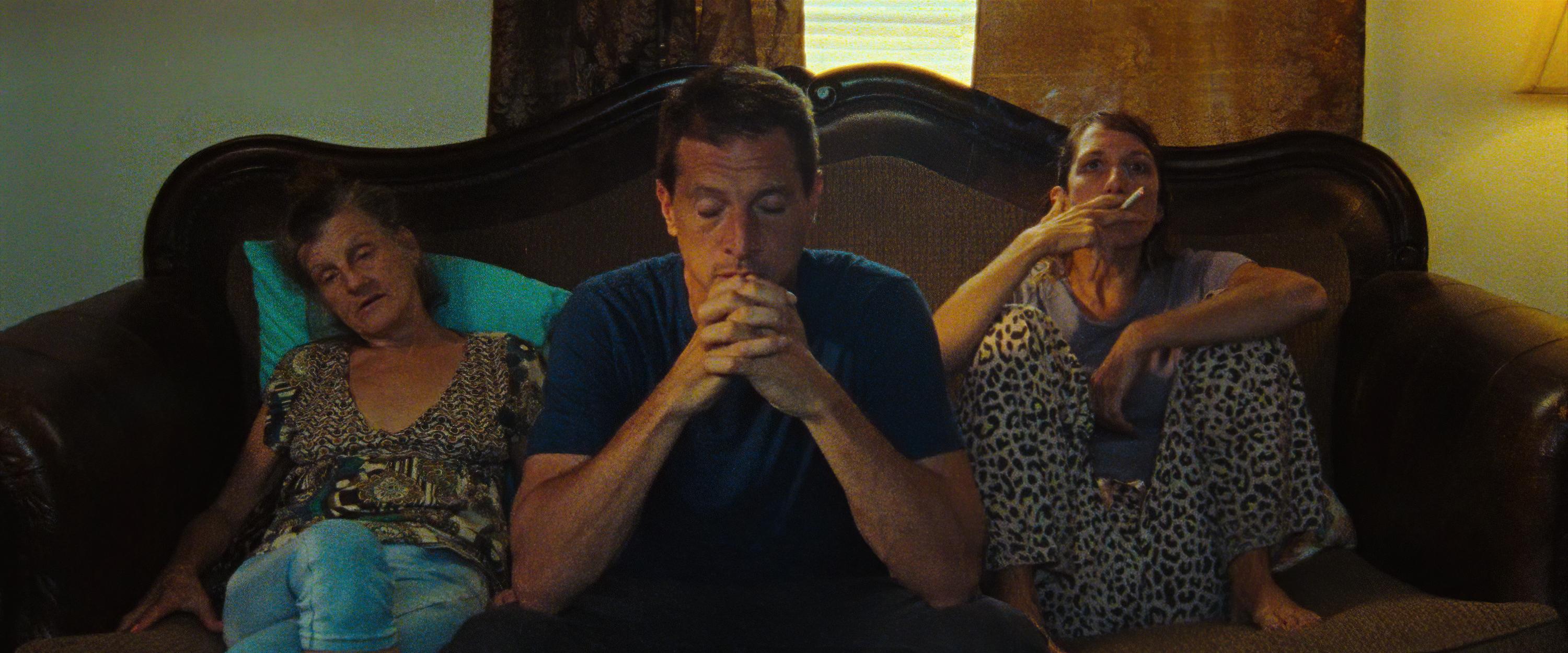
If writer/director/producer/cinematographer/editor and composer Adrian Langley can’t make sense of his muddled thriller “Ash & Dust,” what hope do we mere mortal viewers have?
I mean, kudos for wearing all those hats at once, chief. But all those extra voices you might have had on the set could have told you, “Wait man, this doesn’t make any sense.”
It’s a murderous tale of rural North America, all about the killing people will do to get their hands on this anachronistic box, whose contents we’ll just leave a mystery because that’s what Mr. Langley does.
“Ash” begins with a wintry woodlands chase and execution set in the horseback pursuer/over-under shotgun past.
“Y’can’t outrun fate,” our killer tells his frontier victim before grabbing a box that looks a hundred years more modern than it should.
A century or more later, a guy whose dog gets mauled and killed digs that perfectly-preserved wooden box up whilst burying his pet. He makes the mistake of getting a coin from that box appraised, and all of a sudden a whole daisy chain of killers and relatives-of-killers set upon him, his wife and anybody else they think might have an inkling of where that box is.
We see a thug (Nick Biskupek) and his moll snort cocaine off the box. But that’s not what’s in it.
We see the thug’s nephew (BlakeCanning), with a pregnant wife or girlfriend, join in the shenanigans, asking for “work.”
“You know what we do?”
A guy’s shot, left for dead and survives. A laconic loner cop (Kayla Meyer) walks onto various crime scenes and ponders ponders ponders whatever the hell is going on here and whoever the hell it is that’s doing it.
There’s a whole hierarchy of folks — one with an eyepatch, one with a British accent — who want that box, and as most aren’t called by name, I’ll decline to try and look them up. See the credits below for the names of the cast, whose performances range from indifferent to inept.
It’s a difficult movie to get a handle on partly because the timeline seems to jump back and forth. That cop/sheriff wanders upon a crucifixion in a snow-covered field, the young guy drives up to a house in what looks like early fall and inside that house, we see snow out the windows and characters’ breath fogs up as they engage in a little lick the pistol barrel sexual foreplay.
Back and forth it goes, with even its “revenge” motto — that Confucius quote about when you embark on a journey of revenge, remember to “dig two graves” — seeming totally wrong. The first murders and tortures we see have nothing to do with that. Greed is the engine that drives this story, or would if it had any wheels on it.
Simple as it is, “Ash & Dust” lurches between incoherent and shout-at-the-screen mess and there’s barely a minute that’s worth sitting through the other 83 minutes of it for.
Rating: unrated, graphic violence, sexual situations, profanity
Cast: Michael Swatton, Kayla Meyer, Simon Philips, Nick Biskupek, Olivia Tilly, Blake Canning and Anne-Carolyne Binette
Credits: Scripted and directed by Adrian Langley. A Blue Fox release.
A tragic accident of war is remembered in the quiet and wrenching Danish World War II drama, “TheBombardment,” a film about the day the RAF came to destroy Copenhagen’s Gestapo headquarters and hit a nearby school as well.
Titled, “The Shadow in My Eye (Skyggen i mit øje)” in Denmark, writer-director Ole Bornedal’s film hews to classic disaster movie formula, following several story threads — the lives of those who will be thrown together on that fateful day in the last months of the war.
Frederick (Alex Høgh Andersen) is a working class lad who joined the wrong side, something his enraged father never lets him forget. He’s in the HIPO, Denmark’s secret police, collaborators with the Gestapo who often do the Germans’ dirty work for them. He’s conflicted, but realistic enough to know “the war is lost” and “I’m a dead man.”
Teresa (Fanny Bornedal) is a nun, a teacher at the French Catholic School, so upset at what she’s seen in this war that she questions her faith.
Eva (Ella Josephine Lund Nilsson) is a student, as are cousins Rigmor (Ester Birch) and Henry (Bertram Bisgaard Enevoldsen). He’s witnessed another bloody accident at the start of the film, a wedding party strafed by an RAF Mosquito as they drove to the ceremony. Henry has stopped speaking due to the trauma, and his sister and her friend Eva have little luck getting him to talk again.
There are Danish Resistance fighters, many being rounded up as the Gestapo and HIPO close in, even with the war going so badly for the Axis elsewhere. These fighters know that they only thing that will spare those not already rounded-up and being tortured is a raid on a commandeered Shell Oil building in the center of the city where they Gestapo and HIPO hold prisoners as “human shields” against an air raid.
Some of those Resistance prisoners even know that the RAF has reluctantly agreed to carry out that raid.
Bornedal sets his film in the normalcy of civilian life — families eating and quarreling before school, where the children of Nazi officers inject anti-Semitism into lessons, gently-corrected by the less anti-Semitic nuns. But “Bombardment” is weighted with the doom that the Resistance, the jackbooted HIPO “traitors” and the nervous aircrews prepping for a deadly, little-margin-for-error rooftop level air raid, “Operation Carthage,” that they all know is coming.
I was convinced during the film’s first act that Bornedal (“Nightwatch”) had over-reached, included too many storylines and sidebars. It’s hard to keep everything and everyone straight in your mind and their place in the story.
The troubled, questioning nun is into self-flagellation as she seeks evidence of God in the middle of mass murder.
“We’re not 15th century Jesuits,” her prioress (Susse Wold) scolds her, in Danish or dubbed into English.
Sister Teresa also has dangerous interactions with the traitor Frederik. Young Henry struggles to recover his speech with little effective help from a bullying doctor. The RAF crews are flying in guilt, as they know about their previous mistaken strafing. And more and more Resistance members are picked-up and tortured or summarily executed.
But the sound of “ticking” on the soundtrack takes us into the crowded cockpits of those two-seat bombers, into the school and inside the infamous Shell Building as the picture thunders towards a climax.
“Bombardment” pulls you in, and like the worst videos from Russia’s murderous invasion of Ukraine, doesn’t flinch from showing us the heartbreaking slaughter of war and its frantic-search-for-survivors aftermath.
If you’ve seen other Danish films set during World War II, you’ll know that they generally adhere to a couple of basic narratives. There are stories of the plucky little country’s defiant Resistance to the murderous, morally bankrupt invaders. And we get versions of the oft-repeated account of how they smuggled most of the Jews living there out of the country before the Germans could seize them. Here’s a movie that shows us that not all Danes were righteous, that reminds us that the “neutral” Danes were occupied as a protectorate.
I was struck by how current and topical it all feels. There are still air attack accidents that hit wedding parties and schools and the bad guys are still in the habit of using “human shields” and compiling hit lists of those who resist tyranny.
The flying scenes, bathed in rain and fog, are quite convincing and the delayed fuse (“time bomb”) explosions are more grimly realistic than theatrical.
And the faces of the rescuers, the weepy, frantic parents and the victims will leave you gutted, no matter how numb we’ve all become to the horrors of war and its grisly body count.
Rating: TV-MA, torture, graphic violence
Cast: Alex Høgh Andersen, Fanny Bornedal, Ester Birch, Bertram Bisgaard Enevoldsen, Alex Figueiredo, Casper Kjær Jensen and Olaf Johannessen
Credits: Scripted and directed by Ole Bornedal. A Netflix release.
Pedro Pascal plays the rich dude who hires Nicolas Cage to come hang, Tiffany Haddish and her bud Ike Barinholtz are CIA agents who need Nic Cage’s help, and Neil Patrick Harris is his agent in this potentially hilarious self own/spoof.
As he has proven, time and again over his checkered career, that Nic Cage is down for ANYthing.
Somewhere on the dystopian Road to Nowhere — Destination Thunderdome –a drifter stumbles across a giant nugget and must battle the desert, snakes, scorpions and wild dogs, interlopers and his sketchy partner to hang onto his hunk of “Gold.”
That’s the premise of this “Treasure of the Terra Australis,” a down and dirty and entirely-too-minimalist sci-fi spin on what greed does to a man. So little happens that this might have passed unnoticed had Zac Efron not signed on to star and take a suffer-for-your-art paid vacation in the Outback.
Anthony Hayes‘ film’s stark, arid beauty reminds us of why so many primal tales — apocalyptic to horror to “Priscilla, Queen of the Desert” — have been set there. There are no distractions and survival is visually reduced to its most elemental — water, shelter from the heat, and transportation to get the hell out of there.
As Efron’s loner notes to the roughneck (director and co-writer Hayes) he hires to drive him across it, “It is what it is.”
That goes for the nugget, which is too huge to move without help, and the movie itself. As the driver must go off to obtain the gear to extract it, Efron’s limping, scarred survivor of whatever reduced civilization to this, must stay alive, protect their “claim” and keep his wits in the baking heat and other tests this too-simple thriller throws at him.
Susie Porter plays an Irish-accented trekker curious about what the Man with No Name is doing here, scavenging a crashed airplane for shelter, lighting fires at night to keep away the “dogs” nobody dares call “dingoes.”
I like the look and minimalism in play here. But at some point, something needs to happen — something more, anyway.
Hayes blows the “discovery” moment and gives his own character lines that hint at a gentility his brute of a driver-bloke might have once had — “I don’t mean to condescend to you or nothing,” but this desert can leave a lad in a very bad spot “indeed.”
Efron, covered in stubble, scars, grime and flies, doesn’t do enough to animate the character, give away his past or consider his interior life. He’s just there, exerting himself despite having little water, and we assume going a tad mad over the few days that are the film’s timeframe.
“Gold” isn’t really bad. It’s just not enough to amount to anything, or anything much.
Rating: R for language and some violent content
Cast: Zac Efron, Anthony Hayes, Susie Porter
Credits: Directed by Anthony Hayes, scripted by Anthony Hayes and Polly Smyth. A Screen Media release.
Encounters with real-life survivors of the Holocaust can be wrenchingly emotional. The stories of suffering and travail, the grim resignation of starvation and sudden, brutal death all around you, the soul-searing realization of the inhumanity of humanity can turn even a stony heart into a puddle of tears.
The first survivor I ever interviewed was in Charlotte, N.C., when I worked for a public radio station there. I’ve been grateful that every such interview I’ve done since was for newspapers, because keeping one’s composure can be a real struggle when listening to such narratives, doubly so when you’re in front of a live mike.
“I Am Here” tells the remarkable story of Ella Blumenthal, a survivor who came to the filmmaker’s attention for writing a compassionate “loving” open letter to a Holocaust denier, insisting there was more “that unites us than divides us.”
Born in Warsaw in 1921, Ella was the youngest in her family and one of only three extended family members to survive the mass deportation, enslavement and murder of Jews by Nazi Germany. She witnessed the Warsaw Ghetto Uprising, hid out in a walled-in basement with her father and niece, and survived not one but three Nazi concentration camps — Majdanek, Auschwitz and Bergen-Belsen.
Framing the film with Ella’s 98th birthday party, with family gathered around her, South African documentarian Jordy Sank captures a woman of wit, warmth and pathos as she interacts with her family. She shows old photographs and embraces great grandchildren, grandchildren and her children, who remember hearing her night terrors growing up and the “story” she told them about the car accident she used to explain the scar on her arm, the one where the tattoo with “48632” and a triangle, “for Jews,” used to be.
Sank uses newsreel footage and animated recreations of Ella’s experiences as she narrates her story. We see and hear of the idyllic childhood interrupted by invasion, the terrifying upheaval that entered her life, her fleeing, hiding out and her eventual capture and deportation.
With executions and people starving to death all around her, one cannot help but be moved by the many awful tests of Blumenthal’s touching story of endurance. She even chillingly recalls being stripped and “pushed into a gas chamber” with her niece Roma, comforting the child with “We’ll see our loved ones soon,” only to have the officious Germans open the door with a gruff announcement that they’d met their “quota” for the day.
Through it all, “I never lost hope.” To her offspring, she lectures “Who left this biscuit?” Wasting food remained a cardinal sin for someone who nearly starved many times over five hellish years.
And to the great grandkids who might doubt her, “It’s not a STORY. This really happened!”
But this film’s sentimental depiction of Ella Blumenthal’s later years, thriving and raising a family, gives it a problematic, unspoken subtext. There’s a South African elephant in the room that the South African filmmaker didn’t notice. As we see images from Ella and her husband’s thriving Johannesburg retail clothing establishment in the 1960s, of course we don’t see a single Black face among the staff or the customers.
The Blumenthals lived their entire married lives, with Ella surviving her husband, in the most racist country on Earth. Are we to believe this woman who went through so much in her teens and 20s didn’t have reactions, even flashbacks, seeing the violent removal and relocations of millions of Black South Africans in the 1960s, ’70s and 80s, the “separation” and brutally violent repression of the nation’s majority native-born population?
She didn’t have opinions? Even if she didn’t speak out due to past trauma or fear, surely she had something to say about that. Why not ask? And since you the filmmaker didn’t ask, we left wondering what we don’t know.
Not even touching on this in the most basic documentarian’s CYA way makes this film problematic in the least, damning if there are stories of exploitation and racism woven into what has to be a more complicated family history than Sank presents here.
I dare say only a South African filmmaker would have so conspicuously avoided that, but only if he was planning on showing it mostly abroad. Hearing Blumenthal’s adult children talk to her and about her in their Afrikaans accents just underscores it.
There’s an urgency to every film capturing the stories of the last of the survivors. There are scores of these documentaries, and every survivor telling her or his story is varying degrees of gripping, moving and “life affirming” in that “we must go on” way. Blumenthal’s stirring story would be an invaluable addition to any anthology of various survivors’ experiences.
But when the ethos of keeping these stories alive is “Never Again,” and “Never again” was happening again right in front of Ella Blumenthal and her entire family for decades upon decades, it isn’t “off message” for your movie to make some effort to address it.
Ignoring that is disingenuous at best, and tone deaf at the very least.
Rating: unrated, discussions of genocidal violence
Cast: Ella Blumenthal, her children and grandchildren
Credits: Directed by Jordy Sank. A Blue Fox release.
There’s no horror movie that’s ever been made that wouldn’t benefit from a proper blood-curdling scream, delivered at the right moment by a character under life-threatening distress.
Screen veteran Melora Walters of “Dead Poet’s Society,” “Beneath the Leaves,” “Big Love” and scores of other credits, delivers a doozie of a shriek to open “Offseason.” Playing a vampy actress-mother, she tells her story to the camera, and perhaps her daughter, of running, of “never going back.”
But “Wherever I went,” she laments, “there they were!”
“Offseason” is about that daughter (Jocelin Donahue) being summoned back to the island where her mother is buried. Her tombstone’s “been vandalized.” A storm is ‘a’coming.” So she’d best make it to this remote, palm and palmetto-covered section of the southern coast, where the drawls are thick and the mystery thicker.
Boyfriend George (“Mumblecore” mainstay Joe Swanberg of “Drinking Buddies”) is her hapless, somewhat put-out driver for this emergency trip. He’s the one ready to turn back the moment they reach the drawbridge where the tender (Richard Brake) warns them it’ll be locked up — for the storm, and for the season — if they don’t hurry.
George, of course, is right. Anybody living along the southern coast knows drawbridges are locked “down” not up in storms. There’s something fishy about an island hellbent on being isolated during “off season.”
What ensues is a “Twilight Zone” waking nightmare, with apparitions in the saw palmetto forest and creepers all gathered at the Sand Trap, the local bar where we see just how “off” the inhabitants all seem and how unfriendly they most certainly are.
Daughter Marie finds herself on a lonely quest through the vacant village, along the spooky beach (the “storm” is an indifferent presence, mostly-forgotten), remembering her talks with her mother, scaring George to death with an account she never told him that her mother passed on to her. Mom “didn’t want to be buried here,” no how, no way.
George is, like the viewer, thrilled with this revelation and that it came too late to get them off the island, or keep him from agreeing to risk his neck and his late model Mercedes on whatever the hell Marie’s family’s mixed up in.
Writer-director Mickey Keating, while taking a step up from “Darling” and “Psychopaths,” can’t help but lean on pointless crutches like “chapter” headings for an 83 minute movie. We don’t need to be told a sequence is set in “Lone Palm” cemetery or “The Sand Trap,” or that a character’s about to meet “The Damned.”
And golly, there’s that “locked-up” bridge thing, no necessary to the plot but illogical on every level. Again, the storm bearing down on them is dispensed with. For that matter, who in the name of Jamie Lee Curtis would risk life, limb, boyfriend and Mercedes over a vandalized tombstone?
But Donahue (“Doctor Sleep”) makes a properly spooked heroine, antsy as she pokes around an empty village, puzzling out an answer to this mystery which early on she hints has to do with her fate.
Swanberg? He does “irked” and “ill-used” well. And the locals, including Jeremy Gardner as “The Fisherman,” may be horror tropes, but they’re interesting variations on a theme.
The occasional blood-curdling scream notwithstanding, “Offseason” is more chilling and gloomy than frightening. But the fog, the creepy old coots, the formidable drawbridge as an obstacle and Mama’s cryptic warnings and horror diva shrieks tip the scales. There’s a reason the locals call it “off season,” after all. “Stay away” sounds too hostile.
Rating: unrated, violence, profanity
Cast: Jocelin Donahue, Joe Swanberg, Richard Brake, Jeremy Gardner and Melora Walters
Credits: Scripted and directed by Mickey Keating. A Shudder/RLJE release.
There are more than a few laughs in the coming-of-age dramedy “The Invisible Thread,” about a teen coming to terms with himself and his life with “my two dads.” This Italian “Around the World with Netflix” outing (in Italian, or dubbed into British English) has lovely messaging about parenthood, first love, infidelity, drugs…oh, and Italy’s laughably slow march to legal and social acceptance of gay rights.
And even if “Il filo invisbile” as they call it in Rome stumbles a lot, lapses into melodrama and really doesn’t know when to get off stage, it finishes with a simple “family” image so warm it could move you to tears.
So, a mixed bag? Very much so. But it’s one of the most interesting Italian offerings Netflix has financed, a comedy of misunderstandings and gender expectations, “traditional” vs “unconventional” family clashes and that “edge” that even teen-oriented tales from Italy always deliver.
Leone (Francesco Gheghi) is 15 and together with his best-mate Jacopo (Emanuele Maria Di Stefano) is putting the finishing touches on their class video project, “My Colorful Family.” He’s narrated the broad strokes of all his two dads (Francesco Scianna, Filippo Timi) went through and gave up to have him, from California college pal surrogate (Jodhi May) to legal battles in Italy over everything from his parents’ right to marry to whose names would be on the kid’s birth certificate.
One dad is an anthropologist who ended up running a restaurant, the other a trained architect who settled for owning a kitchen-renovation design business. But they’ve raised a kid in comfort and love, which is all anybody could ask for.
They’ve never taken DNA tests to see who exactly “fathered” the lad. There was never any need, even though “knowing” that would make their documentary more exciting, Jacopo argues.
The parents are uneasy about this project as it is, with restaurateur Simone (Timi) feigning annoyance but architect Paolo (Scianna) fretting that they’ve “raised an opportunist,” willing to “exploit” their unusual private lives for personal gain.
Naturally, events conspire to make that test a necessity. What’s impressive here is the amount of clutter director Marco Simon Puccioni and his co-writers conjure up to point us to that foreshadowed climax.
Leone has to fall in love with the new French girl Anna (Guilia Maenza). Her family has to get all confused over Leone’s parentage, with her brawling bully of a brother Dario (Matteo Oscar Giuggioli) leaping to the his own conclusions.
Jacopo’s science experiments with drugs could interfere — the subtitling/dubbing tries to scrub “cocaine” and ecstasy down to “weed” in a couple of instances. And the school’s obsession with rock-climbing as a sport sets us up for tests beyond the emotional ones that Leone is overwhelmed with.
Puccioni (“Shelter Me”) serves up a few almost-madcap fights and ever-so-Italian shouting matches about sex, sexuality, parentage and cheating and makes a few jokes at California’s expense, a whole lot more at Italy’s expense, with various characters stirring the pot and creating the misunderstandings.
Gheghi is something of a blank slate as our lead, but Maenza picks up the slack as a classic “I’m pretty so I get away with being rude, creating conflict and what have you.” Di Stefano and Giugglioli make sharp impressions in roles that border on being simple “types.”
The two dads are best showcased in shouting matches that point towards a breakup, which plays out as alternately sad and amusing.
And always in the background are those not-quite-getting-it Italians — Anna and Dario, their mom, lawyers, “the system,” hospital doctors and admissions clerks. Perhaps that “culture changing/culture clash” stuff plays funnier in Italy. Let’s hope so.
“The Invisible Thread” could do with a little streamlining, although some of the complications produce daft moments and exasperated laughs.
Clutter aside, it’s a likeable, well-intentioned mess of a comedy, one that’ll leave you with the warm fuzzies even if it loses the “thread” once, twice or thrice along the way.
Rating: TV-MA, drug abuse, sexual situations, profanity
Cast: Francesco Gheghi, Francesco Scianna, Filippo Timi, Giulia Maenza, Emanuele Maria Di Stefano, Matteo Oscar Giuggioli and Jodhi May.
Credits: Directed by Marco Simon Puccioni, scripted by Luca De Bei, Gianluca Bernardini and Marco Simon Puccioni. A Netflix release.
This minimalist, mostly wordless depiction of a milk cow’s life, with human analogies as we see the world from two females’ point of view, has endless buzz, an April 8 release date and almost no awards season attention.