
I mean, considering all the movies he’s smoked in, you’d think he’d look like that Gibson fella. Or, you know, a well used catcher’s mitt.
I mean, considering all the movies he’s smoked in, you’d think he’d look like that Gibson fella. Or, you know, a well used catcher’s mitt.
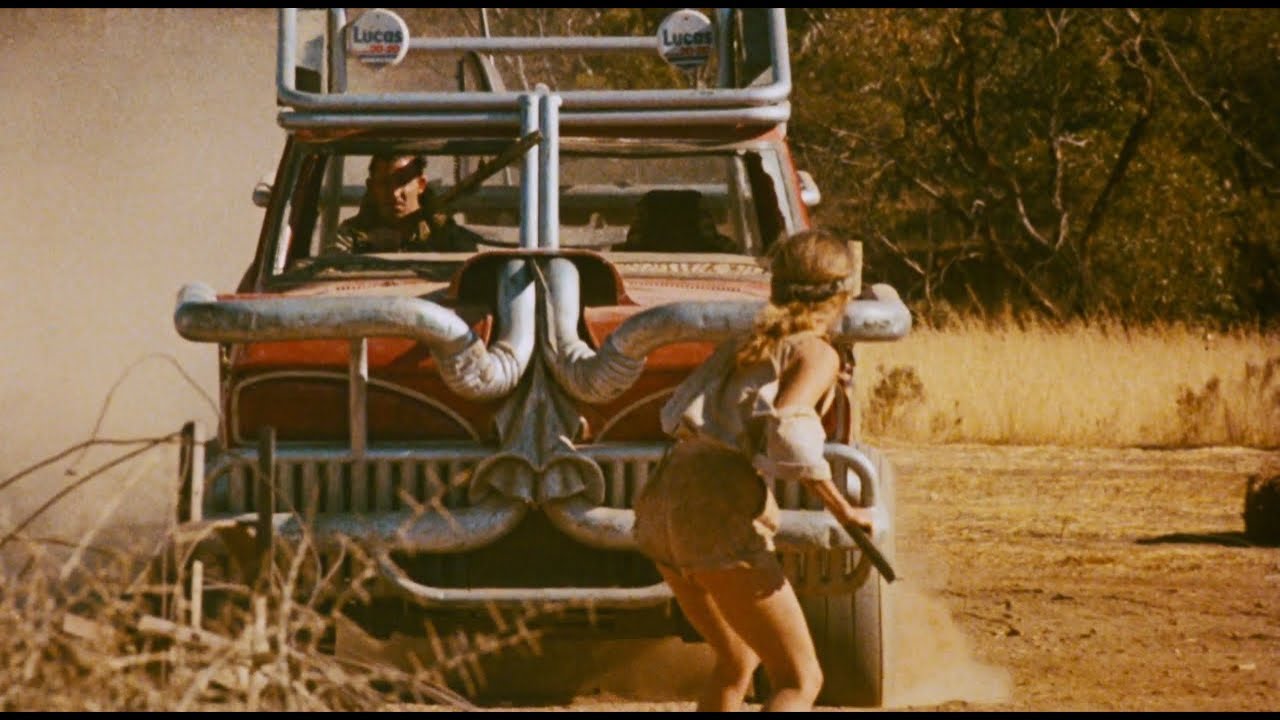
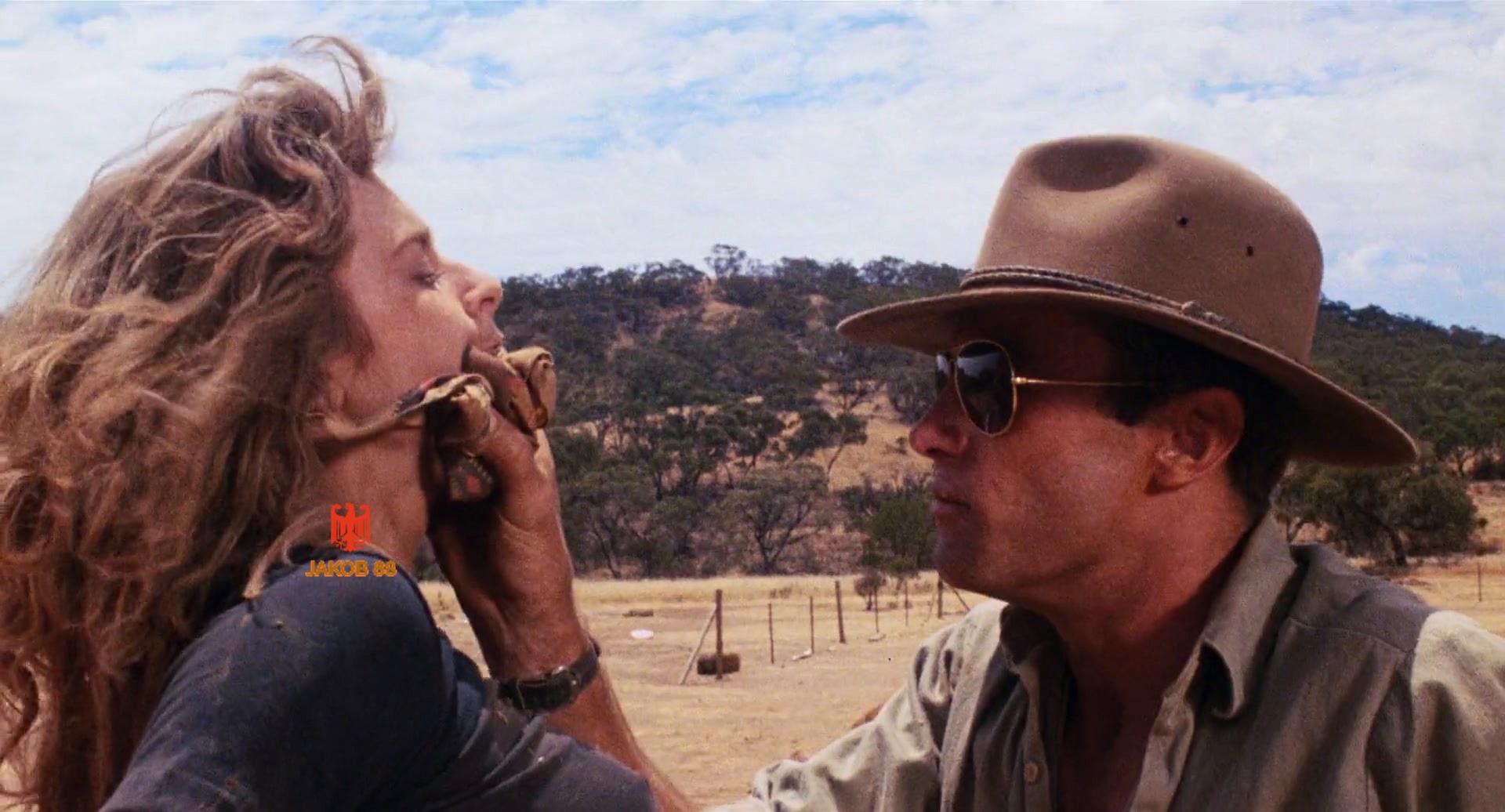
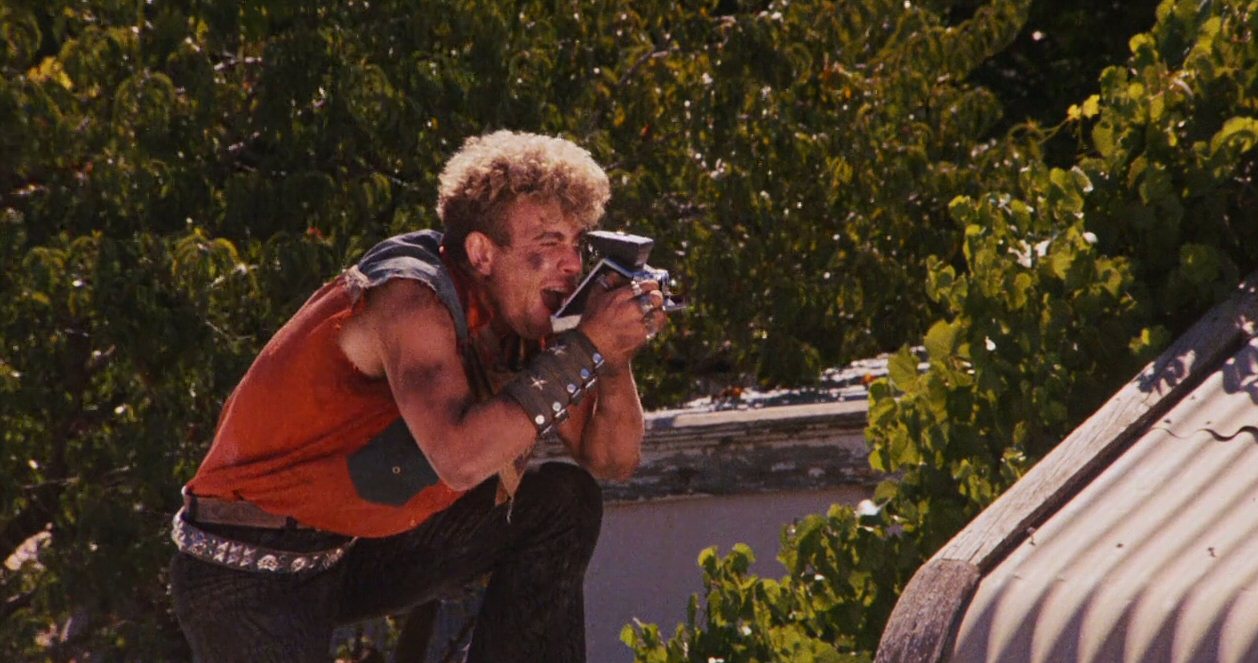
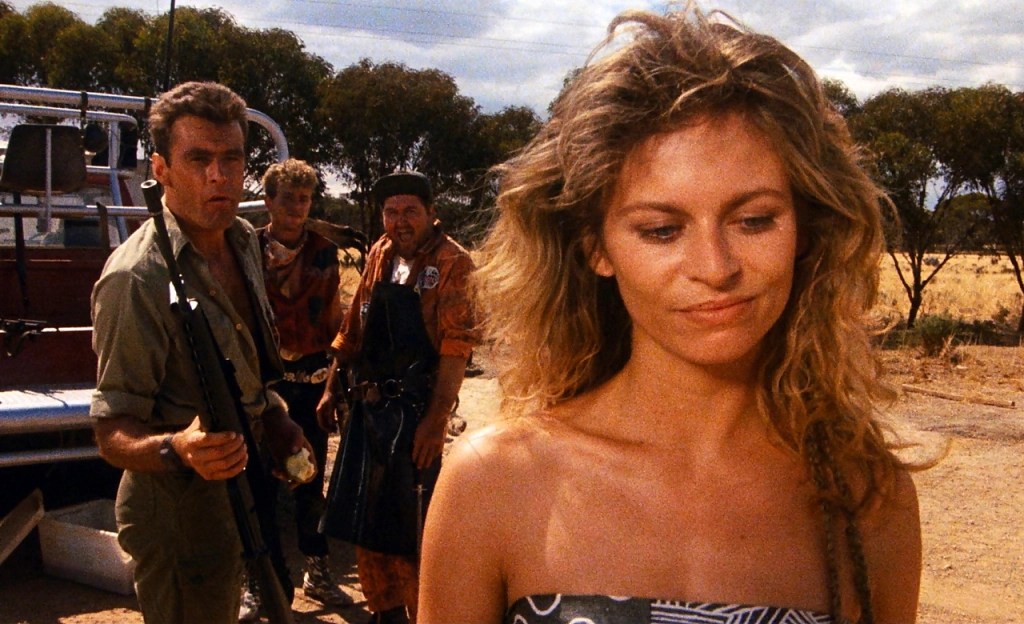
Quentin Tarantino has mentioned the down-and-dirty Outback thriller “Fair Game” as one of his inspirations for his “Grindhouse” segment, “Death Proof.” With cinemas starved for content, why not pull this woman-hunted-by-bogans (Aussie for “redneck goons”) out of cold storage for a little visceral vengeance?
Mind you, Tarantino improved on just about everything about “Fair Game” for “Death Proof.” He had Kurt Russell as his pitiless thrill-killer, real stuntwoman Zoe Bell along with Tracie Thoms and Rosario Dawson playing the “victims,” as in “Guess he picked the wrong broads to mess with.”
He focused on the cars, the antagonists and the nearly relentless terror and suspense of the chase.
There’s a little of that in “Fair Game,” which is about a trio of strangers, kangaroo bounty killers who torment, threaten, chase and torment a woman (Cassandra Delaney) who runs a remote, run-down wildlife sanctuary.
Within the first half hour, tough-enough Jess (Delaney) is being stalked through the waterless Outback by Sunny, Ringo and Sparks (Peter Ford, David Sandford and Garry Who). This comes 15 minutes after they’ve used their big Ute (a modified Ford F-150 of the day) to run her tiny ancient Falcon Ranchero off the road.
Telling the local law (Don Barker) about that led nowhere. “Ha’dly what I’d call a hangin’ offense!” And what happens when people with badges don’t do their jobs? Bad guys are emboldened.
Next thing she knows, Jess is running, riding or hiding for her life. She’s slow on the uptake. Her Australian shepherd Kyla — Do they just call them “Shepherds” Down Under? — figures it out before she does.
These brutes kill her sheep, sneak into her house at night with their Polaroid and photograph her sleeping…in the buff, because, you know, it’s hot.
What’s maddening about the movie is the way the script has somebody hard enough to live in the Outback (her “man” is away) respond — or FAIL to respond — to a clear and present and REPEATED danger.
They come damn near to killing or hurting her, time and again. And she still runs home, or confronts these heavily-armed marauders unarmed and shouts “Leave me ALONE!” as if she thinks that’ll work.
“Don’t think you can scare ME with your sick, pointless game!”
Even after she’s recognized her peril, she repeatedly gets the drop on bad guys and fails to drop the hammer. So naturally they take things up a notch, time and again. And God forbid she actually fight back, because all of a sudden all their sniggering previous thuggery is forgotten and they deserve to “even the score a bit,” classic redneck grievance signaling.
The action is brisk and brutal, the scripted “problem solving” not the worst I’ve seen in such movies. Jess has to use what she’s got on hand as they steadily demolish her ranch and kill the wildlife she’s been trying to save, and some of the “traps” she sets are plausible and interesting, perhaps most interesting when they don’t work.
I mean, only in the movies is Rambo sitting in the very tree above the cop he wants to drop down and clobber from, only in “Home Alone” does an elaborate booby-trap trap the boobies the first time.
I can’t really endorse “Fair Game.” But there’s enough good stuff in it — “Mad Max/Road Warrior” mimicking stunts, etc — that you can see what QT saw in it and why he figured he could “improve” on a good idea whose execution wasn’t all it might have been.
Check it out at a Grindhouse (July 8) near you.

Rating: R, violence, nudity
Cast: Cassandra Delaney, Peter Ford, David Sandford, Garry Who and Don Barker.
Credits: Directed by Mario Andreacchio, scripted by Rob George. A Dark Star release, in theaters and on demand.
Running time: 1:25
The director of “Sinister” and the first “Doctor Strange” movie is behind the camera for this. Looks a bit like “It” and a lot of “Call from the Other Side” thrillers.
Opens Friday.
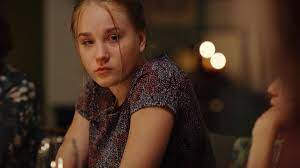
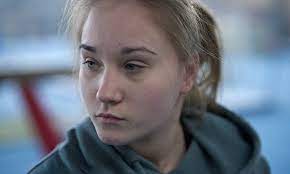
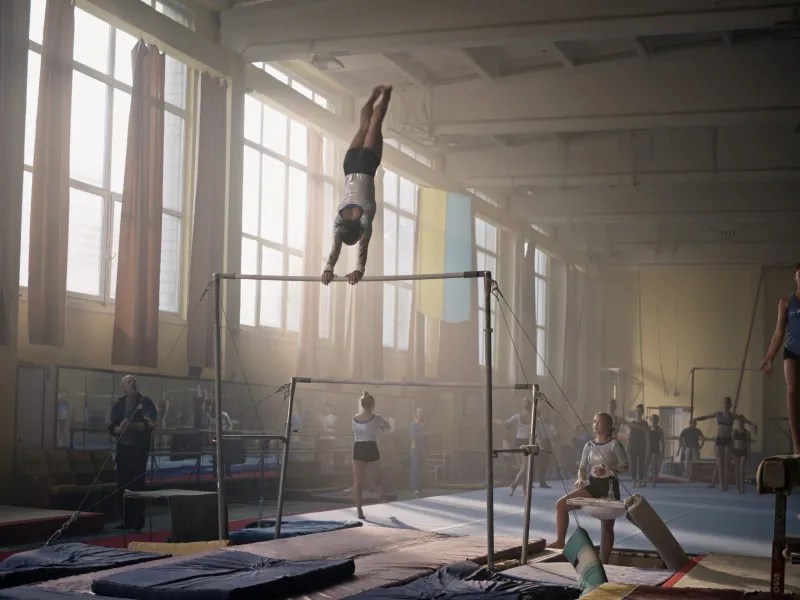
A young gymnast focused on getting to the Olympics faces the serious and deadly-personal distractions of unrest in her native Ukraine in “Olga,” an intimate and moving drama starring real-life Ukrainian gymnast Anastasiia Budiashkina.
The first feature film from Swiss director and co-writer Elie Grappe takes us inside a sport and into a historical flashpoint — Ukraine’s 2014 “Revolution of Dignity” — for a gripping story at the intersection of sports and politics.
Olga is having enough pulling off her Jaeger release on the uneven bars, when her country’s turmoil and her mother’s place in it become a life-and-death “distraction.”
She’s a muscular, hyper-focused Kyiv teen prepping for the European championships, self-involved and resentful for her widowed mother’s inattention when it comes to her passion. But Mom (Tanya Mikhina) has her own all-consuming life’s work. She’s a journalist covering a corrupt, Russian-backed regime in a country on the precipice. It’s 2013, and Mom’s work gets her attention, some of it unwanted.
She and Olga are rammed with murderous intent on their drive home from gymnastics practice and Olga is cut up in the crash.
Months later, she’s having to adjust to an abrupt change in her life. She’s in Switzerland, a part of a team there, trading on her late father’s Swiss citizenship and leaning on his family for a place to stay as her mother’s gotten her out of the danger zone.
Olga speaks a little French, which doesn’t mean her unfriendlier teammates can’t get away with a little smack talk in German or Italian in trilingual Switzerland.
She’s stubborn, ignoring direct instructions to stop trying to master that Jaeger by her new coach, ignoring his “No practice alone” edict, neglecting her studies. She misses her friends, isn’t all that welcome in her grandfather’s house, and then Ukraine bursts into violence. Not only does she have to rethink her application for Swiss citizenship. She adds “guilt” to the swirl of emotions she’s got to tamp down to make it in the sport that has dominated her life thus far.
Grappe and co-writer Raphaëlle Desplechin narrow the frame of the film, concentrating only on Olga, her trials and her reactions to every bit of Internet bad news from home. Her best friend Sasha (Sabrina Rubtsova) had been Facetiming her accounts of what’s going on with the old team. Now, she’s all about Maidan Square, ground zero for the uprising, and what life is like on “the barricades,” questioning Olga’s priorities and patriotism.
Olga is rattled, lashing out at her mother who keeps cutting her off as she puts herself in danger to cover the huge and violent story that is exploding around her. And her new teammates aren’t all fans. Things are sure to come to a head in that locker room, sooner than later.
Casting Budiashkina pays dividends all around as she shows us a poker-faced competitor with a vulnerable side. She’s utterly credible on the uneven bars and other gymnastics competition categories. A lot of screen time is spent establishing her personality on the bars, refusal to give up on something difficult, sucking it up when it counts, in or out of the gym.
It’s a near perfect performance in an intensely myopic movie, a film that narrows our focus to what matters much as it does Olga’s, and lets its protagonist and star surprise us more than once along the way.

Rating: unrated, violence, teen smoking, profanity
Cast: Anastasiia Budiashkina, Tanya Mikhina, Sabrina Rubtsova, Théa Brogli and Caterina Barloggio.
Credits: Directed by Elie Grappe, scripted by Raphaëlle Desplechin and Elie Grappe. A Kino Lorber release.
Running time: 1:25
C’mon. Who doesn’t love Zoey Deutch?
Dylan O’Brian co stars. Searchlight made this edgy comedy, about an influencer who bends the truth to become “a victim.”
It comes to Hulu July 29.


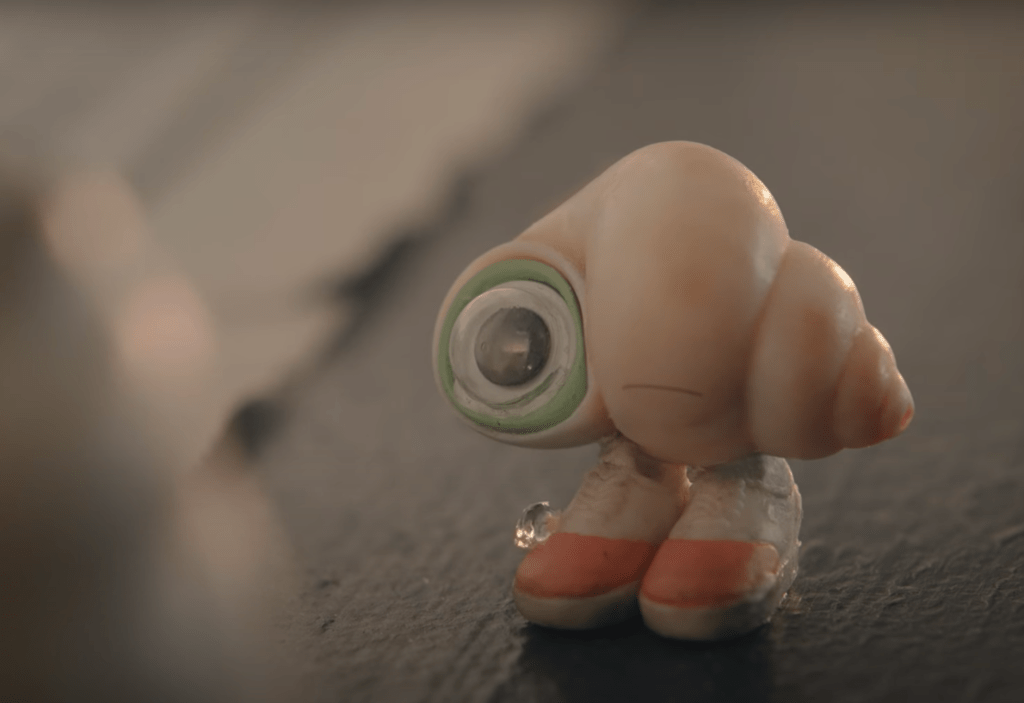

“Marcel the Shell with Shoes On” is a charming little stop-motion animated project built on an Internet/Youtube sensation from long ago. Well, pre-Pandemic anyway.
Dreamed up by Jenny Slate, then freshly-dropped from “Saturday Night Live” for dropping a live f-bomb, and her then-husband Dean Fleischer-Camp, it’s about a one-eyed, talking hermit crab shell with pink sneakers.
The humor is built around mousy-voiced Marcel (Slate, who also does voices of “Bob’s Burgers” and many others) observed coping, adapting and DIYing his way through the human-scaled world, drolly commenting on what he’s experiencing and what he’s observing, always with a child’s understanding.
“Marcel the Shell” starts with the sight gags — a tiny shell showing us his diet, interacting with (stop-motion-animated) bugs and a live Jack Russell terrier, throwing up on a car ride and, once he’s gotten Internet famous, bouncing on a MacBook keyboard, writing or web searching his Youtube videos, marveling at how many people watch this ongoing “documentary” about him.
He interacts with the human whose house this now is, Dean (Fleischer-Camp), who talked Marcel into being interviewed for his documentary. Marcel, sometimes reluctantly, demonstrates ways he gets around, gets things done and improvises transport (he cuts a hole in a tennis ball and rolls around), uses wire-tops from champagne corks to make tables and chairs, etc, and turns a sewing machine into a gadget that tugs on twine that shakes a tree out the window so that he and his grandma can harvest apricots.
“I like myself,” he opines, “and I have a lot of other great qualities as well.”
An aproned woman periodically comes into the house where he lives — “She’s a harbinger of the vacuum.”
His beloved Grandma Connie (Isabella Rossellini) is another shell with shoes, and a more reluctant participant in interviews for the film. She requires some explaining, Marcel figures.
“She’s not really from here. She’s from the garage. That’s why she has the accent.“
That’s the other source of giggles, Marcel’s deadpan humor. A teeny, tiny living shell has to flee things like vacuums and a friendly, curious canine.
“I actually like the concept of having a dog.”
The film tells the story of Marcel wondering where his and Connie’s family and “community” went, and shows us flashbacks of another couple arguing, splitting up, and in the noise and confusion of that, hiding shells — friends and family — must have been whisked away in the move.
That takes this story into something deeper, or at least bittersweet. Marcel is lonely, and he wants his grandma to have that community around her as well. Helped by Dean, he starts the process of searching — via Marcel’s comically childish (and inadequate) clues and Google search ideas.
“Marcel the Shell” takes on an undertone of childhood longing, loss and grief as Dean’s posted videos make The Shell with Shoes famous, but brings Marcel and his Grandma the stress of overzealous fans who find Marcel’s house, while getting them no closer to finding their community.
Maybe Granny’s favorite TV show and TV interviewer, Lesley Stahl, can help.
The back-story to this project — which took years to complete — is that Slate and Fleischer-Camp split up themselves, and yet agreed to carry on with it. That split gives a poignant, wistful undertone to “Marcel” if you know about it coming in.
There’s also the unmistakable sense that this years-in-in-the-making stop-motion tale, built on ideas, jokes, and Internet novelty from a dozen years ago, kind of missed its moment. Twee can have a short shelf life, and once we’ve gotten the Youtube-length-joke the picture loses some of the edge that makes it interesting.
But while “Marcel the Shell with Shoes” might have lost its cutesy, two-person production DIY cachet, he finishes the journey to the big screen with his charm and Slate’s wit intact. What he goes through can be laugh-out-loud weird, and surprisingly touching. And if this film is Marcel’s teeny, tiny curtain call as a cultural phenomenon, it’s a perfectly adorable one.

Rating: PG, some suggestive elements.
Cast: The voices of Jenny Slate and Isabella Rossellini, with Dean Fleischer-Camp, Rosa Salazar, Thomas Camp and Lesley Stahl.
Credits: Directed by Dean Fleischer-Camp, scripted by Dean Fleischer-Camp, Jenny Slate and Nick Paley. An A24 release.
Running time: 1:28

“Swap Me, Baby” is a self-consciously goofy two-handed farce about a mismatched couple about to have a baby.
Their story? He’s “an escort, and the condom broke.”
It’s a stoner “Catastrophe,” for those who remember that Sharon Horgan/Rob Delaney TV series of a few years back — trippier and raunchier if not as sensitive or frankly, as funny.
But for a no-budget “body swap” comedy (“Big,” “Freaky Friday,” etc) made by a German and an American who apparently met making a German TV series, a film so simple that it could’ve been shot during a COVID lockdown, it’s not half bad.
We meet Lily (Kimberly Leemans) and Phillippe (Falk Hentschel) at couples counseling. She’s smart, hyper-organized, if too busy to date. That’s implied because she’s pretty and 30something and she had to hire an escort.
Phillippe, on the other hand, is a porn-stached Frenchman who happily accepts the label “off brand Fabio” as a description. He’s a ditz whose hair is too long, his shorts too short and his attention span nothing to brag about.
Unfiltered red alert warnings from their therapist (Ava Bogle) tell them that their baby has no prayer in this world if they don’t get it — something, anything — together. So Juniper the licensed therapist lets them pick from the solutions provided by this treasure chest (“magic box”) she stores such solutions in. That sends them to this forest “Empathy Getaway.”
Lily has them listening to a “things that can KILL your baby” podcast on the drive up. Phillippe is laid-back, showing off the magic mushrooms he figures they’ll share once they’re “on vacation,” and making plans for Little Phillippe’s future. He could be a musician!
Lily is NOT accepting “Little Phillippe” as a name, and she’s not having the whole music thing.
“You don’wan’ him to be a muuusician, like Broose Springsten or Samuel JackSON?”
Phillippe really works the French accent, and “dumb pretty boy” thing.
They fight until they arrive, fight after they arrive and Phillippe wanders off to be with nature and take his ‘shrooms. And it’s while he’s tripping (distorted images, animated birds and butterflies visit) that the “magic box” makes another appearance, bubbling out of a hot spring. He hasn’t sobered up when Lily shows up, accuses him of stealing the box from the shrink’s office, and sha-ZAM, they’re knocked out wrestling over it.
When they come to, Lily is puzzled to be in a man’s body — Phillippe’s. And Phillippe?
“I always zought ‘aving boobies would be fun. But zey kind of ‘urt!”
The mismatched expectant parents are stuck in each other’s bodies to learn to be better parents. The magic box will spit out clues about things to do. Lily gets this in an instant.
Those are “the riddle in every ‘body swap movie.'” She knows the genre. But as the puzzles and exercises change, her ability to outthink the “riddle” is tested. They’re given a bow and arrow, and a (fake, obviously) rabbit to shoot for food. But even though Phillippe considers himself a manly man — for a Frenchman — being stuck in Lily’s body gives him a big belly and “no upper body strength!”
Lily knows that somehow, they have to work around this and other problems if they’re going to be able to parent this child.
“I should’ve watched the ORIGINAL ‘Freaky Friday! F—–g Lindsay Lohan!”
I got a charge out of the French accent each actor has to attempt once Phillippe is in this body or that one. There’s comical nudity, lots of sexual humor, fart and masturbation jokes that try to get by on “Oh no they didn’t” shock value.
For me, there are more “almost laughs” than actual ones, although the pacing is brisk and the jokes that land zing. The predicted “body swap movie” “lesson learned” sweet moments show up, right on cue, and the picture — giggles or not — just skips by to get to those moments.
But there wasn’t enough funny stuff going on to keep me from getting lost in the novelty of watching the most convincingly pregnant actress I’ve seen on screen wrestle with an “off brand Fabio” out of lust, post-coital munchies, etc.
Was Leemans pregnant when she made this? That big baby bump certainly looks real, and while I can find no news coverage of the co-stars as a couple and having a baby together — neither one is a big name and thus they both live below the gossip sheet headlines — there is this. Well, mazel tov, kids! I think.
It’s a pity “Swap Me, Baby” didn’t dazzle. But no matter how many paying customers see it, you’ve still got something like the ultimate home movie to show your kid, when they’re old enough for (should be) R-rated movies.

Rating: unrated, drug abuse, nudity, profanity
Cast: Falk Hentschel, Kimberly Leemans
Credits: Directed by Caden Butera, scripted by Jesse Lumans. A Scatena and Rosner elease.
Running time: 1:21
Animated? Why yes it is. Weird? A24 has it. You betcha.
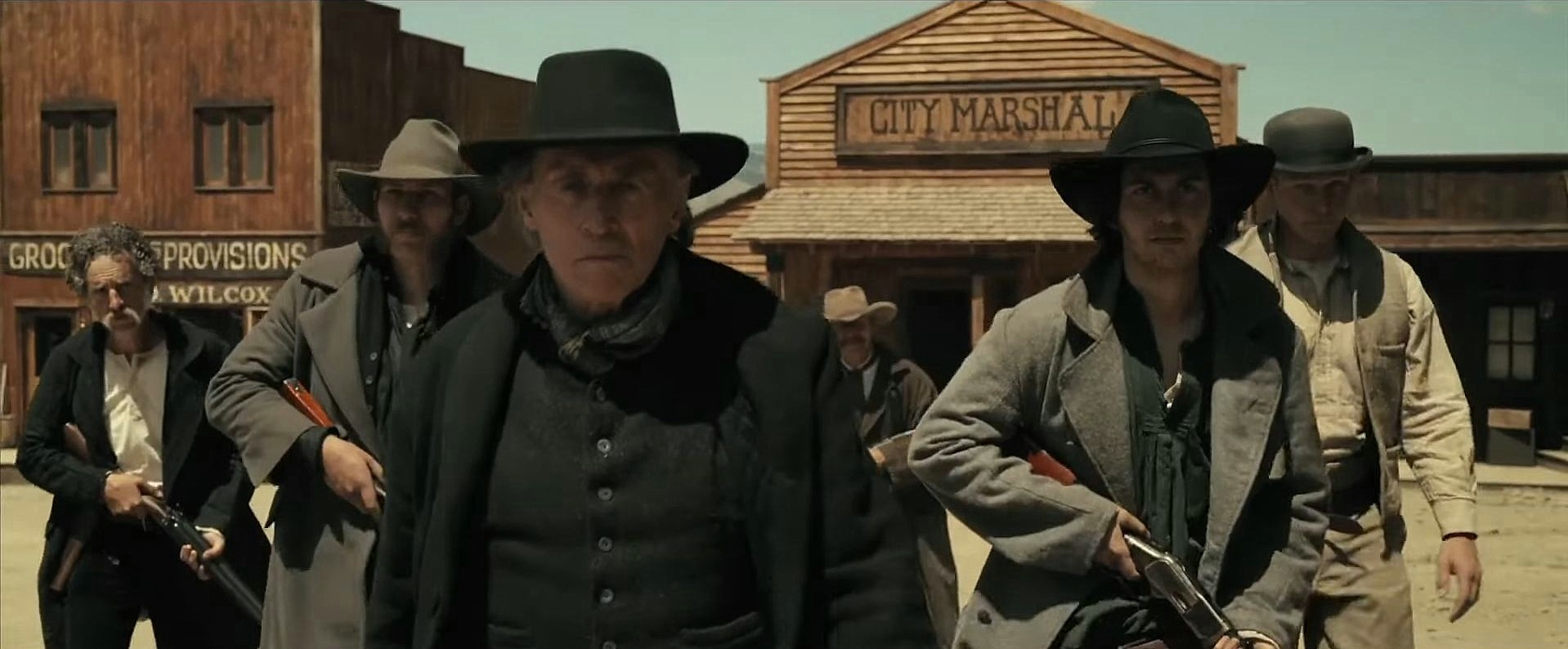
For Western fans who aren’t all that particular about how they get to The Big Shootout, and aren’t that concerned about how pokey the picture is that gets them there, we give you “Murder at Yellowstone City,” a murder mystery set in frontier Big Sky Country.
That Big Shootout? It’s a doozy, with the good guys and gals muttering questions about how good each is with a firearm.
“Good as I needed to be. And you?”
“Better’n I ought to have been.”
That last line kind of fits the movie, which is basically a primo Western filming location in search of a movie. They rounded up a decent cast, an Aussie director who’s made a few films (that recent “Robert the Bruce” outing) and a middling script and had a go.
The results aren’t great. The picture’s predictable except when it’s at its most illogical, and the pacing is slow-footed when it needed to canter. But hell, you throw Thomas Jane, Gabriel Byrne, Scottie Thompson, Anna Camp and Oscar winner Richard Dreyfuss against a saloon wall, you’re going to hit something.
Hanging your plot on Old Spice spokesman/spokesmodel Isaiah Mustafa isn’t the worst gamble ever, either.
There’s a decent backlit shot or two, tidy newly-built recreations of an Old West town, and Mel Elias managed a proper Western score, with lots of diegetic — on set, played live fiddle, piano and guitar tunes. The basics are here, even if they’re not in the most thrilling package.
Mustafa rides in as the stranger in town, a guy who might’ve thought twice about changing directions when he heard the explosion. A miner in the foothills has just struck gold.
But the stranger finds a fellow Shakespeare buff (Dreyfuss) behind the bar in the Miners Saloon, and a pleasant tune from the barkeep’s life partner (John Ales of TV’s “True Story” and “Euphoria”).
“I’d give all my fame for a pot of ale, and safety!”
The sheriff (Byrne) seems like a stand-up guy, a widower with a motherless son (Nat Wolff, last seen in TV’s “The Stand”). And that sheriff even makes sure church is full on Sundays, which suits the preacher (Jane) and his helpmate/wife (Camp of “Pitch Perfect”).
But then the celebrating miner is murdered, “the stranger” is rousted and arrested and the bloodletting has only begun as everybody — from the madam in the brothel (Aimee Garcia) to the Native woman who runs the stables (Tanaya Beatty) — will have to take sides.
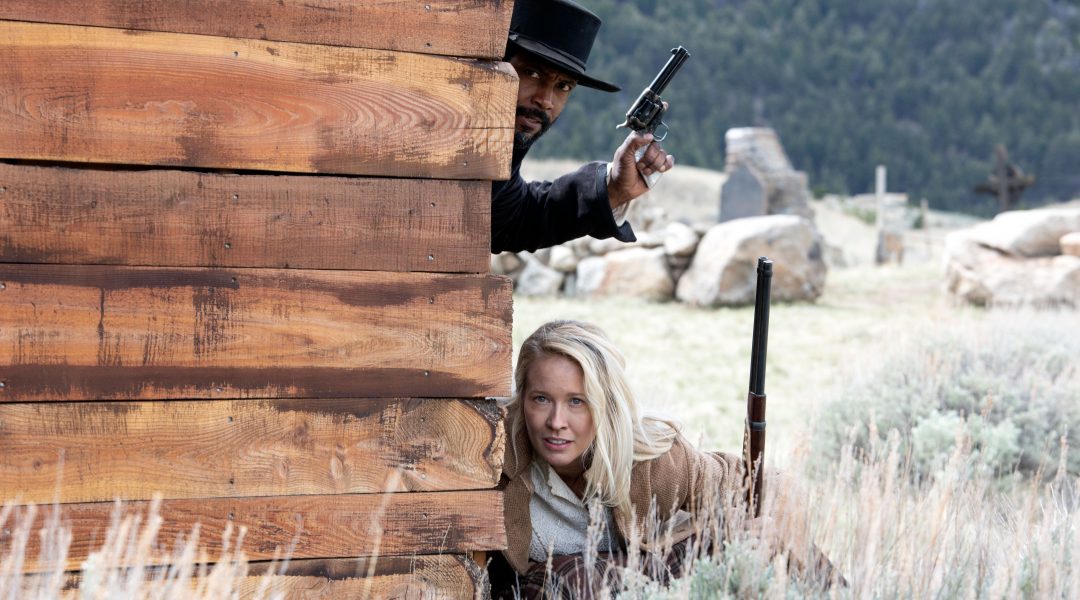
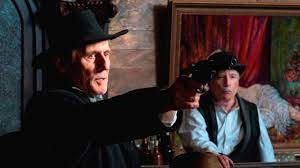
The bit players aren’t remotely on the charismatic and believable level of the leads. Some of the dialogue is just clunky and other bits — every word out of the ex-slave Cicero’s mouth — are eye-rollingly florid.
“What man can know the morrow?”
The “mystery” is one of those that an old hand at the genre will figure out in the first act.
While every Old West town was “New” at some point, the new construction and cleanliness of the bar/brothel and the spotless wardrobes make one wonder if a dry cleaner wasn’t the first business to open here. Nothing looks lived-in or worn.
The scenery is striking, but the digital photography has more of a travelogue tint than anything leathery, dusty or decorated with sagebrush. None of which would call attention to itself had this 90 minute Western murder mystery not slogged along for 2:07.
The producers and screenwriter Eric Belgau had a few novel ideas — gays and African American drifters in the Old West, for starters. But “Murder in Yellowstone City” stumbles most badly in the editing or lack of it, a location-in-search-of-a-Western trapped by the needs to justify dead weight scenes that get fair value out of every big name they needed to cast to get this financed. And once financed, they neglected one last rewrite of the script, because the one they filmed leaves too much of the action in the hands of lesser talents.
Rating: unrated, graphic violence, sex
Cast: Thomas Jane, Gabriel Byrne, Isaiah Mustafa, Alice Camp, Aimee Garcia, Tanaya Beatty, Nat Wolff and Richard Dreyfuss.
Credits: Directed by Richard Gray, scripted by Eric Belgau. An RLJE release.
Running time: 2:07

Everybody has their own threshold of tolerance of or enthusiasm for the dominant streaming service.
If you’re hooked on series, love the online version of water-cooler conversation about “Stranger Things,” “Squid Games,” earlier break-out “Ozark” and the like, you’re probably getting enough out of Netflix.
But if you’re a Taika Waititi fan, you can’t help but notice his series are on Hulu or HBO Max. “Handmaid’s Tale” and a lot of other content is over on Amazon.
And don’t get me started on Disney+ and its Marvel/”Star Wars” content stranglehold.
For me and I dare say a lot of critics, even the hottest series are a time investment whose limited shelf-life — Who reads reviews of a series a month after it’s come out? Six months? Six years? — isn’t worth it.
When I do review such series, I’m consistently out of step with the popular sentiment and TV critic reviews of such shows. Either I’m watching deeper into the series before filing or I have different standards for what I expect out of a “WandaVision” or “The Great” or “Mosquito Coast” or even that damned Baby Yoda thing.
The storytelling style is obvious and annoying, a simple tale padded out for time and cliff-hanging suspense. I simply prefer the more compact, brisk storytelling of movies, which are more like novels and plays. TeeVee seems more soap opera/comic-bookish in terms of The Never-Ending Narrative. Everything is designed to bring the viewer back, to postpone or never-actually-deliver real endings.
You end your show, it’s a “failure,” seems to be the thinking.
And anyway, preferring movies is how I keep running into the wall with Netflix. They’re not making enough or buying enough that haven’t been shown elsewhere to make the streamer worth my trouble.
I looked ahead and saw that Netflix has the Sony production “The Man from Toronto,” with Kevin Hart and Woody Harrelson, an action comedy about a hit-man, the Ryan Gosling Russo Brothers (ugh) actioner “The Gray Man,” and Dakota Johnson’s take on Jane Austen’s “Persuasion.”
That’s it. So I got an early look at “Toronto,” and maybe I’ll renew if “The Gray Man” becomes the first ever Netflix action picture to truly pay off. I liked “Spiderhead,” but every other actioner starring Hemsworth or Theron, Pena or whoever, has been kind of “write these action guys a check and hope for the best” bust.
Dakota Johnson doing Jane Austen! The mind reels.
A LOT of Netflix movies suffer from that “blank check to Hollywood” filmmaking. They’ve been spending money with little genuine “studio” supervision by people who know what makes a good movie. Every studio start-up goes through this.
Another problem is the algorithm that determines what Netflix offers for your viewing pleasure. You watch one Indonesian or South African or Indian or Peruvian movie, because it’s guaranteed to be something neither you nor many others have reviewed, and that’s what they fill your feed with.
One has to dig and dig and dig to find content outside of what they “think” you want. Not just just a film critic problem, but it is what it is. Netflix is always time consuming to browse because it’s trying to outguess you. Ask anybody.
So I’ll take a break, pay more attention to Apple TV, Amazon, Hulu, the major studios and the minor distributors, and see how long it takes for me to miss Netflix again.

 Movie Nation