Movie Review: Viennese Couples face digital love’s pitfalls in “Lovecut”

The most perilous minefield in the movies might be daring to explore teen sexuality on screen.

Raunchy farces use the cover of comedy, because everybody knows taking this subject seriously risks crossing the line into straight-up exploitation. And whatever notoriety you want for your film, few are going to embrace the scandal of turning up on a “hot teen sex” web search.

And yet every generation has a version of Larry Clark’s salacious “Kids,” with that film’s screenwriter, Harmony Korine, unleashing “Spring Breakers” a generation later.

Those are the stakes for filmmakers’ Iliana Estañol and Johanna Lietha’s “Lovecut,” a never-sordid but somewhat sterile survey of sexuality in the social media age set amongst the young, beautiful and under-parented in Vienna. They take care to avoid the whole “hot teen sex” trap by limiting nudity and keeping their focus on the young couples, their challenges and the life-altering dead-ends they can drift into trying to figure out love and sex on their own.

Everybody in the movie has secrets. Each of them is homeless, recklessly rebellious or otherwise damaged going in. And all of them end up in relationships limited or doomed by the digital nature of dating for this generation.

Anna and Jakob (Sara Toth and Kerem Abdelhamed) are in the white-hot heat stage of their affair, always in search of the next place they can “do it,” and capture what they do on video. Instagram keeps taking down Anna’s exhibitionist displays of their ardor. But if they want to move in together, the older (maybe 19) Jakob has an idea — uploading their videos to paying porn sites.

“But what if our friends see them?” Anna frets, as if their friends aren’t seeing them in bed, on rooftops or wherever the next sexual selfie is set.

Besties Luka and Momo (Luca von Schrader and Melissa Irowa) are bar and club-hopping teens on the loose, each providing the other with cover and a sense of security as Luka drags Momo — who likes playing with the assumed name and guise of “Olga, from Russia” — along on a Tinder date with Ben (Max Kuess).

Luka is all about messing around. “I don’t want a relationship,” she insists (in German with English subtitles). “Me either.” And “No FEELINGS,” she insists.

Momo isn’t content being the third wheel for Luka’s “no feelings” hook-ups. But her relationship with Alex (Valentin Gruber) is strictly online, video calls for mutual, semi-clothed masturbation. She’s anxious to meet in person, but Alex isn’t.

The “secrets” here range from the obvious to the genuinely surprising, and all point to what we “know” about someone based on their social media profile and the superficial nature of the love connections.

Everybody’s young and sexy in their streak-dyed hair, top knots, torn fishnets, short skirts or belly-baring shirts. Getting beyond that is where everything turns messy — “too old for her,” probation, greed, “using” people, exhibitionism and the like doom every affair captured here, a generation digitally trapped in a learning curve that earlier ones never had to contend with, although each era has its own challenges.

For all their film’s surface intimacy, Estañol and Lietha have the hardest time connecting the viewer with these kids. We may see their flaws and emphasize with their challenges, but there’s a clinical distance to the portrayals, a Teutonic iciness that robs them of emotions.

Nobody cries at what they’re going through, no one loses her or his temper at the way whoever they’ve hooked-up with uses them.

The drama is limited to a few mild parental outbursts, a lot of measured, under-challenged acting-out, plenty of episodes where things come to a head and yet don’t. Not really.

This milieu, kids flopping from apartment to house-breaking to checked-out hotel room that the maids haven’t cleaned yet, has an earthy promise that rarely delivers. Younger viewers may find a character to identify with, but the movie presents us only with superficialities — the hot guy on probation, the “virgin” who wants not just experience, but a real boyfriend.

And the message of “Lovecut,” that there is no “learning” through all this, unless it’s learning to manipulate each other and get away with murder with your parents, is just dispiriting.

Rating: unrated, sex, nudity, alcohol abuse, all involving teens

Cast: Sara Toth, Max Kuess, Kerem Abdelhamed, Luca von Schrader, Melissa Irowa and Valentin Gruber.

Credits: Scripted and directed by Iliana Estañol and Johanna Lietha. A Film Movement release.

Running time: 1:34

Posted in Reviews, previews, profiles and movie news | Comments Off on Movie Review: Viennese Couples face digital love’s pitfalls in “Lovecut”

Movie Preview: Thor gets the Band Together for “Love & Thunder”

The rest of the “team” he assembles to take down the great evil menacing the universe makes its bow.

Looks fun, and by July 8 we’ll all need a laugh and a reason to duck into a cold cineplex.

Posted in Reviews, previews, profiles and movie news | Comments Off on Movie Preview: Thor gets the Band Together for “Love & Thunder”

Movie Review: Life in Service of the “Good Madam” has supernatural consequences in this South African Thriller

“Good Madam” is a tight, lightly-chilling horror tale from South Africa, a parable of a housekeeper and what “life in service” can mean, in a supernatural sense, in the former Apartheid state.

And how this relatively simple story has twelve listed screenwriters may be the ultimate example of sharing the credit in what is always described as the ultimate “collaborative” art form.

Tsidi (Chumisa Casa) and her little girl Winnie (Kamvalethu Jonas Raziya) have just shown up at the door of the elderly, wealthy woman her mother works for. Tsidi, who was raised by her grandmother, was forced out of the house by greedy, manipulative family members when she died. As her baby daddy (Khanyiso Kenqa) is an undependable lump, mother Mavis, “Sisi” (Nosipho Mtebe) is who she turns to.

She and her mother aren’t close, and the reason is as obvious as the first ting-a-ling of the bell that elderly Diane summons Mavis with. Mavis couldn’t get away to attend her own mother’s funeral.

As we see her 60ish mother on her knees, scrubbing floors, teetering on step stools to dust light fixtures and hear her mother sternly remind her daughter of “the house rules,” we get a bad feeling about what’s going on here. This is something beyond the whitewashed version of such relationships — “devotion.” Tsidi says the obvious out loud.

“She has you living under Apartheid!”

But mother-daughter quarrels and flashbacks to the testy family meeting that cost Tsidi her home are just sideshows. As she pokes around the house, things start to happen. That husky who stuck his head in the door and gave her a look?

“Oh, he died years ago.”

When Winnie notices her mother turning paranoid and obsessed, Mom’s words of comfort are no comfort at all.

“It seems this house doesn’t like Mama.”

Director and co-writer (with many others) Jenna Cato Bass saves most of the jolts here for the third act. The patient pacing means we’re allowed plenty of time to wonder who or what and in what form the “Good Madam” is behind that locked bedroom door, which neither Tsidi nor Winnie should ever attempt to open.

“Rules of the house,” remember.

The dialogue, in English or Xhosa (play it with closed captioning on), is spare and often argumentative. Piecing together relationships and the final twists requires your undivided attention.

But the story has hints of Edgar Allan Poe and other masters of horror about it, and is clever enough to be well worth a look, no matter how many credited screenwriters it took to come up with it and polish into the production screenplay.

Rating: unrated, violence, profanity

Cast: Chumisa Casa, Nosipho Mtebe, Kamvalethu Jonas Raziya, Sanda Shandu and Khanyiso Kenqa

Credits: Directed by Jenna Cato Bass, scripted by Babalwa Baartman, Jenna Cato Bass, Chumisa Cosa, Chris Gxalaba, Khanyiso Kenqa, Steve Larter, Sizwe Ginger Lubengu, Nosipho Mtebe, Kamvalethu Jonas Raziya, Sanda Shandu, Siya Sikawuti, Peggy Tunyiswa. A Shudder release.

Running time: 1:32

Posted in Reviews, previews, profiles and movie news | Comments Off on Movie Review: Life in Service of the “Good Madam” has supernatural consequences in this South African Thriller

Movie Preview: Strangers Tess and Keith meet at an AirBnB from hell — “Barbarian”

Labor Day, all you people will see why ol’Rodg always stays in hotels.

Posted in Reviews, previews, profiles and movie news | Comments Off on Movie Preview: Strangers Tess and Keith meet at an AirBnB from hell — “Barbarian”

Movie Review: Survivors Face the Sad Aftermath of Gun Violence — “Peace in the Valley”

Movies that take us beyond showing gun violence as entertainment are rare. It’s not just the immediate, factual consequences of what happens when a human being is shot, the damage done and the trauma of the moment that we rarely see. The void that comes after the horror is mostly undiscovered country.

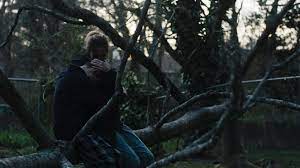
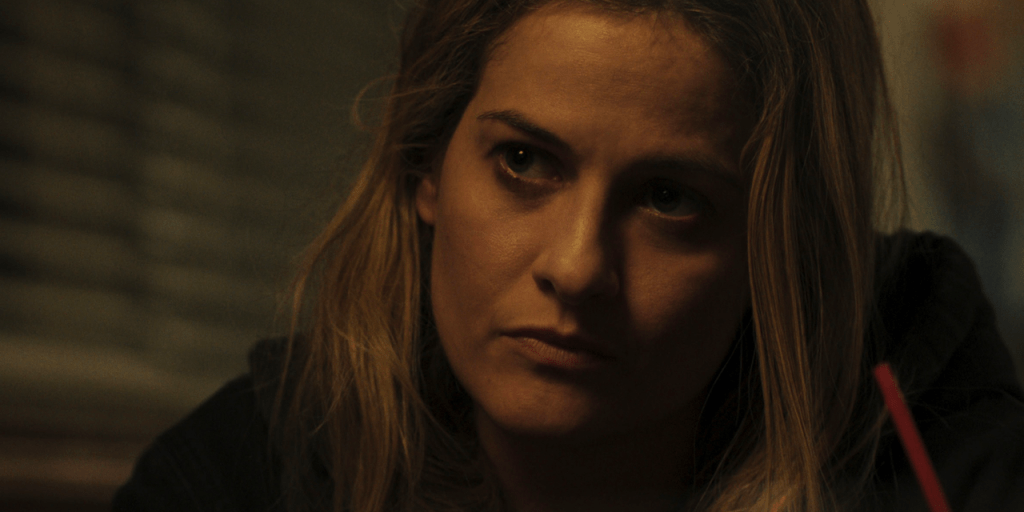
“Peace in the Valley” is an indie drama that goes there, a quietly compelling account of what comes next and the varying responses of a newly-widowed mother to the tragedy that happened almost right in front of her.

It was just supposed to be a short stop at the supermarket, a trip to pick up items needed for ten-year-old Jess’s (William Samri) science project. We see Dad (Michael Abbott Jr.) indulge the kid, egg him on to race against the clock so they can get in and out, and Mom (Brit Shaw) try to temper that irresponsible joke.

And then we hear the first shots. As John herds his family into the back and sprints to the sound of the gunfire, Ashley weeps and we hear the unmistakable rat-a-tat firing of a semi-automatic weapon.

“Peace in the Valley” isn’t about a shooter, that shooter’s motives, the machine-gun makers, marketers and apologists, or any other victims. It’s about this family’s response to the aftermath, the empty feeling that the funeral engenders, the late arrival of John’s more devil-may-care brother (also Abbott) and what he’ll do to comfort his nephew and sister-in-law.

“Peace” mainly rests on the shoulders of Shaw, a veteran of TV guest-shots and small parts in little-seen features, and she doesn’t disappoint. Ashley is sullen enough around “Uncle Billy” to suggest that they have history, that she knows this tactless, camo-clad jerk a little too well. Her comforting mother (Dendrie Taylor) is little comfort, and her suggestion that “It’s ok to need help” gets dismissed.

The last thing Ashley wants is the “pointless pity party” of a support group, she says.

But overwhelmed and acting-out, ducking into the local honkytonk to drink and get hit on, and not rebuff it, tells her she might be wrong. Even the bar singer hitting on her recognizes her.

“I guess I’m pretty famous right now.”

Self help in a group setting is a must, but only fellow griever Sandra (Nicky Buggs) seems relatable to Ashley.

With clingy, hyperactive Jess fighting in school and begging her to let him join gun culture with fun Uncle Billy, who tactlessly invites him to “go see if we can nab us a buck,” weeks after his father was gunned down, Ashley needs all the help she can get.

Writer-director Tyler Riggs, of “God’s Waiting Room,” finds a few twists and turns to throw at us in this somewhat novel variation on a timeworn “grief” melodrama. The occasional seriously sad exchange stands out as much as the sexual come-ons, which are jarring and generic thanks to their grating male writer-director’s point-of-view “tells.”

Punches are pulled and things left unsaid in Ashley’s disapproval of her tactless brother-in-law’s hunting invitation. But in this corner of the world, being anti anything to do with firearms is not something the pickup truck set says aloud.

“Peace in the Valley” is a good film, showing a lot of promise behind the camera and in front of it. Hopefully somebody will pick it up and distribute it, and soon. Because if there’s any country that needs to consider how crushing and disruptive gun violence is, it’s this one.

Rating: unrated, sex, profanity, smoking

Cast: Brit Shaw, Michael Abbott Jr., Nicky Buggs, William Samri and Dendrie Taylor

Credits: Scripted and directed by Tyler Riggs. Reviewed at the Tribeca Film Festival.

Running time: 1:28

Posted in Reviews, previews, profiles and movie news | Comments Off on Movie Review: Survivors Face the Sad Aftermath of Gun Violence — “Peace in the Valley”

Documentary Review: An Afro-Latina filmmaker takes an unblinking look at herself and her family in “Beba”

The documentary as autobiography has been around for a while, with filmmakers like Ross McElwee (“Sherman’s March”) turning “personal essay” films into exercises in family history and a soul searching exploration of one’s place in it.

Filmmaker and sometime actress Rebecca Huntt makes a Millennial-defining statement on the genre with “Beba,” an alternately searing and scalding piece of family history that doesn’t spare the beautiful narcissist doing the examining, either.

“I am the lens, the subject, the authority,” she declares in voice-over behind images of her on the beach, walking the New York streets and the like. “Violence lives in my DNA. I use it to hurt those closest to me.”

A film eight years in the making, shot on sumptuous, saturated (16mm) celluloid, “Beba” explores “the curses of my family slowly killing us,” seeing herself as the product of her striving and succeeding immigrant parents and her trainwreck siblings, and her place within that circle of pain.

Her father fled Trujillo’s dictatorial oligarchy and its “ethnic cleansing” of the Dominican Republic to New York, where after the shock of seeing 1960s Bedford Stuyvesant , vowed to get out of there and move his family to Central Park West. Which, after marrying a rebellious middle class Venezuelan college graduate, he did.

Huntt, whom her mother nicknamed “Beba,” and her two older siblings, lived with their parents in a crowded rent-controlled one-bedroom apartment at that tony address, “the poorest kids in Central Park West.”

She talks with her doting, proud Dad and her reluctant mother. And while we don’t know how they made a living and managed to lift this family into the middle class, we start to get a hint of Beba’s grievances, how she doesn’t really “get” her father, and heaps blame on her stern, fair-skinned mother, who snippily cuts off the interview in the middle of Rebecca’s accusation of “microaggressions.”

“I am going to war,” she warned us in the opening voice over, “and there will be casualties.”

Existential angst is laid bare in this self-portrait masquerading as family photo album. We don’t really hear from her estranged brother Juancarlos, just that he made Beba cry on a family drive to Disney World “and that’s the last time my brother remembers our father talking to him.” Her free spirited, pot smoking, rebel sister Raquel whirls through a chain-smoking walk/chat that reveals little but her restlessness, “agoraphobia” Beba says.

Director of photography and camera operator Sophia Stieglitz got years of shots of model-slim and pretty Rebecca/Beba as she debates “privilege” with her mostly-white college crowd, remembers a Latin lover who killed himself and weeps while singing a sad Dominican song at a karaoke bar and narrates her story in voice over.

Still, the Disney World trip and Central Park West clues hint at a pretty normal, middle class upbringing. Rebecca got into prestigious Bard College, indulged by her favorite professor (interviewed here), who recalls her seemingly taking that education for granted, she was shaped by an upscale and free thinking school where Mia and Ronan Farrow, Tom Ford, Todd Haynes, Chevy Chase and Christopher Guest and the rich lads who formed Steely Dan matriculated and where the great philosopher Hannah Arendt once taught.

She studied abroad, and chose Ghana in West Africa for that. Rebecca Huntt all but demands that we ask, “What is this spoiled, entitled brat’s problem?”

She talks about Blackness in identity politics terms, but we aren’t shown specific examples of barriers and burdens associated with race and class. She moves back home some time after college, and admits her callous treatment of her and describes the ongoing war with her brother that includes his cruel sabotage — in her eyes — of a coveted job interview in film production.

And she finds the most pretentious turn of phrase for wanting to learn to cook for herself, “making time for the ritual of cooking.”

Yes, there are eye-rolling moments at her expense aplenty. But as we remember this is her film and that her portrayal is under her control, we appreciate the bluntness, the “snitching” she’s doing on her family, whom she confesses may “never speak” to her again, and herself.

Her family’s history, and her own racial status, help explain Beba’s angst. And if she’s asking DNA-deep questions, looking for answers and somewhat adrift and perhaps not wholly self-aware as she does it, maybe that’s a hallmark of her generation.

“Beba” is not a feat she’ll be able to repeat, not with herself and her family as subject matter. She’s unlikely to ever have the many years it took to make this deep dive. Thanks to this beautiful, nakedly honest film, she could be a filmmaker and a screen presence to watch. Or this could be that one movie she has in her.

Either way, Huntt laid it all out there and put it all on the screen and let the family-rending chips fall where they may, and she should be celebrated for having the guts to strip herself and those around her this naked with her snitching.

We are all heroes of our own stories, victims of our own tragedies. And as Huntt reminds us, at times we can be the villains, as well.

Rating: R, for language (profanity)

Cast: Rebecca Huntt

Credits: Scripted and directed by Rebecca Huntt. A Neon release.

Running time: 1:20

Posted in Reviews, previews, profiles and movie news | Comments Off on Documentary Review: An Afro-Latina filmmaker takes an unblinking look at herself and her family in “Beba”

Movie Review: French soul searching on the trail — “My Donkey, My Lover & I”

“My Donkey, My Lover & I” is one of the unexpected filmgoing delights of this summer. It’s a French road comedy in which the “road” is a famous French hiking trail pioneered by a legendary Scottish writer, the vehicle a donkey and the journey one of romantic self discovery through beautiful scenery, cozy hostels and homey dining rooms..

So, “Eat, Bray Love” it is, then.

Titled “Antoinette dans les Cévennes” when it came out in France, it’s about a French fifth grade teacher out to meet a lover in the The Stevenson Trail, a multi-day trek through the Cévennes region along a route Robert Louis Stevenson took with a donkey named Modestine, from Puy-en-Velay to Ales.

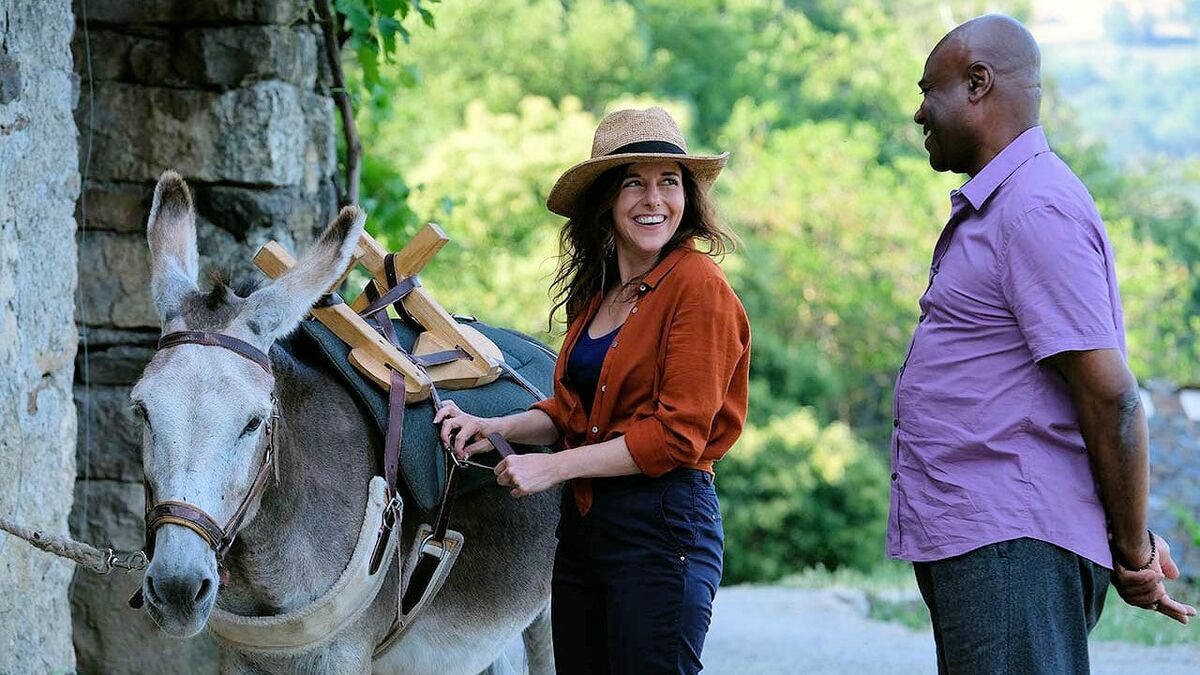
Antoinette Lapouge (Laure Calamy) wasn’t planning on taking this trip, at least not alone. When we meet the vivacious 30something she is changing into a fancy costume in her classroom, and topping that inappropriate overexposure by leading her kids in an end of year performance of a too sexy love ballad.

Parental eyebrows are raised, especially when Antoinette, in a fit of passion, takes over the singing at the end. And then we see who this exhibition was for. Vladimir (Benjamin Lavernhe) is the father of one of her students. The second they can grab a moment alone, they’re going at it.

But their little “vacation” together is off. He’s married and he’s taking a donkey hike with the wife and daughter. Antoinette may not be a hiker, or an experienced donkey handler, or even somebody who knows how to tie a proper slipknot. That doesn’t keep her from impulsively booking such a trip on that same trail herself.

We’ll see who ruins whose vacation, won’t we?

A Hollywood version of this story would have played-up the mayhem Antoinette causes or might cause by finding and crashing her lover’s family vacation. It would have leaned hard on the quirky eccentrics she meets on the trail and milked stubborn donkey jokes for all that they’re worth.

Writer-director Caroline Vignal, inspired by Stevenson’s “Travels with a Donkey in the Cevennes,” goes for something gentler, if just as light. It’s a quirky spiritual journey in the tradition of “The Way,” whimsical and soulful, but with swearing and braying.

Right from her first meal with a table full of strangers in a hostel, Antoinette is interrogated, mocked for doing things the Stevenson way with a donkey, which is an added hassle, and gently-and-not-so-gently judged for her life choices, her affair with a married man — the father of a student, no less.

“You’re right,” she giggles, in French with English subtitles. “Shame on me.”

Her over-sharing that first night sets up a running gag. Antoinette makes this trek in notoriety. Her plans to “stumble into” the lover and his family are widely known, and sometimes scorned. Almost every hostel keeper and many others on the trail know her story.

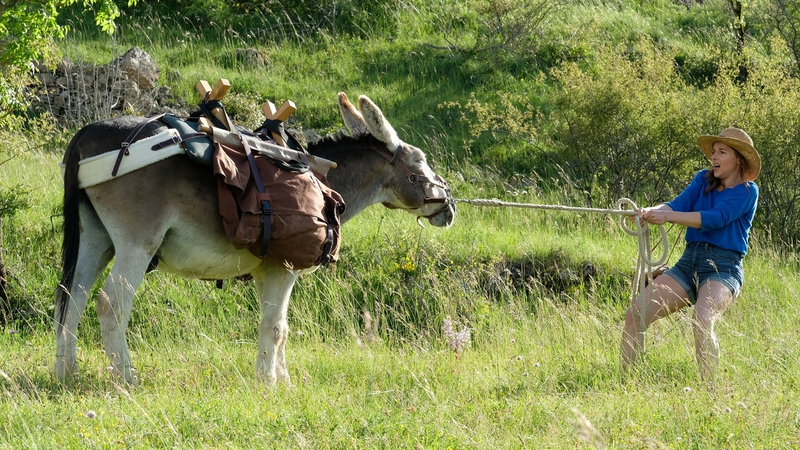
And if you don’t know how to curse in French, her interactions with Patrick the Irish donkey are a great primer and another running gag.

The donkey is just enough of a character in this film to register, a critter who only walks when she talks to him. Her talking, on these 20 or so kilometer a day hikes, is filled with chatter about Vladimir, what she loves and what she hopes, her anger and her despair and longing for this unavailable mate.

Naturally, when the donkey finally meets Vlad, his wife (Olivia Côte) and child, he’s had time to form an opinion of them.

“My Donkey” is a travelogue with weepy moments and grace notes — Antoinette breaking down at the sight of a loving, hostel-running couple and their kids, and then comforted by the story of why Stevenson took his own solitary trek told to her by sympathetic husband Idriss (Denis Mpunga).

The picture gets by on such moments, but even the meandering that goes on between them is cute and has its own charm.

If you’re looking for low-exertion a summer escape movie with a bucket list travel destination as its setting and a donkey and the hapless, lovelorn sap who rides him as its stars, “My Donkey, My Lover & I” certainly fills the bill.

Rating: unrated, sex, nudity, profanity

Cast: Laure Calamy, Benjamin Lavernhe, Olivia Côte and Denis Mpunga

Credits: Scripted and directed by Caroline Vignal. A Greenwich Entertainment release.

Running time: 1:36

Posted in Reviews, previews, profiles and movie news | Comments Off on Movie Review: French soul searching on the trail — “My Donkey, My Lover & I”

Netflixable? So is Kevin Hart or Woody Harrelson “The Man from Toronto?”

Kevin Hart‘s always good for a few manic, exasperated laughs. Laid back Woody Harrelson adds value to pretty much anything he’s in.

Both are experts at “buddy pictures.” “The Man from Toronto” should be a pretty safe bet.

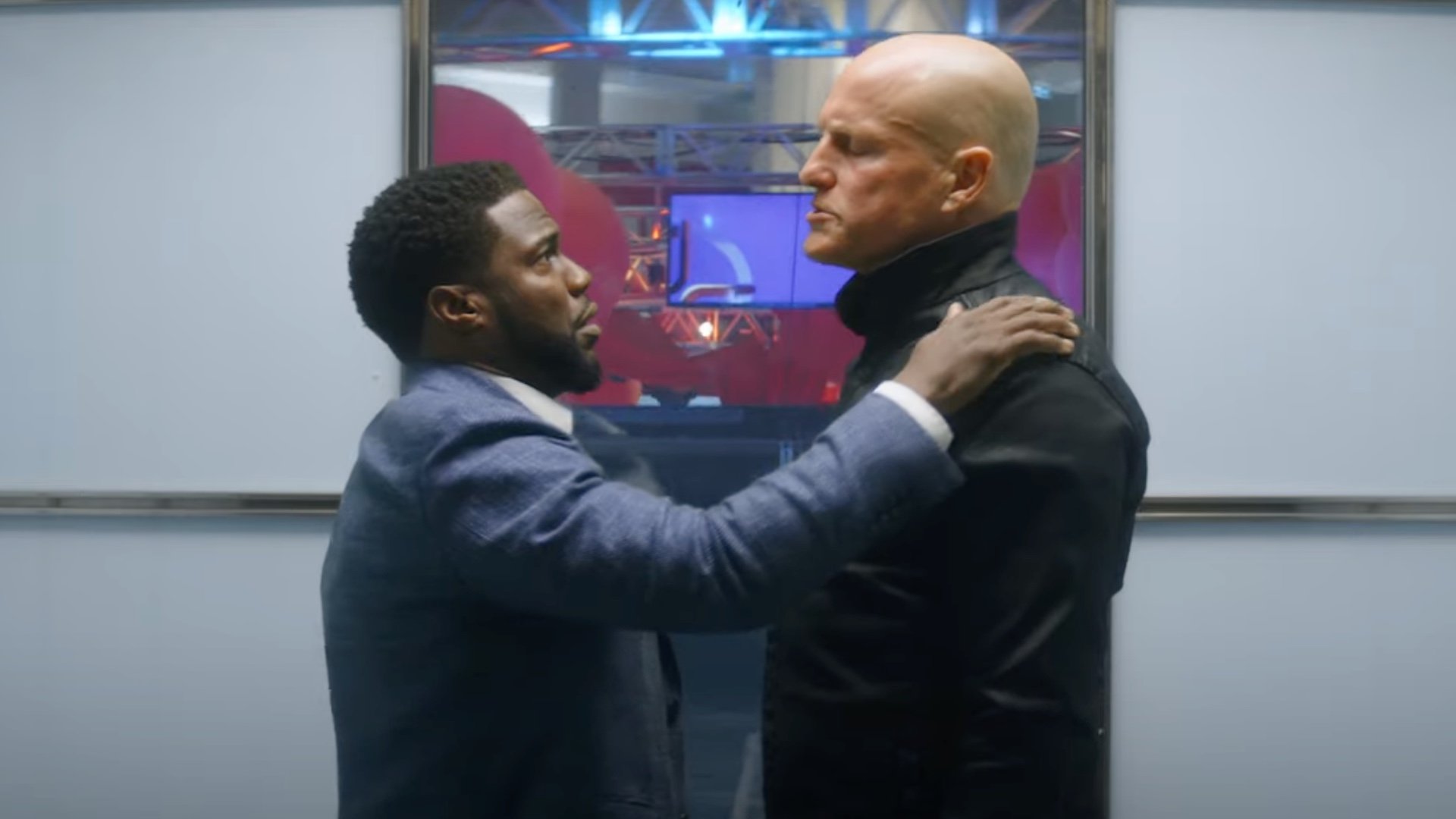
And it is. Safe. There’s a little energy and the tiniest hint of edge to this hit-man meets the guy confused for a hit-man action comedy. But as likable as the two stars are, as experienced as each is at sharing the screen this way, they barely make this “Man” worth your trouble.

Hart’s a fumbling promotions manager at a friend’s gym. Or was. We see him get the sack. His “big ideas” weren’t big enough, or smart. He’s always been like this, creating DIY Youtube exercise videos for the “Teddy Burn” and “Teddy Boxing” (no punches land).

“All the ‘WOW without the ‘ow!'”

“Teddy” has a reputation, which even his wife Lori (Jasmine Matthews) has heard of. His name has “become a verb.” Everybody knows what it means to “Teddy something up.”

They’re getting away for the weekend, to scenic Onancock, Virginia. But after dropping Lori off at a spa, Teddy rolls up to the wrong address for their AirBnB. They two guys there are waiting for someone else. As one guy is tied up and the other has failed to get some needed information out of him, we can guess what “The Man from Toronto” will do.

Especially since we’ve seen this shaved-head, black-hat, shades, overcoat and gloves “specialist” at work.

“When you beg for your life,” The Man tells the first victim he tortures on behalf of a mobster, “I’m not gonna hear your screams.”

But since no one’s ever SEEN this “Man from Toronto,” that’s who they think Teddy is. A nice bit of business — Teddy sees the guy tied up, spins on his heels with a “Oh hell n…..” He’s stopped, and instantly he starts to wing it.

Some mysterious someone from Venezuela has hired this expert “in 23 martial arts,” “a ghost.”

“They say he filleted an entire poker parlor in Minnesota!”

Teddy’s mix-up becomes a government problem when they bust in. He’s been photographed, and now all these mobsters and bad faith/bad state actors think he’s the real “man.” In a “North by Northwest” twist, Teddy is forced to continue the charade. He’s been through some things. He’s about to go through some more.

“The Man from Toronto” only finds its first laughs some minutes in, when Hart and Harrelson’s characters meet for the first time. The “real” man tests the fake one by using his trademark. He quotes s 19th century poets as a code. Lay some Keats on me, little man.

“You wanna hear her old stuff or her new stuff?”

“Well, HE…died at 25.”

“You got some SACK to come with no gender etiquette! ‘He’ may not IDENTIFY as ‘he!'”

It wouldn’t be much of a movie if the “real” man executed the fake one straight off. The script turns itself inside out to keep them paired up, hunted by the Feds and those who hire guys like “The Man from Toronto.” They send “The Man from Miami” (Pierson Fode) after him.

A couple of half-decent escapes and stunt-double-assisted brawls pay off. The whole “Man from” gimmick has promise, because every city has its “man,” apparently. Some one-liners land, such as the way Teddy takes what he’s heard from the Feds and other thugs to relate how he became a hit-man.

“Are you stealing my origin story, now?”

The pretend “relationship” has Teddy and Lori double-dating with his “friend” and hers (Kaley Cuoco).

Cuoco’s presence in this points to a general gripe about Netflix “star” comedies. They spend all their money on the stars (Jason Statham originally had the title role, and Sony set this up for theatrical release). And there’s nothing left for the supporting players.

Sitcom-sharp Cuoco registers and manages a funny moment, but no other supporting players in this thing is famous or funny or was given anything amusing to do.

The leads click well enough. But every moment Hart and Harrelson aren’t on the screen, the film dies. The real torture in this torture comedy becomes the too-long wait for it to end.

Rating: PG-13 (Some Strong Language|Violence Throughout|Suggestive Material)

Cast: Kevin Hart, Woody Harrelson, Jasmine Matthews, Pierson Fode and Kaley Cuoco

Credits: Directed by Patrick Hughes, scripted by Robbie Fox and Chris Bremner. A Netflix release.

Running time: 1:50

Posted in Reviews, previews, profiles and movie news | Comments Off on Netflixable? So is Kevin Hart or Woody Harrelson “The Man from Toronto?”

Movie Preview: A Killer trailer for Paramount’s “Smile”

Here you go. Yes, you have to wait until Sept. 30 to grow your own grin.

Posted in Reviews, previews, profiles and movie news | Comments Off on Movie Preview: A Killer trailer for Paramount’s “Smile”

Movie Review: Will Alice Krige have her revenge? “She Will”

The South African actress Alice Krige first gained notice in America in a sprawling “Tale of Two Cities” TV adaptation that broadcast in 1980. But her fate was ordained by her big screen debut.

In “Ghost Story,” she was the young woman once coveted young men, who now haunts the old men — Fred Astraire, Melvyn Douglas and John Houseman — who caused her death half a century before.

Although she has enjoyed a grand run in film and on TV in a great variety of roles, playing up her scary side has proven her secret to longevity.

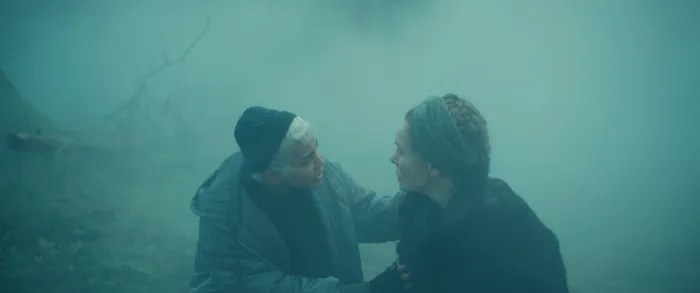
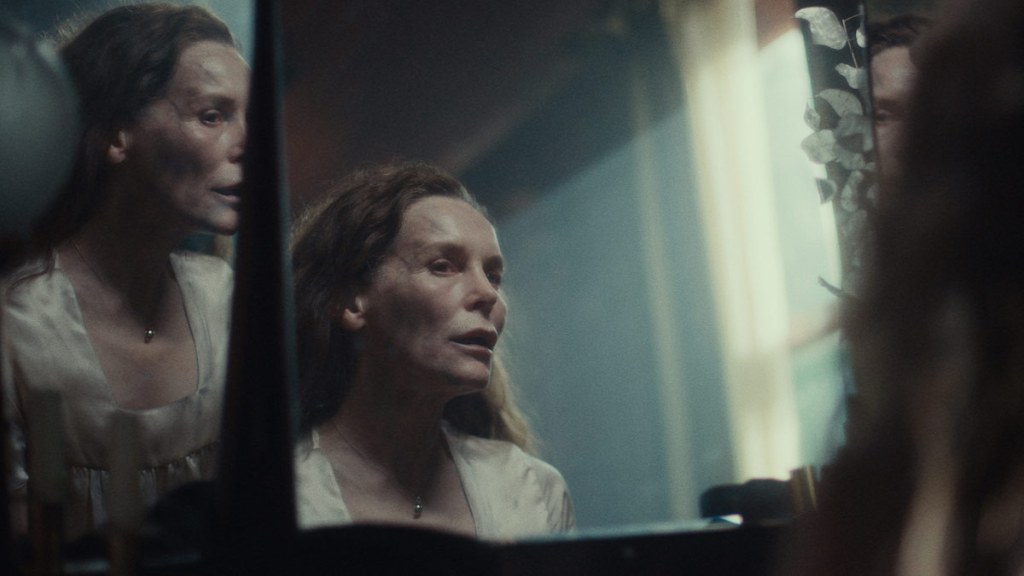
“She Will” gives her a fine showcase, a horror movie without the frights, but with creepy, gloomy style to burn as any picture “presented by Dario Argento” would have to be. Charlotte Colbert’s debut feature is a reclamation of the lost art of montage. Extreme close-ups and images shrouded in fog of horrors of the distant past and recent surgery, witch burnings and filmmaking trauma blend together in chilling and gorgeous sequences that are a credit to the entire production, but particularly to editors Matyas Fekete and Yorgos Mavropsaridis.

You watch this film and never, for a second, do you forget you’re seeing art in motion.

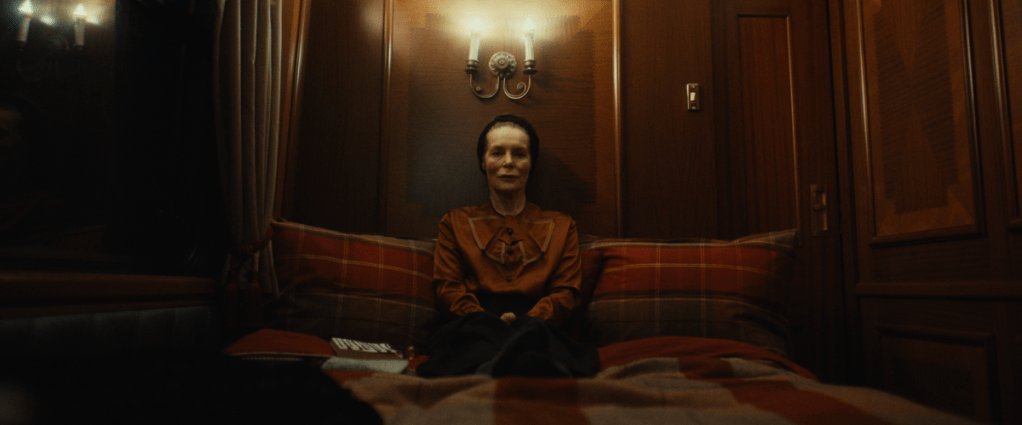
Krige plays an aging screen diva, fresh off a double mastectomy, haunted by what happened on her big break film over 50 years before. As she travels in a private train coach north through Britain, it all comes to a head as news of a “sequel” to that long-ago film, “Navajo Frontier,” breaks.

Veronica Ghent has a hint of Norma “Sunset Boulevard” Desmond to her — aged, infirm and damaged. She travels with a personal healthcare worker, Desi (Kota Eberhardt), whom she barely tolerates.

“That haircut, ‘Anarchist with a Day Job?'”

Her trip is to a “solitary retreat” in the forests of Scotland, but which turns out to be anything but solitary.

Her “I don’t do groups” protests are to no avail. It’s off-season, and everybody else is there for the activities organized by this crystal pyramid-gazing seer and charlatan, given a playful, boozy touch by Rupert Everett. Some of his cultish followers, young and old, are big Veronica fans.

Holing up in a remote cabin on the site won’t save Veronica from their lectures and painting lessons.

But there’s something about the place, the soil and the vibe of it. They used to burn witches there, and perhaps that gave the earth curative properties. It’s certainly giving Veronica, and even Desi dreams.

Veronica’s nightmares have her confronting an old co-star, a screen icon constantly working into his dotage, headed for a knighthood and much more in the public eye than her.

Malcolm McDowell and Krige only have a single scene where they’re in the same frame together. But these two screen legends, horror mainstays in their later years, make it a juicy one.

Colbert uses her stars to great advantage and her film to weave a spell around them. Krige’s turn as Veronica has a valedictory air, a celebration of her skills at turning a two word phrase into as succinct a description of old age as any ever uttered.

“Any pain,” her caregiver wants to know?

“Every pain.”

As for the film itself, it takes predictable turns, lacking only the predictable shocks that usually accompany those to make it something more than merely chilling.

Colbert emphasizes “local color” as the ashes flaked off a wood fire are “witches feathers” in this part of Scotland and the only pub in town is the only place to get wifi and be plied with drinks and other exotic substances by the retreat’s hunky handyman (Jack Greenlees).

“She Will” is so well-acted and so visually sophisticated and striking that I didn’t mind the missing “terror” in all this. Like Krige’s horror debut, it’s more about the story than the “ghosts” — witches, in this case.

And if anybody deserves a smart supernatural thriller that pays homage to her horror bonafides, it’s the witch from “Gretel & Hansel,” the matriarch of the most recent “Texas Chainsaw Massacre,” the Queen of Jean-Luc Picard’s Enterprise enemies, the Borg.

Rating: unrated, violence, substance abuse

Cast: Alice Krige, Kota Eberhardt, Rupert Everett, Layla Burns and Malcolm McDowell/

Credits: Directed by Charlotte Colbert, scripted by Kitty Percy and Charlotte Colbert. An IFC Midnight/Shudder release.

Running time: 1:36

Posted in Reviews, previews, profiles and movie news | Comments Off on Movie Review: Will Alice Krige have her revenge? “She Will”