That’s the buzz. Let’s see what we see.


The first-person narration of a killer patiently plotting his “perfect crime,” pitilessly committing it and then going mad by the pounding of “The Tell-Tale Heart” of his long-dead victim is the most sinister component of Edgar Allan Poe’s masterpiece. It’s something you don’t abandon lightly, as it has been key to many a dramatic reading (James Mason, et al), radio production (starring Orson Welles, Don Ameche, Fred Gwynne and others) and stage and screen adaptation.
IMDb lists 25 screen versions of the Poe short story — features, TV productions and shorts — and the most unusual may be the one the deviates from Poe the most.
British director Ernest Morris is best-known for being behind the camera for several long-running British TV series, the most famous being the Roger Moore version of “The Saint” that ran for most of the 1960s. As TV directors, especially of that era, knew how to make something “intimate” without that first person narration, he and screenwriters Brian Clemens and Eldon Howard thought they’d take a shot.
Their 1960 “Tell-Tale” looks like a slick and decently-budgeted TV adaptation — elaborately decorated mid-19th century interiors, a few decent backlot exteriors and actors filmed in tense closeups and tight, TV-framed group compositions.
They chose to replace the arbitrarily-chosen “vulture-eyed” old man victim with someone far more conventional. The crime is closer to impulsive than anything elaborately planned. And instead of interior narration, star Laurence Payne has to get across cunning, as well as lust, rage, terror and scheming with just his face and sometimes his body.
It’s not proper Poe, even though our murderous “hero” — unnamed in the short story, is now called “Edgar” and looks a little like a mustache-free Poe. The inciting event is a romantic betrayal, turning this into a murder born of a love triangle. But it’s stylish, tense, quite violent and racy for its time. And the performances, tense and tightly-framed, are quite good.
Edgar is a lonely bachelor in 1850s London, having only his library work, his stops by the pub and his weekly chess matches with his lone chum, dashing, rakish Carl (Dermot Walsh) to look forward to.
Well, that and his collection of art nudes which he keeps in a folder in his desk at home. Still, they’re not Japanese, so they aren’t even proper “porn.”
“How do you even get to KNOW a girl?” he begs of Carl, who advises the poor wallflower the best he can.
That sort of knowledge would come in handy when Edgar gets a new neighbor, a ravishing beauty (Adrienne Corri) who moves in across the street. She’s new at the florist shop down the block, and Edgar contrives to meet her — repeatedly.
“Getting to know” her, however, includes taking in the view through her window as she undresses each night. Edgar is awkward, forward and obsessed. And a bit of a perv.
Betty Clare bears his attentions, even his caddish clumsiness, because she’s new in town and that’s pretty much what women had to endure. Then they run into Carl at dinner one night, and idiotic Edgar keeps imposing on him to have a drink, “join us,” and on and on, while Carl — who can see the arch of Betty’s eyebrows and the widening of her pupils — tries to put a stop to his friend’s self-sabotage.
Betty is infatuated, and her betrayal with Carl — also racy for 1960, even in Britain — becomes a motive for murder.
The violence is bloody enough and broadly in the ballpark of this film’s contemporary, Hitchcock’s “Psycho” — a poker, thrashing blows, blood everywhere (in black and white), a body to be disposed of, preferable under the floorboards of Edgar’s piano.
This “Tell-Tale” opens with a cheesy graphic warning for “the squeamish” about when to avert one’s eyes — at the sounds of the thumping heart. The single “special” effect is a rug, rising and falling underneath that piano in time to the pumping heartbeat.
No, Payne isn’t Vincent Price or Boris Karloff (a great radio version) or Welles, but he cracks up in a perfectly British way.
And when Edgar gets his, well let’s just say it’s a lot more violent than was the norm for films of the era.
I like the visual compositions, the close-ups and the depth of field. It’s not suspenseful, being an over-familiar story. But once we get around to the murder and its consequences, “The Tell-Tale Heart” gets closer to what the master had in mind when he wrote this, the perfect horror story, for a $10 bill way back in 1843.
Rating: TV-14. violence, sexuality
Cast: Laurence Payne, Adrienne Corri, Dermot Walsh
Credits: Directed by Ernest Morris, scripted by Brian Clemens and Eldon Howard, based on the short story by Edgar Allan Poe. A Brigade release, on Tubi, Amazon and other streamers.
Running time: 1:20
Several things stand out in Viola Davis’ just published memoir, “Finding Me.”
She likes to eat, a product of a grueling food-deprived childhood. She’s never been afraid to work out, get in shape — or out of shape — for roles. That gets harder over time, and the Oscar winner’s on the backside of 50 these days.
And among the landmark events of her life was her first trip to Africa, as a college student, on an educational journey to The Gambia organized by a a dance teacher from North Carolina who wasn’t at Juilliard, which she attended in a graduate program.
An actress who grew up very sensitive about how “Black” she was found herself on a continent where she didn’t stand out, didn’t face an extra layer of discrimination from “fair skinned Black” people and didn’t have to do anything but soak up the culture, learn a little of the language, and dance.
Every time I see fierce “The Woman King” trailer I think about that. Here’s a vignette about Viola, “VAH-la,” as her mother called her, and her crew getting African warfare fit.


There is nothing finer in the cinema than a simple, well-acted and well-crafted thriller.
“Delia’s Gone” checks off all of those boxes in a brisk but methodical and unhurried mystery set in rural Ohio.
Damn, it’s good.
You know who’s always good? Marisa Tomei. You know who else fits that description? That Paul Walter Hauser of “Richard Jewell.”
And if you haven’t been paying attention to Stephan James (“Race,” “If Beale Street Could Talk”), “Delia’s Gone” is a reminder that maybe you’d better.
“Delia’s Gone” is a Buckeye Gothic tale of murder and revenge about a man wrongly imprisoned for the death of his sister. The million dollar hook in writer-director Robert Budreau’s screenplay? The wrongly-imprisoned man is “on the spectrum,” or has a childhood brain injury that mimics the symptoms, as the staff shrink at the facility where he’s living puts it.
How might “Rainman” reason out what really happened to his dead sister, once he realizes he’s been set up? Will he go “John Wick?” Or is “Memento” the template for this confused man-child of selective memory, distracted by the most random things — birds and their behavior, for starters?
James is Louis, 30something and living in a small town with his sister, Delia (Genelle Williams, far better than she was in Netflix’s “The Holiday Calendar”). He’s reasonably independent, can drive himself to work at the hardware store, cook and so on. But she’s just been laid off and has to tell him she’s got to move to take another job.
Even though we’ve seen her ensure by extra-legal means that Louis has a ready supply of his medications — “Some things you can only get with a gun,” she tells him — Louis does not take her news well. He lashes out, and she leaves. He drinks, and the next morning he wakes up in a fog with her body on the kitchen floor of the house they grew up in.
The sheriff (Tomei) and deputy (Hauser) know him, but take his confused answers to their questions as a confession. He guiltily remembers he hurt his sister, not how she ended up dead. And that’s his ticket to prison.
But years later, a man who knew Delia and subsequently “found God” visits him. Stacker Cole (Travis Fimmel) starts talking about “that night,” and Louis snaps. It’s his first clue that he didn’t murder Delia, and this guy — tossed out of the facility for triggering our hero — knows who did. Louis impulsively breaks out with just two “memories” to cling to — reciting them over and over to direct his quest.
“Billy Dyson lives in Downey. Stacker Cole’s at the tavern.”
The sheriff’s now a state police detective still prone to insulting and bullying her former deputy, who is now sheriff. But the way she answers his “I’ve got it” when this “escape” call goes out goes beyond mere put-down, and gets a firm side-eye from lumpy, frumpy and slow Sheriff Bo.
“Like hell.”
Tomei doesn’t get a lot of roles that remind us they don’t give Oscars to slouches, and she is all over this mean and bitter tough broad whose ties to this case are small towns in a nutshell. Everybody’s related. Everybody knows everybody else.
Williams makes a sharp impression in just a couple of scenes — a downtrodden, lonely woman maybe a little bitter herself at the trap that having to stay with her brother has represented.
Hauser’s developed a distinct character actor “brand,” the hapless “I, Tonya/Richard Jewell” slowpoke everybody under-estimates.
And James goes deep into character as mental tween more comfortable talking and bargaining with small children — “stranger danger” be damned — than wringing answers out of potentially violent adults. He is a revelation.
Too many “on the spectrum” performances seem artificial, with behavioral parameters dictated by the necessities of the screenplay. James makes every word Louis says and every impulse he follows feel in the moment and organic.
“Delia’s Gone” never wholly transcends formula, and when it strays from expectations it seems on more uncertain ground. But Budreau, who wrote and directed Ethan Hawke’s fine Chet Baker jazz biopic “Born to be Blue,” bathes his film in overcast, sets his characters up with the sparest of sketches and then runs the table with them like a pool hustler with a film camera.
I say again, damn, it’s good.
Rating: R, violence, some profanity
Cast: Stephen James, Marisa Tomei, Travis Fimmel, Genelle Williams and Paul Walter Hauser
Credits: Scripted and directed by Robert Budreau. A Vertical release.
Running time: 1:31
Dirty cops are misusing wiretaps and setting up people under surveillance. Dillon’s not one of them. Bruce is.
Sept. 2

“A Song for Us” is an inane bordering on insipid Canadian melodrama without the drama.
Its sole saving grace is the hippie nostalgia it wallows in, and the fact that I use “wallow” should tell you that’s praising with faint damnation.
Set in Toronto, writer-director Peter Hitchcock’s debut feature is a rosy, almost conflict-free remembrance of Toronto’s Yorkville neighborhood, the hippest, singer-songwriter-friendliest corner of that city in the ’60s. Joni Mitchell and Gordon Lightfoot got their start in the “Canadian Haight Ashbury.”
An elderly folk busker gets the attention of a filmmaker (Karen Scobie) making a documentary about homelessness in Toronto. It turns out, he’s somebody her 60somehing mother’s friend (Brian Scott Carleton) used to know. Which means the homeless man is someone her mother (Lisa Kovack) recognizes, too.
Visiting painter-mom’s time-capsule home on Ward Island reveals that “Tom” (Keith McTie) and Mom used to be an item. He may look “beaten and sad” now. But back in the day…
A flashback takes us back to the least edgy, most PG depiction of the swinging, war-protesting, drug-abusing, free-loving ’60s ever committed to film. Mom remembers the day she (Haley Midgette) arrived in Yorkville from London, “and not the one in Ontario,” a folkie with a dream.
Young Tom (Tyson Coady), a popular San Francisco expat dodging the American Vietnam War draft, was a rising star of “the scene.” And that song we heard him busking in the film’s opening credits, “A Song for Us,” might have been his ticket to the Big Time.
Because “Come with me and sing along, this is a song for us” is the sort of thing that sold back then, right?
“A Song for Us” is a movie of drifting conversations and narrative with no more forward motion than a soap bubble in a breeze. We’ve seen enough tough-minded Canadian thrillers and boundary-pushing Canadian comedies that we know the “They’re just too nice” stereotype is easy to send up. Here’s a movie that embraces it, and is all the poorer for it.
“Any chance you’re a vegetarian?” “I’d LIKE to be!”
Too many scenes are aimless, too much of the dialogue is just — that word again — inane and every one of the ’60s references, from drugs to “head shops” to “The Tibetan Book of the Dead” are just cliches.
The acting’s as banal as everything else — line readings that sound like “readings,” “American” accents full of “oot and aboot.”
The film’s opening dedication “For a tribe I knew…..” would ring false if I hadn’t looked up a photo of first-time filmmaker Peter Hitchcock. Gray hair? This looks, sounds and plays like a student film — a very young student’s film.
Rating: unrated, drug use and abuse
Cast: Lisa Kovack, Haley Midgette, Keith McKie, Tyson Coady, Karen Scobie and Brian Scott Carleton
Credits: Scripted and directed by Peter Hitchcock.
Running time: 1:31
Idris the Jinn. Or Genie. Tilda has…wishes.
This is the year’s most intriguing fantasy title. Hey George Miller, you rebooted “Mad Max.” The world’s your oyster! What is your auteur heart’s desire project?
“Make a Wish!”
Looks quite mad.


Close your eyes and listen to “Man with the Gun” and you can hear hints of “The Mercury Theatre on the Air.” The crisp, crackling dialogue, the brisk pace, it’s a film that has the aural qualities of an Orson Welles radio production.
I noticed that before I realized the director and co-writer was “THAT Richard Wilson,” aka “Dick Wilson,” longtime member of Welles’ rep company and the survivor of that group who helped oversee the editing and release of the documentary “It’s All True” from footage Welles shot making his unfinished South American project, a debacle that forever stained his Hollywood career.
This little seen Western, now on Tubi and some other platforms, caught my eye because of Robert Mitchum, Mr. Always Gives Fair Value, and the role he plays. In this outing, he’s a “town tamer,” a professional gunfighter/temporary lawman brought in to “tame” a town that’s gotten so violent and vice-ridden that only a temporary gunslinging dictator can set things right.
Especially when there’s a cruel and corrupt rich man with a lot of hired guns who has already set himself up as dictator, keeping the town and the local sheriff under his thumb.
It’s a longtime trope of Westerns. Remember “Support Your Local Sheriff?” This movie is what that James Garner comedy was sending up. There was even a Dana Andrews film titled “Town Tamer” released ten years later.
I couldn’t find any reference to this being an actual named profession in the Old West, where “bounty hunting” thrived. But it does sound suspiciously like the role the real-life Earps played — corrupt as they were — running gambling and law enforcement at the same time in assorted towns.
Mitchum’s Clint Tollinger rides in looking for a woman. Nelly (Jan Sterling) runs the local brothel, “dance hall girls” early Westerns on TV labeled them. Look for young Angie Dickinson as one of them. Clint has unfinished business with Nelly.
Clint’s ridden into town fresh on the heels of the chief goon (veteran heavy Leo Gordon) of the local cattle baron killing a dog that annoyed him by barking too much. Before the day is over, while Clint is tracking down the elusive Nelly, that thug and his Palace Saloon Boys (Claude Akins is one) have gotten into it with a local farmer (John Lupton).
In the sparsely-populated West, gunslingers and townsfolk often knew each other by face, name or reputation. Might the famous Clint Tollinger be available to tidy up this mess? The Doc (Florenz Ames) used to live in a past project of Tollinger’s professional interest.
“Mighty sick town,” Doc remembers. “Clint operated on it. Patient lost a lotta blood…but lived.”
Clint, famously all “dressed in gray” even though “black would fit his profession better,” has other concerns. And he’s got rules.
“I always try to make sure a town needs doing, and wants doing.”
It does. Considering what a chatterbox the old sheriff (Henry Hull of “Lifeboat”) is, Clint won’t have much help. This “peacemaker by profession” prefers to work alone.
The first things that jump right out in this picture are the tense, martial Alex North score, the clean, simple narrative and the startling realism of the art direction by Hilyard M. Brown. Silent film vet Lee Garmes photographed it, and the static set-ups give it a TV Western feel. But it’s what he captured that sets the film’s look apart from legions of run-of-the-mill Westerns.
The streets are narrow, not built for driving cattle through. There’s grass, not just sand. There are cross streets and there’s visual depth to the village — buildings behind other buildings, of various vintages and designs. The moment Mitchum rides in, we notice Sheridan City has a slope to it (The Samuel Goldwyn backlot). That’s rare enough — in Westerns — to make you notice.
And then there’s that radio-drama-snappy dialogue.
“Where’ya heading?” “Not HERE.”
The film’s themes are more liberal than the usual amoral shoot-em-ups of TV of the era, recycled and re-broadcast and worshipped as some sort of code-for-living by generations of gun nuts. I wonder if that’s why I’ve never seen it, and I was sure I’d seen every Western worth taking in. It serves up simple, rough justice without ever feeling simplistic, and stands out from the crowd and the more reactionary guy-with-the-fastest-gun-makes-the-law dogma of most Westerns.
Here, Clint’s first order of business is gun control. “No weapons worn in town.” When he oversteps his bounds and overstays his welcome — he promises to be “quick” with his work, in and out in days — the locals start to grouse about the dictator they’ve put in charge.
Mitchum is bluff and tough, settling into the screen icon image he’d been building for ten years. Not all the casting works, but veteran character actors like James Westerfield ground the film in genre “reality,” of a sort.
“Man with a Gun” — also called “The Trouble Shooter” and “The Deadly Peacemaker” — gets a lot of characters, a lot of story and plenty of action into its lean 84 minutes. All that crisp dialogue delivered at a sprint helps, too. Clint’s first “arrest” is two shots heard off camera, and the big set piece isn’t the “High Noon” finale, but a big fire that lets us see Clint’s realization that he’s crossing the line, upping the violence ante because he knows they’ll be coming for him with pitchforks sooner rather than later.
Film buffs know the telltale signs of any movie Orson Welles had anything to do with — the visual flourishes, depth of field and shadows that suggest he “helped” direct “The Third Man” and “Journey into Fear.” But those of us who know his radio work beyond “War of the Worlds” can hear his influence on other projects, such as this Richard Wilson Western, scripted and performed like a classic radio drama, packing all the back story, character and plot in as if he’s expecting to be interrupted by commercials for Lux Soap and Lucky Strikes.
Rating: “passed,” violence, suggestions of prostitution, alcohol
Cast: Robert Mitchum, Jan Sterling, Leo Gordon, Henry Hull, Karen Sharpe, John Lupton, Ted de Corsia, Emile Meyer, Angie Dickinson and Claude Akins.
Credits: Directed by Richard Wilson, scripted by N.B. Stone and Richard Wilson. A United Artists release on Tubi, Amazon, etc.
Running time: 1:24
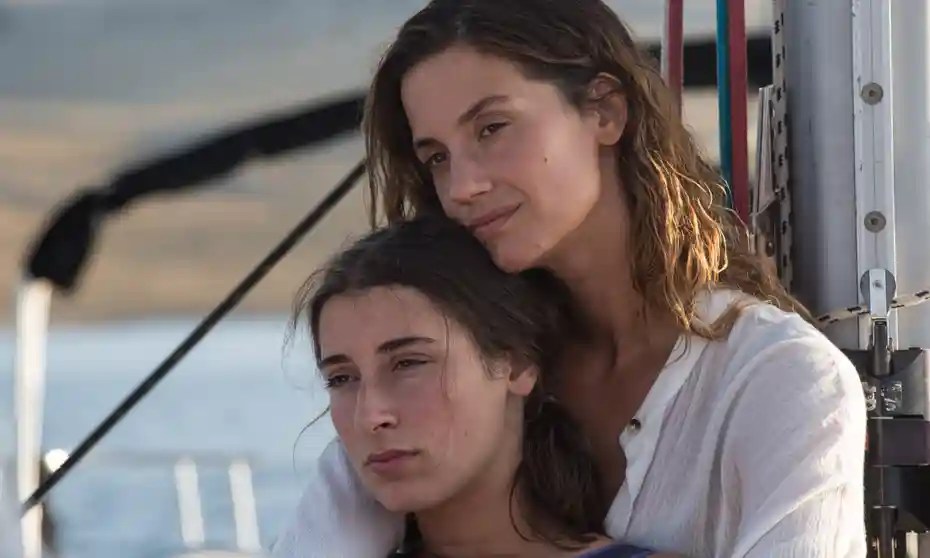
A mother who leaves, who doesn’t give us a reason — not straight away, anyway. The “Diving Bell and the Butterfly” star directs Krieps and Arieh Worthalter in a screen adaptation of a play by Claudine Galéa, Sept. 9, in theaters. From Kino Lorber.
Could be something. Colson Baker (the star) hopes so, with Storm Reid, Drea Di Matteo and Travis Fimmel all playing Six Degrees of Kevin Bacon from now on.
A Sept. 2 getaway undertaken by cross-country bus.