Musical road warriors Chicago, who have toured for half a century and faced their first enforced year not touring thanks to COVID, this one hits select cinemas Sept. 30.
They used to travel with The Beach Boys, who’ve been around in some form even longer.
Remember that sequence of scenes in “The Godfather” in which Don Corleone receives visitors who come to ask for favors, make complaints and request justice?
That’s basically the plot for Eduardo Filippo’s play, “Il sindaco del Rione Sanità,” “The Mayor of Rione Sanità.” Director Mario Martone (“The King of Laughter”) may take us to a club, a street shooting and out of doors for more action in the third act. But the film he serves up is a maddeningly talky morning, noon and early evening of a Neapolitan mobster — Antonio Barracano — granting audiences to assorted petitioners on his turf and dealing with the sorts of nonsense a mob boss must contend with because only he can dispense justice in this lawless underworld.
Francesco Di Leva plays Don Antonio, a charismatic and fit 40something who has such a hard time sleeping that his underlings fear disturbing him with whatever goes on in the wee hours in his world or in his Vesuvius villa in the hills overlooking Naples.
Two of his young toughs (Ralph P., Armando De Giulio) joke around about who’s stepping on whose toes, and laughingly pull their pistols in the alleys outside of the club where they grinned and played macho. Joking or not, one dude gets shot, and the villa’s doctor (Roberto De Francesco) has to stitch somebody up.
The don’s wife (Daniela Ioia) comes home late, and the don’s mastiffs attack her and maul her. Somebody’ll have to break the news to the boss that his beloved dogs sent his wife to the emergency room.
The doctor is held in virtual involuntary servitude and wants to travel and visit his brother in America. The don may smile and joke around about who he will ask to “greet” him (in Italian with English subtitles) in the U.S. But that’s a threat. And that trip? No dice.
This man with a debt, that one with a beef with his rich baker father, approach. A young pregnant woman is here with her boyfriend, another petitioner, all of them wanting the favor of/a favor from Don Antonio, whom one and all know is a “sincere man,” a reasonable man, if not someone to be trifled with.
The fact that one hand is bandaged up speaks volumes. The way the don wears his hoodie and does sit-ups — boxer-style — lets us know he’s tough. And he’s smart. The two pot-shot taking underlings get a good beatdown — with his good hand — when they come to beg his forgiveness.
“He has his own take on the law,” his wife admits as the doctor tries to get her on board the idea of sending those dogs into quarantine.
The little bits of action are well-handled. The setting is less striking than the dimly lit office of Don Corleone, but interesting in a “This is how the Naples mob lives” way. But the movie’s theatrical origins — stagey and talk-talk-talkie– weigh it down and render it too boring to justify an investment of two hours.
“Basta,” as the Italians say. Enough is enough. Give us some ACTION.
Rating: unrated, violence, profanity
Cast: Francesco Di Leva, Daniela Ioia, Roberto De Francesco, Ralph P., Armando De Giulio and Francesco Di Leva.
Credits: Directed by Mario Martone, scripted by Mario Martone and Ippolita Di Majo, based on the play by Eduardo De Filippo. A Film Movement release.
The tamest movie ever made about dabbling in LSD and Riot Grrrl culture has to be “Acid Test,” a non-prescription sleep aid of a movie.
Here’s a PG rated treatment of an R-rated subject.
It’s about a high school senior rebelling against her conservative, Harvard alum dad by being hesitant to become a “legacy” applicant to his alma mater. Nothing says “Viva la REVOLUCION!” like attacking the patriarchy on your Harvard admission essay.
Juliana Destefano is Jennifer, wearing the Harvard hoodie and all-in on her father’s (Brian Thornton) dream of her following him into the Ivy League and all the doors it could open for her. We meet her at her pre-admission meeting with a counselor, follow her and her kid brother to the movies with Dad and pick up on the dynamic of her home life. Mom (Mia Ruiz) is Latina, and that’s another leg-up for getting into Harvard.
It’s 1992 in Texas, and her senior year begins with civics class focusing on the election — lots of Clinton, Bush and Perot news coverage in montages — and “Hamlet.” Does Dad, who doesn’t seem all that unreasonable at first, know what he’s doing when he quotes “To thine own self be true” to Jennifer?
It turns out she’s not sure of her life direction. Her BFF Drea (Mai Le) is headed to UT-Austin. That gives Jennifer her first second thoughts. Then they duck out to catch a live show and are introduced to estrogen-powered punk rock and the Riot Grrrrl Manifesto.
“What is a girl?” Jennifer wonders. Here, in Bikini Kill pamphlet form, is an answer.
“BECAUSE I believe with my wholeheartmindbody that girls constitute a revolutionary soul force that can, and will change the world for real.”
Next thing we know “straight edge” Drea is debating her supposedly straight edge pal’s decision to accept a tab of acid from the flirtatious hunk Owen (Reece Everett Ryan). Everything that follows — the shift in Jennifer’s music tastes, the decision to lop off her hair, the “SLUT” magic marker tattoos she and Drea don to join the Riot Grrrl scene, sex with Owen — flies in the face of Drea’s seemingly sound advice before that first tab is dropped.
“Rich kids are the worst!”
The club scenes, capturing what I assume are real bands in real performance, are shot and edited so flatly that you’d swear we were seeing a Three Tenors show.
The acid trips are no-budget DIY dull, the “romance” isn’t remotely romantic and the character’s story arc isn’t A-to-Z, passing through a hell of self-discovery. It’s A to B. Yawn.
Writer-director Jennifer Waldo grew up in DC and went to USC, so whatever “memories” she was tapping into for this just-short-of-“true” story (per the opening credits) are seriously mild-mannered.
She must’ve forgotten that “acid” added or not, “Riot Grrrl” is more than a haircut and a bit of magic markering.
Rating: unrated, drug content, profanity
Cast: Juliana Destefano, Brian Thornton, Mia Ruiz, Reece Everett Ryan and Mai Le.
Credits: Scripted and directed by Jennifer Waldo. A Giant Pictures release.
Posted inReviews, previews, profiles and movie news|Comments Off on Movie Preview: A Senegalese “Nanny” faces trauma and “presence” in the New York family that hires her
A small distributor backs a little known cast that takes on the sensation of 1930s Broadway, Welles’ Haitian set “Voodoo Macbeth.”
Oct. 21.
Posted inReviews, previews, profiles and movie news|Comments Off on Movie Preview: Orson Welles and New York’s best African Americans actors take on “The Scottish Tragedy” — “Voodoo MacBeth”
If it was a “spoiler,” I wouldn’t use the word. And the word for “Don’t Worry Darling” is “Stepford.”
I mean, read and comprehend the title. There it is.
It’s an easily-grasped and obvious analogy for this satiric thriller from director Olivia Wilde and screenwriters Karen Silberman and Carey and Shane Van Dyke, and any filmgoer should pick up on it early on.
What matters is what they and the cast add to that sort of framework, the other possibilities about where this is going and why. A little whiff of “The Master,” a bit of “The Matrix,” a taste of “Truman Show” and a hint of “Twilight Zone” all enter into Wilde’s oddly unaffecting overreach of a Statement on Women in a War-on-Women/Age-of-Incels and the End-of-Roe era.
“Handmaids” much? “Logan’s Run,” anyone?
Forget the bad buzz surrounding the film, meet it on its own terms and it’s a chilly-not-chilling story set in a desert. Avoid the gossip about the actors and you’re still stuck with how uninteresting pop moptop Harry Styles is as an actor, how much Chris Pine leans into his inner Shatner and how unflattering the light or the way the cinematographer lights them makes Pine, leading lady Florence Pugh, the director/co-star Wilde and others look.
Lose yourself in a story that’s cryptic, but not so cryptic that one cannot figure out that it’s all about the wives, and whatever’s going on they’re kind of “Stepford” about it.
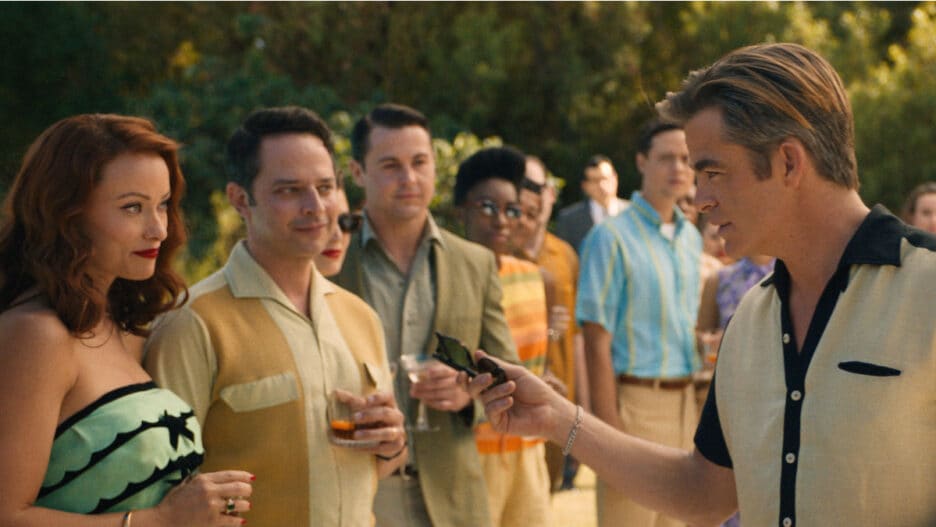
Pugh and Styles play “perpetual newlyweds,” a young couple in a 1950s oasis of middle class privilege — a mod ranch-style house in a posh, uniform subdivision, “Victory Town,” in a Palm Springsish corner of the desert.
Alice and Jack don’t need an excuse to go at it, and vigorously, morning noon and night. But dutiful and sexually-fulfilled housewife Alice can’t keep Jack from his clockwork AM departure for work, popping into his T-bird along with all the men in the neighborhood, convoying into the desert to work at “The Victory Project” run by the mysterious, cultish Frank (Pine).
Every day, Alice drinks and gossips in the sun, at the local pool or shopping with her posse (Wilde, Kate Berlant) between bouts of maniacally cleaning the entire house.
At night, rowdy cocktail parties rotate through town, with everybody showing off their Mid Century Modern decor and 1950s pre-rock record collections. Lots of Mel Torme and hepcat jazz-pop and martinis and Tom Collins highballs and cigarettes, even for the ever-pregnant Peg (Berlant).
Whenever the mysterious Frank is around, he praises those willing to “join this mission” to “change the world,” and Frank’s wife (Gemma Chan, chilling), who teaches the ladies’ dance class, compliments one and all for realizing “how extraordinary (Frank) really is.”
But something’s going on, something the wife (Kiki Layne) in the only Black couple of note seems to notice. And Alice can’t help but notice Margaret’s confusion and growing dismay.
“I’m not fine,” Margaret snaps at those who try to comfort her. “Nothing is fine.”
The immaculate design allows us to pick up on “signs” of what’s happening, the daily “radio” chats from Frank that the wives tune into, the buzz words in most every sentence he speaks, the calculating eye contact Pine makes with one and all.
The parody of 1950s life is so on-the-mark that the occasional anachronistic haircut and scripted line doesn’t so much break the movie’s spell as make you ponder what it will do as it takes you where you know it must go. It gets so invested in the women that next to no time at all is devoted to the “providers,” the men also trapped in gender roles in what older, conservative Americans (and Britons) seem to regard as “the good ol’days.”
Pugh, who came to fame in period pieces, seems out of place here, and that could be by design. Alice is an interesting choice for her first real star vehicle. The character is a passive, compliant “team” player waiting for her call to action, and we have to patiently wait with her. Pugh might have had more chemistry with Styles if he didn’t seem like a tall, gawky forelock and a child hanging with the grownups.
Wilde lets herself be filmed and made-up in a way that emphasizes the severity of her features, the “TRON” beauty with a Cruella in her future. I shouldn’t even get into how Nick Kroll, as one of Jack’s colleagues, is lit and framed.
But the original sin of “Don’t Worry Darling” might be how drunk the filmmakers get on the universe they create, dragging and dragging a less and less interesting pastiche of ’50s life — a drunken office party with a stripper, because we’re all so liberal and “modern” — on for so long that the more exciting third act comes as a refreshing jolt.
Sure, it’s as predictable as scores of science fiction finales. But the viewer’s big gripe at this point has to be, “OK, but what TOOK you so long?”
Rating: R for sexuality, violent content and language
Cast: Florence Pugh, Harry Styles, Olivia Wilde, Nick Kroll, Timothy Simons, Kiki Layne, Gemma Chan and Chris Pine
Credits: Directed by Olivia Wilde, scripted by Katie Silberman, Carey Van Dyke and Shane Van Dyke. A Warner Brothers release.
Well, there’s an hour of my life I’ll never get back.
“How Dark They Prey” is a quartet of ineptly-scripted, randomly-assembled, adequately-shot but amateurishly-acted short horror films that fall under the broad horror subheading of “claptrap.”
They include the worst written, acted and envisioned World War II short I have ever seen. And I’ve judged student films, “48 Hour Film Project” saps and worse. There’s a demonic slaughter opener that slices up some UFO hucksters. That could have been funny. A black and white finale that begins with a traffic stop isn’t quite up to “student film,” unless we’re talking “middle school” students.
There is absolutely nothing anyone writing, directing or appearing in any of these has to say that would amount to a defense. It’s just rubbish, and never should have seen the light of day. But here it is, pushed by a publicist (waste of money) and rendered legit by its own page on Rotten Tomatoes.
Wait’ll they find out.
Rating: unrated, violence
Cast: Names withheld to protect their acting conservatories, or online thespian courses.
Credits: Scripted and directed Jamison M. LoCascio and Adam Ambrosio. A Film Valor release.
Long before they shot the serio-comic transgender odyssey “Tangerine” on a cell phone, over a decade before “The Florida Project” became an Oscar-buzzed drama about the transient-hotel homeless of Orlando, Sean Baker and producer Shih-Ching Tsou co-directed a gem about the dark underbelly of Chinese diner workers in New York.
“Take Out,” like the later documentary “The Search for General Tso,” sees America’s Chinese fast food world underpinned by illegal immigrants, often trapped in onerous “loans” that paid for their transit into the country, working as virtual indentured servants because it’s not like they can go to the police and complain about their plight.
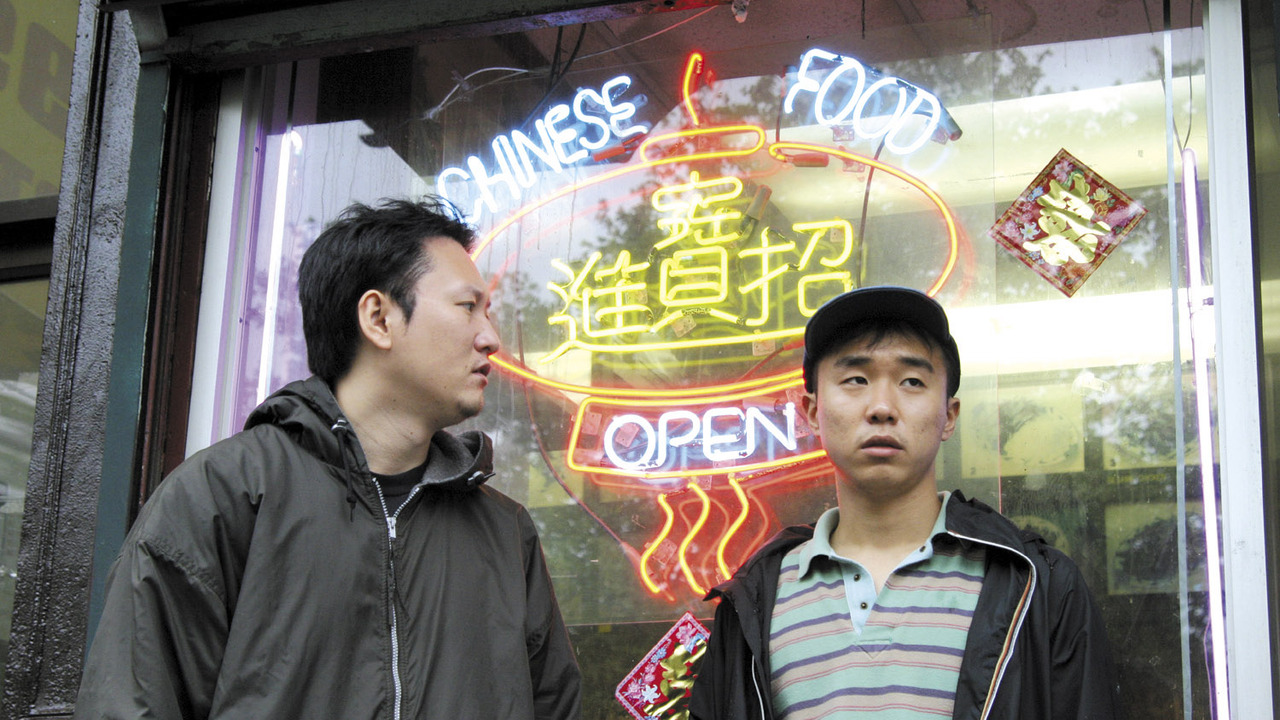
Using the jumpy, fly-on-the-wall camera work that gave “Tangerine” and “The Florida Project” their intimacy and immediacy, they take us into one tiny eatery in New York and the big debt that faces kitchen worker, cook and delivery guy Ming Ding, played without a hint of affectation by Charles Jang.
“Take Out” is documentary-real as we see a couple of enforcers show up at the flop house when Ming Ding lives, shake him down for a 30% loan he’s behind on, and once they’ve cleaned him out and kidney punched him, ask for the $800 he’s still behind by tonight or “your debt will double.” “Mind your own business,” they tell his many roommates, who look on. Never once do they raise their voices.
Ming Ding’s options are limited. He speaks little English, has few relatives he can tap for loans. The fact that he’s still $300 short at the start of work drives our narrative. Can he make enough in tips to avoid the worst?
This simple scenario makes a great framework for giving us a little slice of urban working class life in New York City. Each brief interaction, often in an apartment doorway, could get Ming closer to his goal. Some customers are rude, a couple are hostile, and almost all are distracted. Speaking no English and being Chinese, he’s not inclined to smile and hasn’t mastered the “Thank you” that might boost his tips.
His chatterbox pal Young (Jeng-Hua Yu) passes along his wisdom — “Rainy day means more deliveries, more deliveries mean more money!” He gives Ming all of his deliveries to him to help him out, and tries to coach him on the niceties of getting a tip out of New Yorkers. No dice.
“I could’ve mail-ordered Chinese food faster’n this!”
And God forbid the kitchen, or the friendly owner and chef, Big Sister (Wang-Thye Lee) mess up an order.
What little dialogue there is is mostly Mandarin, with smatterings of English and Spanish from the customers. In the kitchen, the employees swap “How I got here” stories, make trips into storage to fetch more MSG and slice, pound, boil and fry their way through the day and night’s orders. Young provides non-stop banter as Big Sister gruffly handles counter customers, some of whom flirt in the hopes of getting a discount.
Even she doesn’t smile. This next order? “That bitch at 845 West End,” again, the young woman who complains about the order every single time. Yeah, “Seinfeld” got that right, too.
“Take Out,” beautifully shot and coming to a Criterion DVD, makes a gritty, intimate portrait of working life on the struggling end of the spectrum as we see Ming grind through a day of tip stiffers, bicycle flats and meltdowns over the stress he won’t talk about with just anyone, a debt that stands in the way of him ever getting his “You need to focus” wife and child into the U.S.
The plot has built-in melodrama, and the co-writers/directors add more, giving the story a glum inevitability. But if you’ve liked anything they’ve produced since, it’s well worth seeing this anchor title for that boxed set to come, The Real America of Sean Baker and Shih-Ching Tsou.
Cast: Charles Jang, Jeng–Hua Yu, Wang-Thye Lee, Justin Wan, Jeff Huang
Credits: Scripted and directed Sean Baker and Shih-Ching Tsou. A Criterion re-release, also on some streaming platforms.












 Movie Nation