Movie Review: Thandiwe Newton is tested in “God’s Country”

“God’s Country” is a the most interesting fall drama that you will never let yourself love. “Adult” in the grownup sense, thought-provoking, hot button-hitting and unpredictably predictable, it makes a fascinating showcase for Thandiwe Newton and invites more than one spirited debate about its characters, themes and issues on the ride home.

Director Julian Higgins and co-writer Shaye Ogbonna — TV veterans — introduce issues of race, class and the American ideal challenged in a story of an escalating conflict enfolding privacy and property rights, tribalism and white entitlement. It’s got a lot to digest and frustrate, and a bit to excuse.

Newton plays Cassandra, a woman we meet as she says good-bye to a loved-one at the funeral home’s crematorium. She is gutted, guarded and solitary.. Newton and the filmmakers reveal her backstory in layers that they peel away one patient layer at a time.

Cassandra teaches at a college in Big Sky country — remote Montana — and we get the feeling that her public speaking students get something more meaningful than the simple skills needed to not panic while preparing and delivering a speech. But the New Orleans native is the only Black face in her department. And she and another woman on the faculty are fighting an uphill battle in trying to get the hidebound tenured white males to shake “the same old way of doing things.”

At home, she’s got the company of an old Labrador and the great views her hillside chateau affords. She seems isolated, but her old colleague and new department chair (Kai Lennox) lives a few acres over.

But that’s of little comfort when she has to deal with camo-clad pickup-trucking locals who figure her property is just a parking lot and entryway to their hunting grounds. She leaves them a note, and finds a spattered bird and the note torn up. She tells them (Joris Jarsky, Jefferson White) in polite but firm terms, “before you park on someone’s property have to come and ask.”

We don’t need a translator to know what there “I heard about you,” comeback means.

Lines have been drawn, and as anybody who’s ever lived away from the cities knows, the offending beer-swilling hunters are the ones to take the quickest offense. Next thing we know she’s giving evidence and filing a complaint with a reluctant sheriff’s deputy (Jeremy Bobb). Next thing the deputy knows, she’s following him to make sure he goes and warns these two off.

Naturally, he knows them. Naturally, they know him. And no, she’s not interested in his “out here, things are a little different,” his suggestion that she talk and “work things out” herself with two burly, armed men, and his warning that “contacting the authorities just makes things worse.”

Cassandra may be a little on edge and may have a chip on her shoulder. But she’s speaking for a lot of people when she snaps “We’ve all got to play by the same rules if this thing is gonna work.”

What she’s talking about is America. What’s she’s is broaching is unequal justice. And what she’s saying to biased, never-touch-my-pickup-truck-paisanos rural law enforcement is loud and clear before she puts Deputy Gus on blast.

“What are you even here for” if it’s not to enforce the law? Because letting those who would do whatever the hell they want as long as they’re willing to intimidate those who aren’t burly and armed and the law does nothing is unacceptable, even if it is commonplace.

In rural America, where the law enforcement is scarce, where everyone knows everyone else and a whole lot of people are trapped in generational bubbles of relationships, grievances and denial, a lot of encounters have a built-in might-makes-me-right “What’re you gonna do about it?”


“God’s Country” is a modern Western working around the “confront those who would take from you” code of the Old West. But where Higgins and Ogbonna take us on this never-less-than-tense journey is startling in its connections, bracing in its grace notes.

Cassandra jogs by herself, sometimes in the dark. Her house has a lot of windows. She enjoys the presence of the deer on her property. She has a dog. We fear for her, first scene to last.

Nobody is all that laudable or even pleasant, but the one character most of us can identify with is Cassandra, who shows a cool head and moments of compassion that rattle even the quickest-to-anger honkytonk loving hunter. No slur is ever uttered, but we feel them in the characters’ chin-jutting posture and testy tone.

And whatever she’s up against isn’t just white hunters avoiding the “n” word, it’s faculty thinking but trying to avoid saying the “token” word instead of “diversity out loud in her presence. She’s got to fight the urge to scream “REDNECKS” as well.

In the end, what “God’s Country” is wrestling with is too big for the movie or the filmmakers’ ambitions. It’s about the reasonable trying to reason with the unreasonable, about race and relative deprivation and the ignorant, angry and armed refusal to accept change. And it’s about neither side recognizing the blind spots in their logic, the biases they’re giving in to and the ugliness they lash out with.

I don’t have to identify who says “Why are you like this?” for you to know who said it, or that any number of characters could also say it with just as much conviction, just as certain they’re on the moral high ground.

Rating: R, for language (profanity)

Cast: Thandiwe Newton, Joris Jarsky, Jefferson White,

Credits: Directed by Julian Higgins, scripted by Julian Higgins and Shaye Ogbonna.

Running time: 1:42

Posted in Reviews, previews, profiles and movie news | Comments Off on Movie Review: Thandiwe Newton is tested in “God’s Country”

Movie Preview: Whitney’s life story in a song — “I Wanna Dance With Somebody”

This trailer, from the screenwriter of the much loved and critically dismissed “Bohemian Rhapsody,” pushes buttons and leans in the music to remind us what a “once-in-a-generation” voice Whitney Houston had.

Naomi Ackie plays Whitney, Tamara Tunie is mother Cissy Houston, Ashton Sanders is Bobby Brown. And Stanley Tucci as music mogul Clive Davis? On the money, baby.

“I Wanna Dance with Somebody” opens this Dec.

Posted in Reviews, previews, profiles and movie news | Comments Off on Movie Preview: Whitney’s life story in a song — “I Wanna Dance With Somebody”

BOX OFFICE: “King” Viola rules, “Barbarian” buries “Pearl,” “Fletch” is stillborn

A decent Thursday night morphed into a big Friday, and “The Woman King,” the African history lesson starring Viola Davis, is owning its opening weekend with a whopping $19 million take at the box office.

It’s like a non-super-heroic “Black Panther” back story based on real West African history, and the Oscar winner Davis carries it like a queen.

“Barbarian” is holding up well, with a $6.5 million second weekend pushing it over the $21 million mark by midnight Sunday.

Ti West’s “X” prequel, written by and starring Mia Goth as “Pearl,” isn’t doing “X” numbers. And “X,” you might remember, didn’t blow up the box office. “X” opened at $4, “Pearl” is clawing its way to $3.2. I didn’t think it was nearly as good as “X,” so we’ll have to see if word-of-mouth saves it.

The period piece murder-mystery comedy “See How They Run” opened not quite as wide as “Pearl,” and is teetering towards a $2.7 million take. It’s cutes and aimed at an older audience. Let’s see if they find it. With a lean release slate in the coming weeks, they’ll certainly have time to.

“Bullet Train” is $2.6 million closer to “$100 million, according to Deadline.com. It’s over $96 now, and should hit $100 by the end of next week.

And Neon’s IMAX Bowie doc “Moonage Dream” cracked the top ten with a middling $1.2 million take.

Paramount released a cute but no blockbuster version of “Fletch,” “Confess, Fletch,” on 516 screens…and on Paramount+. That’s the best place for this Jon Hamm reboot, as it only managed $255K this weekend in theaters. Love to see more “Fletch” films, expect to see them on Paramount+.

More new releases opening wide don’t really show up until the end of this month, with “Avatar” coming back out next week to gin up interest in the sequel set for Dec.

Posted in Reviews, previews, profiles and movie news | Comments Off on BOX OFFICE: “King” Viola rules, “Barbarian” buries “Pearl,” “Fletch” is stillborn

Classic Film Review: “Life is Cheap…But Toilet Paper is Expensive” (1989), restored and in-your-face again

Journeyman indie filmmaker Wayne Wang had already enjoyed a break-out indie hit (“Chan is Missing”) and followed it with “Slam Dance” and “Dim Sum” when he and Spencer Nakasako set out for Hong Kong in the late ’80s to capture a manic, madcap capitalist culture before the freewheeling territory was absorbed back into totalitarian China in 1997.

“Life in Cheap…But Toilet Paper is Expensive” is unlike any other film on his resume. He co-directed it with producer and screenwriter Spencer Nakasako. It came out with an X rating. “Life” has a loose narrative and a frenetic, in-your-face energy that mimics the chaotic clash of Chinese culture and unfettered capitalism. “Hong Kong,” more than one local muses (in English, or Cantonese with English subtitles), “where anything” “and everything happens.”

The film is also, and I cannot stress this enough, seriously triggering. The guerilla filmmaking crew not only stage scenes with a blind “Hong Kong (fake) Rolex” street seller (the great Victor Wong), and with a grizzled guy only credited as a “duck killer” (Wan Ken Cheng) in the aptly-named “wet markets” of the place, the perfect setting for him to mutter the film’s joke title — “Life is cheap, but toilet paper is expensive!” Wang shows us chickens and clusters of white ducks, writhing and dangling, tied in a bunch, spattered with the blood of those who have already suffered the fate that faces them.

All these decades later, that’s still pretty rough to sit through, and it scared off audiences — even at film festivals — when this dark comedy made the rounds in 1989-90.

In all the years since its release, I’ve never heard Wang explain what the poor dog running itself breathless on a treadmill (decades before “exercise” treadmills) is being subjected to. Powering a machine? Conditioned for other word? Muscled up for culinary purposes?

So there’s fair warning. If you wouldn’t see “Inside Llewyn Davis” because of what happens to the cat, move along.

Wang, like Spielberg and Lucas, has messed around with this film over the years. He had to delete Disney Mouse ears from one ironic scene thanks to legal threats. And he shot fresh footage in 1996 which he’s added to this newly-restored print being re-released by Arbelos. As I’ve mentioned in other reviews, the literary concept of a “final” version of a book, the “copy-text,” does not exist in film. Even after the director’s death, movies get tampered with.

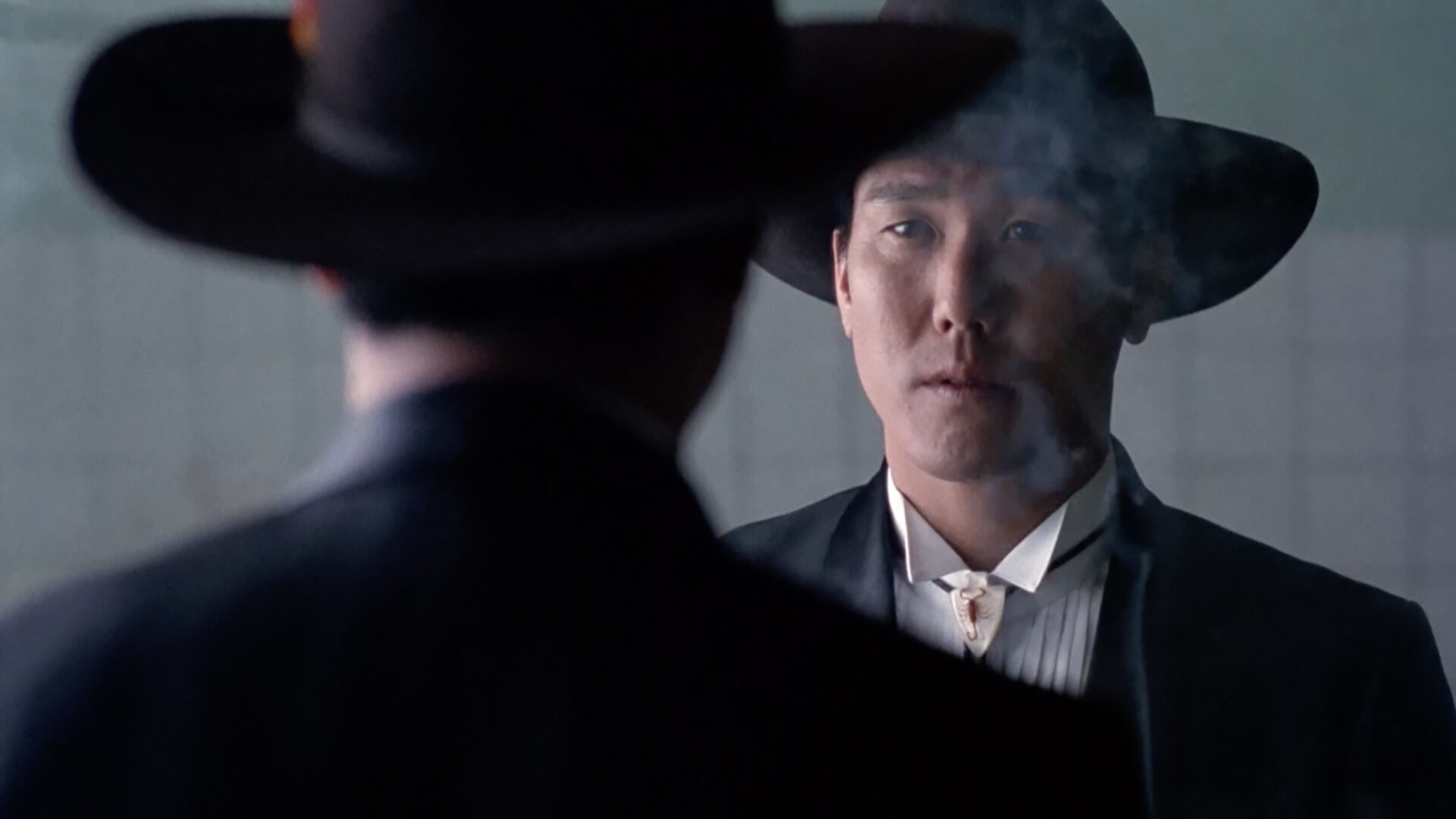
The story — a Man with No Name (screenwriter/co-director Nakasako) who works in a San Francisco stables and favors cowboy boots, hat and bolo tie, is given a message to take to a “Big Boss” in Hong Kong. It’s packed in what was known in the day as a “drug dealer’s briefcase” — brushed aluminum, popularized on “Miami Vice” and wherever drug deals were depicted on screen.

Once in Hong Kong, he has trouble reaching the Big Boss, and even after meeting him (Wei Lo), has more trouble getting him to accept that briefcase.

Our “man with no name” (Dennis Dun provides his voice in the narration) is left with nothing to do but “explore” Hong Kong.

A subjective camera ventures into the markets, on the streets and into a sound booth at a foley studio where men do voice-looping for porn films and sound out martial arts fights. That noise Hong Kong kung fu fighters make when they throw a punch while wearing long sleeves? It’s just a guy with a pillow case, yanking and snapping it for emphasis.

Our narrator meets an aged dance teacher who randomly serves up the “rules” for success in life and encounters the Big Boss’s…mistress? Film starlet? The ill-tempered “Money” is played by Cora Miao, who is always seen in a crimson ensemble. A one-armed pianist wearing a medal pinned to his chest relates how he held onto his principles in communist China, and how that cost him that arm.

A hand is chopped off in assorted cut-aways throughout, symbolizing our narrator’s peril if he fails to fulfill his mission.

Almost everyone he meets is irritable, vulgar and coarse. Wang noticed the Chinese passion for spitting and love of the phrase “Gweilo,” which some apply to any “foreign devil” they meet.

A film lover approaches “Life is Cheap,” which I missed on first release (though God knows I heard enough about it) by marveling at the permit-free foot chase our narrator is forced to make when the briefcase is snatched. It leaves us as breathless as the (celluloid) camera operator. Wang looks in on the open-air butchery stalls and doesn’t turn away from the baleful stares of the locals who don’t know what the hell he’s up to.

As Man with No Name dances with a hooker sent to him by somebody in the Big Boss’s entourage (perhaps the ever-angry ex-Red Guard gang lieutenant), the theme music of “The Magnificent Seven” wafts into the score, emphasizing how out of place our not-a-cowboy is here, and the tectonic collision of East and West in Hong Kong has its recurring musical motif.

But despite the occasional laugh (the sound-looping sessions, etc), there isn’t much more to this than an ironic slice of life that now plays as a period piece, “Hong Kong as it used to be.” There’s ironic humor is some of the semi-random scenes — a daughter of the Big Boss pouts and lies she’s interviewed about her arranged engagement with a effete Chinese-American paleontologist.

“I’m going to help him dig up bodies,” she says, summing up her future.

The new 4K restoration plays up the lurid vitality of the life, city and people Wang was capturing.

But coherence is an ongoing issue, which might explain why Wang keeps tinkering with this picture, decades after flirting with mainstream Hollywood (“Maid in Manhattan,” “Because of Winn-Dixie”), even after returning to the indie-and-little-seen sorts of films where he got his start.

If you’re a Wang-completist, “Life is Cheap” is a must-see. For the rest of us, it’s a mildly-transgressive/still-triggering blast from the past that has lost some of its glow, if none of its mystery.

Rating: Originally an X, due to violence, graphic animal slaughter, sexual situations, profanity

Cast: Spencer Nakasako, Cora Miao, Wei Lo, John Chan, Cinda Hui, Wan Ken Cheng and Victor Wong, narrated by Dennis Dun.

Credits: Directed by Wayne Wang, co-directed by Spencer Nakasako, scripted by Spencer Nakasako. An Arbelos 4K restoration re-release.

Running time: 1:25

Posted in Reviews, previews, profiles and movie news | Comments Off on Classic Film Review: “Life is Cheap…But Toilet Paper is Expensive” (1989), restored and in-your-face again

Movie Review: Actor-junkie faces withdrawal, a mistrusting wife and his sketchy brother — “To the Moon”

“To the Moon” is a psychological/psychedelic thriller that has a lot of trouble coming together and more trouble getting to its fairly obvious point.

Writer, director and co-star Scott Friend’s movie leaves “clues” hanging, drags out it supposed mystery and ends on a predictably perfunctory note.

A film star (Scott Friend, again) and his figure skater wife (Madeleine Morgenweck) show up at his grandfather’s hunting lodge with a mission.

Dennis has just been fired from his TV show. He has a drug problem, and sneaking off to big pine country “upstate” will help him kick, cold turkey. Wife Mia is his rock, the one who “won’t leave you.”

“I would kill for you,” she declares, out of nowhere. “You know that, right?”

OK.

Dennis is having just enough withdrawal symptoms to pass for “junkie,” and it’s causing hallucinations and nightmares.

But as Dennis starts his sober life walking the dog in the woods, he spies a monk in a red habit across the lake. The next day, they awaken to a bearded, yellow-jumpsuited kook doing a Maori Hakka exercise in the yard. Not to worry. Much.
“It’s my brother!”

Dennis isn’t thrilled to see him, and the babbled self-help nonsense that that passes for wisdom coming out of brother Roger’s mouth makes little sense. Dennis has heard this shtick before. Some of it, anway. But Mia? She seems impressed. I mean, the guys knows all about her crystals.

“I sensed that you’re not...in full.”

Husband and wife close their eyes and chew a berry that their new guru says “will ease the withdrawal.” Is it some sort of “natural” hallucinogen? They trust this loon?

And thus begins Roger’s move-in/take-over of their withdrawal week. Is he having them on, with his dropping the phrase “in the hospital” (As a patient, or janitor?), leading them through “cleansing poses” and generally getting all up in their business.

Dennis can’t be sure of what he’s really seeing and experiencing — Roger coming on to Mia through a window, etc. — and what he’s hallucinating.

“He’s gonna ruin the whole trip. Just watch.”

There’s not a lot to grab hold of, here. The mind games aren’t that convincing or interesting, the interloper is more of an embarrassing goof, at first. Is there menace afoot? Enabler or figment of Dennis’ imagination, monkey on his back? The demon he must slay?

Just an opportunistic jerk/escaped mental patient here to bring his envied brother down?

The acting isn’t particularly convincing, which hampers any “buy in.” The writer-director-star isn’t exactly a poster boy for “in demand actor/TV-star.”

Whatever’s going on with those “monks,” whatever Roger’s real agenda is, whatever Dennis settles on as “This is my reality” or “Maybe it was all in my head,” “To the Moon” — as in “How much do I love you? To the MOON!” — keeps running into the same brick wall that the plot, the annoying/rarely emotional characters and blase dialogue and situations have built.

Who cares?

Rating: unrated, violence, drug abuse, sexual situations

Posted in Reviews, previews, profiles and movie news | Comments Off on Movie Review: Actor-junkie faces withdrawal, a mistrusting wife and his sketchy brother — “To the Moon”

Movie Review: Danish Family learns why the Dutch “Speak No Evil”

The polite, kind and considerate are forever at the disadvantage when dealing with boorish, brutish bullies. That’s the message in “Speak No Evil,” a taut, pitiless Danish/Dutch thriller that unfolds as a series of cringe-worthy moments, one right after the other.

Danish actor turned director and co-writer Christian Tafdrup (“A Horrible Woman”) serves up a scary send-up of “United Europe” in the form of a Danish family invited to spend a weekend with a Dutch family they just met on vacation.

Danish Bjørn (Morten Burian) may toast their new friends as “just like us…same humor, same culture,” unlike those damned “Swedes.” But we’ve seen a Dutch horror movie or two. We know the windmills-and-wooden-shoes folks have their “issues.”

Bjørn, wife Louse (Sidsel Siem Koch) and their little girl Agnes (Liva Forsberg) have been in their Tuscan resort just long enough to get bored with their fellow tourists when gregarious Patrick (Fedja van Huêt) and Karin (Karina Smulders) show up. Finally, they have somebody to talk to who isn’t obsessed with food, culinary classes and the like.

Great fun! Let’s keep in touch! Come visit sometimes!

Still, the postcard that arrives some while later surprises Bjørn and leaves Louise a bit taken aback, this invitation from foreigners, “people we hardly know.” But Bjørn won’t be denied his bro-time, and they’re off.

Family dynamics are strained a bit when Louise emasculates Bjørn by suggesting they only got there by GPS. But Patrick’s got his back. Parenting styles are always going to be at odds with one another.

It’s only when the guy’s boorish refusal to accept Louise’s vegetarianism and harsh handling of their mute son that the warning signs come out on Dr. Patrick. Everyone speaks English. Why do their hosts keep switching to Dutch, like some secret code? And that kid? He’s creepy AF.

Still, little confrontations about who disciplines whose child, sticking them with the check at dinner, unhealthy sleeping arrangements and the like have to be ignored or papered over.

Heaven forbid anybody think these Danes are rude! Maybe they should be. Perhaps they should listen to us, shouting at the screen — “Get OUT.”

Tafdrup’s film plays as nightmarish to anyone with real sensitivity long before it turns truly sinister. First Bjørn then Louise sticks up for these creeps, excuses their behavior. At least Louise has lines she’s won’t cross.

“I don’t find them that pleasant to be around.”

“Pleasant” falls by the wayside early. It’s everything beyond that which makes “Speak No Evil” grimly suspenseful and horrifically involving. If you’re sentient and have lived a few years on this Earth, chances are you’ve been in PG versions of this situation — unpleasant, bullying people trying to bully you into accepting their behavior, presence and company.

The acting is organic and realistic. People react to affronts and shocks the way the well-mannered often do, trying to see things from even the most irredeemable ogre’s point of view. Fedja van Huêt’s turn from flattery and charming to monstrous might seem abrupt, but Patrick’s unable to keep his inner ogre out of sight forever.

Tafdrup doesn’t let up the way most Hollywood horror writer-directors would. The universe doesn’t owe the polite anything resembling a happy ending. Will these well-mannered Danes get a clue?

You have to endure this cringe-fest to find out. Just make sure you “Speak No Evil” and “Deliver No Spoilers” after you do.

Rating: unrated, graphic violence, nudity, sex, profanity

Cast: Morten Burian, Sidsel Siem Koch, Fedja van Huêt and Karina Smulders

Credits: Directed by Christian Tafdrup, scripted by Christian Tardrup and Mads Tafdrup. A Shudder release.

Running time: 1:37

Posted in Reviews, previews, profiles and movie news | Comments Off on Movie Review: Danish Family learns why the Dutch “Speak No Evil”

Movie preview: Park chan-wook’s “Parasite” follow up, “Decision to Leave”

A sinister, seductive thriller, this one opens in the US Oct. 14.

Posted in Reviews, previews, profiles and movie news | Comments Off on Movie preview: Park chan-wook’s “Parasite” follow up, “Decision to Leave”

Will John le Carré  fans ever get our “Tinker Tailor” sequel, “Smiley’s People?”

As some John le Carré  fanatic has uploaded “Smiley’s People” to Youtube (Does Paramount still own this series?), I’ve allowed myself the luxury of revisiting it for the first time since it aired on British and US TV in 1982.

This mini-series, based on a le Carré novel that served as a sequel to “Tinker Tailor Soldier Spy,” was the last great leading man role of Sir Alec Guinness, and makes a grand showcase for one of Britain’s most revered actors. Flush with “Star Wars” money, he’d taken on ensemble work in the British TV “Tinker Tailor” (1979) with the promise of an even bigger showcase to come with the sequel.

“Smiley’s People” turned into an acting master class, and the gold standard for “real” espionage thrillers, films or TV series, to follow. From its opening gambit to the “Bridge of Spies” finale, this is as good as spy thrillers get.

As buttoned-down, retired from the service (“The Circus,” as the characters called British Intelligence, MI6) introvert George Smiley, Guinness impresses and holds our attention and interest for six episodes, some five hours of TV performance.

Smiley is patient and guarded, attentive and quiet — keeping his cards to himself. He is conscious of blending in, commanding when need be, but plainly a weak older man who needs to avoid putting himself in peril or overplaying his hand. He is class conscious above his station, demanding and never once saying “Thank you” to a former contact, subordinate, hireling or waiter.

Ditched by a faithless wife who took up with a Soviet mole in his office, he should be shamed and he lets us see how hard it is to keep his poker face when former colleagues drop her name. Which they do, even though they summon him out of retirement when an old contact, an Eastern European expat (Curd Jürgens) asks for him, and is promptly murdered on his way to a meeting.

Smiley must figure out what his long-retired network of aged cold warriors have stumbled into, and why it was worth it for his longtime nemesis, the Soviet spy master Karla, to kill them off to cover his tracks.

When “Tinker Tailor” was filmed and became an Oscar-nominated hit in 2011, everyone, including star Gary Oldman, assumed that a sequel would be forthcoming. But even though the project is still listed as “in development,” there doesn’t seem to be any great impetus to making it.

“Tinker” was first a terrific TV showcase for some of the best British character actors of their era — Guinness, Ian Bannen, Beryl Reid, Ian Richardson, Alexander Knox. The same could be said of the film version, which featured Oldman and Oscar winner Colin Firth and Toby Jones, Ciaran Hinds, Benedict Cumberbatch and Mark Strong.

“Smiley’s People” was also a veritable embarrassment of riches in that regard — with Guinness, the great German actor Jürgens, Eileen Atkins, Michael Byrne, Michael Lonsdale, Bill Paterson, Michael Gough (future “Alfred the Butler”) and relative newcomers Patrick Stewart and Alan Rickman turn up in single scene roles.

As no espionage picture or series of the era would be complete without him,
As former spy Otto, Vladek Sheybal has a curiously small role (basically as a corpse). His inclusion gives this series THREE Bond villains.

Could this be the reason “Smiley’s” hasn’t been adapted? The only other holdover from the other novel/series and film is Smiley’s former subordinate Peter Guillam (Michael Byrne on TV), played by Cumberbatch in the “Tinker” movie, a superstar now, and far pricier than Oscar winner Oldman.

David Dencik, who plays the Eastern European British agent Toby Esterhase, would probably love for this sequel to happen. Toby is a key and colorful centerpiece to “Smiley’s People.” And there’s a great part for anyone taking the Lonsdale role, that of a compromised and interrogated Russian.

Lonsdale, Jurgens and Sheybal are your three Bond villains, BTW.

Another issue is that telling any Cold War story outside of the Bond context doesn’t readily lend itself to diversity in representation. The racist, classist Britain of the ’60s, ’70s and ’80s can’t have had many gentleman spies from racial minorities. The film of “Tinker Tailor” underscores that. While that might be the true history, or the whitewashed version, ignoring a huge chunk of the potential viewing public plays into marketing and limits such films’ viability.

James Bond got around this with his usual panache. The Bond pictures often had African American, Latin and Asian characters in beefy support roles, and the New Britain was brilliantly represented in the even more diverse Daniel Craig Bond films.

But one has to figure the biggest barrier to putting “Smiley” on the screen is the novel itself. The TV version has a nice autumnal gloom about it, but was almost written with pedestrian “TV” filmmaking in mind. As related on the series’ IMDb page, British radio hosts would go on air and joke about “What the hell” was actually going on in the series after each cryptic installment,  tickling le Carré, who always went for subtle.

The story starts slow and slows down some more before the pieces start popping into place and the trap is set.

This is why I prefer movies to long-form TV or streaming series. A lot of chaff could be whacked out of this for clarity and pacing purposes. There is a 100-125 minute movie in this spy yarn. You just have to be willing to cast familiar faces to help the viewer keep up and willing to whack out some of the texture as you speed things up.

Smiley goes looking for the elusive Otto in a derelict German marina and homeless encampment. The patience of that scene has stuck with me since I first saw it — lots of questions and menacing evasions — before Smiley finally gets to see his man. It is slow enough to savor, but easily twice as long as it needs to be.

With the passage of time, the momentum for doing a big screen version of “Smiley” may be gone. Paramount co-produced the TV series, but Focus/Universal did the big screen “Tinker” and has the rights, although perhaps they’ve lapsed. The author le Carré has died in the interim, and the multiplex universe is so changed that maybe streaming is a safer bet now.

But with Bond in between Bonds and Bourne out to pasture and the Russians back to being history’s villains, I dare say there’s an appetite for this sort of story. Heaven knows I want to see it, and before Oldman’s too old to play Smiley and before Cumberbatch reaches his rich, fat and happy “I’m cutting back” years.

And if not, there’s still the original series, a slowly unfolding puzzle and espionage touchstone as far as great screen acting is concerned.

Posted in Reviews, previews, profiles and movie news | Comments Off on Will John le Carré  fans ever get our “Tinker Tailor” sequel, “Smiley’s People?”

Movie Review: Morose McElhone’s Makeover on Malta — “Carmen”

Plum parts for film actresses over 50 have always been in criminally short supply, and roles “with legs,” as Susan Sarandon likes to say — with romantic, sexual subtexts — are even rarer.

So the great British beauty Natascha McElhone makes the most of such a unicorn in “Carmen,” a sad-eyed last chance romance set on the scenic isle of Malta. In the title role, she impresses and sometimes dazzles as a downcast local figure of fun, the village priest’s sister who “never smiles and never speaks,” so the locals gossip.

Always dressed in black, always seated at the back of mass, she has been her older brother’s housekeeper since he joined the priesthood. But what’s she to do when he dies?

God never abandons the faithful, the smug bishop tells her, taking care to not use the word “church.” She’s got to move out for the new priest — returning to Malta from abroad — and the new priest’s caretaker sister.

“In prayer you can find your way.”

With no family, no money, no friends and no home, Carmen wanders the streets with her lone suitcase in silence, utterly at a loss. She overhears lover’s quarrels and flashes back to some romantic trauma from her past. She sees the local hooker bow and accept her affectionate catcalls, notes how much the village policeman naps. And she ‘s in the shadows when the new priest’s sister, a local (Michela Farrugia) moves into the rectory, and fights with her lover (in Maltese and English), who wants to take her away from all this.

The lover, the church bellringer, breaks the clapper on the bell as he storms off. And Rita, like Carmen, finds herself alone.

But there are places within the church to hide. A purloined set of keys means she can take a nap in the confessional. When locals duck in, thinking the new priest has arrived, Carmen starts hearing the women’s complaints, darkens her voice (not much), and doles out homespun, blunt advice.

Your dead weight husband won’t leave? “Cook him the same meal, morning noon and night.” The offering box starts to fill up as word gets around.

Carmen may have found her calling. But surely Rita’s going to catch on to this. Eventually.

Maltese actress turned director Valerie Buhagiar (“The Anniversary”) does three things with great elan here. She showcases the beauty of her rocky island home. She gives her leading lady free rein. And she trips up expectations time after time in this quirky 1980s period piece.

A street vendor selling capers from his donkey cart flirts with quiet Carmen with Zorba-like enthusiasm.

“A person can get sick keeping their love to themselves!”

That’s not what the movie’s about, him courting her and leading her back to life. We never see him again.

The whole fake priest in the confessional bit is cute, but more a means to an end. The backstory of a lost love/forbidden love dating from “the war” has more import, but isn’t really the meat of the movie either.

Buhagiar keeps things on the cusp of fantasy as Carmen’s distant past and recent past and simple survival (we wonder how she eats) aren’t fussed over. She just is, and she’s overdue for a makeover. Maybe that cute younger pawn shop operator (Steven Love) in the capital city of Valetta can help.

McElhone mopes in the early scenes and shimmers through the later ones, even as she suffers. “Carmen” becomes a veritable Maltese fashion shoot at times.

But shortcuts and missing details aside, it’s never less than charming and a grand showcase for a busy and beautiful actress whose best roles are on TV (“Hotel Portofino,” “Designated Survivor”) these days.

Rating: unrated

Cast: Natascha McElhone, Michela Farrugia, Steven Love

Credits: Scripted and directed by Valerie Buhagiar. A Good Deeds Entertainment release.

Running time: 1:28

Posted in Reviews, previews, profiles and movie news | Comments Off on Movie Review: Morose McElhone’s Makeover on Malta — “Carmen”

Movie Preview: “Please Baby Please,” a lurid Queer Period Noir with Andrea and Demi

This one promises to stand out, a 1950s “Sin City” noir about gangs and gay men and Andrea Riseborough and Demi Moore as a couple of tough broads.

Oct. 28.

Posted in Reviews, previews, profiles and movie news | Comments Off on Movie Preview: “Please Baby Please,” a lurid Queer Period Noir with Andrea and Demi