James Ponsoldt, my idea of the quintessential “indie” filmmaker, who makes character-driven dramas such as “The Spectacular Now” and “The End of the Tour,” takes a stab at bringing us a girls’ coming of age picture in the “Stand By Me” mold.
In “Summering,” four tweenage girls spend their last weekend before starting middle school finding a body and not telling their parents — event the “helicopter moms” among them — about it. Instead they “investigate” who he was and what happened, and even hold a seance to “contact” him.
So yes, there’s the whiff of Stephen King’s story “The Body” to this, with emotional BFF bonding and the like. But barely a note of this contrived, Nutrasweetened melodrama engages, even on those rare instances in which something rings true.
Daughters or not, having a guy co-write this girls’ story with Ponsoldt shows in every false note.
Daisy (Lia Barnett) is our narrator in this sentimental — set in the present day — tale of suburban 11 year-olds who finish off a giddy suburban summer of somersaulting through sprinklers by stumbling across a man, in a suit, lying beneath an overpass.
Mari (Eden Grace Redfield) wants to phone it in, tell the cops and her mother. But Lola (Sanai Victoria), Daisy and Dina (Madalen Mills) vote her down.
A couple of their moms are “helicopter” qualified, but Mari’s mom (Megan Mullally) is the pilot. Their reasoning? If they tell their mothers, “they’ll think we’re like, traumatized” and go overboard in their concern. It’s “our last weekend” of summer. Who wants to deal with the cops AND their mothers (Sarah Cooper, Ashley Mdadekwe and Lake Bell play the others) for an entire weekend?
In news stories and in the movies, dating back to “River’s Edge” and “Stand By Me,” it’s pretty well established that kids are fully capable of this sort of insensate stupidity.
With narrator Daisy leading the way, they start poking around the body, looking for clues — “What, you’ve never seen ‘C.S.I?” And their last adventure of summer takes them to a bar, a locked school, online and elsewhere in search of who this man was, which will tell them whether he jumped or might have been pushed off that bridge.
The dynamics of the various families are interesting enough — a joking pep talk about “the seventh circle of hell” that middle school is from an older sister, this painter mom or that smothering-mothering mom picking up on “something” being off when their children come home from their trip to “Terabithia” (a tree they’ve decorated with mementoes).
The fathers are mostly invisible here.
The kids hang together but don’t really click, largely because the characters don’t have much in the way of earthy reality about them. Their edges have been rubbed off by the daddy screenwriters. They don’t even cuss, the little angels. And here they are, picking over a body and MOVING the body so nobody else sees it?
I’ve been a Ponsoldt fan since his feature debut, “Off the Black.” He’s made three outstanding films built around alcoholics (“Smashed” and “Spectacular Now” and “Off the Black”), and his winners far outnumber the occasional missteps like “The Circle” or now, “Summering.”
The occasional great line in even this one — about “how August feels, like ‘the good part’ is over” — will have to tide one over until his next movie, hopefully one that’s a lot better than this.
Rating: PG-13 for some thematic material
Cast: Lia Barnett, Sanai Victoria, Madalen Mills, Eden Grace Redfield, Sarah Cooper, Megan Mullally, Ashley Mdadekwe and Lake Bell.
Credits: Directed by James Ponsoldt, scripted by James Ponsoldt and Benjamin Percy. A Bleecker Street release.
A triumph of tone more than anything else, Perry Blackshear’s “When I Consume You” is “The Fisher King” reimagined as a bleak horror tale bathed in abuse and mental illness.
Desperately poor co-dependent siblings struggle to forget their traumatized childhoods and lose themselves in the delusions they live under — that a drug addict and a mental “14 year old” can adopt a child, or become an early childhood educator.
But lurking in the shadows is the green-eyed demon of their past. It’s not just their permanent records and employment histories holding them back. Daphne and Wilson are stalked by a great evil, which each must face in her or his own time.
Writer-director Perry Blackshear revisits the themes and general plot outline of his earlier film “They Look Like People” for this down-market New York story set in the grime, violence and poverty of the city’s underbelly.
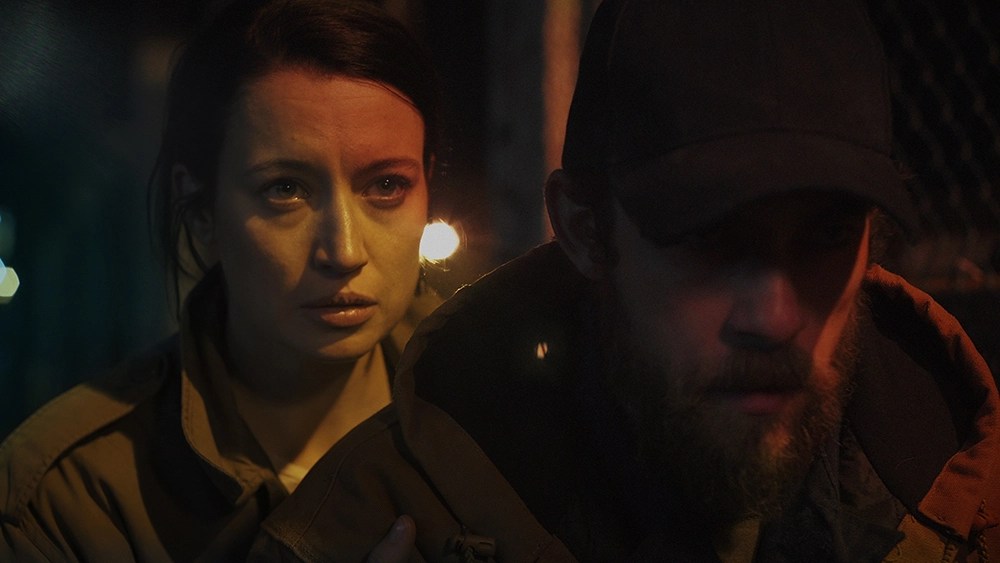
Libby Ewing (TV’s “Grow the F*ck Up”) is Daphne, barely holding it together, fielding unannounced three a.m. visits from her panic-attack prone “on the spectrum” brother Wilson (Evan Dumouchel, of “They Look Like People”) and patiently meeting with an adoption counselor, as if a “recovering” addict with a police record has a prayer of that ever happening.
All her self-help/self-actualization “Buddhist” “Zen” etc. jargon can’t hide the obvious. She’s too damaged, too needy and too broke to offer anything to a child.
Wilson, a college drop-out janitor, figures he’ll become a teacher to “help kids” and “make them feel safe.” Well, maybe in Florida. There’s quite the governor-generated shortage here, you know.
Daphne is great at calming her brother, propping him up and understanding him. Imagine his and the viewer’s shock when he walks in on her, OD’d in her bed, her blow-dryer still running.
The “14 year old boy” that Wilson is, he flees, trying to outrun this shock and his own lungs in a breathless (handheld camera) sprint. When he catches his breath and comes back, he first assumes he can revive the dead sister, then he calls the cops and insists he saw “a man” fleeing through her no-fire-escape fourth-floor window.
It’s only when Daphne comes back to him that his task becomes clear. He will find “the murderer,” and “become someone who can fight the man who killed you.”
To the ghost of Daphne, and to us, it’s pretty obvious that was no “man.” And as she exhorts Wilson and “trains” him for the big confrontation, we wonder just who or what Wilson will track down and how he might face it.
Blackshear’s preferred vibe here is down and out and fatalistic. Doom and gloom hang over this story and this quest, and Daphne’s spirit does not sugarcoat it for the brother she’s no longer there to protect.
The sibling relationship and intimate details of their lives — he keeps plants that he names after “Lord of the Rings” or “Hunger Games” characters — are major selling points of this downbeat story.
The supernatural nature of the quest make it “horror.” But “When I Consume You” is closer to being an arm’s-length character study in illness, an arrested-mental-development take on what a childish brother believes he’s seen and the “evil” he must confront.
For all its brevity, packaging a simple psychological horror story in a relatively short film, I felt my interest drifting away in the internalized struggle and contrived, externalized confrontation of the later acts.
It’s still an intriguing and somewhat cerebral entry in the horror canon, a movie that reminds us that the real “monsters” are trauma and the real confrontations are best handled in a therapist’s office.
A good puzzle thriller entertains with the story it’s telling, and the other directions you figure the story just might go, if only in your mind.
“Rogue Agent” begins in late IRA bombing campaign era Britain, with its intrigues and espionage and pieces of spycraft delivered by our voice-over narrator. But where that story — about “keeping an eye on” suspected terrorists at a British college — goes “nine years later” in the early 2000s, is a cat and mouse tale with cruel and tragic undertones.
It’s a film that keeps a lot of possibile outcomes afloat, any one of which is as plausible as the one that’s “the true story.”
Reviewing the film, written and directed by veterans of British “true crime” series and the upcoming Peacock cyber-combat series “The Undeclared War,” presents a critic with a minefield of potential “spoilers.” But let’s see how many I can avoid as I heartily recommend it.
It’s a Gemma Arterton vehicle, as hers is the voice of the all-knowing narrator we hear in the opening scenes. She lets us know “tricks that spies use” about “how to read a room” and how to make “a connection” with someone just by looking “into their eyes long enough to register their eye color.”
We see a fellow, played by James Norton, take a barman (bartender) job at a pub near a college to “recruit” students to be field agents for his operation. One (Marisa Abela) is reluctant, but soon Sophie and her two classmates (Freya Mavor, Rob Malone) are observing, tricking and even searching the rooms of people “Rob” identifies as under suspicion.
Risky work, seeing as how the Irish Republican Army treated spies. Then Rob rounds them all up in the dead of night with a “You’ve been COMPROMISED” and whisks them away.
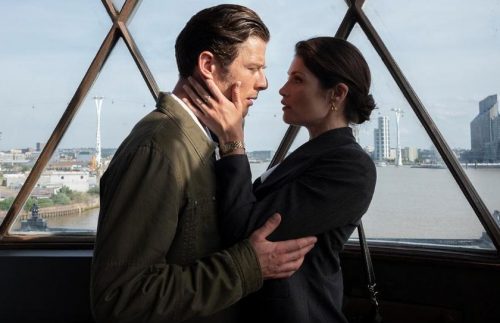
“Nine years later,” a London litigation lawyer (Arterton) attracts the attention of a somewhat slick luxury car salesman (Norton), someone she dismisses with extreme prejudice, but someone she returns to apologize to.
And for the first time in this smart, twisty tale, we wonder who’s playing whom and just what all this is about. Because the love affair that ensues is only somewhat credible, with his intriguing intensity and odd blend of gaucherie and charm and her a woman of class and intelligence and her firm’s private investigator (Julian Barratt) on retainer.
But all is not what it seems, and the more she and we learn, the prospects of what this attorney might do to trip up, evade or unite with this “rogue agent” seem to grow in number rather than shrink to just a few choices.
Norton — he had the title role in the very fine “Mr. Jones” — evinces an oily charm here that puts us on our guard, and we’d assume our attorney on hers. I’d say that’s a logically lacking element to the film, the hardest sell among many hard sells folded into it.
But the always beguiling Arterton is quite good at suggesting a focused but perhaps lonely professional woman disarmed by this confident, handsome guy’s excuses, evasions and deflections, maybe even charmed by them. Rob might see red flags in her mistrust and suspicion. But as Alice the attorney doesn’t spot them at every turn, she’s putting a lot more romantic stock in the offbeat magic of having someone introduce you to “the thousand year song” of echoing Tibetan music bowls than one would expect.
“Rogue Agent” presents some things that truly stretch credulity as simple facts, leaving the viewer to slap our head in wonder because, damned if this story isn’t “true.” You can look it up, although that’s not recommended until after you’ve seen it.
Because as this clever script winds its way towards a finale that’s not really a conclusion, you’d be cheating yourself of the fun of the mystery-thriller you’re watching, and the one you’re frantically writing in your head as possibility after possibility pops up, is wrestled with and discarded to make way for the next.
Rating: unrated, sex, smoking, profanity
Cast: Gemma Arterton, James Norton, Marisa Abela, Sarah Goldberg, Freya Mavor, Rob Malone and Shazad Latif.
Credits: Directed by Declan Lawn and Adam Patterson, scripted by Michael Bonner, Adam Patterson and Declan Lawn. An IFC release.
Every long form “embedded” sports documentary is an incredible leap of faith.
Think of “Hoop Dreams,” where you go in, invest years covering and getting close to a small group of players, clinging to the hope that at least one of them will become a star in the NBA — eventually.
A filmmaker sees a narrative going in, a classic underdog story. But the reason so many of us love sports is the knowledge that you never know how things are going to turn out. Hard to plan “heartwarming” when a rattle off the rim, “a ground ball with eyes” or a tipped pass can upend your “Hollywood Ending.”
“Hockeyland” is a polished, intimate and somewhat generic look at lives on and off the ice in the Motherland of American hockey, northern Minnesota’s Iron Range. It sets up as an underdog story — the dying town clinging to its glorious hockey past, a high school revival, a storied program’s first playoff run in 18 years. But as any hockey fan’ll tell you, it’s a fast-paced, brutal and fickle game. You can have a star or stars bound for the NHL, working class kids “maturing” and seeking redemption, or playing through debilitating back pain, a tragic backstory or two off the ice. None of that matters if run into that red hot goalie who guards the net like his firstborn.
“Saving Brinton” director Tommy Haines, a Midwesterner, knows the lay of the land and gives us a sometimes graceful, occasionally bone-jarring film that vividly captures action on the ice — trash talk and brawls include — and far more banal lives off of it.
He contrasts modern Minnesota high school hockey power Hermantown with fading, once-lauded Eveleth, once so storied it became home of the U.S. Hockey Hall of Fame. More populous Hermantown had become “the big bad bullies” of Minnesota high school hockey. Eveleth’s a dying town on the Iron Range, its high school reduced to merging with neighboring Gilbert and destined — before the film was finished — to be absorbed by the larger school in nearby Virginia, Minnesota.Hermantown’s coach preaches “mindfulness” and meditation in addition to his usual exhortations. Eveleth’s is Mr. Old School “Go out there kick their asses.”
Hermantown had a bound for glory star in Blake Biondi, a very good team — including brothers Indio Dowd and Ardyn Dowd — around him and a winning culture thanks to its all-involved coaching staff.
In 2019-20 Eveleth fielded a team with 15 seniors. But star Elliot Van Orsdel is a reckless sort who “gets into trouble” in between hockey seasons, everybody says. A senior not deemed fit to be “captain” material, his redemption story is winning back that trust and restoring a fading town’s reputation as capital of Hockeyland.
Haines is a good enough filmmaker to get a decent movie out of this rivalry and these characters when things aren’t likely to give him a storybook finale. We pick up on that early on, with the army of talent making relentless Hermantown seem unstoppable. Still, there’s that “one hot goalie” hope, hanging around as we see games over the course of the season, every storyline pointing to the state playoffs, “Mr. Hockey” voting and hockey hopes post-graduation.
The brutal action on the ice might not deliver lump-in-the-throat moments. But the backstories — this kid lost a mentoring father to cancer, that one has a mother fighting the deadly disease, a scoliosis diagnosis here, pro scout visits there — give the movie a dab of heart.
If it wasn’t for the “Slap Shot” trash talk on the ice, “Hockeyland” would feel positively quaint, a Minnesota of Garrison Keillor’s imagination — wholesome kids hanging with grandad, (some) religious families, a PG-dating scene and recklessness limited to skidding your SUV off the road in the snow. High school kids being the way they are, and with the obviously blue collar nature of Eveleth’s stars and their families, I wondered what the kids weren’t letting Haines see.
And despite Haines’ best efforts, the film’s shift in focus once its original narrative breaks down is jarring. All of a sudden, golden boy Blake is the focus when he’s barely in the early acts. Haines set up expectations when he shows us the “It’s Eveleth” disdain in the Hermantown locker room, a “pride goeth before the fall” trope, one neither the underdogs nor the movie about them can deliver.
But the slice of life stuff — busting up lumber scraps for firewood at one of those ever-unfinished Minnesota working class houses, bowling night, post-game parties — is somewhat immersive and paints a portrait of one place where the kids want to escape and another that’s found meaning and attention and self-worth thanks to hard work, discipline and not running into that “one hot goalie” all that often.
Rating: unrated, hockey violence, profanity
Cast: Elliot Van Orsdel, Indio Dowd, Lori Dowd, Blake Biondi, Jeff Torrel, Pat Andrews, Jessica Van Orsdel
Credits: Directed by Tommy Haines, scripted by J.T. Haines, Tommy Haines and Andrew Sherburne. A Greenwich Entertainment release.
A young career criminal gives his protege — “Emily the Criminal” — a look after she says something that definitely ups the ante and increases the risks of their latest undertaking.
“You’re a very bad influence,” he mutters.
Emily is played by Aubrey Plaza. So talk about “goes without saying.”
The cinema’s favorite “naughty girl” turns “badass woman” in this gritty and bitingly-topical thriller set in LA’s thriving illegal underground economy.
The milieu is the world of stolen credit cards, the thin line that many see and cross to use them and the nerve it takes to walk into a business with fake card and fake ID and walk out with a flatscreen TV, sound system, laptop or automobile.
First-time feature-director John Patton Ford’s slap-in-the-face thriller is about generational angst and generational burdens, watching the star-kissed succeed and live their best lives while you’re trapped under student debt, “entry level” work and a dream that dies a little more with every “your payment was applied to the interest, not the principal” message.
Emily has it worse. We meet her at a job interview where she’s tricked into minimalizing something on her “permanent record,” a college-years assault charge.
We watch her struggle, sharing a dumpy apartment with a young Japanese couple, delivering for a catering company and never getting the graphic artist gig interview with the firm where her gorgeous high school pal (Megalyn Echikunwoke) landed. We see her flinch when Liz shares her “going to Portugal, for work” news. And we pick up on Emily’s kryptonite.
She has two of those, one being a temper and outspoken willingness to call out abusive employers, would-be employers and “internship” hustlers.
“Are you an employee?” one of them barks back. “You’re an INDEPENDENT contractor. It’s not like you’ve got RIGHTS.”
And a night of “just drinks” with Liz reveals Emily’s other handicap. She ends up staggering onto the sidewalk, from liquor to a random guy’s offer of coke, in a flash.
But a colleague texts her a phone number, a “dummy shopping” hustle, offering “$200 in an hour.” That’s how she meets the sketchy Yousef (Theo Rossi, excellent), his ruder and sketchier brother Khalil (Jonathan Avigdori, brooding menace incarnate) aand her introduction to the world of bad credit cards, fake licenses, bad checks and bad people on both sides of almost every transaction.
We hear the rules and guess which ones Emily is fated to break.
“Don’t mess with ATMs, don’t meet customers in your home, don’t go to the same store more than once a week.”
We pick up on how tough and morally “flexible” Emily is. We see her eyes widen as doors seem to open, if only a crack.
Could this be her ticket out — of debt, working poverty, the limited horizons dictated by her “permanent record” past?
Plaza turns off her bug-eyed on-the-make act, and dials down her finely-tuned “bitch you don’t want to cross” for Emily, a fierce creature when she’s cornered, and this world seems dead set on cornering her.
Rossi plays Yousef as cagey — perhaps smitten, perhaps using or “playing” Emily. Is he really a Lebanese guy in an unsavory line of work but idealistically determined to go legit and see his American Dream come true?
And Gina Gershon shows up as an “unpaid internship” employer, the person who uses Millennial “lazy” “spoiled” slurs to justify exploiting people like Emily. Emily both fits the stereotype — “I just want to be free. I just want to experience things, travel” have money without the hazing rituals of grunt work life — and is EveryMillennial’s nightmare, buried under college debt before life even begins.
I love the portrait painted here, of a flawed young woman trapped in a system that seems corrupt wherever you look. The people buying the illicit purchases from her are far bigger crooks and more dangerous, and plenty of those she purchases from are just as sketchy as her and Yousef.
Ford has tapped into resentments deep and wide here, and in Plaza, he’s cast the perfect complaining spokeswoman and one badass broad who isn’t going to take any of this lying down.
“Top Gun” may be the blockbuster of the summer, and “Everything Everywhere All At Once” the movie event of the season. “Emily the Criminal” is the face and voice of not just the summer, but an American generation right now, looking for a break and desperate enough to cross the line if they don’t get it.
Rating: R, violence, brief drug use and “language” (profanity)
Cast: Aubrey Plaza, Theo Rossi, Bernardo Badillo, Megalyn Echikunwoke, Jonathan Avigdori and Gina Gerhson.
Credits: Scripted and directed by John Patton Ford. A Roadside Attractions release.
“Pahuna: The Little Visitors” is a tiny tots on their own children’s fantasy about barely-school-age Nepalese siblings who take a child’s view of taking care of themselves and their infant brother after they get separated from parents.
Although it begins in violence — because that’s what puts this family from Daalpur on the road, fleeing to the neighboring Indian state of Sikkim — it quickly evolves into a picaresque and just realistic enough “how little imps like this might manage” when stuck, on their own, with a baby.
It’s adorable, the most adorable thing on Netflix right now.
The sounds of gunfire makes everyone back up a few things and flee into the woods. But when the father goes back to “distract” the unnamed bandits, revolutionaries or what have you, it’s natural that the mother would entrust her three kids — Amrita (Ishika Gurung), the oldest (maybe 7 or so), Pranay (Anmoul Limboo), a year younger, and baby Bishal — to her sister as Mom turns back to find her husband.
“Promise me you’ll stay together and look after Bishal,” is her plea. And then she’s gone.
Everybody hikes and camps their way to safety. But as the grownups in their village party debate the merits of crossing into Sikkim, Pranay is the one listening to flaky, rice beer-loving “uncle” Rai (Mahendra Bajgai). That town, Pelling, it has a church! The “monsters” there attack our old gods. And the priests? “They wear long robes, to catch and HIDE children in,” he says (in Nepali with English subtitles)! “They EAT babies!”
Pranay convinces the (slightly) more sensible Amrita of this, and there’s nothing for it but for them to give the grownups the slip and keep their promise to Mom (Manju Chhetri).
They move into an old bus, abandoned in the woods, make a fire, cook and eat and set up housekeeping.
There’s a sad moment of “Wonder if Dad’s OK,” a little wondering of when Mom will find them, and how, and then they’re lightly bickering over who does the dishes and how they’ll get by with the little food and water they have with them.
A snare to catch a bunny? Sure. Wait, we have to kill it to eat it? Maybe not.
The childish problem solving is countered by universal bits of early childhood behavior any parent will recognize. Take a tumble, washing clothes at the waterfall? There’s no sense in crying your eyes out, there. Go back to the bus and bawl, where you’re sure to have an audience.
The baby starts crying inconsolably, and they check his nappy, try and feed him and even rig a hammock to rock him. No dice. And then he breaks wind, “Bishal the Farting Machine” is “cured.”
The cuteness goes into overload as Pranay meets a friendly goatherd (Binod Pradhan) and sweetly talks the old man into a job, grazing his goats, in exchange for milk. Amrita finds out her Nepalese cash won’t buy anything at the store, but a sweet pregnant lady (Banita Lagun) might be talked into giving her chores for “IC” — Indian Currency.
The sweetness hangs over this picturesque picture is as simple as the “we’re all related, after all” tradition of calling even strangers “Auntie” and “Uncle.”
Melodramatic moments aside, we never really fear for anyone’s well-being, and even the menacing, faceless presence of the robed priest, who takes a morning walk near their bus in the woods each AM, is headed for a sweet solution.
Kindness rules the day, kids comforting grownups, grownups looking after kids, making them think charity is something they’re working for.
The story is simple enough to follow without reading the subtitles, but if your kids are too young to read, you’ll have to explain the silly superstitions and translate the fart jokes for them, which is really the best part of parenting, isn’t it?













 Movie Nation