Classic Film Review: Laughton and Lean make “Hobson’s Choice” (1954)

British editor-turned-director David Lean is most widely-known for his epics. Starting with “Bridge on the River Kwai” and “Lawrence of Arabia,” on through to “Dr. Zhivago” and “A Passage to India,” he gave the cinema films of scale, scope and depth, and collected accolades and Oscars for his trouble.

His pre-epic career is best remembered for a couple of classic Charles Dickens adaptations. But even if “Oliver Twist” and “Great Expectations” managed a light moment here and there, the maestro was never known for comedy.

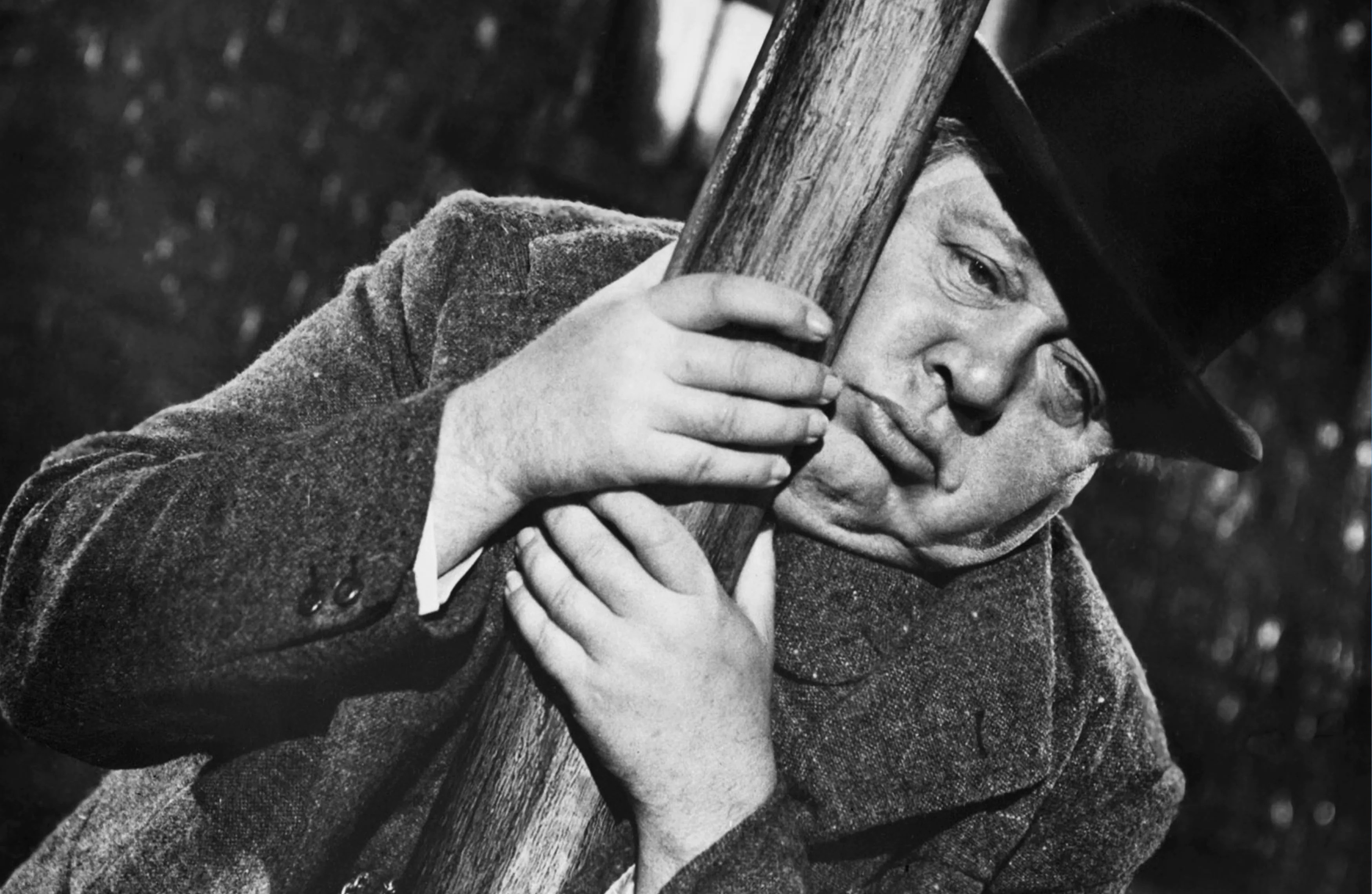
It’s not like he couldn’t manage it. “Hobson’s Choice” is proof of that. This 1954 farce, based on a comically timeless 1915 play, made a fine showcase for the great Charles Laughton, marked another successful teaming with Lean’s early career acting muse John Mills, and features the future Mrs. Basil Fawlty, Prunella Scales, in a role that would become her first big break.

It’s adorable.

The plot and character “types” are what make it timeless. It’s about a lazy widower (Laughton) who runs the most-highly-regarded bootery in 1880s Salford, suburban Lancashire — near Manchester. “Runs” is a tad generous as a description of his duties. Old Henry Hobson started the business and built it, but he’s got two cobblers in his employ, and when he’s not around, he has three daughters running the shop, his house and his life.

Maggie (Brenda de Banzie, also seen in “The Man Who Knew Too Much” and “The Pink Panther”) is the eldest, the one with the head for business. Alice (Daphne Anderson) is the middle daughter, the one who can cook. And Vicky (Scales, immortalized in “Fawlty Towers”) is the youngest and prettiest, trusted mainly with housekeeping.

Vicky and Alice have wary suitors who must time their visits to her father’s habits, his mid-morning and mid-afternoon treks down the street to the Moonraker’s Inn, his favorite public house, where he regales one and all about how he keeps his daughters under his thumb and his business thriving thanks to the underpaid wizard with leather in his employ, unassuming William Mossop (Mills).

But all it takes is one severe but enthusiastic and wealthy dowager (Helen Haye) to upset Hobson’s life of dipsomaniacal leisure. She compliments Mossop, and Maggie does the quick math and resolves “You’re for me, then,” deciding that they’ll marry, start their own shop and build their lives together, whether Mossop is amenable to this or not.

With the other two daughters already plotting their marital escape, what choices does that leave for our pint-happy capitalist?
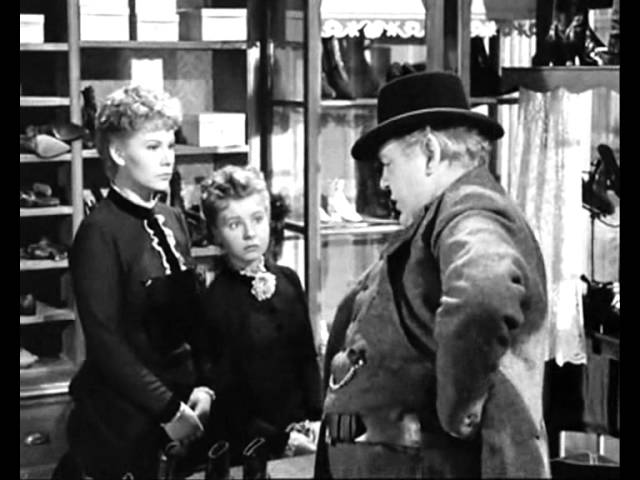
Filmed mostly on Shepperton soundstages, “Hobson’s” relies on a mere handful of sets. But Lean and especially Lawton find funny things to do on them. Laughton’s drunken dash up the stairs, reminiscent of Teddy’s “CHARGE!” up San Juan Hill in “Arsenic and Old Lace,” is a stitch.

This is a comedy of classic set-ups, double-crosses, schemes and true love, with a generous peppering of witty one-liners — mostly delivered by Laughton — regarding Hobson’s situation, his growing exasperation and the daughters he finds less “manageable” by the hour.

On Vicky’s provocative fashion sense, he gripes about the “bump” on her rump (a bustle) that he notices as she walks the streets “with the kind of waist that’s normal in wasps, unusual in women.”

 On a lawyer he finds himself haggling with — “I’m not so fond of the sound of your voice as you are.”

His elbow-bending mates at the Moonraker’s hear why he is determined to foil that first marriage of his most indispensible daughter, Maggie.

“I’ve noticed that if you get one marriage in a family, it goes through t’lot like measles.

Laughton was never funnier on screen. More sadistic, sure. But he makes a perfectly delightful blowhard drunk in his sole collaboration with Lean.

The film’s immaculately-framed compositions and perfect editing don’t make an effort to hide how slight this all is. The story is Shakespearean in its multiple daughters unable to easily marry their way out from under their father’s control. But the play and the film give them agency, especially Maggie, who sets all this in motion with an unflinching march towards the altar, dragging poor Mossop along because he plainly and amusingly doesn’t know what’s good for him.

Lean’s black and white films about Victorian Britain — Wilfred Shingleton did the art direction for “Hobson’s” and “Great Expectations” — have aged into what amount to historical documentaries of the era. If it didn’t actually look and feel like his, that’s still the way we expect even today’s gloriously colored versions of Dickensian London and environs to appear.

Shingleton won an Oscar for “Great Expectations.” Cinematographer Jack Hildyard would go on to win an Oscar for filming Lean’s “The Bridge on the River Kwai.”

“Hobson’s Choice” has enough delights that while one would never wish Lean had forgone any of his later films for another out-and-out comedy (Well, maybe “Ryan’s Daughter”), perhaps he might have had a better go of it than his next film, the heavy and more wistful romance “Summertime,” with Katherine Hepburn and Rossano Brazzi, also an adaptation of a play.

But if you’ve missed choosing “Hobson’s” in your survey of Lean’s 19 film (a few uncredited assists) directing career, it’s definitely worth a look. Laughton, the always warm and engaging Mills, de Banzie and the future and forevermore SYBILL!” of our nightmares seal the deal.

Rating: unrated, alcohol abuse, with an “ass” here and there

Cast: Charles Laughton, Brenda de Banzie, John Mills, Daphne Anderson and Prunella Scales.

Credits: Directed by David Lean, scripted by Norman Spencer and David Lean, based on the play by Harold Brighouse. British Lion production on Tubi, Youtube, Amazon etc.

Running time: 1:48

Posted in Reviews, previews, profiles and movie news | Comments Off on Classic Film Review: Laughton and Lean make “Hobson’s Choice” (1954)

Netflixable? Gerard Butler gets back to making B-movies — “Last Seen Alive”

And just like that, Gerard Butler’s back to making B and C movies?

Sure, he’s got the imaginatively-titled thriller “Plane” due out in January, and not everything Lionsgate releases is a B-movie. But is this it? Is “Last Seen Alive” is the end of his “Olympus Has Fallen” late-career bounce?

Butler still gives fair value, bringing the emphatic “Where’s my WIFE?” pleas, threats and beat-downs in this riff on “The Vanishing” and “Breakdown.” But it’s inferior material, with a script that does a poor job at deepening the mystery of a missing wife, never giving us enough misdirection to believe for a second that, as the cops always say, “it’s usually the husband.” The waypoints in the plot are laughably worn out, the direction is pedestrian, at best.

Butler plays Will, a New England property developer in what one doesn’t need to stay through the credits to recognize as Over-Filmed Rural Georgia and not New Hampshire. He and Lisa (Jaime Alexander) are “going through some things” and she “needs to take a break.”

He’s driving her to her parents’ (Cindy Hogan and Bruce Altman) place when that last “stop for gas” is where she disappears. We don’t even have time to wonder why she isn’t driving herself in her own car. Because this isn’t 1959, even if she did cheat.

Will goes through an increasingly frantic search, calls in a cop (Russell Hornsby), and when he doesn’t seem to “get” the urgency, or pick up on the fact that “broken” CCTV cameras at the gas station actually work, Will takes matters into his own hands.

The picture’s clumsiest scene is the contrived fight Will starts with her parents, who couldn’t possibly think he’s done something to their daughter. Its most predictable scene involves that trope of big city screenwriters who see romance in rural trailer park meth labs.

Aside from that, it’s interesting to see former child star Ethan Embry devolve into The New Clint Howard, not a bad thing to be if you want to keep working.

I remember posting the trailer to “Last Seen Alice” last June, and half-wondering what happened to it. Netflix is the answer, and that might be a good place for Butler’s agent to be door-knocking these days. He’s still good value, even if the movies he’s offered are no longer reflecting that.

Rating: R violence, drug content, profanity

Cast: Gerard Butler, Jaime Alexander, Russell Hornsby, Ethan Embry, Michael Irby, Cindy Hogan and Bruce Altman.

Credits: Directed by Brian Goodman, scripted by Marc Frydman. A Voltage release on Netflix.

Running time: 1:35

Posted in Reviews, previews, profiles and movie news | Comments Off on Netflixable? Gerard Butler gets back to making B-movies — “Last Seen Alive”

Classic Film Review: The Fine Madness that was “The Messenger: The Story of Joan of Arc”(1999)

Historical dramas are as much a reflection of their times as those they’re bringing back to life on the screen. That’s one reason why the many versions of the life and martyrdom of Joan of Arc play like harsh judgements on the character of France, especially in the “Joan” films made outside of France.

When French action auteur Luc Besson took on the subject in the late 1990s, turning it into a star vehicle for his then-very young wife Milla Jovovich, it promised to be something new. No heavenly light beaming down on the future “Saint Joan,” no saintly Ingrid Bergman or Jean Seberg, but with perhaps a touch of “The Passion of Joan of Arc,” Carl Dreyer’s silent masterpiece (starring Renée Jeanne Falconetti).

“Excalibur” had forever raised the bar on depictions of Medieval combat, so it was sure to be grim, bloody and personal as The 100 Years War played out here. And a Frenchman, albeit one with plenty of bones to pick with his native land, might go easier on the French crown and the French clergy in casting blame for the teenaged martrys’ fate in this international production. It’s the English who wanted her dead more than anyone else, lest we forget.

“The Messenger: The Story of Joan of Arc” became a sprawling, historical and occasionally ahistorical rendition of the character and her mercurial rise to fame and glory, and her execution for “heresy” at the age of 19.

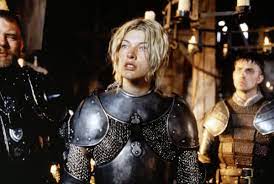
Jovovich, then best-known for “Return to the Blue Lagoon” and Besson’s madcap sci-fi “The Fifth Element,” portrays Jeanne d’Arc as touched with madness, overwhelmed by the battles she was ill-prepared to find herself fighting. Her wild-eyed lashing-out seems even more pronounced by the ways she’s photographed, often in extreme close-up in the most extreme situations, a delusional schizophrenic trying to reconcile “the voice” she’s hearing with her faith and her homeland’s military and existential crisis.

Seen now, Jovovich’s take comes off as perhaps the best way to imagine Joan — pious, self-righteous and perhaps a tad deranged. She was a child “playing” a part, feigning bravado, a teenaged egoist grabbing her people’s attention and inspiring them because she believed so fervently that she made them believe, in turn. Jovovich, who aged into a decent actress trapped in a lucrative, long-running B-movie action franchise later, seems properly overwhelmed and overmatched as “The Messenger.”

The screenplay may fictionalize how Joan was “made” this way — witnessing her older sister’s rape and murder at the hands of the English (never happened). But this written and performed interpretation does a better job of explaining this historical figure without the gift of supernaturalism.

Take the way Besson, whose “The Transporter” movies and “The Fifth Element” gave him license to try his hand at “epic,” introduces Joan as a teen to the dauphin, the French King to be. There’s all this hand-wringing and worry by Charles (John Malkovich, terrific), his mother-in-law (Faye Dunaway, alarming) and the bishops and knights of his court about whether he should “receive” this already-famous teen.

Jovovich’s first appearance on screen here is a “star entrance,” and whatever her impact on the cynics of the court, the viewing audience and Charles are quite bowled-over by this confident, monomaniacal madwoman of faith. They’ve heard her reputation and respect it, they all say. She’s not having it.

“There’s nothing to hear! And why is there nothing to hear? Because I haven’t DONE anything! And why haven’t I done anything? Because none of you WILL LISTEN TO ME!”

Charles, with the English claiming the throne he can’t just take as his own, does listen and gambles on her charisma. Next thing we know, she’s running riot amongst the increasingly exasperated — and amusingly-resigned knights (the wonderful Tchéky Karyo and Vincent Cassel) who find themselves under her command, if not in her thrall the way their army is.

Besson depicts this signature siege of Orleans, so central to Joan’s legend, as result of a bit of luck, some pluck and ingenuity, and some genuine fanatical bravery. It’s an “El Cid” moment, Washington at Monmouth Courthouse, a battle turned by force of will and personality and a leader’s impact on morale.

It is spectacularly-rendered, and utterly believable here, with Jovovich showing us Joan’s confusion, grief and almost psychotic disconnect from what she’s unleashed.

But as with every telling of this time-honored story, we know this is the peak. Backroom politics, Catholic intrigues and backbiting and buck-passing, a public trial and a burning at the stake are to come.

Besson’s cleverest third act touch is putting a face on a “new” voice in Joan’s head. We haven’t heard what she’s said she hears, haven’t seen a miracle manifest itself in giving her this “mission.”

Dustin Hoffman’s casting as “The Conscience,” a cowled, bearded visitor who questions Joan using the Socratic Method, testing her faith, her memories and the illiterate’s knowledge of God as a means of questioning her motives, is telling. He is Jewish, and his appearance here screams “OLD TESTAMENT.” This is Joan’s true judgement, whether or not she passes muster with her own sense of piety and devotion, not the verdict of a compliant religious court.

That’s a self-consciously theatrical choice on the part of the filmmaker, something we’ve seen or picked up hints of in stage interpretations of this story. The difference here is that it’s the acting titan Dustin Hoffman bearing down on Milla Jovovich’s psyche and youth. It could have played as campy, but instead it is unsettling, dismantling, and it works.

The film’s bracing opening scenes let up a bit as Besson falls all over himself to build up that “star entrance” for his wife. But Jovovich shows up, takes over and carries the picture and herself as if she, like Joan, is unsure of what she’s doing, unfamiliar with the spotlight and unaware of how crazy the right lens can make her look. Not that either character or actress, often bathed in blood and mud and madness, seem to care.

I’ve always thought there was too much to admire in this somewhat (not as widely as you remember) maligned overreach of an epic to simply write it off. Judging from the “Joans” that have followed it (a two-part French film in 2019 that failed), “The Messenger” feels more and more like a classic, a modern twist on the sort of old-fashioned epic that occasionally thrills, and always invites us to lose ourself in another time with another take on a character we long ago figured was simply chiseled in stone.

Rating: R for strong graphic battles, a rape and some language

Cast: Milla Jovovich, John Malkovich, Faye Dunaway, Tchéky Karyo, Vincent Cassel and Dustin Hoffman.

Credits: Directed by Luc Besson, scripted by Andrew Birkin and Luc Besson.

Running time: 2:28

Posted in Reviews, previews, profiles and movie news | Comments Off on Classic Film Review: The Fine Madness that was “The Messenger: The Story of Joan of Arc”(1999)

Netflixable? An Animated Fantasy for Kids by the “Kells” Team — “My Father’s Dragon”

“My Father’s Dragon,” the new film version of Ruth Stiles Gannett’s beloved 1940s children’s books, is an adorable and engaging fantasy and, in this interpretation, something of a parable.

Animated by the Irish Cartoon Saloon team that gave us “The Secret of Kells” and “Wolfwalkers,” its about taking responsibility for others, thinking through problems and figuring out that no one person, deity or whatever is going to have “the answer.”

An older woman narrates this tale of “my father” when he was a little boy. He grew up helping his mother run their rural general store until business dried up and they had to move to NeverGreen City. Elmer (Jacob Tremblay) is out of sorts there, and Mom (Goldshifteh Farahani) struggles to find work and feed them. Even Elmer’s ingrained salesmanship is of no use.

But when a stray cat follows him home he at least has someone to vent to. Why is everything so HARD?” She has some thoughts. And as she sounds like Oscar winner Whoopi Goldberg, she’s worth hearing out. She suggests he go fetch this dragon she’s heard of.

Next thing he knows, Elmer’s riding a giggly/ditzy/chatty whale named Soda (Judy Greer, of course) to Wild Island. But upon arrival, the boy learns the dragon in question is enslaved, forced to periodically fly and tow the island airborne, because it’s steadily sinking into the sea.

Elmer frees the dragon, whom we learn is named Boris (Gaten Matarazzo) and who is quite young a tad silly himself. But the apes of Wild Island are thrown into a tizzy. Gorilla leader Saiwa (Ian McShane) is the one who dreamed up that desperate measure of enslaving Boris to lift the island out of the water so that everybody else — monkeys to rhinos, crocodiles to tigers — won’t drown.

Saiwa counsels that “This is not the time to panic,” but from Kwan the macaque (Chris O’Dowd) to the tiny tamarin Tamir (Jackie Earle Haley), they do. Saiwa tries to balance the understandable need to change an unsustainable status quo. But the howler monkeys around him just want to recapture the dragon and save themselves.

Elmer has to reconcile what he’s done, because his main interest was in having a dragon to display for profit in NeverGreen City, with his responsibility to all the creatures he meets on the island. Saiwa has to admit he kept the dragon hostage for equally selfish motives and figure out something new, maybe tying the dragon back up until a solution is discovered.

That said, the film goes easy on the messaging, as younger viewers (I’d say this was an eight-and-under cartoon) will more interested in the many chatty creatures young Elmer and younger Boris encounter on their quest to see the all-wise old tortoise, Aratuah, who surely will have an answer.

Alan Cumming plays a crocodile and Oscar winner Diane Wiest voices a rhino, for instance.

It’s all very cute and simple and childish in all the best kid-lit ways, with a star-studded voice cast that includes a third Oscar winner, Rita Moreno, playing a cranky landlady.

And thanks to the distinct look of films from Cartoon Saloon, this Nora Twomey (she also directed “The Breadwinner”) project plays and feels like a fairytale that has a bit more going on than sight-gags and punchlines.

Rating: PG, animated peril

Cast: The voices of Jacob Tremblay, Rita Moreno, Judy Greer,
Gaten Matarazzo, Ian McShane, Chris O’Dowd, Jackie Earle Haley, Alan Cumming, Leighton Meester, Golshifteh Farahani, Yara Shahidi, Diane Wiest and Whoopi Goldberg, narrated by Mary Kay Place.

Credits: Directed by Nora Twomey, scripted by Meg LeFauve, based on the book by Ruth Stiles Gannett. A Cartoon Saloon production for Netflix.

Running time: 1:39

Posted in Reviews, previews, profiles and movie news | Comments Off on Netflixable? An Animated Fantasy for Kids by the “Kells” Team — “My Father’s Dragon”

Classic Film Review: Semi-Scandalous “Age of Consent (1969)” final feature of Michael Powell, Helen Mirren’s Big Break

However lightly-regarded it might be in the canon of the filmmaker who gave us “The Red Shoes,” “Black Narcissus” and “The 49th Parallel,” Michael Powell’s “Age of Consent” seems something of a landmark,now. It’s a movie that had a reputation in its time, and that impacted the reputations of many of those involved with it, directly or indirectly.

Powell’s lush Technicolor pictures of the ’40s and ’50s kept their sex mainly in the realm of sublimated psychology. But “Consent” and his most scandalous film, “Peeping Tom” (1960) were movies that coated his career with a more lurid brush, in reflection.

Long before I started reviewing films with Helen Mirrren in them, she had a reputation for daring nudity on the screen, something chiseled in stone, willingly or exploitatively, with this her breakout feature. “Excalibur,” “The Cook, the Thief, His Wife and Her Lover” — by the time “Calendar Girls” rolled around, she was ready to mock that rep.

And if you never made the connection between the Irish-born, Kiwi/Aussie actor actor Sam Neill and James Mason, this film makes it stunningly obvious. Mason plays the lead, a character the Australian painter and novelist Norman Lindsay based on himself, an artist who loved being surrounded by gorgeous models. Neill gave us his version of Lindsay in “Sirens,” his first Oz film after his “Jurassic Park” breakout.

The accents are different, with the non-Irish Mason more posh and patrician by nature. But the timing, intonations and understated “animation” of eyebrow expression are damned near uncanny. I wouldn’t be surprised in Neill saw this film as a lad and got into acting because of this Down Under story.

No doubt the sight of Helen Mirren skinny-dipping would drive a lot of lads into acting.

The story’s not quite as creepy as the titles suggests. Not. Quite. But it wouldn’t be set up and cast this way today.

Mason plays Bradley Morahan, a famous Aussie abstract artist who has experienced about as much of New York as he can stand. He flies home, and is immediately hooked up with a former lover (Clarissa Kaye-Mason, who married Mason after they met on the set) and hunted down by a mooch of a former mate, Nat, played by veteran character actor Jack MacGowran (“The Quiet Man”).

Luckily for “Brad,” he’s set for a little enforced isolation. He’s headed for Checkabaronie, an island so far from everything “it’s a morgue, a dump, a desert island” Nat insists. And it’s off season.

Brad moves into a shack there, with a dog he’s named Godfrey, after his last New York art dealer. He starts decorating the place with dabs of color and found objects.

But he’s being watched, and robbed. Godfrey spied her first, hiding under the dock, stealing Morahan’s eggs. Cora (Mirren) is local, primitive and untamed, and below “the age of consent” her hateful drunk of a granny (Neva Carr-Glynn) reminds her.

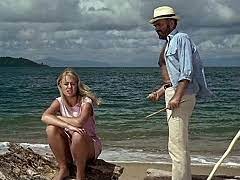
Morahan starts buying her fresh catch — “crayfish” (lobsters) — and other seafood (and chicken) she can provide. And the greying, bearded painter takes a fatherly interest in her efforts to escape from her miserly grandmother and the isolation of this island.

He talks her into modeling for him.

Mirren, credited here as a member of “The R.S.C., The Royal Shakespeare Company,” is at her most playful in this film, striking coquettish poses such as Cora might have seen in magazines the tourists leave behind.

As Morahan is paying Cora to model, money which she can add to “escape from this island” kitty, she can reluctantly be talked into posing nude. But soon she figures out his regard for is strictly professional and starts to take on that air herself. Not that she likes that.

Mirren brings a youthful confusion to the performance of this arrangement, a girl bruised by her grandmother’s greed and drunken “You little slut!” labels. Cora’s late mother went wrong at about her age, turning into “the town bicycle,” who might give “anybody” “a ride.”

Mason, having a go at the accent and the Oz slang, embodies something Neill’s later mirrored in his interpretation of the painter who was writing a fictional account of his own life in this novel, Lindsay’s casual regard for female nudity. Mason’s Morahan has plainly has compartmentalized his interactions with this girl and doesn’t need the leering threats from her grandmother to behave like a detached adult when dealing with her, taking care to respect her privacy and even her reputation when his piggish pal Nat tracks him down again.

When the (somewhat) more age appropriate local fisherman/ferryman Ted (Harold Hopkins) tries to figure out the nature of their relationship, Morahan’s mind is anywhere but in the gutter.

“She’s all right, you know,” the young man chirps. “Glad to hear it” the older man distractedly agrees.

Powell put a lot of things on film he wasn’t known for in “Age of Consent,” from sex and nudity to underwater scenes and lots of genuine, Great Barrier Reef island (Dunk Island) local color. There’s virtually nothing here that smacks of “soundstage,” although the New York scenes had to be faked, and there are interiors that were most certainly sets.

I was surprised that the only real offense to modern sensibilities is fairly tame and confined to the faintly-icky finale. That can be read as a teen girl’s first serious “daddy issues” crush, or more transactional, “This is the geezer that can take me places.”

In any event, its sense of inappropriateness is more of a modern thing that would have merited no more than a raised eyebrow at any earlier point in history, from Jane Austen’s England to the “Swinging ’60s” in New York, London or Brisbane.

The film itself can be seen as the fine, lightweight curtain call it was, even though Powell made a couple of TV films before fully retiring by 1980. The story has a text and a lively sub text — everybody seems to be stealing from the artist, and he in turn, is stealing Cora’s ephemeral youth and immortalizing it on canvas.

It isn’t “The Red Shoes,” but even the great Michael Powell could only manage one or two those.

Rating: R, nudity

Cast: James Mason, Helen Mirren, Neva Carr-Glynn and Jack MacGowran.

Credits: Directed by Michael Powell, scripted by Peter Yeldam, based on the novel by Norman Lindsay. A Columbia release on Tubi, Amazon, etc.

Running time: 1:40

Posted in Reviews, previews, profiles and movie news | Comments Off on Classic Film Review: Semi-Scandalous “Age of Consent (1969)” final feature of Michael Powell, Helen Mirren’s Big Break

Movie Preview: “Knock at the Cabin” frights from M. Night

A horror movie parable, adapted from a novel, with a “Sophie’s Choice” dilemma.

A February release.

Posted in Reviews, previews, profiles and movie news | Comments Off on Movie Preview: “Knock at the Cabin” frights from M. Night

Netflixable? “Roald Dahl’s Matilda” gets the riotous musical it deserves

He didn’t write it as a musical, but Roald Dahl might approve of the dark, mean yet sentimental and sweet confection that rolls off the screen as “Roald Dahl’s Matilda the Musical.”

Writer Danny Kelly and composer/adaptor Tim Minchin’s stage hit, filmed to maximum choreographed effect by “Pride” director Matthew Warchus, bowls us over from the start, a dazzling romp that can’t possibly keep up the infectious energy of its joyous opening acts.

Ellen Kane, opening up Peter Darling’s choreography of the Tony winning stage musical to cinematic dimensions, gives the delightful in-your-face dancing the energy and currency of a Tik Tok video.

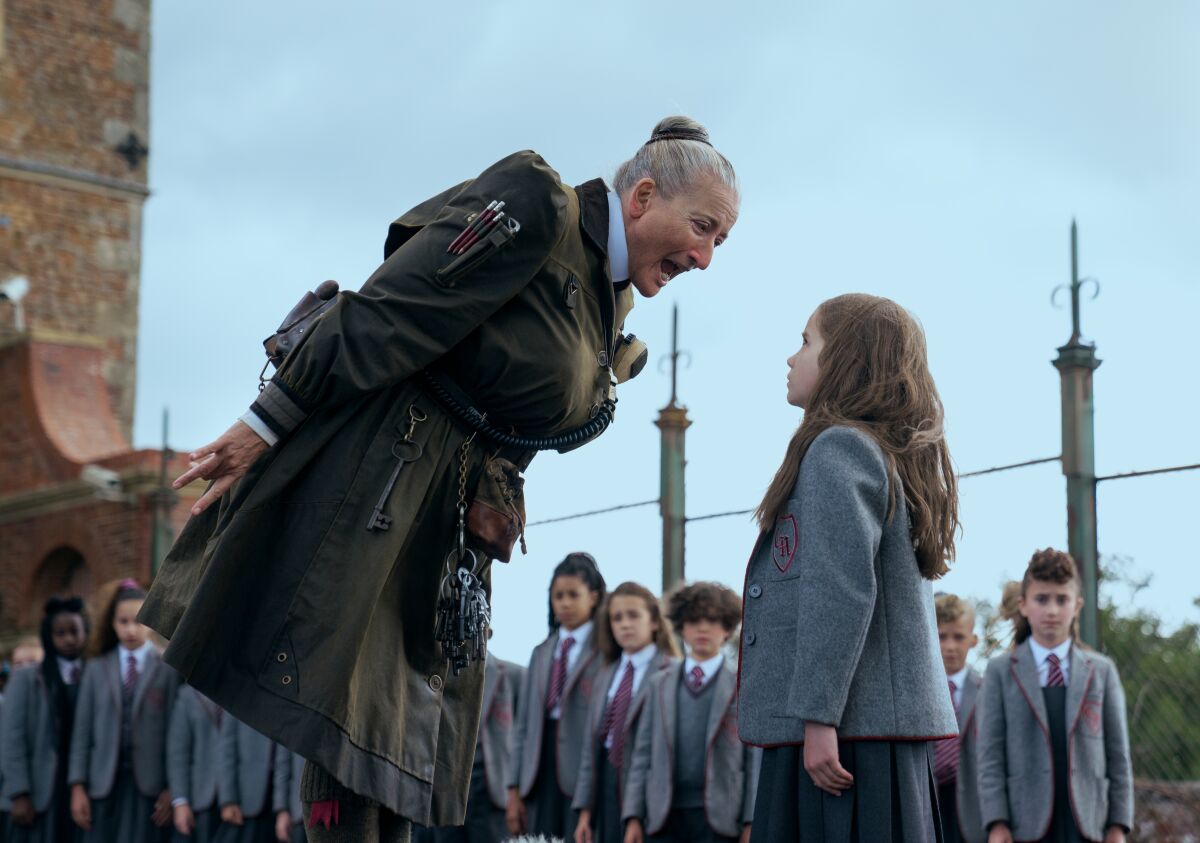
And an almost-unrecognizable Emma Thompson makes the perfect villainess as Agatha Trunchbull, the Olympic hammer-thrower headmistress at Crunchem Hall, a Dickens-meets-Orwell private school where smart, irrepressible and unwanted Matilda (Alisha Weir) is sent by her self-absorbed, incompetent parents (Andrea Riseborough and Stephen Graham).

Her birth may have inspired a big production number sung and performed by her mother’s OB-GYN (Matt Henry). But her mother, the last to realize she was pregnant, and her father, who shows up with blue balloons and can’t countenance the fact that they’re not having a boy, never embrace the idea. Matilda realizes, through them, that “kids like me should be against the law.”

Reading is her salvation, and the helpful bookmobile librarian Mrs. Phelps (Sindhu Vee) encourages this by lending her every novel, history and textbook she has. Matilda is just starting to spin her own story, about an “escapologist” — a word she’s heard bandied by her parents — and an acrobat, their love, pregnancy and increasingly dangerous act, when child welfare intervenes and makes Matilda’s parents put her in school.

The escapologist (Carl Spencer) and high wire acrobat (Lauren Alexander) and their story will have to wait, with daily installments related to Mrs. Phelps before school every day.

Because once at Crunchem Hall, Matilda faces the same oppression and terror as her pint-sized classmates. Any school whose Latin motto is “Bambinatum est maggitum,” (“Children are maggots”) is going to be a trial.

Trunchwood believes “To TEACH the child we must first BREAK the child,” and no coddling by the sympathetic and nurturing teacher Miss Honey (Lashana Lynch of “Captain Marvel” and “No Time to Die”) will be tolerated.

Matilda will be the square peg who tests all that, and bests their shared tyrant in the process.

Tim Minchin’s songs are bubbly and bouncy, and ever-so-“Oliver!” in their British schoolkid choruses. “Revolting Children” is the showstopper, with Thompson vamping through the life-lessons one learns throwing “The Hammer,” and every aspect of English schooling that the acrid kid-lit king Dahl hated is lit up in music.

There are echoes of “Annie,” even Pink Floyd’s “The Wall” in the music, which isn’t likely to contribute any “standards” to the pantheon of great pop musicals, but which convey the emotions and capture the tone of what book writer Danny Kelly, Dahl and Minchin were shooting for.

Young Miss Weir is all a magnetic moppet should be, and the show’s deliriously affecting diversity — perhaps the one thing that would’ve annoyed the dyspeptic Dahl — opens it up and populates it to look and sound like modern Britain.

The kids are collectively adorable and talented. The adults could not have been cast better, with Riseborough and Graham relishing every over-the-top moment as the Parents from Hell — or at least Hemel Hampstead — Lynch shimmering as a teacher with a heart and Thompson giving us a seriously Soviet vibe as the fireplug-shaped ogre Trunchbull.

The film sputters a bit after that breathless opening, and takes a while to rope us back in for the finale. It is hardly alone in the musical theater canon in that “sags through the middle” regard. Here, a touch of supernaturalism means added effects in the late second act that further bog down the proceedings.

But pair this with Guillermo del Toro’s “Pinocchio” and you have to hand it to Netflix. Their “no expense spared” style of filmmaking has two produced of the best two movies for kids of 2022. “Matilda” is gloriously, musically macabre fun.

Rating: PG

Cast: Alisha Weir, Emma Thompson, Lashana Lynch, Stephen Graham, Sindhu Vee, Carl Spencer, Lauren Alexander and Andrea Riseborough.

Credits: Directed by Matthew Warchus, scripted by Danny Kelly and Tim Minchin, based on their musical adapted from the Roald Dahl novel. A Netflix release.

Running time: 2:06

Posted in Reviews, previews, profiles and movie news | Comments Off on Netflixable? “Roald Dahl’s Matilda” gets the riotous musical it deserves

Movie Review: Sexually Curious and Uninhibited Young Israelis Work Things Out with “All Eyes Off Me”

Israeli actress turned director Hadas Ben Aroya continues her exploration of the love and sex lives of young Israeli Jews with “All Eyes Off Me,” her follow-up to “People That Are Not Me.”

Her debut feature explored the curiosity, longing and sexual thrill-seeking of a young woman unwilling to commit, unable to satisfy her urges in any way that doesn’t render every relationship “casual,” to the point where she adds strangers she’s just met to the ex and the new guy she keeps around as part time partners.

The new film follows three people whose interlocking love lives would make things terribly complicated if everyone know all about everyone else.

Ben Aroya tells us their stories in three episodes. In the first, bisexual and bedazzled Danny (Hadar Katz) makes her way into a party, somewhat dazed. She smiles, asks for “Max” and takes a break from her poking around from room to room to have a random, long makeout session with a woman who seems drunk enough to have decided this is how she will spend the evening.

But Danny eschews drink and lets a group of intimates know why. She’s just tested pregnant. So we can guess why she’s looking for Max.

Seeing him with another woman doesn’t throw her completely. That’s the vibe we get from this crowd — young, not committing to anyone, “exclusivity” or even a single gender. But when she finally gets Max (Leib Levin) alone, Danny can’t bring up the topic at hand. She finds herself deflecting by giving dating advice, which he seems to take.

Episode two is Max, all smitten with Avishag (Elisheva Weil), confessing his almost instant “love” for her and his attraction to men, as well, “but not ‘manly men,'” he hastens to add (in Hebrew with English subtitles). “Feminine ones.”

The vivacious Avishag rolls with this, and might even take it as a major selling point of this insatiable new lover. Avishag has been around enough to know what she likes, and she has very particular cravings in bed. She’d liked to be choked, choked like he’s serious. And she wouldn’t mind the occasional pre-orgasmic slap.

And the third episode gets at the consequences of those predilections, Avishag’s avoidance of her latest dalliance and eagerness for a next distraction, literally the first guy who comes along.

Ben Aroya tells these stories in long, slow and conversation-heavy takes, each episode a lingering, slowly-unfolding sequence with monologues and sexual encounters ranging from light and casual to heavy and revealing.

Danny’s revelation to friends at the party earns her a long discourse of how abortion is “granted” in Israel, the drawn-out physical and psychological pain of “the pills,” vs. the single-visit surgical options from women who know.

Max’s suggestion that he’s ready to dash into a weekend away with new love Avishag earns a lecture on rushing things from Danny.

Avishag’s pointed requests for sexual activities are noted and turn into “appointment” sex talk with Max, who has to “schedule” this in.

The film’s middle act is nude and sexually explicit enough that it takes over the film and narrow its interpretations. The third act seems a disheartening reaction to “taking things too far,” with no learning from the previous experience.

The “So, that’s it?” structure undercuts, somewhat, the promise of its title, that we’re seeing young people who need to be beyond judgement and scrutiny during their “I’m working this out” years of experimenting. That lowers the stakes and strips the pathos from the performances, flattening out the movie watching experience.

And the second act’s length and explicit nature suggest the filmmaker got lost in the particulars of filming intercourse and titillation and decided to make a primer on rough sex, Israeli style.

“Eyes Off Me” is more carnal than emotional or particularly psychological. But I guess Ben Aroya has her brand and she’s just going to stick with it.

Rating: unrated, sexually explicit

Cast: Hadar Katz, Leib Levin, Yoav Hayt and Elisheva Weil

Credits: Scripted and directed by Hadas Ben Aroya. A Film Movement release.

Running time: 1:28

Posted in Reviews, previews, profiles and movie news | Comments Off on Movie Review: Sexually Curious and Uninhibited Young Israelis Work Things Out with “All Eyes Off Me”

Classic Film Review: Nicol Williamson is Irish, Out of Control and headed for “The Reckoning” (1969)

Long before Nicol Williamson broke character and fight choreography the sacred vows of the theater and went after a co-star, mid-performance, in “I Hate Hamlet,” he had a reputation. Scary. Dangerous. Volatile. Did not give a f—.

I remember interviewing that co-star, Evan Handler, when Handler’s memoir “It’s Only Temporary” came out some years later. Handler quit the Broadway production on the spot, even though some corners of the press (the Brits) played down the incident with a prop sword as a “swat on the bottom.” Pressing him on the matter, Handler set me straight and gave one an appreciation of what terror it was, being on stage with a deranged and armed co-star in front of an unsuspecting audience.

Williamson, one of the most acclaimed British stage actors of his generation, was difficult on sets, theatrical and cinematic. He could be a bit of a loose cannon after hours. But he rarely got across that scary, psychotic, anger-mismanagement quality on screen.

Stumbling into the 1969 tour de force The Reckoning,” there it all is. He’s downright alarming in this blunt instrument of a thriller. Williamson lets us see a man of violence who represses that violence as best he can, until that moment when his past demands that he “do something” when one of his own is wronged.

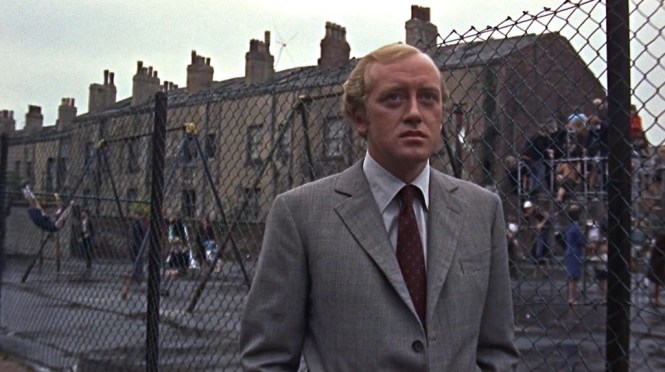
Williamson plays Michael “Mick” Marler, a raging, on-edge mid-level manager at an adding machine manufacturer that was too late getting into the computer game. He toxic testosterones his secretary and bullies subordinates, but saves his most intense “management” for his reserved, timid boss (Paul Rogers), whose path to the top Michael defends as if his own manhood is threatened.

“I couldn’t give a pennyworth of COLD TEA what you ‘feel,’ Mr. Berham!”

At home, he’s a drunken brute of a “paddywhacker,” a trait barely tolerated by his “English bitch” of a wife (Ann Bell). But the upper class minx lets lust be her guide when considering her mate’s rougher qualities.

Then Michael gets the phone call that makes him “Mick” again. His father up in Liverpool is on his deathbed. And no amount of reckless Jaguar driving will get him there on time. But he notices bruises under the old man’s ribs. No matter what the go-along-to-get-along Irish doctor (Godfrey Quigley) says, Mick can guess what’s happened.

Meeting with one of Da’s mates (J.G. Devlin) confirms it. And as old Cocky tells of that night at The Bricklayer’s Arms, of Mick’s dad singing mournful Irish ballads only to get beaten up by “Teddy Boys,” it’s plain that there’ll be no calling “the English PO-lice,” “the bogeys.” Something will have to be done, and it’ll be businessman/suburban estate gentleman Mick who’ll have to do it.

Continue reading
Posted in Reviews, previews, profiles and movie news | Comments Off on Classic Film Review: Nicol Williamson is Irish, Out of Control and headed for “The Reckoning” (1969)

Netflixable? Neglected “Old People” launch this “Night of the Living Dead”

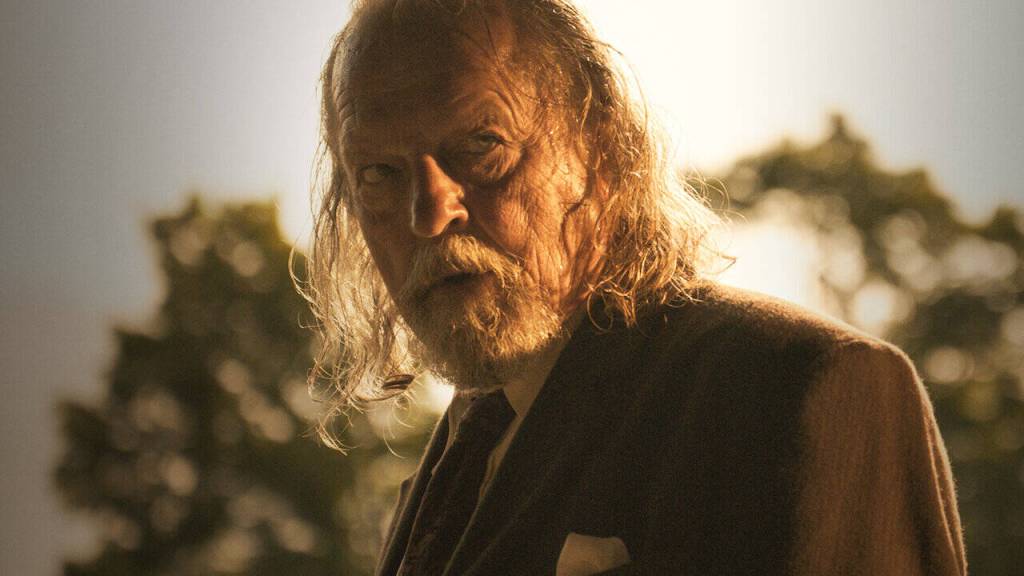
The neglected and abused elderly become avenging zombies in the German thriller “Old People,” a film with a clever hook, grisly details and a motivated, some would say justifiably so, “villain” class.

Writer-director Andy Fetscher’s depiction of the horrors of old age has its sad, universal truths, even if it uses them to trot us through the same old genre tropes, even if it stumbles from its initial premise.

In the opening tease, a fictional “present” a young, distracted elder-care nurse hangs up her phone, checks in on an aged client and is promptly murdered by him.

The implication is that this has been going on for some time, that seniors started turning into the “Living Dead” the previous summer in a rural nursing home visited in a long flashback that is the movie’s primary focus. Yet somehow, this front line worker in the present day’s social safety net is unaware of the threat that every home visit now carries with it.

That summer before, Ella (Melika Foroutan), her teen daughter (Bianca Nawrath) and younger son (Otto Emil Koch) return from Berlin to the rural hamlet where she grew up. They’re back because her sister (Maxine Kazis) is getting married.

Ella figures she and the kids will drive her dad to the wedding and reception, celebrate the ceremony and head back to the city. But sister Sanna notes “you haven’t called” or been back in quite a while. She doesn’t know Dad’s in a nursing home? Wait, the head nurse there (Anna Unterberger) turns out to be the woman Ella’s husband (Stephen Luca) left her for. How’d that hap…never mind.

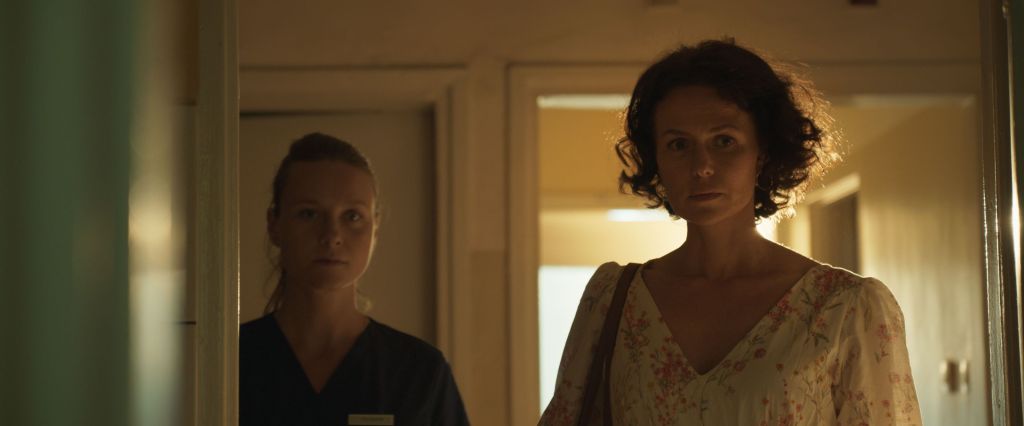
Ella’s guilty neglect is all over her face as she visits the chillingly quiet Saalheim Home and sees the nearly catatonic residents there, the more active among them “restrained” in their beds. This Nurse Kim gives a “What can you do?” (in German with subtitles, or dubbed) and strikes us as a real piece of work. And she might be one of the “good” nurses there.

Because as the family dresses for the wedding, and Ella and Sanna’s silent father (Paul Faßnacht) is taken out for the evening, the impersonal cruelty of such warehouses for the very old becomes clear. They’re kept to a schedule, lightly taunted that they weren’t “invited” to the wedding festivities in this aged, dying village they’ve spent their entire lives in, but which they can hear across the way — until the windows are unceremoniously closed.

They snap. There’ll be no “happily ever after” for the newly-married couple or for Ella and her obviously-conflicted ex, who never wanted to leave this town. The mob may be old and largely quiet. But they’re motivated.

Continue reading
Posted in Reviews, previews, profiles and movie news | Comments Off on Netflixable? Neglected “Old People” launch this “Night of the Living Dead”