Netflixable? “One Night Stand” stands around and talks for an hour

It’s not just the title that makes “One Night Stand” the raciest, most sexual Indonesian film to ever make it to Netflix.

It opens with a fevered road-side in-the-car hook-up — in broad daylight on the access road to an airport, no less — and ends with a bit of a bender that climaxes in the clenches.

But this being conservative Indonesia, it still earns a TV-14 rating — no nudity, nothing graphic and no profane come-ons or pillow talk.

Don’t let that smiley/flirty photograph posted above fool you. This is from late in the third act of what might be the slowest movie since that holiday favorite, the Yule Log-on-fire video.

The moment “they” meet inertia sets in. Ra (Jourdy Pranata), whom we’ve seen in the throes in that sex-before-flying prologue set one year earlier (?) has just landed in Yogyakarta for the funeral of his mentor’s wife. Lea (Putri Marino) was sent to pick him up.

And as the fetching assistant and the hunky young painter walk and talk through the airport at one third the normal speed, one first gets the feeling one is watching paint dry. In the humid, forever-to-dry tropics, no less. It’s as if the camera operator had a bum leg, or nobody involved wanted to leave the air conditioned indoors. SLOW walking.

There’s a lot of walking and talking and driving and talking in this film, with these two cute but dull characters sizing each other up and Ra not very coy about dodging the calls from some other woman back home. Was she the hook-up at the airport the year before? I think that’s implied, but their brief phone chats give NO clues, and do nothing to spice up the plot, or advance it.

He’s plainly interested in Lea, and after the funeral, makes his play. Would she accompany him to the wedding of an old friend?

The sole Around the World with Netflix value in this Adriyanto Dewo film — in Indonesian with subtitles — is in its depictions of Indonesian funeral rites and wedding traditions.

Agreeing to accompany a guy she just met doesn’t mean Lea won’t be subject to immersion in wedding prep rituals — made-up, hair-done and loaned a dress and welcomed as a member of the wedding party, even as a stranger.

It’s only after these two tentative, fairly tedious people get drunk on the beach that they “get real,” as the kids used to say. And get busy. But even that’s pretty tame.

Tedium itself, this “romance” has little point, and takes an absurd amount of slow-walking time getting to it.

Rating: TV-14, sex, drinking

Cast: Jourdy Pranata, Putri Marino

Credits: Scripted and directed by Adriyanto Dewo. A Netflix release.

Running time: 1:20

Posted in Reviews, previews, profiles and movie news | Comments Off on Netflixable? “One Night Stand” stands around and talks for an hour

Documentary Review: One Family’s Odyssey through Opioids — “Anonymous Sister”

“Anonymous Sister” is one filmmaker’s effort to tell the story of America’s “man-made”/Purdue Pharma engineered opioid epidemic simply by the impact on her family.

Writer-director Jamie Boyle tells the story of growing up during the birth of the opioid crisis and how it almost consumed her sister and her mother and the toll that took on a tightnit group, a toll that they’re still feeling today.

Boyle profiles and interviews her sister Jordan, siblings so tight that Jordan describes younger sister Jamie as “the other piece of my heart” pretty from birth. She intereviews her mother Julie and details their lives before, during and after her and Jordan’s addiction to Oxycontin, Vicadin and the opium-based pain pills America’s doctors were mad to prescribe from the ’90s to very recently.

She interviews other addicts, a Purdue Pharma rep, and a doctor who is one of the leading experts on this “epidemic,” its cause and its effects. She uses archival news coverage, old home movies and the years of family video about this struggle, including snippets from a student film about her mother and sister, to paint a personal portrait of a national tragedy created by marketing so pervasive it changed our notion of “pain tolerance” and “pain management” to suit the needs of Purdue and the Sackler family that controls it.

The film is both touching and infuriating as Boyle shows us as direct a cause-and-effect in an addiction case as any documentary ever.

Home movies capture pre-school Jamie begging her dad to let her do the video recording, the girls’ early fascination with figure skating after seeing Kristi Yamaguchi win Olympic gold in 1996, and Jordan’s body-and-soul commitment to the sport, with her parents detailing the staggering cost of training, equipping and supporting her. Mother Julie took on a cleaning job just to cover that.

Driven and perhaps guilt-ridden over the cost of her obsession, Jordan skates until she gets nerve damage in her feet. That pain leads her down the road to Oxy, in ever-growing doses.

“I will never be able to stop this,” Jordan recalls thinking as her elevated, “happy” state set in. The drug made her “so much better at my life.” What could be the harm?

Her mother travels her own chronic pain to Oxy/Vicadin path. And her husband and especially Jamie are witnesses to and eventual interveners in a years-unfolding family disaster brought on by drugs whose maker insisted were “not addictive.”

Julie Boyle notes that the “drugs alter your reality,” that “it didn’t feel like a ‘high.’ I’ve been high.”

This was an expensive, destructive new “normal” that grew more dangerous as tolerances built up and higher doses were required.

“Anonymous Sister” recounts the Oxy scandal that blew up just as the Bush Recession set in, and how little changed despite the admissions of lying, manipulation of public opinion and government complicity in this lax oversight of “prescription heroin.”

The Boyles are straight-up middle-class suburbanites, so there’s no “Hillbilly Heroin” labeling as “something poor fall into” here. This could happen to just about anybody.

The inclusion of extensive home movies and deep-embedded background that Jamie Boyle’s direct witnessing of all this lends “Anonymous Sister” an authenticity and personal investment that few films on this subject could match.

And the presence of experts and decades of news coverage — first hailing this “breakthrough” on “pain,” then decrying the rampant profiteering that turned whole states into mass-death Oxy Zones, the greed and cynicism that that made the Sacklers rich and almost consequence free — make one hope that “Anonymous Sister” will not simply be lost in a video market flooded with documentaries.

It should play on cable news network as a first person account of a major story, and programming that’s a lot less embarassing and repetitive than the standard fare on most of those services.

Are you listening, CNN?

Rating: drug abuse subject matter, some profanity

Cast: Jordan Boyle, Jamie Boyle, Julie Boyle, John Boyle and Dr. Andrew Kolodny

Credits: Directed by Jamie Boyle. A Long Shot Factory release.

Running time: 1:33

Posted in Reviews, previews, profiles and movie news | Comments Off on Documentary Review: One Family’s Odyssey through Opioids — “Anonymous Sister”

Movie Preview: Charlotte Gainsbourg’s a French Late Night Radio Hostess — “The Passengers of the Night”

This 1981 French election-year period piece has Charlotte Gainsbourg as a newly-divorced woman with two kids, who takes on a radio gig and takes in a troubled teen she meets on the street.

“The Passengers of the Night” — very evocative radio audience title — opens June 30.

Posted in Reviews, previews, profiles and movie news | Comments Off on Movie Preview: Charlotte Gainsbourg’s a French Late Night Radio Hostess — “The Passengers of the Night”

Movie Review: An Aspiring Actress follows her dream in 1942 Paris — “A Radiant Girl”

Irene is young, dancing along the fine line between those French labels “gamine” and “coquette” as she dreams of glory as an actress.

She’s in her late teens, eager to be accepted in a Paris conservatory, supported by her widowed father, her fellow actors and her audition partner Jo. She is a woman-child who attracts attention, and gives it whenever a handsome young man crosses her path.

But “A Radiant Girl” can still have problems, even if she’s loathe to let on. She faints a lot, and it might be due to stress, low blood sugar or something else going on.

It’s 1942, Paris is occupied by the Nazis. And Irene, played to the coquettish hilt by Rebecca Marder of “Someone, Somewhere,” is Jewish. What on Earth could have her “stressed?”

“We’ve become the topic of conversation….It’s unfashionable to be Jewish,” her father shrugs. Irene shrugs as well. She’s got her scene from a play by Maivaux to memorize, rehearse and polished to a talent-that-will-not-be-denied gleam. Ever tightening Nazi “rules?” No concern of hers.

Writer-director Sandrine Kiberlain’s Holocaust Era drama is something of a curiosity, a film that takes us into Irene’s denial, the focus of a committed actress and the flightiness of an indulged child who isn’t letting the never-seen Germans step on her dream.

But as her widowed father (André Marcon) grows increasingly alarmed that his “just follow their rules” won’t save them, as her audition partner Jo (Ben Attal) disappears, perhaps having fled the country, as the red rubber stamp that identifies her as “Juive” on her “papers” is supplanted with a yellow star-of-David badge, as her musician brother (Anthony Bajon) loses his girlfriend and the “no radios” and “no Jews admitted to the Conservatory” rules pile up, maybe Irene will get a clue that the lure of the limelight is a fatal attraction and perhaps a deadly distraction.


“A Radiant Girl,” titled “Une jeune fille qui va bien” doesn’t just keep the Germans out of sight. It lulls Irene and us to the danger she’d rather not consider. There’s a boy ardent for her affection, a handsome doctor’s assistant that makes her heart flutter and the missing Jo, whom we figure she’s also had a crush on.

Irene’s delusion is underscored, in a couple of sequences, by what sounds like four-piece-band 1960s pop, in English no less. That’s a rather ham-fisted way of making the point that at any other time, Irene’s talent would steer her towards stardom and not arrest, transportation and her part in The Final Solution.

Marder has a Shailene Woodley look and vibe that suits her free-spirited character. But our concern for her never crosses the line into alarm or compassion, even if we can explain our puzzlement over how she can’t see what’s coming as historical hindsight. Many of the millions murdered must have harbored “That doesn’t concern me” delusions.

It’s a drama with no action or violence, just keeping-up-appearances and a girl whose family just wants her to be allowed to “dream just a little bit longer.”

As stories of the Occupation and impending Holocaust go, “A Radiant Girl” never overcomes its artistic emotional detachment, even if we know from history that the Nazis didn’t spare coquettish dreamers and would-be actresses, no matter how talented they were.

Rating: unrated, adult themes

Cast: Rebecca Marder, André Marcon, Françoise Widhoff, Anthony Bajon, Cyril Metzger, India Hair and Ben Attal.

Credits: Scripted and directed by Sandrine Kiberlain. A Film Movement+ release.

Running time: 1:38

Posted in Reviews, previews, profiles and movie news | Comments Off on Movie Review: An Aspiring Actress follows her dream in 1942 Paris — “A Radiant Girl”

Movie Preview: French friends find “Two Tickets to Greece” more than they bargained…or scammed for

Scenic Greece, Laure Calamy, Olivia Côte and Kristen Scott Thomas is in it, speaking French?

July 14.

Posted in Reviews, previews, profiles and movie news | Comments Off on Movie Preview: French friends find “Two Tickets to Greece” more than they bargained…or scammed for

Netflixable? A Fourth Serving of Peruvian Cheese — “¡Asu mare! Los amigos”

Today’s journey Around the World with Netflix takes us to Peru, land of the Incas, the Plains of Nazca and these doggoned “¡Asu Mare!” comedies by comic, writer, actor and now director Carlos Alcántara.

The films began ten years ago with a comical autobiography of how Alcántara became the most famous funnyman in Peru. But over four films, “¡Asu Mare!” — that’s a Peruvian exclamation of surprise — has evolved into accounts of the misadventures of four hapless “friends” who appeared in some of those films.

“¡Asu Mare! Los amigos” has Alcántara stepping behind the camera for the first time for a comic tale of eviction, cuisine, politics and dirty money as those four friends — inept businessman Poroto (Emilram Cossío), divorced musican Jaime Culicich (Andrés Salas), street-vendor/clothier Chato (Miguel Vergara) and perpetual hothead Lechuga (Franco Cabrera) — try to start a restaurant in a long-abandoned urban villa.

Long review short, it’s not very good, although the players are game and the direction competent, despite having no flair for turning a laugh-starved script into something funny.

A prologue shows us the guys as tweens frightened after running into Poroto’s uncle’s long-abandoned McMansion as they flee the police, who aren’t keen on their pranks.

Decades later, when Poroto’s latest hair-growing gadget goes bust, when Chato’s motortrike clothing store — complete with shower curtain “changing room — is impounded (he’s been living in it, on the streets), when Culi’s ex-wife takes his kid to Miami and Lechuga is fired for getting into a tussle with a rich racist who calls him “Sambo” on the job — this house could be their salvation.

Throw a barbecue to finance fixing it up, fix it up to open a restaurant.

The comedy comes from a little slapstick, some energetic but not that creative pratfalls, a chase, and limp jokes — in Spanish with English subtitles — some of them self-referential.


“Cachín (Alcántara’s character in some of the earlier films) said this will be the last ‘¡Asu Mare!’ movie! He’s full of crap!”

They freely acknowledge they’re stealing from themselves, if not in plots, then in situations.

“You’re acting like Cachín in the second movie!”

Character names can be Spanish jokes (Lechuga means “lettuce”) or Peruvian slang (“Culi” means “butt”). Not exactly hilarious.

Some of the pratfalls almost find a laugh, but any time the cast and the filmmakers lead the extras in a closing credits sing-along and you’re not Gurinder Chadha, we can tell you’re out of ideas.

Rating: TV-14, profanity, a drug abuse scene, nudity in silhouette

Cast: Franco Cabrera, Andrés Salas, Emilram Cossío, Miguel Vergara, Ximena Palomino, Fiorella Luna and Sandro Calderon.

Credits: Directed by Carlos Alcántara, scripted by Rasec Barrigan, Marco Rubina and Renato Fernandez. A Netflix release.

Running time: 1:52

Posted in Reviews, previews, profiles and movie news | Comments Off on Netflixable? A Fourth Serving of Peruvian Cheese — “¡Asu mare! Los amigos”

Documentary Review: When New York art went New Wave — “Make Me Famous”

“Make Me Famous” is a playful documentary about the New York Lower East Side art scene of the late ’70s and early ’80s, structured as a biography and appreciation of one of the signature characters of that era.

Filmmaker Brian Vincent, a peripheral part of this “New Wave” era, tells us the story of Edward Brezinski via archival footage and a parade of anecdotes from his contemporaries, the famous and the less famous. Thanks to their differing appreciations of the man, the film is both celebratory and bitchy, championing Brezinski at one moment, dismissing him as a narcissistic “boob” and worse in others.

The man doesn’t even merit his own Wikipedia page, but here he is, the embodiment not only of his “scene” but of the “neo expressionist” art of his day.

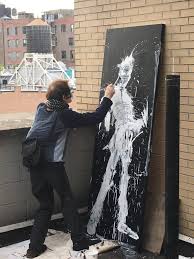
Vincent and co-writer/filmmaker Heather Spore give us a biography firmly-anchored in its context, a mostly-ruined East (Greenwich) Village of flops, tenements and dumpy, “low-rent storefront galleries” which was the anti-Soho of its day.

Keith Haring and (neo-expressionist) Jean-Michel Basquiat and Julian Schnabel were the art stars of that era. But down in the East Village, Brezinski and “shadow” artist Richard Hambleton and James Romberger, David McDermott and others were “living in garbage,” making art and holding openings, “manic” to “make it,” and pooling their efforts in group shows in the hope of surfing a self-branded “New Wave” in art that might mimic the New Wave in music.

Through interviews with the survivors of that scene — a model, art critics, “gallerists,” artists and collectors, Vincent takes us back to those days and the poses of the poseurs who made it, most of them 70ish dandies and artsy fashion statements to this day.

The milieu — struggle and poverty and AIDS and deaths by overdose or suicide — is summoned back to life, as is the role of villains of that time — Ronald and Nancy Reagan — skewered by satiric portraits by Brezinski and others because of the not-so-benign neglect they brought to AIDS.

Poverty made Brezinski and the rest “pure, just by default,” one of them remembers. We see it for ourselves in short films, home videos and the like of gallery openings, parties, clubs and artist-in-his (almost entirely men) element footage of Brezinski himself.

The mercurial, faddish nature of art trends is mocked — “What’s next? Oh, minimalism again?” — as dealers and collectors collectively abandoned painting, came back for “stencils” (pre-dating Banksy by a decade), embraced the realistic “replacement” art installations of Robert Gober, only to have painting come back with a vengeance in Soho and further south, in the East Village.

 Brzezinski, who fiddled with the spelling of his name (of course), made the scene by making “a scene,” infamously eating one of Gober’s “Realistic” donut sculpltures as a stunt, only to realize how toxic the damned things were. It was an incident destined, perhaps even calculated, to make it into the man’s obituary.

Vincent lets interview subjects dig themselves into pretentious holes, allows them to skewer each other and this or that critic or gallery owner only to let the gallery owner give her side of a feud or his take on who didn’t “make it” and why.

And Vincent’s film turns into a sizzle reel for a Netflix series or feature film remake as he and Spore investigate the mysterious circumstances of the struggling artist’s death. Yes, they all dream of “faking” their deaths to drive up their asking prices.

Even though they’re older, now, and dressed to the nines for their appearances on camera (most of them), even though that Capote-esque pixie McDermott lives in a manor house in rural Ireland, there’s still something punk rock about this crowd, with more than a hint of the punks who sold out. We called them “New Wave,” too.

It makes for a fun if sometimes shambolic (a few anecdotes ramble on) remembrance of a time and an artist who symbolized it. And if the filmmakers didn’t buy up a few Brezinskis before releasing this, that’s on them.

Rating: unrated, drug and sexual content

Cast: Edward Brezinski, Duncan Hannah, Peter McGough, James Romberger, Marguerite Van Cook, David McDermott, Eric Bogosian, Richard Hambleton, Marcus Leatherdale, Patti Astor, Kenny Scharf, Annina Nosei, Claudia Summers, Walter Robinson

Credits: Directed by Brian Vincent, scripted by Heather Spore and Brian Vincent. A Red Splat release.

Running time: 1:32

Posted in Reviews, previews, profiles and movie news | Comments Off on Documentary Review: When New York art went New Wave — “Make Me Famous”

Movie Review: Childhood friends consider paths not taken, “Past Lives” that might have bonded them

“Past Lives” is a lovely, bittersweet reverie built on a premise that flirts with fantasy.

Are we “fated” to be with who we end up loving and spending our lives with, and if we are, what happens when events conspire to break that fate?

Playwright and screenwriter (“The Wheel of Time”) Celine Song gets a soulful, brittle romance full of longing, regret and loneliness out of that in a story of childhood not-quite-sweethearts whose shared past and Korean heritage tug at them well into adulthood.

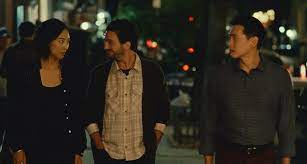
Song establishes the sadness that hangs over the story in the opening shot. Three people — played by Greta Lee, Teo Yoo and John Magaro — are observed by strangers across the New York bar who try to figure out what the relationship is between the two Koreans locking eyes and talking with intense interest, and how the scruffy and seemingly miserable “white guy” who is part of this party and whom they “aren’t even talking to” fits its into that.

Are the Koreans siblings?

A flashback to 24 years before settles that. Na Young (Moon Seung-ah) is seen as a “crybaby” 12 year-old, always engaged in academic competition with her friend Hae Sung (Leem Seung-min), and prone to getting upset when she loses.

He clumsily comforts her, but it’s easy to see their connection is deep, even at that age. They kind of want to try a “date,” which might only be a playground playdate, but the “crush” is real as is the attraction .

But she’s about to leave. Her artist mother and filmmaker father are immigrating, and she and her sister have to pick out English-sounding names. Michelle becomes her kid sister’s name, Nora will be hers.

She jokes to Hae Sung and others at school that she can’t stay because “No Nobel prize winners come from Korea,” but that just wounds him.

A long, silent walk home from school sees a quietly-stricken Hae Sung bid a single word “Bye” to his friend as they part ways, with her literally hiking higher and him turning to to take that level side street that signifies his constancy in conflict with her higher aspirations.

As Nora (Lee) and Hae Sung (Yoo) settle into separate futures and diverging destinies, they lose touch. But Nora, pursuing a life as a playwright, acknowledges a certain ennui about her family’s decision to leave, the tug of home and this Korean concept of fate — “In-yun” — that suggests things happen for a reason, that souls fated to be together have had “8,000 earlier encounters that ordain it.

It’s mysterical and traditional and yes, it’s kind of apt that the best online explanation of it comes from the pastor and cult leader Rev. Moon, another Korean immigrant.

Song’s screenplay introduces this idea on three timelines — their childhood separation, their just-after-college years, when social media has made it possible for Hae Sung to “find my friend,” and another 12 years after that, when they finally meet face to face in New York.

The problem with that belated reconnection is that Nora’s now a playwright, bouncing from productions to grants to artist’s retreats, where she met the Jewish novelist-to-be Arthur (Magaro), whom she married.

Song and her finely-tuned performers make the just-after-college-years Skype calls warm and vulnerable. It takes HaeSung a bit to admit that he reached out in search of her because “I missed you.” The bounce that comes to Nora’s step at their renewed contact, the uninhibited smile that Lee wears in the conversations, lets us root for them as a couple.

Yoo’s tentative take on Hae Sung shows us a guy who lives an “ordinary” Korean life — military service, years of nights out drinking with his mates — someone perhaps “stuck” and thus drawn back to this deep childhood connection, but unwilling or unable to grow to make something of it. He learns Mandarin, because “it will help me with my work (in Korean with subtitles),” not English, Nora’s primary language. He urges her to visit Seoul, but isn’t ready to move heaven and Earth to get to New York, where she’s settled.

With her starting her career and him starting his as an “ordinary” engineer, any reunion could be a year or more away. This long distance connection is impractical, and somebody’s going to have to say so.

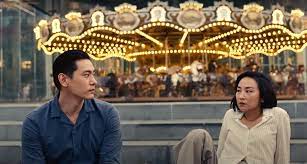
Song and the cast take the unspoken pain and obvious awkwardness to a whole other level with that third act New York meeting, set in familiar landmarks and striking, under-filmed scenic spots along the river and under the bridges. These scenes ache and truly sell this culture clash/cultural pull romantic premise, far-fetched or not.

Sometimes, the best romances are unconsummated or otherwise incomplete, be they a “Brief Encounter” or trapped in the amber of “The Eternal Sunshine of the Spotless Mind,” a movie that Nora helpfully recommends to Hae Sung. It’s not the “love” that lasts. It’s the longing.

And in filtering that universal emotion through a Korean ex-pat lens, Song has given us THE romance of the summer of 2023.

Rating: PG-13, profanity

Cast: Greta Lee, Teo Yoo, Moon Seung-ah, Leem Seung-min, John Magaro

Credits: Scripted and directed by Celine Song. An A24 release.

Running time: 1:45

Posted in Reviews, previews, profiles and movie news | Comments Off on Movie Review: Childhood friends consider paths not taken, “Past Lives” that might have bonded them

Treat Williams: 1951-2023

Treat Williams broke out in “Prince of the City,” a classic righteous officer in a sea of corrupt cops picture, shone bright in “Hair,” in dramas on screen and TV.

But when I heard this active, lovely, always working spirit died in a Vermont motorcycle wreck today, my first thought was his stretch as a comically bullying soldier in Spielberg’s “1941.”

Waaaaaay over the top, and fun.

His Twitter presence was a grace note on his profession, kind and tolerant and always about the work when he got it. He loved flying, motorcycling and traveling for work.

And he was working all the time. He had series and Hallmark movies and a few great film credits, some 120 appearances on the screen in all. From young idealists or hotheads to authority figures, fathers and grandfathers, he lent a bit of class and stature to every project he signed onto.

His friend Mark Hamill reminded everybody on Twitter that Williams even passed muster in the “Star Wars” universe.

But dang it, it’s him all crazed and lecherous in “1941” that sticks in my mind. He could be a hoot when the situation demanded it.

Rest in Peace.

Posted in Reviews, previews, profiles and movie news | 2 Comments

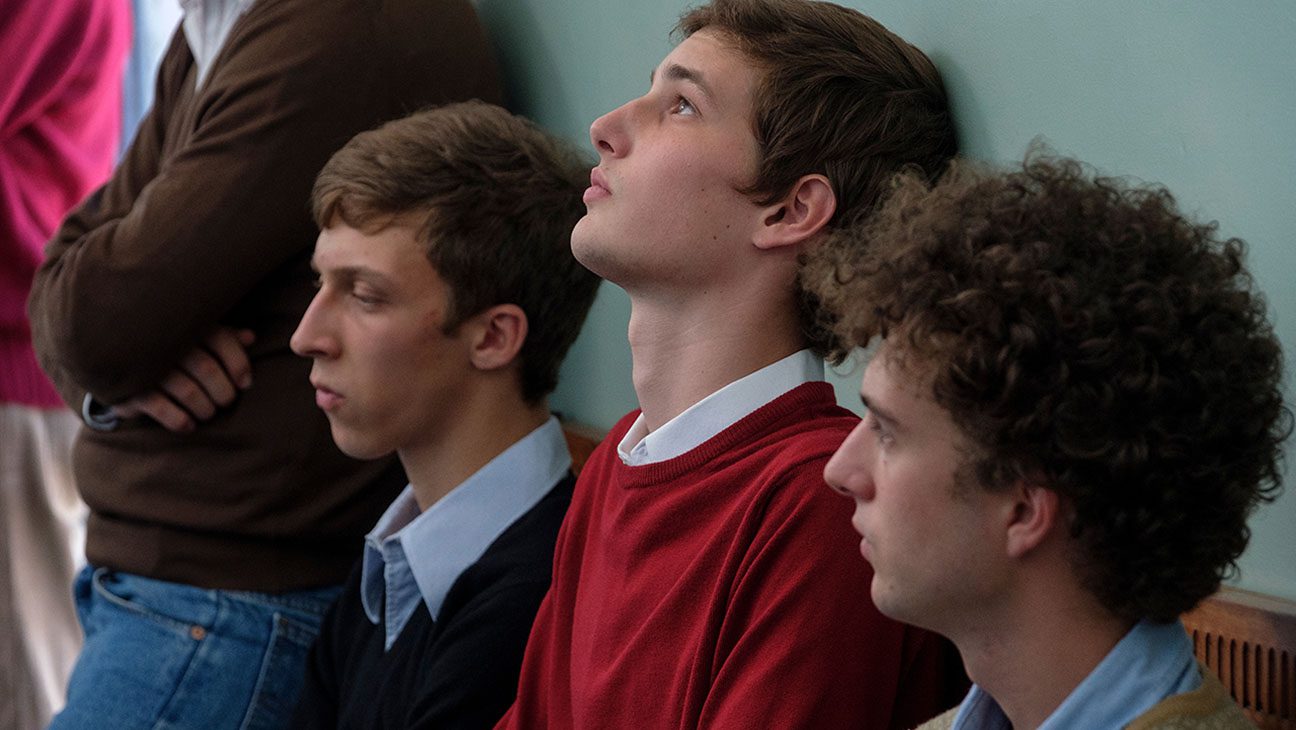
Netflixable? “The Catholic School” for Rich Romans produces a Heinous Crime

“The Catholic School” is a story ripped from recent Italian history, the story of a heartless kidnapping, rape and murder in an age when Italian law did not consider rape a crime against a woman, but rather against the public morals.

The Dark Age in which the Circeo Massacre, as they dubbed it in the press, took place preceded even the Amanda Knox case in giving Italian “justice” a black eye, but at least prompted something resembling a little soul searching about who they were as a culture and the sorts of sons they were raising.

Stefano Mordini’s serious-minded film, based on a novelized memoir account of the case by a classmate of the perpetrators, is a clumsy attempt to “explain” these boys in a Leopold & Loeb way, to recreate the La vita privilegiata these rich monsters grew up in and the school that “produced” them.

Their classmate at San Leone Magno School, Edoardo (Emanuele Maria Di Stefano) is our narrator, and takes us into this world of “virtually limitless freedom,” of bullying, money, and sexism taken to savage extremes, practically ticking off the “contributing factors” that led to this “violent time” (in Italian with subtitles, or dubbed) in an Italy that must have produced these kids.

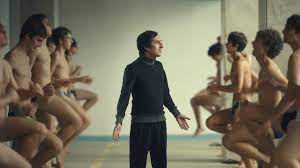
One classmate’s professor-father comes out of the closet and moves out of the family home. The priest and coach of the swim team is spotted picking up prostitutes. One kid’s same-sex attraction hints at masochistic tendencies, another’s worship of his pal’s sister abruptly bears fruit. One student is having an affair with the actress mother of a classmate. One particularly brutish kid’s rich father buys his way out of trouble right up to the moment a body and a surviving victim are found.

There are devout Catholics in their ranks, a tragedy preceding the tragic “event,” a hunting trip, a ritualized initiations into secret societies, parties and pickups and sex and boys with “fascist tendencies” writing essays in admiration of Adolf Hitler and not taking it well when their deep thoughts aren’t appreciated.

None of this is that original or affecting, and NONE of it “explains” “How we groomed a pack of rich monsters.”

We’re treated to a sort of “Rules of the Game” take on how the rich kids lived and learned back then, cossetted in a bubble of money and class, and then jarringly hurled into a graphic depiction of the preparations and the commitment of the crime.

Director and co-writer Mordini makes a total hash of things by battering the timeline into atoms, constantly skipping from “three months before the event” to “130 hours” before back to “two months before,” and on and on.

I kind of get what he was going for. But this is so ham-fisted you wish some woman exec in the production had given Mordini a good bawling out over the lack of sensitivity, whatever accuracy he was going for with the crime, for the women in the story.

Rating: TV-MA, graphic violence, nudity, alcohol abuse

Cast: Emanuele Maria Di Stefano, Giulio Pranno, Benedetta Porcaroli, Federica Torchetti, Alessandro Cantalini, Francesco Cavallo, Leonardo Ragazzini, and Valeria Golino

Credits: Directed by Stefano Mordini, scripted by Luca Infascelli, Massimo Gaudioso and Stefano Mordini, based on the book by Edoardo Albinati. A Netflix release.

Running time: 1:46

Posted in Reviews, previews, profiles and movie news | Comments Off on Netflixable? “The Catholic School” for Rich Romans produces a Heinous Crime