
Were they a big deal? Drawing a blank on that era.
June 30, a slow-rolling release over the sleepy prairie states and their cities.
Were they a big deal? Drawing a blank on that era.
June 30, a slow-rolling release over the sleepy prairie states and their cities.

There was never anything subtle about Luc Besson’s “Leon: The Professional,” titled “Leon” overseas but “The Professional” here, and retitled both as it arrived on video.
A minimalist thriller with maximalist, pull out the stops exess, it’s an opera of violence with performances both understated and bombastic enough to blow the speakers out in the theater.
It’s the film that launched Besson in this hemisphere and set Jean Reno firmly on the path to action stardom. It was the screen debut of future Oscar winner Natalie Portman. And it was the last movie the great Gary Oldman made during his drug binge years, and it shows. He sobered-up from authentically “bleary” and went on to win an Oscar himself.
“Death is…whimsical, today.”
But Oldman’s diva turn as a volcanic, classical music-loving addict, a murderously corrupt D.E.A. agent, isn’t the only thing about this Little Italy epic that’s out of control. This picture is bracing and moving, flippant and cutesy, even.
Oh, and unsettling to the point of disturbing, borderline repellent. That’s just what’s on the screen, not even taking into account the accusations that hit Besson when #MeToo crossed the Atlantic that seem to fold onto the pervy tightrope this picture walks.
The story is a “Gloria” variation about a child taken in after her family is slaughtered by gangster law enforcement agents. She is protected from the mortal threat that comes with being a witness to mass murder. Here, the protector is a “cleaner,” a variation on a hitman character Reno played in “La Femme Nikita.”
Leon is simple, illiterate and all-business. But when the 12 year-old neighbor girl he’s noticed smoking, sporting a black eye and a foul mouth knocks on his door when she realizes four men have just murdered her father, stepmother, half sister and younger half-brother, the always-relocating killer-for-hire lets her in.
It’s the “relationship” that adds an edge beyond edgy and gives “Leon” a heaping helping of cringe. Look at the way Besson has Mathilda dressed — short-shorts, leggings, midriff-baring tops. Jodie Foster in “Taxi Driver” comes to mind, sexualized costuming for a child obsessed with the “Transformers” cartoons.
With Leon being a tad simple, we’re allowed to ponder this connection, which isn’t quite fatherly and yet never crosses any finite line in a romantic regard. But damn, it comes close.
When Mathilda convinces her protector to play a dress-up game of “Who is she, now?” it’s damned creepy, but kind of apt that she trots out as Madonna in bra-baring “Material Girl” mode. But then, bizarely, she is “Seven Year Itch” subway grate “Happy birthday, Mister President” Marilyn Monroe.
Every parent in the audience must have squirmed at that. Did Portman’s?
I went to New York in ’94 to review and interview the stars of this film and Atom Egoyan’s middle-aged men trooping to a slutty schoolgirl-uniformed exotic dance club — “Exotica” –which previewed the same weekend. Between barely-beyond-a-tween Portman and “Exotica” teen Mia Kirshner one could get a seriously jaded take on stage parents, even though Portman’s escorted her to her interviews.
But the best argument against seeing this film through a narrow, creeper-behind-the-camera lens is the bravura movie-making that just bowls you over even as you fret about what lines Monsieur Luc might cross.
Heroes and villains are framed in tight, sweaty close-ups, action beats perfectly-assembled, characters built out of on-the-nose casting (Danny Aiello as Leon’s Italian restaurant “contractor” and banker) right down to Oldman. Who better to play an cultured, psychotic addict, someone whose every swallowed pill is an orgasmic experience,than an actual addict?
Besson limits how much of the city we see, concentrating on the old, iron-railing’d New York flophouse, the worn-out apartment and Leon’s spartan lifestyle.
The contract killer wears Windsor-rimmed sunglasses, even when he’s sleeping — upright, pistol-at-hand, in the comfiest chair in any hotel room or apartment he rents. His outdoor uniform is a stocking cap and trench coat which covers his leather weapons harness/vest.
He is a loner with only an ancient leather suitcase that carries his arsenal and a few clothes, a violin case and a houseplant, “My only friend…always happy.”
Mathilda weeps for her kid brother, not her abusive father, his latest wife or her jazzercise-obsessed half-sister. And when Leon bluntly tells her his line of work, she wants to know his price, and hearing that, if he can teach her to “clean.”
The film’s light treatment of this is seriously twisted, too. He teaches her his rules — “No women, no kids” — borrowed from the hitman thrillers of John Woo. He explains the levels of expertise killers-for-hire acquire. Sniping from afar, at first, with “the knife” being the close quarters weapon you master last, after you’ve grown hardened to murdering.
The training is chilling, but cute.
Mathilda wants to execute the men who killed her little brother. Leon doesn’t discourage this and goes as far to offer her a pistol. That lack of boundaries and push-back will bring the full weight of New York law enforcement down on them.
What sticks with you about the film is that first “hit,” an epic one-man assault on a territory-violating heavy surrounded by body guards.
“Somebody’s coming up. Somebody serious.”
Eric Serra’s score, romantically orchestral if a tad nervy, adds sleigh bells when violence is coming. That’s been copied in many a thriller score since.
Leon comes at his victims from above, and below, one at a time and then in a group. Bullets perforate the metal shutters to the mobster’s rental. We can guess what happened to the mugs on the balcony when the blinds were dropped, blocking our view.
“Leon” is a film that whips the viewer around, snaps us back in our seats and makes us cringe at the adorable business of teaching a child to “clean” and the relationship rendered inappropriate simply by virtue of Leon’s childishness and Mathilda’s immitations of maturity.
Besson launched the “Transporter” series, dabbled in sci-ci (“The Fifth Element”), and produced, wrote and/or directed films like “Lucy” and “Anna.” Very young, very skinny and girlish women have been a regular feature of his thrillers, either as objects of desire to be “transported” or petite young things who kill.
He even gave his then-much-younger wife Milla Jovovich her own epic, “The Messenger.”
Whatever eyebrows his “tendencies” used to raise were once dismissed as “That’s guys in the movie biz for you” and “Well, he’s FRENCH.” Now, post-Weinstein, not so much.
But in a way, that transgressive edge adds to the disquiet of “The Professional,” a movie that would be all flashy technique and Oldman without Mathilda, Portman and Reno’s “Leon” struggling to figure out what to do with her and how to take her.
For my money, it’s every bit the classic that its contemporary thriller, Tarantino’s “Pulp Fiction” is thought to be, a film that engages, thrills and repels in equal measure.

Rating: R, graphic violence, profanity, a child smoking, innuendo
Cast: Jean Reno, Natalie Portman, Danny Aiello and Gary Oldman.
Credits: Scripted and directed by Luc Besson. A Columbia Pictures release on Amazon, Netflix, Youtube, etc.
Running time:



There’s a properly extravagant and epic-length long-take showacase moment in the first act of “Extraction 2,” a 21 minutes/no edits first-person-shooter video game-style plunge through a prison break that takes the viewer and our hero Rake (Chris Hemsworth) from tunnels underneath the Republic of Georgia prison, inside to extract his target — a woman and her two children — through crowded hallways, a brutal beat-your-way-through-the-exercise-yard, a vicious SUVs pursued by motorbikes, etc. chase onto an escape train hounded by helicopters.
It is something to see, more impressive than thrilling, although it does deliver “The Cool Parts,” with Hemsworth deftly ducking bullets and blows, turning his back on explosions he’s caused at just the perfect moment, man-handling a heavy machine gun needed to shoot down gangster helicopters and the like.
The 15 minutes or so opening that introduces the Georgian gangster family that must be contended with here, with scenes where we see our hero “recover” from the grievous wounds of “Extraction I,” sent into retirement in the Austrian hinterlands only to be commissioned by a nameless tough-guy/smartass (Idris Elba) and reassembling his “team?” Kind of dull, save for Elba.
“If it all goes well, you don’t get caught or shot in the face, I’ll meet you on the other side t’give you a kiss!”
Well, we’d sit through two hours waiting for that “prize,” right?
“Extraction 2” is more relentless than “Extraction,” as if that was possible, an almost endless succession of firefights as Tyler Rake and his team (Golshifteh Farahan and Adam Bessa plus cannon fodder extras) mow down more Georgians than a drunk driving Reese Witherspoon ever could. OK, the “other” Georgians.
Hearing the top lieutenant of the “Nagazi” gang tell his dear leader (Tornike Gogrichiani) undercount the death toll at “10” at one point may be the biggest laugh in this thing. How Putinesque of him. We’ve seen dozens dropped, and unless the Nagazi have really good insurance and maybe their own MASH units, they’re goners.
The set-up — a Georgian mobster is imprisoned for murder. A corrupt politician has allowed him to keep his wife (Tinatin Dalakishvili), teen son (Andro Japaridzem) and little girl inside with him. They’re all in jail together, with the husband (Tornike Bziava) only one psychotic killer among many.
A deep-pocketed somebody’s willing to pay to get the wife and kids out. By the way, she’s Rake’s ex sister-in-law. Go figure.
Rake, who barely clung to life after his Bangladeshi bloodbath, must survive another array of unsurvivable stabbings, explosions, brawls and falls to get them out and collect that kiss from his unnamed contractor.
Hemsworth, an amusingly self-aware Thor, is just a brawny piece of man-meat trained to handle fight choreography in most scenes here. Here Rake is, given the chance to “reach mindfulness” in retirement,” one of his sibling team cracks, and he’s going into action to save a mob moll and her brainwashed mobster-in-the-making son.
“These men are killers,” his rescued damsel tells him, stating the obvious.
“Yeah? So am I!”
The violence is extreme, but it has consequences. There are “stakes” in all this, formulaic though they are.
There’s a lot of money on the screen here, and one can understand the Netflix impulse to make a movie that makes a splash. But considering the scarcity of fresh English language dramas, thrillers, romances and rom-coms in their “film” queue, one does wonder if they’re spending that cash wisely.
If you’re like me, you go much of each month wondering why there’s so little that’s not a doc-series that’s “original,” so that I end up watching lots of Spanish language, Nigerian, Filipino and Indonesian films just because of how slim the pickings are otherwise.
In any event, “streaming” is a good place for this action overdose. It’s not interesting enough in between action beats to make you stay in the same room with it. Bathroom break? Need to make a sandwich? Just leaving it running. You’re not missing much.

Rating: R, lots of graphic violence, profanity
Cast: Chris Hemsworth, Golshifteh Farahani, Tornike Gogrichiani, Adam Bessa,Tinatin Dalakishvili, Andro Japaridzem and Idris Elba.
Credits: Directed by Sam Hargrave, scripted by Joe Russo and Anthony Russo, based on a graphic noel by Ande Parks. A Netflix release.
Running time: 2:02
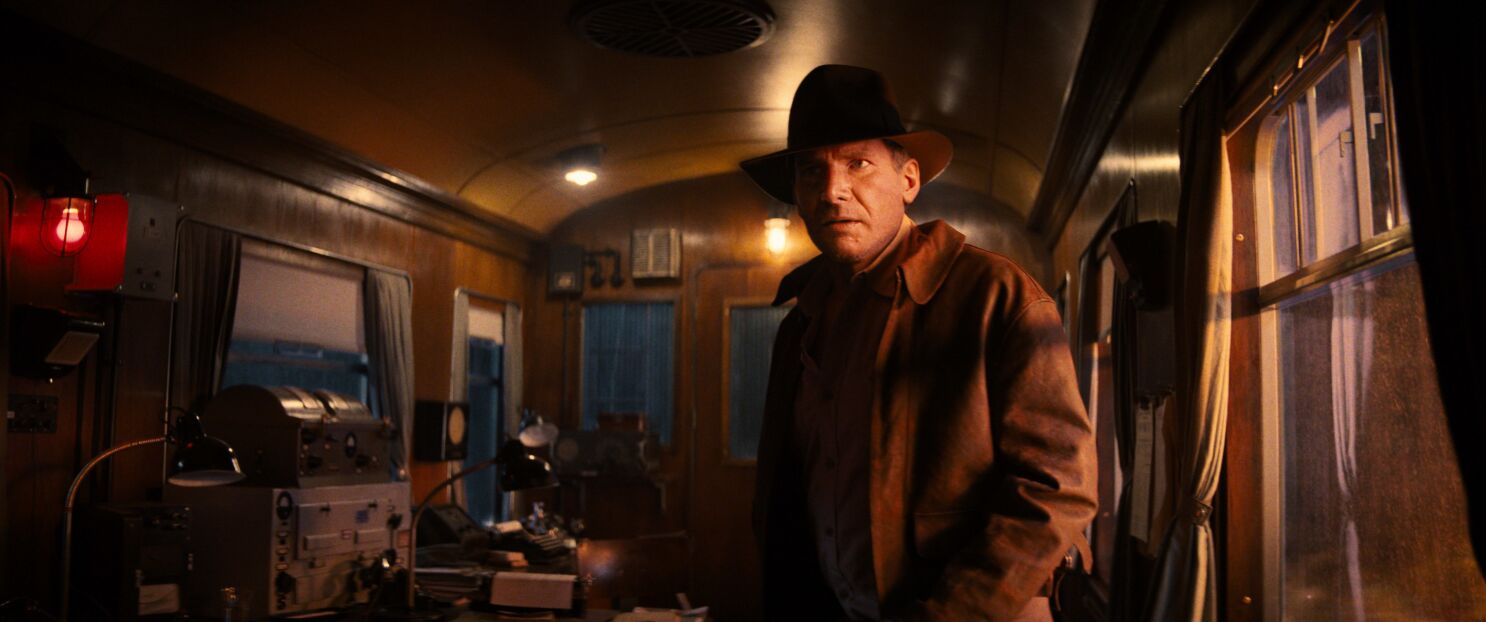
It’s not everything you could have hoped for, but for a fan, the final Indiana Jones movie tips the scale as “not bad, not bad at all.”
A film with exhillerating action beats, well-cast villains, fan service in the form of a “Greatest Hits” of the series and warm grace notes for returning members of the family, “Indiana Jones and the Dial of Destiny” is too long, which makes for mischief in the plotting and the pacing.
Paying homage to the earlier films just reminds of us how dazzling real stunts were before cinematic digitalis took over, and how much more expressive Harrison Ford was as a young man than he is as an old one — even an old one “de-aged” for the action-packed late WWII opening gambit of this film.
Indy is an old man when we meet him here, a set-for-retirement professor trying to pass on all he knows to indifferent flower children students in 1969. He’s even trying to teach on what turns out to be “Moon Day.” There’s a tickertape parade for the Apollo 11 Astronauts scheduled for downtown Manhattan, where Hunter College is located.
That’s when these mysterious “agents” working for this German physicist (Mads Mikkelsen) show up, chasing a woman (Phoebe Waller-Bridge) who is anxious to meet Dr. Jones. She has something they want, and in short order, people are killed in pursuit of it.
Helena is the daughter of Indy’s WWII era British colleague, Basil (Toby Jones, seen in flashbacks). She’s finished her doctorate and taken up her father’s obsession, the mysterious Antikythera “dial” of this film’s title. She thinks her godfather, Indy, can help her find it.
Helena is a smart cookie, and a monomanical bruiser. She wants the “Dial” to sell it. The Nazi, vital to the U.S. space program’s current success, wants it to reset history. He, like Helena’s dad, believes the gadget, in its complete form, could direct the user to wormholes in time.
Indy figures out what she’s all about the first, second and third time she crosses him. He doesn’t need to figure out Nazis. They’re who you foil, vote against and when they threaten you, dispatch with extreme prejudice.
No wonder America’s wingnuts are up in arms over this movie.
Indy and Helena’s competing agendas and shared quest will take them to exotic Tangier, Sicilian Syracuse and Greece, trapped, facing death at the hands of Nazis both German and American (Boyd Holbrook, giving another vicious turn) time and again.
“You should have stayed in New York,” Indy is lectured.
“You should have stayed out of POLAND!”
Old friends (John Rhys-Davies) and new ones (Antonio Banderas) will be enlisted. Because that dial the headstrong Helena covets and that the unrepentant Nazi Voller craves could change the outcome of World War II.
“See you in the past, Doctor Jones!”



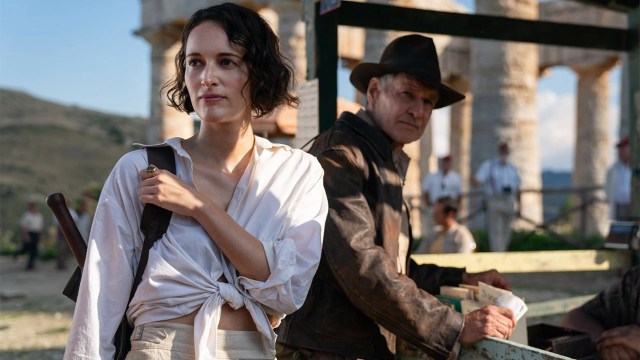
With Ford over 80, new director to the franchise James Mangold (“Logan,” “Walk the Line,” “3:10 to Yuma”) and the team of screenwriters pass along some of the punchouts to “Fleabag” alumna Waller-Bridge, whose Helena is a two-fisted, cunning and self-dealing addition to the franchise.
She even has a Short Round sidekick, the Spanish Moroccan Teddy (Ethann Isidore).
After throwing in big, digitally-assisted chases in Germany and mid-parade New York in the opening act and a late ’60s Tuk Tuk pursuit through Tangier to begin the second, “Dial of Destiny” slows down to a crawl. The bloated running time suggests they didn’t want to trim expensive sequences to make this picture fly by the way “Raiders” and “The Last Crusade” did.
Forty years-plus into this series, and the dialogue is no longer a flippant, cheesy homage to 1940s action serials. It’s an homage to earlier Indys.
Eels? “They look like SNAKES!”
“No they don’t!”
But for a fan, here’s your make or break point of interest. In that opening act, when a flashback takes Old Man Indy back to a bit of 1944 “Monuments Men” derring do, he and Helena’s English archeologist Dad are trapped on a Nazi train hauling stolen artifacts to some Bavarian hiding place. Among them are the “Antikythera,” the ingenius computer perhaps designed by the proteges of the brilliant ancient Greek scientist and engineer, Archidemes.
Yet there’s another piece that catches the eyes of Indy, his pal Basil and the Nazi physicist and V2 rocket team member Voller on board. It’s a spearhead, the Lance of Longinus, alleged to have been used by a Roman soldier to pierce the side of Jesus on the Cross to hasten his death.
Fans of Indy lore know that Philip Kaufman, who’d go on to film “The Right Stuff,” was obsessed with a book of Medieval lore that attached magical significance to this spear point, “The Spear of Destiny.” He convinced producer George Lucas to build a movie around this relic and the fact that Hitler made it a point of taking possession of it as soon as he came to power and annexed his native Austria, where the spearhead was housed.
Some of the legends “Raiders of the Lost Ark” attaches to the Ark of the Covenant, which has never been found, were also applied to The Lance of Longinus, that no army that possessed it could be defeated in battle.
Including the lance in “Dial of Destiny” completes the franchise’s circle and shows a reverence for all that spun off that unlikely blockbuster over 40 years ago. For a serious fan, that’s as cool as “Easter Eggs” get.
Ford is only allowed a few scenes to get across the weight of his years, what he’s experienced — “A few times in my life I’ve seen things…” — and those he’s lost.
Taking another swipe at what could have been a better finale to “The Last Crusade” seems just as futile as the first try. “Dial of Destiny” doesn’t so much end as drop the curtain.
But for a fan, there’s a warmth in “The Dial of Destiny” experience, a richness in seeing the devotion of old friends and loves, a sentiment not just built from nostalgia, but from a singular moment in popcorn movie history, the first film Siskel & Ebert described as an exhilerating “out of body experience” that reset the bar on summer action.
This one cannot match that. Few films have since.
Yet there’s still pleasure in the old War Horse, his leather jacket and decades out of date fedora. “Dial of Destiny” isn’t a particularly good movie. But it’s still a movie event you won’t want to miss.
Rating: PG-13 for sequences of violence and action, language and smoking
Cast: Harrison Ford, Phoebe Waller-Bridge, Mads Mikkelsen, Boyd Holbrook, Toby Jones, Thomas Kretschmann, Antonio Banderas and John Rhys-Davies.
Credits: Directed by James Mangold, scripted by Jez Butterworth, John Henry Butterworth, David Koepp and James Mangold. A Disney/Paramount release.
Running time: 2:34

Oviedo, Florida can sample a different sort of Holocaust story in this fictional tale of a Jewish teen so deep into the smell of the greasepaint, the roar of the crowd and the promise of the limelight that she minimizes the harrowing reality swirling up around her in1942 Paris.
Not great, but not bad. Get to it before some book banner decides DVDs about the Holocaust are offensive to her Aryan Brotherhood relatives.



The exciting, clever bang-up finale to “Maggie Moore(s)” rather softens the disappointing blow that this off-key dark comedy’s first 90 minutes have delivered. I’m not saying that makes the film worth watching, but it makes this Jon Hamm and Tina Fey vehicle a much closer call than it might have been.
An “inspired by a true story” tale of the bizarre murders of two women with the same name, it’s basically a sweet (ish) rom-com starring old friends and sometime collaborators Fey and Hamm pasted over a deadpan (ish) “Only Murders in New Mexico” mystery.
There are many “ishes” here — funny(ish), exciting(ish), clever(ish), cute(ish). They don’t add up to a wholly satisfying experience, despite that killer combo of leads.
What Hamm’s “Mad Men” co-star and sometime director John Slattery and screenwriter Paul Bernbaum conjure up is a “Columbo” styled “We know whodunit, but will they get away with it?” comedy with cruelty, corpses and a touch of Cohen Brothers rube-comedy absurdism.
Hamm plays the police chief in a town big enough to have maybe five cops and a casino, small enough to have only two “Maggie Moores.”
One of them (Louisa Krause) is married to a short-cuts taking sub-shop franchisee (Micah Stock of TV’s “Bonding”). Jay Moore is buying and serving expired meats, cheeses and ingredients rather than buying those products from his franchiser. That’s got him in business with the shady ex-con Tommy D (Derek Basco).
And that’s why Jay’s side-hustle includes distributing child porn. The waitress wife finds out, threatens to tell the cops, and Jay needs somebody to “scare” her out of that notion. Not to worry. Tommy D “knows a guy.”
Bizarre turn number one — the “guy” (hulking Happy Anderson) is deaf. He takes “contracts” by reading lips and passing notes, which he destroys with the shredder he keeps at hand for such cover-ups. The goon with the unlikely name “Kosco” is also not fond of loose ends.
“Scare her” isn’t where he stops. Suddenly, Jay’s got a dead wife, her car burnt in the desert and a neighbor (Fey) who heard them fighting.
Luckily for Jay the cops are nobody’s idea of “Columbo.” The chief (Hamm) is serious-minded, and grieving a dead wife. His Brit-immigrant sidekick (Nick Mohammed) is here for the one-liners.
“We have a victim who is unable to yield any clues because of her…”
“Crispiness?”
Jay’s the obvious suspect. But bizarre turn number two is when he realizes there are two “Maggies,” so he comes up with a plan and the cash to have another Maggie (Mary Holland) attacked, to throw the police off the scent.
Matters get messier and more bizarre as the second Maggie turns out to have an anti-Semitic enemy from work and a cheating husband (Christopher Denham) who isn’t any more torn-up about his Maggie’s death than Jay Moore seems to be.
Lots of suspects, a chief who takes a shine to one of the witnesses — neighbor Rita (Fey) — and a partner who is looking for the next joke, not a logical chain of evidence, so maybe the real killer will never be caught.
Fey and Hamm have an easy rapport that doesn’t really lead to sparks. But it’s cute seeing him play “the vulnerable one” in this pairing, considering their “30 Rock” relationship.
The performances that seem properly pitched to match the material are around the edges — a brazen casino waitress (Bobbi Kitten) here, a sassy store clerk (Oona Roche) there.
The problem is that the serious stuff is barely more interesting than the funny stuff — maybe six chuckles — is amusing.
You’re kind of left with the nagging feeling that this could work or could have worked with a more deft touch at the wordprocessor or sitting behind the camera on set.
Funny “ish” and twisty “ish” don’t quite get it done.

Rating: R for (profanity) throughout, violence, some sexual material, brief nudity and drug use
Cast: Jon Hamm, Tina Fey, Nick Mohammed, Christopher Denham, Micah Stock, Happy Anderson, Derek Basco, with Mary Holland and Louisa Krause.
Credits: Directed by John Slattery, scripted by Paul Bernbaum. A Screen Media release.
Running time: 1:39


Yes, a film buff can get his or her hands on every Bogart, Alan Ladd and John Garfield film noir in an economical amount of time. But it seems like there’s always another Dick Powell outing that you’ve passed-over, missed, or has become hard to track down.
And you want to track down Dick, who was Bogie-tough with William Powell’s sharp-edged patter and way with a one-liner.
In the Andre de Toth thriller “Pitfall,” Powell barks off a half a dozen zingers just in the opening scene, establishing what an “average American” insurance guy/family guy John Forbes is.
His second-grader needs cash for a school fund drive.
“Don’t spend it on a woman!”
John’s wife (Jane Wyatt) needs money for new shoes for the kid.
“What does he DO with his shoes? Eat’em?”
To the kid — “Until my rich uncle dies, stop GROWING!”
“Pitfall” is a shorter, more domestic variation of a “Double Indemnity” theme. Andre de Toth (“Crime Wave,” “House of Wax,””Day of the Outlaw”) never had Billy Wilder’s sophistication or cachet or studio security. “Pitfall” was released by Regal Films, which I’d never heard of before today.
But the movie crackles with sharply-drawn characters, deadly complications and murky motivations, a brisk, brief noir with bite…and Lizabeth Scott.
John Forbes is a recovery officer with Olympic Mutual, someone in need of the services of a “weird” private eye, played by Raymond Burr during his “screen heavies” period. Mack has tracked down the woman a jailed embezzler was stealing for — “quite a girl,” a looker, and as it turns out, a model.
But “finding” her is all the P.I. has to do, even though he tried to figure out where the money went. This is where Forbes comes in. And even though he doesn’t let on, Mister Married “Old Man of Routine” is smitten by this seeming innocent who had the bad luck to fall for a guy whose only means of spoiling her was stealing.
A leopard skin coat, an engagement ring, but will Forbes insist on seizing the weathered runabout motorboat she just repainted, too?
If she playing him? Is he ripe to be played? He seems awfully settled, even if he’s griped to his wife how unsettling that is. Mona flirts and judges him and he’s not happy with that.
“I’d shoot myself if I thought I was turning into the kind of guy you describe.”
“I have a gun,” she mentions, helpfully.
The script, adapted from a paperback potboiler, sets up the jealous jailbird (Byron Barr), the delusional stalker (Burr) and the “family man” who doesn’t let on that he is for reasons Mona might easily guess, if she’s noticed his ring. If she cares. If she’s looked in the mirror lately.
There are beat-downs and shootouts and “We can’t go to the police,” a plot that resembles “Double Indemnity,” without the acid-stained prose or body heat.
But Powell is a movie star in his element here, with de Toth parking him in lots of LA and Marina del Ray late ’40s locations for him to navigate, by land or by sea, chasing after the life he didn’t choose with the looker who might not offer the comforts of home. But then, femme fatales, if that’s who Mona is, never do.
Rating: “approved,” violence
Cast: Dick Powell, Lizabeth Scott, Jane Wyatt, Byron Barr and Raymond Burr.
Credits: Directed by Andre de Toth, scripted by Karl Kamb, based on a novel by Jay Dratler. A Regal Films release.
Running time: 1:25
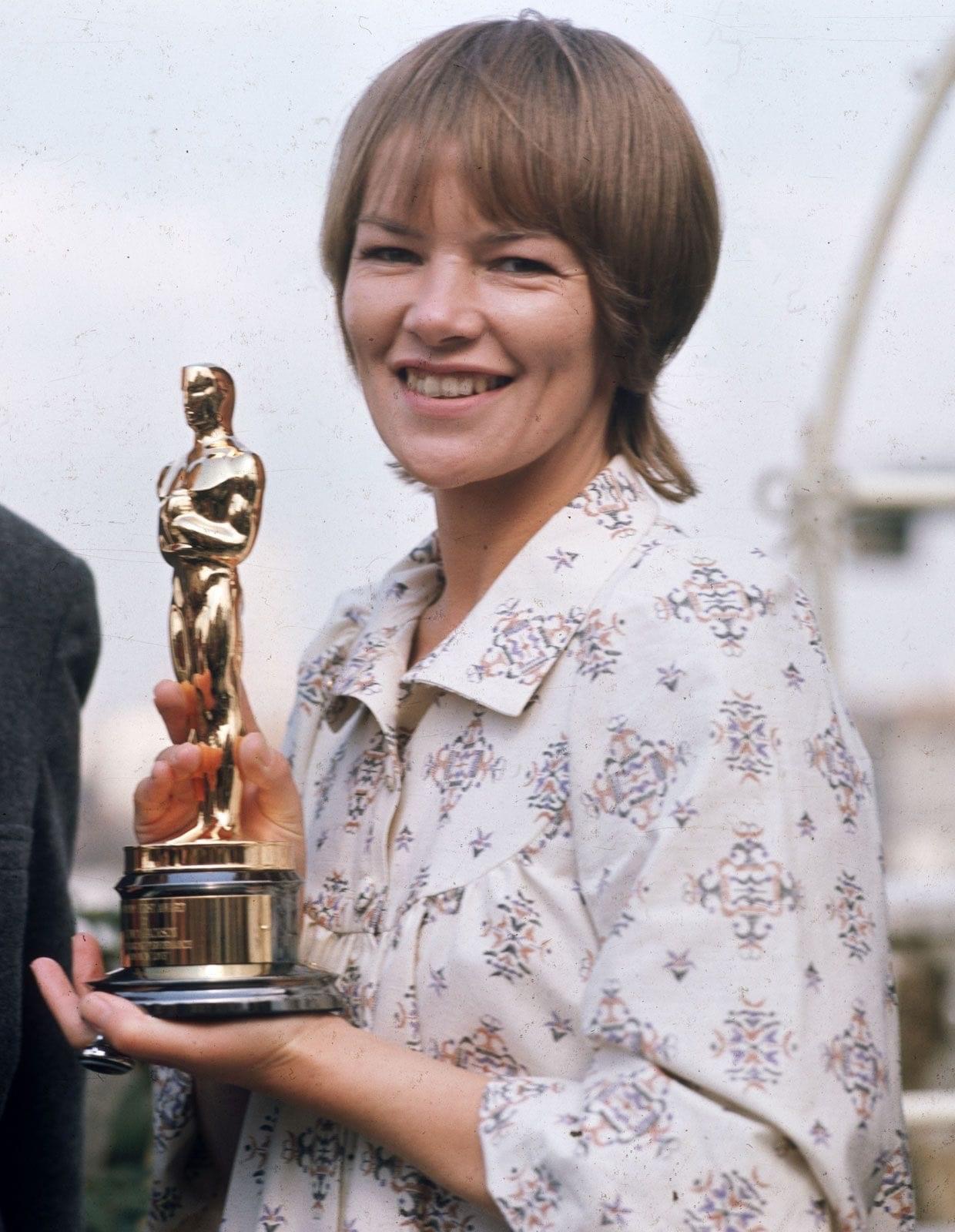
Two-time Oscar winner, former member of Parliament, grande dame of the stage, the small screen and the big one, Glenda Jackson was one of a kind.
She lived 87 years, most of them bathed in glory.
Tough, flinty, a British Hepburn only less patrician with more middle class roots, adept at dramas, romances and boundary-pushing cinema of the daring ’70s — “Women in Love” — and loopy laughers like “A Touch of Class.”
She also made a helluva funny sparring partner for Walter Matthau in two pretty funny films of the ’80s, “Hopscotch” and “House Calls.”
And she still has one more movie “in the can,” as they say. Well done.


The journey isn’t epic, and it doesn’t cover a great distance — emotionally or geographically.
But Mikhaël Hers’ latest film, set entirely in the XVth arrondisement of Paris and taking place over just under ten years, shows us the little details, small-scale tragedies and minor triumphs of a woman, her children and a homeless girl they take in, all of them thrown together as “The Passengers of the Night.”
Charlotte Gainsbourg is Elisabeth, 40something and her kids in the car with her, giddy at the sight of the street celebrations that accompanied the election of a Socialist president in 1981. It is a high moment and but the prologue of a story with a lot of ups and downs to it as she and her family pass through the decade.
By 1984, she is weeping at the news that her husband has moved in with his girlfriend, leaving her with teenager Matthias (Quito Rayon Richter) and college-age Judith (Megan Northam) and a high rise Beaugrenelle apartment that she can’t afford without going to work. Her ex won’t even support his kids.
The fact that “you’ve never worked” shouldn’t hold her back, her father (Didier Sandre) insists. Any job that “requires common sense and sensitivity” (in French with English subtitles) would be lucky to have her.
Elisabeth despairs of finding anything until her desperate letter to the hostess of her favorite late-night radio show, Vanda (Emmanuelle Béart) gets her an interview and a job as a call screener.
In the world of night owls, confessional callers and empty streets, the insomniac Elisabeth finds a home.
Meanwhile, the witty, writerly Matthias is failing at school, more interested in girl-watching than buckling down. Judith is making protesting a full-time job. And a drug-abusing street urchin (Noée Abita) brought in as an anonymous, “tell me nothing but truths” interview subject on the radio show taps into Elisabeth’s empathy and she takes her in.
Talulah, as she calls herself, will change lives and have her own changed, but mostly in tiny, incremental ways as she drifts in and out of lives and Elisabeth struggles to get out of the funk a divorce and the rejection that comes with it entails.
The dramatic touches here are simple and real-world relatable. We see — early on — that Elisabeth is a breast cancer survivor. Gainsbourg, a French actress with a resting depressed face, wholly inhabits Elisabeth’s self-loathing plight, her journey and the impulses — good and bad — that guide her out of it.
Matthias begins the tale as a 16 year-old almost too shy to flirt. But he throws over anything that might develop with a cute classmate to fall deep into a crush on Talulah, who shows the siblings “the streets” and the easiest way to sneak into a cinema.
Sure, you may want to see Matthew Modine and Nicolas Cage in “Birdy.” But “Full Moon in Paris” will have to do. Street urchins can’t be choosie.
Talulah is troubled, and her connection to Matthias has its dangers. They end up in the River Seine at one point. But even this melodramatic moment plays as a slice of the life-that-happens-to-you while you’re wondering what to do about your addictions or how to express yourself to your first love or trying to figure out how one becomes a writer in Paris.
The story isn’t the most arresting, with Elisabeth’s journey from call-screener to part-time librarian and fill-in on-air hostess mere background to the family life/love life/”real” life outside of work that Hers (“Amanda” and “This Summer Feeling” were his) is capturing here.
The late night radio milieu is arresting, but barely in the film. Judith, the ever-protesting “leftist” daughter, is one character whose story is given short shrift. I generally like movies that give us more to grab hold of than intimate, myopic melodramas like this offer.
But Hers and his leading lady highight the minor miracles, little kindnesses and “we’re all in this together” idealism of the film’s socialist era and make the idea of traveling as “The Passengers of the Night” inviting, if never quite exciting or intoxicating.

Rating: unrated, sex, nudity, alcohol abuse, smoking
Cast: Charlotte Gainsbourg, Quito Rayon Richter, Noée Abita, Megan Northam and Emmanuelle Béart.
Credits: Directed by Mikhael Hers, scripted by Maud Ameline, Mariette Désert and Mikhael Hers. A KimStim release.
Running time: 1:52
A little one-eyed boy whose Mom works with…NORAD? The first guy you think of when aliens say, “Bring us your LEADER.”

 Movie Nation