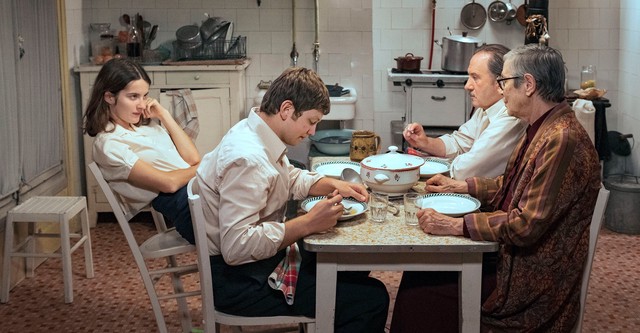
Movie Review: More Sad than Desperate, “The Miracle Club” travels to Lourdes

“The Miracle Club” is a downbeat Irish Catholic character study in a minor key, a period piece about the tragedy, desperation and simple superstition that sends the faithful to the French shrine at Lourdes in search of “the cure.”

What recommends the film is the sadness of it all, as it isn’t just physical maladies that motivates these characters to seek the salvation of “Our Lady.” Grief, guilt and regrets bond these women on their 1967 pilgrimage. And the fact that their ranks include Oscar winners Kathy Bates and Maggie Smith and Oscar nominee Laura Linney makes it an acting showcase for legends of the silver screen.

An old woman has died in Ballygar. Her estranged daughter Chrissie (Linney) has come all the way from Boston, but just missed the viewing and church service. Father Dermot (Mark O’Halloran) is full of reassurances that her mother was loved and will be missed, but Chrissie seems disconnected from that. She just wants to know who paid for the flowers, so she can pay them back.

Her mother had been organizing a church talent show/fundraiser, whose top prize is tickets to the church-sponsored bus tour/pilgrimage to Lourdes. Mother Maureen had a ticket to go, but her niece Eileen (Bates) and oldest friend Lily (Smith) formed a singing trio in the hopes of winning their way their way onto the bus.

Their third singer, Dolly (Agnes O’Casey) has a 4 year-old boy who hasn’t spoken yet, and Lily isn’t singing to seek a “miracle” for the club foot she was born with. She wants to help Dolly. That’s Eileen’s motivation, too. That, and this worrisome lump in her breast.

They all have disapproving, doubting and absurdly-needy husbands (Mark McKenna, Niall Bugger and Oscar nominee Stephen Rea) they could use a break from. Eileen’s big, clingy Catholic family and all their problems are another motivation for her to flee.

And then there’s the stark and secret connection the older women share, hinted at by the seawall shrine Lily visits almost daily to a son who drowned there 40 years before. Something still has Eileen carrying an ugly grudge, Lily wracked by grief and Chrissie hardened to loss and regret.

Veteran Irish director Thaddeus O’Sullivan (“Nothing Personal”) does well by his leading ladies, showcasing Bates in a role that calls for mercurial turns of temperament — testy, sarcastic, tender and vulnerable. Eileen’s to-her-face insults to Chrissie are jaw-droppingly cruel and Bates’ accent easily passes the ear-test. Smith’s Lily is the most devout and seemingly the most magnimous. But her magnanimity can flash its nasty edge when it comes to Chrissie.

Linney’s Chrissie is harder to pin down, a woman who almost regrets showing up for her mother’s funeral because she can trace a lifetime of hurt and damage to this town and these people. Her decision to join the pilgrimage is the most abrupt and contrived.

O’Sullivan gets a little out of the lighter moments, and the film’s budget precludes making the bus tour anything but digitally-augmented perfunctory. We see the same bus and same set-dressing Mini and Citroen in scene after scene.

But they all do justice to Lourdes as an experience that’s holy, and wholly commercialized ballyhoo. Some of the best-written scenes have the ladies’ illusions stripped away, cynicism almost overwhelming them and the priest hastening to explain that you don’t come to Lourdes for a “miracle,” but for the strength to “carry on” when no miracle is forthcoming.

I also liked the way the characters address the burdens of being a woman in a country and a time where the Church dictated a ban on not just abortion, but birth control, and staked an unholy claim on unwed mothers and their babies. Shared tales of attempted miscarriages are have a hint of desperation, and an almost comical resignation about them.

But this uneven and often unsatisfying dramedy’s saving grace might be the sadness that permeates the sunny settings, the sunny bus ride and the beatific awe they feel upon reaching that holy grotto and giving themselves over to the water “cure” machinery the nuns there run.

“The heartbreak of the world is upon us,” Lily declares, and so it is. And no “miracles” will alleviate it. Only a tiny dollop of closure delivered with compassion helps, and even that’s never really enough. Evolving, liberating “change” is the subtext this “Club” hints at but never really grapples.

Rating: PG-13 for thematic elements and some language

Cast: Kathy Bates, Maggie Smith, Laura Linney, Agnes O’Casey, Mark O’Halloran and Stephen Rea.

Credits: Directed by Thaddeus O’Sullivan, scripted by Joshua D. Maurer, Timothy Prager and Jimmy Smallhorne. A Sony Classics release.

Running time: 1:31

Posted in Reviews, previews, profiles and movie news | Comments Off on Movie Review: More Sad than Desperate, “The Miracle Club” travels to Lourdes

Documentary Review: Black and Trans, or Trans-attracted — “Kokomo City” street life

Friend, if you can’t get an entertaining documentary built around defiant, defensive, sassy and verbose Black transgender sex-workers, you’re talking to the WRONG Black transgender sex workers.

Transgender filmmaker D. Smith finds a fascinating subjects to profile in New York, Miami and Atlanta — almost everywhere BUT Kokomo, Indiana — for “Kokomo City,” a raw and rough, blunt and bold look at the people doing this work, the “community” they come from and the men from that community attracted to them.

If you don’t think this is a touchy subject, you must not have been paying attention to Black comics like Kevin Hart or Tracy Morgan or the long history of open homophobia in that community.

Smith is canny enough to remind the viewer that age-old numbers like “Sissy Man Blues” point to a whole other side of Black life, one not often openly acknowledged.

Assorted trans sex workers talk about men, “the trade,” “biologicaal women” and “getting work done” and what one does if not enough “work” has been “done.”

“We be broken down, but we NEED to stand out!”

The film’s a series of interviews edited into monologues in the often-vulgar but occasionally-insightful street argot of their corner of the Black world.

When transgender prostitutes get beaten up is a hard and fast truth to these hookers.

“Violence don’t happen before the orgasm. It happen after,” a form of “acting out” on one’s “embarassed masculinity,” Dominique Silver explains.

Smith, a singer who transition, gives us an intimate portrait of this segment of the transgender sex worker workforce, catching prostitutes as they primp to go out, groom their facial hair and lie in the tub ruminating the meaning of their existence, their ongoing beefs with society, the system, men and women and their struggle for “acceptance.”

There’s a lot here to offend the easily-and-not-so-easily offended, so if the “B” word and “N” word and “C” word sprayed about life confetti bother you, or the very idea of transgender triggers you, “Kokomo City” isn’t a stop for you.

But these generally uninterviewed sex-workers will give you an earful if you give them the chance. They tell tales from “the life” and dream of moving out of it. Because they all know the lyrics to the Randy Crawford/Crusaders tune that opens the film — “Street Life.”

“Street life, but you’d better not get old, street life, or you’re gonna feel the cold.”

But the film’s more unusual interviews come with from “trans-attracted,” men who have formed relationships with former sex workers, book night clubs with trans revues and who address the “fetishes” some of the sex workers have observed in their attraction.

“It depends on what state I’m in,” one music promoter shrugs. “If somebody’s attractive, they’re attractive.”

Some of the psychological and sociological opinions delivered are more colorful than peer-reviewed and proven. And some of the pontificating is wearing in that particularly gay trans narcissist way.

But “Kokomo City” is eye-and-ear-opening and mind-expanding and easily the most colorful black and white documentary you’re going to see this year. Guaranteed.

Rating: R (Strong Sexual Content|Drug Use|Language Throughout|Graphic Nudity)

Cast: Koko Da Doll, Daniella Carter, Liyah Mitchell, Michael Carlos Jones, Dominique Silver, Lexx Pharoah, Rich-Paris and Xotommy

Credits: Directed by D. Smith. A Magnolia release.

Running time: 1:13

Posted in Reviews, previews, profiles and movie news | Comments Off on Documentary Review: Black and Trans, or Trans-attracted — “Kokomo City” street life

Movie Preview: Temuera Morrison and Isabel Lucas star in a Down Under surfing thriller, “Sons of Summer”

Shades of “Point Break,” mate.

Looks solid and salty. July 28.

Posted in Reviews, previews, profiles and movie news | Comments Off on Movie Preview: Temuera Morrison and Isabel Lucas star in a Down Under surfing thriller, “Sons of Summer”

Movie Review: A brooding, self-absorbed writer looks up to find his world “Afire”

Leon talks a good game.

He’s come to the summer house of a friend, in the forest set back from the sea, to “work.” He has “a manuscript” and a “deadline.”

The friend — Felix — wants to dash off for a swim, fix a leaking roof on his mother’s cottage, socialize. He too has a “deadline,” a photography portfolio to finish for an art school application.

But Leon is the one who says “work” all the time. “I need to work alone.” “I have to go. Work.”

Noises — from the woods, planes and helicopters overhead, the other woman staying in this house in the words having sex — distract and alarm him. He’s always dozing off and rarely really zeroing in on the task at hand. What’s up with that?

At least his intense focus on the “work” that he’s not really doing, the deadline he’s probably going to miss, keeps his head down. All around him, people are recreating, chatting, enjoying their time off as if they also have limited time.

A cataclysm is coming. Those planes and helicopters? They’re hauling water. Just down the way, the forest is “Afire” and getting closer all the time.

The latest from writer-director Christian Petzold– “Undine” and “Phoenix” were his — isn’t a disaster movie. It’s another character study in Germanic stereotypes and a romance that never quite becomes romantic.

He has Felix (Landston Uibel) drag his friend Leon (Thomas Schubert) away for a long weekend at his mother’s hutte by the sea. And once there, Felix and we wonder why in the hell he would bother.

Leon is pedantic, sullen, dull and humorless, an all “work” wet blanket. Even the fetching young “seasonal worker” (Paula Beer) also staying at Felix’s mother’s place can’t drag him out of his funk.

Leon won’t go swimming. He’s constantly trying to get Felix on task — either finishing his portfolio, getting the Mercedes that broke down on the way fixed, or fetching groceries. He’s tactless to Nadja about her noisy love-making, and about her job. She can’t even bribe him into being human with an offer of a free ice cream cone from her resort town cart.

“I’m not a big fan of ice cream.”

As romance and hurt feelings and short tempers and increasingly alarming signs of the fire-to-come swirl around him, Leon will have to break out of his existential funk if he wants to survive and if he wants his “work” to be readable.

Schubert, an award-winning young Austrian actor, makes Leon on-the-spectrum unlikable pretty much start to finish. Leon’s self-seriousness crosses into insufferability. So there’s no sense confessing his love to the pretty woman he can’t have a conversation with without insulting her.

Uibel’s Felix is more carefree, open to experience and distraction. Uibel doesn’t have much to play in a light character with a casual disregard for deadlines and risk. Even though he never becomes a sweetness and light “type,” we never stop wondering why he brought this stick in the mud with him.

Beer, who played “Undine,” leans into guarded but beguiling here, a free spirit who keeps her secrets even as she’s reaching out to this hapless, tuned-out narcissist who seems to live his life by the rules and a discipline he professes but rarely practices.

“Afire” is a dry, downbeat character study for the first two acts and a film that turns to melodrama — the fire upon them — for the third.

It’s likeable and engrossing, with Petzold not shy about spending the time to let a wild card character, lifeguard Devid (Enno Trebs), tell an anecdotal joke that only a German would find funny, or to bring in Leon’s publisher/editor late in the story to sort of “explain” why Leon’s the way he is.

The film, titled “Roter Himmel” (Red Sky) in Germany, makes an intriguing journey from irritating to melancholy and sad thanks largely to an engaging cast and a filmmaker brave enough to bore and annoy us before belatedly getting to his point, which we’ve known it all along.

Rating: unrated, animal peril, nudity, sexual situations, profanity

Cast: Thomas Schubert, Paula Beer, Langston Uibel, Enno Trebs and Matthias Brandt.

Credits: Scripted and directed by Christian Petzold. A Janus release.

Running time: 1:44

Posted in Reviews, previews, profiles and movie news | Comments Off on Movie Review: A brooding, self-absorbed writer looks up to find his world “Afire”

Today’s DVD Donation? “Are You Lonesome Tonight,” Maitland, Fla?

I really enjoyed this moody Chinese film noir about an inmate remembering why he’s in prison.

“Spare, dark and gritty,” an award winner at Cannes, this Film Movement release deserves a bigger audience.

Now the good folks of Maitland, Florida can enjoy a movie with subtitles added to their library’s collection.

MovieNation, spreading fine foreign language cinema all over the Southeast, no matter how much their George Wallace wannabe governors may hate the idea of minds being broadened by movies.

Posted in Reviews, previews, profiles and movie news | Comments Off on Today’s DVD Donation? “Are You Lonesome Tonight,” Maitland, Fla?

Classic Film Review: Matthau and Glenda evade Beatty, Waterston and Herbert Lom in a little game of “Hopscotch” (1980)

The first time I heard that Britishism disguised by the clever British acronym “Cee YoU Next Tuesday” was right around the first of October, 1980.

And because it came out of the plummy, posh Oscar-winning mouth of the late Glenda Jackson, it went right by me.

I can pinpoint this date because she said it in the movie “Hopscotch,” a jaunty little spy comedy starring her and set up as a star vehicle for Walter Matthau. Last night I spat out my Guinness in comic surprise at having missed the joke, the first time around.

Jackson wasn’t the first person I heard use the Yiddishism “feygeleh,” probably the origin of the gay slur, something her character drops into a description her character is passing onto Kendig, played by the Yiddish-mad Matthau. Mel Brooks slipped it into “Blazing Saddles” and maybe elsewhere, if memory serves. It too, is kind of an out-of-nowhere gag that trots by without notice.

The first time I interviewed Matthau was about the movie “I.Q.,” in which he played The tallest Einstein Ever. As he and the great scientist were contemporaneous enough to have possibly met, I asked him when he’d have said to Albert E. if he had the chance.

Matthau said “I’d have probably have told him a joke in Yiddish. Einstein LOVED Yiddish!”

Then Matthau, who got his start in New York’s Yiddish theater, launched into an off-color comic anecdote/joke about three men, in Yiddish. It took a minute of two to get to the punchline, in Yiddish. Which he then breathlessly translated. HILARIOUSLY.

Matthau was mad for Yiddish, relished a joke well-told, adored Mozart and loved the high life he both worked his way into with his acting, and that he married into by tying the knot with the famous playwright William Saroyan’s ex-wife, the celebrated socialite Carol Marcus.

“Hopscotch” was thus tailor-made for the then-60 year-old Matthau, a comic actor having a grand second wind in the late ’70s and early ’80s. He’d play a globe-trotting spy who doesn’t take being put out to pasture well.

Using his spycraft, and with a little help from a retired Brit lady spook and lover (Jackson), Kendig” would “Hopscotch” around Europe and America, teasing his amoral CIA boss (Ned Beatty) and his Old World Charm Soviet nemesis (Herbert Lom) with a tell-all “tell-the-truth” memoir about spy-shenanigans with dictators like Somoza and Papa Doc and the “mysterious death of Dag Hammarskjold.”

In a post-Watergate age of growing government mistrust and government agency misbehavior, the rival spy agencies would do anything to silence this rogue agent who was telling all their secrets. Kendig? He’d travel from Salzburg to Switzerland, London to Marseilles and even Savannah, skipping along, using old contacts and everything he knew about his hunters to evade them and vex them no end, sending them one scandalized chapter at a time.

“Hopscotch” thus becomes a comic thriller and travelogue, with Matthau in assorted Homberg hats, safari jackets and trenchcoats, merrily plotting this trick, that escape and the occasional humiliation, singing along, humming and on occasion conducting the music of Wolfgang Amadeus Mozart every step of the way.

British cinematographer/producer/director Ronald Neame, who got his start shooting the films of David Lean in the ’40s, wasn’t known for comedy. “The Poseidon Adventure” and “The Prime of Miss Jean Brody” were his most famous films. But Mozart turns this bon bon of a movie into a bouncy little gambol of a Grand Tour.

How much did Matthau love Mozart? On his one visit to “Saturday Night Live,” he threw his weight around (a lot, according to the cast) and made cast-member Garrett Morris the night’s musical guest, singing a Mozart aria.

The film is a case study in effortlessness. It’s never hilarious, but the laughs stick with you and there are chuckles scattered throughout this picture. Matthau is playing at playing a spy, and he makes damned sure you know he isn’t trying too hard.

In one scene, recognized as a blown take that got in the movie, he’s typing away at his book in the vacation home of his hateful, violent (and foul-mouthed) boss, “C U Next Tuesday Meyerson (Beatty)” outside of Savannah when Kendig returns his typewriter carriage a bit clumsily and knocks over his just-opened bottle of Michelob.

Not in the script. Matthau, unrattled, stays in character, picks up the beer the way every one of us would in such a mishap and drinks it to stop it from foaming all over everything.

The whole movie is like that, with Jackson lending her equally effortless “touch of class” to the proceedings right from her “meet cute” introduction.

“Oh where have you BEEEEEN you old GOAT?”

I hadn’t watched “Hopscotch” all the way through in decades, but the scenes that stick still stick, and the charm just twinkles off scene after scene. Matthau and Jackson, who had clicked in “House Calls” a couple of years earlier, have a laid-back chemistry that’s hard to top. Beatty makes a perfectly vile autocratic villain. Lom, the “Pink Panther” series veteran, stands out among the supporting cast, and look for Matthau’s son and stepdaughter in cute bit parts.

Munich, Salzburg and Savannah and environs make it feel Bond-lite, a well-traveled caper comedy as spy thriller with laughs instead of bloodshed and stakes so low you never for a moment fear for the safety of our “Barber of Seville” singing hero.

It’s as watchable as ever, so See it Next Tuesday or at your convenience.

Rating: R, profanity

Cast: Walter Matthau, Glenda Jackson, Ned Beatty, Herbert Lom and Sam Waterston.

Credits: Directed by Ronald Neame, scripted by Brian Garfield and Bryan Forbes, based on the novel by Brian Garfield. An AVCO Embassy release on Movies!, Amazon, Youtube, etc.

Running time: 1:46

Posted in Reviews, previews, profiles and movie news | Comments Off on Classic Film Review: Matthau and Glenda evade Beatty, Waterston and Herbert Lom in a little game of “Hopscotch” (1980)

Movie Review: Topless Women Martyred in Atlanta, all for the sake of “Sebastian”

“My veins no longer pump the blood of life,” Gus purrs to Irene, when he finally gets her to agree to go out with him. “We NEED you to nurture me back to life, Irene. An ETERNITY awaits us!”

Irene? She’s hearing those alarm bells go off, the ones that might have been dinging the first few times this gorgeous, foreign-accented Adonis hit on her as he was jogging. But then Irene (Jamie Bernadette) didn’t know women named Iris and Ireland and Ivy and Irerce and Ira have been getting killed all over metro Atlanta, apparently by a serial killer who can’t spell worth a damn.

There’s something about this Augustus “Gus” fellow (Luca Della Valle) who’s haunted her dreams, something from Catholic mythology, something about a saint pierced by a bunch of arrows, as if that excused this weirdo going around town gutting women with an ancient spearhead.

“Sebastian,” this ridiculous, almost-not-quite-amateurish picture’s title, is our clue.

The slickest thing in this no-budget indie is writer-director Mann Robinson’s animated production logo. But hats off to anybody who gets his or her script written, talks just enough “name recognition” talent to sign on to get it financed, filmed and released…to Tubi.

That Mr. Mann must be damned persuasive. I lost count of how many grown-ass-actresses he talked into taking their tops off for this fiasco.

The acting isn’t awful, although if I see one more student-film-level flop with veteran character player Clifton Powell‘s name in the credits, I’m taking that as a warning.

The story — cops (Torrei Hart and Darius McCrary) slow-walking and stumble-footing their way through disappearances that turn into murder cases, poor Irene abused by her cheating bro beau (Michael Emery), then courted by the tall, dark stranger “Gus” — has zero forward momentum. It’s a still-life.

And the dialogue?

“This s–t is SERIOUS,” the captain (Powell) says.

“That serious, Captain?”

“SERIOUS.”

Me? I’m getting too old for this s–t.

Rating: unrated, bloody violence, nudity, profanity.

Cast: Jamie Bernadette, Luca Della Valle, Torrei Hart, Darius McCrary and Clifton Powell.

Credits: Directed by Mann Robinson, scripted by Ken King and Mann Robinson. A Mann Robinson Production on Tubi.

Running time: 1:30

Posted in Reviews, previews, profiles and movie news | Comments Off on Movie Review: Topless Women Martyred in Atlanta, all for the sake of “Sebastian”

Movie Preview: Willy Effing “Wonka” Again

Sorry, if you’re OK with this faster and faster cycle of recycling, and Chalameting — in this case — of this worn out Roald Dahl story — you’re part of the problem.

Hugh Grant as an Oompa Loompa? Sure. Seeing as how “Paddington” director Paul King is on board, that suits.

What was the last thing we say Chalamet in, kids? Wasn’t about eating chocolate now, was it?

Warner Brothers might want to put in more effort on original material.

Just in time for the holidays. No Wilder, no Depp, little in the way of music.

Posted in Reviews, previews, profiles and movie news | Comments Off on Movie Preview: Willy Effing “Wonka” Again

Netflixable? An Aussie mother is haunted by her daughter’s possession or reincarnation — “Run Rabbit Run”

The right viewer in the proper frame of mind, in the mood for a gloomy, symbolic and supernatural dip into the psyche, might get more out of the Aussie thriller “Run Rabbit Run” than I did.

A slower-than-slow slide into a mother’s concern for a psychosis seemingly taking over her child, or perhaps herself, Daina Reid’s film almost made good on its threat to put me to sleep.

Sarah Snook, of “The Glass Castle,” “Pieces of a Woman” and “An American Pickle,” stars as Sarah, a fertility specialist and single mother in suburban Adelaide, South Australia.

She’s just lost her father, we gather in a compact little bit of opening exposition. She’s newly divorced. And we learn all this via her daughter Mia (Lily LaTorre), who asks a lot of questions about her upcoming seventh birthday party, which give the viewer a lot of answers about their lives.

They’re in a new place, with boxes filling the garage. And Mia is saying “I miss” this or that person — including Sarah’s estranged mother, Joan.

“I miss people I’ve never met all the time,” the kid assures her.

Then a white rabbit turns up at their door one day, and quite aside from the symbolism of a fertility doc taking care of a bunny, there’s the fact that her nickname for her child is “Bunny.”

Sarah tries to get the bunny to “f— off” once Mia’s gone to bed. The rabbit fights back, and Mia sees this from her window. That’s when Mia starts acting out, demanding to see “Joan,” looking for pictures of her mother’s childhood. There’s another girl in some of those old family photos. Mia declares “That’s me,” and when they visit Joan (Greta Scacchi) in the nursing home that’s stuck dealing with her dementia, Mia insists that she’s Alice, Sarah’s long lost sister.

Sarah skips from puzzled to infuriated to frantic over this turn of events, as Mia becomes more and more difficult to handle and starts sketching your standard issue “child seeing monsters” drawings at home and at school.

Can this child and mother be saved?

After that elegantly compact scene-setting opening, Reid — best known for TV’s “Shining Girls” — has a devil of a time getting this picture started and getting over a serious case of streaming-TV beating-around-the-bushism.

Yes, we can guess where this is heading, and quickly. Confusing us with whom exactly Mia is apparently reincarnating (Could be Joan, for a few scenes, “Alice” it is…eventually) doesn’t improve the narrative or throw us off the scent.

Snook does a nice job of unraveling, and LaTorre makes a perfectly infuriating, undisciplined child.

But “Run Rabbit Run” never moves at anything faster than a saunter, and takes forever to stop meandering about and get on the obvious horror parable it is trying to put over.

Rating: unrated, violence, profanity

Cast: Sarah Snook, Lily LaTorre, Greta Scacchi and Damon Herriman.

Credits: Directed by Daina Reid, scripted by Hannah Kent. An XYZ films release on Netflix.

Running time: 1:40

Posted in Reviews, previews, profiles and movie news | Comments Off on Netflixable? An Aussie mother is haunted by her daughter’s possession or reincarnation — “Run Rabbit Run”

Next Screening? A wee tale of Lourdes and Irish Ladies — “The Miracle Club”

Dame Maggie, Oscar Queen Kathy Bates and always-a-contender Laura Linney make their way from Ireland to a famous French shrine.

Wonder if the cinema’ll serve a decent pint for the occasion?

Harp or Guinness I’m thinking.

(Updated: My review of the film from that Guinness free screening is here )

Posted in Reviews, previews, profiles and movie news | Comments Off on Next Screening? A wee tale of Lourdes and Irish Ladies — “The Miracle Club”