Movie Review: Surf and slaughter blend badly in “Sons of Summer”

The stuff I’ll sit through for a little primo surfing footage, an Aussie accent or three and Temuera Morrison going bloody psycho killer on everybody.

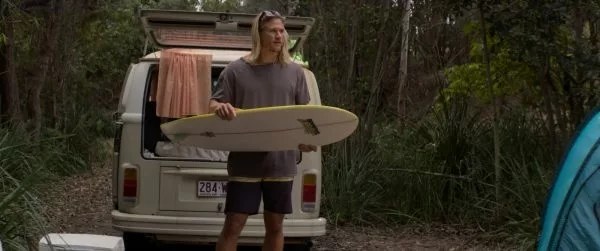
“Sons of Summer” is a sentimental “surfie” bros tribute trip tale that crashes up against a drug heist that goes deathly wrong. The movie never lets those two threads mesh, as the surfies continue their VW Microbus camping trek to a great surfing spot on Australia’s Gold Coast (Austinville) despite the body count they learn is piling up behind them.

It’s an out-of-its-time sequel to an Australian B-movie surf thriller, “Summer City” notable only for being a pre-stardom vehicle for a very young Mel Gibson. That was about the fathers of the bros of this film getting mixed-up in something that got one of them killed. Three of them survived, and Mel’s role was mercifully recast.

But not because he’s been “canceled” (he hasn’t). It’s because that first film came out in 1977, and they’re trying to pass off this “tribute trip” as happening “30 years later.” No, changing the dates and recasting “most” of those guys (co-writer Phillip Avalon returns as Robbie) is fooling no one.

Those Aussies. Too many Fosters and they’re all “flamin’ galahs” at math. And it’s no wonder the “fathers” are quickly shuffled into the background.

Sean (Joe Davidson) is the blond Adonis son of Boo, the surfer murdered all those years ago. He and his mates, the sons of the survivors of that long-ago quartet, decide to head down the coast to Austinville for a tribute to Sean’s dad.

Jack (Matao Boosie) isn’t that close to Sean, but Kane (Matthew McDonald) and Clay (Jonathan Weir) take no convincing.

It’s just that Sean’s got his own “past” that’s catching up to him, with Rick (Alex Fleri) and Pete (Steve Nation) calling in favors for that “last one, for me. Promise!”

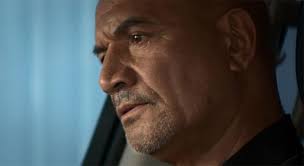
Sean doesn’t realize that he’s about to grand-theft-auto the wrong Mustang, belonging to the wrong hood (Christopher Pate), and that those drugs in the trunk will not help them “get ahead.” Not with ferocious Frank (Morrison, the Once and Always Boba Fett) on their trail.

The project’s clumsy grasp of math and re-casting means that not much effort is put into tying the old guys and their long-ago misadventures with today. That wrong-foots the picture from the start, as getting us up to speed as to what this is all about — the connections, their shared past, the tragedy that binds them — takes forever and is botched in the process.

Sean’s long-suffering girlfriend (Isabel Lucas) doesn’t flee the moment he breaks his promise about leaving “that life” behind, and only considers it when Frank the thug busts into their house.

And if learning of that first “like a father to me” murder isn’t enough to derail their plans, their surf addiction must be a longer stronger and less moral than we’ve been led to believe.

Davidson has a hint of Chris Hemsworth about him — good lucks and hunky screen presence. But this isn’t a film to get a guy noticed outside of Oz.

Veteran B-movie director Clive Fleury (Burt Reynolds’ “Big City Blues”) finds himself clumsily alternating between graphic violence and goofy surfing mating rituals, 30 year-old “boy bonding” and the like. Logic aside, the picture is off-key pretty much from the start.

He’d have spared himself and any potential viewers that whiplash by taking the awful reviews of 1977’a “Summer City” to heart. This didn’t deserve a sequel, mate. You’re just recycling a plot that was crap the first time around.

Rating: R, violence and profanity

Cast: Joe Davison, Isabel Lucas, Jonathan Weir, Alex Fleri, Matao Boosie, Matthew McDonald, Christopher Pate, and Temuera Morrison.

Credits: Directed by Clive Fleury, scripted by Phillip Avalon and Greg Clayton. A Lionsgate release.

Running time: 1:31

Posted in Reviews, previews, profiles and movie news | Comments Off on Movie Review: Surf and slaughter blend badly in “Sons of Summer”

Movie Preview: Ben Kingsley meets an alien — “Jules”

This quirky country life close encounter comedy co stars Jane Curtin, Zoë Winters and the delightful Harriet Samson Harris of “Frasier.”

Bleecker Street has this Marc Turtletaub comedy slated for Aug.11 release.

Posted in Reviews, previews, profiles and movie news | Comments Off on Movie Preview: Ben Kingsley meets an alien — “Jules”

Movie Review: A Native American woman drives through “The Unknown Country” of her past

Some movies come to you, passing on their insights directly, underlining their message and themes. More challenging films make you come to them.

Morissa Maltz’s “The Unknown Country” is a rare example of the latter made even rarer by the fact that it’s a docu-drama.

Real people narrate anecdotes, truths about their lives as a waitress, a motel operator or a Texas dance hall owner, as our protagonist makes her way across the vast middle of America, from Minneapolis to South Dakota’s Pine Ridge Indian Reservation to Dallas and Big Bend, Texas.

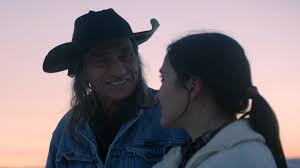
Something, some trauma, put Tana (Lily Gladstone, star of the upcoming Scorsese epic “Killers of the Flower Moon”) on the road in a thirty year-old Cadillac DeVille, cracked windshield and ever-present cigarette, a sad woman with a story to tell that she’s not telling.

“You never know what’s going on in somebody’s life,” real-life waitress Pam Richter tells us, which is why she practically gushes over every single customer she serves, including Tana.

Tana was living in Minneapolis, we gather. She’s “just kinda floating” down the Blue Highways, convenience store to diner to motel, when she checks in with a relative, and next thing you know, she’s heading for a wedding.

She mixes with the happy couple (Lainey Bearkiller Shangreaux and Devin Shangreaux), plays with their daughter and the kids of others gathering for the nuptials. And she chats with acquaintances and relatives she hasn’t seen since she was a child. Everybody wants to know if she’s “been to the Rez,” Pine Ridge (also the setting of the colorful “War Pony”) and “How long are you gonna be here?”

Not long, of course. Just a taste of her past and a few folks gently boosting her sense of who she is thatnks to her heritage. But it’s not like she’s going back to where she started, Minneapolis, her home since she was eight years old. That ancient Caddy gives a hint of why she was there and who must’ve owned it before her.

Tana faces a traffic stop and a nervous, wordless moment of fear with a creeper at a remote gas station, but mostly just a lot of encounters with just folks — most of them perfectly nice, and much better company than the soundtrack of NPR stations and reactionary red state talk radio.

We get a better handle on Tana when she finally reaches a city. She’s a Native American woman whose “tribe” — people her own age, people who go out to honky tonks and dance halls — are outsiders who understand something of her outsider heritage.

The most direct comparison this film invites is to William Least Heat Moon’s best-selling road trip memoir of self-discovery, about the world he encountered off the interstates and along the aforementioned “Blue Highways.”

Tana’s trauma — a recent loss and the older dislocation from her home, perhaps with good cause — is internalized and not something she speaks about. Her “road trip” has a purpose, which we can guess once we get a handle on her destination. But her interior life is mostly just that as she takes in the family lives she grew up apart from and the family she’s never made for herself.

Gladstone carries the picture as a reactor — to the stories she hears from this waitress, that grandfatherly distant relative, the bride-to-be. But even those reactions are subdued.

“The Unknown Country” avoids melodrama and some obvious turns the story could take, but doesn’t. Truth be told, it could use more incidents, more drama, more insights into Tana’s journey, what she’s escaping and what she’s looking for.

It’s still a sweet, meditative drive through the flatlands across America’s middle, snowy north to line-dancing south.

Rating: unrated, smoking

Cast: Lily Gladstone, Lainey Bearkiller Shangreaux, Richard Ray Whitman, Devin Shangreaux, Pam Richter and Raymond Lee

Credits: Directed by Morissa Maltz, scripted by Morrisa Maltz, Lily Gladstone and Lainey Bearkiller Shangreaux. A Music Box release.

Running time: 1:25

Posted in Reviews, previews, profiles and movie news | Comments Off on Movie Review: A Native American woman drives through “The Unknown Country” of her past

Classic Film Review: Debriefing a “classic” that wasn’t —  John le Carré’s “The Looking Glass War” (1969)

By the late 1960s, John le Carré was just coming into his own as the  the new Graham Greene, a sophsticated, subtle “thinking person’s spy novelist.” “The Spy Who Came in from the Cold” had shown the former MI5/MI6 insider to be a writer whose work was in sharp contrast to the pulp fiction of most everybody else in the genre.

“The Spy Who Came in from the Cold” had already been turned into a pretty good film, sort of an “anti-Bond” dose of the cold realities of this deadly business.

His tales were unsentimental, not particularly sexy and generally quite cynical about the Cold War and the spy game.

Frank Pierson was a two-time Oscar-nominated screenwriter (“Cool Hand Luke,””Cat Ballou”) who had a little TV directing on his resume.

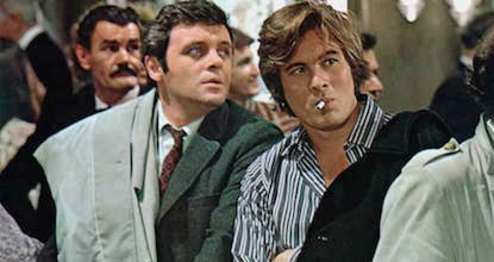
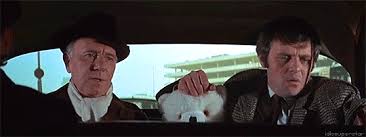
But the future Oscar winner and soon-to-be-lionized novelist weren’t a good fit on “The Looking Glass War,” a “send a man over the border” Iron Curtain thriller built around the estimable Ralph Richardson, rising-star Anthony Hopkins, blonde-du-jour Susan George and hunk-of-the-moment Christopher Jones.

It’s dark and cynical enough — wheezing old men playing old-fashioned, even by 1960s standards, spy games, gambling with a new recruit’s life. But the film is so choppy, uneven and abrupt in its shifts of focus and truncated ending as to make one wonder if they didn’t leave a reel out here and there in uploading it to stream.

The problem begins with the novel, widely regarded as one of John le Carré’s weakest. He even changed the ending of it in later editions just to get the damned thing to make sense.

Jones, a mop top in the Peter Fonda/Michael Sarrazin mold, makes a passable lead, and Richardson and Hopkins and most of the supporting cast are up to snuff.

But whatever le Carré was getting at, it’s pretty obvious Pierson had his sights set on Bond, James Bond — sending him up in a bloody account of a bungled bit of spycraft gone wrong. The picture is too serious to hit that shaken, not stirred target in this story of a brutish, catnip-to-the-chicks Polish sailor blackmailed into taking on a job of espionage to determine where the Soviets are parking their latest missiles, “700 miles from London.”

An agent (Timothy West) in Finland picks up a roll of film shot by an airline pilot he’s bribed to drift low and off course to get film of mobile “Sandal” missiles and where they’re being deployed, we later gather.

I’ve never read anywhere that this sort of spy flight really happened. If so, one can almost understand the Soviet attacks on commercial flights like the Korean Airlines flight 902 and KAL 007 shootdowns. If this sort of surveillance never took place via civilian airliners, le Carré may have very well put that idea in the Russians’ heads via this book.

Their tradecraft at the airport bar is laughable, an open conversation and public exchange. And we get our first hints of the impoverished state of British Intelligence after the spy scandals that its inbred, classist culture produced in the Guy Burgess era. The agent makes the pilot pick up the bar tab, and gripes about not having car-fare provided by his employers.

It’s on his ludicrous snowy trek home on a deserted road that he is run down. But his killers don’t get the film.

That murder is treated somberly by the junior man (Hopkins) at HQ. But it’s a confirming clue to his boss, LeClerc, given an old man’s gravitas by Richardson. The killing, added to grainy, blurry photos they got from a photographer in East Germany point to the deployment of these new missiles within range of London.

Memories of the fiery assaults of German V-2s of WWII have old men like LeClerc and and Haldane (Paul Rogers) waxing gravely about a terrible threat. For certain?

“I don’t deal in certainties, I deal in doubts,” LeClerc snaps.

That’s when they turn the screws on an impudent Polish drifter (Jones, of “Wild in the Streets” and “Ryan’s Daughter”) who jumped ship to be with this English lass he fancies and apparently impregnated. If he wants to stay in Britain to be with her (Susan George) and his child, he needs to do this little job for them.

“I think that heroes are only happy in parks, with pigeons sitting on them,” sailor Leiser sneers at his elders.

But he agrees. Why?

“Biology,” LeClerc says with the certainty of someone who’s done this scores of times. “Men change their politics. But sex? Sex is something you can depend upon.”

They get him out of immigration detention, set him up in a safe house and drill him on spycraft, radio protocols and self-defense.

The “never trust anyone” training includes Hopkins’ Avery jumping him, “Pink Panther” Kato style, for brutal punch-outs that have the feel of DIY fights to the death.

It’s all very old OLD school — the backpack Morse code “wireless,” shuttling this guy across the border by literally cutting through a fence and dodging a minefield, the limited training.

But Leiser, the multi-lingual ladies’ man of 23, can’t take a gun across a foreign border because “that would be an act of war,” you see. James Bond’s Walther must be left behind.

With a guy this green, this insolent, this hotheaded and careless, the “mission” goes wrong, pretty much from the start.

The juicy le Carré details here aren’t the misadventures of a Pole in Soviet-controlled East Germany. It’s the domestic disasters facing the married men of the spy agency — secretive workaholic and maybe alcoholic agents married to bitter, mistrustful women.

“Don’t try and RUN me like one of your wretched agents!”

The disastrously faithless marriage of George Smiley in “Tinker Tailor Soldier Spy” is prefigured here.

“I’m a patriot,” Avery declares to his snappish wife. “We’re fighting a war. We’re in the dark.

Leiser and Avery are equally mercurial, taking their training fights to very personal extremes, cheerfully knocking back indiscrete drinks in the pub after Leiser busts out to see his girl, and slap her bloody for getting an abortion.

Yes, the movie is head-snapping like that. A truck-driver is killed and his body stuffed in the back, with his barking, whimpering dog. When the truck is stopped by man-hunting East German troops, the body’s gone. And the dog.

Another compliant blonde (Pia Degermark) throws herself at Leiser in Germany. Is she a spy sent to trap him? Is it all just a big Russian fake-out?

Perhaps that explains why the Brits rely on a method of gathering information so old fashioned it predates the first World War. The WWII “wireless” set, the cypher hidden in a tube of toothpaste, “it’s the last thing” the Russians would expect. And it’s cheap, the sort of thing you try when you’re not sure if your enemy is pulling one over on you.

The behavior of the communists once they first tussle with Leiser should provide us with our answers. As to the old men pulling the strings, who’s going to miss one more Polish hippy? They give up on him before they have any reason to.

“We never really knew him, did we? Like a waiter at one’s club. ‘Good morning.’ ‘Good evening.’ And a guinea at Christmas.”

The choppiness and lapses in logic, even if by design, ruin “The Looking Glass War.” But the tone, the cast, the cynicism and the deathly personal business of kill-or-be-killed spying tell us the movie this might have been.

The novel wasn’t great, but looking at the film and the way Leiser takes to violence and thinking of James Dickey’s marvelous American-airman-downed-in-1945-Japan thriller “To the White Sea,” one can imagine other changes le Carré might have considered for the book, or that Pierson, who’d go on to win an Oscar for scripting “Dog Day Afternoon” and be a guiding light in famous TV movies and the Emmy-honored “Mad Men,” could have added.

If only an under-funded, disgraced agency of tired old men had underestimated their Pole and dropped a pitless murderer behind the Iron Curtain. That would’ve been a lot more exciting than this.

Rating: PG for its day, violent

Cast: Christopher Jones, Ralph Richardson, Anthony Hopkins, Pia Degermark, Paul Rogers, Cyril Shaps, Timothy West, Paul Swanick and Susan George.

Credits: Scripted and directed by Frank Pierson, based on the novel by John le Carré. A Columbia release on Tubi, Amazon, Youtube, etc.

Running time: 1:

Posted in Reviews, previews, profiles and movie news | 1 Comment

Movie Preview: English Eccentricity entangles Simon Pegg, Minnie Driver and Christopher Lloyd — “Nandor Fodor & the Talking Mongoose”

Writer-director Adam Sigal (“The Two Dogs,” no, me either) has cooked up a true (ish) story about a Hungarian American parapsychologist who visited the Isle of Man in 1935 to figure out why the locals insisted they were hearing from a talking mongoose.

As Nandor Fodor was a real person, sort of a pre-TV “In Search of” expert in the weird and paranormal, we’ve got that much to go on, at least.

As the estimable Simon Pegg stars, with Minnie Driver, Christopher Lloyd and Neil Gaiman lending his voice, there could be something cute to this.

Sept. 1.

Posted in Reviews, previews, profiles and movie news | Comments Off on Movie Preview: English Eccentricity entangles Simon Pegg, Minnie Driver and Christopher Lloyd — “Nandor Fodor & the Talking Mongoose”

Jamie Foxx speaks!

He looks worn and weary from a bout…with something, we don’t know what.

The rumor that made the most sense to me was a “stroke” after a heated argument, but there’s little evidence of that in his speech, which would have been a good reason to stay out of the public eye while he recovered/rehabbed.

He dropped this video on his Instagram feed.

No idea what happened to him, and the void he’s left by not giving specifics isn’t helpful. You know what rumor mongers will fill a void with. “Stroked out” among them.

But it’s good to see him recovering, and good to see him killing it in “They Cloned Tyrone” on Netflix. Maybe he’ll tell Orpah what ailed him.

Posted in Reviews, previews, profiles and movie news | Comments Off on Jamie Foxx speaks!

Netflixable? “Seasons” romance outstays its welcome

“Seasons” is a tedious, tepid and inane romance about a woman who toys with her boy “friend” and reaps the consequences.

It’s meant to be a rom-com, but it isn’t the least bit funny. The leads are pretty, and Lovie Poe sings and co-wrote the screenplay. But it limps along from one improbable turn of events to the next, all of it meant to “test” a couple who give us no “spark” to make us root for them. Ever.

That’s something that might be missing from the long-term coupling of Charlie (Poe) and beau Kurt (Carlo Aquino). They look good together. He’s a 30something bar owner always coming to her rescue, propping up the part-time singer/full-time something in advertising — I think — always there for her at friend and family events.

But the “spark” was never there for this relationship to progress. Now good time Charlie is turning 32, concerned that her friends are well into marriages and child-rearing. So why doesn’t she feel more for “my best friend?”

If he’s got an issue, maybe that’s reflected in her quick-to-out-them-as-mismatched sex-partners at a group gathering. Maybe the ways she takes him for granted play into it as well.

Sure, she’s beautiful and fond of the bare-midriff look, which she always pulls off. But even Kurt knows that the gal-pal who calls him “Uggo” and who answers to him calling her “Uggo” is permanently in the “friend zone.”

As Charlie narrates the story (in Tagalog/Filipino/English, “Tanglish?” with subtitles, or dubbed), she made “the worst decision of my life three years ago.” That was when she taunted Kurt into trying online dating — with someone else — and she let him talk her into submitting to the entreaties of her lovesick co-worker, Hans (Jolo Estrada).

Charlie got stuck with a work “buddy” never destined to be a beau. And Charlie went out of her way to hook Kurt up with a cute cake-baker, Jane (Sarah Edwards) at a local restaurant.

As Charlie watches Kurt fall in love, she figures out her mistake. Only a desperate move — faking a pregnancy — can stop that Kurt-Jane trip to the altar, or so she thinks.

Poe’s a passable singer and perky leading lady, but this character is bland and there’s little she can do to fix that. Aquino has almost no screen presence. Yes, he used to be in a boy band.

There are situations here that have worked in other rom-coms. But you’ve got to get more “com” and at least a hint of “rom” in there if you want this to play.

Director Easy Ferrer lets this handsomely-mounted production just mope along until it slows to a crawl, never wringing a laugh or big romantic moment out of it.

“Seasons” isn’t as chaste as the romances we see from much of the rest of Asia. But there’s no edge to it, no stakes to the love affair and little for the viewer to invest in or root for. It settles on “insipid” and never manages to rise above it.

Rating: TV-MA, sexual situations and profanity

Cast: Lovie Poe, Carlo Aquino

Credits: Directed by Easy Ferrer, scripted by Dwein Baltazar and Lovi Poe. A Netflix release.

Running time: 1:50

Posted in Reviews, previews, profiles and movie news | Comments Off on Netflixable? “Seasons” romance outstays its welcome

Indigo Girls — having a “Barbie” moment

If you didn’t see “Glitter & Doom,” a wistful musical set to the songs of Indigo Girls, you should.

It’s damned adorable.

I saw it, but didn’t realize it was a harbinger of Amy Ray and Emily Saliers having ” a moment” this summer.

The ladies who rode into folk-rock immortality with this tune would see the song making another statement in a feministBarbie” movie that would become an unexpected blockbuster.

Having raised two girls who watched every cut-rate animated Barbie cartoon to come along, I’d never guess what Greta Gerwig would get out of A Doll’s Life.

But having interviewed the Indigos a few times over the years, I can say this couldn’t have happened to two cooler and nicer musicians.

Somebody re-release that single. Hey, it worked for Kate Bush.

“Closer to Fine” is even in the ads for “Barbie.”

Enjoy the ride, ladies. And take a bow.

Posted in Reviews, previews, profiles and movie news | Comments Off on Indigo Girls — having a “Barbie” moment

Movie Preview: Check out this trailer to the Yakuza thriller, “Bad City”

The mere hint of the fights sampled here is “Old Boy” gonzo. Stuntman turned director Kensuke Sonomura (“Hydra”) really outdid himself this time.

“Bad City,” streams Aug. 1 and hits DVD Sept. 19 from our font of all fun films from Asia — Well Go USA.

Posted in Reviews, previews, profiles and movie news | Comments Off on Movie Preview: Check out this trailer to the Yakuza thriller, “Bad City”

Classic Film Review: Carol Reed’s IRA noir — “Odd Man Out” (1947)

“For a number of reasons, film buffs have long harbored the feeling that Orson Welles had a hand in directing some of — perhaps his own scenes — Carol Reed’s film noir masterpiece “The Third Man.”

The best arguments for that are Welles’ performance, his crackling good lines and big “cuckoo clock” speech, and the Wellesian camera placement and shot-framing of the inky-black post-war Viennese streets in that classic.

The best argument against Welles “co-directing” that film has to be “Odd Man Out,” made two years before “Third Man” by Reed, the first-ever BAFTA Best Picture winner and a film noir classic in its own right.

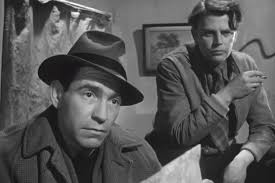
It’s another man-on-the-lam thriller and stars James Mason as a weary and wounded IRA section chief on the run after killing a clerk in a payroll robbery. Over the course of a day and a very long night, Johnny McQueen will drop in and out of consciousness, struggle to hide, meet a lot of folks on the fence about him and what he does, fans and friends hoping to help, bystanders fearful of IRA reprisals if they turn him in and those coveting the reward the authorities have slapped on his head to keep him from slipping out of Belfast.

Meanwhile his confederates, led by Denis (Robert Beatty) and egged on by Kathleen (Kathleen Ryan), who loves Johnny, are trying to find him, debating how to manage that, arguing over what went wrong in the heist and how to get Johnny — already a wanted escaped convict — out of town.

Neither the “IRA” nor “Belfast” are mentioned, mainly to avoid U.K. censorship. John Ford’s “The Informer” had also skirted the murky-bloody politics of rebellion against British occupation and colonization. But Reed’s film has a definite Brit-centric bias, one that mirrors the F.L. Green novel it is based on, with even Johnny questioning his and his accomplices’ actions.

“I believe in everything we’re trying to do. But this violence isn’t getting us anywhere.”

Johnny’s mention of winning “at the ballot box” is a glib bit of British propaganda that ignores how they’d colonized the northern Irish counties with generations of loyal Scots to “pacify” the Irish, rendering such electoral hopes futile, something any IRA man would have known.

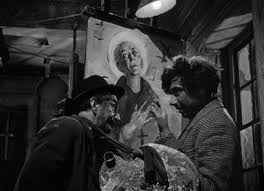
Johnny hides in a neighborhood air raid shelter, in a horse-drawn hansom cab, is taken in by strangers who think he’s been hit by a truck (he’s been shot in the arm and is bleeding out), holes up in a “snug” in a pub and falls under the control of a demented painter (Robert Newton) and his failed-surgeon (tumbledown) flatmate (Elwyn Brook-Jones).

All night, as the rain changes to snow and the police inspector (Denis O’Dea) turns the screws on Kathleen, she implores the IRA-friendly priest (W.G. Fay) and Dennis to get her to Johnny.

“Sooner or later, the police will get to him,” she pleads. “Let me have him until then!”

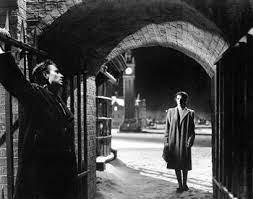
It is a beautiful black and white film of lovely, tight compositions, nervy hand-held shots mimicking Johnny’s frame of mind and gloomy, damply-lit and narrow West Belfast (and some London exteriors) streets, flats and factories.

No, it’s not as gorgeous as “The Third Man.”

The chases are well-handled even as Mason’s place in the film — he has few lines to start with, and recedes into the background in the middle acts — means that most of those chases will involve those in on the robbery with him — men played by Cyril Cusack, Dan O’Herlihy and Roy Irving — and his comrade Dennis.

Those scenes have a polished competence and brio to them, but the action beats of “The Third Man” are next-level thrilling.

Reed’s use of natural sound — streets, bar scenes, crowded tram, etc. — adds to the reality of it all, something replicated with “Third Man,” which also leaned on “The Third Man Theme,” that unforgettable piece of zither music, to place the film in its locale and heighten emotions.

But the “Odd Man” narrative loses much of its urgency in the melodramatic middle acts as Johnny slips into the background and assorted folks — two sisters (Fay Compton and Beryl Measer), the priest, the cabbie (Joseph Tomelty), and a barman (William Hartnell) ponder what to do with him or about him.

The most vivid characters in these scenes are the cynical brothel madam and “chancer” (Maureen Delaney) and greedy, broke barfly Shell (F.J. McCormick), the one fellow willing to admit he’d love to have the reward, IRA reprisals be damned.

But it’s Shell’s stumbling across Johnny that invites the mad painter and his never-quite-a-surgeon friend in. And Newton, raving and ranting, trashing a bar and wild about capturing on canvas “the eyes” of a “doomed man” before he perishes, ensures the finale is both action-packed and layered with pathos.

Mason, despite his fumbled efforts to tone down the posh Received Pronunciation accent to sound like an Irish Catholic ex-con, would call this his favorite role and go on to decades of greater glory as a great character actor and leading man.

Reed was already a veteran filmmaker with a dozen years of directing credits on his CV. He’d made some prestige pictures (“Night Train to Munich,” “The Young Mr. Pitt”) before, but “Odd Man Out” heralded his arrival on the pantheon of his generation of British directors.

“The Fallen Idol” would be his next film, followed by “The Third Man.” But after this brief peak, his work fell off until he got to make Graham Green’s “Our Man in Havana” in 1960, after which he took big checks for the epic “The Agony and the Ecstacy” and the blockbuster musical “Oliver!”

Watching “Odd Man Out” now, it’s easy to see that discounting Reed at his peak artistry is unfair, even as the superior writing, acting, pacing and production values of “The Third Man” still make it the best film Orson Welles didn’t direct. But pretending Welles didn’t make that movie what it’s become is just as incorrect.

Reed lifted his game and plainly took suggestions on set. Welles must have camera-blocked and scripted some of his scenes.

And “Odd Man Out,” if not Reed’s very best film, certainly shows us that “The Third Man,” “Fallen Idol,” Our Man in Havana” and the Technicolor glories of “Oliver!” were produced by a singular talent who only suffers when he’s compared to the greatest directors of his era — Welles, Ford and Lean among them.

Rating: “approved”

Cast: James Mason, Robert Newton, Kathleen Ryan, Cyril Cusack, Denis O’Dea, Dan O’Herlihy, Robert Beatty, W.G. Fay, F.J. McCormick, Kitty Kirwan, Ann Clery, Joseph Tomelty, William Hartnell and Elwyn Brook-Jones.

Credits: Directed by Carol Reed, scripted by R.C. Sheriff. based on a novel by F.L. Green. A Two Cities/Univeral release available on Tubi, Amazon, Youtube, etc.

Running time: 1:56

Posted in Reviews, previews, profiles and movie news | Comments Off on Classic Film Review: Carol Reed’s IRA noir — “Odd Man Out” (1947)